warning light SUBARU BRZ 2023 User Guide
[x] Cancel search | Manufacturer: SUBARU, Model Year: 2023, Model line: BRZ, Model: SUBARU BRZ 2023Pages: 432, PDF Size: 16.56 MB
Page 45 of 432
Seatbelts
39
Seat, Seatbelt and SRS Airbags1
– CONTINUED –
1-4. Seatbelts■Seatbelt Safety Tips
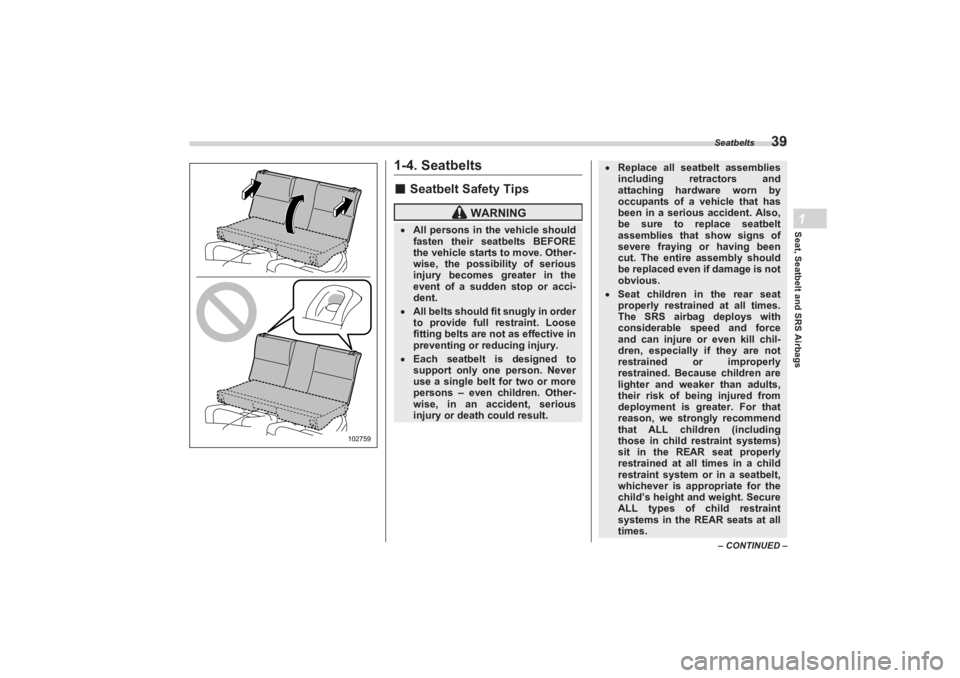
102759
WARNING
All persons in the vehicle should
fasten their seatbelts BEFORE
the vehicle starts to move. Other-
wise, the possibility of serious
injury becomes greater in the
event of a sudden stop or acci-
dent. All belts should fit snugly in order
to provide full restraint. Loose
fitting belts are not as effective in
preventing or reducing injury. Each seatbelt is designed to
support only one person. Never
use a single belt for two or more
persons – even children. Other-
wise, in an accident, serious
injury or death could result.
Replace all seatbelt assemblies
including retractors and
attaching hardware worn by
occupants of a vehicle that has
been in a serious accident. Also,
be sure to replace seatbelt
assemblies that show signs of
severe fraying or having been
cut. The entire assembly should
be replaced even if damage is not
obvious. Seat children in the rear seat
properly restrained at all times.
The SRS airbag deploys with
considerable speed and force
and can injure or even kill chil-
dren, especially if they are not
restrained or improperly
restrained. Because children are
lighter and weaker than adults,
their risk of being injured from
deployment is greater. For that
reason, we strongly recommend
that ALL children (including
those in child restraint systems)
sit in the REAR seat properly
restrained at all times in a child
restraint system or in a seatbelt,
whichever is appropriate for the
child’s height and weight. Secure
ALL types of child restraint
systems in the REAR seats at all
times.
BRZ_U.book 39 ページ 2022年3月29日 火曜日 午後3時59分
Page 47 of 432
Seatbelts
41
Seat, Seatbelt and SRS Airbags1
– CONTINUED –
slightly, the retractor locks the seatbelt in
that position and the seatbelt cannot be
extended. As the belt is rewinding, clicks
will be heard which indicate the retractor
functions as an ALR. When the seatbelt is
retracted fully, the ALR mode is canceled
and the ELR mode is restored.
When securing a child restraint system on
the rear seats by using a seatbelt, the
seatbelt must be changed over to the
Automatic Locking Retractor (ALR) mode.
For instructions on how to install the child
restraint system using a seatbelt, refer to
"Installing Child Restraint Systems with
ALR/ELR Seatbelt" P51.
When the child restraint system is
removed, make sure that the retractor is
restored to the Emergency Locking
Retractor (ELR) mode by allowing the
seatbelt to retract fully.■ Seatbelt Warning Light
and Chime Refer to "Seatbelt Warning Light and
Chime" P131.
■ Fastening the Seatbelt
WARNING
Never use a belt that is twisted or
reversed. In an accident, this can
increase the risk or severity of
injury. Keep the lap belt as low as
possible on your hips. In a colli-
sion, this spreads the force of the
lap belt over stronger hip bones
instead of across the weaker
abdomen. Seatbelts provide maximum
restraint when the occupant sits
well back and upright in the seat.
To reduce the risk of sliding
under the seatbelt in a collision,
the front seatbacks should be
always used in the upright posi-
tion while the vehicle is running.
If the front seatbacks are not used
in the upright position in a colli-
sion, the risk of sliding under the
lap belt and of the lap belt sliding
up over the abdomen will
increase, and both can result in
serious internal injury or death.
Do not put cushions or any other
materials between occupants and
seatbacks or seat cushions. If
you do so, the risk of sliding
under the lap belt and of the lap
belt sliding up over the abdomen
will increase, and both can result
in serious internal injury or death.
WARNING
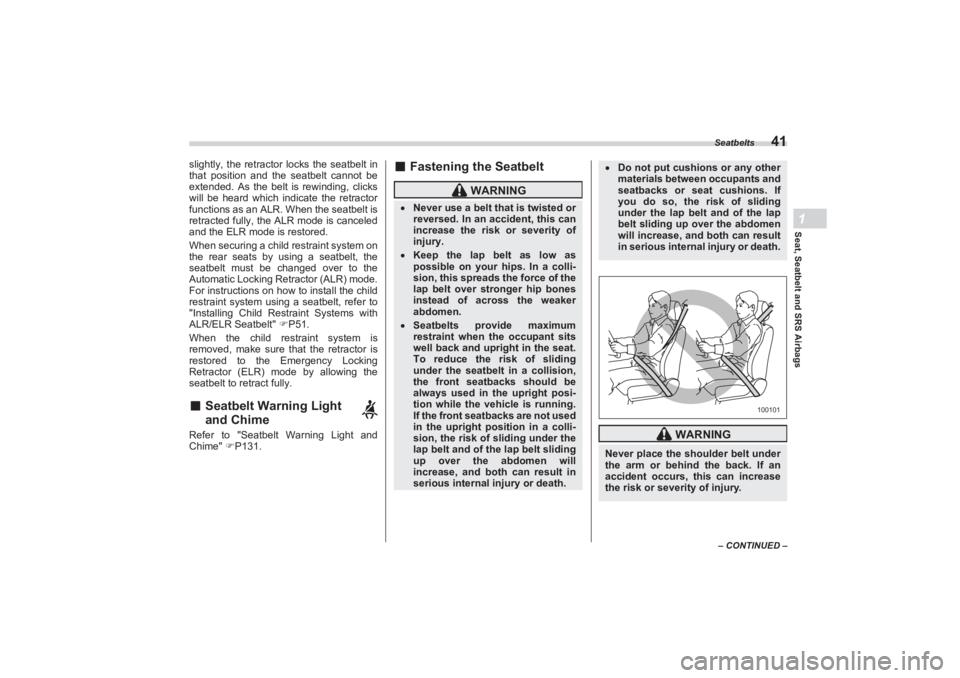
Never place the shoulder belt under
the arm or behind the back. If an
accident occurs, this can increase
the risk or severity of injury.
100101
BRZ_U.book 41 ページ 2022年3月29日 火曜日 午後3時59分
Page 51 of 432
Seatbelt Pretensioners
45
Seat, Seatbelt and SRS Airbags1
– CONTINUED –
When you sell your vehicle, we urge
you to inform the bu yer that the vehicle
is equipped with seatbelt
pretensioners. Also, notify the buyer of
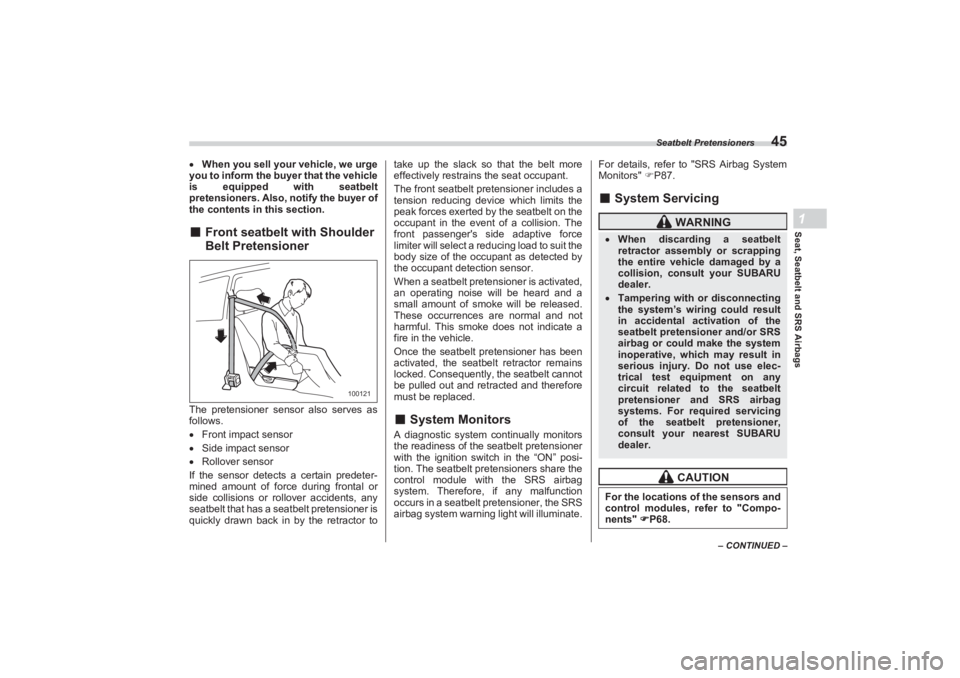
the contents in this section.■ Front seatbelt with Shoulder
Belt PretensionerThe pretensioner sensor also serves as
follows.
Front impact sensor
Side impact sensor
Rollover sensor
If the sensor detects a certain predeter-
mined amount of force during frontal or
side collisions or rollover accidents, any
seatbelt that has a se atbelt pretensioner is
quickly drawn back in by the retractor to take up the slack so
that the belt more
effectively restrains the seat occupant.
The front seatbelt pretensioner includes a
tension reducing device which limits the
peak forces exerted by the seatbelt on the
occupant in the event of a collision. The
front passenger's side adaptive force
limiter will select a reducing load to suit the
body size of the occupant as detected by
the occupant detection sensor.
When a seatbelt pretensioner is activated,
an operating noise will be heard and a
small amount of smoke will be released.
These occurrences are normal and not
harmful. This smoke does not indicate a
fire in the vehicle.
Once the seatbelt pretensioner has been
activated, the seatbelt retractor remains
locked. Consequently, the seatbelt cannot
be pulled out and retracted and therefore
must be replaced.
■ System MonitorsA diagnostic system continually monitors
the readiness of the seatbelt pretensioner
with the ignition switch in the “ON” posi-
tion. The seatbelt pr etensioners share the
control module with the SRS airbag
system. Therefore, if any malfunction
occurs in a seatbelt pretensioner, the SRS
airbag system warning light will illuminate. For details, refer to "SRS Airbag System
Monitors" P87.
■ System Servicing
100121
WARNING
When discarding a seatbelt
retractor assembly or scrapping
the entire vehicle damaged by a
collision, consult your SUBARU
dealer. Tampering with or disconnecting
the system’s wiring could result
in accidental activation of the
seatbelt pretensioner and/or SRS
airbag or could make the system
inoperative, which may result in
serious injury. Do not use elec-
trical test equipment on any
circuit related to the seatbelt
pretensioner and SRS airbag
systems. For required servicing
of the seatbelt pretensioner,
consult your nearest SUBARU
dealer.
CAUTION
For the locations of the sensors and
control modules, refer to "Compo-
nents" P68.
BRZ_U.book 45 ページ 2022年3月29日 火曜日 午後3時59分
Page 55 of 432
Child Restraint Systems
49
Seat, Seatbelt and SRS Airbags1
– CONTINUED –
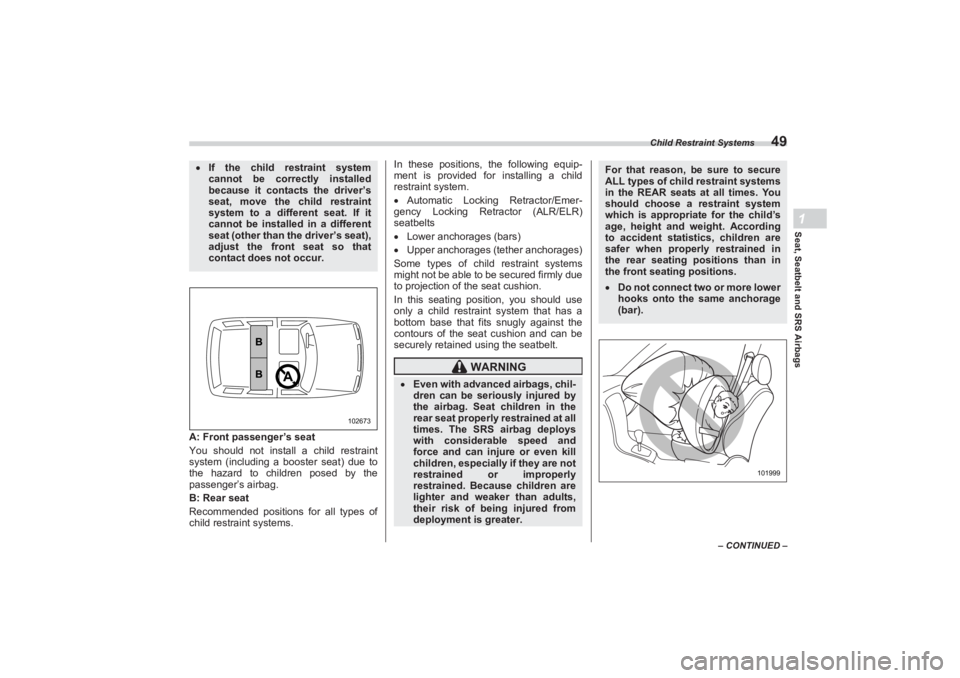
A: Front passenger’s seat
You should not install a child restraint
system (including a bo oster seat) due to
the hazard to children posed by the
passenger’s airbag.
B: Rear seat
Recommended positions for all types of
child restraint systems. In these positions, the following equip-
ment is provided for installing a child
restraint system.
Automatic Locking Retractor/Emer-
gency Locking Retractor (ALR/ELR)
seatbelts
Lower anchorages (bars)
Upper anchorages (tether anchorages)
Some types of child restraint systems
might not be able to be secured firmly due
to projection of the seat cushion.
In this seating position, you should use
only a child restrain t system that has a
bottom base that fits snugly against the
contours of the seat cushion and can be
securely retained using the seatbelt. If the child restraint system
cannot be correctly installed
because it contacts the driver’s
seat, move the child restraint
system to a different seat. If it
cannot be installed in a different
seat (other than the driver’s seat),
adjust the front seat so that
contact does not occur.
102673
WARNING
Even with advanced airbags, chil-
dren can be seriously injured by
the airbag. Seat children in the
rear seat properly restrained at all
times. The SRS airbag deploys
with considerable speed and
force and can injure or even kill
children, especially if they are not
restrained or improperly
restrained. Because children are
lighter and weaker than adults,
their risk of being injured from
deployment is greater.
For that reason, be sure to secure
ALL types of child restraint systems
in the REAR seats at all times. You
should choose a restraint system
which is appropriate for the child’s
age, height and weight. According
to accident statistics, children are
safer when properly restrained in
the rear seating positions than in
the front seating positions. Do not connect tw o or more lower
hooks onto the same anchorage
(bar).
101999
BRZ_U.book 49 ページ 2022年3月29日 火曜日 午後3時59分
Page 61 of 432
Child Restraint Systems
55
Seat, Seatbelt and SRS Airbags1
– CONTINUED –
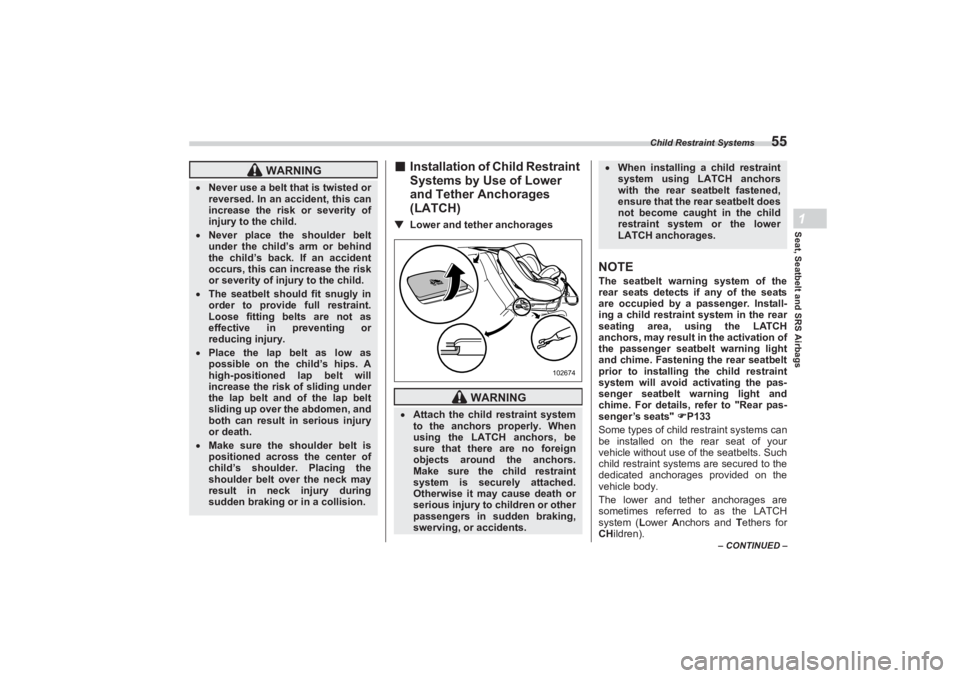
■Installation of Child Restraint
Systems by Use of Lower
and Tether Anchorages
(LATCH)▼ Lower and tether anchorages
NOTEThe seatbelt warning system of the
rear seats detects if any of the seats
are occupied by a passenger. Install-
ing a child restraint system in the rear
seating area, using the LATCH
anchors, may result in the activation of
the passenger seatbelt warning light
and chime. Fastening the rear seatbelt
prior to installing the child restraint
system will avoid activating the pas-
senger seatbelt warning light and
chime. For details, refer to "Rear pas-
senger’s seats" P133
Some types of child restraint systems can
be installed on the rear seat of your
vehicle without use of the seatbelts. Such
child restraint systems are secured to the
dedicated anchorages provided on the
vehicle body.
The lower and tether anchorages are
sometimes referred to as the LATCH
system ( Lower Anchors and T ethers for
CHildren).
WARNING
Never use a belt that is twisted or
reversed. In an accident, this can
increase the risk or severity of
injury to the child. Never place the shoulder belt
under the child’s arm or behind
the child’s back. If an accident
occurs, this can increase the risk
or severity of injury to the child. The seatbelt should fit snugly in
order to provide full restraint.
Loose fitting belts are not as
effective in preventing or
reducing injury. Place the lap belt as low as
possible on the child’s hips. A
high-positioned lap belt will
increase the risk of sliding under
the lap belt and of the lap belt
sliding up over the abdomen, and
both can result in serious injury
or death. Make sure the shoulder belt is
positioned across the center of
child’s shoulder. Placing the
shoulder belt over the neck may
result in neck injury during
sudden braking or in a collision.
WARNING
Attach the child restraint system
to the anchors properly. When
using the LATCH anchors, be
sure that there are no foreign
objects around the anchors.
Make sure the child restraint
system is securely attached.
Otherwise it may cause death or
serious injury to children or other
passengers in sudden braking,
swerving, or accidents.
102674
When installing a child restraint
system using LATCH anchors
with the rear seatbelt fastened,
ensure that the rear seatbelt does
not become caught in the child
restraint system or the lower
LATCH anchorages.
BRZ_U.book 55 ページ 2022年3月29日 火曜日 午後3時59分
Page 71 of 432
SRS Airbag (Supplemental Restraint System Airbag)
65
Seat, Seatbelt and SRS Airbags1
– CONTINUED –
■General Precautions
regarding SRS Airbag
System and Children
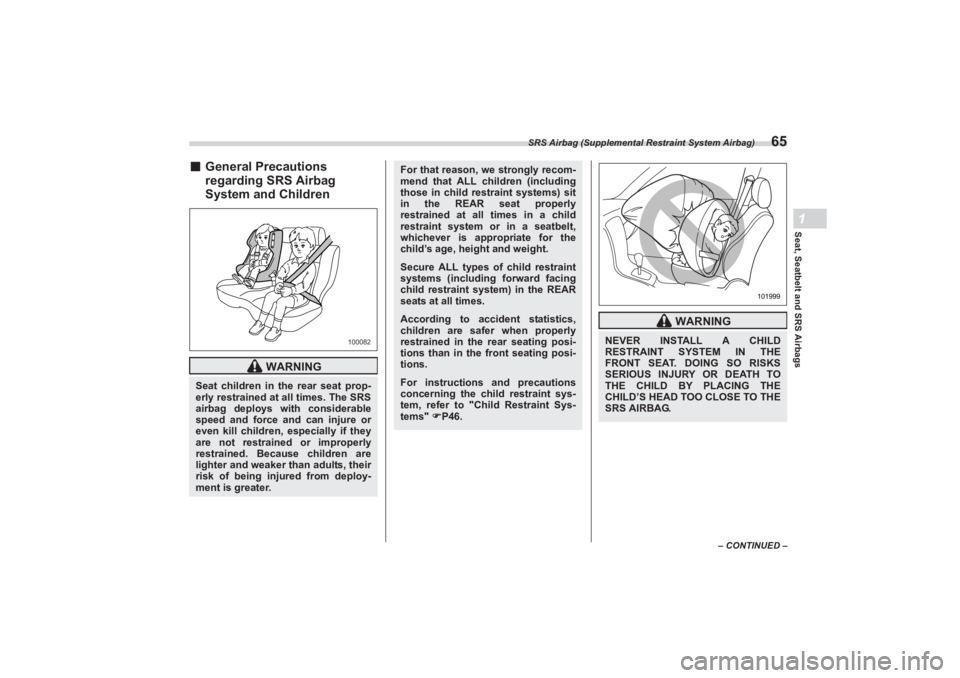
WARNING
Seat children in the rear seat prop-
erly restrained at all times. The SRS
airbag deploys with considerable
speed and force and can injure or
even kill children, especially if they
are not restrained or improperly
restrained. Because children are
lighter and weaker than adults, their
risk of being injured from deploy-
ment is greater.
100082
For that reason, we strongly recom-
mend that ALL children (including
those in child rest raint systems) sit
in the REAR seat properly
restrained at all times in a child
restraint system or in a seatbelt,
whichever is appropriate for the
child’s age, height and weight.Secure ALL types of child restraint
systems (including forward facing
child restraint system) in the REAR
seats at all times.According to accident statistics,
children are safer when properly
restrained in the rear seating posi-
tions than in the front seating posi-
tions.For instructions and precautions
concerning the child restraint sys-
tem, refer to "Ch ild Restraint Sys-
tems" P46.
WARNING
NEVER INSTALL A CHILD
RESTRAINT SYSTEM IN THE
FRONT SEAT. DOING SO RISKS
SERIOUS INJURY OR DEATH TO
THE CHILD BY PLACING THE
CHILD’S HEAD TOO CLOSE TO THE
SRS AIRBAG.
101999
BRZ_U.book 65 ページ 2022年3月29日 火曜日 午後3時59分
Page 75 of 432
SRS Airbag (Supplemental Restraint System Airbag)
69
Seat, Seatbelt and SRS Airbags1
– CONTINUED –
120
2
3
4
6
14
9
7
5
10
11
13
12
8
15
21
22
23
17
16
19
18
102764
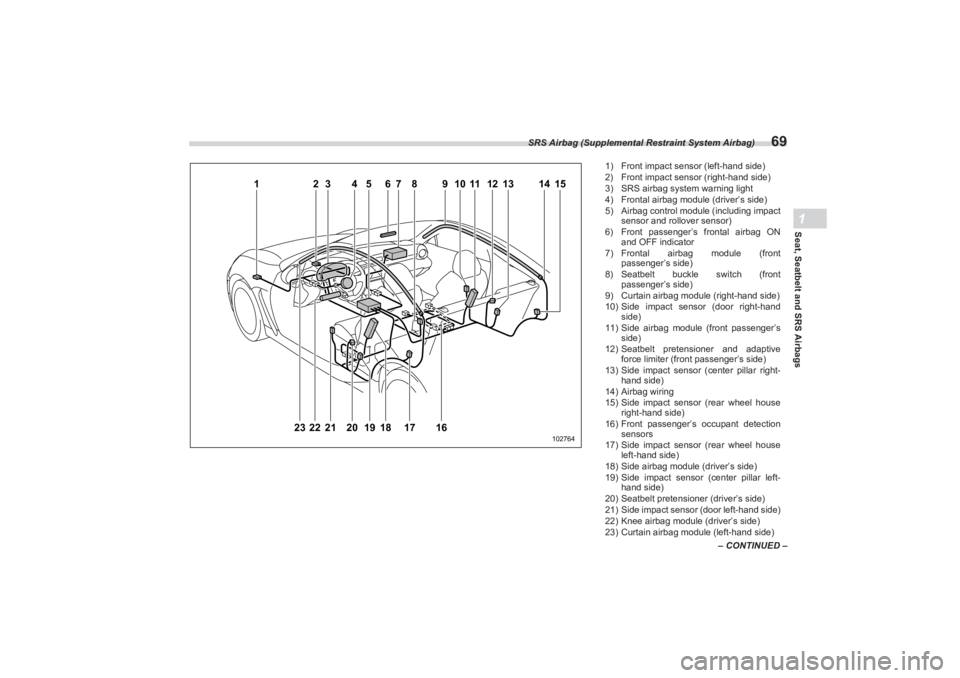
1) Front impact sensor (left-hand side)
2) Front impact sensor (right-hand side)
3) SRS airbag system warning light
4) Frontal airbag module (driver’s side)
5) Airbag control module (including impact
sensor and rollover sensor)
6) Front passenger’s frontal airbag ON
and OFF indicator
7) Frontal airbag module (front
passenger’s side)
8) Seatbelt buckle switch (front
passenger’s side)
9) Curtain airbag module (right-hand side)
10) Side impact sensor (door right-hand
side)
11) Side airbag module (front passenger’s
side)
12) Seatbelt pretensioner and adaptive
force limiter (front passenger’s side)
13) Side impact sensor (center pillar right-
hand side)
14) Airbag wiring
15) Side impact sensor (rear wheel house
right-hand side)
16) Front passenger’s occupant detection
sensors
17) Side impact sensor (rear wheel house
left-hand side)
18) Side airbag module (driver’s side)
19) Side impact sensor (center pillar left-
hand side)
20) Seatbelt pretensi oner (driver’s side)
21) Side impact sensor (door left-hand side)
22) Knee airbag module (driver’s side)
23) Curtain airbag module (left-hand side)
BRZ_U.book 69 ページ 2022年3月29日 火曜日 午後3時59分
Page 76 of 432
SRS Airbag (Supplemental Restraint System Airbag)
70■SUBARU Advanced Frontal
Airbag SystemThis vehicle is equipped with a SUBARU
advanced frontal airbag system that
complies with the new advanced frontal
airbag requirements in the amended
Federal Motor Vehicle Safety Standard
(FMVSS) No. 208.
The SUBARU advanced frontal airbag
system automaticall y determines the
deployment force of the driver’s SRS
frontal airbag at the time of deployment as
well as whether or not to activate the front
passenger’s SRS frontal airbag and, if
activated, the deployment force of the
SRS frontal airbag at the time of deploy-
ment.
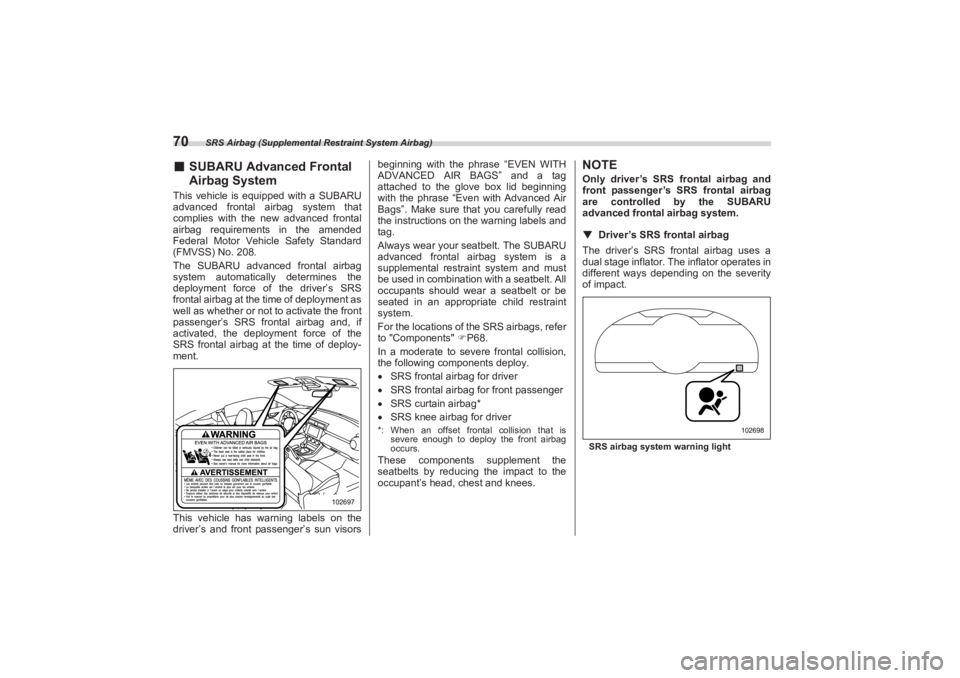
This vehicle has warning labels on the
driver’s and front passenger’s sun visors beginning with th
e phrase “EVEN WITH
ADVANCED AIR BAGS” and a tag
attached to the glove box lid beginning
with the phrase “Even with Advanced Air
Bags”. Make sure that you carefully read
the instructions on the warning labels and
tag.
Always wear your seatbelt. The SUBARU
advanced frontal airbag system is a
supplemental restraint system and must
be used in combination with a seatbelt. All
occupants should wear a seatbelt or be
seated in an appropriate child restraint
system.
For the locations of the SRS airbags, refer
to "Components" P68.
In a moderate to severe frontal collision,
the following components deploy.
SRS frontal airbag for driver
SRS frontal airbag for front passenger
SRS curtain airbag*
SRS knee airbag for driver
*: When an offset frontal collision that is
severe enough to deploy the front airbag
occurs.These components supplement the
seatbelts by reducing the impact to the
occupant’s head, chest and knees.
NOTEOnly driver’s SRS frontal airbag and
front passenger’s SRS frontal airbag
are controlled by the SUBARU
advanced frontal airbag system.
▼ Driver’s SRS frontal airbagThe driver’s SRS frontal airbag uses a
dual stage inflator. The inflator operates in
different ways depending on the severity
of impact.SRS airbag system warning light
102697
102698
BRZ_U.book 70 ページ 2022年3月29日 火曜日 午後3時59分
Page 78 of 432
SRS Airbag (Supplemental Restraint System Airbag)
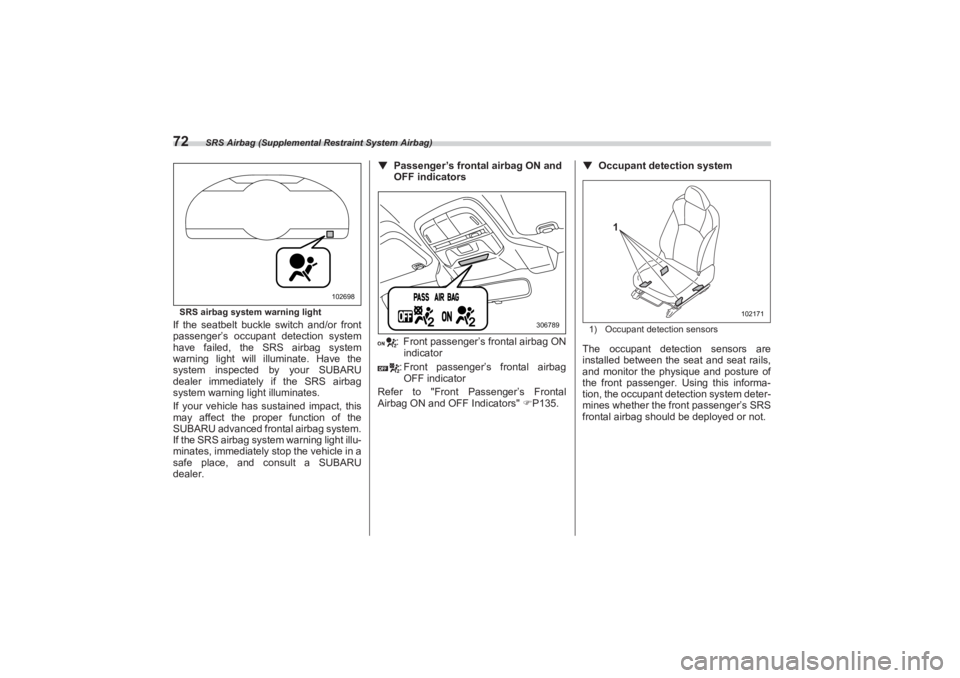
72SRS airbag system warning lightIf the seatbelt buckle switch and/or front
passenger’s occupant detection system
have failed, the SRS airbag system
warning light will illuminate. Have the
system inspected by your SUBARU
dealer immediately if the SRS airbag
system warning light illuminates.
If your vehicle has sustained impact, this
may affect the proper function of the
SUBARU advanced frontal airbag system.
If the SRS airbag system warning light illu-
minates, immediately stop the vehicle in a
safe place, and consult a SUBARU
dealer.
▼ Passenger’s frontal airbag ON and
OFF indicators
: Front passenger’s frontal airbag ON
indicator
: Front passenger’s frontal airbag
OFF indicator
Refer to "Front Passenger’s Frontal
Airbag ON and OFF Indicators" P135. ▼
Occupant detection system
1) Occupant detection sensorsThe occupant detection sensors are
installed between the seat and seat rails,
and monitor the physique and posture of
the front passenger. Using this informa-
tion, the occupant det ection system deter-
mines whether the front passenger’s SRS
frontal airbag should be deployed or not.
102698
306789
102171
1
BRZ_U.book 72 ページ 2022年3月29日 火曜日 午後3時59分
Page 79 of 432
SRS Airbag (Supplemental Restraint System Airbag)
73
Seat, Seatbelt and SRS Airbags1
– CONTINUED –
: Front passenger’s frontal airbag ON
indicator
: Front passenger’s frontal airbag
OFF indicator
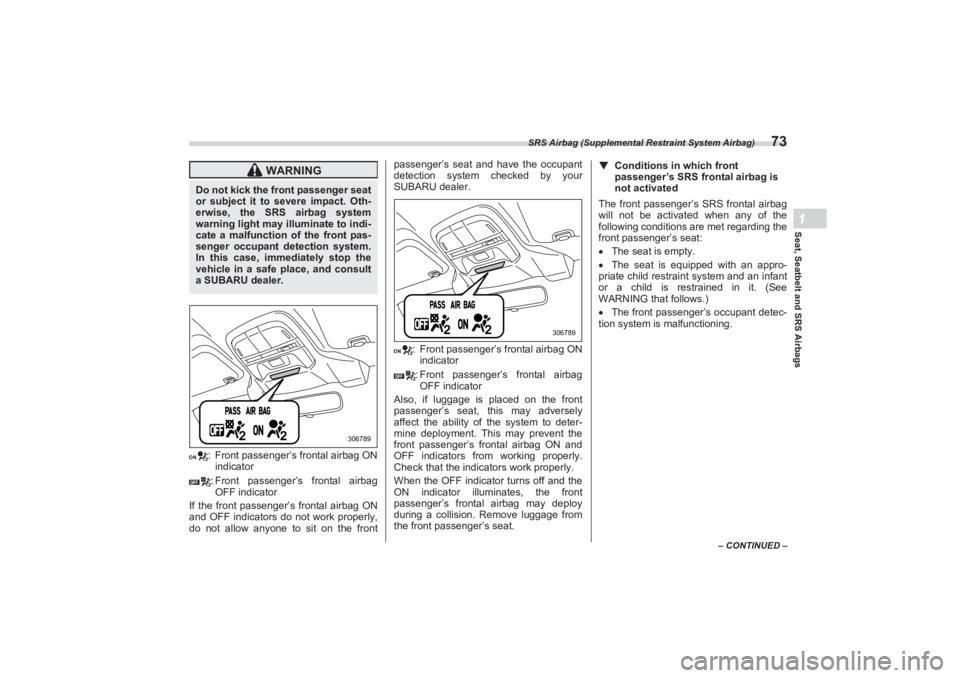
If the front passenger’s frontal airbag ON
and OFF indicators do not work properly,
do not allow anyone to sit on the front passenger’s seat and have the occupant
detection system checked by your
SUBARU dealer.
: Front passenger’s frontal airbag ON
indicator
: Front passenger’s frontal airbag
OFF indicator
Also, if luggage is placed on the front
passenger’s seat, this may adversely
affect the ability of the system to deter-
mine deployment. This may prevent the
front passenger’s frontal airbag ON and
OFF indicators from working properly.
Check that the indicators work properly.
When the OFF indicator turns off and the
ON indicator illuminates, the front
passenger’s frontal airbag may deploy
during a collision. Remove luggage from
the front passenger’s seat.
▼ Conditions in which front
passenger’s SRS frontal airbag is
not activatedThe front passenger’s SRS frontal airbag
will not be activated when any of the
following conditions are met regarding the
front passenger’s seat:
The seat is empty.
The seat is equipped with an appro-
priate child restrain t system and an infant
or a child is restrained in it. (See
WARNING that follows.)
The front passenger’s occupant detec-
tion system is malfunctioning.
WARNING
Do not kick the front passenger seat
or subject it to severe impact. Oth-
erwise, the SRS airbag system
warning light may illuminate to indi-
cate a malfunction of the front pas-
senger occupant detection system.
In this case, immediately stop the
vehicle in a safe pl ace, and consult
a SUBARU dealer.
306789
306789
BRZ_U.book 73 ページ 2022年3月29日 火曜日 午後3時59分