lock SUBARU BRZ 2023 Owner's Manual
[x] Cancel search | Manufacturer: SUBARU, Model Year: 2023, Model line: BRZ, Model: SUBARU BRZ 2023Pages: 432, PDF Size: 16.56 MB
Page 53 of 432
Child Restraint Systems
47
Seat, Seatbelt and SRS Airbags1
– CONTINUED –
Children could be endangered in an acci-
dent if their child restraint systems are not
properly secured in the vehicle. When
installing the child re straint system, care-
fully follow the manufacturer’s instruc-
tions.
According to accident statistics, children
are safer when properly restrained in the
rear seating positions than in the front
seating positions.
All U.S. states and Canadian provinces
require that infants and small children be
restrained in an approved child restraint
system at all times while the vehicle is
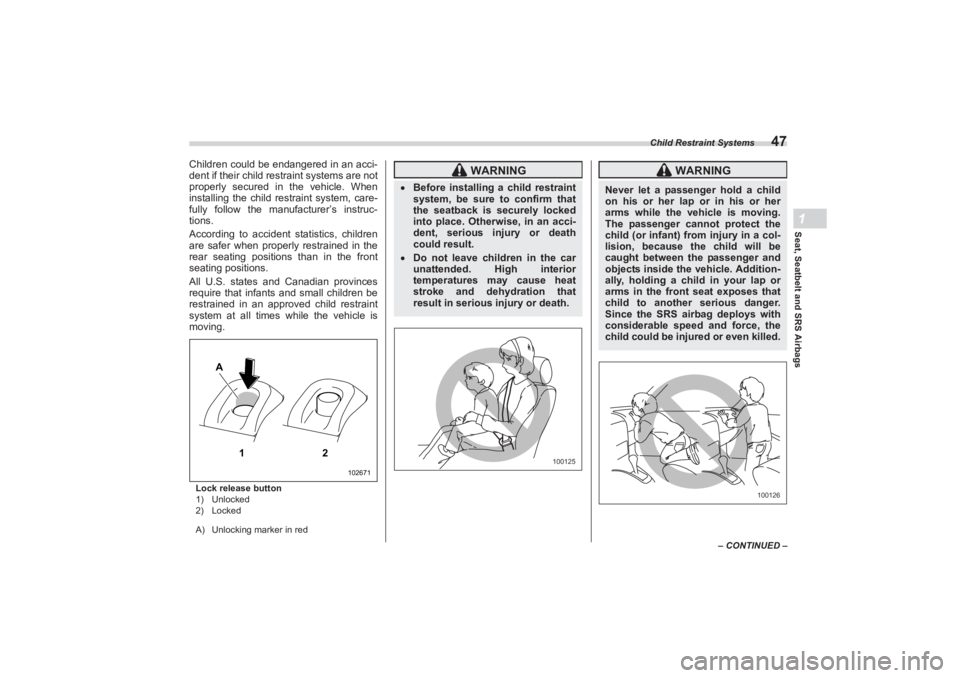
moving.Lock release button
1) Unlocked
2) Locked
A) Unlocking marker in red
A
12
102671
WARNING
Before installing a child restraint
system, be sure to confirm that
the seatback is securely locked
into place. Otherwise, in an acci-
dent, serious injury or death
could result. Do not leave children in the car
unattended. High interior
temperatures may cause heat
stroke and dehydration that
result in serious injury or death.
100125
WARNING
Never let a passenger hold a child
on his or her lap or in his or her
arms while the vehicle is moving.
The passenger cannot protect the
child (or infant) from injury in a col-
lision, because the child will be
caught between the passenger and
objects inside the vehicle. Addition-
ally, holding a child in your lap or
arms in the front seat exposes that
child to another serious danger.
Since the SRS airbag deploys with
considerable speed and force, the
child could be injured or even killed.
100126
BRZ_U.book 47 ページ 2022年3月29日 火曜日 午後3時59分
Page 55 of 432
Child Restraint Systems
49
Seat, Seatbelt and SRS Airbags1
– CONTINUED –
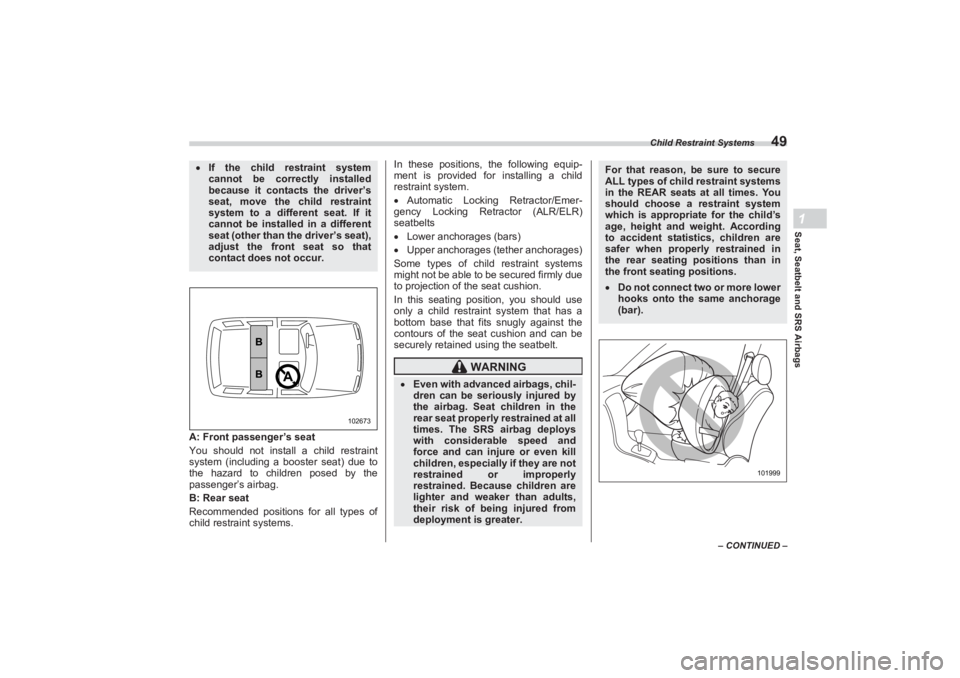
A: Front passenger’s seat
You should not install a child restraint
system (including a bo oster seat) due to
the hazard to children posed by the
passenger’s airbag.
B: Rear seat
Recommended positions for all types of
child restraint systems. In these positions, the following equip-
ment is provided for installing a child
restraint system.
Automatic Locking Retractor/Emer-
gency Locking Retractor (ALR/ELR)
seatbelts
Lower anchorages (bars)
Upper anchorages (tether anchorages)
Some types of child restraint systems
might not be able to be secured firmly due
to projection of the seat cushion.
In this seating position, you should use
only a child restrain t system that has a
bottom base that fits snugly against the
contours of the seat cushion and can be
securely retained using the seatbelt. If the child restraint system
cannot be correctly installed
because it contacts the driver’s
seat, move the child restraint
system to a different seat. If it
cannot be installed in a different
seat (other than the driver’s seat),
adjust the front seat so that
contact does not occur.
102673
WARNING
Even with advanced airbags, chil-
dren can be seriously injured by
the airbag. Seat children in the
rear seat properly restrained at all
times. The SRS airbag deploys
with considerable speed and
force and can injure or even kill
children, especially if they are not
restrained or improperly
restrained. Because children are
lighter and weaker than adults,
their risk of being injured from
deployment is greater.
For that reason, be sure to secure
ALL types of child restraint systems
in the REAR seats at all times. You
should choose a restraint system
which is appropriate for the child’s
age, height and weight. According
to accident statistics, children are
safer when properly restrained in
the rear seating positions than in
the front seating positions. Do not connect tw o or more lower
hooks onto the same anchorage
(bar).
101999
BRZ_U.book 49 ページ 2022年3月29日 火曜日 午後3時59分
Page 57 of 432
Child Restraint Systems
51
Seat, Seatbelt and SRS Airbags1
– CONTINUED –
■Installing Child Restraint
Systems with ALR/ELR Seat -
belt▼ Installing a rearward facing child
restraint system
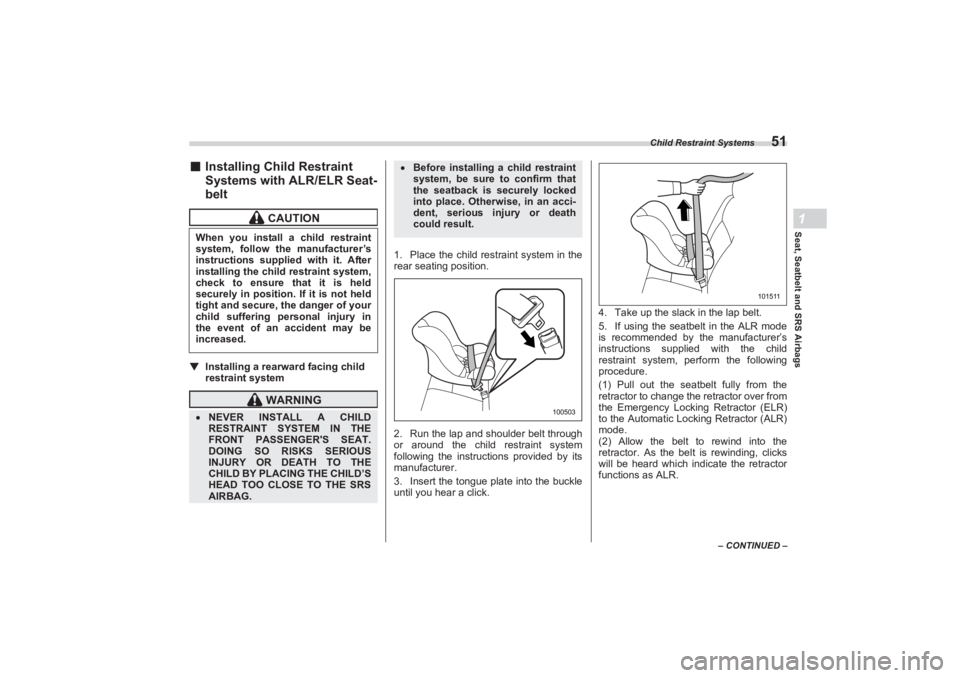
1. Place the child rest raint system in the
rear seating position.
2. Run the lap and shoulder belt through
or around the chil d restraint system
following the instructions provided by its
manufacturer.
3. Insert the tongue plate into the buckle
until you hear a click. 4. Take up the slack in the lap belt.
5. If using the seatbelt in the ALR mode
is recommended by the manufacturer’s
instructions supplied with the child
restraint system, perform the following
procedure.
(1) Pull out the seatbelt fully from the
retractor to change the retractor over from
the Emergency Locking Retractor (ELR)
to the Automatic Locking Retractor (ALR)
mode.
(2) Allow the belt to rewind into the
retractor. As the belt is rewinding, clicks
will be heard which indicate the retractor
functions as ALR.
CAUTION
When you install a child restraint
system, follow the manufacturer’s
instructions supplied with it. After
installing the child restraint system,
check to ensure that it is held
securely in position. If it is not held
tight and secure, the danger of your
child suffering personal injury in
the event of an accident may be
increased.
WARNING
NEVER INSTALL A CHILD
RESTRAINT SYSTEM IN THE
FRONT PASSENGER'S SEAT.
DOING SO RISKS SERIOUS
INJURY OR DEATH TO THE
CHILD BY PLACING THE CHILD’S
HEAD TOO CLOSE TO THE SRS
AIRBAG.
Before installing a child restraint
system, be sure to confirm that
the seatback is securely locked
into place. Otherwise, in an acci-
dent, serious injury or death
could result.
100503
101511
BRZ_U.book 51 ページ 2022年3月29日 火曜日 午後3時59分
Page 58 of 432
Child Restraint Systems
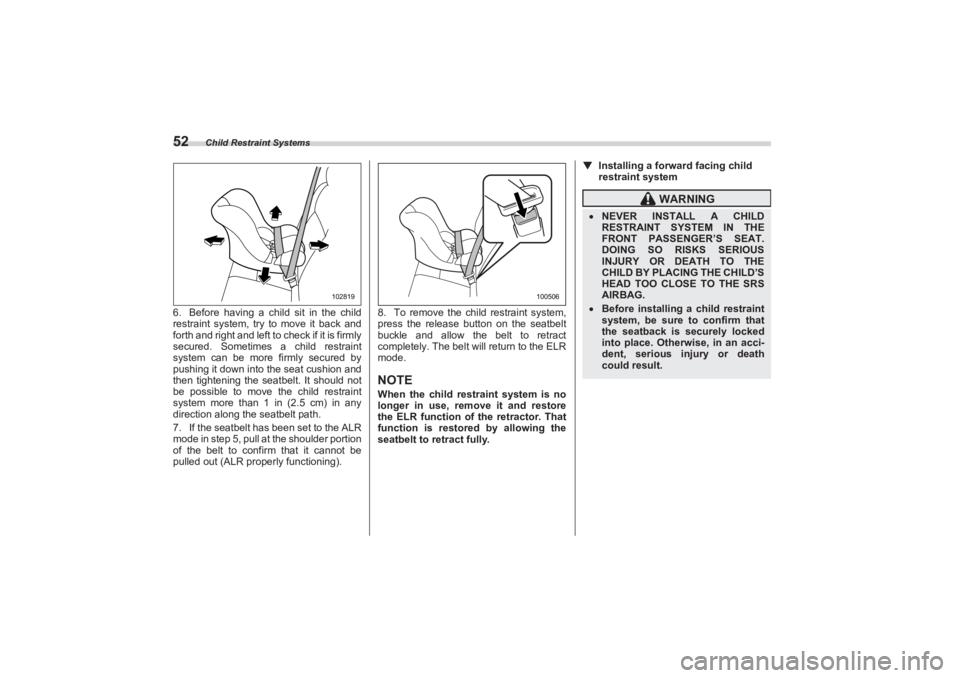
526. Before having a child sit in the child
restraint system, try to move it back and
forth and right and left to check if it is firmly
secured. Sometimes a child restraint
system can be more firmly secured by
pushing it down into the seat cushion and
then tightening the seatbelt. It should not
be possible to move the child restraint
system more than 1 in (2.5 cm) in any
direction along the seatbelt path.
7. If the seatbelt has been set to the ALR
mode in step 5, pull at the shoulder portion
of the belt to confir m that it cannot be
pulled out (ALR properly functioning). 8. To remove the child restraint system,
press the release button on the seatbelt
buckle and allow the belt to retract
completely. The belt will return to the ELR
mode.
NOTEWhen the child restraint system is no
longer in use, remove it and restore
the ELR function of the retractor. That
function is restored by allowing the
seatbelt to retract fully.
▼ Installing a forward facing child
restraint system
102819
100506
WARNING
NEVER INSTALL A CHILD
RESTRAINT SYSTEM IN THE
FRONT PASSENGER’S SEAT.
DOING SO RISKS SERIOUS
INJURY OR DEATH TO THE
CHILD BY PLACING THE CHILD’S
HEAD TOO CLOSE TO THE SRS
AIRBAG. Before installing a child restraint
system, be sure to confirm that
the seatback is securely locked
into place. Otherwise, in an acci-
dent, serious injury or death
could result.
BRZ_U.book 52 ページ 2022年3月29日 火曜日 午後3時59分
Page 59 of 432
Child Restraint Systems
53
Seat, Seatbelt and SRS Airbags1
– CONTINUED –
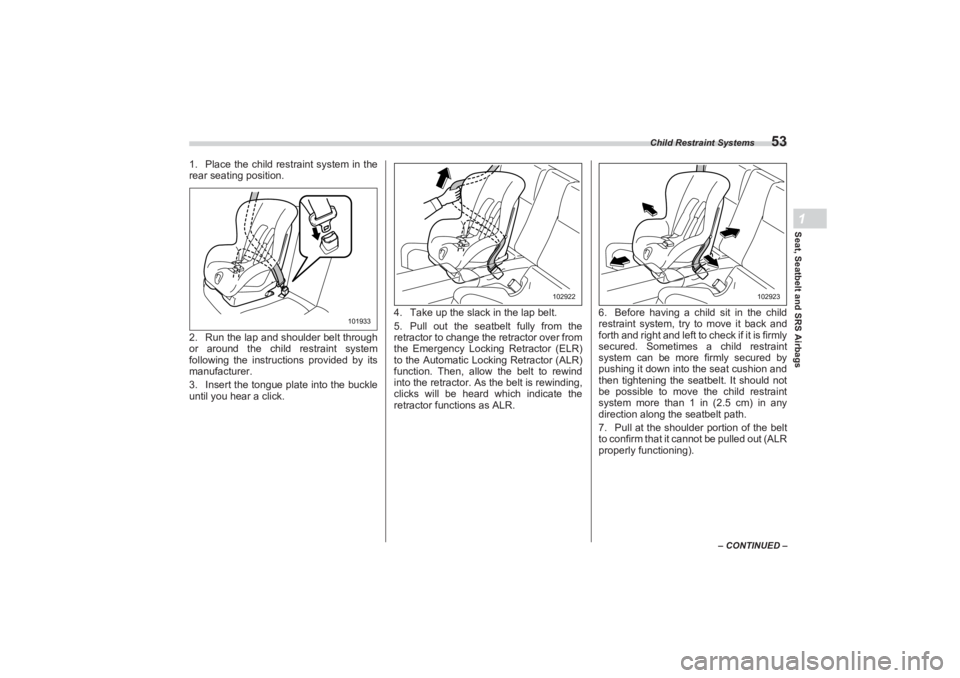
1. Place the child restraint system in the
rear seating position.
2. Run the lap and shoulder belt through
or around the child restraint system
following the instructions provided by its
manufacturer.
3. Insert the tongue plate into the buckle
until you hear a click. 4. Take up the slack in the lap belt.
5. Pull out the seatbelt fully from the
retractor to change the retractor over from
the Emergency Locking Retractor (ELR)
to the Automatic Locking Retractor (ALR)
function. Then, allow the belt to rewind
into the retractor. As the belt is rewinding,
clicks will be heard which indicate the
retractor functions as ALR. 6. Before having a child sit in the child
restraint system, try to move it back and
forth and right and left to check if it is firmly
secured. Sometimes a child restraint
system can be more firmly secured by
pushing it down into the seat cushion and
then tightening the seatbelt. It should not
be possible to move the child restraint
system more than 1 in (2.5 cm) in any
direction along the seatbelt path.
7. Pull at the shoulder portion of the belt
to confirm that it cannot be pulled out (ALR
properly functioning).
101933
102922
102923
BRZ_U.book 53 ページ 2022年3月29日 火曜日 午後3時59分
Page 63 of 432
Child Restraint Systems
57
Seat, Seatbelt and SRS Airbags1
– CONTINUED –
in the above illustration. For details, refer
to "Top Tether Anchorages" P59.
▽ To install a child restraint
system using lower and tether
anchorages
1. Move the seatback back and forth to
confirm that it is securely locked into
place.
Check that the red colored
unlocking marker on the lock release
button is not visible. For details, refer
to "Folding Down the Rear Seatback"
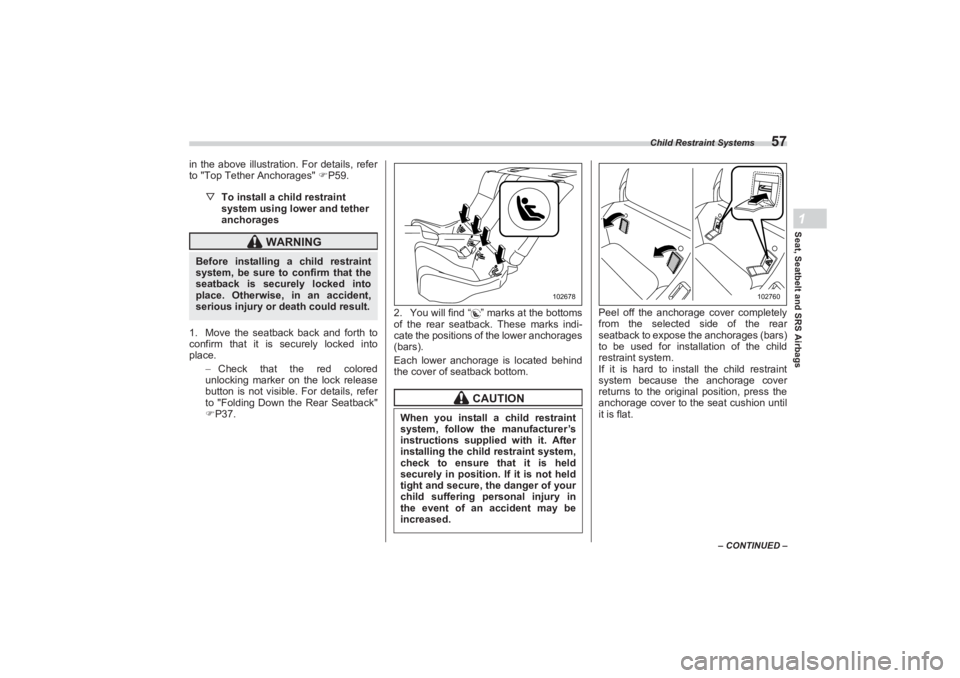
P37. 2. You will find “ ” marks at the bottoms
of the rear seatback. These marks indi-
cate the positions of the lower anchorages
(bars).
Each lower anchorage is located behind
the cover of seatback bottom. Peel off the anchorage cover completely
from the selected side of the rear
seatback to expose the anchorages (bars)
to be used for installation of the child
restraint system.
If it is hard to install the child restraint
system because the anchorage cover
returns to the original position, press the
anchorage cover to the seat cushion until
it is flat.
WARNING
Before installing a child restraint
system, be sure to confirm that the
seatback is securely locked into
place. Otherwise, in an accident,
serious injury or death could result.
CAUTION
When you install a child restraint
system, follow the manufacturer’s
instructions supplied with it. After
installing the child restraint system,
check to ensure that it is held
securely in position. If it is not held
tight and secure, the danger of your
child suffering personal injury in
the event of an accident may be
increased.
102678
102760
BRZ_U.book 57 ページ 2022年3月29日 火曜日 午後3時59分
Page 77 of 432
SRS Airbag (Supplemental Restraint System Airbag)
71
Seat, Seatbelt and SRS Airbags1
– CONTINUED –
▼Front passenger’s SRS frontal
airbagThe front passenger’s SRS frontal airbag
uses a dual stage inflator. The inflator
operates in different ways depending on
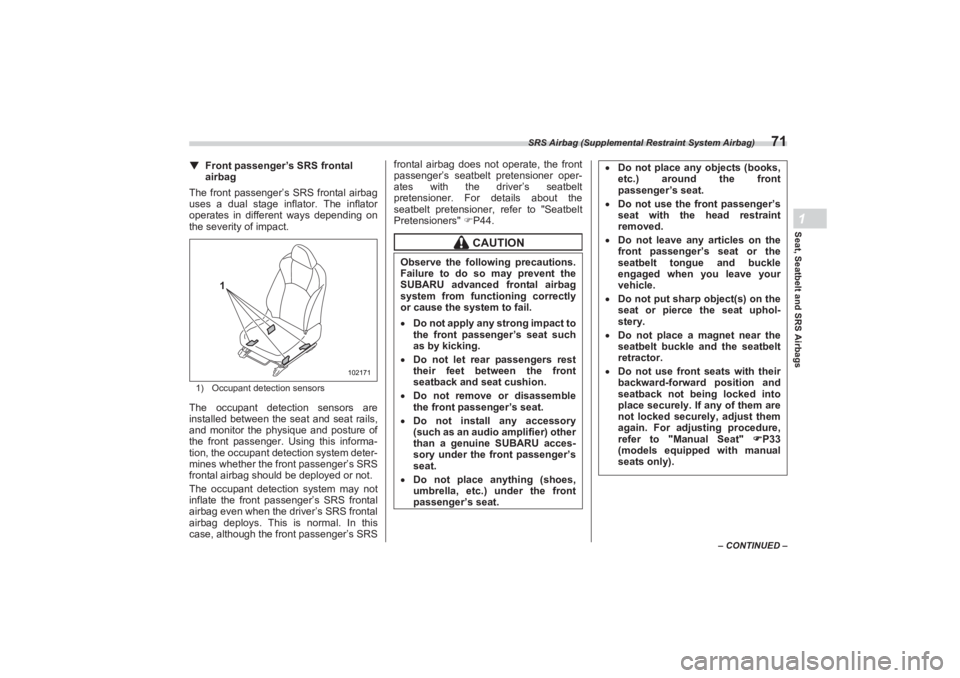
the severity of impact.1) Occupant detection sensorsThe occupant detection sensors are
installed between the seat and seat rails,
and monitor the physique and posture of
the front passenger. Using this informa-
tion, the occupant detection system deter-
mines whether the front passenger’s SRS
frontal airbag should be deployed or not.
The occupant detect ion system may not
inflate the front passenger’s SRS frontal
airbag even when the driver’s SRS frontal
airbag deploys. This is normal. In this
case, although the front passenger’s SRS frontal airbag does not operate, the front
passenger’s seatbelt pretensioner oper-
ates with the driver’s seatbelt
pretensioner. For details about the
seatbelt pretensioner, refer to "Seatbelt
Pretensioners" P44.
102171
1
CAUTION
Observe the following precautions.
Failure to do so may prevent the
SUBARU advanced frontal airbag
system from functioning correctly
or cause the system to fail. Do not apply any strong impact to
the front passenger’s seat such
as by kicking. Do not let rear passengers rest
their feet between the front
seatback and seat cushion. Do not remove or disassemble
the front passenger’s seat. Do not install any accessory
(such as an audio amplifier) other
than a genuine SUBARU acces-
sory under the front passenger’s
seat. Do not place anything (shoes,
umbrella, etc.) under the front
passenger’s seat.
Do not place any objects (books,
etc.) around the front
passenger’s seat. Do not use the front passenger’s
seat with the head restraint
removed. Do not leave any articles on the
front passenger’s seat or the
seatbelt tongue and buckle
engaged when you leave your
vehicle. Do not put sharp object(s) on the
seat or pierce the seat uphol-
stery. Do not place a magnet near the
seatbelt buckle and the seatbelt
retractor. Do not use front seats with their
backward-forward position and
seatback not being locked into
place securely. If any of them are
not locked securely, adjust them
again. For adjusting procedure,
refer to "Manual Seat" P33
(models equipped with manual
seats only).
BRZ_U.book 71 ページ 2022年3月29日 火曜日 午後3時59分
Page 80 of 432
SRS Airbag (Supplemental Restraint System Airbag)
74
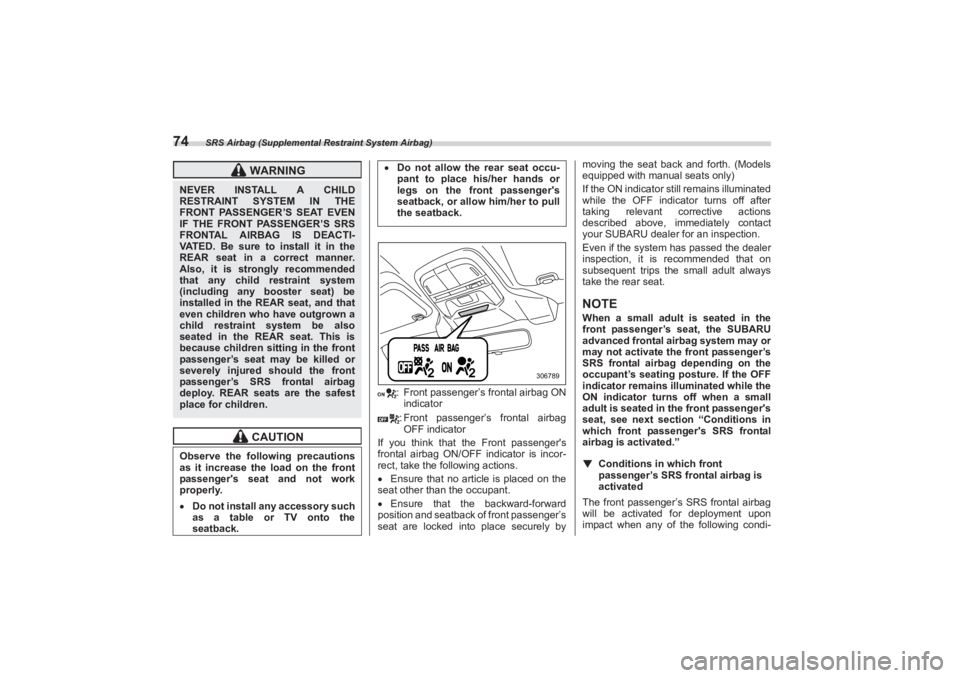
: Front passenger’s frontal airbag ON
indicator
: Front passenger’s frontal airbag
OFF indicator
If you think that the Front passenger's
frontal airbag ON/OFF indicator is incor-
rect, take the following actions.
Ensure that no article is placed on the
seat other than the occupant.
Ensure that the backward-forward
position and seatback of front passenger’s
seat are locked into place securely by moving the seat back and forth. (Models
equipped with manual seats only)
If the ON indicator still remains illuminated
while the OFF indicator turns off after
taking relevant corrective actions
described above, immediately contact
your SUBARU dealer for an inspection.
Even if the system has passed the dealer
inspection, it is recommended that on
subsequent trips the small adult always
take the rear seat.
NOTEWhen a small adult is seated in the
front passenger’s seat, the SUBARU
advanced frontal airbag system may or
may not activate th e front passenger’s
SRS frontal airbag depending on the
occupant’s seating posture. If the OFF
indicator remains illuminated while the
ON indicator turns off when a small
adult is seated in the front passenger's
seat, see next section “Conditions in
which front passenger's SRS frontal
airbag is activated.”▼ Conditions in which front
passenger’s SRS frontal airbag is
activatedThe front passenger’s SRS frontal airbag
will be activated for deployment upon
impact when any of the following condi-
WARNING
NEVER INSTALL A CHILD
RESTRAINT SYSTEM IN THE
FRONT PASSENGER’S SEAT EVEN
IF THE FRONT PASSENGER’S SRS
FRONTAL AIRBAG IS DEACTI-
VATED. Be sure to install it in the
REAR seat in a correct manner.
Also, it is strongly recommended
that any child restraint system
(including any booster seat) be
installed in the REAR seat, and that
even children who have outgrown a
child restraint system be also
seated in the REAR seat. This is
because children sitting in the front
passenger’s seat may be killed or
severely injured should the front
passenger’s SRS frontal airbag
deploy. REAR seats are the safest
place for children.
CAUTION
Observe the following precautions
as it increase the load on the front
passenger's seat and not work
properly. Do not install any accessory such
as a table or TV onto the
seatback.
Do not allow the rear seat occu-
pant to place his/her hands or
legs on the front passenger's
seatback, or allow him/her to pull
the seatback.
306789
BRZ_U.book 74 ページ 2022年3月29日 火曜日 午後3時59分
Page 99 of 432
Keys and Doors2
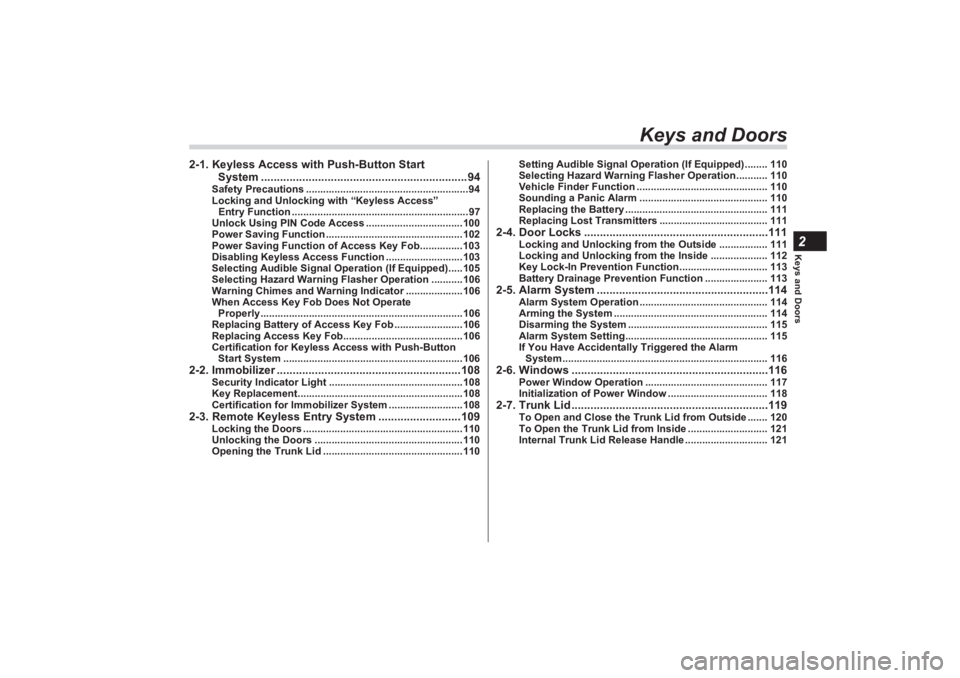
Keys and Doors
2-1. Keyless Access with Push-Button Start
System .................................................................94
Safety Precautions ..... .......................................... ..........94
Locking and Unlocking with “Keyless Access”
Entry Function ..............................................................97
Unlock Using PIN Code Access ..................................100
Power Saving Function ................................................102
Power Saving Function of Access Key Fob...............103
Disabling Keyless Access Function ...........................103
Selecting Audible Signal Operation (If Equipped).....105
Selecting Hazard Warning Flasher Operation ...........106
Warning Chimes and Warning Indicator ....................106
When Access Key Fob Does Not Operate
Properly.......................................................................106
Replacing Battery of Access Key Fob ........................106
Replacing Access Key Fob..........................................106
Certification for Keyless Access with Push-Button
Start System ...............................................................106
2-2. Immobilizer ..........................................................108
Security Indicator Light ...............................................108
Key Replacement..........................................................108
Certification for Immobilizer System ..........................108
2-3. Remote Keyless Entry System ..........................109
Locking the Doors ........................................................110
Unlocking the Doors ....................................................110
Opening the Trunk Lid .................................................110 Setting Audible Signal Operation (If Equipped)........ 110
Selecting Hazard Warning Flasher Operation........... 110
Vehicle Finder Function .............................................. 110
Sounding a Panic Alarm ............................................. 110
Replacing the Battery .................................................. 111
Replacing Lost Transmitters ...................................... 111
2-4. Door Locks ..........................................................111
Locking and Unlocking from the Outside ................. 111
Locking and Unlocking from the Inside .................... 112
Key Lock-In Prevention Function............................... 113
Battery Drainage Prevention Function ...................... 113
2-5. Alarm System ......................................................114
Alarm System Operation ............................................. 114
Arming the System ...................................................... 114
Disarming the System ................................................. 115
Alarm System Setting.................................................. 115
If You Have Accidentally Triggered the Alarm
System........................................................................ 116
2-6. Windows ..............................................................116
Power Window Operation ........................................... 117
Initialization of Power Window ................................... 118
2-7. Trunk Lid ..............................................................119
To Open and Close the Trunk Lid from Outside ....... 120
To Open the Trunk Lid from Inside ............................ 121
Internal Trunk Lid Release Handle ............................. 121
BRZ_U.book 93 ページ 2022年3月29日 火曜日 午後3時59分
Page 100 of 432
Keyless Access with Push-Button Start System
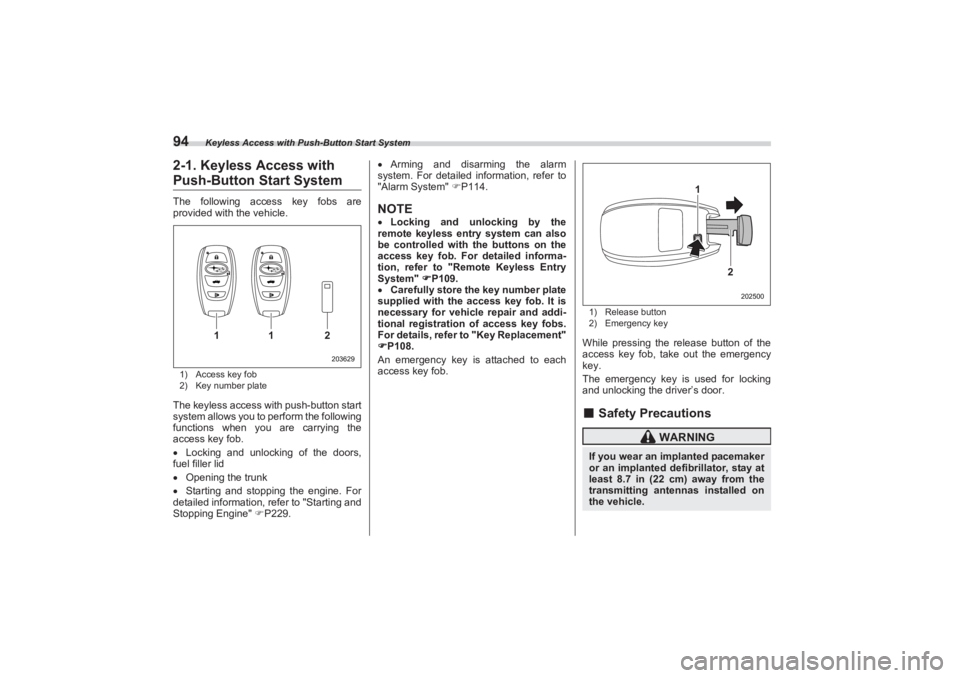
942-1. Keyless Access with Push-Button Start SystemThe following access key fobs are
provided with the vehicle.1) Access key fob
2) Key number plateThe keyless access with push-button start
system allows you to perform the following
functions when you are carrying the
access key fob.
Locking and unlocking of the doors,
fuel filler lid
Opening the trunk
Starting and stopping the engine. For
detailed information, refer to "Starting and
Stopping Engine" P229.
Arming and disarming the alarm
system. For detailed in formation, refer to
"Alarm System" P114.
NOTE Locking and unlocking by the
remote keyless entry system can also
be controlled with the buttons on the
access key fob. For detailed informa-
tion, refer to "Remote Keyless Entry
System" P109.
Carefully store the key number plate
supplied with the access key fob. It is
necessary for vehicle repair and addi-
tional registration of access key fobs.
For details, refer to "Key Replacement"
P108.
An emergency key is attached to each
access key fob.
1) Release button
2) Emergency keyWhile pressing the release button of the
access key fob, take out the emergency
key.
The emergency key is used for locking
and unlocking the driver’s door.■ Safety Precautions
203629
11 2
WARNING
If you wear an implanted pacemaker
or an implanted defibrillator, stay at
least 8.7 in (22 cm) away from the
transmitting antennas installed on
the vehicle.
1
2
202500
BRZ_U.book 94 ページ 2022年3月29日 火曜日 午後3時59分