belt SUBARU BRZ 2023 Owner's Guide
[x] Cancel search | Manufacturer: SUBARU, Model Year: 2023, Model line: BRZ, Model: SUBARU BRZ 2023Pages: 432, PDF Size: 16.56 MB
Page 57 of 432
Child Restraint Systems
51
Seat, Seatbelt and SRS Airbags1
– CONTINUED –
■Installing Child Restraint
Systems with ALR/ELR Seat -
belt▼ Installing a rearward facing child
restraint system
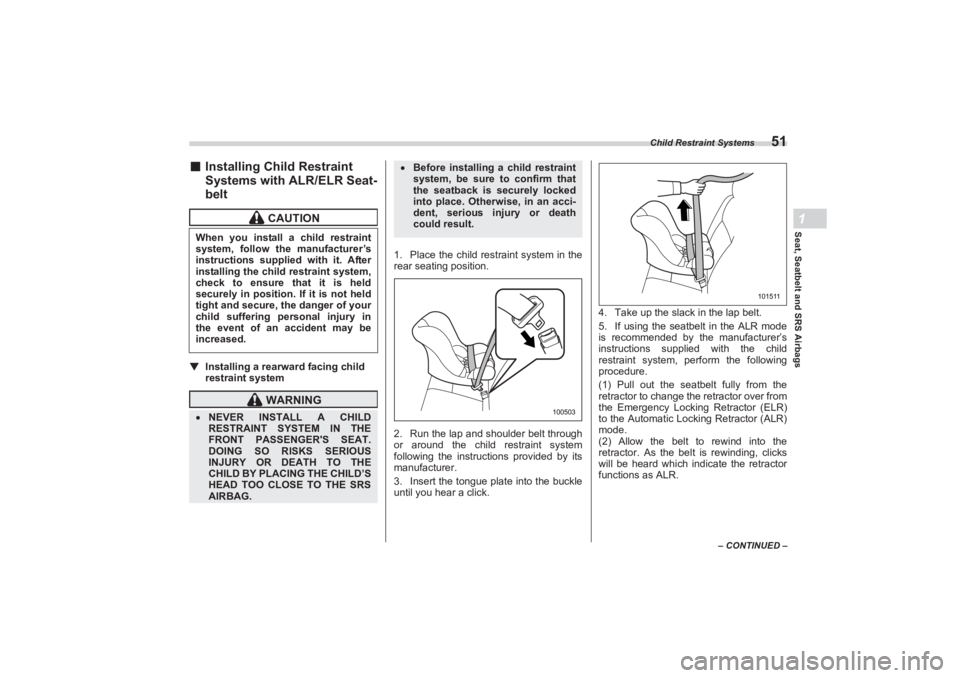
1. Place the child rest raint system in the
rear seating position.
2. Run the lap and shoulder belt through
or around the chil d restraint system
following the instructions provided by its
manufacturer.
3. Insert the tongue plate into the buckle
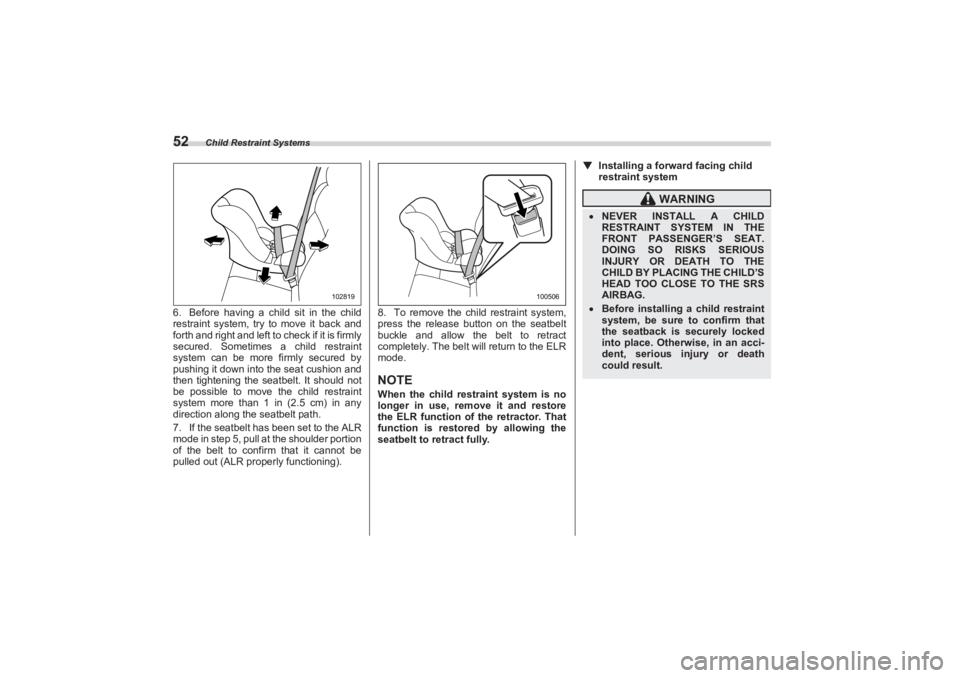
until you hear a click. 4. Take up the slack in the lap belt.
5. If using the seatbelt in the ALR mode
is recommended by the manufacturer’s
instructions supplied with the child
restraint system, perform the following
procedure.
(1) Pull out the seatbelt fully from the
retractor to change the retractor over from
the Emergency Locking Retractor (ELR)
to the Automatic Locking Retractor (ALR)
mode.
(2) Allow the belt to rewind into the
retractor. As the belt is rewinding, clicks
will be heard which indicate the retractor
functions as ALR.
CAUTION
When you install a child restraint
system, follow the manufacturer’s
instructions supplied with it. After
installing the child restraint system,
check to ensure that it is held
securely in position. If it is not held
tight and secure, the danger of your
child suffering personal injury in
the event of an accident may be
increased.
WARNING
NEVER INSTALL A CHILD
RESTRAINT SYSTEM IN THE
FRONT PASSENGER'S SEAT.
DOING SO RISKS SERIOUS
INJURY OR DEATH TO THE
CHILD BY PLACING THE CHILD’S
HEAD TOO CLOSE TO THE SRS
AIRBAG.
Before installing a child restraint
system, be sure to confirm that
the seatback is securely locked
into place. Otherwise, in an acci-
dent, serious injury or death
could result.
100503
101511
BRZ_U.book 51 ページ 2022年3月29日 火曜日 午後3時59分
Page 58 of 432
Child Restraint Systems
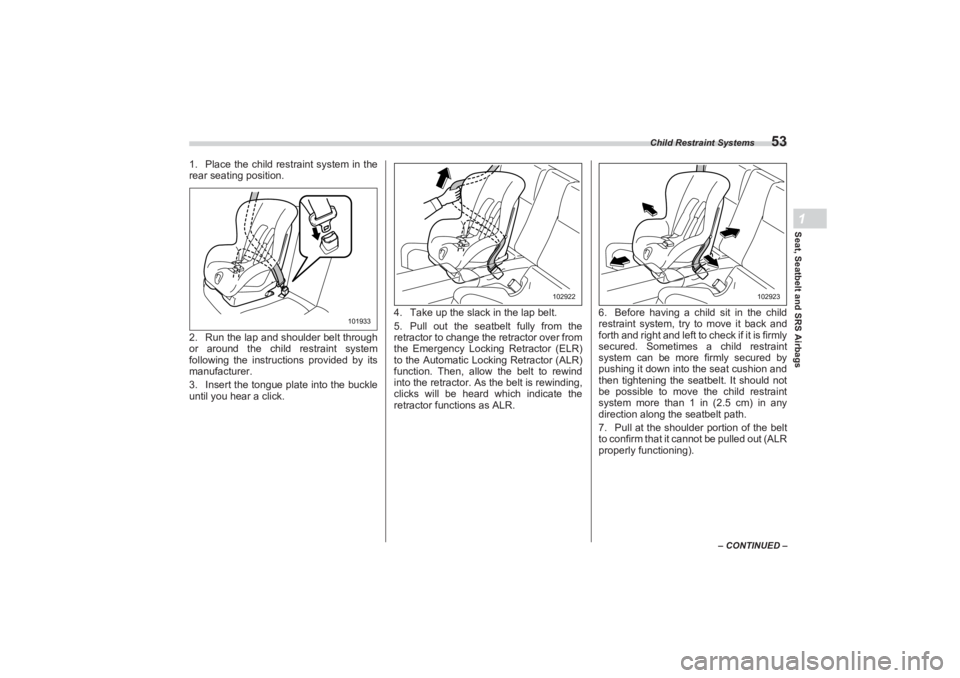
526. Before having a child sit in the child
restraint system, try to move it back and
forth and right and left to check if it is firmly
secured. Sometimes a child restraint
system can be more firmly secured by
pushing it down into the seat cushion and
then tightening the seatbelt. It should not
be possible to move the child restraint
system more than 1 in (2.5 cm) in any
direction along the seatbelt path.
7. If the seatbelt has been set to the ALR
mode in step 5, pull at the shoulder portion
of the belt to confir m that it cannot be
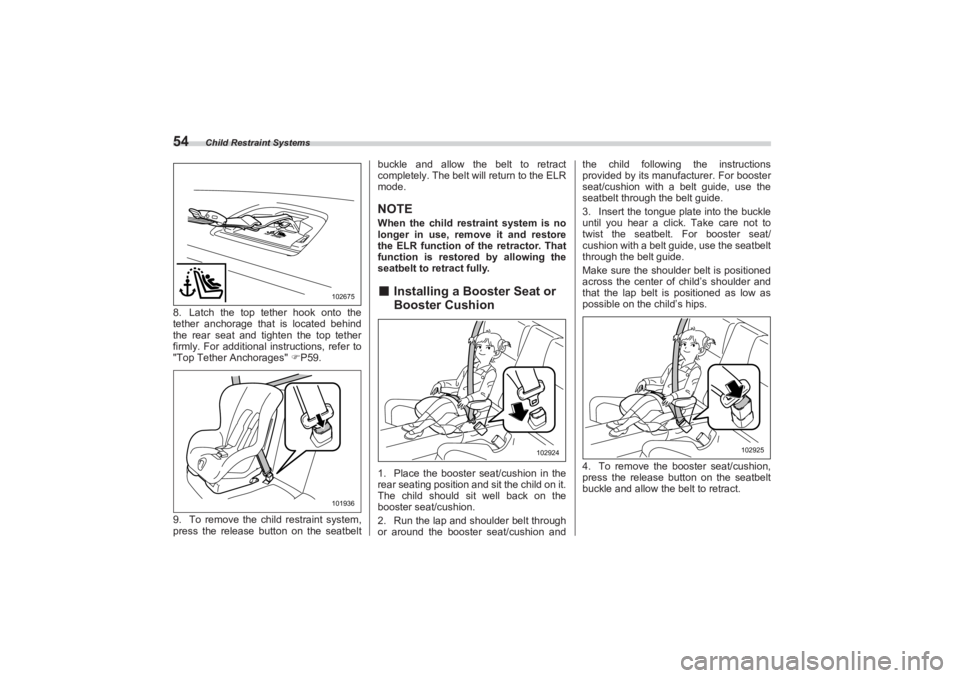
pulled out (ALR properly functioning). 8. To remove the child restraint system,
press the release button on the seatbelt
buckle and allow the belt to retract
completely. The belt will return to the ELR
mode.
NOTEWhen the child restraint system is no
longer in use, remove it and restore
the ELR function of the retractor. That
function is restored by allowing the
seatbelt to retract fully.
▼ Installing a forward facing child
restraint system
102819
100506
WARNING
NEVER INSTALL A CHILD
RESTRAINT SYSTEM IN THE
FRONT PASSENGER’S SEAT.
DOING SO RISKS SERIOUS
INJURY OR DEATH TO THE
CHILD BY PLACING THE CHILD’S
HEAD TOO CLOSE TO THE SRS
AIRBAG. Before installing a child restraint
system, be sure to confirm that
the seatback is securely locked
into place. Otherwise, in an acci-
dent, serious injury or death
could result.
BRZ_U.book 52 ページ 2022年3月29日 火曜日 午後3時59分
Page 59 of 432
Child Restraint Systems
53
Seat, Seatbelt and SRS Airbags1
– CONTINUED –
1. Place the child restraint system in the
rear seating position.
2. Run the lap and shoulder belt through
or around the child restraint system
following the instructions provided by its
manufacturer.
3. Insert the tongue plate into the buckle
until you hear a click. 4. Take up the slack in the lap belt.
5. Pull out the seatbelt fully from the
retractor to change the retractor over from
the Emergency Locking Retractor (ELR)
to the Automatic Locking Retractor (ALR)
function. Then, allow the belt to rewind
into the retractor. As the belt is rewinding,
clicks will be heard which indicate the
retractor functions as ALR. 6. Before having a child sit in the child
restraint system, try to move it back and
forth and right and left to check if it is firmly
secured. Sometimes a child restraint
system can be more firmly secured by
pushing it down into the seat cushion and
then tightening the seatbelt. It should not
be possible to move the child restraint
system more than 1 in (2.5 cm) in any
direction along the seatbelt path.
7. Pull at the shoulder portion of the belt
to confirm that it cannot be pulled out (ALR
properly functioning).
101933
102922
102923
BRZ_U.book 53 ページ 2022年3月29日 火曜日 午後3時59分
Page 60 of 432
Child Restraint Systems
548. Latch the top tether hook onto the
tether anchorage that is located behind
the rear seat and tighten the top tether
firmly. For additional instructions, refer to
"Top Tether Anchorages" P59.
9. To remove the child restraint system,
press the release butt on on the seatbelt buckle and allow the belt to retract
completely. The belt will return to the ELR
mode.
NOTEWhen the child restraint system is no
longer in use, remove it and restore
the ELR function of the retractor. That
function is restored by allowing the
seatbelt to retract fully.■ Installing a Booster Seat or
Booster Cushion1. Place the booster seat/cushion in the
rear seating position and sit the child on it.
The child should si t well back on the
booster seat/cushion.
2. Run the lap and shoulder belt through
or around the booster seat/cushion and the child following the instructions
provided by its manufacturer. For booster
seat/cushion with a belt guide, use the
seatbelt through the belt guide.
3. Insert the tongue plate into the buckle
until you hear a click. Take care not to
twist the seatbelt. For booster seat/
cushion with a belt guide, use the seatbelt
through the belt guide.
Make sure the shoulder belt is positioned
across the center of child’s shoulder and
that the lap belt is positioned as low as
possible on the child’s hips.
4. To remove the booster seat/cushion,
press the release button on the seatbelt
buckle and allow the belt to retract.
102675101936
102924
102925
BRZ_U.book 54 ページ 2022年3月29日 火曜日 午後3時59分
Page 61 of 432
Child Restraint Systems
55
Seat, Seatbelt and SRS Airbags1
– CONTINUED –
■Installation of Child Restraint
Systems by Use of Lower
and Tether Anchorages
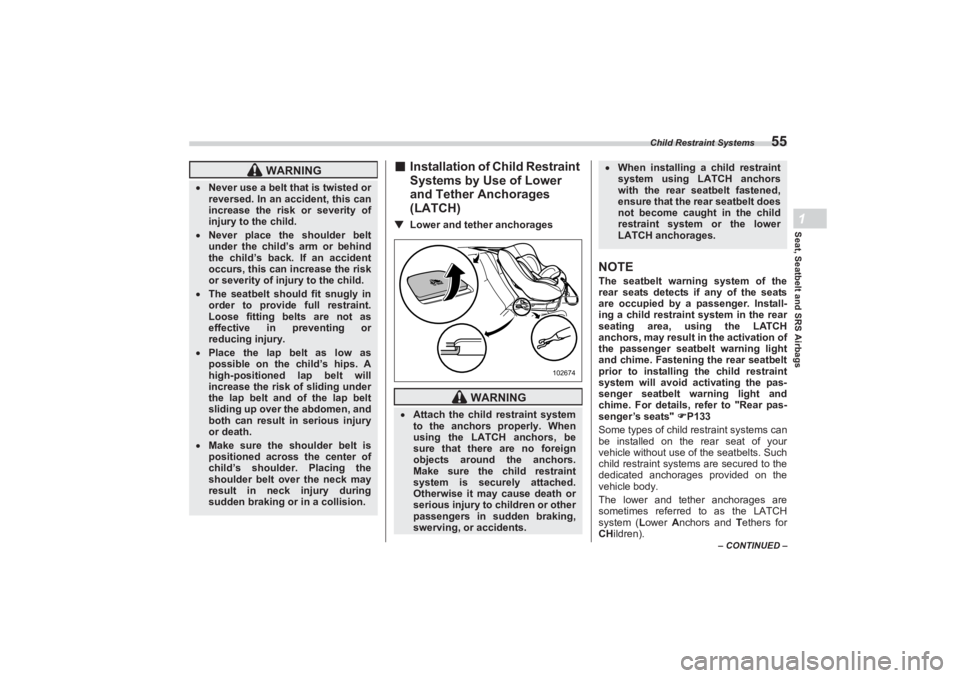
(LATCH)▼ Lower and tether anchorages
NOTEThe seatbelt warning system of the
rear seats detects if any of the seats
are occupied by a passenger. Install-
ing a child restraint system in the rear
seating area, using the LATCH
anchors, may result in the activation of
the passenger seatbelt warning light
and chime. Fastening the rear seatbelt
prior to installing the child restraint
system will avoid activating the pas-
senger seatbelt warning light and
chime. For details, refer to "Rear pas-
senger’s seats" P133
Some types of child restraint systems can
be installed on the rear seat of your
vehicle without use of the seatbelts. Such
child restraint systems are secured to the
dedicated anchorages provided on the
vehicle body.
The lower and tether anchorages are
sometimes referred to as the LATCH
system ( Lower Anchors and T ethers for
CHildren).
WARNING
Never use a belt that is twisted or
reversed. In an accident, this can
increase the risk or severity of
injury to the child. Never place the shoulder belt
under the child’s arm or behind
the child’s back. If an accident
occurs, this can increase the risk
or severity of injury to the child. The seatbelt should fit snugly in
order to provide full restraint.
Loose fitting belts are not as
effective in preventing or
reducing injury. Place the lap belt as low as
possible on the child’s hips. A
high-positioned lap belt will
increase the risk of sliding under
the lap belt and of the lap belt
sliding up over the abdomen, and
both can result in serious injury
or death. Make sure the shoulder belt is
positioned across the center of
child’s shoulder. Placing the
shoulder belt over the neck may
result in neck injury during
sudden braking or in a collision.
WARNING
Attach the child restraint system
to the anchors properly. When
using the LATCH anchors, be
sure that there are no foreign
objects around the anchors.
Make sure the child restraint
system is securely attached.
Otherwise it may cause death or
serious injury to children or other
passengers in sudden braking,
swerving, or accidents.
102674
When installing a child restraint
system using LATCH anchors
with the rear seatbelt fastened,
ensure that the rear seatbelt does
not become caught in the child
restraint system or the lower
LATCH anchorages.
BRZ_U.book 55 ページ 2022年3月29日 火曜日 午後3時59分
Page 63 of 432
Child Restraint Systems
57
Seat, Seatbelt and SRS Airbags1
– CONTINUED –
in the above illustration. For details, refer
to "Top Tether Anchorages" P59.
▽ To install a child restraint
system using lower and tether
anchorages
1. Move the seatback back and forth to
confirm that it is securely locked into
place.
Check that the red colored
unlocking marker on the lock release
button is not visible. For details, refer
to "Folding Down the Rear Seatback"
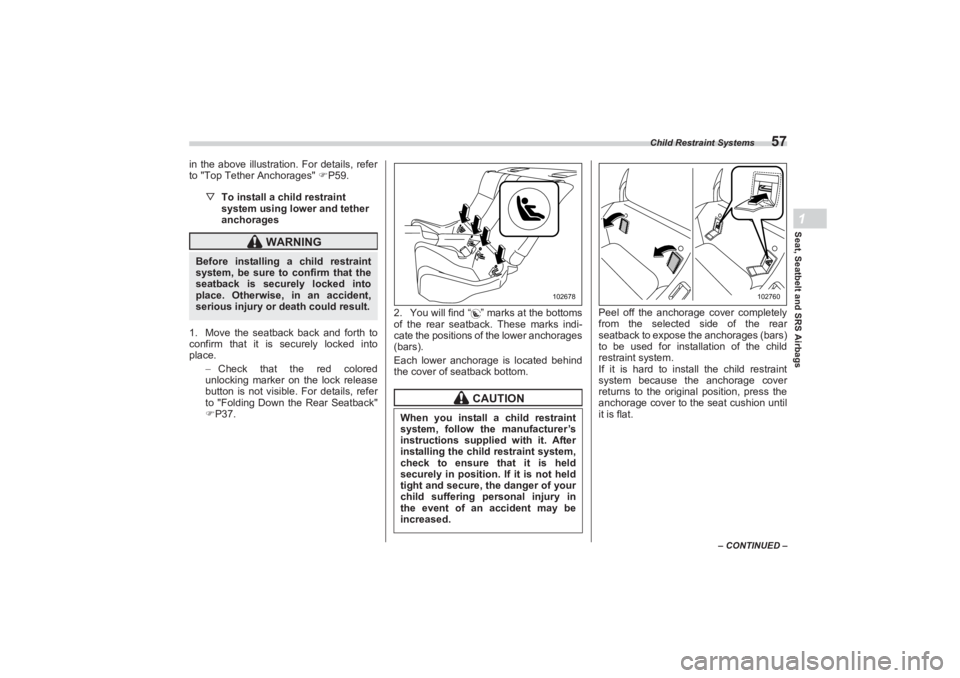
P37. 2. You will find “ ” marks at the bottoms
of the rear seatback. These marks indi-
cate the positions of the lower anchorages
(bars).
Each lower anchorage is located behind
the cover of seatback bottom. Peel off the anchorage cover completely
from the selected side of the rear
seatback to expose the anchorages (bars)
to be used for installation of the child
restraint system.
If it is hard to install the child restraint
system because the anchorage cover
returns to the original position, press the
anchorage cover to the seat cushion until
it is flat.
WARNING
Before installing a child restraint
system, be sure to confirm that the
seatback is securely locked into
place. Otherwise, in an accident,
serious injury or death could result.
CAUTION
When you install a child restraint
system, follow the manufacturer’s
instructions supplied with it. After
installing the child restraint system,
check to ensure that it is held
securely in position. If it is not held
tight and secure, the danger of your
child suffering personal injury in
the event of an accident may be
increased.
102678
102760
BRZ_U.book 57 ページ 2022年3月29日 火曜日 午後3時59分
Page 64 of 432
Child Restraint Systems
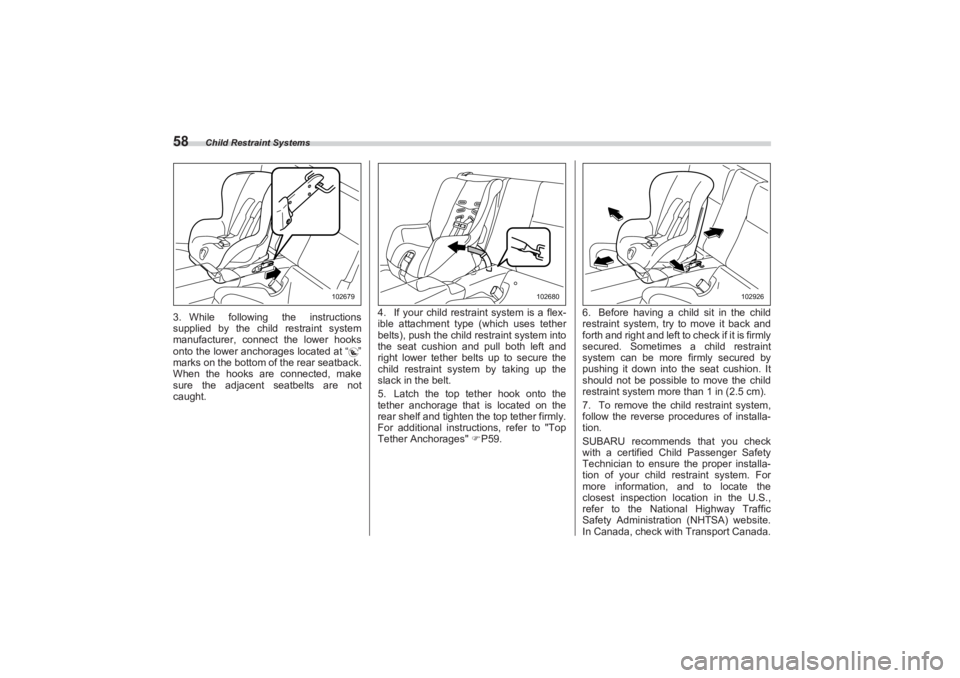
583. While following the instructions
supplied by the child restraint system
manufacturer, connect the lower hooks
onto the lower anchorages located at “ ”
marks on the bottom of the rear seatback.
When the hooks are connected, make
sure the adjacent seatbelts are not
caught. 4. If your child restraint system is a flex-
ible attachment type (which uses tether
belts), push the child restraint system into
the seat cushion and pull both left and
right lower tether belts up to secure the
child restraint system by taking up the
slack in the belt.
5. Latch the top tether hook onto the
tether anchorage that is located on the
rear shelf and tighten the top tether firmly.
For additional instructions, refer to "Top
Tether Anchorages" P59. 6. Before having a child sit in the child
restraint system, try to move it back and
forth and right and left to check if it is firmly
secured. Sometimes a child restraint
system can be more firmly secured by
pushing it down into the seat cushion. It
should not be possible to move the child
restraint system more than 1 in (2.5 cm).
7. To remove the child restraint system,
follow the reverse procedures of installa-
tion.
SUBARU recommends that you check
with a certified Child Passenger Safety
Technician to ensure the proper installa-
tion of your child restraint system. For
more information, and to locate the
closest inspection location in the U.S.,
refer to the National Highway Traffic
Safety Administration (NHTSA) website.
In Canada, check with Transport Canada.
102679
102680
102926
BRZ_U.book 58 ページ 2022年3月29日 火曜日 午後3時59分
Page 65 of 432
Child Restraint Systems
59
Seat, Seatbelt and SRS Airbags1
– CONTINUED –
■Top Tether AnchoragesYour vehicle is equipped with two top
tether anchorages so that a child restraint
system having a top tether can be
installed in the rear seat. When installing a
child restraint system using top tether,
proceed as follows, while observing the
instructions by the child restraint system
manufacturer.
Since a top tether can provide additional
stability by offering another connection
between a child restraint system and the
vehicle, we recommend that you use a top
tether whenever one is required or avail-
able. ▼
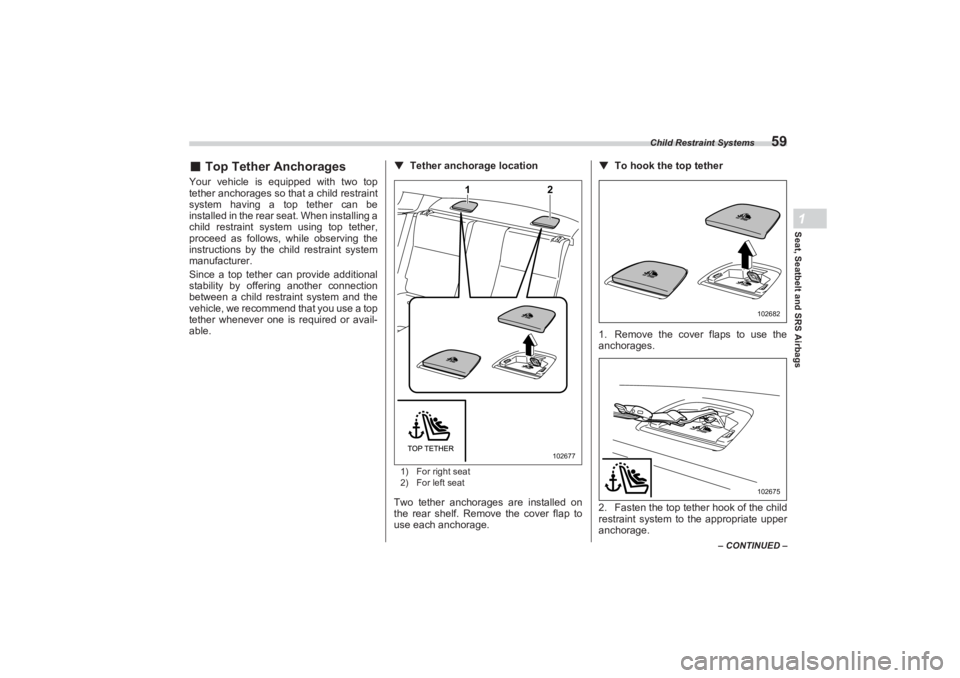
Tether anchorage location
1) For right seat
2) For left seatTwo tether anchorages are installed on
the rear shelf. Remove the cover flap to
use each anchorage. ▼
To hook the top tether
1. Remove the cover flaps to use the
anchorages.
2. Fasten the top tether hook of the child
restraint system to the appropriate upper
anchorage.
1
2102677
102682102675
BRZ_U.book 59 ページ 2022年3月29日 火曜日 午後3時59分
Page 66 of 432
SRS Airbag (Supplemental Restraint System Airbag)
603. Tighten the top tether securely.
SUBARU recommends that you check
with a certified Child Passenger Safety
Technician to ensure the proper installa-
tion of your child restraint system. For
more information, and to locate the
closest inspection location in the U.S.,
refer to the National Highway Traffic
Safety Administrati on (NHTSA) website.
In Canada, check with Transport Canada.
After removing a ch ild restraint system,
make sure to install the top tether cover to
its original position.
1-7. SRS Airbag (Supple -
mental Restraint System Airbag)Supplemental Restraint System (SRS)
name is used because the airbag system
supplements the vehi cle’s seatbelts.
This vehicle is equipped with a supple-
mental restraint system which consists of
seven airbags.
The configurations are as follows.
Driver’s and front passenger’s frontal
airbags
Driver’s and front passenger’s side
airbags
Curtain airbags (for driver, front
passenger and rear passengers)
Knee airbag for driver
These SRS airbags are designed only
to be a supplement to the primary
protection provided by the seatbelt.
The system also cont rols front seatbelt
pretensioners. For operation instructions
and precautions conc erning the seatbelt
pretensioner, refer to "Seatbelt Preten-
sioners" P44.
■ General Precautions
regarding SRS Airbag
System
WARNING
To obtain maximum protection in
the event of an accident, the
driver and all passengers must
always wear seatbelts when in
the vehicle. The SRS airbag is
designed only to be a supplement
to the primary protection
provided by the seatbelt. It does
not eliminate the need to fasten
seatbelts. In combination with the
seatbelts, it offers the best
protection in case of a serious
accident.
Not wearing a seatbelt increases
the chance of severe injury or
death in a crash even when the
vehicle has the SRS airbag.For instructions and precautions
concerning the seatbelt system,
refer to "Seatbelts" P39.
BRZ_U.book 60 ページ 2022年3月29日 火曜日 午後3時59分
Page 67 of 432
SRS Airbag (Supplemental Restraint System Airbag)
61
Seat, Seatbelt and SRS Airbags1
– CONTINUED –
The SRS side airbags and SRS
curtain airbags are designed only
to be a supplement to the primary
protection provided by the
seatbelt. They do not eliminate
the need to fasten seatbelts. It is
also important to wear a seatbelt
to help avoid injuries that can
result when an occupant is not
seated in a proper upright posi-
tion.
100155
WARNING
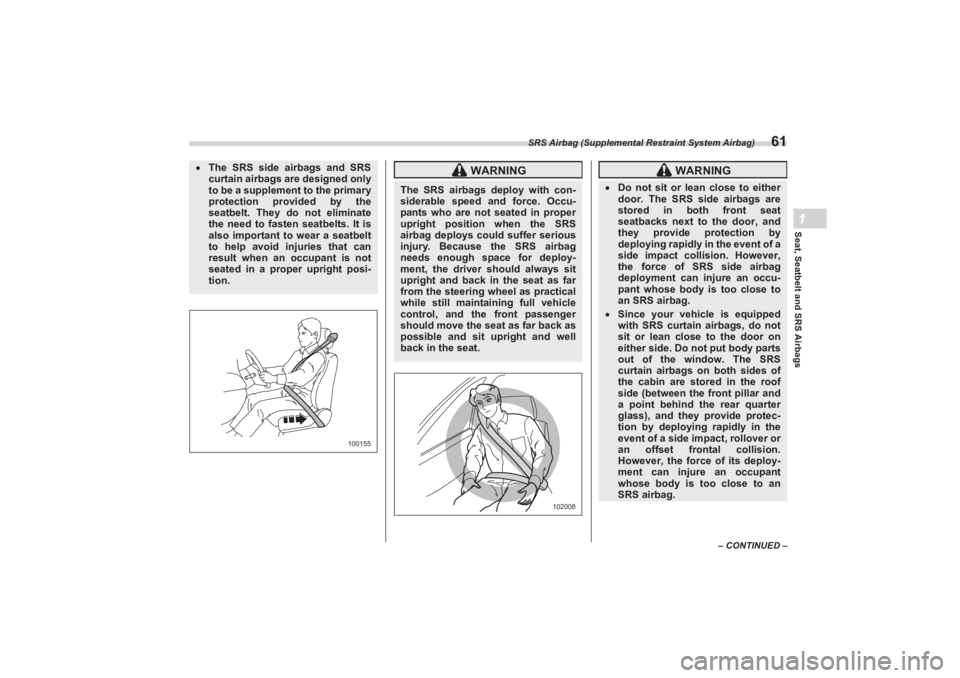
The SRS airbags deploy with con-
siderable speed and force. Occu-
pants who are not seated in proper
upright position when the SRS
airbag deploys could suffer serious
injury. Because the SRS airbag
needs enough space for deploy-
ment, the driver should always sit
upright and back in the seat as far
from the steering wheel as practical
while still maintaining full vehicle
control, and the front passenger
should move the seat as far back as
possible and sit upright and well
back in the seat.
102008
WARNING
Do not sit or lean close to either
door. The SRS side airbags are
stored in both front seat
seatbacks next to the door, and
they provide protection by
deploying rapidly in the event of a
side impact collision. However,
the force of SRS side airbag
deployment can injure an occu-
pant whose body is too close to
an SRS airbag. Since your vehicle is equipped
with SRS curtain airbags, do not
sit or lean close to the door on
either side. Do not put body parts
out of the window. The SRS
curtain airbags on both sides of
the cabin are stored in the roof
side (between the front pillar and
a point behind the rear quarter
glass), and they provide protec-
tion by deploying rapidly in the
event of a side impact, rollover or
an offset frontal collision.
However, the force of its deploy-
ment can injure an occupant
whose body is too close to an
SRS airbag.
BRZ_U.book 61 ページ 2022年3月29日 火曜日 午後3時59分