ignition SUBARU BRZ 2023 Repair Manual
[x] Cancel search | Manufacturer: SUBARU, Model Year: 2023, Model line: BRZ, Model: SUBARU BRZ 2023Pages: 432, PDF Size: 16.56 MB
Page 230 of 432
Fuel
224need to add any fuel system cleaning
agents to your fuel tank.
Many gasolines are now blended with
materials called oxygenates. Use of these
fuels can also help keep the air cleaner.
Oxygenated blend fuels, such as ethanol
(ethyl or grain alcohol) may be used in
your vehicle, but should contain no more
than 15% ethanol for the proper operation
of your SUBARU.
Do not use any gasoline that contains
more than 15% ethanol, including from
any pump labeled E30, E50 or E85 (which
are only some examples of fuel containing
more than 15% ethanol).
In addition, some gasoline suppliers are
now producing reformulated gasolines,
which are designed to reduce vehicle
emissions. SUBARU approves the use of
reformulated gasoline.
If you are not sure what the fuel contains,
you should ask your service station oper-
ators if their gasolines contain detergents
and oxygenates and if they have been
reformulated to reduce vehicle emissions.
As additional guidance, only use fuels
suited for your vehicle as explained in the
following description.
Fuel should be unleaded and have an
octane rating no lower than that specified
in this manual.
Methanol (methyl or wood alcohol) is
sometimes mixed with unleaded gasoline.
Methanol can be used in your vehicle
ONLY if it does not exceed 5% of the fuel
mixture AND if it is accompanied by suffi-
cient quantities of the proper cosolvent
and corrosion inhibitors required to
prevent damage to the fuel system. Do not
use fuel containing methanol EXCEPT
under these conditions.
If undesirable driveability problems are
experienced and you suspect they may be
fuel related, try a different brand of gaso-
line before seeking service at your
SUBARU dealer.
Fuel system damage or driveability
problems which result from the use of
improper fuel are not covered under the
SUBARU Limited Warranty.
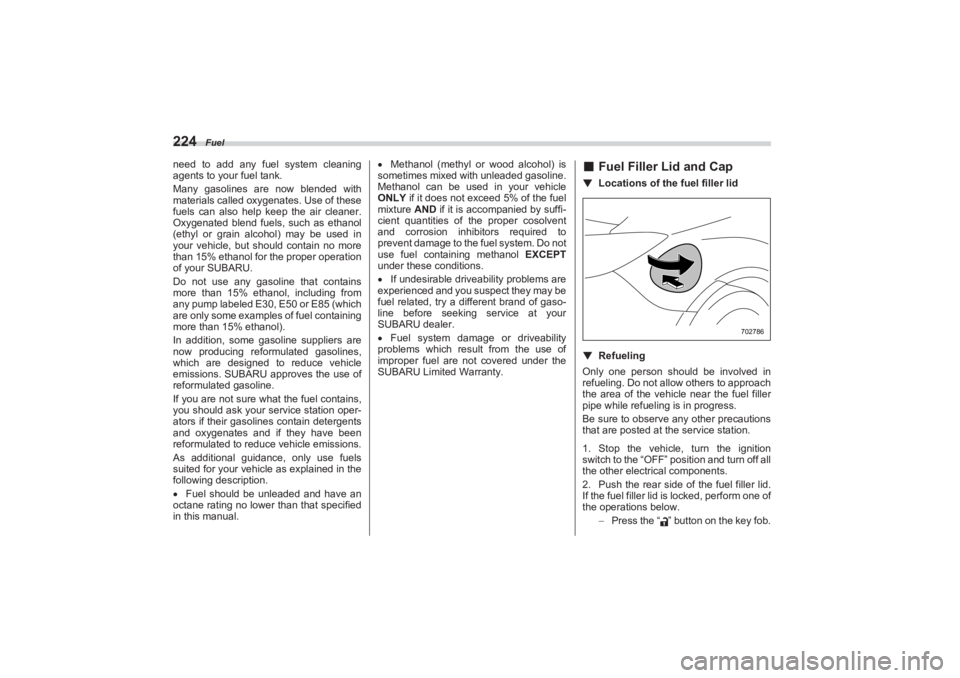
■ Fuel Filler Lid and Cap▼ Locations of the fuel filler lid▼RefuelingOnly one person should be involved in
refueling. Do not allow others to approach
the area of the vehicl e near the fuel filler
pipe while refueling is in progress.
Be sure to observe any other precautions
that are posted at the service station.
1. Stop the vehicle, turn the ignition
switch to the “OFF” position and turn off all
the other electrical components.
2. Push the rear side of the fuel filler lid.
If the fuel filler lid is locked, perform one of
the operations below.
Press the “ ” button on the key fob.
702786
BRZ_U.book 224 ページ 2022年3月29日 火曜日 午後3時59分
Page 231 of 432
Fuel
225
Starting and Operating7
– CONTINUED –
Press the unlock side of the power
door locking switch.
3. The fuel filler lid opens automatically.
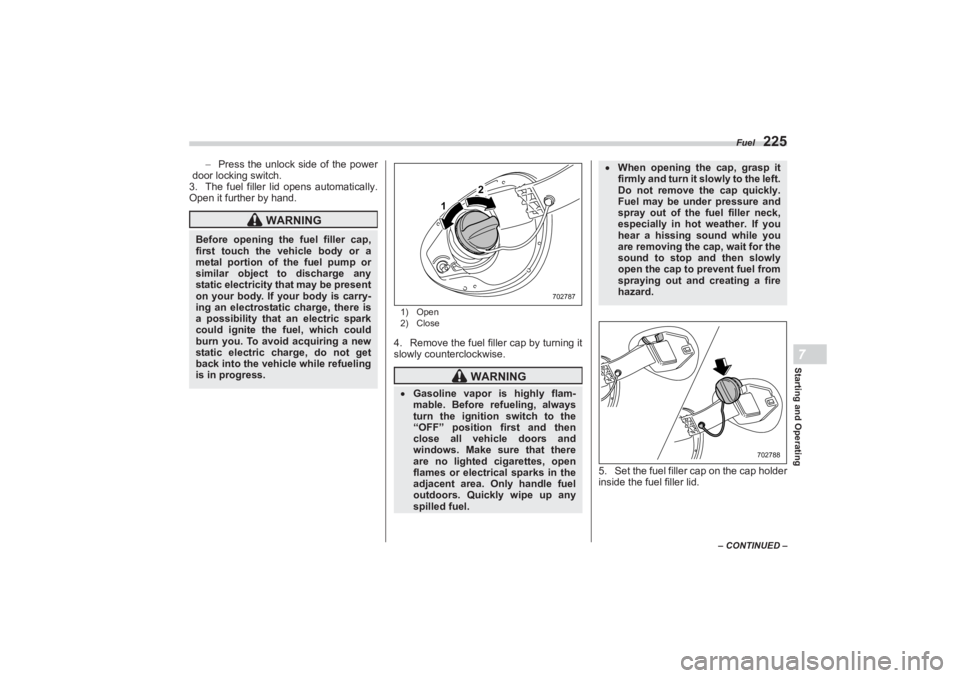
Open it further by hand.
1) Open
2) Close4. Remove the fuel filler cap by turning it
slowly counterclockwise.
5. Set the fuel filler cap on the cap holder
inside the fuel filler lid.
WARNING
Before opening the fuel filler cap,
first touch the veh icle body or a
metal portion of the fuel pump or
similar object to discharge any
static electricity that may be present
on your body. If your body is carry-
ing an electrostatic charge, there is
a possibility that an electric spark
could ignite the fuel, which could
burn you. To avoid acquiring a new
static electric charge, do not get
back into the vehicle while refueling
is in progress.
WARNING
Gasoline vapor is highly flam-
mable. Before refueling, always
turn the ignition switch to the
“OFF” position first and then
close all vehicle doors and
windows. Make sure that there
are no lighted cigarettes, open
flames or electrical sparks in the
adjacent area. Only handle fuel
outdoors. Quickly wipe up any
spilled fuel.
1
2
702787
When opening the cap, grasp it
firmly and turn it slowly to the left.
Do not remove the cap quickly.
Fuel may be under pressure and
spray out of the fuel filler neck,
especially in hot weather. If you
hear a hissing sound while you
are removing the cap, wait for the
sound to stop and then slowly
open the cap to prevent fuel from
spraying out and creating a fire
hazard.
702788
BRZ_U.book 225 ページ 2022年3月29日 火曜日 午後3時59分
Page 234 of 432
Preparing to Drive
228have implemented emission inspection of
the OBDII system.
The inspection of the OBDII system
consists of a visual operational check of
the “ CHECK ENGINE ” warning light/
malfunction indicator light (MIL) and an
examination of the OBDII system with an
electronic scan tool.
A vehicle passes
the OBDII system
inspection if proper operation of the
“ CHECK ENGINE ” warning light is
observed, there are no stored diagnostic
trouble codes, and the OBDII readiness
monitors are all complete.
A vehicle fails
the OBDII inspection if
the “ CHECK ENGINE ” warning light is not
properly operating (light is illuminated or is
not working due to a burned out bulb) or
there is one or more diagnostic trouble
codes stored in the vehicle’s computer.
A state emission in spection may reject
(not pass or fail) a vehicle if the number of
OBDII system readiness monitors “ NOT
READY ” is greater than one. If the
vehicle’s battery has been recently
replaced or disconnected, the OBDII
system inspection may indicate that the
vehicle is not ready for the emission test.
Under this condition, the vehicle driver
should be instructed to drive his/her
vehicle for a few days to reset the readi-
ness monitors and return for an emission
re-inspection.
Owners of rejected or failing vehicles
should contact their SUBARU Dealer for
service.
7-3. Preparing to DriveYou should perform the following checks
and adjustments every day before you
start driving.
1. Check that all windows, mirrors, and
lights are clean and unobstructed.
2. Check the appearance and condition
of the tires. Also check tires for proper
inflation.
3. Look under the vehicle for any sign of
leaks.
4. Check that no small animals enter the
engine compartment.
5. Check that the hood and trunk are fully
closed.
6. Check the adjustment of the seat.
7. Check the adjustment of the inside
and outside mirrors.
8. Fasten your seatbelt. Check that your
passengers have fastened their seatbelts.
9. Check the operation of the warning
and indicator lights when the ignition
switch is turned to the “ON” position.
10. Check the gauges, indicator and
warning lights after starting the engine.
BRZ_U.book 228 ページ 2022年3月29日 火曜日 午後3時59分
Page 235 of 432
Starting and Stopping Engine
229
Starting and Operating7
– CONTINUED –
NOTEEngine oil, engine coolant, brake fluid,
washer fluid and other fluid levels
should be checked daily, weekly or at
fuel stops.
7-4. Starting and Stopping Engine■Safety PrecautionsRefer to "Safety Precautions" P94.■Operating Range for Push-
Button Start SystemRefer to "Operating Range for Push-
Button Start System" P125.■ General Precautions When
Starting Engine
NOTEIt may be difficult to start the engine
when the battery has been discon-
nected and reconnected (for mainte-
nance or other purposes). This
difficulty is caused by the electroni-
cally controlled throttle’s self-diag-
nosis function. To overcome it, keep
the ignition switch in the “ON” position
for approximately 10 seconds before
starting the engine.
Avoid rapid racing and rapid accel-
eration immediately after the engine
has started.
After the engine starts, the engine
speed will be kept high.
CAUTION
Small animals trapped in the cool-
ing fan and belt of the engine may
result in a malfunction. Check that
no small animal enters the engine
compartment and under the vehicle
before starting the engine.
WARNING
Never start the engine from
outside the vehicle. It may result
in an accident. Do not leave the engine running
in locations with poor ventilation,
such as a garage and indoors.
The exhaust gas may enter the
vehicle or indoors, and it may
result in carbon monoxide
poisoning.
Do not start the engine near dry
foliage, paper, or other flammable
substances. The exhaust pipe
and exhaust emissions can
create a fire hazard at high
temperatures.
CAUTION
If the engine is stopped during
driving, the catalyst may overheat
and burn. When starting the engine, be sure
to sit in the driver’s seat.
BRZ_U.book 229 ページ 2022年3月29日 火曜日 午後3時59分
Page 236 of 432
Starting and Stopping Engine
230On rare occasions, it may be difficult
to start the engine depending on the
fuel and the usage condition (repeated
driving of a distance in which the
engine has not warmed up suffi-
ciently). In such a case, it is recom-
mended that you change to a different
brand of fuel.
On rare occasions, transient
knocking may be heard from the
engine when the accelerator is oper-
ated rapidly such as a rapid start-up
and a rapid acceleration. This is not a
malfunction.
The engine starts more easily when
the headlights, air conditioner and rear
window defogger are turned off.■ Starting Engine
NOTEWhen pressing the push-button
ignition switch while depressing the
clutch pedal (MT models) or the brake
pedal (AT models): - The engine starter operates for a
maximum of 10 seconds and after
starting the engine, the starter stops
automatically.
- The engine can be started
regardless of the power status.
If the engine does not start, check
the security indicator light. Then press
the push-button ignition switch
without depressing the clutch pedal
(MT models) or the brake pedal (AT
models) to switch the power to “OFF”. - If the light had illuminated, try to
start the engine again.
- If the light had been off, press the
push-button ignition switch while
depressing the clutch pedal (MT
models) or the brake pedal (AT
models) more forcefully.
The engine start procedures may
not function depending on the radio
wave conditions around the vehicle. In
such a case, refer to "Starting Engine"
P326.
If the vehicle battery is discharged,
the steering cannot be unlocked.
Charge the battery.
WARNING
There are some general precau-
tions when starting the engine.
Carefully read the precautions
described in "General Precau-
tions When Starting Engine"
P229. If the steering lock cannot be
released after the engine has
started, never drive the vehicle.
The steering is still locked, and it
may result in an accident.
CAUTION
If a system malfunction warning
message is displayed on the
combination meter, there may be
a malfunction with the vehicle.
Contact a SUBARU dealer imme-
diately. If a steering lock warning
message is displayed on the
combination me ter after the
engine has started, it means that
the steering is still locked. While
moving the steering wheel right
and left, depress the brake pedal,
and press the push-button igni-
tion switch. Do not continue pressing the
push-button ignition switch for
more than 10 seconds. Doing so
could cause a malfunction. If the
engine does not start, stop
pressing the push -button ignition
switch. Instead, press the push-
button ignition switch without
depressing the clutch pedal (MT
models) or the brake pedal (AT
models) to switch the power
status to “OFF”. Wait 10 seconds,
and then press the push-button
ignition switch to start the
engine.
BRZ_U.book 230 ページ 2022年3月29日 火曜日 午後3時59分
Page 237 of 432
Starting and Stopping Engine
231
Starting and Operating7
– CONTINUED –
After the engine starts, the engine
speed will be kept high.
Do not shift the select lever (AT
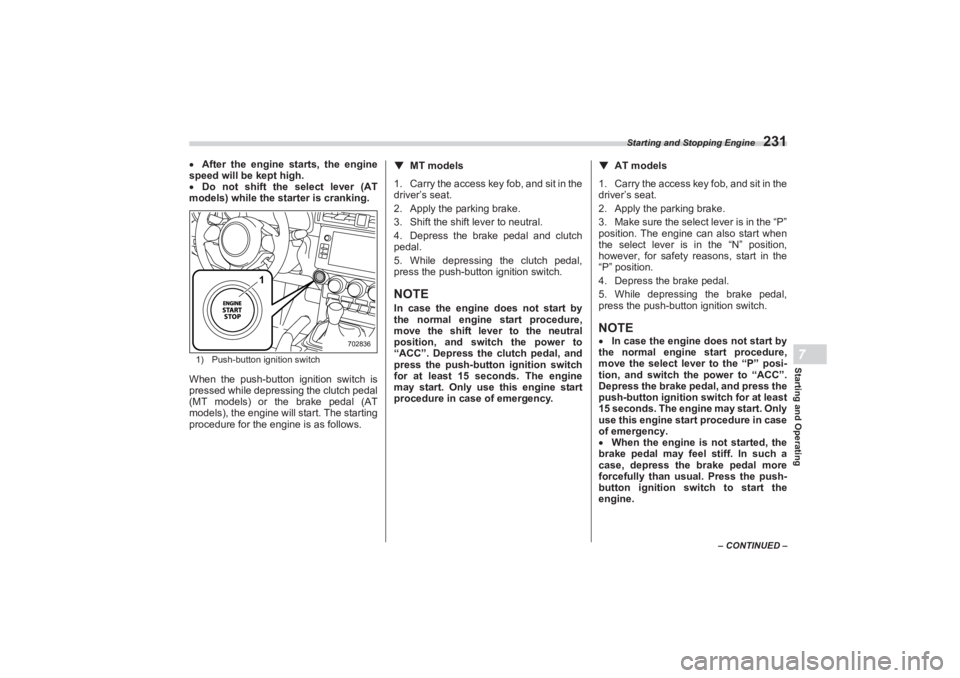
models) while the starter is cranking.1) Push-button ignition switchWhen the push-button ignition switch is
pressed while depressing the clutch pedal
(MT models) or the brake pedal (AT
models), the engine will start. The starting
procedure for the engine is as follows.
▼ MT models
1. Carry the access key fob, and sit in the
driver’s seat.
2. Apply the parking brake.
3. Shift the shift lever to neutral.
4. Depress the brake pedal and clutch
pedal.
5. While depressing the clutch pedal,
press the push-button ignition switch.NOTEIn case the engine does not start by
the normal engine start procedure,
move the shift lever to the neutral
position, and switch the power to
“ACC”. Depress the clutch pedal, and
press the push-butto n ignition switch
for at least 15 seconds. The engine
may start. Only use this engine start
procedure in case of emergency. ▼
AT models
1. Carry the access key fob, and sit in the
driver’s seat.
2. Apply the parking brake.
3. Make sure the select lever is in the “P”
position. The engine can also start when
the select lever is in the “N” position,
however, for safety reasons, start in the
“P” position.
4. Depress the brake pedal.
5. While depressing the brake pedal,
press the push-button ignition switch.NOTE In case the engine does not start by
the normal engine start procedure,
move the select lever to the “P” posi-
tion, and switch th e power to “ACC”.
Depress the brake pedal, and press the
push-button ignition switch for at least
15 seconds. The engine may start. Only
use this engine start procedure in case
of emergency.
When the engine is not started, the
brake pedal may feel stiff. In such a
case, depress the brake pedal more
forcefully than usual. Press the push-
button ignition switch to start the
engine.
1
702836
BRZ_U.book 231 ページ 2022年3月29日 火曜日 午後3時59分
Page 238 of 432
Starting and Stopping Engine
232■Stopping Engine1. Stop the vehicle completely.
2. Move the shift lever to neutral (MT
models) or select leve r to the “P” position
(AT models).
3. Press the push-button ignition switch.
The engine will stop, and the power will be
switched off.
NOTEAlthough you can stop the engine by
operating the push -button ignition
switch, do not stop the engine during
driving except in an emergency.■ When Access Key Fob Does
Not Operate ProperlyRefer to "Access Key Fob – If Access Key
Fob Does Not Operate Properly" P325.■ Steering LockAfter stopping the engine and any door is
opened, the steering wheel will be locked
due to the steering lock function.
When the engine is restarted, the steering
lock will be automatically released.
WARNING
Do not touch the push-button
ignition switch during driving.
When the push-button ignition
switch is operated as follows, the
engine will stop.–The switch is pressed and held
for 2 seconds or longer.–The switch is pressed briefly 3
times or more in succession.When the engine stops, the brake
booster will not function. A
greater foot pressure will be
required on the brake pedal.The power steering system will
not operate either. A greater
force will be required to steer,
and it may result in an accident.
If the engine stops during driving,
do not operate the push-button
ignition switch or open any of the
doors until the vehicle is stopped
in a safe location. It is dangerous
because the steering lock may be
activated. Stop the vehicle in a
safe place, and contact a
SUBARU dealer immediately.
CAUTION
For AT models:Do not stop the engine while the
select lever is in a position other
than the “P” position. If the engine is stopped while the
select lever is in a position other
than the “P” position, the power
will be in “ACC”. If the vehicle is
left in this cond ition, the battery
may be discharged.
BRZ_U.book 232 ページ 2022年3月29日 火曜日 午後3時59分
Page 239 of 432
Manual Transmission
233
Starting and Operating7
– CONTINUED –
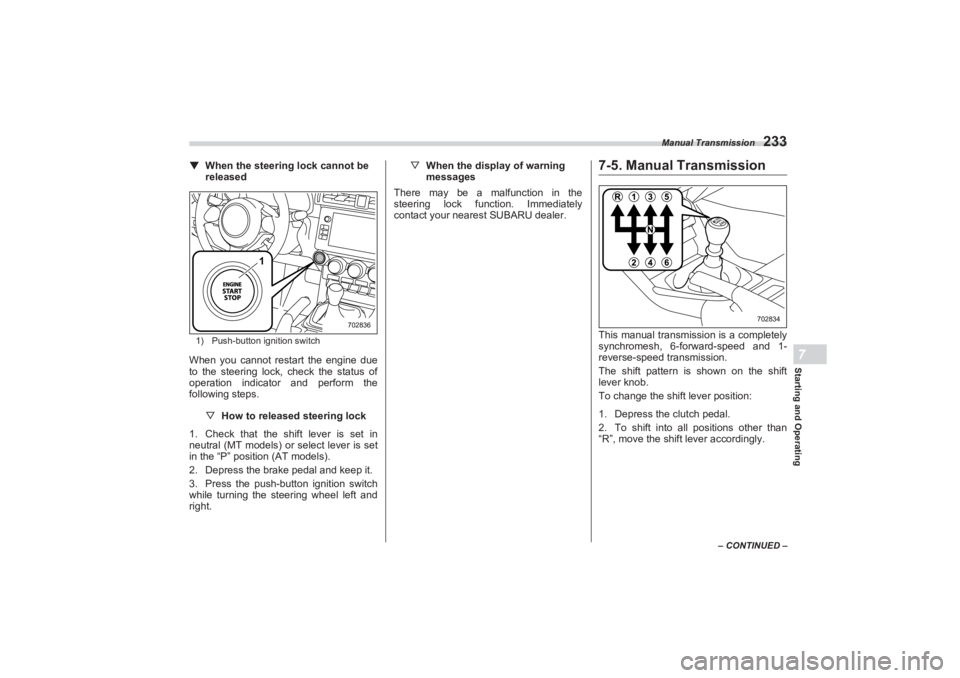
▼When the steering lock cannot be
released1) Push-button ignition switchWhen you cannot restart the engine due
to the steering lock, check the status of
operation indicator and perform the
following steps.
▽How to released steering lock
1. Check that the shift lever is set in
neutral (MT models) or select lever is set
in the “P” position (AT models).
2. Depress the brake pedal and keep it.
3. Press the push-button ignition switch
while turning the steering wheel left and
right. ▽
When the display of warning
messages
There may be a malfunction in the
steering lock function. Immediately
contact your nearest SUBARU dealer.
7-5. Manual TransmissionThis manual transmission is a completely
synchromesh, 6-forward-speed and 1-
reverse-speed transmission.
The shift pattern is shown on the shift
lever knob.
To change the shift lever position:
1. Depress the clutch pedal.
2. To shift into all positions other than
“R”, move the shi ft lever accordingly.
1
702836
702834
BRZ_U.book 233 ページ 2022年3月29日 火曜日 午後3時59分
Page 242 of 432
Automatic Transmission
236NOTEWhen the engine coolant tempera-
ture is still low, the transmission will
shift at higher engine speeds than
when the coolant temperature is suffi-
ciently high in order to shorten the
warm-up time and improve driveability.
The gearshift timing will automatically shift to the normal
timing after the
engine has warmed up.
Immediately after transmission fluid
is replaced, you may feel that the trans-
mission operation is somewhat
unusual. This results from invalidation
of data which the on-board computer
has collected and stored in memory to
allow the transmission to shift at the
most appropriate times for the current
condition of your vehicle. Optimized
shifting will be restored as the vehicle
continues to be driven for a while.
Place the shift boot to the original
position after it is lifted. If the shift lever
is operated with the shift boot in the
rolled up position, the shift boot may
have tension and it may disturb the
shift lever operation.
When the vehicle is idling at high
rpm in order to warm up, and the
vehicle is on a slippery road, the trans-
mission may automatically shift to 2nd
gear for stopping and starting off.
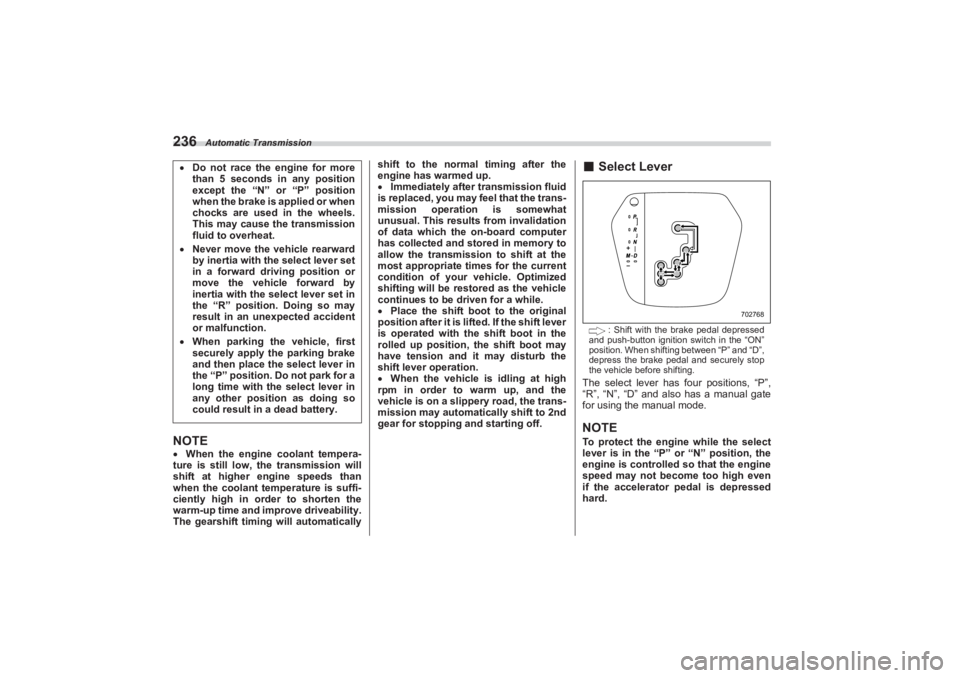
■ Select Lever
: Shift with the brake pedal depressed
and push-button ignition switch in the “ON”
position. When shifting between “P” and “D”,
depress the brake pedal and securely stop
the vehicle before shifting.
The select lever has four positions, “P”,
“R”, “N”, “D” and also has a manual gate
for using the manual mode.NOTETo protect the engine while the select
lever is in the “P” or “N” position, the
engine is controlled so that the engine
speed may not become too high even
if the accelerator pedal is depressed
hard.
Do not race the engine for more
than 5 seconds in any position
except the “N” or “P” position
when the brake is applied or when
chocks are used in the wheels.
This may cause the transmission
fluid to overheat. Never move the vehicle rearward
by inertia with the select lever set
in a forward driving position or
move the vehicle forward by
inertia with the select lever set in
the “R” position. Doing so may
result in an unexpected accident
or malfunction. When parking the vehicle, first
securely apply the parking brake
and then place the select lever in
the “P” position. Do not park for a
long time with the select lever in
any other position as doing so
could result in a dead battery.
702768
BRZ_U.book 236 ページ 2022年3月29日 火曜日 午後3時59分
Page 244 of 432
Automatic Transmission
238When driving uphill, prevents unneces-
sary upshifting and downshifting.
When driving downhill, downshifting is
performed at engine speeds higher than
usual.
When driving on curves, prevents
upshifting even when accelerating.
When the brake pedal is depressed
firmly, downshifting is automatically
performed, fully utilizing engine braking.
When the accelerator pedal is
suddenly released, prevents upshifting.NOTEAdaptive control operates automati-
cally when the select lever is in the “D”
position. The function is canceled
when the paddle shift levers are oper-
ated or the select lever is shifted to the
“M” position.■ Shift Lock FunctionThe shift lock function helps prevent the
improper operation of the select lever.
The select lever cannot be operated
unless the ignition switch is turned to the
“ON” position and the brake pedal is
depressed.
The select lever cannot be moved from
the “P” position to any other position
before the brake pedal is depressed. Depress the brake pedal first, and then
operate the select lever.
Only the “P” position allows you to turn
the push-button ignition switch to the
“OFF” position.
▼ Shift lock release
If the select lever cannot be operated, turn
the ignition switch back to the “ON” posi-
tion then move the select lever to the “P”
position with the brake pedal depressed.
If the select lever does not move after
performing the above procedure, refer to
"Shift lock release using the shift lock
release portion" P238. ▼
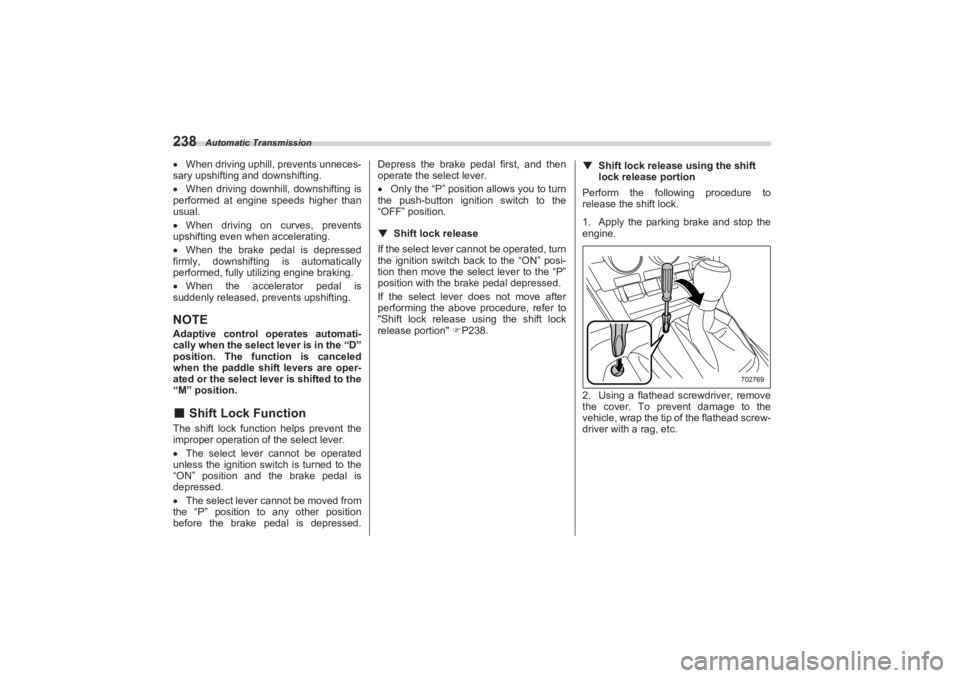
Shift lock release using the shift
lock release portion
Perform the following procedure to
release the shift lock.
1. Apply the parking brake and stop the
engine.
2. Using a flathead screwdriver, remove
the cover. To prevent damage to the
vehicle, wrap the tip of the flathead screw-
driver with a rag, etc.
702769
BRZ_U.book 238 ページ 2022年3月29日 火曜日 午後3時59分