Tire change SUBARU BRZ 2023 Owners Manual
[x] Cancel search | Manufacturer: SUBARU, Model Year: 2023, Model line: BRZ, Model: SUBARU BRZ 2023Pages: 432, PDF Size: 16.56 MB
Page 10 of 432
How to Use This Owner’s Manual
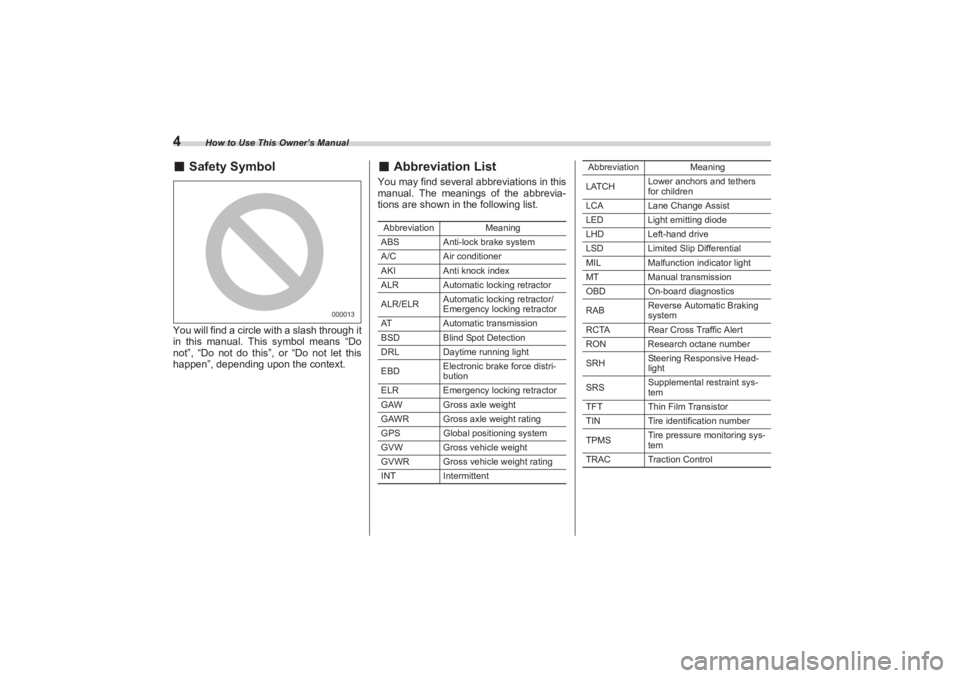
4■Safety SymbolYou will find a circle with a slash through it
in this manual. This symbol means “Do
not”, “Do not do this”, or “Do not let this
happen”, depending upon the context.
■ Abbreviation ListYou may find several abbreviations in this
manual. The meanings of the abbrevia-
tions are shown in the following list.
000013
Abbreviation Meaning
ABS Anti-lock brake system
A/C Air conditioner
AKI Anti knock index
ALR Automatic locking retractor
ALR/ELR Automatic locking retractor/
Emergency locking retractor
AT Automatic transmission
BSD Blind Spot Detection
DRL Daytime running light
EBD Electronic brake
force distri-
bution
ELR Emergency locking retractor
GAW Gross axle weight
GAWR Gross axle weight rating
GPS Global positioning system
GVW Gross vehicle weight
GVWR Gross vehicl e weight rating
INT Intermittent
LATCHLower anchors and tethers
for children
LCA Lane Change Assist
LED Light emitting diode
LHD Left-hand drive
LSD Limited Slip Differential
MIL Malfunction indicator light
MT Manual transmission
OBD On-board diagnostics
RAB Reverse Automatic Braking
system
RCTA Rear Cross Traffic Alert
RON Research octane number
SRH Steering Responsive Head-
light
SRS Supplemental restraint sys-
tem
TFT Thin Film Transistor
TIN Tire identification number
TPMS Tire pressure monitoring sys-
tem
TRAC Traction Control Abbreviation
Meaning
BRZ_U.book 4 ページ 2022年3月29日 火曜日 午後3時59分
Page 50 of 432
Seatbelt Pretensioners
44Inspect the seatbelts and attachments
including the webbing and all hardware
periodically for cracks, cuts, gashes,
tears, damage, loose bolts or worn areas.
Replace the seatbelts even if only minor
damage is found.
1-5. Seatbelt PretensionersThe following seatbelts have a seatbelt
pretensioner.
Driver’s seatbelt
Front passenger’s seatbelt
The seatbelt preten sioners are designed
to be activated in the event of an accident
involving a moderate to severe frontal and
side collision and rollover accident.
NOTE Seatbelt pretensioners are not
designed to activate in minor impacts
or in rear impacts.
Pretensioners are designed to func-
tion on a one-time-o nly basis. In the
event that a pretensioner is activated,
both the driver’s and front passenger’s
seatbelt retractor assemblies should
be replaced only by an authorized
SUBARU dealer. When replacing
seatbelt retractor assemblies, use only
genuine SUBARU parts.
If a seatbelt that has a seatbelt
pretensioner does not retract or cannot
be pulled out due to a malfunction or
activation of the pretensioner, contact
your SUBARU dealer as soon as
possible.
If the seatbelt retractor assembly or
surrounding area has been damaged,
contact your SUBARU dealer as soon
as possible.
CAUTION
Keep the belts free of polishes,
oils, chemicals and particularly
battery acid. Never attempt to make modifica-
tions or changes that will prevent
the seatbelt from operating prop-
erly.
WARNING
To obtain maximum protection,
the occupants should sit in an
upright position with their
seatbelts properly fastened.
Refer to "Seatbelts" P39. Do not modify, remove or strike
the seatbelt retractor assemblies
equipped with seatbelt
pretensioners or surrounding
area. This could result in acci-
dental activation of the seatbelt
pretensioners or could make the
system inoperative, possibly
resulting in serious injury. Seat-
belt pretensioners have no user-
serviceable parts. For required
servicing of seatbelt retractors
equipped with seatbelt
pretensioners, consult your
SUBARU dealer.
When discarding seatbelt
retractor assemblies equipped
with seatbelt pretensioners or
scrapping the entire vehicle due
to collision damage or for other
reasons, consult your SUBARU
dealer.
BRZ_U.book 44 ページ 2022年3月29日 火曜日 午後3時59分
Page 137 of 432
Warning and Indicator Lights
131
Instruments and Controls3
– CONTINUED –
NOTEWhen the control dial is turned fully
upward, the illumination brightness
becomes the maximum and the auto-
matic dimming function does not work
at all.
The brightness setting is not
canceled even when the ignition switch
is turned to th e “OFF” position.■Auto Dimmer Cancel Func -
tionWhen the ambient light is bright, the illumi-
nation brightness is set to the maximum
regardless of the position of the control
dial. In this case, you cannot adjust the
illumination brightness by using the
control dial. When the ambient light is
dark, you can dim the illumination bright-
ness as described above.
The operational/non-operational setting
and sensitivity of the auto dimmer cancel
function can be changed by your
SUBARU dealer. Contact your SUBARU
dealer for details.
3-6. Warning and Indicator LightsSeveral of the warning and indicator lights
illuminate momentarily and then go out
when the ignition switch is initially turned
to the “ON” position. This permits
checking the operation of the bulbs.
Apply the parking brake and turn the igni-
tion switch to the “ON” position. For the
system check, the following lights illumi-
nate and turn off after several seconds or
after the engine has started:
: Seatbelt warning light (The seatbelt
warning light turns off only when the
driver fastens the seatbelt.)
: Front passenger’s seatbelt warning
light (The seatbelt warning light turns
off only when the front seat passenger
fastens the seatbelt.)
: Rear passenger’s seatbelt warning
light (The seatbelt warning light turns
off only when the rear seat
passenger fastens the seatbelt.)
: SRS airbag system warning light
: Front passenger’s frontal airbag ON
indicator light
: Front passenger’s frontal airbag OFF
indicator light
/ : CHECK ENGINE warning light/ Malfunction indicator light : Coolant temperature high warning
light (red)
: Charge warning light : Oil pressure warning light
/ :ABS warning light
: Vehicle Stability Control (VSC)
warning light/Vehicle Stability
Control (VSC) operation indicator
light
: Vehicle Stability Control (VSC) OFF
indicator light
: TRAC OFF indicator light / :Brake system warning light (red)
:Power steering warning light
: Low tire pressure warning light (if
equipped)
: Low fuel warning light :Master warning light
If any lights fail to i lluminate, it indicates a
burned-out bulb or a malfunction of the
corresponding system.
Consult your authorized SUBARU dealer
for repair.
■ Seatbelt Warning Light
and ChimeYour vehicle is equipped with a seatbelt
warning device at the driver’s and
passenger’s seats, as required by current
safety standards.
BRZ_U.book 131 ページ 2022年3月29日 火曜日 午後3時59分
Page 145 of 432
Warning and Indicator Lights
139
Instruments and Controls3
– CONTINUED –
If this light illuminates while driving,
never brake suddenly. Instead, per-
form the following procedure. Oth-
erwise an accident involving
serious vehicle damage and serious
personal injury could occur.1) Keep driving straight ahead while
gradually reducing speed.2) Slowly pull off the road to a safe
place.If this light still illuminates while
driving after adjusting the tire pres-
sure, a tire may have significant
damage and a fast leak that causes
the tire to lose air rapidly. If you
have a flat tire, replace it with a
spare tire as soon as possible.
When a spare tire is mounted or a
wheel rim is replaced without the
original pressure sensor/transmitter
being transferred, the Low tire pres-
sure warning light will illuminate
steadily after blinking for approxi-
mately one minute. This indicates
the TPMS is unable to monitor all
four road wheels. Contact your
SUBARU dealer as soon as possi-
ble for tire and sensor replacement
and/or system resetting. If the light
illuminates steadily after blinking
for approximately one minute,
promptly contact a SUBARU dealer
to have the system inspected.
CAUTION
The tire pressure monitoring sys-
tem is NOT a substitute for manu-
ally checking tire pressure. The tire
pressure should be checked period-
ically (at least monthly) using a tire
gauge. After any change to tire
pressure(s), the tire pressure moni-
toring system will not re-check tire
inflation pressures until the vehicle
is first driven mo re than 25 mph (40
km/h). After adjusting the tire pres-
sures, increase the vehicle speed to
at least 25 mph (40 km/h) to start the
TPMS re-checking of the tire infla-
tion pressures. If the tire pressures
are now above the severe low pres-
sure threshold, the low tire pres-
sure warning light should turn off a
few minutes later. Therefore, be
sure to install the specified size for
the front and rear tires.
BRZ_U.book 139 ページ 2022年3月29日 火曜日 午後3時59分
Page 160 of 432
Combination Meter Display (Color TFT)
154Pressing and holding will reset the
average vehicle speed/driving time/
driving distance.▼ Drive information (page 4) (if
equipped)
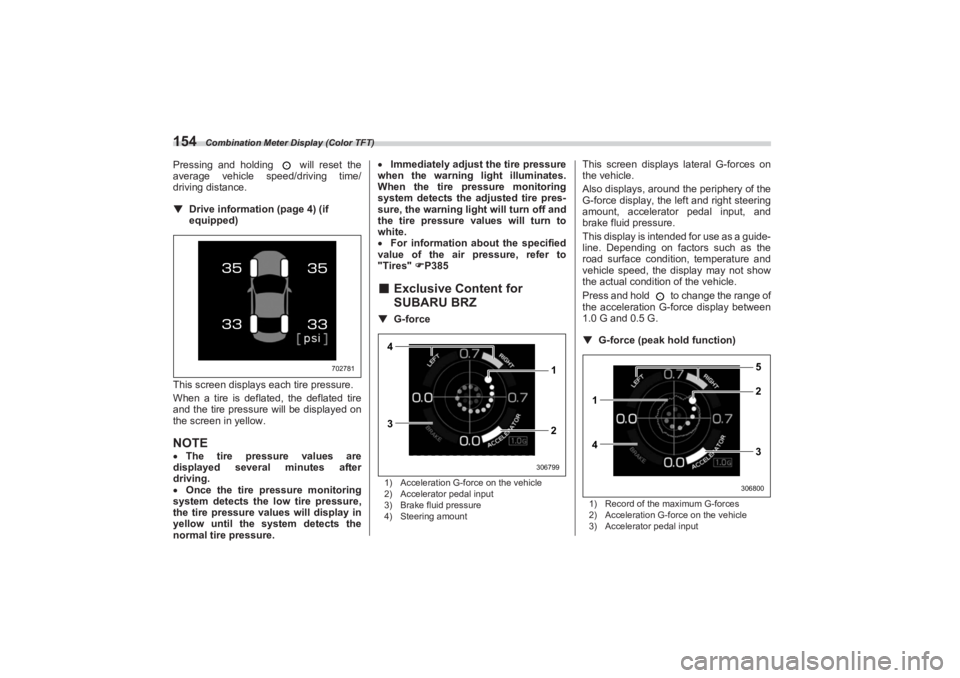
This screen displays each tire pressure.
When a tire is deflated, the deflated tire
and the tire pressure will be displayed on
the screen in yellow.NOTE The tire pressure values are
displayed several minutes after
driving.
Once the tire pressure monitoring
system detects the low tire pressure,
the tire pressure values will display in
yellow until the system detects the
normal tire pressure.
Immediately adjust the tire pressure
when the warning light illuminates.
When the tire pr essure monitoring
system detects the adjusted tire pres-
sure, the warning ligh t will turn off and
the tire pressure values will turn to
white.
For information about the specified
value of the air pressure, refer to
"Tires" P385
■ Exclusive Content for
SUBARU BRZ▼ G-force1) Acceleration G-force on the vehicle
2) Accelerator pedal input
3) Brake fluid pressure
4) Steering amount
This screen displays lateral G-forces on
the vehicle.
Also displays, around the periphery of the
G-force display, the left and right steering
amount, accelerator pedal input, and
brake fluid pressure.
This display is intended for use as a guide-
line. Depending on factors such as the
road surface conditi on, temperature and
vehicle speed, the display may not show
the actual condition of the vehicle.
Press and hold to change the range of
the acceleration G-force display between
1.0 G and 0.5 G.
▼ G-force (peak ho ld function)1) Record of the maximum G-forces
2) Acceleration G-force on the vehicle
3) Accelerator pedal input
702781
4
3 1
2
306799
1
42 5
3
306800
BRZ_U.book 154 ページ 2022年3月29日 火曜日 午後3時59分
Page 185 of 432
Light Control Switch
179
Instruments and Controls3
– CONTINUED –
- In bad weather (fog, snow, sand
storm, heavy rain, etc.).
- When the windshield glass is dirty or
fogged.
- When the windshield is cracked or
damaged.
- If there are lights similar to the head-
lights or the tail lights in the surrounding
area.
- When an oncoming vehicle or
vehicle ahead is driven without its
headlights and tail lights on.
- If the headlights of an oncoming
vehicle or the tail lights of a vehicle
ahead are dirty or discolored, or if the
light beams are not aimed correctly.
- When a rapid change of brightness
continues while driving.
- When driving on a road with many
ups and downs or uneven surfaces.
- When driving on a road with many
curves.
- When there are some objects that
reflect light strongly, such as a road
sign or a mirror in vehicle ahead.
- When the rear part of the vehicle
ahead, such as a container, reflects
light strongly.
- When the headlights of your vehicle
are damaged or dirty.
- When your vehicle is tilted, such as
in case the vehicle has a flat tire or is
being towed. - When the stereo camera is
deformed or the stereo camera lenses
are dirty.
- Immediately after the engine has
started.
In the following conditions, the head-
light mode will not be automatically
changed from the high beam to the low
beam.
- When your vehicle passes an
oncoming vehicle suddenly in a blind
curve.
- When another vehicle passes in
front of your vehicle.
- When an oncoming vehicle or
vehicle ahead comes in and out of view
because of continuous curves, median
strips, roadside trees, etc.
If the stereo camera detects the light of
the front fog lights of an oncoming vehicle,
the headlight mode may change from the
high beam to the low beam automatically.
The headlight mode may change from
the high beam to the low beam, or the low
beam mode may continue, when affected
by a street light, traffic signal, illumination
of an advertisement board, or a reflective
object such as a road sign and signboard.
The timing of the change of headlight
mode may differ due to the following
factors. - Color or brightness of the headlights
of an oncoming vehicle or the tail lights
of a vehicle ahead.
- The headlights of the oncoming
vehicle or the tail lights of the vehicle
ahead are covered with mud, snow,
etc.
- Movement and direction of an
oncoming vehicle or a vehicle ahead.
- When the headlights of an
oncoming vehicle or the tail lights of a
vehicle ahead illuminate on only one
side.
- When the oncoming vehicle or
vehicle ahead is a motorcycle.
- Conditions of a road (slope, curve,
road surface, etc.).
- Number of passengers and weight
of loaded cargo.
- Limitation of the detection ability of
the stereo camera.
BRZ_U.book 179 ページ 2022年3月29日 火曜日 午後3時59分
Page 247 of 432
Driving Mode Select Switch (If Equipped)
241
Starting and Operating7
– CONTINUED –
7-7. Driving Mode Select Switch (If Equipped)By pressing the driving mode select
switch the following modes can be
selected to suit driving and usage condi-
tions:■ Normal ModeProvides an optimal balance of fuel
economy, quietness, and dynamic perfor-
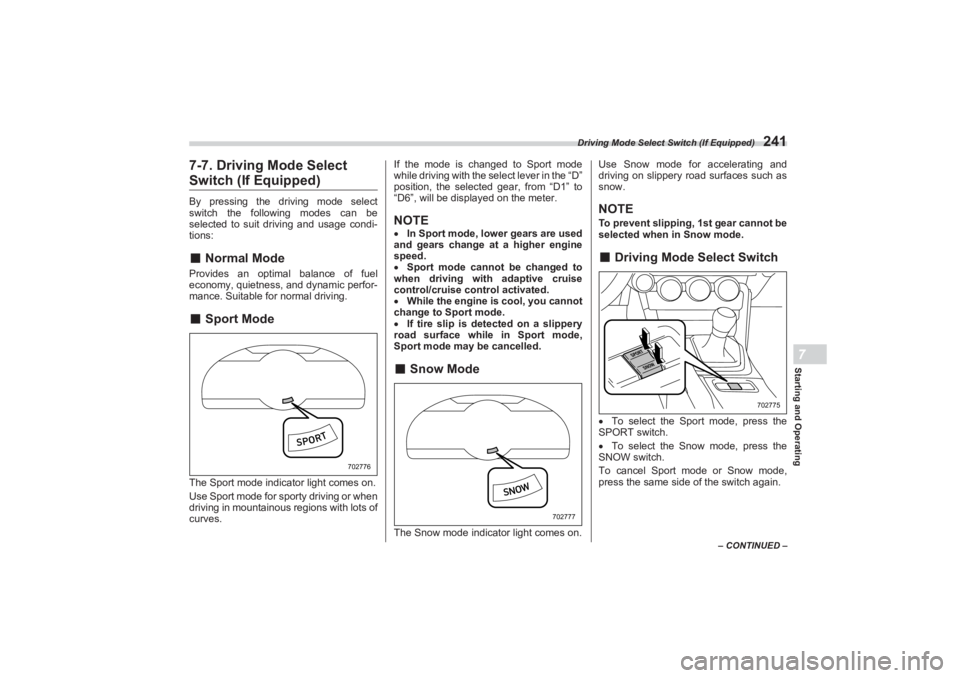
mance. Suitable for normal driving.■Sport ModeThe Sport mode indicator light comes on.
Use Sport mode for sporty driving or when
driving in mountainous regions with lots of
curves. If the mode is changed to Sport mode
while driving with the select lever in the “D”
position, the selected gear, from “D1” to
“D6”, will be displayed on the meter.
NOTE In Sport mode, lower gears are used
and gears change at a higher engine
speed.
Sport mode cannot be changed to
when driving with adaptive cruise
control/cruise control activated.
While the engine is cool, you cannot
change to Sport mode.
If tire slip is detected on a slippery
road surface while in Sport mode,
Sport mode may be cancelled.■ Snow ModeThe Snow mode indicator light comes on. Use Snow mode for accelerating and
driving on slippery road surfaces such as
snow.
NOTETo prevent slipping, 1st gear cannot be
selected when in Snow mode.■ Driving Mode Select SwitchTo select the Sport mode, press the
SPORT switch.
To select the Snow mode, press the
SNOW switch.
To cancel Sport mode or Snow mode,
press the same side of the switch again.
702776
702777
702775
BRZ_U.book 241 ページ 2022年3月29日 火曜日 午後3時59分
Page 259 of 432
Tire Pressure Monitoring System (TPMS) (If Equipped)
253
Starting and Operating7
– CONTINUED –
■Certification for the ReceiverFCC ID: HYQ23ABGNOTEThis device complies with part 15 of
the FCC Rules. Operation is subject to
the following two conditions: (1) This
device may not cause harmful interfer-
ence, and (2) this device must accept
any interference received, including
interference that may cause unde-
sired operation.
FCC WARNING
Changes or modifications not
expressly approved by the party
responsible for compliance could void
the user’s authority to operate the
equipment.
■ Certification for the Trans -
mitter U.S.-spec. models
FCC ID: PAXPMVE000NOTEThis device complies with part 15 of
the FCC Rules. Operation is subject to
the following two co nditions: (1) This
device may not cause harmful interfer-
ence, and (2) this device must accept
any interference received, including
interference that may cause unde-
sired operation.
FCC WARNING
Changes or modifications not
expressly approved by the party
responsible for compliance could void
the user’s authority to operate the
equipment.
Mexico-spec. models
MEX: RLVPAPM17-1337
When a tire is repaired with liquid
sealant, the tire pressure warning
valve and transmitter may not
operate properly. If a liquid
sealant is used, contact your
nearest SUBARU dealer or other
qualified service shop as soon as
possible. Make sure to replace
the tire pressure warning valve
and transmitter when replacing
the tire. You may reuse the wheel
if there is no damage to it and if
the sealant residue is properly
cleaned off. Do not inject any tire
liquid or aerosol tire sealant into
the tires, as this may cause a
malfunction of the tire pressure
sensors. If the light illuminates
steadily after blinking for approx-
imately one minute, promptly
contact a SUBARU dealer to have
the system inspected.
CAUTION
Do not place metal film or any metal
parts under the driver’s seat. This
may cause poor reception of the
signals from the tire pressure sen-
sors, and the tire pressure monitor-
ing system will not function
properly.
BRZ_U.book 253 ページ 2022年3月29日 火曜日 午後3時59分
Page 261 of 432
Parking Your Vehicle
255
Starting and Operating7
– CONTINUED –
■When Initialization of the Tire
Pressure Monitoring System
has FailedInitialization can be completed in a few
minutes. However, in the following case,
the settings have not been recorded and
the system will not o perate properly. If
repeated attempts to record tire inflation
pressure settings ar e unsuccessful, have
the vehicle checked at your SUBARU
dealer.
When operating the TPMS set switch,
low tire pressure warning light does not
blink 3 times.
After carrying out the initialization
procedure, the low tire pressure warning
light blinks for 1 minute then stays on after
driving for 20 minutes.
■ Registering ID CodesEvery tire pressure warning valve and
transmitter has a unique ID code. In addi-
tion to the set of tire pressure monitoring
system sensor ID code s initially registered
to the vehicle, a second set of ID codes
can be registered.
A second set of tire pressure monitoring
system sensor ID codes can be registered
at your SUBARU dealer. When 2 sets of
ID codes have been registered, either ID
code set can be selected.■ Changing the ID code set1. Park the vehicle in a safe place and
turn the ignition swit ch to the “ON” posi-
tion.
2. Press the TPMS set switch 3 times
within 3 seconds.
3. The low tire pressure warning light will
illuminate for 3 seconds and then blink 3
times.
4. The low tire pressure warning light will
blink for 1 minute and then illuminate.
5. When the ID code change has
completed, the tire pressure monitoring
light will turn off.
Check that tire pressures are displayed on
the TPMS screen.
7-16. Parking Your Vehicle■ Parking BrakeTo set the parking brake, depress the
brake pedal firmly and hold it down until
the parking brake lever is fully pulled up.
WARNING
Do not operate the TPMS set switch
without first adjust ing the tire infla-
tion pressure to the specified level.
Otherwise, the low tire pressure
warning light may not come on even
if the tire inflation pressure is low,
or it may come on when the tire
inflation pressure is actually nor-
mal.
WARNING
Never leave unattended children
or pets in the vehicle. They could
accidentally injure themselves or
others through inadvertent oper-
ation of the vehicle. Also, on hot
or sunny days, the temperature in
a closed vehicle could quickly
become high enough to cause
severe or possibly fatal injuries to
people. Do not park the vehicle over flam-
mable materials such as dry
grass, waste paper or rags, as
they may burn easily if they come
near hot engine or exhaust
system parts. Be sure to stop the engine if you
take a nap in the vehicle. If engine
exhaust gas enters the passenger
compartment, occupants in the
vehicle could die from carbon
monoxide (CO) contained in the
exhaust gas.
BRZ_U.book 255 ページ 2022年3月29日 火曜日 午後3時59分
Page 304 of 432
Loading Your Vehicle
298
NOTEFor better fuel economy, do not carry
unneeded cargo.
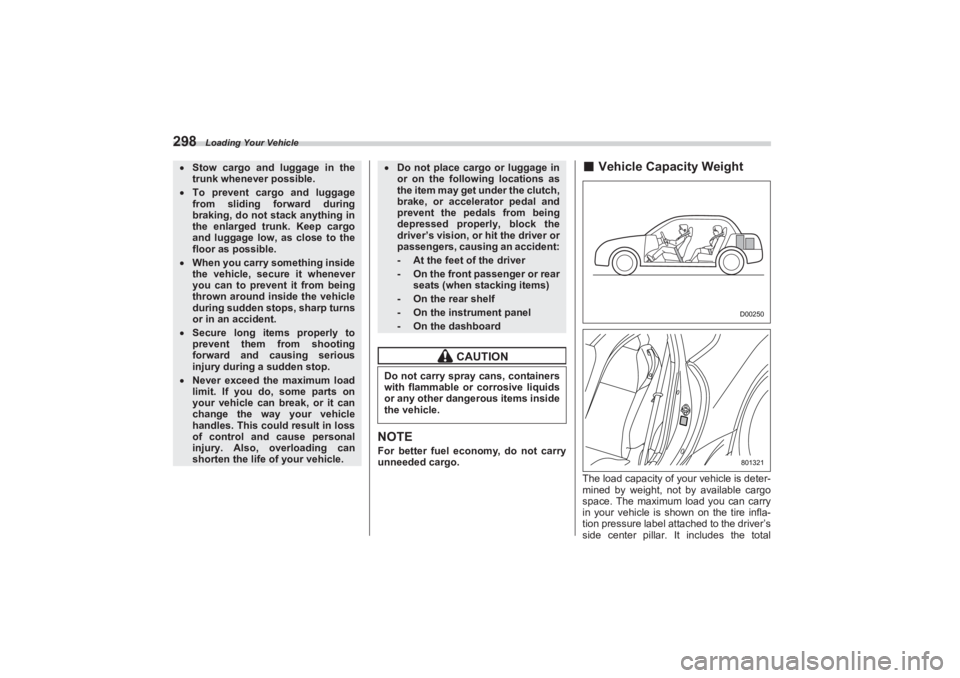
■ Vehicle Capacity WeightThe load capacity of your vehicle is deter-
mined by weight, not by available cargo
space. The maximum load you can carry
in your vehicle is shown on the tire infla-
tion pressure label attached to the driver’s
side center pillar. It includes the total
Stow cargo and luggage in the
trunk whenever possible. To prevent cargo and luggage
from sliding forward during
braking, do not stack anything in
the enlarged trunk. Keep cargo
and luggage low, as close to the
floor as possible. When you carry something inside
the vehicle, secure it whenever
you can to prevent it from being
thrown around inside the vehicle
during sudden stops, sharp turns
or in an accident. Secure long items properly to
prevent them from shooting
forward and causing serious
injury during a sudden stop. Never exceed the maximum load
limit. If you do, some parts on
your vehicle can break, or it can
change the way your vehicle
handles. This could result in loss
of control and cause personal
injury. Also, overloading can
shorten the life of your vehicle.
Do not place cargo or luggage in
or on the following locations as
the item may get under the clutch,
brake, or accelerator pedal and
prevent the pedals from being
depressed properly, block the
driver’s vision, or hit the driver or
passengers, causing an accident:
- At the feet of the driver- On the front passenger or rear
seats (when stacking items)- On the rear shelf- On the instrument panel- On the dashboard
CAUTION
Do not carry spray cans, containers
with flammable or corrosive liquids
or any other dangerous items inside
the vehicle.
D00250801321
BRZ_U.book 298 ページ 2022年3月29日 火曜日 午後3時59分