park assist SUBARU BRZ 2023 Owners Manual
[x] Cancel search | Manufacturer: SUBARU, Model Year: 2023, Model line: BRZ, Model: SUBARU BRZ 2023Pages: 432, PDF Size: 16.56 MB
Page 147 of 432
Warning and Indicator Lights
141
Instruments and Controls3
– CONTINUED –
If the brake system warning light should
illuminate while driving (with the parking
brake fully released and with the ignition
switch positioned in “ON”), it could be an
indication of leaking of brake fluid or worn
brake pads. If this occurs, immediately
stop the vehicle at the nearest safe place
and check the brake fluid level. If the fluid
level is below the “MIN” mark in the reser-
voir, do not drive the vehicle. Have the
vehicle towed to the nearest SUBARU
dealer for repair.▼ Electronic Brake Force Distribution
(EBD) system warning
If the warning light remains on even
though the parking brake is released, the
brake fluid level may be low or there could
be a problem with the EBD system. Park
the vehicle in a safe place immediately
and contact a SUBARU dealer.
▼ Vacuum pressure system warning
The brake system warning light will illumi-
nate when the vacuum pressure sensor is
malfunctioning or brake booster pressure
is decreasing. If the light continues to illu-
minate for several minutes after starting
the engine, there may be a malfunction in
the vacuum system. In this case, drive the
vehicle carefully and have the system
inspected by a SUBARU dealer.
■ Low Fuel Warning LightThe low fuel warning light illuminates
when the tank is nearly empty approxi-
mately 1.8 US gal (7.0 liters, or 1.5 Imp
gal). It only operates when the ignition
switch is in the “ON” position.■ Door Open IndicatorWhen any of the doors or the trunk lid is
not fully closed, the door open indicator
appears. This function is effective even if
the ignition switch is in the “OFF” or “ACC”
position.
The open door is indicated by the corre-
sponding part of the door open indicator.
Always make sure this indicator does not
appear before you start to drive.■ Power Steering
Warning LightWhile the engine is running, a warning
light illuminates and a buzzer sounds if a malfunction is detected in the electric
power steering system.
NOTEIf the steering wheel is operated in the
following ways, the power steering
control system may temporarily limit
the power assist in order to prevent
the system components, such as the
control computer and drive motor,
from overheating.
The steering wheel is operated
frequently and turned sharply while the
vehicle is maneuvered at extremely low
speeds, such as while frequently
turning the steering wheel during
parallel parking.
The steering wheel remains in the
fully turned position for a long period
of time.
At this time, there will be more resis-
tance when steering. However this is
not a malfunction. Normal steering
CAUTION
Promptly put fuel in the tank when-
ever the low fuel warning light illu-
minates. Engine misfires as a result
of an empty tank could cause dam-
age to the engine.
CAUTION
When the power steering warning
light is illuminated, there may be
more resistance when the steering
wheel is operated. Drive carefully to
the nearest SUBARU dealer and
have the vehicle inspected immedi-
ately.
BRZ_U.book 141 ページ 2022年3月29日 火曜日 午後3時59分
Page 184 of 432
Light Control Switch
178NOTEEven when the operation conditions of
the high beam assist function are met,
there may be a case in which the high
beam assist indicator does not illumi-
nate.▼ How to temporarily lower the sensi -
tivity of the high beam assist func -
tion
The sensitivity of the high beam assist
function can be lowered by using the
following operations.
1. After turning the ignition switch to the
“ON” position, set the light control switch
to the “AUTO” position and push the
signal lever forward (high beam position).
2. After the high beam assist indicator on
the combination meter will illuminate, turn
the ignition switch to the “OFF” position.
3. Turn the ignition switch to the “ON”
position and within approximately 15
seconds, press the “ ” (following
distance setting) switch more than 10
times consecutively.
When the sensitivity of the high beam
assist function is lowered, the high beam
assist indicator light “ ” on the combina-
tion meter display (col or TFT) will flash.
NOTEThe sensitivity of the high beam
assist function cannot be lowered in
the following conditions. - Cruise control or Adaptive
Cruise Control indicator is illumi-
nated.
- The EyeSight warning indicator
(yellow) is illuminated
The sensitivity of the high beam
assist function retu rns to normal level
the next time the ignition switch is
turned to the “OFF ” position and the
engine is restarted.
▼ How to change the headlight mode
manually
Change to the low beam:
Set the light control switch to “ ”.
Pull the lever while the high beam is
turning on and release it.
Change to the high beam:
Push the lever forward and release it.
At this time, the high beam assist function
will turn off, the high beam assist indicator
will turn off and the high beam indicator
light will turn on.NOTE After manually changing the head-
light mode to the high beam, if you turn on the high beam assist function, push
the lever forward and release it.
When manually changing the head-
light mode to the high beam, if you turn
the light control switch to the “ ”
position, the parking lights, side
marker lights, tail lights and license
plate lights will turn on.
▼ Tips for the high beam assist
system
The high beam assist function recog-
nizes the condition surrounding the
vehicle based on the brightness of illumi-
nation ahead of your vehicle, etc. There-
fore, the headlight mode may switch in
some situations that do not match to the
driver’s sense.
A bicycle or cargo cycle may not be
detected.
Under the following situations, the
brightness of ambient illumination may not
be detected correctly and the high beam
assist function may not work properly. As
a result, the glare of the high beam may
disturb the oncoming vehicle or vehicle
ahead. Also, the low beam mode may
continue although there are no oncoming
vehicles and vehicles ahead. In the such
cases, change the headlight mode manu-
ally.
BRZ_U.book 178 ページ 2022年3月29日 火曜日 午後3時59分
Page 228 of 432
Starting and Operating
Changing the ID code set ............................................ 255
7-16. Parking Your Vehicle ........................................255
Parking Brake ............................................................... 255
Parking Tips.................................................................. 256
7-17. Hill Start Assist System ....................................257
To Activate/Deactivate the Hill Start Assist
System ........................................................................ 258
Hill Start Assist Indicator Light................................... 259
7-18. Cruise Control (Models without the
EyeSight system) ..............................................260
To Set Cruise Control .................................................. 260
To Temporarily Cancel the Cr uise Control ................ 261
To Turn Off the Cruise Control ................................... 262
To Change the Cruising Speed ................................... 262
Cruise Control Indicator Light .................................... 263
7-19. Rear View Camera .............................................263
How to Use the Rear View Camera ............................. 264
Viewing Range on the Screen ..................................... 265
Help Lines ..................................................................... 266
7-20. BSD/RCTA (If Equipped)...................................268
System Features .......................................................... 268 System Operation......................................................... 270
BSD/RCTA Approach Indi
cator Light/Warning
Buzzer ......................................................................... 271
BSD/RCTA OFF Indicator ............................................ 273
BSD/RCTA Warning Indicator ..................................... 274
To Turn On/Off the BSD/RCTA .................................... 274
Certification for the BSD/RCTA................................... 274
Handling of Radar Sensors ......................................... 276
7-21. Reverse Automatic Braking (RAB) System
(If Equipped) ..................................................... 277
Reverse Automatic Braking (RAB) System
Overview ..................................................................... 278
Operating Conditions................................................... 279
Sonar Audible Alarm .................................................... 282
Automatic Braking Operation ..................................... 284
Canceling the Reverse Au tomatic Braking (RAB)
System Operation ...................................................... 285
Reverse Automatic Braking (RAB) System
ON/OFF Setting .......................................................... 286
RAB Warning Indicator ................................................ 286
Handling of the Sonar Sensors ................................... 286
BRZ_U.book 222 ページ 2022年3月29日 火曜日 午後3時59分
Page 243 of 432
Automatic Transmission
237
Starting and Operating7
– CONTINUED –
▼P (Park)
This position is for parking the vehicle and
starting the engine. In this position, the
transmission is mechanically locked to
prevent the vehicle from rolling freely.
When you park the vehicle, first apply the
parking brake, then shift into the “P” posi-
tion. Do not hold the vehicle with only the
mechanical friction of the transmission.
To shift the select lever from the “P” to any
other position, you should depress the
brake pedal fully then move the select
lever. This prevents the vehicle from
lurching when it is started.
▼ R (Reverse)
This position is for backing the vehicle. To
shift from the “N” to “R” position, stop the
vehicle completely th en move the lever to
the “R” position.
▼ N (Neutral)
This position is for restarting a stalled
engine. In this position, the transmission is
neutral, meaning that the wheels and
transmission are not locked. Therefore,
the vehicle will roll freely, even on the
slightest incline unless the parking brake
or foot brake is applied. ▼
D (Drive)
This position is for normal driving. The
transmission shifts automatically into a
suitable gear according to the vehicle
speed and the acceleration you require.
Also, while driving up and down a hill, the
transmission assists and controls the
driving performance and engine braking
while corresponding to the road grade.
When more acceleration is required in “D”
position, depress the accelerator pedal
fully to the floor and hold that position. The
transmission will auto matically downshift.
When you release the pedal, the transmis-
sion will return to the original gear posi-
tion.
To use the manual mode, move the lever
from this position into the manual gate.
If one of the shift paddles behind the
steering wheel is operated while driving in
the “D” position, the transmission will
temporarily switch to the manual mode. In
this mode, you can shift into any gear position using the shift paddles. For
details about the manual mode, refer to
"Selection of Manual Mode" P239.
Once the vehicle speed stabilizes, the
transmission will switch from the manual
mode back to the “D” position for normal
driving.
▽ While climbing a grade
When driving up a hill, undesired upshift is
prevented from taking place when the
accelerator is releas ed. This minimizes
the chance of subsequent downshifting to
a lower gear when accelerating again.
This prevents repeated upshifting and
downshifting resulting in a smoother oper-
ation of the vehicle.
NOTEThe transmission may downshift,
depending on the way the accelerator
pedal is depressed to accelerate the
vehicle again.■ Adaptive ControlIn order to realize smoother driving while
driving in “D” position, an appropriate gear
is automatically selected by limiting
upshifting and performing downshifting
operations according to driver operations
and driving conditions.
WARNING
Do not drive the vehicle with the
select lever in the “N” (neutral)
position. Engine braking has no
effect in this co ndition and the risk
of an accident is consequently
increased.
BRZ_U.book 237 ページ 2022年3月29日 火曜日 午後3時59分
Page 249 of 432
Braking
243
Starting and Operating7
– CONTINUED –
NOTEIf the steering wheel is operated in the
following ways, the power steering
control system may temporarily limit
the power assist in order to prevent
the system components, such as the
control computer and drive motor,
from overheating.
The steering wheel is operated
frequently and turned sharply while the
vehicle is maneuvered at extremely low
speeds, such as while frequently
turning the steering wheel during
parallel parking.
The steering wheel remains in the
fully turned position for a long period
of time.
At this time, there will be more resis-
tance when steering. However this is
not a malfunction. Normal steering
force will be restored after the steering
wheel is not operated for a while and the power steering control system has
an opportunity to cool down. However,
if the power steering is operated in a
non-standard way which causes
power assist limitation to occur too
frequently, this may result in a mal-
function of the power steering control
system.
7-10. Braking■ Braking Tips▼ When the brakes get wet
When driving in rain or after washing the
vehicle, the brakes may get wet. As a
result, brake stopping distance will be
longer. To dry the brakes, drive the
vehicle at a safe speed while lightly
depressing the brake pedal to heat up the
brakes.
▼ Use of engine brakingRemember to make use of engine braking
in addition to foot braking. When
descending a grade, if only the foot brake
is used, the brakes may start working
improperly because of brake fluid over-
heating, caused by overheated brake
pads. To help prevent this, shift into a
lower gear to get stronger engine braking.
CAUTION
While the power steering warning
light is illuminated, there may be
more resistance when the steering
wheel is operated. Drive carefully to
the nearest SUBARU dealer and
have the vehicle inspected immedi-
ately.
WARNING
Never rest your foot on the brake
pedal while driving. This can cause
dangerous overheating of the
brakes and needless wear on the
brake pads.
BRZ_U.book 243 ページ 2022年3月29日 火曜日 午後3時59分
Page 263 of 432
Hill Start Assist System
257
Starting and Operating7
– CONTINUED –
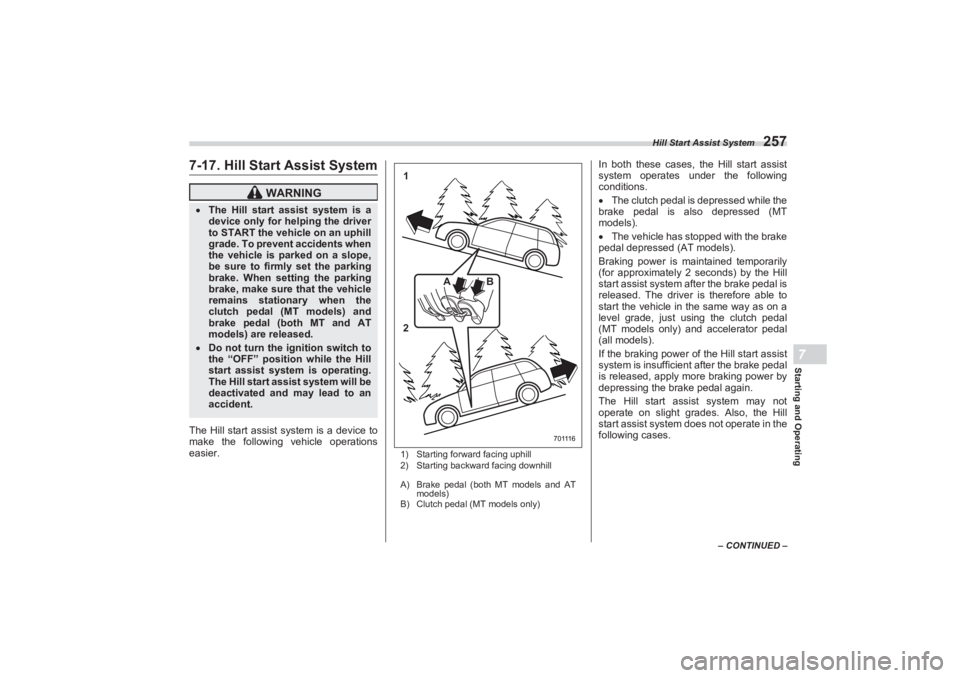
7-17. Hill Start Assist SystemThe Hill start assist system is a device to
make the following vehicle operations
easier.
1) Starting forward facing uphill
2) Starting backward facing downhill
A) Brake pedal (both MT models and AT
models)
B) Clutch pedal (MT models only)
In both these cases, the Hill start assist
system operates under the following
conditions.
The clutch pedal is depressed while the
brake pedal is also depressed (MT
models).
The vehicle has stopped with the brake
pedal depressed (AT models).
Braking power is maintained temporarily
(for approximately 2 seconds) by the Hill
start assist system after the brake pedal is
released. The driver is therefore able to
start the vehicle in the same way as on a
level grade, just using the clutch pedal
(MT models only) and accelerator pedal
(all models).
If the braking power of the Hill start assist
system is insufficient after the brake pedal
is released, apply more braking power by
depressing the brake pedal again.
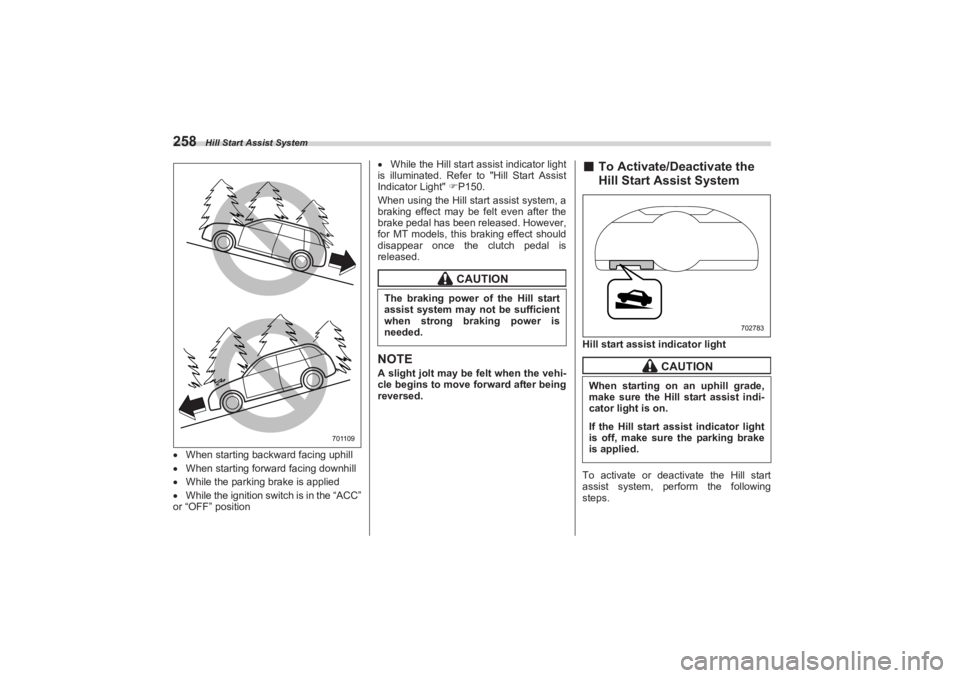
The Hill start assist system may not
operate on slight grades. Also, the Hill
start assist system does not operate in the
following cases.
WARNING
The Hill start assist system is a
device only for helping the driver
to START the vehicle on an uphill
grade. To prevent accidents when
the vehicle is parked on a slope,
be sure to firmly set the parking
brake. When setting the parking
brake, make sure that the vehicle
remains stationary when the
clutch pedal (MT models) and
brake pedal (both MT and AT
models) are released. Do not turn the ig nition switch to
the “OFF” position while the Hill
start assist system is operating.
The Hill start assist system will be
deactivated and may lead to an
accident.
1
2 BA
7 0 111 6
BRZ_U.book 257 ページ 2022年3月29日 火曜日 午後3時59分
Page 264 of 432
Hill Start Assist System
258When starting backward facing uphill
When starting forward facing downhill
While the parking brake is applied
While the ignition switch is in the “ACC”
or “OFF” position
While the Hill start assist indicator light
is illuminated. Refer to "Hill Start Assist
Indicator Light" P150.
When using the Hill start assist system, a
braking effect may be felt even after the
brake pedal has been released. However,
for MT models, this braking effect should
disappear once the clutch pedal is
released.
NOTEA slight jolt may be felt when the vehi-
cle begins to move forward after being
reversed.
■ To Activate/Deactivate the
Hill Start Assist SystemHill start assis t indicator light
To activate or deactivate the Hill start
assist system, perform the following
steps.
701109
CAUTION
The braking power of the Hill start
assist system may not be sufficient
when strong braking power is
needed.
CAUTION
When starting on an uphill grade,
make sure the Hill start assist indi-
cator light is on.If the Hill start assist indicator light
is off, make sure the parking brake
is applied.
702783
BRZ_U.book 258 ページ 2022年3月29日 火曜日 午後3時59分
Page 265 of 432
Hill Start Assist System
259
Starting and Operating7
– CONTINUED –
NOTEIf you make an error when performing
any steps in the following procedure,
place the ignition switch in the “OFF”
position once and then start over
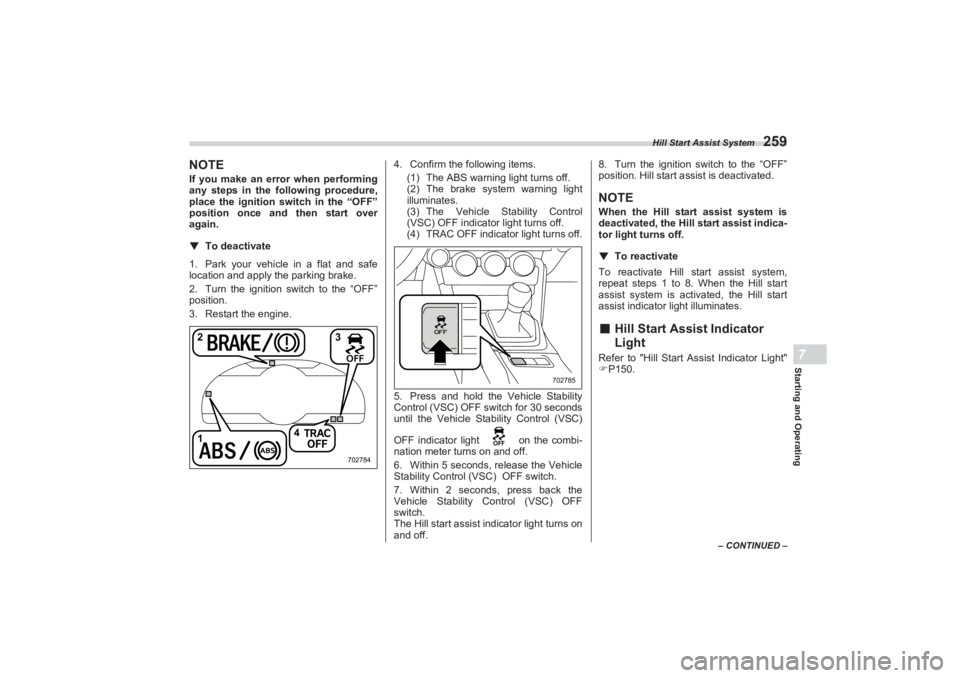
again.▼ To deactivate
1. Park your vehicle in a flat and safe
location and apply the parking brake.
2. Turn the ignition switch to the “OFF”
position.
3. Restart the engine. 4. Confirm the following items.
(1) The ABS warning light turns off.
(2) The brake system warning light
illuminates.
(3) The Vehicle Stability Control
(VSC) OFF indicator light turns off.
(4) TRAC OFF indicator light turns off.
5. Press and hold the Vehicle Stability
Control (VSC) OFF switch for 30 seconds
until the Vehicle Stability Control (VSC)
OFF indicator light on the combi-
nation meter turns on and off.
6. Within 5 seconds, release the Vehicle
Stability Control ( VSC) OFF switch.
7. Within 2 seconds, press back the
Vehicle Stability Control (VSC) OFF
switch.
The Hill start assist i ndicator light turns on
and off. 8. Turn the ignition switch to the “OFF”
position. Hill start a ssist is deactivated.
NOTEWhen the Hill start assist system is
deactivated, the Hill start assist indica-
tor light turns off.
▼ To reactivate
To reactivate Hill start assist system,
repeat steps 1 to 8. When the Hill start
assist system is activa ted, the Hill start
assist indicator light illuminates.■ Hill Start Assist Indicator
LightRefer to "Hill Start A ssist Indicator Light"
P150.
1 4
23
702784
702785
BRZ_U.book 259 ページ 2022年3月29日 火曜日 午後3時59分
Page 275 of 432
BSD/RCTA (If Equipped)
269
Starting and Operating7
– CONTINUED –
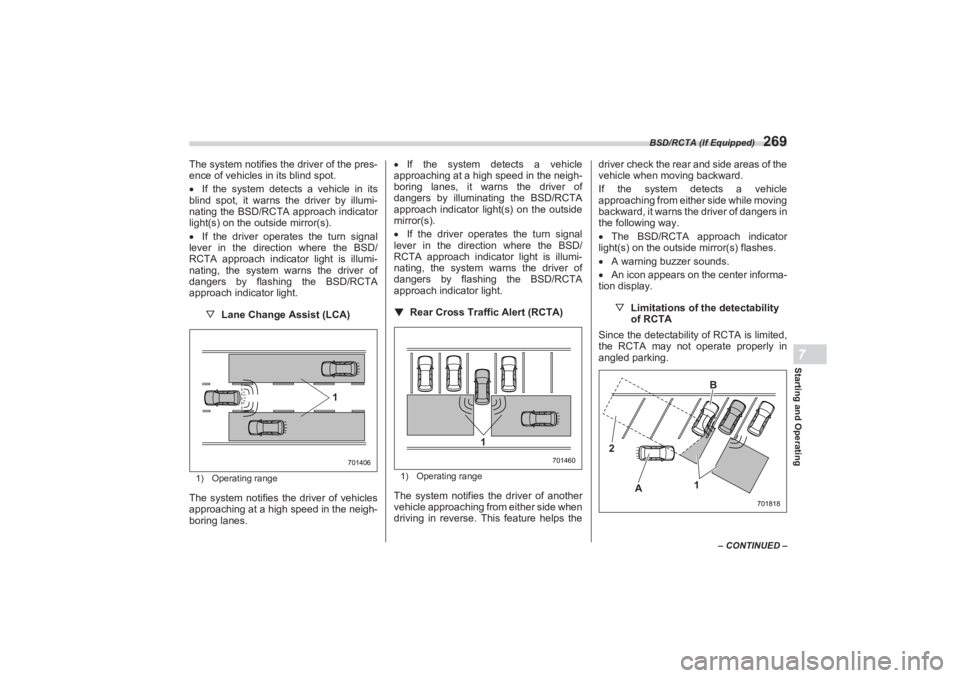
The system notifies the driver of the pres-
ence of vehicles in its blind spot.
If the system detects a vehicle in its
blind spot, it warns the driver by illumi-
nating the BSD/RCTA approach indicator
light(s) on the outside mirror(s).
If the driver operates the turn signal
lever in the direction where the BSD/
RCTA approach indicator light is illumi-
nating, the system warns the driver of
dangers by flashing the BSD/RCTA
approach indicator light.
▽ Lane Change Assist (LCA)1) Operating rangeThe system notifies the driver of vehicles
approaching at a high speed in the neigh-
boring lanes.
If the system detects a vehicle
approaching at a high speed in the neigh-
boring lanes, it warns the driver of
dangers by illuminating the BSD/RCTA
approach indicator light(s) on the outside
mirror(s).
If the driver operates the turn signal
lever in the direction where the BSD/
RCTA approach indicator light is illumi-
nating, the system warns the driver of
dangers by flashing the BSD/RCTA
approach indicator light.
▼ Rear Cross Traffic Alert (RCTA)
1) Operating rangeThe system notifies the driver of another
vehicle approaching from either side when
driving in reverse. This feature helps the driver check the rear and side areas of the
vehicle when moving backward.
If the system detects a vehicle
approaching from either side while moving
backward, it warns the driver of dangers in
the following way.
The BSD/RCTA approach indicator
light(s) on the outside mirror(s) flashes.
A warning buzzer sounds.
An icon appears on the center informa-
tion display.
▽Limitations of the detectability
of RCTA
Since the detectabilit y of RCTA is limited,
the RCTA may not operate properly in
angled parking.
701406
1
701460
1
701818
2
A B
1
BRZ_U.book 269 ページ 2022年3月29日 火曜日 午後3時59分
Page 340 of 432
Corrosion Protection
334Do not use detergent on the wheels
when they are hot, such as after driving or
parking in hot weather.■ Alloy Wheels (Vehicles with
Matte Painted Wheels)As matte painted wheels require different
cleaning methods than conventional alloy
wheels, be sure to observe the following.
For details, consult your SUBARU dealer.
Remove dirt using water. If the wheels
are excessively dirty, use a sponge or soft
cloth dampened with a diluted neutral
detergent to remove the dirt.
To prevent the matte paint from being
damaged, make sure to observe the
following precautions:
- Do not scrub or polish the wheels
using a brush or dry cloth.
- Do not use any wheel coatings or
abrasive detergents.
10-2. Corrosion ProtectionYour SUBARU has been designed and
built to resist corrosi on. Special materials
and protective finishes have been used on
most parts of the vehicle to help maintain
fine appearance, strength, and reliable
operation.■ Most Common Causes of
CorrosionThe most common causes of corrosion
are:
The accumulation of moisture retaining
dirt and debris in body panel sections,
cavities, and other areas.
Damage to paint and other protective
coatings caused by gravel and stone
chips or minor accidents.
Corrosion is accelera ted on the vehicle
when:
It is exposed to road salt or dust control
chemicals, or used in coastal areas where
there is more salt in the air, or in areas
where there is considerable industrial
pollution.
It is driven in areas of high humidity,
especially when temperatures range just
above freezing.
Dampness in certain parts of the
vehicle remains for a long time, even though other parts of the vehicle may be
dry.
High temperatures will cause corrosion
to parts of the vehicle which cannot dry
quickly due to lack of proper ventilation.
■ To Help Prevent CorrosionWash the vehicle regularly to prevent
corrosion of the body and suspension
components. Also, wash the vehicle
promptly after driving on any of the
following surfaces.
Roads that have been salted to prevent
them from freezing in winter
Mud, sand, or gravel
Coastal roads
After the winter has ended, it is recom-
mended that the underbody be given a
very thorough washing.
Before the beginning of winter, check the
condition of underbody components, such
as the exhaust system, fuel and brake
lines, brake cables, suspension, steering
system, floor pan, and fenders. If any of
them are found to be rusted, they should
be given an appropriate rust prevention
treatment or should be replaced. Contact
your SUBARU dealer to perform this kind
of maintenance and treatment if you need
assistance.
Repair chips and scratches in the paint as
soon as you find them.
BRZ_U.book 334 ページ 2022年3月29日 火曜日 午後3時59分