steering wheel SUBARU BRZ 2023 Owners Manual
[x] Cancel search | Manufacturer: SUBARU, Model Year: 2023, Model line: BRZ, Model: SUBARU BRZ 2023Pages: 432, PDF Size: 16.56 MB
Page 11 of 432
Vehicle Symbols
5
Introduction
– CONTINUED –
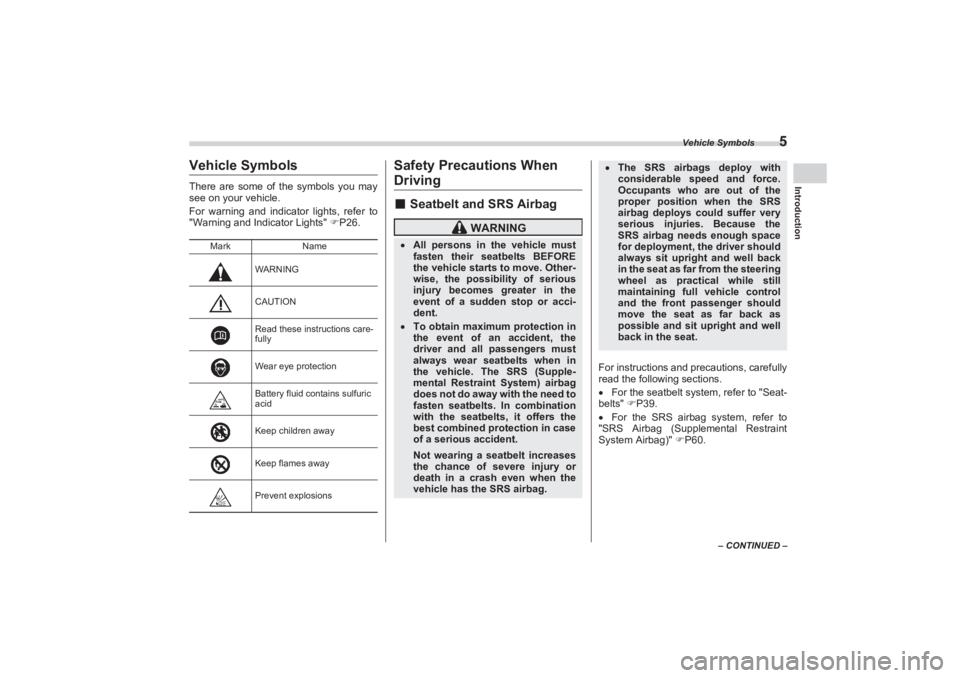
Vehicle SymbolsThere are some of the symbols you may
see on your vehicle.
For warning and indica tor lights, refer to
"Warning and Indicator Lights" P26.
Safety Precautions When Driving■ Seatbelt and SRS Airbag
For instructions and precautions, carefully
read the following sections.
For the seatbelt syst em, refer to "Seat-
belts" P39.
For the SRS airbag system, refer to
"SRS Airbag (Supplemental Restraint
System Airbag)" P60.
Mark Name
WARNING
CAUTION
Read these instructions care-
fully
Wear eye protection
Battery fluid contains sulfuric
acid
Keep children away
Keep flames away
Prevent explosions
WARNING
All persons in the vehicle must
fasten their seatbelts BEFORE
the vehicle starts to move. Other-
wise, the possibility of serious
injury becomes greater in the
event of a sudden stop or acci-
dent. To obtain maximum protection in
the event of an accident, the
driver and all passengers must
always wear seatbelts when in
the vehicle. The SRS (Supple-
mental Restraint System) airbag
does not do away with the need to
fasten seatbelts. In combination
with the seatbelts, it offers the
best combined protection in case
of a serious accident.
Not wearing a seatbelt increases
the chance of severe injury or
death in a crash even when the
vehicle has the SRS airbag.
The SRS airbags deploy with
considerable speed and force.
Occupants who are out of the
proper position when the SRS
airbag deploys could suffer very
serious injuries. Because the
SRS airbag needs enough space
for deployment, the driver should
always sit upright and well back
in the seat as far from the steering
wheel as practical while still
maintaining full vehicle control
and the front passenger should
move the seat as far back as
possible and sit upright and well
back in the seat.
BRZ_U.book 5 ページ 2022年3月29日 火曜日 午後3時59分
Page 19 of 432
Illustrated Index
Illustrated Index
Exterior ..................................................................14
Interior ....................................................................16
Instrument Panel ...................................................19
Steering Wheel ......................................................20
Light Control and Wiper Control Levers/
Switches ..............................................................21
Combination Meter................................................22
U.S. Spec. Models (Normal mode) ............................... 22
U.S. Spec. Models (TRACK mo de) ............................... 23
Except U.S. Spec. Models (Normal mode)................... 24
Except U.S. Spec. Models (TRACK mode) . ................. 25
Warning and Indicator Lights ..............................26
BRZ_U.book 13 ページ 2022年3月29日 火曜日 午後3時59分
Page 26 of 432
Steering Wheel
20Steering Wheel
11
9
33
9
22
4
5
6
8
7
002019
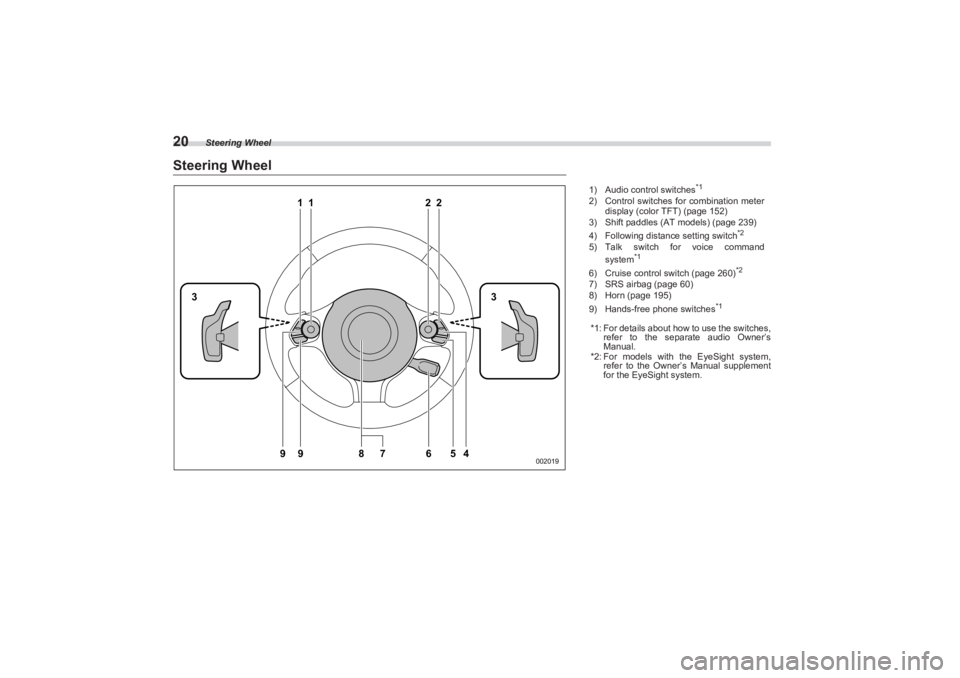
1)
Audio control switches
*1
2) Control switches for combination meter
display (color TFT) (page 152)
3) Shift paddles (AT models) (page 239)
4) Following distance setting switch
*2
5) Talk switch for voice command
system
*1
6) Cruise control switch (page 260)
*2
7) SRS airbag (page 60)
8) Horn (page 195)
9) Hands-free phone switches
*1
*1: For details about how to use the switches,
refer to the separate audio Owner’s
Manual.
*2: For models with the EyeSight system,
refer to the Owner’s Manual supplement
for the EyeSight system.
BRZ_U.book 20 ページ 2022年3月29日 火曜日 午後3時59分
Page 36 of 432
Front Seats
301-1. Front Seats
WARNING
Never adjust the seat while
driving, as personal injury or loss
of vehicle control may occur. Before adjusting the seat, ensure
nothing is blocking the adjusting
mechanism. After adjusting the seat, move it
back and forth to ensure the seat
is securely locked. If it is not, it
may move suddenly or the
seatbelt may not operate prop-
erly. Do not put objects under the front
seats. They may interfere with
front seat locking mechanism
and cause an accident.
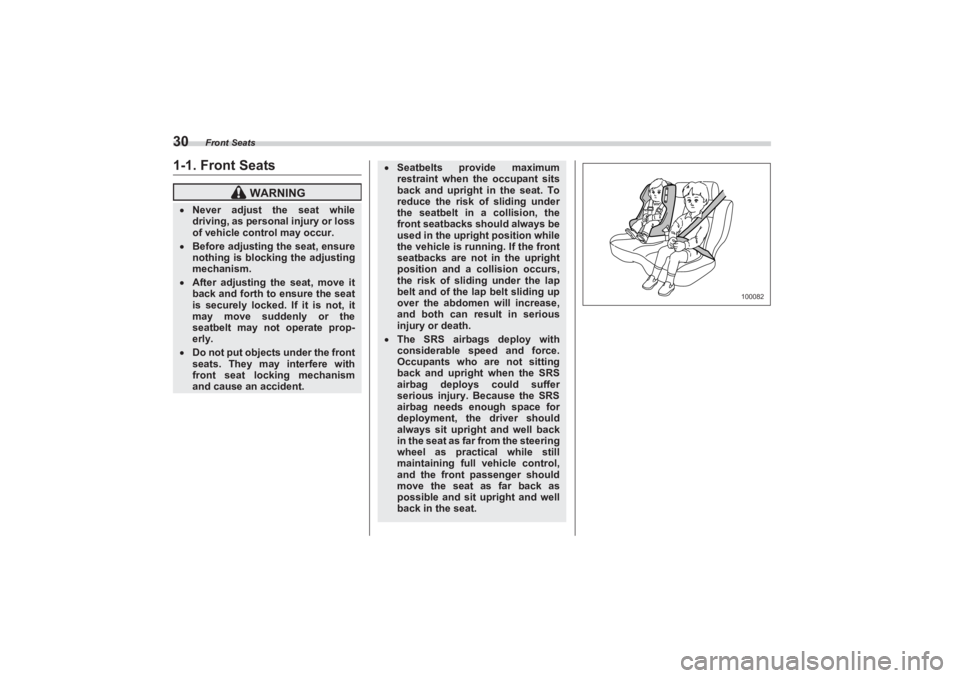
Seatbelts provide maximum
restraint when the occupant sits
back and upright in the seat. To
reduce the risk of sliding under
the seatbelt in a collision, the
front seatbacks should always be
used in the upright position while
the vehicle is running. If the front
seatbacks are not in the upright
position and a collision occurs,
the risk of sliding under the lap
belt and of the lap belt sliding up
over the abdomen will increase,
and both can result in serious
injury or death. The SRS airbags deploy with
considerable speed and force.
Occupants who are not sitting
back and upright when the SRS
airbag deploys could suffer
serious injury. Because the SRS
airbag needs enough space for
deployment, the driver should
always sit upright and well back
in the seat as far from the steering
wheel as practical while still
maintaining full vehicle control,
and the front passenger should
move the seat as far back as
possible and sit upright and well
back in the seat.
100082
BRZ_U.book 30 ページ 2022年3月29日 火曜日 午後3時59分
Page 48 of 432
Seatbelts
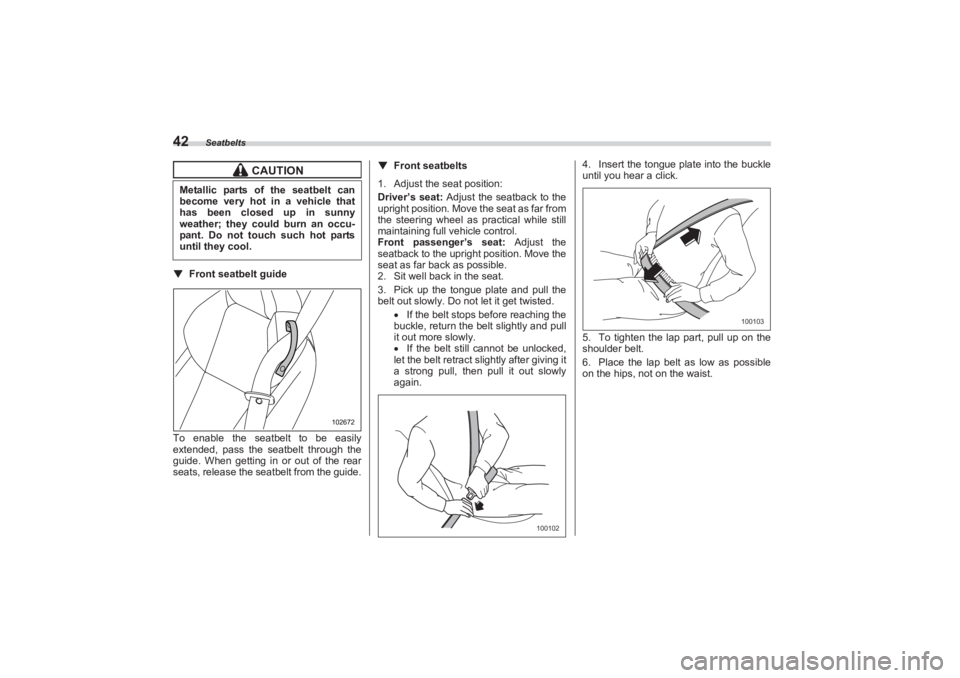
42▼Front seatbelt guide
To enable the seatbelt to be easily
extended, pass the seatbelt through the
guide. When getting in or out of the rear
seats, release the seatbelt from the guide. ▼
Front seatbelts
1. Adjust the seat position:
Driver’s seat: Adjust the seatback to the
upright position. Move the seat as far from
the steering wheel as practical while still
maintaining full vehicle control.
Front passenger’s seat: Adjust the
seatback to the upright position. Move the
seat as far back as possible.
2. Sit well back in the seat.
3. Pick up the tongue plate and pull the
belt out slowly. Do not let it get twisted.
If the belt stops before reaching the
buckle, return the belt slightly and pull
it out more slowly.
If the belt still cannot be unlocked,
let the belt retract slightly after giving it
a strong pull, then pull it out slowly
again. 4. Insert the tongue plate into the buckle
until you hear a click.
5. To tighten the lap part, pull up on the
shoulder belt.
6. Place the lap belt as low as possible
on the hips, not on the waist.
CAUTION
Metallic parts of the seatbelt can
become very hot in a vehicle that
has been closed up in sunny
weather; they could burn an occu-
pant. Do not touch such hot parts
until they cool.
102672
100102
100103
BRZ_U.book 42 ページ 2022年3月29日 火曜日 午後3時59分
Page 67 of 432
SRS Airbag (Supplemental Restraint System Airbag)
61
Seat, Seatbelt and SRS Airbags1
– CONTINUED –
The SRS side airbags and SRS
curtain airbags are designed only
to be a supplement to the primary
protection provided by the
seatbelt. They do not eliminate
the need to fasten seatbelts. It is
also important to wear a seatbelt
to help avoid injuries that can
result when an occupant is not
seated in a proper upright posi-
tion.
100155
WARNING
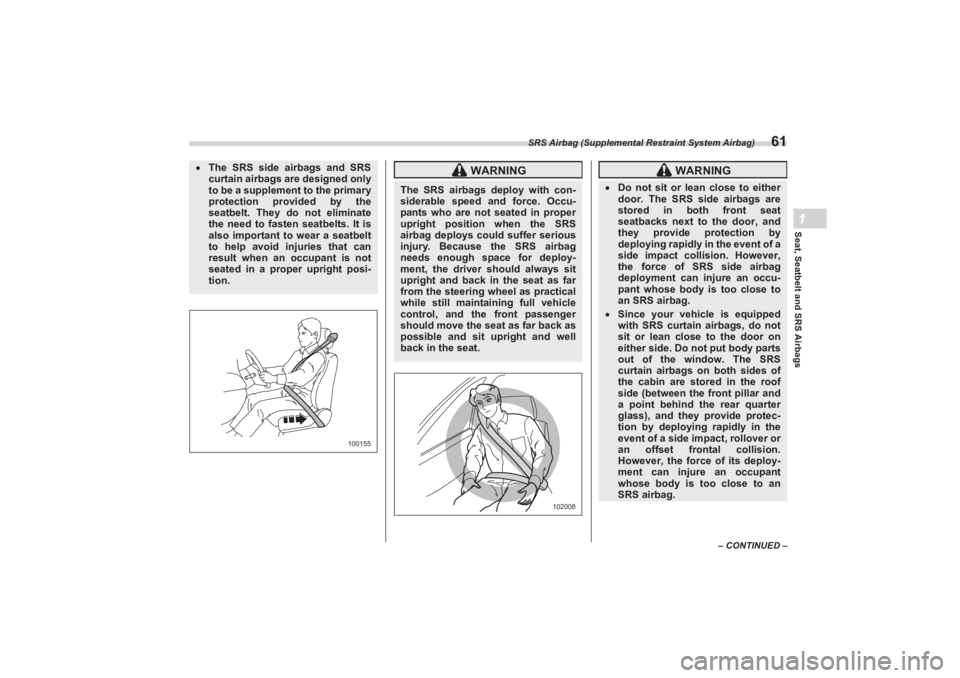
The SRS airbags deploy with con-
siderable speed and force. Occu-
pants who are not seated in proper
upright position when the SRS
airbag deploys could suffer serious
injury. Because the SRS airbag
needs enough space for deploy-
ment, the driver should always sit
upright and back in the seat as far
from the steering wheel as practical
while still maintaining full vehicle
control, and the front passenger
should move the seat as far back as
possible and sit upright and well
back in the seat.
102008
WARNING
Do not sit or lean close to either
door. The SRS side airbags are
stored in both front seat
seatbacks next to the door, and
they provide protection by
deploying rapidly in the event of a
side impact collision. However,
the force of SRS side airbag
deployment can injure an occu-
pant whose body is too close to
an SRS airbag. Since your vehicle is equipped
with SRS curtain airbags, do not
sit or lean close to the door on
either side. Do not put body parts
out of the window. The SRS
curtain airbags on both sides of
the cabin are stored in the roof
side (between the front pillar and
a point behind the rear quarter
glass), and they provide protec-
tion by deploying rapidly in the
event of a side impact, rollover or
an offset frontal collision.
However, the force of its deploy-
ment can injure an occupant
whose body is too close to an
SRS airbag.
BRZ_U.book 61 ページ 2022年3月29日 火曜日 午後3時59分
Page 69 of 432
SRS Airbag (Supplemental Restraint System Airbag)
63
Seat, Seatbelt and SRS Airbags1
– CONTINUED –
■General Precautions
regarding SRS Airbag
System for Accessories and
Any Objects
102683102218
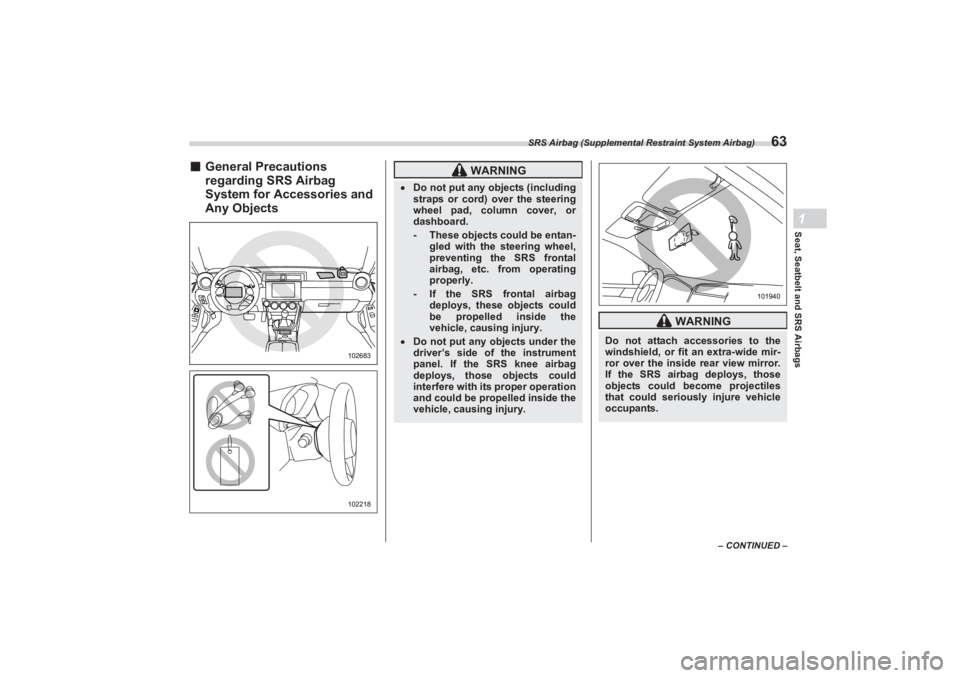
WARNING
Do not put any objects (including
straps or cord) over the steering
wheel pad, column cover, or
dashboard.
- These objects could be entan- gled with the steering wheel,
preventing the SRS frontal
airbag, etc. from operating
properly.- If the SRS frontal airbag
deploys, these objects could
be propelled inside the
vehicle, causing injury.
Do not put any objects under the
driver’s side of the instrument
panel. If the SRS knee airbag
deploys, those objects could
interfere with its proper operation
and could be propelled inside the
vehicle, causing injury.
WARNING
Do not attach accessories to the
windshield, or fit an extra-wide mir-
ror over the inside rear view mirror.
If the SRS airbag deploys, those
objects could become projectiles
that could seriously injure vehicle
occupants.
101940
BRZ_U.book 63 ページ 2022年3月29日 火曜日 午後3時59分
Page 74 of 432
SRS Airbag (Supplemental Restraint System Airbag)
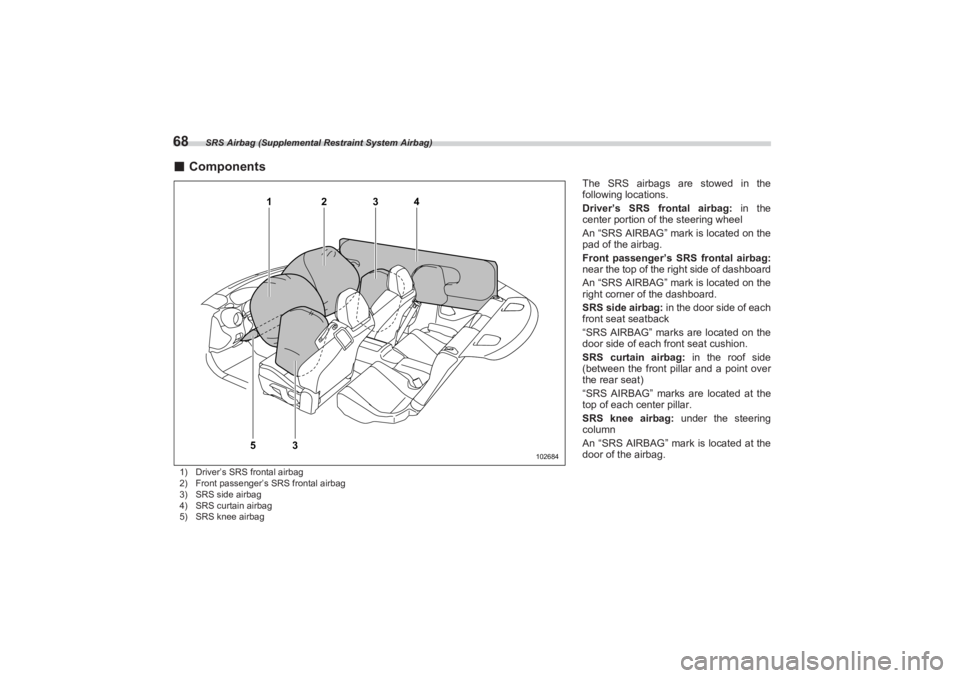
68■Components1) Driver’s SRS frontal airbag
2) Front passenger’s SRS frontal airbag
3) SRS side airbag
4) SRS curtain airbag
5) SRS knee airbag
1
5
2
3
4
3
102684
The SRS airbags are stowed in the
following locations.
Driver’s SRS frontal airbag: in the
center portion of the steering wheel
An “SRS AIRBAG” mark is located on the
pad of the airbag.
Front passenger’s SRS frontal airbag:
near the top of the right side of dashboard
An “SRS AIRBAG” mark is located on the
right corner of the dashboard.
SRS side airbag: in the door side of each
front seat seatback
“SRS AIRBAG” marks are located on the
door side of each front seat cushion.
SRS curtain airbag: in the roof side
(between the front pillar and a point over
the rear seat)
“SRS AIRBAG” marks are located at the
top of each center pillar.
SRS knee airbag: under the steering
column
An “SRS AIRBAG” mark is located at the
door of the airbag.
BRZ_U.book 68 ページ 2022年3月29日 火曜日 午後3時59分
Page 83 of 432
SRS Airbag (Supplemental Restraint System Airbag)
77
Seat, Seatbelt and SRS Airbags1
– CONTINUED –
The front impact sensors
The impact sensors in the airbag
control module
On the driver’s side, the SRS knee airbag
also inflates with the SRS frontal airbag.
The driver’s and front passenger’s SRS
frontal airbags use dual stage inflators.
The two inflators of each airbag are trig-
gered either sequentially or simultane-
ously, depending on the severity of
impact, in the case of the driver’s SRS
frontal airbag and depending on the
severity of impact and the characteristic of
item(s) or person on the seat in the case
of the front passenger’s SRS frontal
airbag.▼ After deployment
After deployment, the SRS airbag immedi-
ately starts to deflate so that the driver’s
vision is not obstructed and the driver’s
ability to maintain control of the vehicle is
not impaired. The time required from
detecting impact to the deflation of the
SRS airbag after deployment is shorter
than the blink of an eye.
Both when only the driver’s SRS frontal
airbag deploys and the driver’s and front
passenger’s SRS frontal airbags deploy,
the driver’s and front passenger’s seatbelt
pretensioners operate at the same time. When the SRS airbag deploys, a sudden,
fairly loud inflation noise will be heard and
some smoke will be released. These
occurrences are a normal result of the
deployment. This smoke does not indicate
a fire in the vehicle.
▼ Example of the type of accident
The driver’s SRS frontal airbag and front
passenger’s SRS frontal airbag are
designed as follows.
To deploy in the event of an accident
involving a moderate to severe frontal
collision
To function on a one-time-only basis
The driver’s SRS frontal airbag and front
passenger’s SRS frontal airbag are not
designed as follows.
To deploy in most lesser frontal
impacts
*1
To deploy in most side or rear impacts
or in most rollover accidents
*2
*1: Because the necessary protection can be
achieved by the seatbelt alone.
*2: Because deployment of only the driver’s
SRS frontal airbag or both the driver’s and
front passenger’s SRS frontal airbags would
not protect the occupant in those situations.SRS airbag deployment depends on the
level of force experienced in the
passenger compartment during a colli-
sion. That level differs from one type of
collision to another, and it may have no
bearing on the visible damage done to the
vehicle itself.
CAUTION
Do not touch the SRS airbag system
components around the steering
wheel and dashboard with bare
hands right after deployment. Doing
so can cause burns because the
components can be very hot as a
result of deployment.
BRZ_U.book 77 ページ 2022年3月29日 火曜日 午後3時59分
Page 87 of 432
SRS Airbag (Supplemental Restraint System Airbag)
81
Seat, Seatbelt and SRS Airbags1
– CONTINUED –
▼SRS curtain airbag
Your vehicle is equipped with a SUBARU
SRS curtain airbag system that complies
with the Federal Motor Vehicle Safety
Standard (FMVSS) No. 226.
The SRS curtain airbag on each side of
the cabin is stored in the roof side
(between the front pillar and a point over
the rear seat). An “SRS AIRBAG” mark is
located at the top of each center pillar.
In a moderate to severe side impact colli-
sion, the SRS curtain airbag on the
impacted side of the vehicle deploys
between the occupant and the side
window and supplements the seatbelt by
reducing the impact on the occupant’s
head.
In a rollover, SRS curtain airbags on both
sides of the vehicle deploy between the
occupant and the side window and
supplement the seatbelt by reducing the
impact to the occupant’s head.
In an offset frontal collision, SRS curtain
airbags on both sides of the vehicle
deploy between the occupant and the side
window and supplement the seatbelt by
reducing the impact to the occupant’s
head and chest. ▼
Operation
The SRS side airbag and SRS curtain
airbag can function only when the ignition
switch is in the “ON” position.
The following airbags deploy inde-
pendently of each other since each has its
own impact sensor.
Driver’s SRS side airbag
Front passenger’s SRS side airbag
SRS curtain airbag (right-hand side)
SRS curtain airbag (left-hand side)
Therefore, they may not both deploy in the
same accident. Also, the SRS side airbag
and SRS curtain airbag deploys inde-
pendently of the driver’s and front
passenger’s SRS frontal airbags in the
steering wheel and instrument panel.
For the locations of the sensors and
control modules, refer to "Components"
P68.
▼ After deployment
After the deployment, the SRS side airbag
immediately starts to deflate. The time
required from detection of an impact to
deflation of an SRS side airbag after
deployment is shorter than the blink of an
eye.
The SRS curtain airbag remains inflated
for a while following deployment then
slowly deflates. The SRS side airbag and SRS curtain
airbag deploy even when no one occupies
the seat on the side on which an impact is
applied.
When the SRS side airbag and SRS
curtain airbag deploy, a sudden, fairly loud
inflation noise will be heard and some
smoke will be released. These occur-
rences are a normal result of the deploy-
ment. This smoke does not indicate a fire
in the vehicle.
▼ Example of the type of accident
The SRS side airbag and SRS curtain
airbag are designed as follows:
CAUTION
Do not touch the SRS side airbag
system components around the
front seat seatback with bare hands
right after deployment. Doing so
can cause burns because the com-
ponents can be very hot as a result
of deployment.After deployment, do not touch any
part of the SRS curtain airbag sys-
tem (from the front pillar to the part
of the roof side over the rear seat).
Doing so can cause burns because
the components can be very hot as
a result of deployment.
BRZ_U.book 81 ページ 2022年3月29日 火曜日 午後3時59分