suspension SUBARU BRZ 2023 Owners Manual
[x] Cancel search | Manufacturer: SUBARU, Model Year: 2023, Model line: BRZ, Model: SUBARU BRZ 2023Pages: 432, PDF Size: 16.56 MB
Page 52 of 432
Child Restraint Systems
46NOTEIf the front or side part of the vehicle is
damaged in an accident to the extent
that the seatbelt pretensioner does not
operate, contact your SUBARU dealer
as soon as possible.■ Precautions against Vehicle
ModificationAlways consult your SUBARU dealer if
you want to install any accessory parts to
your vehicle.
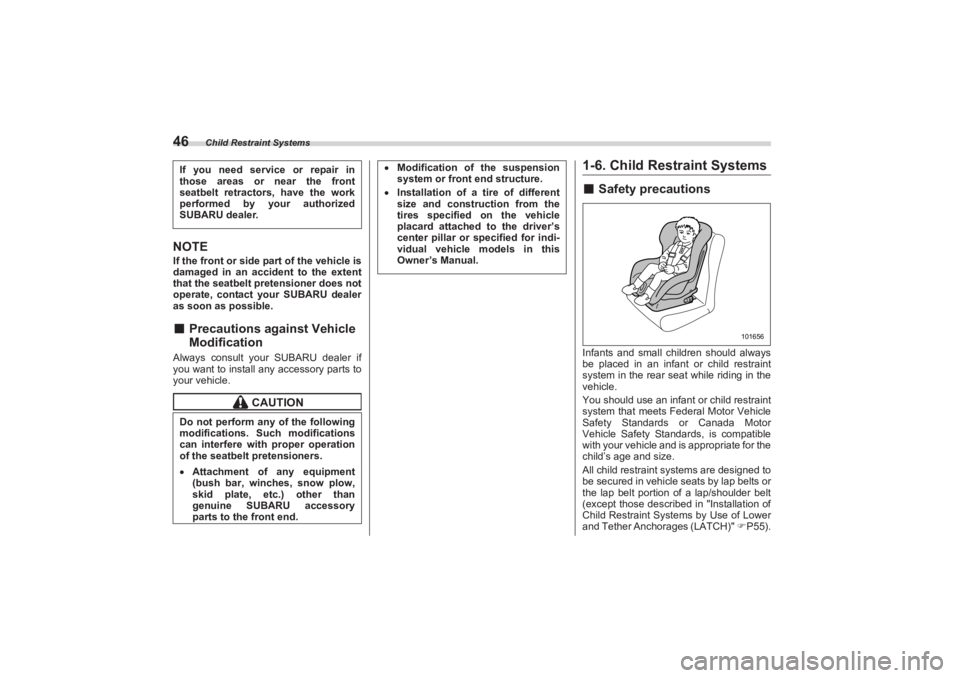
1-6. Child Restraint Systems■ Safety precautionsInfants and small children should always
be placed in an infant or child restraint
system in the rear seat while riding in the
vehicle.
You should use an infant or child restraint
system that meets Federal Motor Vehicle
Safety Standards or Canada Motor
Vehicle Safety Standards, is compatible
with your vehicle and is appropriate for the
child’s age and size.
All child restraint systems are designed to
be secured in vehicle seats by lap belts or
the lap belt portion of a lap/shoulder belt
(except those described in "Installation of
Child Restraint Systems by Use of Lower
and Tether Anchorages (LATCH)" P55).
If you need service or repair in
those areas or near the front
seatbelt retractors, have the work
performed by your authorized
SUBARU dealer.
CAUTION
Do not perform any of the following
modifications. Such modifications
can interfere with proper operation
of the seatbelt pretensioners. Attachment of any equipment
(bush bar, winches, snow plow,
skid plate, etc.) other than
genuine SUBARU accessory
parts to the front end.
Modification of the suspension
system or front end structure. Installation of a tire of different
size and construction from the
tires specified on the vehicle
placard attached to the driver’s
center pillar or specified for indi-
vidual vehicle models in this
Owner’s Manual.
101656
BRZ_U.book 46 ページ 2022年3月29日 火曜日 午後3時59分
Page 96 of 432
SRS Airbag (Supplemental Restraint System Airbag)
90
Always consult your SUBARU dealer if
you want to install any accessory parts on
your vehicle.
■ How to Contact the Vehicle
Manufacturer concerning
Modifications for Persons
with Disabilities That May
Affect the Advanced Airbag
SystemChanging or moving any parts of the front
seats, rear seat, se atbelts, front bumper,
front side frame, radiator panel, instru-
ment panel, combination meter, steering
wheel, steering colu mn, tire, suspension
or floor panel can affect the operation of
the SUBARU advanced airbag system. If
you have any questions, you may contact
the following SUBARU distributors.
Subaru of America, Inc.
Customer Advocacy Department
One Subaru Drive
P.O. Box 9103
Camden, NJ 08101-9877
1-800-SUBARU3 (1-800-782-2783)
Subaru Hawaii
2850-A Pukoloa St.,
Honolulu, HI 96819
877-215-0338
- Installation of additional elec- trical/electronic equipment
such as a mobile two-way
radio on or near the SRS
airbag system components
and/or wiring is not advisable.
This could interfere with
proper operation of the SRS
airbag system.- Modifications on or inside the
door panels for the purpose of
a speaker replacement or
sound insulation
The impact sensors, which detect
the pressure of an impact, are
located in the doors. Do not
modify any components of the
doors or door trims, such as the
addition of door speakers for
example. Any modifications to
the doors will create a risk of the
airbag system becoming inopera-
tive or unintended airbag deploy-
ment.
CAUTION
Do not perform any of the following
modifications. Such modifications
can interfere with proper operation
of the SRS airbag system.
Attachment of any equipment
(bush bar, winches, snow plow,
skid plate, etc.) other than
genuine SUBARU accessory
parts to the front end. Modification of the suspension
system or front end structure. Installation of a tire of different
size and construction from the
tires specified on the vehicle
placard attached to the driver’s
center pillar or specified for indi-
vidual vehicle models in this
Owner’s Manual. Attachment of any equipment
(side steps or side sill protectors,
etc.) other than genuine SUBARU
accessory parts to the side body.
BRZ_U.book 90 ページ 2022年3月29日 火曜日 午後3時59分
Page 254 of 432
Vehicle Stability Control (VSC)/TRAC System
248
NOTEThe Vehicle Stability Control (VSC)
system and TRAC system may be con-
sidered normal when the following
conditions occur.
Slight twitching of the brake pedal is
felt.
The vehicle or steering wheel
shakes to a small degree.
An operating noise from the engine
compartment is heard briefly when
starting the engine and when driving
off after starti ng the engine.
The brake pedal seems to jolt when
driving off after st arting the engine.
■Vehicle Stability Control
(VSC) System MonitorRefer to "Vehicle Stability Control (VSC)
Warning Light/Vehicle Stability Control
(VSC) Operation Indicator Light" P142
and "Vehicle Stability Control (VSC) OFF
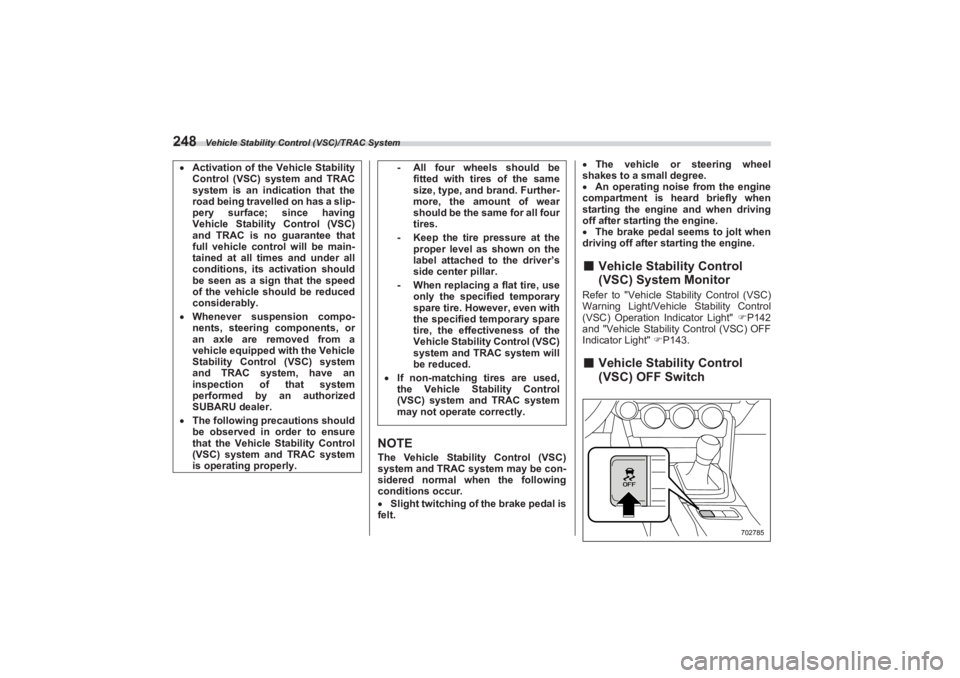
Indicator Light" P143.■ Vehicle Stability Control
(VSC) OFF Switch
Activation of the Vehicle Stability
Control (VSC) system and TRAC
system is an indication that the
road being travelled on has a slip-
pery surface; since having
Vehicle Stability Control (VSC)
and TRAC is no guarantee that
full vehicle control will be main-
tained at all times and under all
conditions, its activation should
be seen as a sign that the speed
of the vehicle should be reduced
considerably. Whenever suspension compo-
nents, steering components, or
an axle are removed from a
vehicle equipped with the Vehicle
Stability Control (VSC) system
and TRAC system, have an
inspection of that system
performed by an authorized
SUBARU dealer. The following precautions should
be observed in order to ensure
that the Vehicle Stability Control
(VSC) system and TRAC system
is operating properly.
- All four wheels should be
fitted with tires of the same
size, type, and brand. Further-
more, the amount of wear
should be the same for all four
tires.- Keep the tire pressure at the
proper level as shown on the
label attached to the driver’s
side center pillar.- When replacing a flat tire, use
only the specified temporary
spare tire. However, even with
the specified temporary spare
tire, the effectiveness of the
Vehicle Stability Control (VSC)
system and TRAC system will
be reduced.
If non-matching tires are used,
the Vehicle Stability Control
(VSC) system and TRAC system
may not operate correctly.
702785
BRZ_U.book 248 ページ 2022年3月29日 火曜日 午後3時59分
Page 288 of 432
Reverse Automatic Braking (RAB) System (If Equipped)
282
- There is an obstacle that is next
to an object.
- Going back along a wall.
- The area where the road starts
touching dirt and snow
- When reversing on an uneven
road.
In circumstances such as the
following, it may not be possible to
avoid a collision even when the system
operates normally. - Roads are slippery.
- The tire air pressure is not
correct.
- The tires have become worn.
- Tire chains are installed.
- Tires which are not the desig-
nated size are installed.
- Emergency repairs were
performed using a puncture repair
kit.
- The suspension was modified.
- Vehicle driving is unstable due to
accident or malfunction.
- The brake warning light is illumi-
nated.
■ Sonar Audible Alarm func -
tionWhen Reverse Automatic Braking (RAB)
system is in operation, an audible warning
beeps will sound in 3 levels to warn the
driver of a potential collision.
NOTEIt may take time to display the wall and
sound warning beeps after the object
was recognized by the Sonar Audible
Alarm function.
BRZ_U.book 282 ページ 2022年3月29日 火曜日 午後3時59分
Page 300 of 432
Winter Driving
294the one used previously, purge the old
fluid from the piping between the wind-
shield washer tank and washer nozzles by
operating the washer for a certain period
of time. Otherwise, if the concentration of
the fluid remaining in the piping is too low
for the outside temperature, it may freeze
and block the nozzles.
▼ Before driving your vehicle
Before entering the vehicle, remove any
snow or ice from your shoes because that
could make the pedals slippery and
driving dangerous.
While warming up the vehicle before
driving, check that the accelerator pedal,
brake pedal, and all other controls operate
smoothly.
Clear away ice and snow that has accu-
mulated under the fenders to avoid
making steering difficult. During severe
winter driving, stop when and where it is
safe to do so and check under the fenders
periodically.
▼ Parking in cold weather
CAUTION
Adjust the washer fluid concen-
tration appropriately for the
outside temperature. If the
concentration is inappropriate,
sprayed washer fluid may freeze
on the windshield and obstruct
your view, and the fluid may
freeze in the windshield washer
tank. State or local regulations on vola-
tile organic compounds may
restrict the use of methanol, a
common windshield washer anti-
freeze additive. Washer fluids
containing non-methanol anti-
freeze agents should be used
only if they provide cold weather
protection without damaging
your vehicle’s paint, wiper blades
or washer system.
WARNING
Snow can trap dangerous exhaust
gases under your vehicle. Keep
snow clear of the exhaust pipe and
from around your vehicle if you
park the vehicle in snow with the
engine running.
CAUTION
Do not use the parking brake
when parking for long periods in
cold weather since it could freeze
in that position. When the vehicle is parked in
snow or when it snows, raise the
wiper blades off the glass to
prevent damage to them. Under either of the following
conditions, icing may develop on
the brake system, which could
cause poor braking action.
- When the vehicle has been left
parked after use on roads
heavily covered with snow- When the vehicle has been left
parked during a snowstormCheck for snow or ice buildup on
the suspension, disc brakes and
brake hoses underneath the vehi-
cle. If there is caked snow or ice,
remove it, being careful not to
damage the disc brakes and
brake hoses and ABS harness.
BRZ_U.book 294 ページ 2022年3月29日 火曜日 午後3時59分
Page 326 of 432
Towing
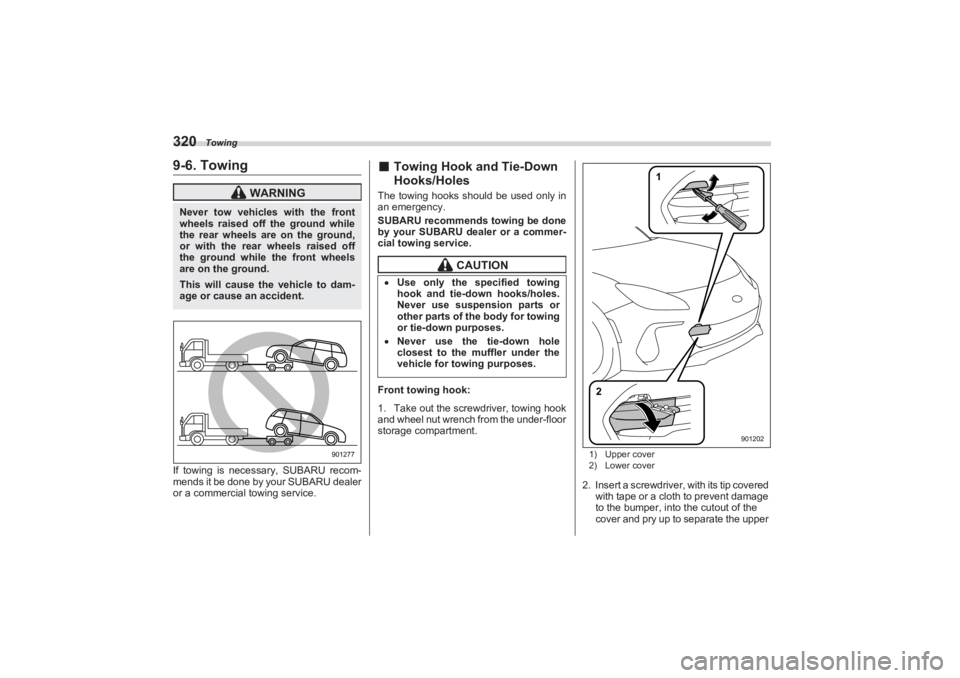
3209-6. TowingIf towing is necessary, SUBARU recom-
mends it be done by your SUBARU dealer
or a commercial towing service.
■ Towing Hook and Tie-Down
Hooks/HolesThe towing hooks should be used only in
an emergency.
SUBARU recommends towing be done
by your SUBARU dealer or a commer-
cial towing service.
Front towing hook:
1. Take out the screwdriver, towing hook
and wheel nut wrench from the under-floor
storage compartment.
1) Upper cover
2) Lower cover2. Insert a screwdriver, with its tip covered with tape or a cloth to prevent damage
to the bumper, into the cutout of the
cover and pry up to separate the upper
WARNING
Never tow vehicles with the front
wheels raised off the ground while
the rear wheels are on the ground,
or with the rear wheels raised off
the ground while the front wheels
are on the ground.
This will cause the vehicle to dam-
age or cause an accident.
901277
CAUTION
Use only the specified towing
hook and tie-down hooks/holes.
Never use suspension parts or
other parts of the body for towing
or tie-down purposes. Never use the tie-down hole
closest to the muffler under the
vehicle for towing purposes.
1
2
901202
BRZ_U.book 320 ページ 2022年3月29日 火曜日 午後3時59分
Page 330 of 432
Towing
324holes, return the plugs to their original
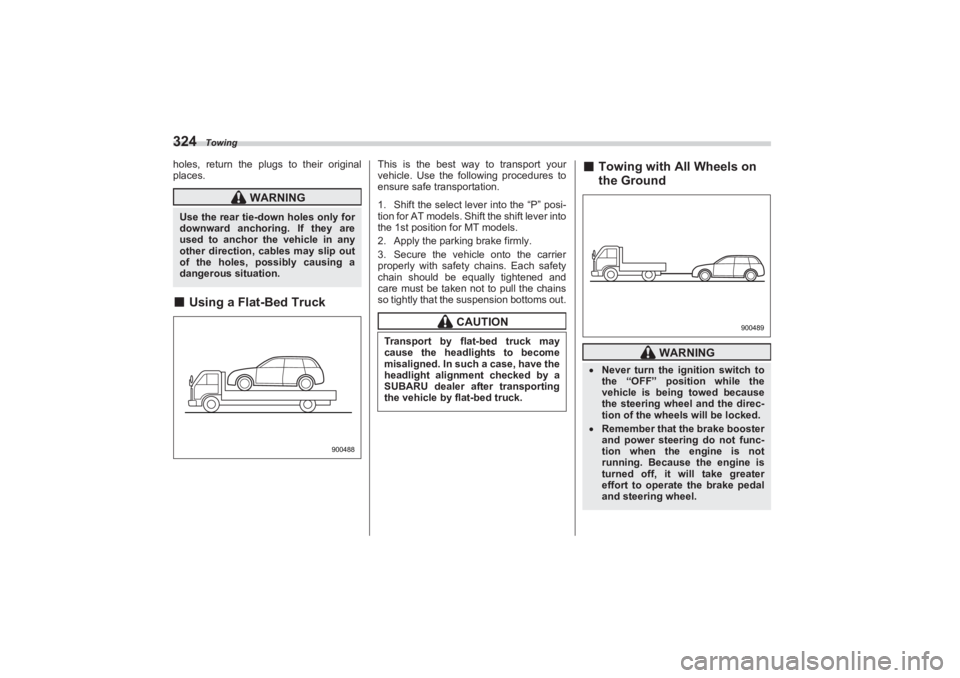
places.■Using a Flat-Bed Truck
This is the best way to transport your
vehicle. Use the following procedures to
ensure safe transportation.
1. Shift the select lever into the “P” posi-
tion for AT models. Sh ift the shift lever into
the 1st position for MT models.
2. Apply the parking brake firmly.
3. Secure the vehicle onto the carrier
properly with safety chains. Each safety
chain should be equally tightened and
care must be taken not to pull the chains
so tightly that the suspension bottoms out.
■ Towing with All Wheels on
the Ground
WARNING
Use the rear tie-down holes only for
downward anchoring. If they are
used to anchor the vehicle in any
other direction, cables may slip out
of the holes, possibly causing a
dangerous situation.
900488
CAUTION
Transport by flat -bed truck may
cause the headlights to become
misaligned. In such a case, have the
headlight alignment checked by a
SUBARU dealer after transporting
the vehicle by flat-bed truck.
WARNING
Never turn the ignition switch to
the “OFF” position while the
vehicle is being towed because
the steering wheel and the direc-
tion of the wheels will be locked. Remember that the brake booster
and power steering do not func-
tion when the engine is not
running. Because the engine is
turned off, it w ill take greater
effort to operate the brake pedal
and steering wheel.
900489
BRZ_U.book 324 ページ 2022年3月29日 火曜日 午後3時59分
Page 338 of 432
Exterior Care
33210-1. Exterior Care■Washing
NOTE
When having your vehicle washed in
an automatic car wash, make sure
beforehand that the car wash is of
suitable type.
The best way to preserve your vehicle’s
beauty is frequent washing. Wash the
vehicle at least once a month to avoid
contamination by road grime.
Wash dirt off with a wet sponge and plenty
of lukewarm or cold water. Do not wash
the vehicle with hot water and in direct
sunlight.
Salt, chemicals, insects, tar, soot, tree
sap, and bird droppings should be washed
off by using a light detergent, as required.
If you use a light detergent, make certain
that it is a neutral detergent. Do not use
strong soap or chemical detergents. All
cleaning agents should be promptly
flushed from the surface and not allowed
to dry there. Rinse the vehicle thoroughly with plenty of lukewarm water. Wipe the
remaining water off with a chamois or soft
cloth. Wear rubber gloves and use a hand
brush when washing down underbody,
inner fenders and suspension to effec-
tively remove mud and dirt off.
▼ Washing the underbody
Chemicals, salts and gravel used for
deicing road surfaces are extremely corro-
sive, accelerating the corrosion of under-
body components, such as the exhaust
system, fuel and brake lines, brake
cables, floor pan and fenders, and
suspension.
Thoroughly flush the underbody and
inside of the fenders with lukewarm or
cold water at frequent intervals to reduce
the harmful effects of such agents.
Mud and sand adhering to the underbody
components may accelerate their corro-
sion.
After driving off-road or on muddy or
sandy roads, wash the mud and sand off
the underbody.
Carefully flush the suspension and axle
parts, as they are particularly prone to
mud and sand buildup. Do not use a
sharp-edged tool to remove caked mud.
CAUTION
When washing the vehicle, the
brakes may get wet. As a result,
the brake stopping distance will
be longer. To dry the brakes,
drive the vehicle at a safe speed
while lightly pressing the brake
pedal to heat up the brakes. Do not wash the engine compart-
ment and areas adjacent to it. If
water enters the engine air intake
or electrical parts, it will cause
engine trouble or a malfunction of
the power steering. When washing inner fenders,
underbody, bumpers and
protruding objects such as
exhaust pipes and exhaust
finishers, be careful to prevent
injuries from contacting sharp
ends.
Do not use any organic solvents
when washing the surface of the
bulb assembly cover. However, if
a detergent with organic solvents
is used to wash the cover surface,
completely rinse off the detergent
with water. Otherwise, the cover
surface may be damaged.
BRZ_U.book 332 ページ 2022年3月29日 火曜日 午後3時59分
Page 339 of 432
Exterior Care
333
Appearance Care10
– CONTINUED –
▼Using a warm water washer
Keep a good distance of 12 in (30 cm)
or more between the washer nozzle and
the vehicle.
Do not wash the same area continu-
ously.
If a stain will not come out easily, wash
by hand. Some warm water washers are
of the high temperature, high pressure
type, and they can damage or deform the
resin parts such as moldings, or cause
water to leak in to the vehicle.■Waxing and PolishingAlways wash and dry the vehicle before
waxing and polishing.
Use a good quality polish and wax and
apply them according to the manufac-
turer’s instructions. Wax or polish when
the painted surface is cool. Be sure to polish and wax the chrome trim,
as well as the painted surfaces. Loss of
wax on a painted surface leads to loss of
the original luster and also quickens the
deterioration of the surface. It is recom-
mended that a coat of wax be applied at
least once a month, or whenever the
surface no longer repels water.
If the appearance of the paint has dimin-
ished to the point wher e the luster or tone
cannot be restored, lightly polish the
surface with a fine-grained compound.
Never polish just the affected area, but
include the surrounding area as well.
Always polish in only one direction. A No.
2000 grain compound is recommended.
Never use a coarse-grained compound.
Coarser grained compounds have a
smaller grain-size number and could
damage the paint. After polishing with a
compound, coat with wax to restore the
original luster. Frequent polishing with a
compound or an incorrect polishing tech-
nique will result in removing the paint layer
and exposing the undercoat. When in
doubt, it is always best to contact your
SUBARU dealer or an auto paint
specialist.
NOTEBe careful not to block the windshield
washer nozzles with wax when waxing
the vehicle.■ Cleaning Alloy WheelsPromptly wipe the alloy wheels clean of
any kind of grime or agent. If dirt is left on
too long, it may be difficult to clean off.
Do not use soap containing grit to clean
the wheels. Be sure to use a neutral
cleaning agent, and later rinse thoroughly
with water. Do not clean the wheels with a
stiff brush or expose them to a high-speed
washing device.
Clean the vehicle (including the alloy
wheels) with water as soon as possible
when it has been splashed with sea water,
exposed to sea breezes, or driven on
roads treated with salt or other agents.
CAUTION
Be careful not to damage brake
hoses, sensor harnesses, and
other parts when washing
suspension components. Be careful not to flush the engine
bottom for a long time. It may
cause damage of some electrical
parts.
CAUTION
Do not use any agents with organic
solvents on the surface of the bulb
assembly cover. However, if a pol-
ish or wax with organic solvents is
applied to the cover surface, com-
pletely wipe off the polish or wax.
Otherwise, the cover surface may
be damaged.
BRZ_U.book 333 ページ 2022年3月29日 火曜日 午後3時59分
Page 340 of 432
Corrosion Protection
334Do not use detergent on the wheels
when they are hot, such as after driving or
parking in hot weather.■ Alloy Wheels (Vehicles with
Matte Painted Wheels)As matte painted wheels require different
cleaning methods than conventional alloy
wheels, be sure to observe the following.
For details, consult your SUBARU dealer.
Remove dirt using water. If the wheels
are excessively dirty, use a sponge or soft
cloth dampened with a diluted neutral
detergent to remove the dirt.
To prevent the matte paint from being
damaged, make sure to observe the
following precautions:
- Do not scrub or polish the wheels
using a brush or dry cloth.
- Do not use any wheel coatings or
abrasive detergents.
10-2. Corrosion ProtectionYour SUBARU has been designed and
built to resist corrosi on. Special materials
and protective finishes have been used on
most parts of the vehicle to help maintain
fine appearance, strength, and reliable
operation.■ Most Common Causes of
CorrosionThe most common causes of corrosion
are:
The accumulation of moisture retaining
dirt and debris in body panel sections,
cavities, and other areas.
Damage to paint and other protective
coatings caused by gravel and stone
chips or minor accidents.
Corrosion is accelera ted on the vehicle
when:
It is exposed to road salt or dust control
chemicals, or used in coastal areas where
there is more salt in the air, or in areas
where there is considerable industrial
pollution.
It is driven in areas of high humidity,
especially when temperatures range just
above freezing.
Dampness in certain parts of the
vehicle remains for a long time, even though other parts of the vehicle may be
dry.
High temperatures will cause corrosion
to parts of the vehicle which cannot dry
quickly due to lack of proper ventilation.
■ To Help Prevent CorrosionWash the vehicle regularly to prevent
corrosion of the body and suspension
components. Also, wash the vehicle
promptly after driving on any of the
following surfaces.
Roads that have been salted to prevent
them from freezing in winter
Mud, sand, or gravel
Coastal roads
After the winter has ended, it is recom-
mended that the underbody be given a
very thorough washing.
Before the beginning of winter, check the
condition of underbody components, such
as the exhaust system, fuel and brake
lines, brake cables, suspension, steering
system, floor pan, and fenders. If any of
them are found to be rusted, they should
be given an appropriate rust prevention
treatment or should be replaced. Contact
your SUBARU dealer to perform this kind
of maintenance and treatment if you need
assistance.
Repair chips and scratches in the paint as
soon as you find them.
BRZ_U.book 334 ページ 2022年3月29日 火曜日 午後3時59分