tire size SUBARU BRZ 2023 Owners Manual
[x] Cancel search | Manufacturer: SUBARU, Model Year: 2023, Model line: BRZ, Model: SUBARU BRZ 2023Pages: 432, PDF Size: 16.56 MB
Page 51 of 432
Seatbelt Pretensioners
45
Seat, Seatbelt and SRS Airbags1
– CONTINUED –
When you sell your vehicle, we urge
you to inform the bu yer that the vehicle
is equipped with seatbelt
pretensioners. Also, notify the buyer of
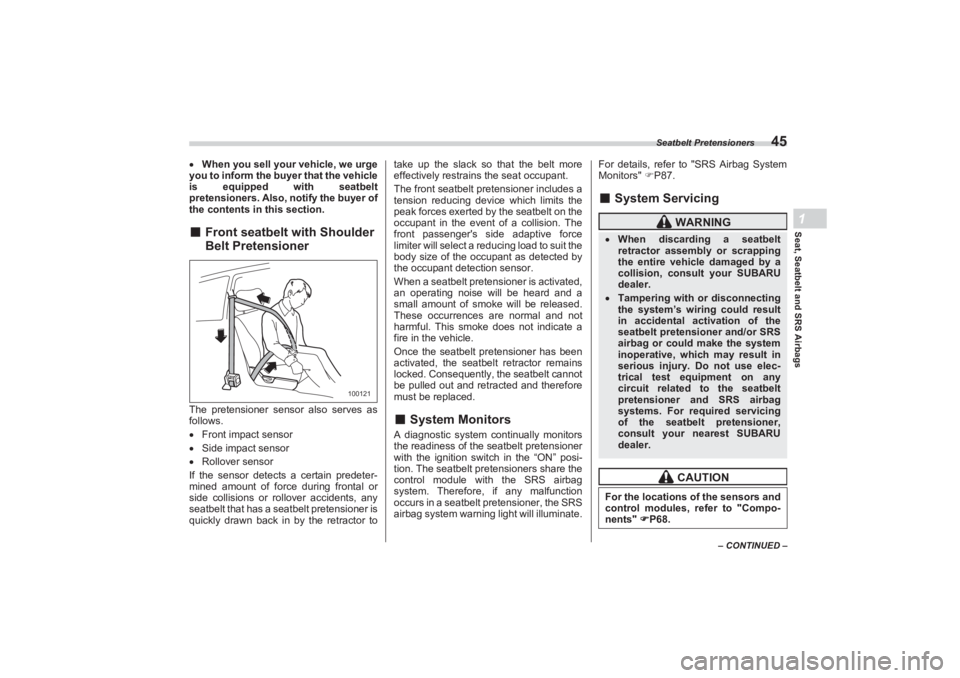
the contents in this section.■ Front seatbelt with Shoulder
Belt PretensionerThe pretensioner sensor also serves as
follows.
Front impact sensor
Side impact sensor
Rollover sensor
If the sensor detects a certain predeter-
mined amount of force during frontal or
side collisions or rollover accidents, any
seatbelt that has a se atbelt pretensioner is
quickly drawn back in by the retractor to take up the slack so
that the belt more
effectively restrains the seat occupant.
The front seatbelt pretensioner includes a
tension reducing device which limits the
peak forces exerted by the seatbelt on the
occupant in the event of a collision. The
front passenger's side adaptive force
limiter will select a reducing load to suit the
body size of the occupant as detected by
the occupant detection sensor.
When a seatbelt pretensioner is activated,
an operating noise will be heard and a
small amount of smoke will be released.
These occurrences are normal and not
harmful. This smoke does not indicate a
fire in the vehicle.
Once the seatbelt pretensioner has been
activated, the seatbelt retractor remains
locked. Consequently, the seatbelt cannot
be pulled out and retracted and therefore
must be replaced.
■ System MonitorsA diagnostic system continually monitors
the readiness of the seatbelt pretensioner
with the ignition switch in the “ON” posi-
tion. The seatbelt pr etensioners share the
control module with the SRS airbag
system. Therefore, if any malfunction
occurs in a seatbelt pretensioner, the SRS
airbag system warning light will illuminate. For details, refer to "SRS Airbag System
Monitors" P87.
■ System Servicing
100121
WARNING
When discarding a seatbelt
retractor assembly or scrapping
the entire vehicle damaged by a
collision, consult your SUBARU
dealer. Tampering with or disconnecting
the system’s wiring could result
in accidental activation of the
seatbelt pretensioner and/or SRS
airbag or could make the system
inoperative, which may result in
serious injury. Do not use elec-
trical test equipment on any
circuit related to the seatbelt
pretensioner and SRS airbag
systems. For required servicing
of the seatbelt pretensioner,
consult your nearest SUBARU
dealer.
CAUTION
For the locations of the sensors and
control modules, refer to "Compo-
nents" P68.
BRZ_U.book 45 ページ 2022年3月29日 火曜日 午後3時59分
Page 52 of 432
Child Restraint Systems
46NOTEIf the front or side part of the vehicle is
damaged in an accident to the extent
that the seatbelt pretensioner does not
operate, contact your SUBARU dealer
as soon as possible.■ Precautions against Vehicle
ModificationAlways consult your SUBARU dealer if
you want to install any accessory parts to
your vehicle.
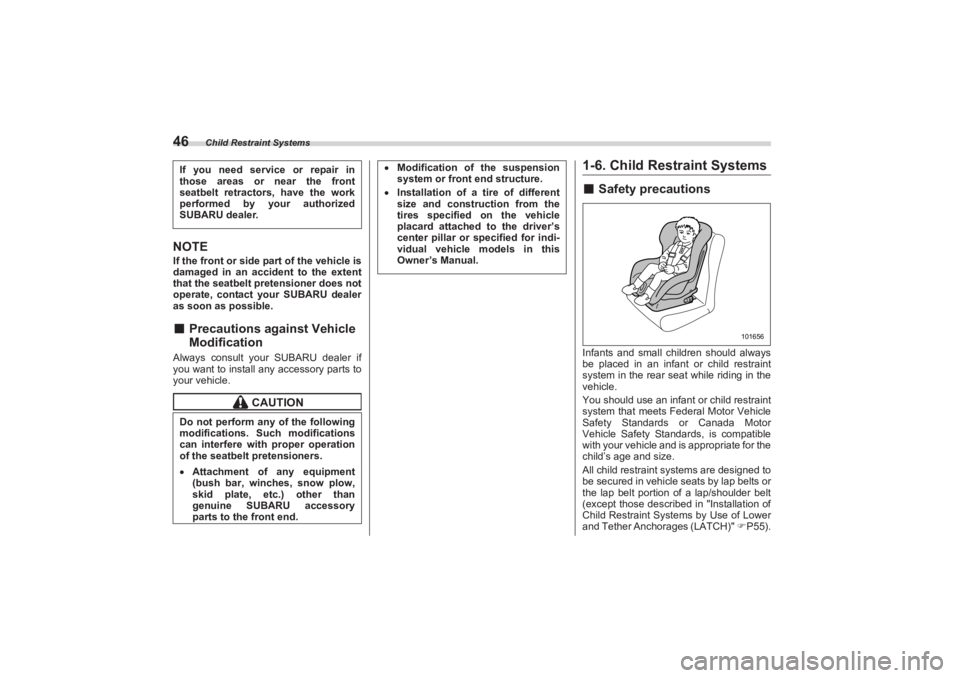
1-6. Child Restraint Systems■ Safety precautionsInfants and small children should always
be placed in an infant or child restraint
system in the rear seat while riding in the
vehicle.
You should use an infant or child restraint
system that meets Federal Motor Vehicle
Safety Standards or Canada Motor
Vehicle Safety Standards, is compatible
with your vehicle and is appropriate for the
child’s age and size.
All child restraint systems are designed to
be secured in vehicle seats by lap belts or
the lap belt portion of a lap/shoulder belt
(except those described in "Installation of
Child Restraint Systems by Use of Lower
and Tether Anchorages (LATCH)" P55).
If you need service or repair in
those areas or near the front
seatbelt retractors, have the work
performed by your authorized
SUBARU dealer.
CAUTION
Do not perform any of the following
modifications. Such modifications
can interfere with proper operation
of the seatbelt pretensioners. Attachment of any equipment
(bush bar, winches, snow plow,
skid plate, etc.) other than
genuine SUBARU accessory
parts to the front end.
Modification of the suspension
system or front end structure. Installation of a tire of different
size and construction from the
tires specified on the vehicle
placard attached to the driver’s
center pillar or specified for indi-
vidual vehicle models in this
Owner’s Manual.
101656
BRZ_U.book 46 ページ 2022年3月29日 火曜日 午後3時59分
Page 96 of 432
SRS Airbag (Supplemental Restraint System Airbag)
90
Always consult your SUBARU dealer if
you want to install any accessory parts on
your vehicle.
■ How to Contact the Vehicle
Manufacturer concerning
Modifications for Persons
with Disabilities That May
Affect the Advanced Airbag
SystemChanging or moving any parts of the front
seats, rear seat, se atbelts, front bumper,
front side frame, radiator panel, instru-
ment panel, combination meter, steering
wheel, steering colu mn, tire, suspension
or floor panel can affect the operation of
the SUBARU advanced airbag system. If
you have any questions, you may contact
the following SUBARU distributors.
Subaru of America, Inc.
Customer Advocacy Department
One Subaru Drive
P.O. Box 9103
Camden, NJ 08101-9877
1-800-SUBARU3 (1-800-782-2783)
Subaru Hawaii
2850-A Pukoloa St.,
Honolulu, HI 96819
877-215-0338
- Installation of additional elec- trical/electronic equipment
such as a mobile two-way
radio on or near the SRS
airbag system components
and/or wiring is not advisable.
This could interfere with
proper operation of the SRS
airbag system.- Modifications on or inside the
door panels for the purpose of
a speaker replacement or
sound insulation
The impact sensors, which detect
the pressure of an impact, are
located in the doors. Do not
modify any components of the
doors or door trims, such as the
addition of door speakers for
example. Any modifications to
the doors will create a risk of the
airbag system becoming inopera-
tive or unintended airbag deploy-
ment.
CAUTION
Do not perform any of the following
modifications. Such modifications
can interfere with proper operation
of the SRS airbag system.
Attachment of any equipment
(bush bar, winches, snow plow,
skid plate, etc.) other than
genuine SUBARU accessory
parts to the front end. Modification of the suspension
system or front end structure. Installation of a tire of different
size and construction from the
tires specified on the vehicle
placard attached to the driver’s
center pillar or specified for indi-
vidual vehicle models in this
Owner’s Manual. Attachment of any equipment
(side steps or side sill protectors,
etc.) other than genuine SUBARU
accessory parts to the side body.
BRZ_U.book 90 ページ 2022年3月29日 火曜日 午後3時59分
Page 144 of 432
Warning and Indicator Lights
138engine at the first safe opportunity and
contact your nearest SUBARU dealer
immediately.■ AT OIL TEMP Warning
Light (AT Models) If this light illuminates when the engine is
running, it may indicate that the transmis-
sion fluid temperature is too hot.
If the light illuminates while driving, imme-
diately stop the vehicle in a safe place and
let the engine idle until the warning light
turns off.■ Low Tire Pressure
Warning Light (If
Equipped)When the ignition switch is turned to the
“ON” position, the low tire pressure
warning light will illuminate for approxi-
mately 2 seconds to check that the tire
pressure monitoring system (TPMS) is
functioning properly. If there is no problem
and all tires are properly inflated, the light
will go out.
Each tire, including the spare (if provided),
should be checked monthly when cold
and inflated to the inflation pressure
recommended by the vehicle manufac-
turer on the vehicle placard or tire inflation
pressure label. (If your vehicle has tires of
a different size than the size indicated on the vehicle placard or tire inflation pres-
sure label, you should determine the
proper tire inflation pressure for those
tires.)
As an added safety feature, your vehicle
has been equipped with a tire pressure
monitoring system (TPMS) that illumi-
nates a low tire pressure telltale when one
or more of your tires is significantly under-
inflated. Accordingly, when the low tire
pressure telltale illuminates, you should
stop and check your tires as soon as
possible, and inflate them to the proper
pressure. Driving on a significantly under-
inflated tire causes the tire to overheat
and can lead to tire failure. Under-inflation
also reduces fuel efficiency and tire tread
life, and may affect the vehicle’s handling
and stopping ability.
Please note that the TP MS is not a substi-
tute for proper tire maintenance, and it is
the driver’s responsibility to maintain
correct tire pressure, even if under-infla-
tion has not reached the level to trigger
illumination of the TPMS low tire pressure
telltale.
Your vehicle has also been equipped with
a TPMS malfunction indicator to indicate
when the system is no t operating properly.
The TPMS malfunction indicator is
combined with the low tire pressure tell-
tale. When the system detects a malfunc-
tion, the telltale will flash for approximately one minute and then remain continuously
illuminated. This sequence will continue
upon subsequent vehicle start-ups as long
as the malfunction exists. When the
malfunction indicator is illuminated, the
system may not be able to detect or signal
low tire pressure as intended. TPMS
malfunctions may occur for a variety of
reasons, including the installation of
replacement or alternate tires or wheels
on the vehicle that prevent the TPMS from
functioning properly. Always check the
TPMS malfunction telltale after replacing
one or more tires or wheels on your
vehicle to ensure that the replacement or
alternate tires and wheels allow the TPMS
to continue to function properly.
Should the warning light illuminate
steadily after blinking for approximately
one minute, have the system inspected by
your nearest SUBARU dealer as soon as
possible.
WARNING
If this light does not illuminate
briefly after the ig nition switch is
turned on or the light illuminates
steadily after blinking for approxi-
mately one minute, you should have
your Tire Pressure Monitoring Sys-
tem checked at a SUBARU dealer as
soon as possible.
BRZ_U.book 138 ページ 2022年3月29日 火曜日 午後3時59分
Page 145 of 432
Warning and Indicator Lights
139
Instruments and Controls3
– CONTINUED –
If this light illuminates while driving,
never brake suddenly. Instead, per-
form the following procedure. Oth-
erwise an accident involving
serious vehicle damage and serious
personal injury could occur.1) Keep driving straight ahead while
gradually reducing speed.2) Slowly pull off the road to a safe
place.If this light still illuminates while
driving after adjusting the tire pres-
sure, a tire may have significant
damage and a fast leak that causes
the tire to lose air rapidly. If you
have a flat tire, replace it with a
spare tire as soon as possible.
When a spare tire is mounted or a
wheel rim is replaced without the
original pressure sensor/transmitter
being transferred, the Low tire pres-
sure warning light will illuminate
steadily after blinking for approxi-
mately one minute. This indicates
the TPMS is unable to monitor all
four road wheels. Contact your
SUBARU dealer as soon as possi-
ble for tire and sensor replacement
and/or system resetting. If the light
illuminates steadily after blinking
for approximately one minute,
promptly contact a SUBARU dealer
to have the system inspected.
CAUTION
The tire pressure monitoring sys-
tem is NOT a substitute for manu-
ally checking tire pressure. The tire
pressure should be checked period-
ically (at least monthly) using a tire
gauge. After any change to tire
pressure(s), the tire pressure moni-
toring system will not re-check tire
inflation pressures until the vehicle
is first driven mo re than 25 mph (40
km/h). After adjusting the tire pres-
sures, increase the vehicle speed to
at least 25 mph (40 km/h) to start the
TPMS re-checking of the tire infla-
tion pressures. If the tire pressures
are now above the severe low pres-
sure threshold, the low tire pres-
sure warning light should turn off a
few minutes later. Therefore, be
sure to install the specified size for
the front and rear tires.
BRZ_U.book 139 ページ 2022年3月29日 火曜日 午後3時59分
Page 254 of 432
Vehicle Stability Control (VSC)/TRAC System
248
NOTEThe Vehicle Stability Control (VSC)
system and TRAC system may be con-
sidered normal when the following
conditions occur.
Slight twitching of the brake pedal is
felt.
The vehicle or steering wheel
shakes to a small degree.
An operating noise from the engine
compartment is heard briefly when
starting the engine and when driving
off after starti ng the engine.
The brake pedal seems to jolt when
driving off after st arting the engine.
■Vehicle Stability Control
(VSC) System MonitorRefer to "Vehicle Stability Control (VSC)
Warning Light/Vehicle Stability Control
(VSC) Operation Indicator Light" P142
and "Vehicle Stability Control (VSC) OFF
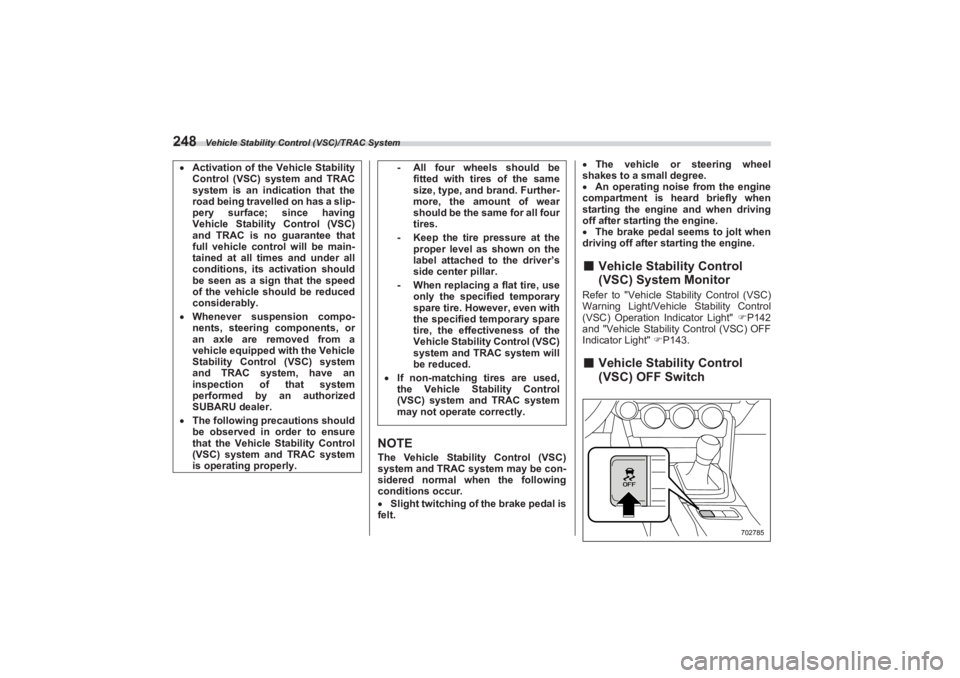
Indicator Light" P143.■ Vehicle Stability Control
(VSC) OFF Switch
Activation of the Vehicle Stability
Control (VSC) system and TRAC
system is an indication that the
road being travelled on has a slip-
pery surface; since having
Vehicle Stability Control (VSC)
and TRAC is no guarantee that
full vehicle control will be main-
tained at all times and under all
conditions, its activation should
be seen as a sign that the speed
of the vehicle should be reduced
considerably. Whenever suspension compo-
nents, steering components, or
an axle are removed from a
vehicle equipped with the Vehicle
Stability Control (VSC) system
and TRAC system, have an
inspection of that system
performed by an authorized
SUBARU dealer. The following precautions should
be observed in order to ensure
that the Vehicle Stability Control
(VSC) system and TRAC system
is operating properly.
- All four wheels should be
fitted with tires of the same
size, type, and brand. Further-
more, the amount of wear
should be the same for all four
tires.- Keep the tire pressure at the
proper level as shown on the
label attached to the driver’s
side center pillar.- When replacing a flat tire, use
only the specified temporary
spare tire. However, even with
the specified temporary spare
tire, the effectiveness of the
Vehicle Stability Control (VSC)
system and TRAC system will
be reduced.
If non-matching tires are used,
the Vehicle Stability Control
(VSC) system and TRAC system
may not operate correctly.
702785
BRZ_U.book 248 ページ 2022年3月29日 火曜日 午後3時59分
Page 288 of 432
Reverse Automatic Braking (RAB) System (If Equipped)
282
- There is an obstacle that is next
to an object.
- Going back along a wall.
- The area where the road starts
touching dirt and snow
- When reversing on an uneven
road.
In circumstances such as the
following, it may not be possible to
avoid a collision even when the system
operates normally. - Roads are slippery.
- The tire air pressure is not
correct.
- The tires have become worn.
- Tire chains are installed.
- Tires which are not the desig-
nated size are installed.
- Emergency repairs were
performed using a puncture repair
kit.
- The suspension was modified.
- Vehicle driving is unstable due to
accident or malfunction.
- The brake warning light is illumi-
nated.
■ Sonar Audible Alarm func -
tionWhen Reverse Automatic Braking (RAB)
system is in operation, an audible warning
beeps will sound in 3 levels to warn the
driver of a potential collision.
NOTEIt may take time to display the wall and
sound warning beeps after the object
was recognized by the Sonar Audible
Alarm function.
BRZ_U.book 282 ページ 2022年3月29日 火曜日 午後3時59分
Page 298 of 432
Periodic Inspections
2928-5. Periodic InspectionsTo keep your vehicle in the best condition
at all times, always have the recom-
mended maintenance services listed in
the maintenance schedule in the
“Warranty and Maintenance Booklet”
performed at the specified time or mileage
intervals.
8-6. Driving in Foreign Coun-triesWhen planning to use your vehicle in
another country:
Confirm the availability of the correct
fuel. Refer to "F uel Requirements"
P223.
Comply with all regulations and
requirements of each country.
8-7. Driving Tips
WARNING
Always maintain a safe driving
speed according to the road and
weather conditions in order to
avoid having an accident on a
sharp turn, during sudden
braking or under other similar
conditions. When replacing or installing
tire(s), all four tires must be the
same for the following items.
(a) Size(b) Speed symbol(c) Load index(d) Circumference(e) Construction(f) Manufacturer(g) Brand (tread pattern)(h) Degrees of wearFor items (a) to (c), you must
obey the specification that is
printed on the ti re inflation pres-
sure label. The tire inflation pres-
sure label is located on the
driver’s center pillar.
BRZ_U.book 292 ページ 2022年3月29日 火曜日 午後3時59分
Page 302 of 432
Winter Driving
296warning flasher to alert other drivers.
Refer to "Hazard Warning Flasher"
P127.
We recommend use of non-freezing type
wiper blades (winter blades) during the
seasons you could have snow and
freezing temperatures. Blades of this type
give superior wiping performance in
snowy conditions. Be sure to use blades
that are suitable for your vehicle.NOTEWhen the season requiring non-freez-
ing type wiper blades is over, replace
them with standard wiper blades.■ Corrosion ProtectionRefer to "Corrosion Protection" P334.
■ Snow Tires
In winter, it may be possible to enhance
performance through use of tires
designed specifically for winter driving
conditions.
If you choose to install winter tires on your
vehicle, be sure to use the correct tire size
and type.
You must install four winter tires that are of
the same size, construction, brand and
load range and you should never mix
radial, belted bias or bias tires since this
may result in dangerous handling charac-
teristics. When you choose a tire, make
sure that there is enough clearance
between the tire and vehicle body.
CAUTION
During high-speed driving, non-
freezing type wiper blades may not
perform as well as standard wiper
blades. If this happens, reduce the
vehicle speed.
WARNING
When replacing or installing
winter tire(s), all four tires must
be the same for the following
items.
(a) Size(b) Speed symbol(c) Load index(d) Circumference(e) Construction(f) Manufacturer(g) Brand (tread pattern)(h) Degrees of wearFor items (a) to (c), you must
obey the specification that is
printed on the tire inflation pres-
sure label. The ti re inflation pres-
sure label is located on the
driver’s center pillar.If all four tires are not the same in
items (a) to (h), serious mechani-
cal damage could be caused to
the drivetrain of the car, and
affect the followings.
-Ride-Handling- Braking- Speedometer/Odometer cali-
bration- Clearance between the body
and the tires
It also may be dangerous and
lead to loss of vehicle control,
and it can lead to an accident.
Do not use a combination of
radial, belted bias or bias tires
since it may cause dangerous
handling characteristics and lead
to an accident.
BRZ_U.book 296 ページ 2022年3月29日 火曜日 午後3時59分
Page 303 of 432
Loading Your Vehicle
297
Driving Tips8
– CONTINUED –
Remember to drive with care at all times
regardless of the type of tires on your
vehicle.■ Tire Chains
NOTEWhen tire chains cannot be used, use
of another type of traction device
(such as spring chains) may be
acceptable if use on your vehicle is
recommended by the device manufac-
turer, taking into account tire size and
road conditions. Follow the device
manufacturer’s instructions, espe-
cially regarding maximum vehicle
speed.
To help avoid damage to your vehicle,
drive slowly, readjust or remove the
device if it is contacting your vehicle,
and do not spin your wheels. Damage
caused to your vehicle by use of a
traction device is not covered under
warranty.
Make certain that any traction device
you use is an SAE class S device, and use it on the rear wheels only. Always
use the utmost care when driving with
a traction device. Overconfidence
because you are using a traction
device could easily lead to a serious
accident.
■ Rocking the VehicleIf you must rock the v ehicle to free it from
snow, sand, or mud, depress the acceler-
ator pedal slightly and move the shift
lever/select lever back and forth between
“1” (MT model)/“D” (AT model) and “R”
repeatedly. Do not race the engine. For
the best possible traction, avoid spinning
the wheels when trying to free the vehicle.
When the road surface is extremely slip-
pery, you can obtain better traction by
starting the vehicle with the transmission
in 2nd than in 1st (MT models).
If your vehicle is a AT model, Snow mode
can be used. For details about how to use
the mode, refer to "Driving Mode Select
Switch (If Equipped)" P241.
8-9. Loading Your Vehicle
CAUTION
Tire chains cannot be used on your
vehicle because of the lack of clear-
ance between the tires and vehicle
body.
WARNING
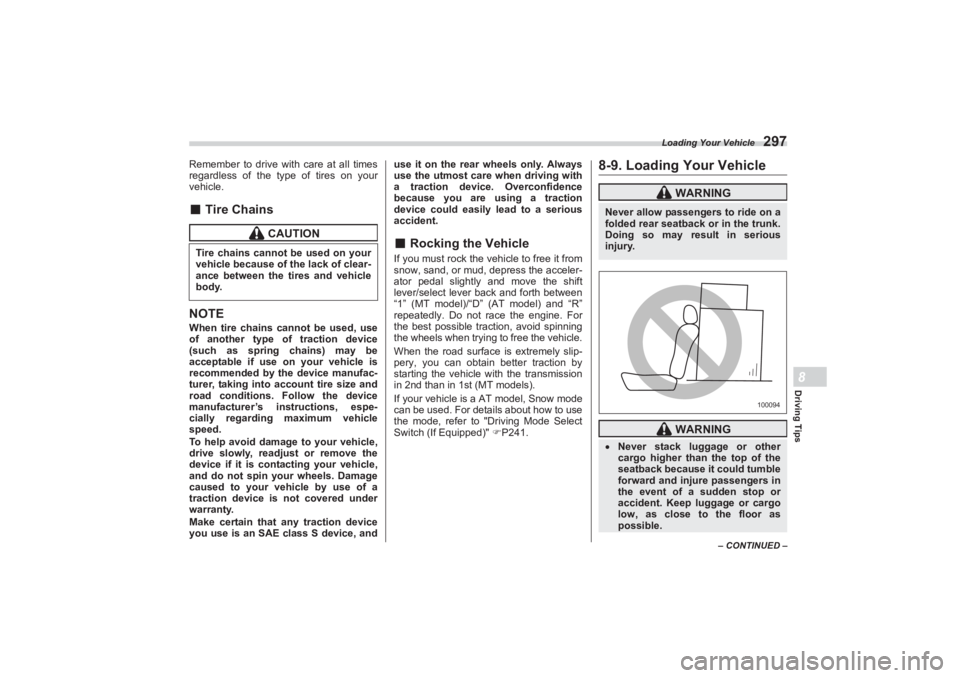
Never allow passengers to ride on a
folded rear seatback or in the trunk.
Doing so may result in serious
injury.
WARNING
Never stack luggage or other
cargo higher than the top of the
seatback because it could tumble
forward and injure passengers in
the event of a sudden stop or
accident. Keep luggage or cargo
low, as close to the floor as
possible.
100094
BRZ_U.book 297 ページ 2022年3月29日 火曜日 午後3時59分