warning SUBARU CROSSTREK 2018 Owners Manual
[x] Cancel search | Manufacturer: SUBARU, Model Year: 2018, Model line: CROSSTREK, Model: SUBARU CROSSTREK 2018Pages: 474, PDF Size: 20.76 MB
Page 406 of 474
(419,1)
北米Model "A1320BE-C" EDITED: 2017/ 10/ 10
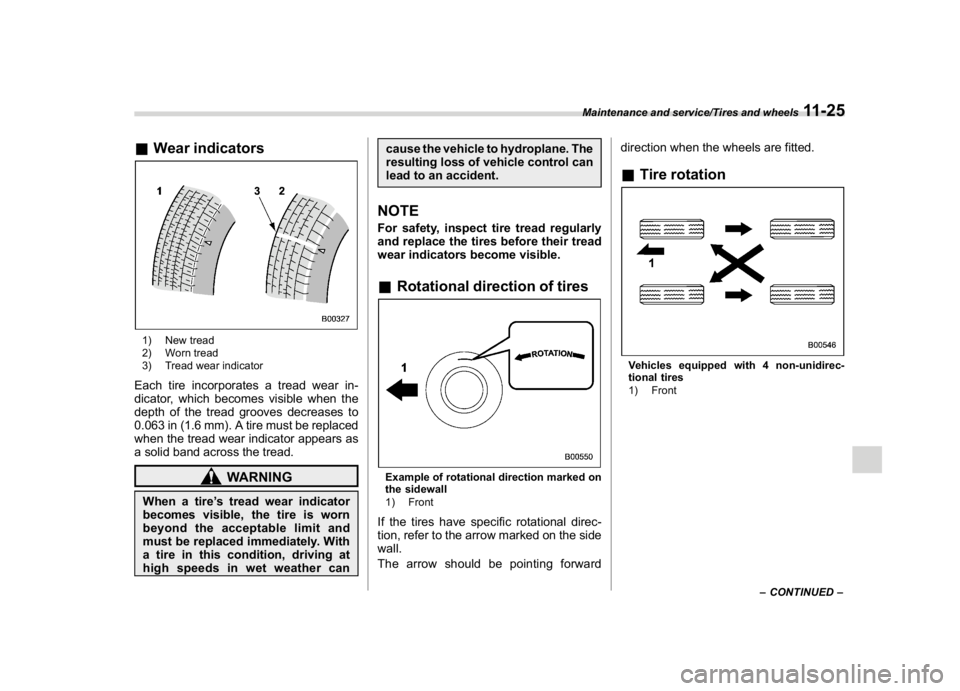
&Wear indicators1) New tread
2) Worn tread
3) Tread wear indicatorEach tire incorporates a tread wear in-
dicator, which becomes visible when the
depth of the tread grooves decreases to
0.063 in (1.6 mm). A tire must be replaced
when the tread wear indicator appears as
a solid band across the tread.
WARNING
When a tire’s tread wear indicator
becomes visible, the tire is worn
beyond the acceptable limit and
must be replaced immediately. With
a tire in this condition, driving at
high speeds in wet weather cancause the vehicle to hydroplane. The
resulting loss of vehicle control can
lead to an accident.
NOTEFor safety, inspect tire tread regularly
and replace the tires before their tread
wear indicators become visible.&Rotational direction of tiresExample of rotational direction marked on
the sidewall
1) FrontIf the tires have specific rotational direc-
tion, refer to the arrow marked on the side
wall.
The arrow should be pointing forwarddirection when the wheels are fitted.
&Tire rotationVehicles equipped with 4 non-unidirec-
tional tires
1) Front
–CONTINUED–
Maintenance and service/Tires and wheels
11-25
11
Page 407 of 474
(420,1)
北米Model "A1320BE-C" EDITED: 2017/ 10/ 10
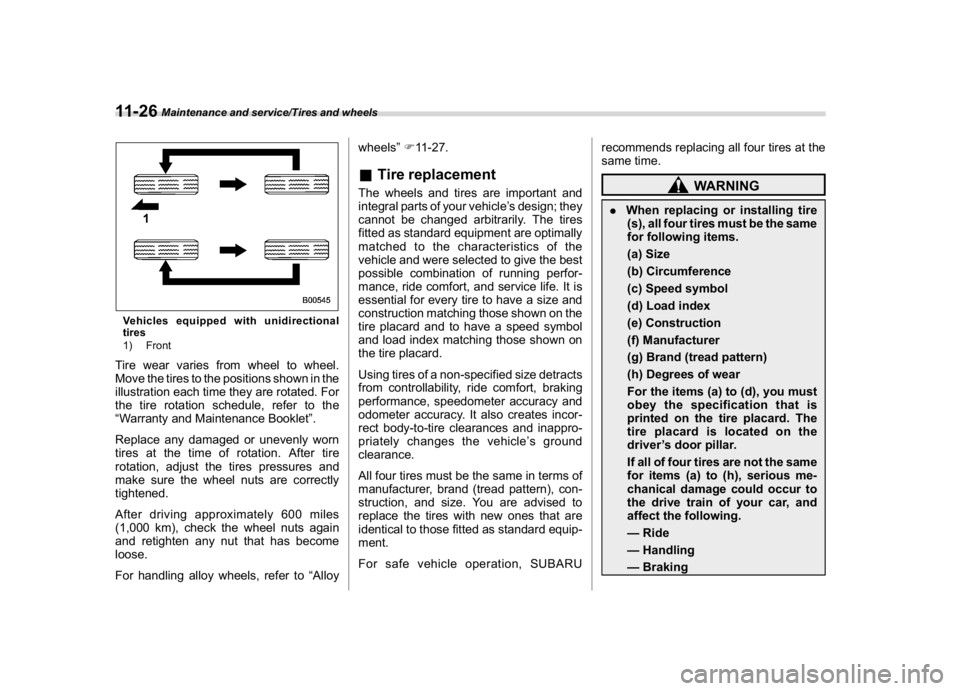
Vehicles equipped with unidirectional
tires
1) FrontTire wear varies from wheel to wheel.
Move the tires to the positions shown in the
illustration each time they are rotated. For
the tire rotation schedule, refer to the
“Warranty and Maintenance Booklet”.
Replace any damaged or unevenly worn
tires at the time of rotation. After tire
rotation, adjust the tires pressures and
make sure the wheel nuts are correctly
tightened.
After driving approximately 600 miles
(1,000 km), check the wheel nuts again
and retighten any nut that has become
loose.
For handling alloy wheels, refer to“Alloywheels”F11-27.
&Tire replacementThe wheels and tires are important and
integral parts of your vehicle’s design; they
cannot be changed arbitrarily. The tires
fitted as standard equipment are optimally
matched to the characteristics of the
vehicle and were selected to give the best
possible combination of running perfor-
mance, ride comfort, and service life. It is
essential for every tire to have a size and
construction matching those shown on the
tire placard and to have a speed symbol
and load index matching those shown on
the tire placard.
Using tires of a non-specified size detracts
from controllability, ride comfort, braking
performance, speedometer accuracy and
odometer accuracy. It also creates incor-
rect body-to-tire clearances and inappro-
priately changes the vehicle’s ground
clearance.
All four tires must be the same in terms of
manufacturer, brand (tread pattern), con-
struction, and size. You are advised to
replace the tires with new ones that are
identical to those fitted as standard equip-
ment.
For safe vehicle operation, SUBARUrecommends replacing all four tires at the
same time.
WARNING
.When replacing or installing tire
(s), all four tires must be the same
for following items.
(a) Size
(b) Circumference
(c) Speed symbol
(d) Load index
(e) Construction
(f) Manufacturer
(g) Brand (tread pattern)
(h) Degrees of wear
For the items (a) to (d), you must
obey the specification that is
printed on the tire placard. The
tire placard is located on the
driver’s door pillar.
If all of four tires are not the same
for items (a) to (h), serious me-
chanical damage could occur to
the drive train of your car, and
affect the following.
—Ride
—Handling
—Braking
Maintenance and service/Tires and wheels
11-26
Page 408 of 474
(421,1)
北米Model "A1320BE-C" EDITED: 2017/ 10/ 10
—Speedometer/Odometer
calibration
—Clearance between the body
and tires
It also may be dangerous and
lead to loss of vehicle control,
and it can lead to an accident.
.Use only radial tires. Do not use
radial tires together with belted
bias tires and/or bias-ply tires.
Doing so can dangerously re-
duce controllability, resulting in
an accident.
&Wheel replacementWhen replacing wheels due, for example,
to damage, make sure the replacement
wheels match the specifications of the
wheels that are fitted as standard equip-
ment. Replacement wheels are available
from SUBARU dealers.
WARNING
Use only those wheels that are
specified for your vehicle. Wheels
not meeting specifications could
interfere with brake caliper opera-
tion and may cause the tires to rub
against the wheel well housing dur-
ing turns. The resulting loss of
vehicle control could lead to an
accident.NOTEWhen any of the wheels are removed
and replaced for tire rotation or for any
other reason, always check the tight-
ness of the wheel nuts after driving
approximately 600 miles (1,000 km). If
any nut is loose, tighten it to the
specified torque.
Alloy wheelsAlloy wheels can be scratched and da-
maged easily. Handle them carefully to
maintain their appearance, performance,
and safety.
.When any of the wheels are removed
and replaced for tire rotation or to change a
flat tire, always check the tightness of the
wheel nuts after driving approximately 600
miles (1,000 km). If any nut is loose,
tighten it to the specified torque.
.Never apply oil to the threaded parts,
wheel nuts, or tapered surface of the
wheel.
.Never let the wheel rub against sharp
protrusions or curbs.
.When wheel nuts, balance weights, or
the center cap is replaced, be sure to
replace them with genuine SUBARU parts
designed for alloy wheels.
.When stacking and storing removed
tires, place shock-absorbing material be-
tween the tires to protect the wheels from
becoming scratched.
Maintenance and service/Alloy wheels
11-27
11
Page 409 of 474
(422,1)
北米Model "A1320BE-C" EDITED: 2017/ 10/ 10
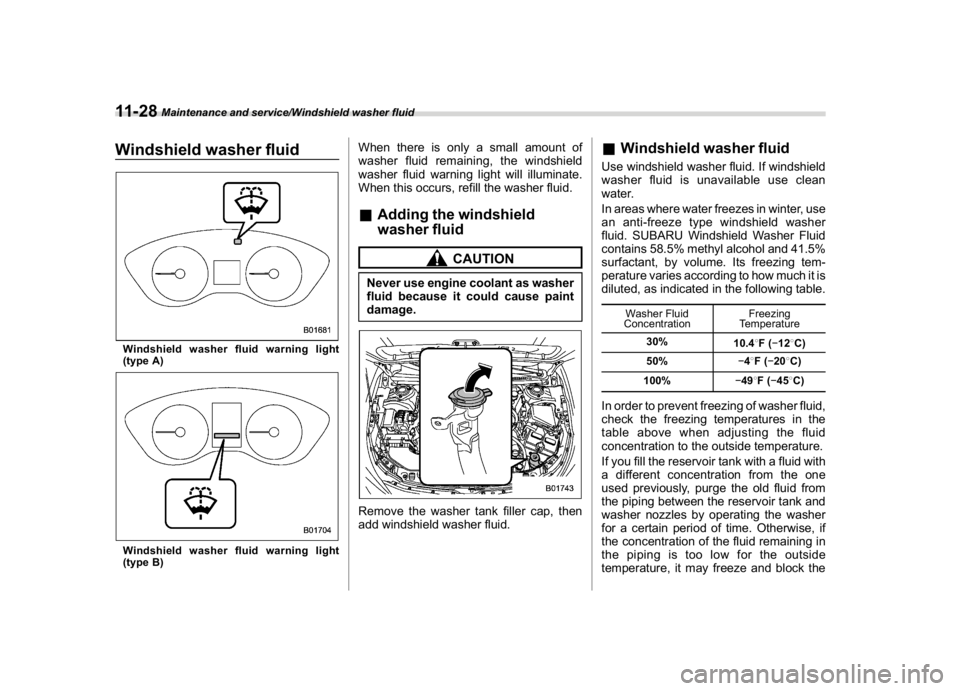
Windshield washer fluidWindshield washer fluid warning light
(type A)Windshield washer fluid warning light
(type B)
When there is only a small amount of
washer fluid remaining, the windshield
washer fluid warning light will illuminate.
When this occurs, refill the washer fluid.&Adding the windshield
washer fluid
CAUTION
Never use engine coolant as washer
fluid because it could cause paint
damage.Remove the washer tank filler cap, then
add windshield washer fluid.
&Windshield washer fluidUse windshield washer fluid. If windshield
washer fluid is unavailable use clean
water.
In areas where water freezes in winter, use
an anti-freeze type windshield washer
fluid. SUBARU Windshield Washer Fluid
contains 58.5% methyl alcohol and 41.5%
surfactant, by volume. Its freezing tem-
perature varies according to how much it is
diluted, as indicated in the following table.
Washer Fluid
ConcentrationFreezing
Temperature
30%
10.48F(128C)
50%48F(208C)
100%498F(458C)
In order to prevent freezing of washer fluid,
check the freezing temperatures in the
table above when adjusting the fluid
concentration to the outside temperature.
If you fill the reservoir tank with a fluid with
a different concentration from the one
used previously, purge the old fluid from
the piping between the reservoir tank and
washer nozzles by operating the washer
for a certain period of time. Otherwise, if
the concentration of the fluid remaining in
the piping is too low for the outside
temperature, it may freeze and block the
Maintenance and service/Windshield washer fluid
11-28
Page 414 of 474
(427,1)
北米Model "A1320BE-C" EDITED: 2017/ 10/ 10
ends. If the rubber is not retained properly,
the wiper may scratch the rear window
glass.
5. Install the wiper blade assembly to the
wiper arm. Make sure that it locks in place.
6. Hold the wiper arm by hand and slowly
lower it in position.
Battery
WARNING
.Before beginning work on or near
any battery, be sure to extinguish
all cigarettes, matches, and light-
ers. Never expose a battery to an
open flame or electric sparks.
Batteries give off a gas which is
highly flammable and explosive.
.For safety, in case an explosion
does occur, wear eye protection
or shield your eyes when working
near any battery. Never lean over
a battery.
.Do not let battery fluid contact
eyes, skin, fabrics, or paint be-
cause battery fluid is a corrosive
acid. If battery fluid gets on your
skin or in your eyes, immediately
flush the area with water thor-
oughly. Seek medical help imme-
diately if acid has entered the
eyes.
If battery fluid is accidentally
swallowed, immediately drink a
large amount of milk or water,
and seek medical attention im-
mediately.
.Tolessentheriskofsparks,remove rings, metal watchbands,
and other metal jewelry. Never
allow metal tools to contact the
positive battery terminal and any-
thing connected to it WHILE you
are at the same time in contact
with any other metallic portion of
the vehicle because a short cir-
cuit will result.
.Keep everyone including children
away from the battery.
.Charge the battery in a well-
ventilated area.
.Battery posts, terminals and re-
lated accessories contain lead
and lead compounds, chemicals
known to the State of California
to cause cancer and reproductive
harm. Batteries also contain
other chemicals known to the
State of California to cause can-
cer.
Wash hands after handling
.
–CONTINUED–
Maintenance and service/Battery
11-33
11
Page 417 of 474
(430,1)
北米Model "A1320BE-C" EDITED: 2017/ 10/ 10
Replacing bulbs
WARNING
Bulbs may become very hot while
illuminated. Before replacing bulbs,
turn off the lights and wait until the
bulbs cool down. Otherwise, there is
a risk of sustaining a burn injury.
CAUTION
Replace any bulb only with a new
bulb of the specified wattage. Using
a bulb of different wattage could
result in a fire. For the specified
wattage of each bulb, refer to“Bulb
chart”F12-14.NOTEFor models with type B combination
meter, if SRH is malfunctioning, the
SRH OFF indicator appears on the
combination meter when the ignition
switch is in the“ON”position. It
indicates that SRH has been deacti-
vated. Contact a SUBARU dealer for an
inspection.
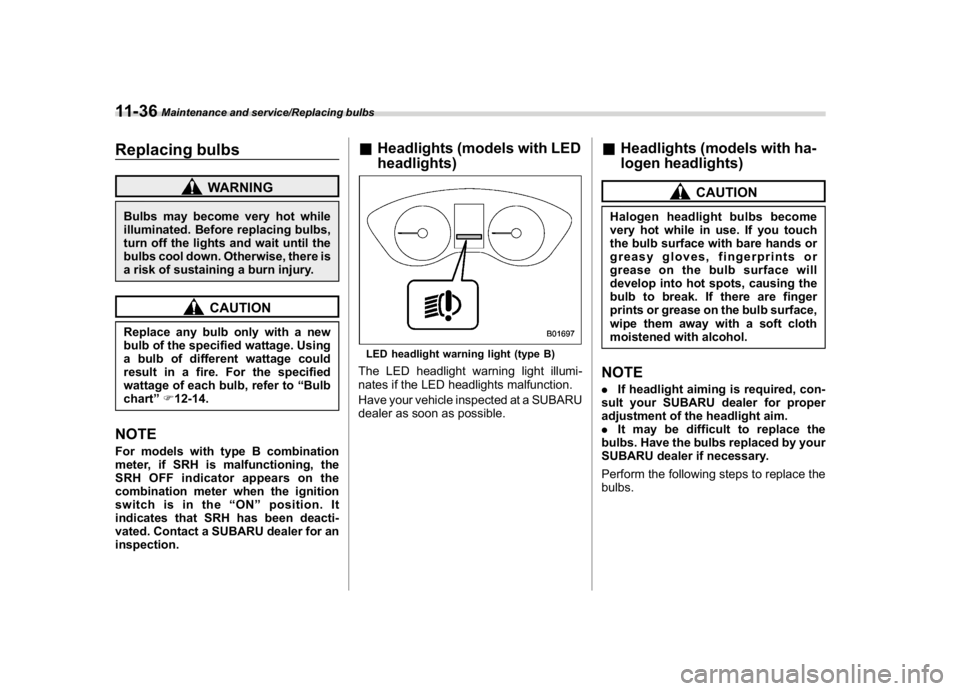
&Headlights (models with LED
headlights)LED headlight warning light (type B)The LED headlight warning light illumi-
nates if the LED headlights malfunction.
Have your vehicle inspected at a SUBARU
dealer as soon as possible.
&Headlights (models with ha-
logen headlights)
CAUTION
Halogen headlight bulbs become
very hot while in use. If you touch
the bulb surface with bare hands or
greasy gloves, fingerprints or
grease on the bulb surface will
develop into hot spots, causing the
bulb to break. If there are finger
prints or grease on the bulb surface,
wipe them away with a soft cloth
moistened with alcohol.NOTE.If headlight aiming is required, con-
sult your SUBARU dealer for proper
adjustment of the headlight aim.
.It may be difficult to replace the
bulbs. Have the bulbs replaced by your
SUBARU dealer if necessary.
Perform the following steps to replace the
bulbs.
Maintenance and service/Replacing bulbs
11-36
Page 439 of 474
(454,1)
北米Model "A1320BE-C" EDITED: 2017/ 10/ 10
Bulb chart&Safety precautions
WARNING
Bulbs may become very hot while
illuminated. Before replacing bulbs,
turn off the lights and wait until the
bulbs cool down. Otherwise, there is
a risk of sustaining a burn injury.
CAUTION
Replace any bulb only with a new
bulb of the specified wattage. Using
a bulb of different wattage could
result in a fire.
Specifications/Bulb chart
12-14
Page 446 of 474
(463,1)
北米Model "A1320BE-C" EDITED: 2017/ 10/ 10
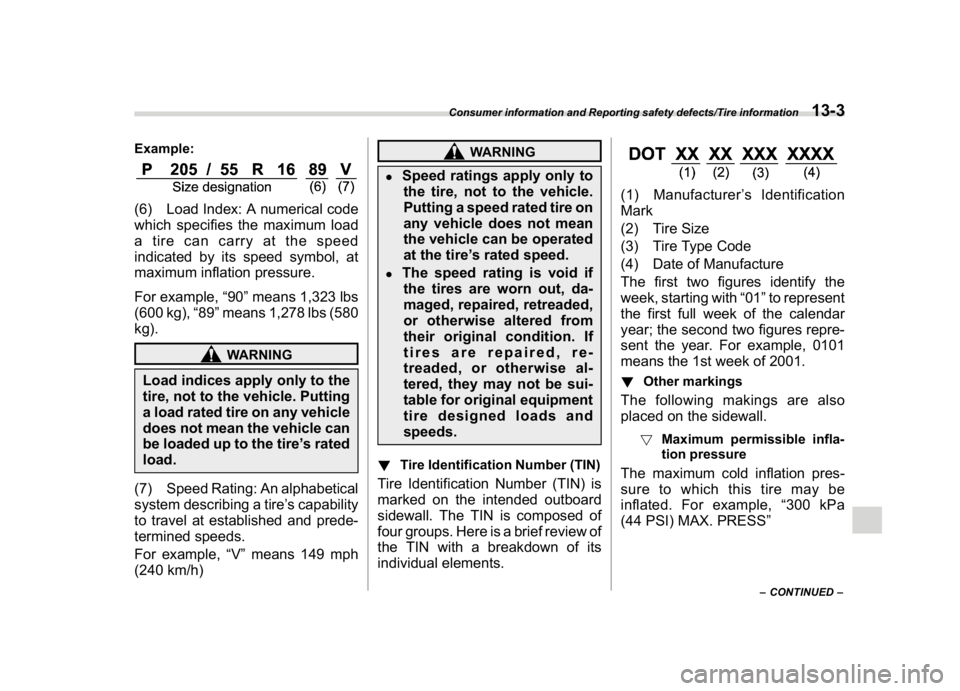
Example:(6) Load Index: A numerical code
which specifies the maximum load
a tire can carry at the speed
indicated by its speed symbol, at
maximum inflation pressure.
For example,“90”means 1,323 lbs
(600 kg),“89”means 1,278 lbs (580
kg).
WARNING
Load indices apply only to the
tire, not to the vehicle. Putting
a load rated tire on any vehicle
does not mean the vehicle can
be loaded up to the tire’s rated
load.
(7) Speed Rating: An alphabetical
system describing a tire’s capability
to travel at established and prede-
termined speeds.
For example,“V”means 149 mph
(240 km/h)
WARNING
.
Speed ratings apply only to
the tire, not to the vehicle.
Putting a speed rated tire on
any vehicle does not mean
the vehicle can be operated
at the tire’s rated speed.
.
The speed rating is void if
the tires are worn out, da-
maged, repaired, retreaded,
or otherwise altered from
their original condition. If
tires are repaired, re-
treaded, or otherwise al-
tered, they may not be sui-
table for original equipment
tire designed loads and
speeds.
!Tire Identification Number (TIN)Tire Identification Number (TIN) is
marked on the intended outboard
sidewall. The TIN is composed of
four groups. Here is a brief review of
the TIN with a breakdown of its
individual elements.
(1) Manufacturer’s Identification
Mark
(2) Tire Size
(3) Tire Type Code
(4) Date of Manufacture
The first two figures identify the
week, starting with“01”to represent
the first full week of the calendar
year; the second two figures repre-
sent the year. For example, 0101
means the 1st week of 2001.!Other markingsThe following makings are also
placed on the sidewall.
!Maximum permissible infla-
tion pressure
The maximum cold inflation pres-
sure to which this tire may be
inflated. For example,“300 kPa
(44 PSI) MAX. PRESS”
–CONTINUED–
Consumer information and Reporting safety defects/Tire information
13-3
13
Page 447 of 474
(464,1)
北米Model "A1320BE-C" EDITED: 2017/ 10/ 10
!Maximum load rating
The load rating at the maximum
permissible weight load for this tire.
For example,“MAX. LOAD 580 kg
(1279 LBS) @ 300 kPa (44 PSI)
MAX. PRESS.”
WARNING
Maximum load rating applies
only to the tire, not to the
vehicle. Putting a load rated
tire on any vehicle does not
mean the vehicle can be
loaded up to the tire’s rated
load.!Construction type
Applicable construction of this tire.
For example,“TUBELESS STEEL
BELTED RADIAL”
!Construction
The generic name of each cord
material used in the plies (both
sidewall and tread area) of this tire.
For example,“PLIES: TREAD 2STEEL + 2 POLYESTER SIDE-
WALL 2 POLYESTER”
!Uniform Tire Quality Grading
(UTQG)
For details, refer to“
Uniform tire
quality grading standards”F13-14.
&Recommended tire inflation
pressure!Recommended cold tire infla-
tion pressureFor recommended cold tire inflation
pressure for your vehicle’s tires,
refer to“
Tires”F12-8.
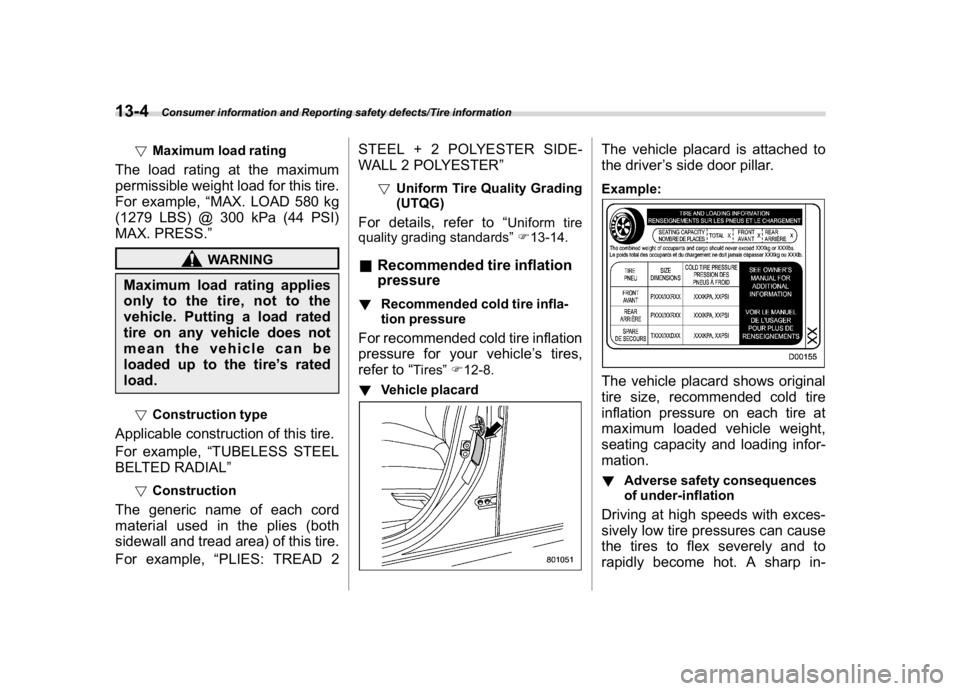
!Vehicle placard
The vehicle placard is attached to
the driver’s side door pillar.Example:The vehicle placard shows original
tire size, recommended cold tire
inflation pressure on each tire at
maximum loaded vehicle weight,
seating capacity and loading infor-
mation.!Adverse safety consequences
of under-inflationDriving at high speeds with exces-
sively low tire pressures can cause
the tires to flex severely and to
rapidly become hot. A sharp in-
Consumer information and Reporting safety defects/Tire information
13-4
Page 458 of 474
(475,1)
北米Model "A1320BE-C" EDITED: 2017/ 10/ 10
All passenger car tires must con-
form to Federal Safety Require-
ments in addition to these grades.&TreadwearThe treadwear grade is a compara-
tive rating based on the wear rate of
the tire when tested under con-
trolled conditions on a specified
government test course.
Forexample,atiregraded150
would wear one and one-half (1-
1/2) times as well on the govern-
ment course as a tire graded 100.
The relative performance of tires
depends upon the actual conditions
of their use, however, and may
depart significantly from the norm
due to variations in driving habits,
service practices and differences in
road characteristics and climate.&Traction AA, A, B, CThe traction grades, from highest to
lowest, are AA, A, B and C. Those
grades represent the tire’s ability to
stop on wet pavement as measuredunder controlled conditions on spe-
cified government test surfaces of
asphalt and concrete.
A tire marked C may have poor
traction performance.
WARNING
The traction grade assigned to
this tire is based on straight-
ahead braking traction tests,
and does not include accelera-
tion, cornering, hydroplaning,
or peak traction characteris-
tics.&Temperature A, B, CThe temperature grades are A (the
highest), B, and C, representing the
tire’s resistance to the generation of
heat and its ability to dissipate heat
when tested under controlled con-
ditions on a specified indoor labora-
tory test wheel.
Sustained high temperature can
cause the material of the tire to
degenerate and reduce tire life, andexcessive temperature can lead to
sudden tire failure.
The grade C corresponds to a level
of performance which all passenger
car tires must meet under the
Federal Motor Vehicle Safety Stan-
dards No. 109.
Grades B and A represent higher
levels of performance on the la-
boratory test wheel than the mini-
mum required by law.
WARNING
The temperature grade for this
tire is established for a tire that
is properly inflated and not
overloaded. Excessive speed,
underinflation, or excessive
loading, either separately or
in combination, can cause
heat buildup and possible tire
failure.
Consumer information and Reporting safety defects/Uniform tire quality grading standards
13-15
13