Maintenance SUBARU CROSSTREK 2018 Manual PDF
[x] Cancel search | Manufacturer: SUBARU, Model Year: 2018, Model line: CROSSTREK, Model: SUBARU CROSSTREK 2018Pages: 474, PDF Size: 20.76 MB
Page 431 of 474
(446,1)
北米Model "A1320BE-C" EDITED: 2017/ 10/ 10
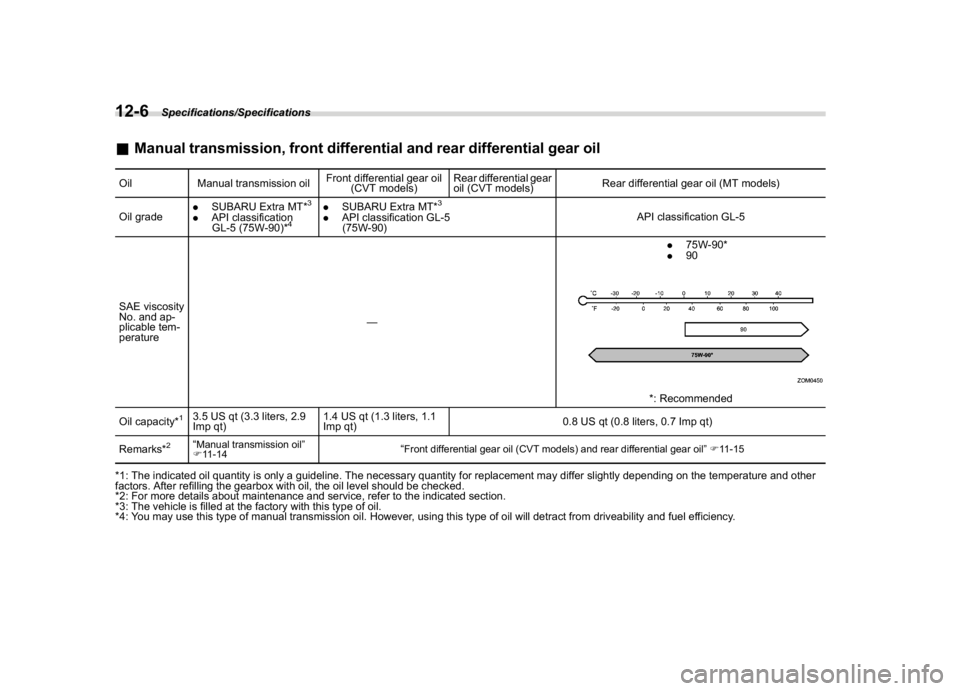
&Manual transmission, front differential and rear differential gear oilOil Manual transmission oilFront differential gear oil
(CVT models)Rear differential gear
oil (CVT models)Rear differential gear oil (MT models)
Oil grade.SUBARU Extra MT*
3
.API classification
GL-5 (75W-90)*
4
.SUBARU Extra MT*
3
.API classification GL-5
(75W-90)API classification GL-5
SAE viscosity
No. and ap-
plicable tem-
perature—.75W-90*
.90
*: Recommended
Oil capacity*
1
3.5 US qt (3.3 liters, 2.9
Imp qt)1.4 US qt (1.3 liters, 1.1
Imp qt)0.8 US qt (0.8 liters, 0.7 Imp qt)
Remarks*
2
“Manual transmission oil”
F11-14
“Front differential gear oil (CVT models) and rear differential gear oil”F11-15
*1: The indicated oil quantity is only a guideline. The necessary quantity for replacement may differ slightly depending on the temperature and other
factors. After refilling the gearbox with oil, the oil level should be checked.
*2: For more details about maintenance and service, refer to the indicated section.
*3: The vehicle is filled at the factory with this type of oil.
*4: You may use this type of manual transmission oil. However, using this type of oil will detract from driveability and fuel efficiency.
Specifications/Specifications
12-6
Page 432 of 474

(447,1)
北米Model "A1320BE-C" EDITED: 2017/ 10/ 10
&Fluids
Fluid
Fluid type*
1
Fluid capacity*
2
Remarks*
3
Continuously variable transmission
fluid (CVT models)Consult your SUBARU dealer. 11.3 US qt (10.7 liters, 9.4 Imp qt)“
Continuously variable transmis-
sion fluid”F11-15
Brake fluidFMVSS No. 116, DOT 3 or DOT 4 brake
fluid–“
Brake fluid”F11-15
Clutch fluid (MT models)FMVSS No. 116, DOT 3 or DOT 4 brake
fluid–
“
Clutch fluid (MT models)”F11-16
*1: Use one of the indicated types of fluid.
*2: The indicated fluid quantity is only a guideline. The necessary quantity for replacement may differ slightly depending on the temperature and other
factors.
*3: For more details about maintenance and service, refer to the indicated section.&Engine coolant
Vehicle model Coolant capacity Coolant type
MT models 8.0 US qt (7.6 liters, 6.7 Imp qt)
SUBARU Super Coolant
CVT models8.2 US qt (7.8 liters, 6.9 Imp qt)
The indicated coolant quantity is only a guideline. The necessary quantity for replacement may differ slightly depending on the temperature and other
factors. For more details about maintenance and service, refer to“
Cooling system”F11-10.
–CONTINUED–
Specifications/Specifications
12-7
12
Page 444 of 474

(461,1)
北米Model "A1320BE-C" EDITED: 2017/ 10/ 10
For U.S.A...............................................................13-2
Tire information.....................................................13-2
Tire labeling..........................................................13-2
Recommended tire inflation pressure....................13-4
Glossary of tire terminology..................................13-5
Tire care–maintenance and safety practices......13-10
Determining compatibility of tire and vehicle
load capacities..................................................13-10
Adverse safety consequences of overloading on
handling and stopping and on tires...................13-10Steps for Determining Correct Load Limit ...........13-11
Vehicle load limit–how to determine...............13-11
Calculating total and load capacities varying
seating configurations.....................................13-12
Uniform tire quality gradingstandards.............13-14
Treadwear...........................................................13-15
Traction AA, A, B, C............................................13-15
Temperature A, B, C...........................................13-15
Reporting safety defects(U.S.A.)......................13-16
Consumer information and Reporting safety defects
13
Page 453 of 474

(470,1)
北米Model "A1320BE-C" EDITED: 2017/ 10/ 10
&Tire care–maintenance and
safety practices.
Check on a daily basis that the
tires are free from serious damage,
nails, and stones. At the same time,
check the tires for abnormal wear.
.
Inspect the tire tread regularly
and replace the tires before their
tread wear indicators become visi-
ble. When a tire’s tread wear in-
dicator becomes visible, the tire is
worn beyond the acceptable limit
and must be replaced immediately.
With a tire in this condition, driving
at even low speeds in wet weather
can cause the vehicle to hydro-
plane. Possible resulting loss of
vehicle control can lead to an
accident.
.
To maximize the life of each tire
and ensure that the tires wear
uniformly, it is best to rotate the
tires every 7,500 miles (12,000 km).
For information about the tire rota-
tion order, refer to“
Tire rotation”
F11-25.
Replace any damaged or
unevenly worn tires at the time ofrotation. After tire rotation, adjust
the tire pressures and make sure
the wheel nuts are correctly tigh-
tened. For information about the
tightening torque and tightening
sequence for the wheel nuts, refer
to“
Flat tires”F9-5.
&Determining compatibility of
tire and vehicle load capaci-
tiesThe sum of four tires’maximum
load ratings must exceed the max-
imum loaded vehicle weight
(“GVWR”). In addition, sum of the
maximum load ratings of two front
tires and of two rear tires must
exceed each axle’smaximum
loaded capacity (“GAWR”). Original
equipment tires are designed to
fulfill those conditions.
The maximum loaded vehicle
weight is referred to Gross Vehicle
Weight Rating (GVWR). And each
axle’s maximum loaded capacity is
referred to Gross Axle Weight Rat-
ing (GAWR). The GVWR and eachaxle’s GAWR are shown on the
vehicle certification label located at
the bottom of driver’s side door
pillar.
The GVWR and front and rear
GAWRs are determined by not only
the maximum load rating of tires but
also loaded capacities of the vehi-
cle’s suspension, axles and other
parts of the body.
Therefore, this means that the
vehicle cannot necessarily be
loaded up to the tire’s maximum
load rating on the tire sidewall.
&Adverse safety conse-
quences of overloading on
handling and stopping and on
tiresOverloading could affect vehicle
handling, stopping distance, and
vehicle and tire performance in the
following ways. This could lead to
an accident and possibly result in
severe personal injury..
Vehicle stability will deteriorate.
.
Heavy and/or high-mounted
Consumer information and Reporting safety defects/Tire information
13-10