cooling SUBARU CROSSTREK 2018 Owners Manual
[x] Cancel search | Manufacturer: SUBARU, Model Year: 2018, Model line: CROSSTREK, Model: SUBARU CROSSTREK 2018Pages: 474, PDF Size: 20.76 MB
Page 226 of 474

(233,1)
北米Model "A1320BE-C" EDITED: 2017/ 10/ 10
Ventilator control....................................................4-2
Center ventilators.................................................. 4-2
Side ventilators...................................................... 4-2
Climate control panel.............................................4-2
Type A ................................................................... 4-3
Type B ................................................................... 4-4
Type C ................................................................... 4-5
Automatic climate control operation
(type B andC) ......................................................4-6
Sensors................................................................. 4-6
Manual climate controloperation..........................4-7
Airflow mode selection........................................... 4-7
MAX A/C mode (for type B and C).......................... 4-8
Temperature control............................................... 4-8
Fan speed control.................................................. 4-9
Air conditioner control........................................... 4-9Air inlet selection...................................................4-9
To turn off the climate control system.....................4-9
Defrosting..............................................................4-10
Operating tips for heater andair conditioner.... 4-10
Cleaning ventilation grille.....................................4-10
Efficient cooling after parking in direct sunlight .... 4-10
Lubrication oil circulation in the refrigerant
circuit................................................................ 4-11
Checking air conditioning system before summer
season.............................................................. 4-11
Cooling and dehumidifying in high humidity
and low temperature weather conditions ............ 4-11
Air conditioner compressor shut-off when
engine is heavily loaded.................................... 4-11
Refrigerant for your climate control system.......... 4-11
Air filtration system...............................................4-11
Replacing a cabin air filter....................................4-12
Climate control
4
Page 227 of 474
(234,1)
北米Model "A1320BE-C" EDITED: 2017/ 10/ 10
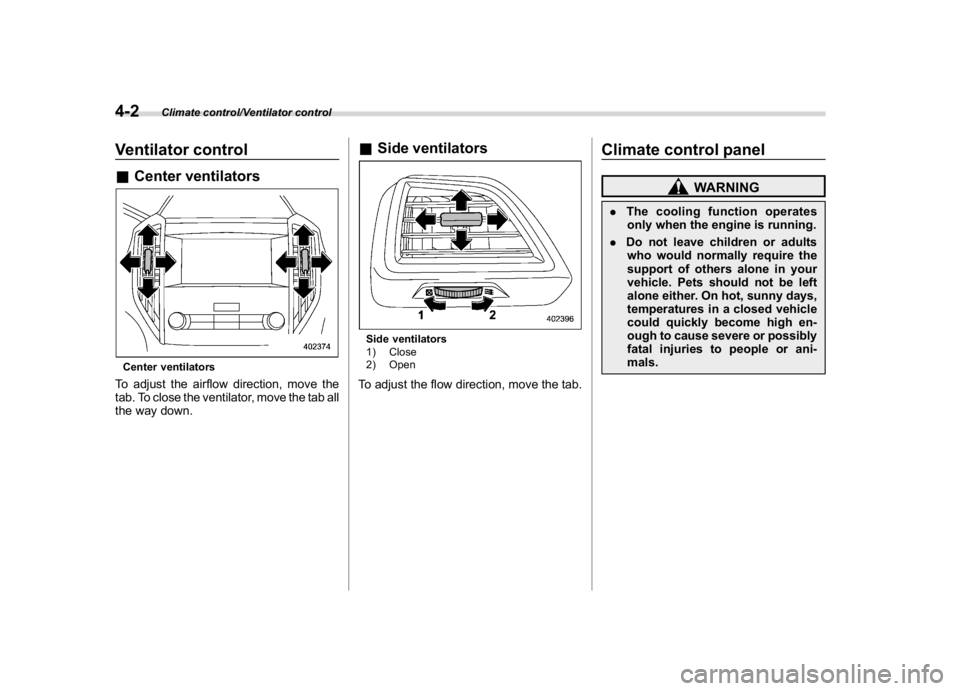
Ventilator control&Center ventilatorsCenter ventilatorsTo adjust the airflow direction, move the
tab. To close the ventilator, move the tab all
the way down.
&Side ventilatorsSide ventilators
1) Close
2) OpenTo adjust the flow direction, move the tab.
Climate control panel
WARNING
.The cooling function operates
only when the engine is running.
.Do not leave children or adults
who would normally require the
support of others alone in your
vehicle. Pets should not be left
alone either. On hot, sunny days,
temperatures in a closed vehicle
could quickly become high en-
ough to cause severe or possibly
fatal injuries to people or ani-
mals.
Climate control/Ventilator control
4-2
Page 231 of 474
(238,1)
北米Model "A1320BE-C" EDITED: 2017/ 10/ 10
Automatic climate control
operation (type B and C)When this mode is selected, the fan speed,
airflow distribution, air-inlet control, and air
conditioner compressor operation are
automatically controlled. To activate this
mode, perform the following.
1. Press the AUTO button. The indicator
light“FULL AUTO”on the multi-function
display (color LCD) illuminates.
2. Set the preferred temperature using
the temperature control dial.NOTE.Operate the automatic climate con-
trol system when the engine is running.
.Even when cooling is not necessary,
the air conditioner compressor will
automatically turn on if the temperature
is set much lower than the current
outlet air temperature. Even in this
case, the“A/C”indicator light on the
control panel illuminates.
.The controllable temperature range
may vary depending on the regional
specifications of the vehicle.
.If you operate any of the buttons on
the control panel other than the ON/
OFF button, rear window defogger
button, SYNC button and temperature
control dial(s) during FULL AUTO modeoperation, the“FULL”indicator light on
the multi-function display (color LCD)
will turn off and the“AUTO”indicator
light will remain illuminated. You can
then manually control the system as
desired using the button you operated.
To change the system back to the FULL
AUTO mode, press the AUTO button.
To turn off the climate control system,
press the ON/OFF button. Then the air
inlet selection will be set to the following.
.When the air inlet selection is set to
auto mode: Outside air circulation
.When the air inlet selection is set to
manual mode: No change
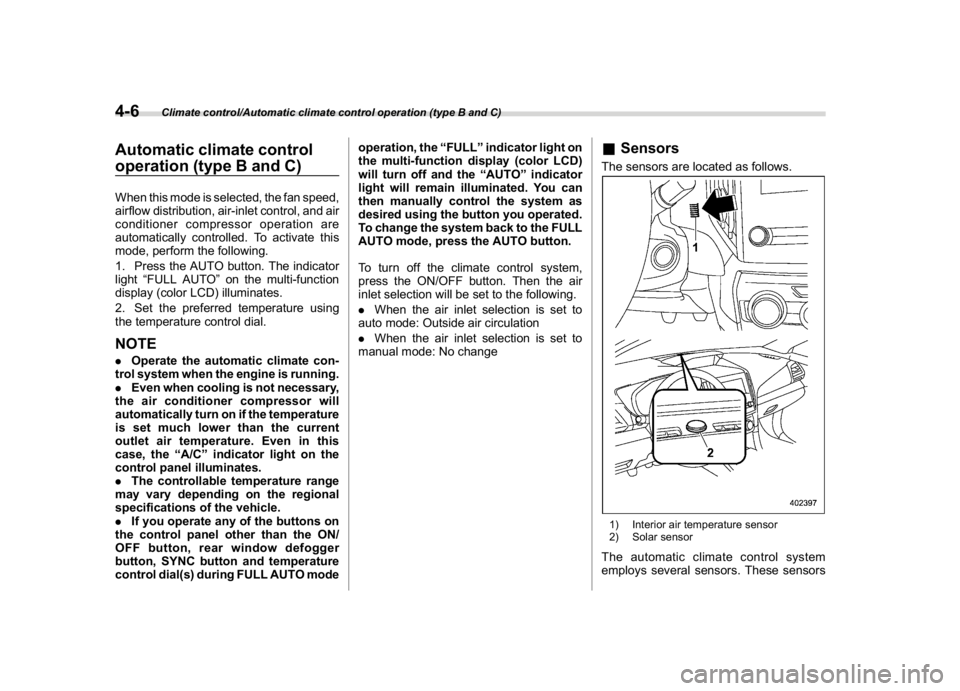
&SensorsThe sensors are located as follows.1) Interior air temperature sensor
2) Solar sensorThe automatic climate control system
employs several sensors. These sensors
Climate control/Automatic climate control operation (type B and C)
4-6
Page 233 of 474

(240,1)
北米Model "A1320BE-C" EDITED: 2017/ 10/ 10
Heat:Foot outlets, both side outlets of the
instrument panel and some through wind-
shield defroster outlets (A small amount of
air flows to the windshield and both side
windows to prevent fogging.)Heat-def:Windshield defroster outlets,foot outlets and both side outlets of the
instrument panel (Refer to“Defrosting”
F4-10.)
Defrost:Windshield defroster outlets and
both side outlets of the instrument panel
(Refer to“Defrosting”F4-10.)&MAX A/C mode (for type B and
C)For quicker cooling, press the MAX A/C
button.
When the MAX A/C mode is on, the
following settings will be changed auto-
matically.
.The air conditioner will turn on.
.The temperature will be set on the
lowest.
.The fan speed will be set on themaximum speed.
.The air inlet will be set to recirculation.
.The air flow mode setting will be set to
ventilation mode.
To turn off MAX A/C mode and return the
previous setting, press the MAX A/C
button again.
&Temperature controlTurn the temperature control dial to set the
preferred interior temperature.NOTEThe controllable temperature range
may vary depending on the regional
specifications of the vehicle.
!SYNC mode (type C)
When the SYNC mode is turned on, both
the driver’s and passenger’s side tem-
peratures are synchronized using the
driver’s side temperature control dial.
Press the SYNC button to turn on the
SYNC mode. The SYNC button indicator
will illuminate.
Press the SYNC button again or turn the
passenger’s side temperature control dial
to cancel the SYNC mode. The SYNC
button indicator will not illuminate. In this
case, temperature control on the driver’s
side and passenger’s side is separated.
Climate control/Manual climate control operation
4-8
Page 234 of 474
(241,1)
北米Model "A1320BE-C" EDITED: 2017/ 10/ 10
The temperature will be controlled indivi-
dually using the driver’s and passenger’s
temperature control dials.&Fan speed controlSelect the preferred fan speed by turning
the fan speed control dial.&Air conditioner controlThe air conditioner operates only when the
engine is running.
Press the air conditioner button while the
fan is in operation to turn on the air
conditioner. When the air conditioner is
on, the“A/C”indicator light illuminates.
To turn off the air conditioner, press the
button again.NOTEFor efficient defogging or dehumidify-
ing in cold weather, turn on the air
conditioner. If the ambient temperature
decreases to approximately 328F(08C),
the air conditioner and dehumidifica-
tion system may not operate properly.
&Air inlet selectionSelect the air inlet by pressing the air inlet
selection button.
.Recirculation:
When the indicator light on the air inlet
selection button illuminates, interior air is
recirculated inside the vehicle. Press the
air inlet selection button to the ON position
for fast cooling with the air conditioner or
when driving on a dusty road.
.Outside air circulation:
When the indicator light on the air inlet
selection button does not illuminate, out-
side air is drawn into the passenger
compartment. Press the air inlet selection
buttontotheOFFpositionwhenthe
interior has cooled to a comfortable tem-
perature and the road is no longer dusty.
WARNING
Continued operation in the ON posi-
tion may fog up the windows. Switch
to the OFF position as soon as the
outside conditions are no longer
dusty.
&To turn off the climate control
systemTo turn off the climate control system:
.Type A: select the“OFF”position using
the fan speed control dial.
.Type B and C: press the ON/OFF
button.
Climate control/Manual climate control operation
4-9
4
Page 235 of 474
(242,1)
北米Model "A1320BE-C" EDITED: 2017/ 10/ 10
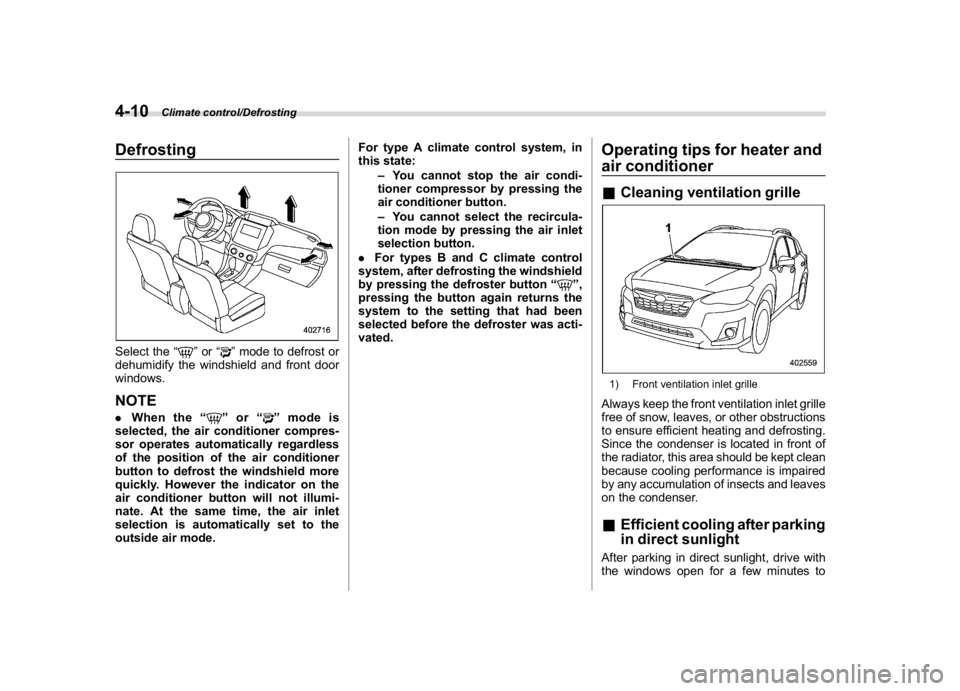
DefrostingSelect the“
”or“
”mode to defrost or
dehumidify the windshield and front door
windows.
NOTE.When the“
”or“
”mode is
selected, the air conditioner compres-
sor operates automatically regardless
of the position of the air conditioner
button to defrost the windshield more
quickly. However the indicator on the
air conditioner button will not illumi-
nate. At the same time, the air inlet
selection is automatically set to the
outside air mode.For type A climate control system, in
this state:
–You cannot stop the air condi-
tioner compressor by pressing the
air conditioner button.
–You cannot select the recircula-
tion mode by pressing the air inlet
selection button.
.For types B and C climate control
system, after defrosting the windshield
by pressing the defroster button“
”,
pressing the button again returns the
system to the setting that had been
selected before the defroster was acti-
vated.
Operating tips for heater and
air conditioner&Cleaning ventilation grille1) Front ventilation inlet grilleAlways keep the front ventilation inlet grille
free of snow, leaves, or other obstructions
to ensure efficient heating and defrosting.
Since the condenser is located in front of
the radiator, this area should be kept clean
because cooling performance is impaired
by any accumulation of insects and leaves
on the condenser.&Efficient cooling after parking
in direct sunlightAfter parking in direct sunlight, drive with
the windows open for a few minutes to
Climate control/Defrosting
4-10
Page 236 of 474

(243,1)
北米Model "A1320BE-C" EDITED: 2017/ 10/ 10
allow outside air to circulate into the
heated interior. This results in quicker
cooling by the air conditioner. Keep the
windows closed during the operation of the
air conditioner for maximum cooling effi-
ciency.&Lubrication oil circulation in
the refrigerant circuitOperate the air conditioner compressor at
a low engine speed (at idle or low driving
speeds) a few minutes each month during
the off-season to circulate its oil.&Checking air conditioning
system before summer sea-
sonCheck the air conditioner unit for refriger-
ant leaks, hose conditions, and proper
operation each spring. Have the air con-
ditioning system checked by your
SUBARU dealer.&Cooling and dehumidifying in
high humidity and low tem-
perature weather conditionsUnder certain weather conditions (high
relative humidity, low temperatures, etc.) a
small amount of water vapor emission
from the air outlets may be noticed. This
condition is normal and does not indicateany problem with the air conditioning
system.
&Air conditioner compressor
shut-off when engine is
heavily loadedTo improve acceleration and gas mileage,
the air conditioner compressor is designed
to temporarily shut off during air condi-
tioner operation whenever the accelerator
is fully depressed such as during rapid
acceleration or when driving on a steep
upgrade.&Refrigerant for your climate
control systemYour air conditioner uses ozone friendly
refrigerant HFC134a. Therefore, the meth-
od of adding, changing or checking the
refrigerant is different from the method for
CFC12 (freon). Consult your SUBARU
dealer for service. Repairs needed as a
result of using the wrong refrigerant are not
covered under warranty.
Air filtration systemYour vehicle’s air conditioning system is
equipped with an air filtration system.
Replace the cabin air filter according to
the replacement schedule found in the
“Warranty and Maintenance Booklet”. This
schedule should be followed to maintain
the filter’s dust collection ability. Under
extremely dusty conditions, the filter
should be replaced more frequently. Have
your filter checked or replaced by your
SUBARU dealer. For replacement, use
only a genuine SUBARU air filter kit.
CAUTION
Contact your SUBARU dealer if the
following occurs, even if it is not yet
time to change the filter:
.Reduction of the airflow through
the vents.
.Windshield gets easily fogged or
misted.NOTEThe filter can influence the air condi-
tioning, heating and defroster perfor-
mance if not properly maintained.
–CONTINUED–
Climate control/Air filtration system
4-11
4
Page 258 of 474

(267,1)
北米Model "A1320BE-C" EDITED: 2017/ 10/ 10
Fuel..........................................................................7-3
Fuel requirements.................................................. 7-3
Fuel filler lid and cap............................................. 7-4
State emission testing (U.S.only).........................7-7
Preparing to drive...................................................7-8
Starting and stopping the engine
(models without push-button startsystem)...... 7-9
Starting engine...................................................... 7-9
Stopping the engine.............................................. 7-11
Starting and stopping engine
(models with push-button startsystem).......... 7-11
Safety precautions................................................ 7-11
Operating range for push-button start system....... 7-11
Starting engine..................................................... 7-11
Stopping engine....................................................7-13
When access key fob does not operate properly ... 7-14
Remote engine start system(dealer option)...... 7-14
Remote engine starter transceiver (fob) .................7-15
Alternate operation method for models with
“keyless access with push-button start
system”..............................................................7-18
Entering the vehicle while it is running via
remote start........................................................7-18
Entering the vehicle following remote engine
start shutdown....................................................7-19
Pre-heating or pre-cooling the interior of
the vehicle..........................................................7-19
Remote transmitter program
(Remote engine starter transceiver).....................7-19
System maintenance.............................................7-19
Certification for remote engine starter...................7-21
Manual transmission............................................7-21
Shifting speeds....................................................7-22
Driving tips...........................................................7-23
Continuously variable transmission...................7-24
Continuously variable transmission features.........7-24
Select lever..........................................................7-25
Selection of manual mode (if equipped)................7-26
Selection of“L”(if equipped) ................................7-28
Shift lock function................................................7-28
Driving tips...........................................................7-30
Power steering......................................................7-30
Power steering warning light ................................7-30
Power steering system features............................7-30
Braking..................................................................7-31
Braking tips..........................................................7-31
Brake system.......................................................7-31
Disc brake pad wear warning indicators................7-32
ABS (Anti-lock BrakeSystem).............................7-33
ABS self-check.....................................................7-33
ABS warning light.................................................7-33
Electronic Brake Force Distribution (EBD)
system................................................................7-34
Steps to take if EBD system malfunctions .............7-34
Vehicle Dynamics Controlsystem......................7-35
Safety precautions................................................7-35
System features....................................................7-36
Vehicle Dynamics Control system monitor ............7-37
Vehicle Dynamics Control OFF switch...................7-37
X-mode (if equipped)............................................7-38
To activate/deactivate the X-mode.........................7-39
Starting and operating
7
Page 276 of 474
(285,1)
北米Model "A1320BE-C" EDITED: 2017/ 10/ 10
and turn to the“START”position to restart
the engine.&Entering the vehicle following
remote engine start shut-
downAn alarm trigger may occur if the vehicle is
opened by the remote keyless entry
transmitter within a few seconds immedi-
ately following remote engine start shut-
down.&Pre-heating or pre-cooling
the interior of the vehicleBefore exiting the vehicle, set the tem-
perature controls to the desired setting and
operation. After the system starts the
engine, the heater or air conditioning will
activate and heat or cool the interior to
your setting.&Remote transmitter program
(Remote engine starter
transceiver)New transmitters can be programmed to
the remote engine start system in the
event that a transmitter is lost, stolen,
damaged or additional transmitters are
desired (the system will accept up to eight
transmitters). New remote engine start
transmitters can be programmed accord-ing to the following procedure.
1. Open the driver’s door (the driver’s
door must remain opened throughout the
entire process).
2. Depress and hold the brake pedal.
3. Turn the ignition switch to“ON”then
“LOCK”/“OFF”, back to“ON”then“LOCK”/
“OFF”, back to“ON”then“LOCK”/“OFF”,
then back to“ON”again and leave the
ignition“ON”throughout the programming
process.
4. The system will flash the side marker
lights, tail lights and parking lights and
honk the horn three times, indicating that
the system has entered the transmitter
learn mode.
5. Press and release the“
”button on
the transmitter that you want to program.
6. The system will flash the side marker
lights, tail lights and parking lights and
honk the horn one time, indicating that the
system has learned the transmitter. Upon
successful programming, the remote start
confirmation transmitter button will flash
one time.
7. Repeat step 5 for any additional
transmitters (the system will accept up to
eight transmitters).
8. The system will exit the transmitter
learn mode if the key is turned to the
“LOCK”/“OFF”position, the door is closedor after 2 minutes.
&System maintenance
NOTEFor remote engine starter transceiver:
In the event that the vehicle’s battery is
replaced, discharged or disconnected,
it will be necessary to start the vehicle a
minimum of one time using the key
prior to activating the remote engine
start system. This is required to allow
the vehicle electronic systems to re-
synchronize.
!Changing the battery
CAUTION
.Do not let dust, oil or water get on
or in the remote engine start
transmitter when replacing the
battery.
.Be careful not to damage the
printed circuit board in the re-
mote engine start transmitter
when replacing the battery.
.Be careful not to allow children to
touch the battery and any re-
moved parts; children could
swallow them.
.There is a danger of explosion if
–CONTINUED–
Starting and operating/Remote engine start system (dealer option)
7-19
7
Page 281 of 474
(290,1)
北米Model "A1320BE-C" EDITED: 2017/ 10/ 10
Continuously variable trans-
mission
WARNING
Do not shift from the“P”or“N”
position into the“D”or“R”position
while depressing the accelerator
pedal. This may cause the vehicle
to jump forward or backward.
CAUTION
.Shift into the“P”or“R”position
only after the vehicle is comple-
tely stopped. Shifting while the
vehicle is moving may cause
damage to the transmission.
.Do not race the engine for more
than 5 seconds in any position
except the“N”or“P”position
when the brake is applied or
when chocks are used in the
wheels. This may cause the
transmission fluid to overheat.
.Never move the vehicle rearward
by inertia with the select lever set
in a forward driving position or
move the vehicle forward by
inertia with the select lever setin the“R”position. Doing so may
result in an unexpected accident
or malfunction.
.Do not shift from the“D”position
into the“R”position or vice versa
until the vehicle has completely
stopped. Such shifting may
cause damage to the transmis-
sion.
.When parking the vehicle, first
securely apply the parking brake
and then place the select lever in
the“P”position. Do not park for a
long time with the select lever in
any other position as doing so
could result in a dead battery.
&Continuously variable trans-
mission featuresThe continuously variable transmission is
electronically controlled and provides an
infinite number of forward speeds and 1
reverse speed. For some models, it also
has a manual mode or an“L”position.NOTE.When the engine coolant tempera-
ture is still low, the transmission will
upshift or downshift at higher engine
speeds than when the coolant tempera-
ture is sufficiently high in order toshorten the warm-up time and improve
driveability. The gearshift timing will
automatically shift to the normal timing
after the engine has warmed up.
.Immediately after transmission fluid
is replaced, you may feel that the
transmission operation is somewhat
unusual. This results from invalidation
of data which the on-board computer
has collected and stored in memory to
allow the transmission to shift at the
most appropriate times for the current
condition of your vehicle. Optimized
shifting will be restored as the vehicle
continues to be driven for a while.
.When driving a CVT model under
continuous heavy load conditions such
as when towing a camper or climbing a
long, steep hill, the engine speed or the
vehicle speed may automatically be
reduced. This is not a malfunction. This
phenomenon results from the engine
control function maintaining the cool-
ing performance of the vehicle. The
engine and vehicle speed will return to
a normal speed when the engine is able
to maintain the optimum cooling per-
formance after the heavy load de-
creases. Driving under a heavy load
must be performed with extreme care.
Do not try to pass a vehicle in front
when driving on an uphill slope while
towing.
Starting and operating/Continuously variable transmission
7-24