heater SUBARU CROSSTREK 2018 Owners Manual
[x] Cancel search | Manufacturer: SUBARU, Model Year: 2018, Model line: CROSSTREK, Model: SUBARU CROSSTREK 2018Pages: 474, PDF Size: 20.76 MB
Page 18 of 474
(17,1)
北米Model "A1320BE-C" EDITED: 2017/ 10/ 10
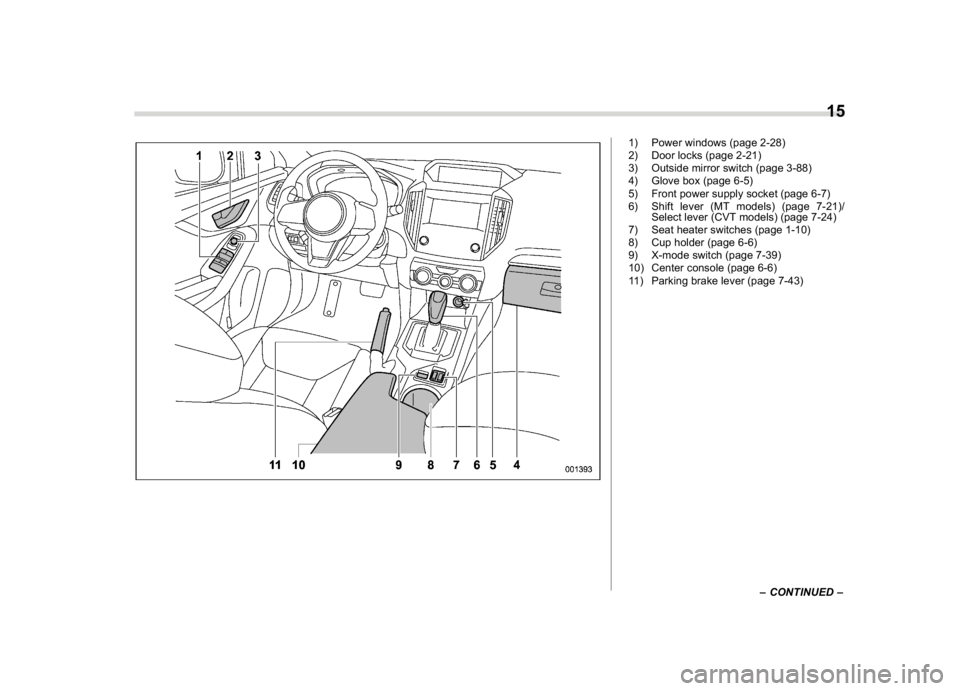
1) Power windows (page 2-28)
2) Door locks (page 2-21)
3) Outside mirror switch (page 3-88)
4) Glove box (page 6-5)
5) Front power supply socket (page 6-7)
6) Shift lever (MT models) (page 7-21)/
Select lever (CVT models) (page 7-24)
7) Seat heater switches (page 1-10)
8) Cup holder (page 6-6)
9) X-mode switch (page 7-39)
10) Center console (page 6-6)
11) Parking brake lever (page 7-43)
–CONTINUED–
15
0
Page 30 of 474

(31,1)
北米Model "A1320BE-C" EDITED: 2017/ 10/ 10
Seats........................................................................1-2
Safety tips............................................................. 1-2
Front seats............................................................ 1-5
Rear seats............................................................. 1-6
Head restraints...................................................... 1-8
Seat heater (ifequipped)......................................1-10
Safety precautions................................................1-10
Operation.............................................................. 1-11
Seatbelts................................................................1-12
Seatbelt safety tips...............................................1-12
Emergency Locking Retractor (ELR)......................1-14
Automatic Locking Retractor/Emergency Locking
Retractor (ALR/ELR)............................................1-14
Seatbelt warning light and chime..........................1-14
Fastening the seatbelt...........................................1-14
Seatbelt maintenance............................................1-20
Seatbelt pretensioners.........................................1-21
Seatbelt with shoulder belt pretensioner................1-21
Seatbelt with shoulder belt and lap belt
pretensioners......................................................1-22
System monitors...................................................1-24
System servicing..................................................1-24
Precautions against vehicle modification...............1-24
Child restraint systems........................................1-25
Safety tips for installing child restraint systems....1-26Where to place a child restraint system................1-26
Choosing a child restraint system.........................1-28
Installing child restraint systems with ALR/ELR
seatbelt.............................................................1-28
Installing a booster seat.......................................1-32
Installation of child restraint systems by use of
lower and tether anchorages (LATCH)................1-33
Top tether anchorages..........................................1-36
SRS airbag
(Supplemental Restraint Systemairbag).........1-37
General precautions regarding SRS airbag
system..............................................................1-38
General precautions regarding SRS airbag
system for accessories and any objects.............1-40
General precautions regarding SRS airbag
system and children..........................................1-42
Components.........................................................1-45
SUBARU advanced frontal airbag system..............1-47
SRS side airbag and SRS curtain airbag...............1-58
SRS airbag system monitors.................................1-66
SRS airbag system servicing ................................1-67
Precautions against vehicle modification..............1-68
How to contact the vehicle manufacturer
concerning modifications for persons with
disabilities that may affect the advanced airbag
system..............................................................1-69Seat, seatbelt and SRS airbags
1
Page 32 of 474
(33,1)
北米Model "A1320BE-C" EDITED: 2017/ 10/ 10
for the child’s age, height and
weight. Secure ALL types of child
restraint devices (including forward
facing child seat) in the REAR seats
at all times.
NEVER INSTALL A FORWARD OR
REARWARD FACING CHILD SEAT IN
THE FRONT SEAT. DOING SO RISKS
SERIOUS INJURY OR DEATH TO
THE CHILD BY PLACING THE
CHILD’S HEAD TOO CLOSE TO
THE SRS AIRBAG.
According to accident statistics,
children are safer when properly
restrained in the rear seating posi-
tions than in the front seating posi-
tions. For instructions and precau-
tions concerning child restraint sys-
tems, refer to“Child restraint sys-
tems”F1-25.
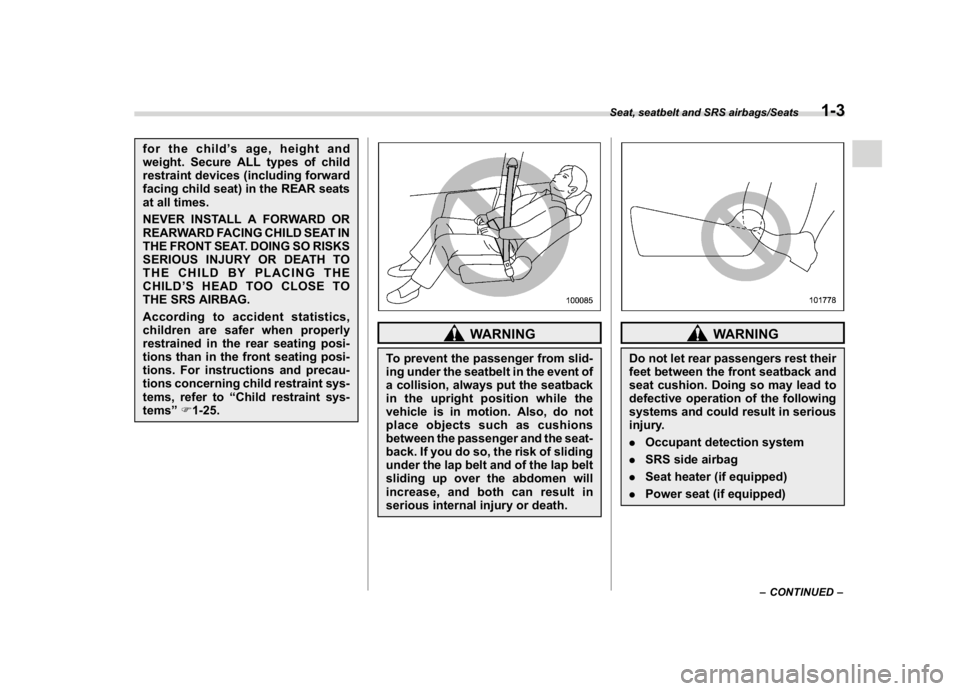
WARNING
To prevent the passenger from slid-
ing under the seatbelt in the event of
a collision, always put the seatback
in the upright position while the
vehicle is in motion. Also, do not
place objects such as cushions
between the passenger and the seat-
back. If you do so, the risk of sliding
under the lap belt and of the lap belt
sliding up over the abdomen will
increase, and both can result in
serious internal injury or death.
WARNING
Do not let rear passengers rest their
feet between the front seatback and
seat cushion. Doing so may lead to
defective operation of the following
systems and could result in serious
injury.
.Occupant detection system
.SRS side airbag
.Seat heater (if equipped)
.Power seat (if equipped)
–CONTINUED–
Seat, seatbelt and SRS airbags/Seats
1-3
1
Page 39 of 474
(40,1)
北米Model "A1320BE-C" EDITED: 2017/ 10/ 10
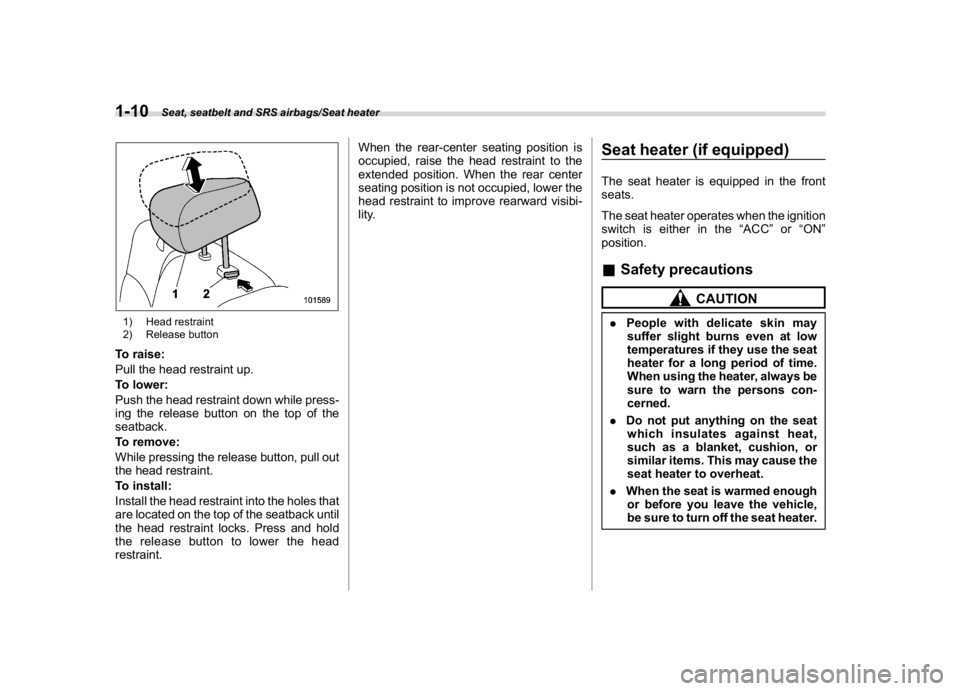
1) Head restraint
2) Release buttonTo raise:
Pull the head restraint up.
To lower:
Push the head restraint down while press-
ing the release button on the top of the
seatback.
To remove:
While pressing the release button, pull out
the head restraint.
To install:
Install the head restraint into the holes that
are located on the top of the seatback until
the head restraint locks. Press and hold
the release button to lower the head
restraint.When the rear-center seating position is
occupied, raise the head restraint to the
extended position. When the rear center
seating position is not occupied, lower the
head restraint to improve rearward visibi-
lity.
Seat heater (if equipped)The seat heater is equipped in the front
seats.
The seat heater operates when the ignition
switch is either in the“ACC”or“ON”
position.&Safety precautions
CAUTION
.People with delicate skin may
suffer slight burns even at low
temperatures if they use the seat
heater for a long period of time.
When using the heater, always be
sure to warn the persons con-
cerned.
.Do not put anything on the seat
which insulates against heat,
such as a blanket, cushion, or
similar items. This may cause the
seat heater to overheat.
.When the seat is warmed enough
or before you leave the vehicle,
be sure to turn off the seat heater.
Seat, seatbelt and SRS airbags/Seat heater
1-10
Page 40 of 474
(41,1)
北米Model "A1320BE-C" EDITED: 2017/ 10/ 10
NOTEUse of the seat heater for a long period
of time while the engine is not running
can cause battery discharge.
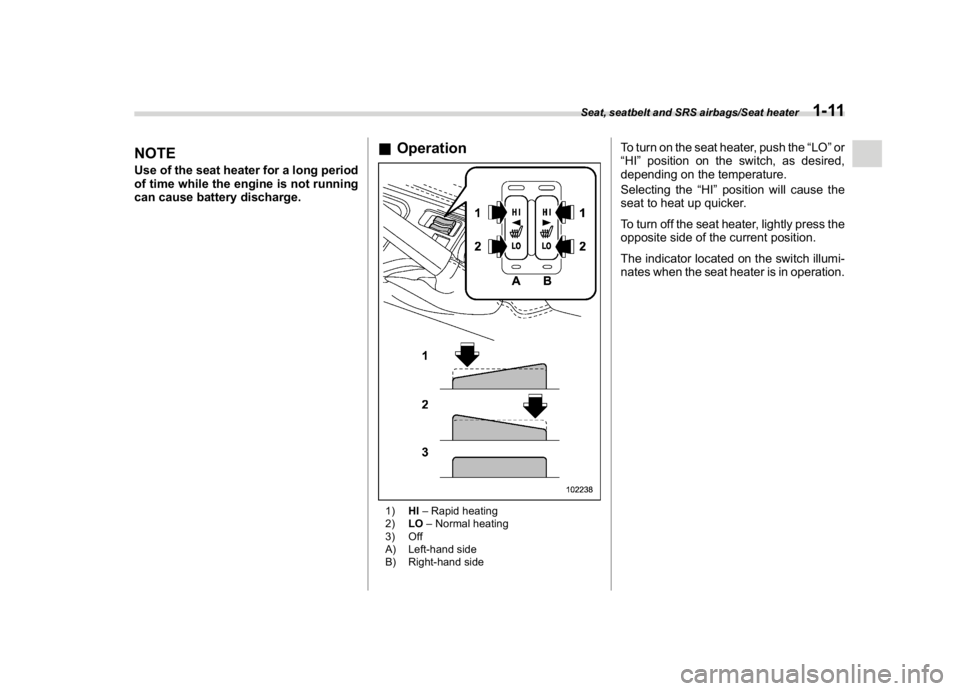
&Operation1)HI–Rapid heating
2)LO–Normal heating
3) Off
A) Left-hand side
B) Right-hand side
To turn on the seat heater, push the“LO”or
“HI”position on the switch, as desired,
depending on the temperature.
Selecting the“HI”position will cause the
seat to heat up quicker.
To turn off the seat heater, lightly press the
opposite side of the current position.
The indicator located on the switch illumi-
nates when the seat heater is in operation.
Seat, seatbelt and SRS airbags/Seat heater
1-11
1
Page 82 of 474
(83,1)
北米Model "A1320BE-C" EDITED: 2017/ 10/ 10
!Conditions in which front passen-
ger’s SRS frontal airbag is activated
The front passenger’s SRS frontal airbag
will be activated for deployment upon
impact when any of the following condi-
tions are met regarding the front passen-
ger’s seat.
.When the seat is occupied by an adult.
.When certain items (e.g. jug of water)
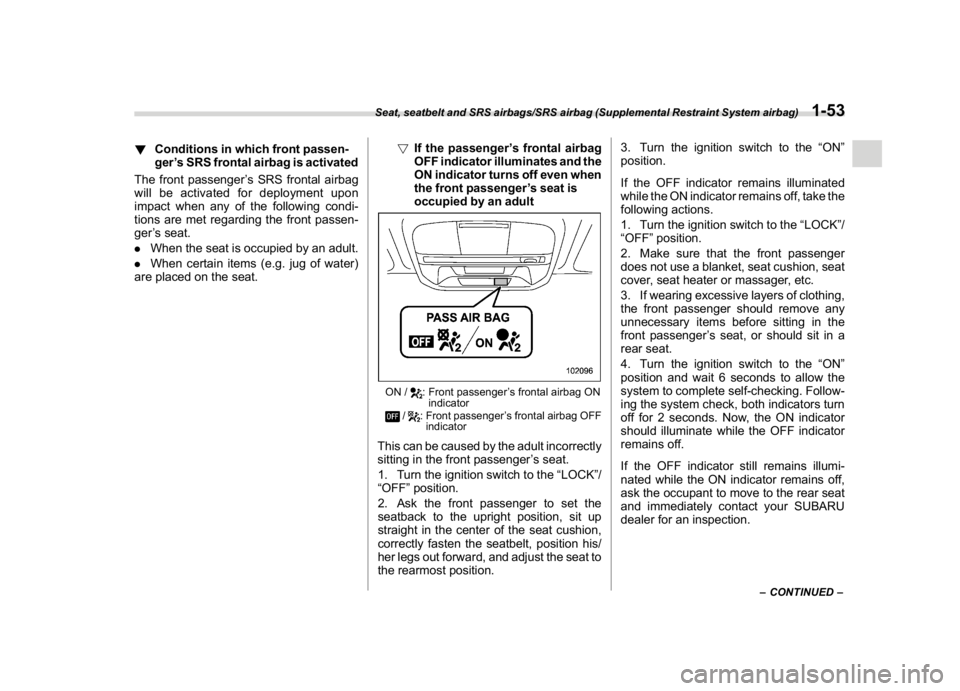
are placed on the seat.!If the passenger’s frontal airbag
OFF indicator illuminates and the
ON indicator turns off even when
the front passenger’s seat is
occupied by an adult
ON /
: Front passenger’s frontal airbag ON
indicator
/
: Front passenger’s frontal airbag OFF
indicator
This can be caused by the adult incorrectly
sitting in the front passenger’s seat.
1. Turn the ignition switch to the“LOCK”/
“OFF”position.
2. Ask the front passenger to set the
seatback to the upright position, sit up
straight in the center of the seat cushion,
correctly fasten the seatbelt, position his/
her legs out forward, and adjust the seat to
the rearmost position.3. Turn the ignition switch to the“ON”
position.
If the OFF indicator remains illuminated
while the ON indicator remains off, take the
following actions.
1. Turn the ignition switch to the“LOCK”/
“OFF”position.
2. Make sure that the front passenger
does not use a blanket, seat cushion, seat
cover, seat heater or massager, etc.
3. If wearing excessive layers of clothing,
the front passenger should remove any
unnecessary items before sitting in the
front passenger’s seat, or should sit in a
rear seat.
4. Turn the ignition switch to the“ON”
position and wait 6 seconds to allow the
system to complete self-checking. Follow-
ing the system check, both indicators turn
off for 2 seconds. Now, the ON indicator
should illuminate while the OFF indicator
remains off.
If the OFF indicator still remains illumi-
nated while the ON indicator remains off,
ask the occupant to move to the rear seat
and immediately contact your SUBARU
dealer for an inspection.
–CONTINUED–
Seat, seatbelt and SRS airbags/SRS airbag (Supplemental Restraint System airbag)
1-53
1
Page 226 of 474

(233,1)
北米Model "A1320BE-C" EDITED: 2017/ 10/ 10
Ventilator control....................................................4-2
Center ventilators.................................................. 4-2
Side ventilators...................................................... 4-2
Climate control panel.............................................4-2
Type A ................................................................... 4-3
Type B ................................................................... 4-4
Type C ................................................................... 4-5
Automatic climate control operation
(type B andC) ......................................................4-6
Sensors................................................................. 4-6
Manual climate controloperation..........................4-7
Airflow mode selection........................................... 4-7
MAX A/C mode (for type B and C).......................... 4-8
Temperature control............................................... 4-8
Fan speed control.................................................. 4-9
Air conditioner control........................................... 4-9Air inlet selection...................................................4-9
To turn off the climate control system.....................4-9
Defrosting..............................................................4-10
Operating tips for heater andair conditioner.... 4-10
Cleaning ventilation grille.....................................4-10
Efficient cooling after parking in direct sunlight .... 4-10
Lubrication oil circulation in the refrigerant
circuit................................................................ 4-11
Checking air conditioning system before summer
season.............................................................. 4-11
Cooling and dehumidifying in high humidity
and low temperature weather conditions ............ 4-11
Air conditioner compressor shut-off when
engine is heavily loaded.................................... 4-11
Refrigerant for your climate control system.......... 4-11
Air filtration system...............................................4-11
Replacing a cabin air filter....................................4-12
Climate control
4
Page 235 of 474
(242,1)
北米Model "A1320BE-C" EDITED: 2017/ 10/ 10
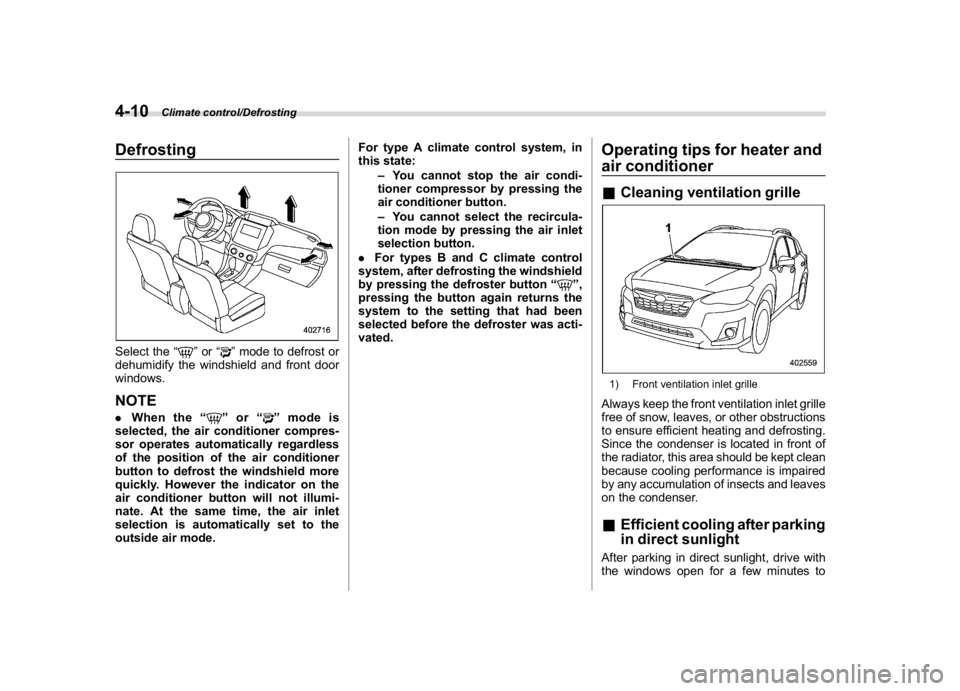
DefrostingSelect the“
”or“
”mode to defrost or
dehumidify the windshield and front door
windows.
NOTE.When the“
”or“
”mode is
selected, the air conditioner compres-
sor operates automatically regardless
of the position of the air conditioner
button to defrost the windshield more
quickly. However the indicator on the
air conditioner button will not illumi-
nate. At the same time, the air inlet
selection is automatically set to the
outside air mode.For type A climate control system, in
this state:
–You cannot stop the air condi-
tioner compressor by pressing the
air conditioner button.
–You cannot select the recircula-
tion mode by pressing the air inlet
selection button.
.For types B and C climate control
system, after defrosting the windshield
by pressing the defroster button“
”,
pressing the button again returns the
system to the setting that had been
selected before the defroster was acti-
vated.
Operating tips for heater and
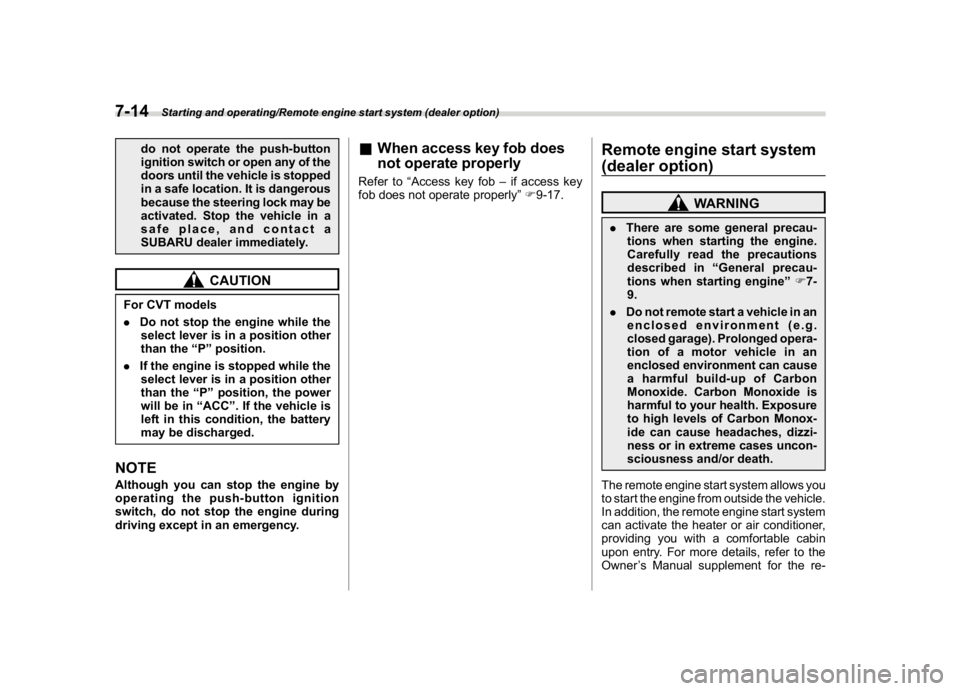
air conditioner&Cleaning ventilation grille1) Front ventilation inlet grilleAlways keep the front ventilation inlet grille
free of snow, leaves, or other obstructions
to ensure efficient heating and defrosting.
Since the condenser is located in front of
the radiator, this area should be kept clean
because cooling performance is impaired
by any accumulation of insects and leaves
on the condenser.&Efficient cooling after parking
in direct sunlightAfter parking in direct sunlight, drive with
the windows open for a few minutes to
Climate control/Defrosting
4-10
Page 271 of 474
(280,1)
北米Model "A1320BE-C" EDITED: 2017/ 10/ 10
do not operate the push-button
ignition switch or open any of the
doors until the vehicle is stopped
in a safe location. It is dangerous
because the steering lock may be
activated. Stop the vehicle in a
safe place, and contact a
SUBARU dealer immediately.
CAUTION
For CVT models
.Do not stop the engine while the
select lever is in a position other
than the“P”position.
.If the engine is stopped while the
select lever is in a position other
than the“P”position, the power
will be in“ACC”. If the vehicle is
left in this condition, the battery
may be discharged.NOTEAlthough you can stop the engine by
operating the push-button ignition
switch, do not stop the engine during
driving except in an emergency.
&When access key fob does
not operate properlyRefer to“Access key fob–if access key
fob does not operate properly”F9-17.
Remote engine start system
(dealer option)
WARNING
.There are some general precau-
tions when starting the engine.
Carefully read the precautions
described in“General precau-
tions when starting engine”F7-
9.
.Do not remote start a vehicle in an
enclosed environment (e.g.
closed garage). Prolonged opera-
tion of a motor vehicle in an
enclosed environment can cause
a harmful build-up of Carbon
Monoxide. Carbon Monoxide is
harmful to your health. Exposure
to high levels of Carbon Monox-
ide can cause headaches, dizzi-
ness or in extreme cases uncon-
sciousness and/or death.
The remote engine start system allows you
to start the engine from outside the vehicle.
In addition, the remote engine start system
can activate the heater or air conditioner,
providing you with a comfortable cabin
upon entry. For more details, refer to the
Owner’s Manual supplement for the re-
Starting and operating/Remote engine start system (dealer option)
7-14
Page 276 of 474

(285,1)
北米Model "A1320BE-C" EDITED: 2017/ 10/ 10
and turn to the“START”position to restart
the engine.&Entering the vehicle following
remote engine start shut-
downAn alarm trigger may occur if the vehicle is
opened by the remote keyless entry
transmitter within a few seconds immedi-
ately following remote engine start shut-
down.&Pre-heating or pre-cooling
the interior of the vehicleBefore exiting the vehicle, set the tem-
perature controls to the desired setting and
operation. After the system starts the
engine, the heater or air conditioning will
activate and heat or cool the interior to
your setting.&Remote transmitter program
(Remote engine starter
transceiver)New transmitters can be programmed to
the remote engine start system in the
event that a transmitter is lost, stolen,
damaged or additional transmitters are
desired (the system will accept up to eight
transmitters). New remote engine start
transmitters can be programmed accord-ing to the following procedure.
1. Open the driver’s door (the driver’s
door must remain opened throughout the
entire process).
2. Depress and hold the brake pedal.
3. Turn the ignition switch to“ON”then
“LOCK”/“OFF”, back to“ON”then“LOCK”/
“OFF”, back to“ON”then“LOCK”/“OFF”,
then back to“ON”again and leave the
ignition“ON”throughout the programming
process.
4. The system will flash the side marker
lights, tail lights and parking lights and
honk the horn three times, indicating that
the system has entered the transmitter
learn mode.
5. Press and release the“
”button on
the transmitter that you want to program.
6. The system will flash the side marker
lights, tail lights and parking lights and
honk the horn one time, indicating that the
system has learned the transmitter. Upon
successful programming, the remote start
confirmation transmitter button will flash
one time.
7. Repeat step 5 for any additional
transmitters (the system will accept up to
eight transmitters).
8. The system will exit the transmitter
learn mode if the key is turned to the
“LOCK”/“OFF”position, the door is closedor after 2 minutes.
&System maintenance
NOTEFor remote engine starter transceiver:
In the event that the vehicle’s battery is
replaced, discharged or disconnected,
it will be necessary to start the vehicle a
minimum of one time using the key
prior to activating the remote engine
start system. This is required to allow
the vehicle electronic systems to re-
synchronize.
!Changing the battery
CAUTION
.Do not let dust, oil or water get on
or in the remote engine start
transmitter when replacing the
battery.
.Be careful not to damage the
printed circuit board in the re-
mote engine start transmitter
when replacing the battery.
.Be careful not to allow children to
touch the battery and any re-
moved parts; children could
swallow them.
.There is a danger of explosion if
–CONTINUED–
Starting and operating/Remote engine start system (dealer option)
7-19
7