roof rail SUBARU CROSSTREK 2018 Owners Manual
[x] Cancel search | Manufacturer: SUBARU, Model Year: 2018, Model line: CROSSTREK, Model: SUBARU CROSSTREK 2018Pages: 474, PDF Size: 20.76 MB
Page 15 of 474

(14,1)
北米Model "A1320BE-C" EDITED: 2017/ 10/ 10
Illustrated index&Exterior
1) Engine hood (page 11-5)
2) Front wipers (page 3-77)
3) Headlights (page 3-67)
4) Replacing bulbs (page 11-36)
5) Moonroof (page 2-32)
6) Roof rails (page 8-13)
7) Outside mirror (page 3-88)
8) Door locks (page 2-21)
9) Tire pressure (page 11-23)
10) Flat tires (page 9-5)
11) Snow tires (page 8-10)
12) Fog lights (page 3-74)
13) Tie-down hooks (page 9-13)
14) Towing hook (page 9-13)
12
Page 328 of 474

(339,1)
北米Model "A1320BE-C" EDITED: 2017/ 10/ 10
New vehicle break-in driving–the first 1,000
miles (1,600 km)...................................................8-2
Fuel economy hints................................................8-2
Engine exhaust gas (carbonmonoxide)............... 8-2
Catalytic converter..................................................8-3
Periodic inspections...............................................8-4
Driving in foreigncountries...................................8-4
Driving tips for AWD models.................................8-4
Off road driving.......................................................8-6
Before driving........................................................ 8-6
During driving........................................................ 8-6
After driving........................................................... 8-7
Winter driving..........................................................8-7
Operation during cold weather............................... 8-7
Driving on snowy and icy roads............................. 8-9
Corrosion protection.............................................8-10
Snow tires............................................................8-10Tire chains........................................................... 8-11
Rocking the vehicle.............................................. 8-11
Loading your vehicle.............................................8-11
Vehicle capacity weight........................................8-12
GVWR and GAWR (Gross Vehicle Weight
Rating and Gross Axle Weight Rating)...............8-13
Roof rail...............................................................8-13
Trailer hitch (dealeroption).................................8-14
Connecting a trailer..............................................8-15
If not towing a trailer............................................8-16
Trailer towing........................................................8-16
Warranties and maintenance.................................8-17
Maximum load limits.............................................8-17
Trailer Hitches......................................................8-20
When you do not tow a trailer ...............................8-21
Connecting a trailer..............................................8-21
Trailer towing tips.................................................8-22
Driving tips
8
Page 339 of 474
(350,1)
北米Model "A1320BE-C" EDITED: 2017/ 10/ 10
WARNING
.When you carry something inside
the vehicle, secure it whenever
you can to prevent it from being
thrown around inside the vehicle
during sudden stops, sharp turns
or in an accident.
.Do not pile heavy loads on the
roof. These loads raise the vehi-
cle’s center of gravity and make it
more prone to tip over.
.Secure lengthy items properly to
prevent them from shooting for-
ward and causing serious injury
during a sudden stop.
.Never exceed the maximum load
limit. If you do, some parts on
your vehicle can break, or it can
change the way your vehicle
handles. This could result in loss
of control and cause personal
injury. Also, overloading can
shorten the life of your vehicle.
.Do not place anything on the
extended cargo area cover. Such
items could tumble forward in the
event of a sudden stop or a
collision. This could cause ser-
ious injury.
CAUTION
Do not carry spray cans, containers
with flammable or corrosive liquids
or any other dangerous items inside
the vehicle.NOTEFor better fuel economy, do not carry
unneeded cargo.&Vehicle capacity weight
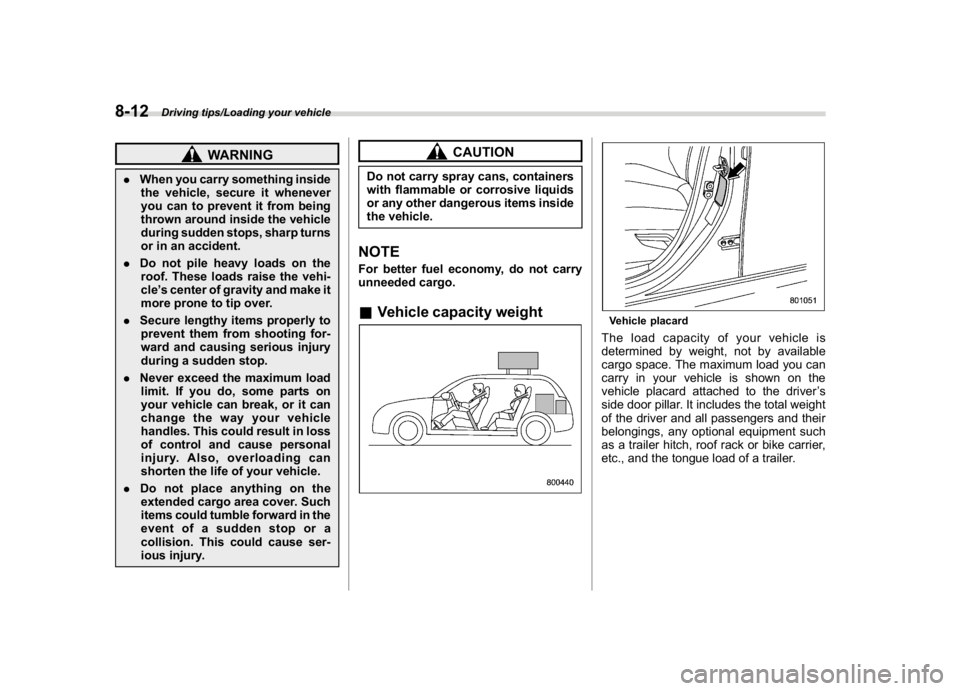
Vehicle placardThe load capacity of your vehicle is
determined by weight, not by available
cargo space. The maximum load you can
carry in your vehicle is shown on the
vehicle placard attached to the driver’s
side door pillar. It includes the total weight
of the driver and all passengers and their
belongings, any optional equipment such
as a trailer hitch, roof rack or bike carrier,
etc., and the tongue load of a trailer.
Driving tips/Loading your vehicle
8-12
Page 340 of 474
(351,1)
北米Model "A1320BE-C" EDITED: 2017/ 10/ 10
&GVWR and GAWR (Gross Ve-
hicle Weight Rating and
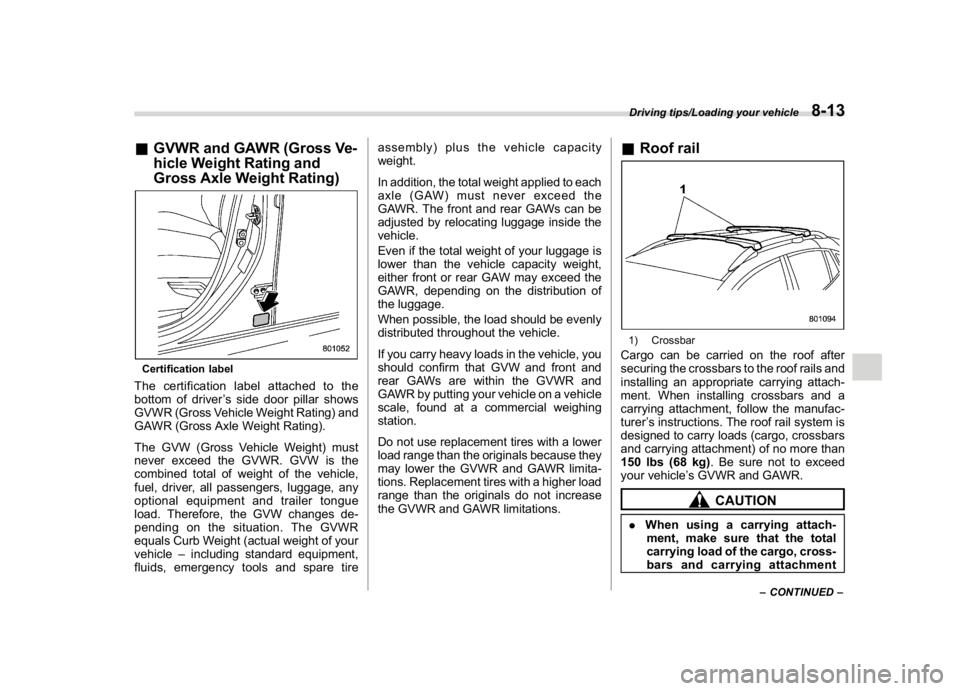
Gross Axle Weight Rating)Certification labelThe certification label attached to the
bottom of driver’s side door pillar shows
GVWR (Gross Vehicle Weight Rating) and
GAWR (Gross Axle Weight Rating).
The GVW (Gross Vehicle Weight) must
never exceed the GVWR. GVW is the
combined total of weight of the vehicle,
fuel, driver, all passengers, luggage, any
optional equipment and trailer tongue
load. Therefore, the GVW changes de-
pending on the situation. The GVWR
equals Curb Weight (actual weight of your
vehicle–including standard equipment,
fluids, emergency tools and spare tireassembly) plus the vehicle capacity
weight.
In addition, the total weight applied to each
axle (GAW) must never exceed the
GAWR. The front and rear GAWs can be
adjusted by relocating luggage inside the
vehicle.
Even if the total weight of your luggage is
lower than the vehicle capacity weight,
either front or rear GAW may exceed the
GAWR, depending on the distribution of
the luggage.
When possible, the load should be evenly
distributed throughout the vehicle.
If you carry heavy loads in the vehicle, you
should confirm that GVW and front and
rear GAWs are within the GVWR and
GAWR by putting your vehicle on a vehicle
scale, found at a commercial weighing
station.
Do not use replacement tires with a lower
load range than the originals because they
may lower the GVWR and GAWR limita-
tions. Replacement tires with a higher load
range than the originals do not increase
the GVWR and GAWR limitations.
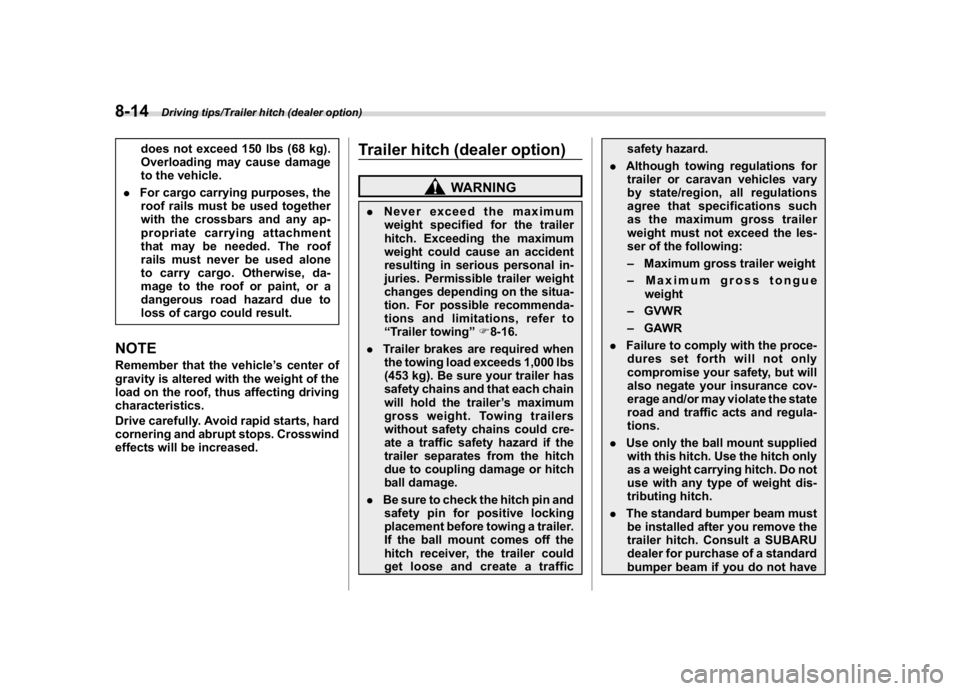
&Roof rail1) CrossbarCargo can be carried on the roof after
securing the crossbars to the roof rails and
installing an appropriate carrying attach-
ment. When installing crossbars and a
carrying attachment, follow the manufac-
turer’s instructions. The roof rail system is
designed to carry loads (cargo, crossbars
and carrying attachment) of no more than
150 lbs (68 kg). Be sure not to exceed
your vehicle’s GVWR and GAWR.
CAUTION
.When using a carrying attach-
ment, make sure that the total
carrying load of the cargo, cross-
barsandcarryingattachment
–CONTINUED–
Driving tips/Loading your vehicle
8-13
8
Page 341 of 474
(352,1)
北米Model "A1320BE-C" EDITED: 2017/ 10/ 10
does not exceed 150 lbs (68 kg).
Overloading may cause damage
to the vehicle.
.For cargo carrying purposes, the
roof rails must be used together
with the crossbars and any ap-
propriate carrying attachment
that may be needed. The roof
rails must never be used alone
to carry cargo. Otherwise, da-
mage to the roof or paint, or a
dangerous road hazard due to
loss of cargo could result.
NOTERemember that the vehicle’s center of
gravity is altered with the weight of the
load on the roof, thus affecting driving
characteristics.
Drive carefully. Avoid rapid starts, hard
cornering and abrupt stops. Crosswind
effects will be increased.
Trailer hitch (dealer option)
WARNING
.Never exceed the maximum
weight specified for the trailer
hitch. Exceeding the maximum
weight could cause an accident
resulting in serious personal in-
juries. Permissible trailer weight
changes depending on the situa-
tion. For possible recommenda-
tions and limitations, refer to
“Trailer towing”F8-16.
.Trailer brakes are required when
the towing load exceeds 1,000 lbs
(453 kg). Be sure your trailer has
safety chains and that each chain
will hold the trailer’s maximum
gross weight. Towing trailers
without safety chains could cre-
ate a traffic safety hazard if the
trailer separates from the hitch
due to coupling damage or hitch
ball damage.
.Be sure to check the hitch pin and
safety pin for positive locking
placement before towing a trailer.
If the ball mount comes off the
hitch receiver, the trailer could
get loose and create a trafficsafety hazard.
.Although towing regulations for
trailer or caravan vehicles vary
by state/region, all regulations
agree that specifications such
as the maximum gross trailer
weight must not exceed the les-
ser of the following:
–Maximum gross trailer weight
–Maximum gross tongue
weight
–GVWR
–GAWR
.Failure to comply with the proce-
dures set forth will not only
compromise your safety, but will
also negate your insurance cov-
erage and/or may violate the state
road and traffic acts and regula-
tions.
.Use only the ball mount supplied
with this hitch. Use the hitch only
as a weight carrying hitch. Do not
use with any type of weight dis-
tributing hitch.
.The standard bumper beam must
be installed after you remove the
trailer hitch. Consult a SUBARU
dealer for purchase of a standard
bumper beam if you do not have
Driving tips/Trailer hitch (dealer option)
8-14
Page 454 of 474

(471,1)
北米Model "A1320BE-C" EDITED: 2017/ 10/ 10
loads could increase the risk of
rollover..
Stopping distance will increase.
.
Brakes could overheat and fail.
.
Suspension, bearings, axles and
other body parts could break or
experience accelerated wear that
will shorten vehicle life.
.
Tires could fail.
.
Tread separation could occur.
.
Tire could separate from its rim.
&Steps for Determining Cor-
rect Load Limit1.
Locate the statement“The com-
bined weight of occupants and
cargo should never exceed XXX
kg or XXX lbs.”on your vehicle’s
placard.
2.
Determine the combined weight
of the driver and passengers that
will be riding in your vehicle.
3.
Subtract the combined weight of
the driver and passengers from
XXX kg or XXX lbs.
4.
The resulting figure equals the
available amount of cargo andluggage load capacity. For exam-
ple, if the“XXX”amount equals
1400 lbs. and there will be five 150
lb passengers in your vehicle, the
amount of available cargo and
luggage load capacity is 650 lbs.
(1400750 (56150) = 650 lbs.)
5.
Determine the combined weight
of luggage and cargo being loaded
on the vehicle. That weight may not
safely exceed the available cargo
and luggage load capacity calcu-
lated in Step 4.
6.
If your vehicle will be towing a
trailer, load from your trailer will be
transferred to your vehicle. Consult
this manual to determine how this
reduces the available cargo and
luggage load capacity of your ve-
hicle.
Vehicle load limit–how to
determineThe load capacity of your vehicle is
determined by weight, not by avail-
able cargo space. The load limit of
your vehicle is shown on the vehicle
placard attached to the driver’s side
door pillar. Locate the statement
“The combined weight of occupants
and cargo should never exceed
XXX kg or XXX lbs”on your
vehicle’s placard.
The vehicle placard also shows
seating capacity of your vehicle.
The total load capacity includes the
total weight of driver and all pas-
sengers and their belongings, any
cargo, any optional equipment such
as a trailer hitch, roof rack or bike
carrier, etc., and the tongue load of
a trailer. Therefore cargo capacity
can be calculated by the following
method.
Cargo capacity = Load limit(total
weight of occupants + total weight
–CONTINUED–
Consumer information and Reporting safety defects/Vehicle load limit–how to determine
13-11
13