wheels SUBARU FORESTER 2001 SF / 1.G User Guide
[x] Cancel search | Manufacturer: SUBARU, Model Year: 2001, Model line: FORESTER, Model: SUBARU FORESTER 2001 SF / 1.GPages: 357, PDF Size: 4.51 MB
Page 236 of 357
8-12mend ed d uring c old weather.
Use only ad d itives that are sp ec ific ally d esig ned f
or this p urp ose.
When an antifreeze ad d itive is used , its effec t las ts long er if the tank is
refilled whenever the fuel level reac hes half emp ty .
If your SUBARU is not g oing to b e used for an exten d ed p eriod , it is
b est to have the fuel tank filled to c ap ac ity. Driving on snowy and icy roads
WARNING
Do not use the cruise control on slippery roads such as snowy or icy roads. This may cause loss of vehicle control.
To p revent skid d ing and slip p ing , avoid sud d en b rak ing , ab rup t ac c el-
eration, hig h-sp eed d riving , and sharp turning when d riving on snowy
or ic y road s.
Always maintain amp le d istanc e b etween your vehic le and the vehic le
ahead of you to avoid the need for sud d en b raking .
To sup p lement the foot b rake, use the eng ine b rake effec tively to c on-
trol the vehic le sp eed . (Shift into a lower g ear wh en nec essary.)
Avoid shifting d own ab rup tly. Suc h b ehavior c an c au se the wheel to
loc k, p ossib ly lead ing to loss of vehic le c ontrol.
Avoid loc king the front wheels b ec ause that c an lea d to a loss of
steering c ontrol. When b raking with a vehic le not e q uip p ed with an
Anti-Loc k Brake System (ABS), p ress the b rake p ed al rep eated ly at
short intervals to p revent the wheels from loc king . Then ap p ly the
b rakes softly to b ring the vehic le to a stop .
An ABS enhanc es your vehic le ’s b raking p erformanc e on snowy and
ic y road s. Refer to the “ABS (Anti-Loc k Brake System) ” in this c hap ter
for information on b raking on slip p ery surfac es in ABS eq uip p ed
vehic le. n Wiper operation when snowing
Before d riving in c old weather, make sure the wip er b lad es are not
frozen to the wind shield or rear wind ow. If the wip er b lad es are frozen
to the wind shield or rear wind ow, use the d efroster with the airflow
c ontrol d ial in the “
” p osition and the temp erature c ontrol lever
Page 238 of 357

8-14c orrec t tire size and typ e. All four tires should b
e of the same size,
c onstruc tion, c irc umferenc e, b rand and load rang e a nd you should
never mix rad ial, b elted b ias or b ias tires sinc e t his may result in d ang er-
ous hand ling c harac teristic s.
Rememb er to d rive with c are at all times reg ard less of the typ e of tires on
your vehic le. Tire chains
Driving on snowy g rad es or ic y road s may req uire th e use of tire c hains,
in whic h c ase p ut the c hains on the front wheels on ly. Use only SAE
c lass S typ e c hains that are of the c orrec t size fo r your tires so as not to
d amag e the vehic le b od y or susp ension.
When d riving with tire c hains, d rive at sp eed s b elo w 19 mp h (30 km/h).
When a temp orary sp are tire is on a front wheel, re p lac e the temp orary
sp are tire with the rear tire on the same sid e of t he vehic le, and then fit
c hains on the front tires.
Always use the utmost c are when d riving with tire c hains — overc onfi-
d enc e b ec ause you are d riving with tire c hains c oul d easily lead to a
serious ac c id ent.
Rocking the vehicle
If you must roc k the vehic le to free it from snow, sand , or mud , d ep ress the
ac c elerator p ed al slig htly and move the selec tor le ver b ac k and forth
b etween “D ” and “R ” rep eated ly. Do not rac e the eng ine. For the b est p os-
sib le trac tion, avoid sp inning the wheels when tryi ng to free the vehic le.
When the road surfac e is extremely slip p ery, you c a n ob tain b etter trac -
tion b y starting the vehic le with the transmission in 2nd than 1st (b oth for
MT and AT).
Refer to the “Automatic transmission ” sec tion in this c hap ter for informa-
tion on hold ing the transmission in 2nd p osition.
Corrosion protection
Refer to the “Corrosion p rotec tion ” sec tion (c hap ter 10).
Page 249 of 357
Starting and operating8-25
–
CONTINUED –
HS0143
Gross Axle Weight Certification plate
HS0144
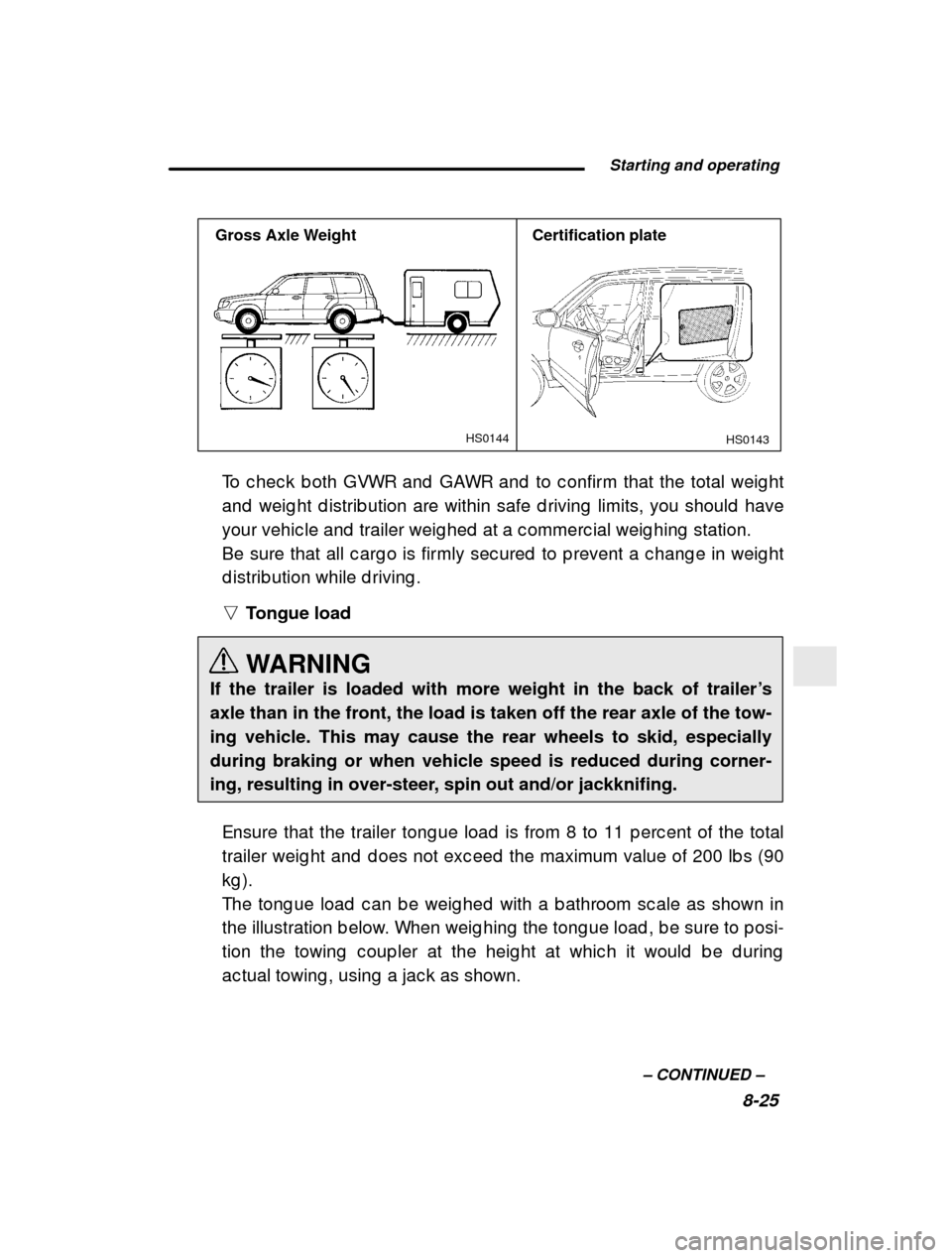
To c hec k b oth GVWR and GAWR and to c onfirm that the total weig ht
and weig ht d istrib ution are within safe d riving lim its, you should have
your vehic le and trailer weig hed at a c ommerc ial we ig hing station.
Be sure that all c arg o is firmly sec ured to p revent a c hang e in weig ht
d istrib ution while d riving . n Tongue load
WARNING
If the trailer is loaded with more weight in the back of trailer ’s
axle than in the front, the load is taken off the rear axle of the tow- ing vehicle. This may cause the rear wheels to skid, especiallyduring braking or when vehicle speed is reduced during corner-
ing, resulting in over-steer, spin out and/or jackknifing.
Ensure that the trailer tong ue load is from 8 to 11 p erc ent of the total
trailer weig ht and d oes not exc eed the maximum valu e of 200 lb s (90
kg ).
The tong ue load c an b e weig hed with a b athroom sc al e as shown in
the illustration b elow. When weig hing the tong ue lo ad , b e sure to p osi-
tion the towing c oup ler at the heig ht at whic h it w ould b e d uring
ac tual towing , using a jac k as shown.
Page 251 of 357
Starting and operating8-27
–
CONTINUED –
Trailer hitches
WARNING
Never drill the frame or under-body of your vehicle to install a
commercial trailer hitch. If you do, dangerous exhaust gas, wateror mud may enter the passenger compartment through the drilledhole. Exhaust gas contains carbon monoxide, a colorless andodorless gas which is dangerous, or even lethal, if inhaled. Also,drilling the frame or under-body of your vehicle could cause dete-rioration of strength of your vehicle and cause corrosion aroundthe drilled hole.
CAUTION
Do not modify the vehicle exhaust system, brake system, or
other systems when installing a hitch or other trailer towingequipment. Do not use axle-mounted hitches as they can cause damage to
the axle housing, wheel bearings, wheels or tires.
Choose a p rop er hitc h for your vehic le and trailer.
The use of a g enuine SUBARU trailer hitc h is rec omm end ed . A g enu-
ine SUBARU hitc h is availab le from your SUBARU d eal er.
If use of a non-g enuine hitc h is unavoid ab le, b e su re the hitc h is
suited to your vehic le and trailer. Consult with a p rofessional hitc h
sup p lier to assist you in c hoosing an ap p rop riate h itc h for your
vehic le. Be sure to follow all of the hitc h manufac turer’s instruc tions for
installation and use.
Never use a hitc h that mounts only to the rear b ump er. The b ump er is
not d esig ned to hand le that typ e of load .
For all typ es of hitc hes, reg ularly c hec k that the hitc h mounting b olts
and nuts are tig ht.
Page 255 of 357

Starting and operating8-31
–
CONTINUED –
sig nal lever is op erated .
–
the safety c hains are c onnec ted p rop erly.
– all c arg o in the trailer is sec ured safety in p osit ion.
– the sid e mirrors p rovid e a g ood rearward field of v iew without a
sig nific ant b lind sp ot.
Suffic ient time should b e taken to learn the “feel ” of the vehic le/
trailer c omb ination b efore starting out on a trip . In an area free of traf-
fic , p rac tic e turning , stop p ing and b ac king up . n Driving with a trailer
You should allow for c onsid erab ly more stop p ing d is tanc e when
towing a trailer. Avoid sud d en b raking b ec ause it m ay result in skid -
d ing or jac kknifing and loss of c ontrol. Avoid ab rup t starts and sud d en ac c elerations. If yo ur vehic le has a
manual transmission, always start out in first g ear and release the
c lutc h at mod erate eng ine RPM. Avoid uneven steering , sharp turns and rap id lane c hang es.
Slow d own b efore turning . Make a long er than normal turning
rad ius b ec ause the trailer wheels will b e c loser th an the vehic le
wheels to the insid e of the turn. In a tig ht turn, the trailer c ould hit your
vehic le. Crosswind s will ad versely affec t the hand ling of yo ur vehic le and
trailer, c ausing sway. Crosswind s c an b e d ue to wea ther c ond itions or
the p assing of larg e truc ks or b uses. If swaying oc c urs, firmly g rip the
steering wheel and slow d own immed iately b ut g rad ua lly.
When p assing other vehic les, c onsid erab le d istanc e is req uired
b ec ause of the ad d ed weig ht and leng th c aused b y at tac hing the
trailer to your vehic le. When b ac king up with a trailer, never ac c elerate or steer rap id ly.
When turning b ac k, g rip the b ottom of the steering wheel with one
hand and turn it to the left for a left turn, and t urn it to the rig ht for a
rig ht turn.
Page 257 of 357

Starting and operating8-33
–
CONTINUED –
n
Parking on a grade
Always b loc k the wheels und er b oth vehic le and trai ler when p arking .
Ap p ly the p arking b rake firmly. You should not p ark on a hill or slop e.
But if p arking on a hill or slop e c annot b e avoid ed , you should take
the following step s:
1. Ap p ly the b rakes and hold the p ed al d own.
2. Have someone p lac e wheel b loc ks und er b oth the ve hic le and
trailer wheels.
3. When the wheel b loc ks are in p lac e, release the r eg ular b rakes
slowly until the b loc ks ab sorb the load .
4. Ap p ly the reg ular b rakes and then ap p ly the p arki ng b rake; slowly
release the reg ular b rakes.
5. Shift into 1st or reverse g ear (manual transmissi on) or “P ” (auto-
matic transmission) and shut off the eng ine.
Page 260 of 357
In case of emergency9-3
–
CONTINUED –
Always turn the engine off before raising the flat tire off the
ground using the jack. Never swing or push the vehicle sup- ported with the jack. The jack can come out of the jacking pointdue to a jolt and this can result in a severe accident. Do not use oil or grease on the wheel studs or nuts when the
spare tire is installed. This could cause the nuts to become looseand lead to an accident. Never place a tire or tire changing tools in the passenger
compartment after changing wheels. In a sudden stop or colli-
sions, loose equipment could strike occupants and cause injury.Store the tire and all tools in the proper place.
If you have a flat tire while d riving , never b rake sud d enly; keep d riving
straig ht ahead while g rad ually red uc ing sp eed . Then slowly p ull off the
road to a safe p lac e.
1. Park on a hard , level surfac e, whenever p ossib le, then stop the eng ine.
2. Set the p arking b rake sec urely and shift a manual transmission ve-
hic le in reverse or an automatic transmission vehic le in the “P ” (Park)
p osition.
3. Turn on the hazard warning flasher and have every one g et out of the
vehic le.
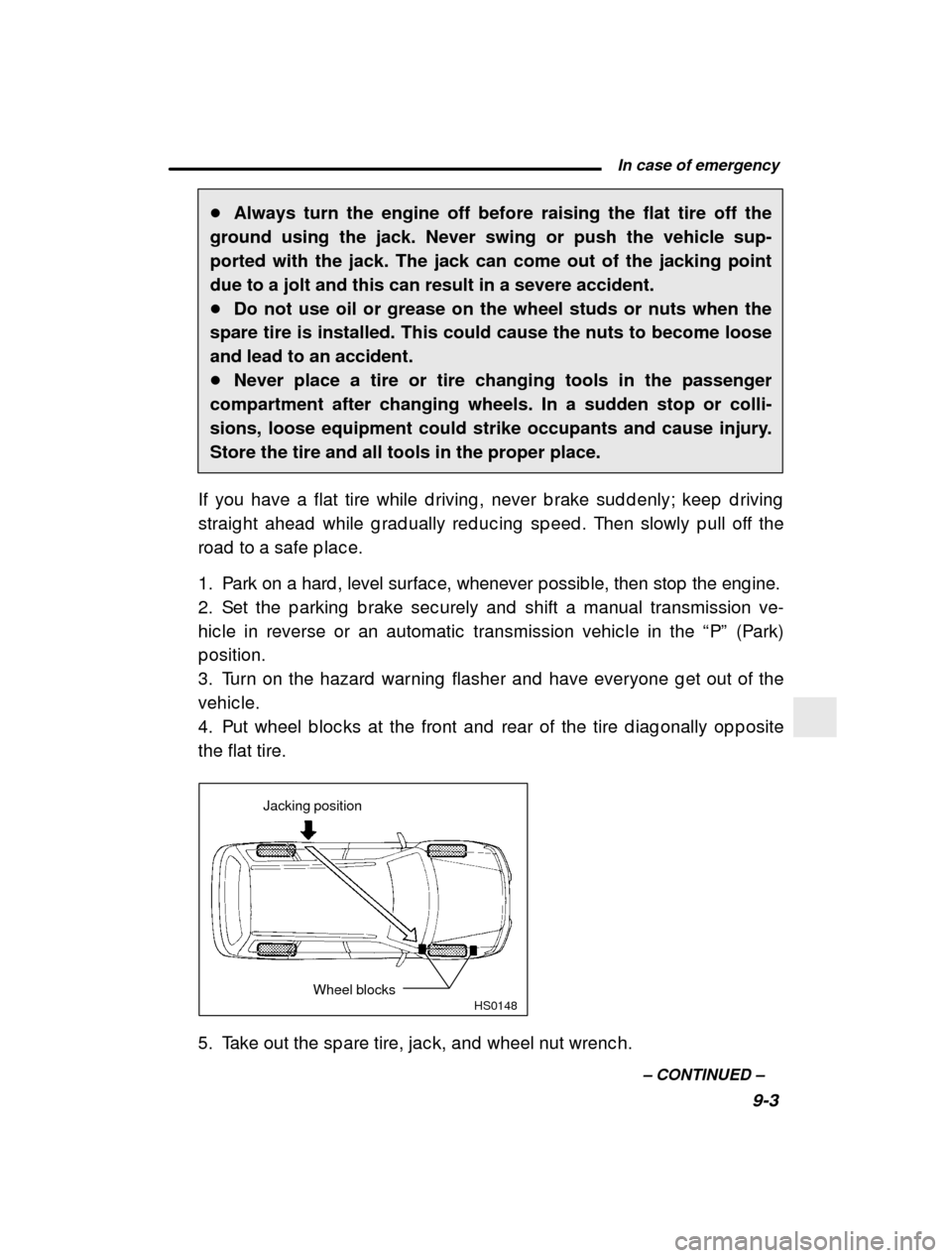
4. Put wheel b loc ks at the front and rear of the tir e d iag onally op p osite
the flat tire.
HS0148
Jacking position
Wheel blocks
5. Take out the sp are tire, jac k, and wheel nut wren c h.
Page 268 of 357
In case of emergency9-11
–
CONTINUED –
the reserve tank.
If the c oolant level is b elow the
“MIN ” mark, ad d c oolant up to the
“ MAX ” mark.
5. If there is no c oolant in the reserve tank, ad d c oolant to the reserve
tank. Then remove the rad iator c ap and fill the rad iator with c oolant.
If you remove the rad iator c ap from a hot rad iator, first wrap a thic k
c loth around the rad iator c ap , then turn the c ap c o unterc loc kwise
slowly without p ressing d own until it stop s. Releas e the p ressure from
the rad iator. After the p ressure has b een fully rel eased , remove the
c ap b y p ressing d own and turning it.
Towing
WARNING
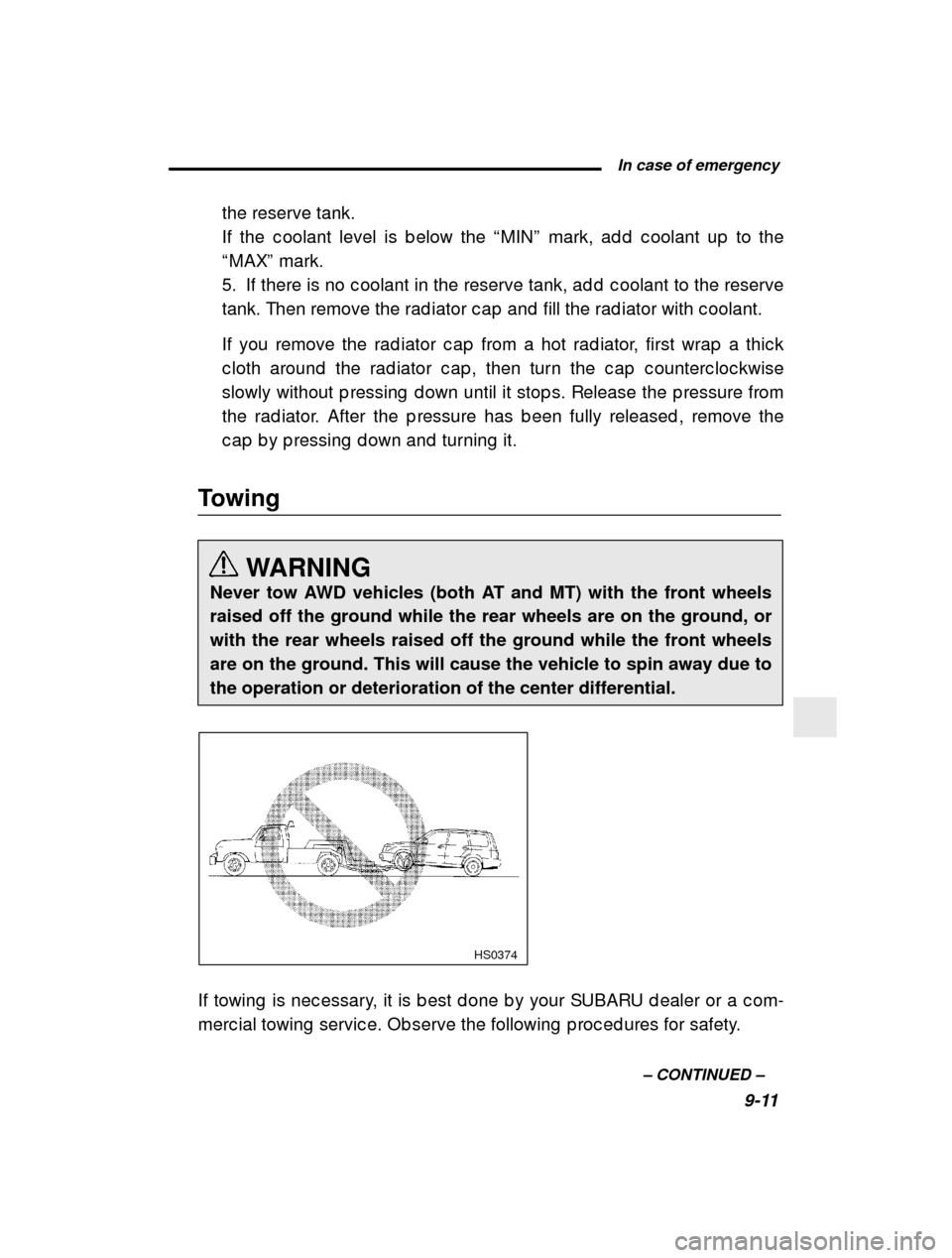
Never tow AWD vehicles (both AT and MT) with the front wheelsraised off the ground while the rear wheels are on the ground, orwith the rear wheels raised off the ground while the front wheelsare on the ground. This will cause the vehicle to spin away due tothe operation or deterioration of the center differential.
HS0374
If towing is nec essary, it is b est d one b y your SUB ARU d ealer or a c om-
merc ial towing servic e. Ob serve the following p roc e d ures for safety.
Page 270 of 357
In case of emergency9-13
–
CONTINUED –
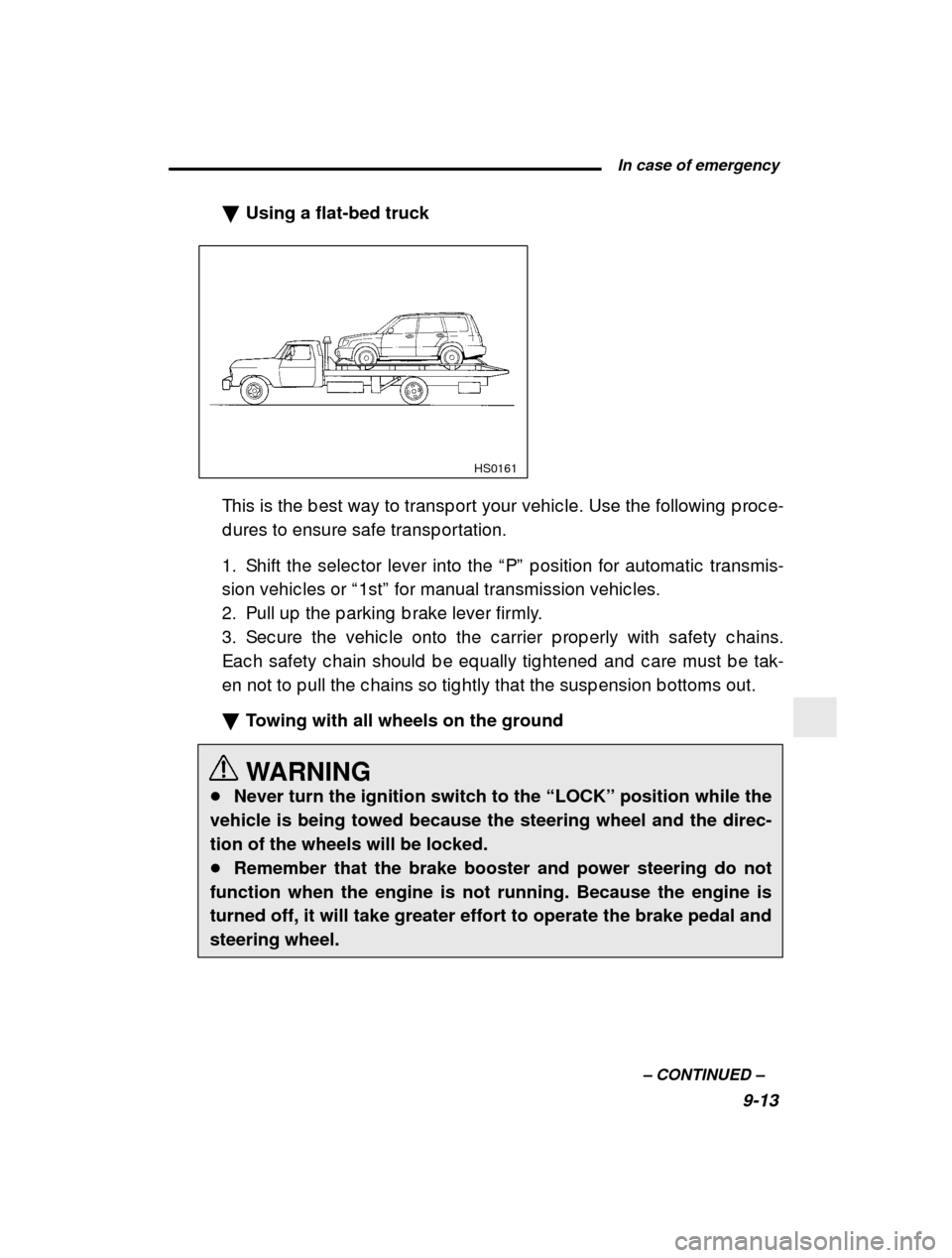
Using a flat-bed truck
HS0161
This is the b est way to transp ort your vehic le. Use the following p roc e-
d ures to ensure safe transp ortation.
1. Shift the selec tor lever into the “P ” p osition for automatic transmis-
sion vehic les or “1st ” for manual transmission vehic les.
2. Pull up the p arking b rake lever firmly.
3. Sec ure the vehic le onto the c arrier p rop erly with safety c hains.
Eac h safety c hain should b e eq ually tig htened and c are must b e tak-
en not to p ull the c hains so tig htly that the susp e nsion b ottoms out.
Towing with all wheels on the ground
WARNING
Never turn the ignition switch to the “LOCK” position while the
vehicle is being towed because the steering wheel and the direc- tion of the wheels will be locked. Remember that the brake booster and power steering do not
function when the engine is not running. Because the engine isturned off, it will take greater effort to operate the brake pedal andsteering wheel.
Page 275 of 357

10
Appearance care Exterior care10-2
. . . . . . . . . . . . . . . . . . . . . . . . . . . . . . . . . . . . . . . . . . . . . . . . . . . . . . . . . . . . . . . .
Washing 10-2
. . . . . . . . . . . . . . . . . . . . . . . . . . . . . . . . . . . . . . . . . . . . . . . . . . . . . . . . . . . . . . . . . . .
Waxing and polishing 10-3
. . . . . . . . . . . . . . . . . . . . . . . . . . . . . . . . . . . . . . . . . . . . . . . . . . .
Cleaning aluminum wheels 10-3
. . . . . . . . . . . . . . . . . . . . . . . . . . . . . . . . . . . . . . . . . . . .
Cleaning fog light lens 10-4
. . . . . . . . . . . . . . . . . . . . . . . . . . . . . . . . . . . . . . . . . . . . . . . . . .
Corrosion protection 10-4
. . . . . . . . . . . . . . . . . . . . . . . . . . . . . . . . . . . . . . . . . . . . . . . . . . . .
Cleaning the interior 10-6
. . . . . . . . . . . . . . . . . . . . . . . . . . . . . . . . . . . . . . . . . . . . . . . . . . . . .