Transmission SUBARU FORESTER 2001 SF / 1.G Owner's Manual
[x] Cancel search | Manufacturer: SUBARU, Model Year: 2001, Model line: FORESTER, Model: SUBARU FORESTER 2001 SF / 1.GPages: 357, PDF Size: 4.51 MB
Page 235 of 357
Starting and operating8-11
–
CONTINUED –
tor p ed al, b rake p ed al, and all other c ontrols op er
ate smoothly.
Clear away ic e and snow that has ac c umulated und er the fend ers to
avoid making steering d iffic ult. During severe wint er d riving , stop
when and where it is safe to d o so and c hec k und er the fend ers p eri-
od ic ally. n During cold weather below –4°F ( –20 °C)
If the eng ine is d iffic ult to start using the norma l method (without
d ep ressing the ac c elerator p ed al), turn the ig nitio n switc h to the
“ START ” p osition while slig htly d ep ressing the ac c elerator p ed al.
n Parking in cold weather
WARNING
Snow can trap dangerous exhaust gases under your vehicle. Keep snow clear of the exhaust pipe and from around your
vehicle if you park the vehicle in snow with the engine running.
Do not use the p arking b rake when p arking for long p eriod s in c old
weather sinc e it c ould freeze in that p osition. Ins tead , ob serve the fol-
lowing :
1. Plac e the shift lever in “1 ” or “R ” for manual transmission vehic les,
and in “P ” for automatic transmission vehic les.
2. Use tire stop s und er the tires to p revent the veh ic le from moving .
When the vehic le is p arked in snow or when it snows , raise the wip er
b lad es off the g lass to p revent d amag e to them.
When the vehic le has b een left p arked after use on road s heavily c ov-
ered with snow, or has b een left p arked d uring a sn owstorm, ic ing
may d evelop on the b rake system, whic h c ould c ause p oor b raking
ac tion. Chec k for snow or ic e b uild up on the susp en sion, d isc b rakes
and b rake hoses und erneath the vehic le.
If there is c aked snow or ic e, remove it, b eing c ar eful not to d amag e
the d isc b rakes and b rake hoses and ABS harness. n Refueling in cold weather
To help p revent moisture from forming in the fuel s ystem and the risk
of its freezing , use of an antifreeze ad d itive in t he fuel tank is rec om-
Page 238 of 357

8-14c orrec t tire size and typ e. All four tires should b
e of the same size,
c onstruc tion, c irc umferenc e, b rand and load rang e a nd you should
never mix rad ial, b elted b ias or b ias tires sinc e t his may result in d ang er-
ous hand ling c harac teristic s.
Rememb er to d rive with c are at all times reg ard less of the typ e of tires on
your vehic le. Tire chains
Driving on snowy g rad es or ic y road s may req uire th e use of tire c hains,
in whic h c ase p ut the c hains on the front wheels on ly. Use only SAE
c lass S typ e c hains that are of the c orrec t size fo r your tires so as not to
d amag e the vehic le b od y or susp ension.
When d riving with tire c hains, d rive at sp eed s b elo w 19 mp h (30 km/h).
When a temp orary sp are tire is on a front wheel, re p lac e the temp orary
sp are tire with the rear tire on the same sid e of t he vehic le, and then fit
c hains on the front tires.
Always use the utmost c are when d riving with tire c hains — overc onfi-
d enc e b ec ause you are d riving with tire c hains c oul d easily lead to a
serious ac c id ent.
Rocking the vehicle
If you must roc k the vehic le to free it from snow, sand , or mud , d ep ress the
ac c elerator p ed al slig htly and move the selec tor le ver b ac k and forth
b etween “D ” and “R ” rep eated ly. Do not rac e the eng ine. For the b est p os-
sib le trac tion, avoid sp inning the wheels when tryi ng to free the vehic le.
When the road surfac e is extremely slip p ery, you c a n ob tain b etter trac -
tion b y starting the vehic le with the transmission in 2nd than 1st (b oth for
MT and AT).
Refer to the “Automatic transmission ” sec tion in this c hap ter for informa-
tion on hold ing the transmission in 2nd p osition.
Corrosion protection
Refer to the “Corrosion p rotec tion ” sec tion (c hap ter 10).
Page 255 of 357

Starting and operating8-31
–
CONTINUED –
sig nal lever is op erated .
–
the safety c hains are c onnec ted p rop erly.
– all c arg o in the trailer is sec ured safety in p osit ion.
– the sid e mirrors p rovid e a g ood rearward field of v iew without a
sig nific ant b lind sp ot.
Suffic ient time should b e taken to learn the “feel ” of the vehic le/
trailer c omb ination b efore starting out on a trip . In an area free of traf-
fic , p rac tic e turning , stop p ing and b ac king up . n Driving with a trailer
You should allow for c onsid erab ly more stop p ing d is tanc e when
towing a trailer. Avoid sud d en b raking b ec ause it m ay result in skid -
d ing or jac kknifing and loss of c ontrol. Avoid ab rup t starts and sud d en ac c elerations. If yo ur vehic le has a
manual transmission, always start out in first g ear and release the
c lutc h at mod erate eng ine RPM. Avoid uneven steering , sharp turns and rap id lane c hang es.
Slow d own b efore turning . Make a long er than normal turning
rad ius b ec ause the trailer wheels will b e c loser th an the vehic le
wheels to the insid e of the turn. In a tig ht turn, the trailer c ould hit your
vehic le. Crosswind s will ad versely affec t the hand ling of yo ur vehic le and
trailer, c ausing sway. Crosswind s c an b e d ue to wea ther c ond itions or
the p assing of larg e truc ks or b uses. If swaying oc c urs, firmly g rip the
steering wheel and slow d own immed iately b ut g rad ua lly.
When p assing other vehic les, c onsid erab le d istanc e is req uired
b ec ause of the ad d ed weig ht and leng th c aused b y at tac hing the
trailer to your vehic le. When b ac king up with a trailer, never ac c elerate or steer rap id ly.
When turning b ac k, g rip the b ottom of the steering wheel with one
hand and turn it to the left for a left turn, and t urn it to the rig ht for a
rig ht turn.
Page 256 of 357

8-32
OM-H2791
If the ABS warning lig ht illuminates while the vehi c le is in motion,
stop towing the trailer and have rep airs p erformed immed iately b y the
nearest SUBARU d ealer. n Driving on grades
Before g oing d own a steep hill, slow d own and shift into low g ear
in ord er to utilize the eng ine b raking effec t and p revent overheating of
your vehic le ’s b rakes. Do not make sud d en d ownshifts.
When d riving up hill in hot weather, the air c ond iti oner may turn off
automatic ally to p rotec t the eng ine from overheatin g .
When d riving up hill in hot weather, p ay attention t o the water tem-
p erature g aug e need le (for all vehic les) and ATF OI L TEMP warning
lig ht (for AT vehic les) sinc e the eng ine and transm ission are relatively
p rone to overheating und er these c ond itions. If the water temp erature
g aug e need le ap p roac hes the OVERHEAT zone or the AT F OIL TEMP
warning lig ht illuminates, immed iately switc h off t he air c ond itioner
and stop the vehic le at the nearest safe p lac e. Ref er to “Eng ine over-
heat ” sec tion (c hap ter 9), and “Warning and ind ic ator lig hts ” sec tion
(c hap ter 3) in the owner ’s manual.
If your vehic le has a automatic transmission, avoid using the ac c el-
erator p ed al to stay stationary on an up hill slop e instead of using the
p arking b rake or foot b rake. That may c ause the tra nsmission fluid to
overheat. Also, if your vehic le is eq uip p ed with an automatic transmis-
sion, avoid d riving with the g ear selec tor lever in “ D ” when towing a
heavy trailer to p revent fluid overheating .
Page 257 of 357

Starting and operating8-33
–
CONTINUED –
n
Parking on a grade
Always b loc k the wheels und er b oth vehic le and trai ler when p arking .
Ap p ly the p arking b rake firmly. You should not p ark on a hill or slop e.
But if p arking on a hill or slop e c annot b e avoid ed , you should take
the following step s:
1. Ap p ly the b rakes and hold the p ed al d own.
2. Have someone p lac e wheel b loc ks und er b oth the ve hic le and
trailer wheels.
3. When the wheel b loc ks are in p lac e, release the r eg ular b rakes
slowly until the b loc ks ab sorb the load .
4. Ap p ly the reg ular b rakes and then ap p ly the p arki ng b rake; slowly
release the reg ular b rakes.
5. Shift into 1st or reverse g ear (manual transmissi on) or “P ” (auto-
matic transmission) and shut off the eng ine.
Page 260 of 357
In case of emergency9-3
–
CONTINUED –
Always turn the engine off before raising the flat tire off the
ground using the jack. Never swing or push the vehicle sup- ported with the jack. The jack can come out of the jacking pointdue to a jolt and this can result in a severe accident. Do not use oil or grease on the wheel studs or nuts when the
spare tire is installed. This could cause the nuts to become looseand lead to an accident. Never place a tire or tire changing tools in the passenger
compartment after changing wheels. In a sudden stop or colli-
sions, loose equipment could strike occupants and cause injury.Store the tire and all tools in the proper place.
If you have a flat tire while d riving , never b rake sud d enly; keep d riving
straig ht ahead while g rad ually red uc ing sp eed . Then slowly p ull off the
road to a safe p lac e.
1. Park on a hard , level surfac e, whenever p ossib le, then stop the eng ine.
2. Set the p arking b rake sec urely and shift a manual transmission ve-
hic le in reverse or an automatic transmission vehic le in the “P ” (Park)
p osition.
3. Turn on the hazard warning flasher and have every one g et out of the
vehic le.
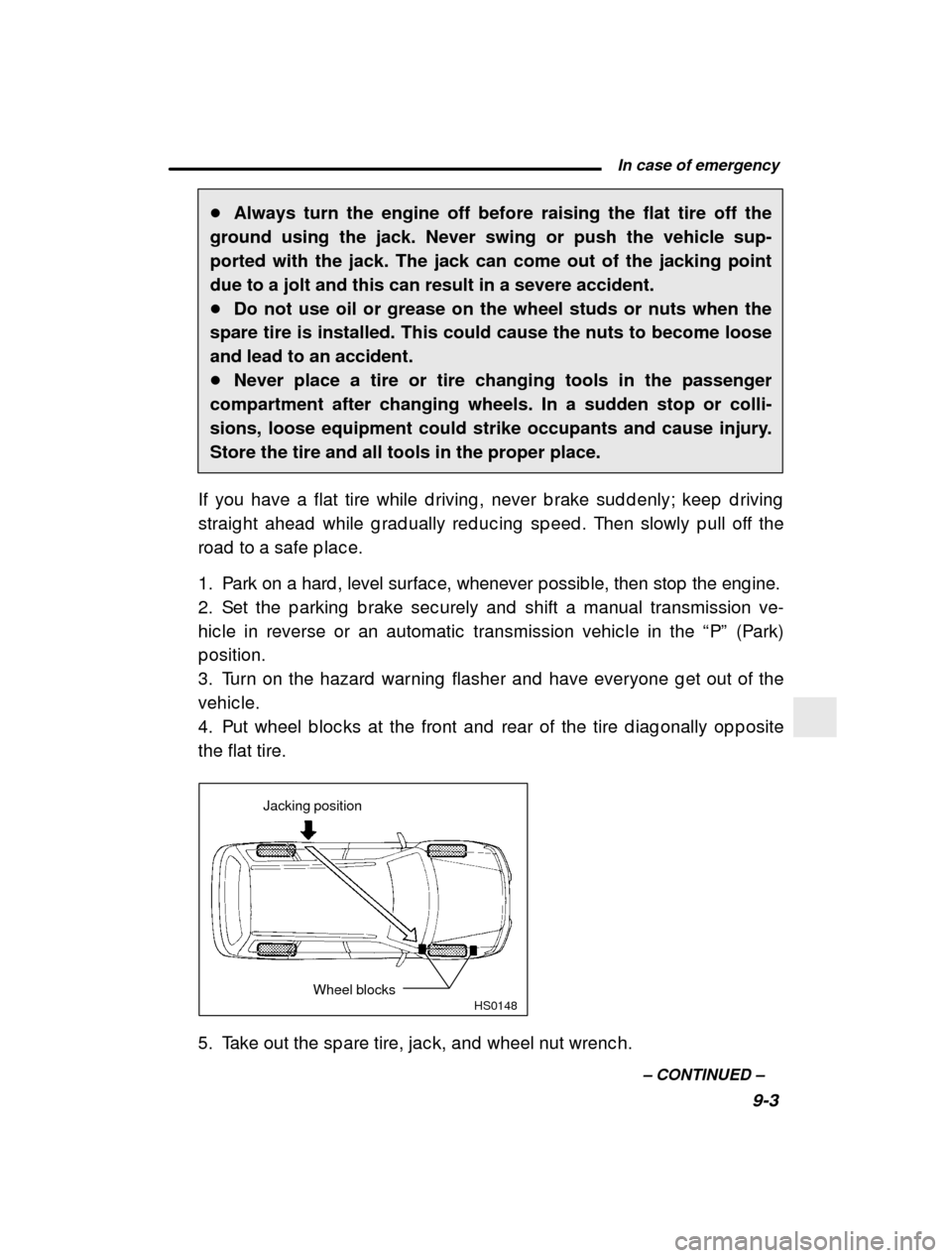
4. Put wheel b loc ks at the front and rear of the tir e d iag onally op p osite
the flat tire.
HS0148
Jacking position
Wheel blocks
5. Take out the sp are tire, jac k, and wheel nut wren c h.
Page 270 of 357
In case of emergency9-13
–
CONTINUED –
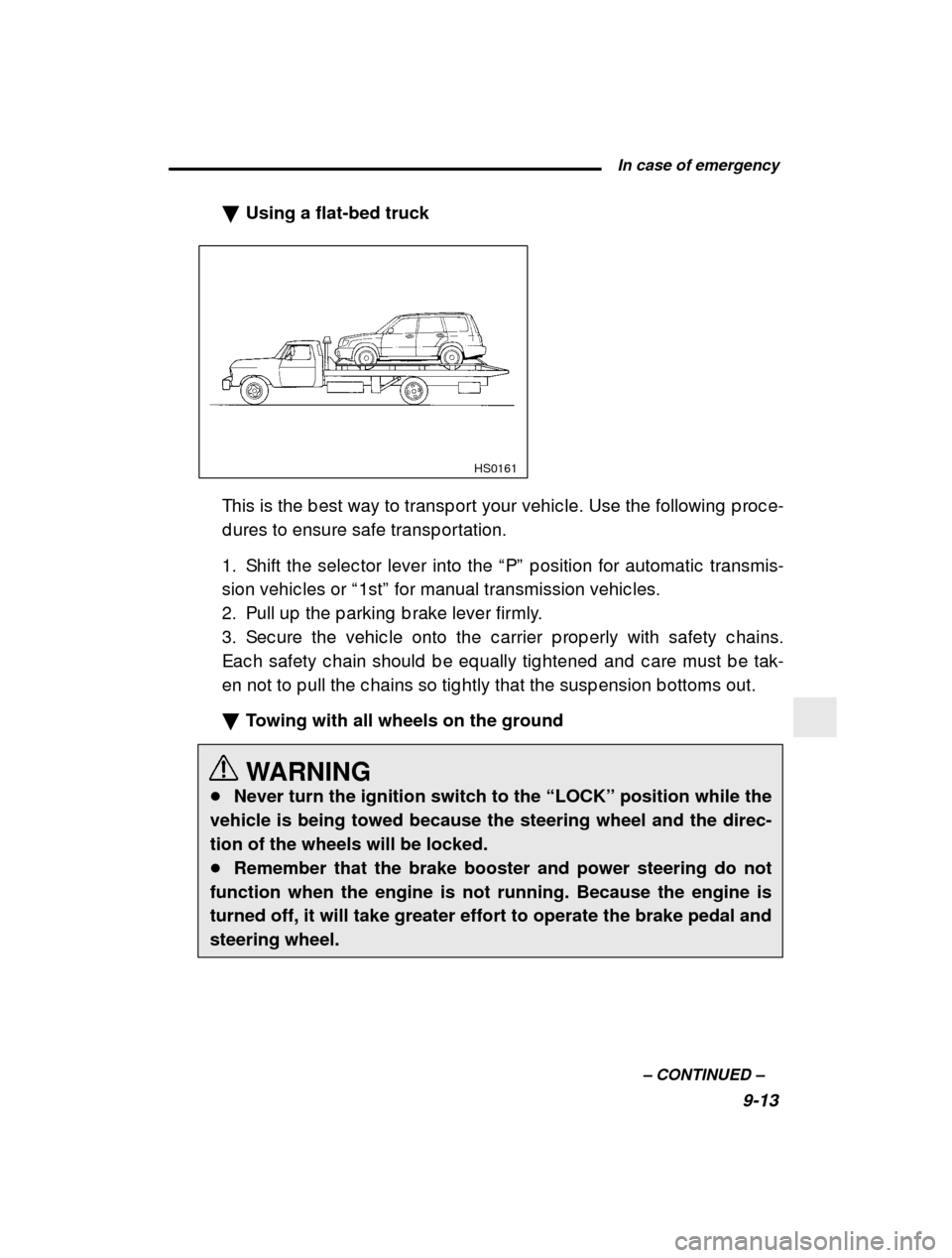
Using a flat-bed truck
HS0161
This is the b est way to transp ort your vehic le. Use the following p roc e-
d ures to ensure safe transp ortation.
1. Shift the selec tor lever into the “P ” p osition for automatic transmis-
sion vehic les or “1st ” for manual transmission vehic les.
2. Pull up the p arking b rake lever firmly.
3. Sec ure the vehic le onto the c arrier p rop erly with safety c hains.
Eac h safety c hain should b e eq ually tig htened and c are must b e tak-
en not to p ull the c hains so tig htly that the susp e nsion b ottoms out.
Towing with all wheels on the ground
WARNING
Never turn the ignition switch to the “LOCK” position while the
vehicle is being towed because the steering wheel and the direc- tion of the wheels will be locked. Remember that the brake booster and power steering do not
function when the engine is not running. Because the engine isturned off, it will take greater effort to operate the brake pedal andsteering wheel.
Page 271 of 357

9-14CAUTION
If transmission failure occurs, transport your vehicle on a flat-
bed truck. For AWD vehicles, the traveling speed must be limited to less
than 20 mph (30 km/h) and the traveling distance to less than 31
miles (50 km). For greater speeds and distances, transport your
vehicle on a flat-bed truck.
HS0163
We d o not rec ommend this method of towing . Use this method only
when towing servic e b y a SUBARU d ealer or a c ommerc ial towing
servic e is not availab le.
1. Chec k the transmission and d ifferential oil level s and ad d oil to
b ring it to the up p er level if nec essary.
2. Release the p arking b rake and p ut the transmissio n in neutral.
3. The ig nition switc h should b e in the “ACC ” p osition while the ve-
hic le is b eing towed .
4. Take up slac k in the towline slowly to p revent d a mag e to the ve-
hic le.
Page 282 of 357

11
Maintenance and service
Maintenance schedule11-3
. . . . . . . . . . . . . . . . . . . . . . . . . . . . . . . . . . . . . . . . . . . . . . . . . .
Maintenance precautions 11-3
. . . . . . . . . . . . . . . . . . . . . . . . . . . . . . . . . . . . . . . . . . . . . .
Engine hood 11-6
. . . . . . . . . . . . . . . . . . . . . . . . . . . . . . . . . . . . . . . . . . . . . . . . . . . . . . . . . . . . . . . .
Engine compartment overview 11-8 . . . . . . . . . . . . . . . . . . . . . . . . . . . . . . . . . . . . . . .
Engine oil 11-9
. . . . . . . . . . . . . . . . . . . . . . . . . . . . . . . . . . . . . . . . . . . . . . . . . . . . . . . . . . . . . . . . . . . .
Cooling system 11-14
. . . . . . . . . . . . . . . . . . . . . . . . . . . . . . . . . . . . . . . . . . . . . . . . . . . . . . . . . . . .
Engine coolant 11-15
. . . . . . . . . . . . . . . . . . . . . . . . . . . . . . . . . . . . . . . . . . . . . . . . . . . . . . . . . . .
Air cleaner element 11-18
. . . . . . . . . . . . . . . . . . . . . . . . . . . . . . . . . . . . . . . . . . . . . . . . . . . . . .
Spark plugs 11-19
. . . . . . . . . . . . . . . . . . . . . . . . . . . . . . . . . . . . . . . . . . . . . . . . . . . . . . . . . . . . . . . . .
Drive belts 11-20
. . . . . . . . . . . . . . . . . . . . . . . . . . . . . . . . . . . . . . . . . . . . . . . . . . . . . . . . . . . . . . . . . . .
Manual transmission oil 11-21
. . . . . . . . . . . . . . . . . . . . . . . . . . . . . . . . . . . . . . . . . . . . . . . .
Automatic transmission fluid 11-22 . . . . . . . . . . . . . . . . . . . . . . . . . . . . . . . . . . . . . . . . .
Front differential gear oil (Automatic transmission vehicles) 11-24 . . . . . . . . . . . . . . . . . . . . . . . . . . . . . . . . . . . . . . . . . . . . . . . . . . . . . . . . . . . . . . . . . .
Rear differential gear oil 11-25
. . . . . . . . . . . . . . . . . . . . . . . . . . . . . . . . . . . . . . . . . . . . . . . .
Power steering fluid 11-27
. . . . . . . . . . . . . . . . . . . . . . . . . . . . . . . . . . . . . . . . . . . . . . . . . . . . .
Brake fluid 11-28
. . . . . . . . . . . . . . . . . . . . . . . . . . . . . . . . . . . . . . . . . . . . . . . . . . . . . . . . . . . . . . . . . . .
Clutch fluid 11-30
. . . . . . . . . . . . . . . . . . . . . . . . . . . . . . . . . . . . . . . . . . . . . . . . . . . . . . . . . . . . . . . . . .
Brake booster 11-31
. . . . . . . . . . . . . . . . . . . . . . . . . . . . . . . . . . . . . . . . . . . . . . . . . . . . . . . . . . . . . .
Battery 11-31
. . . . . . . . . . . . . . . . . . . . . . . . . . . . . . . . . . . . . . . . . . . . . . . . . . . . . . . . . . . . . . . . . . . . . . . .
Windshield washer fluid 11-33
. . . . . . . . . . . . . . . . . . . . . . . . . . . . . . . . . . . . . . . . . . . . . . . .
Replacement of windshield wiper blades 11-34 . . . . . . . . . . . . . . . . . . . . . . . .
Brake pedal 11-37
. . . . . . . . . . . . . . . . . . . . . . . . . . . . . . . . . . . . . . . . . . . . . . . . . . . . . . . . . . . . . . . . .
Clutch pedal (Manual transmission vehicles) 11-38 . . . . . . . . . . . . . . . . . . .
Replacement of brake pad and lining 11-39 . . . . . . . . . . . . . . . . . . . . . . . . . . . . . .
Parking brake stroke 11-40
. . . . . . . . . . . . . . . . . . . . . . . . . . . . . . . . . . . . . . . . . . . . . . . . . . . .
Tires and wheels 11-41
. . . . . . . . . . . . . . . . . . . . . . . . . . . . . . . . . . . . . . . . . . . . . . . . . . . . . . . . . .
Tire pressure 11-41
. . . . . . . . . . . . . . . . . . . . . . . . . . . . . . . . . . . . . . . . . . . . . . . . . . . . . . . . . . . . .
Tire rotation 11-42
. . . . . . . . . . . . . . . . . . . . . . . . . . . . . . . . . . . . . . . . . . . . . . . . . . . . . . . . . . . . . . .
Aluminum wheels (If equipped) 11-43 . . . . . . . . . . . . . . . . . . . . . . . . . . . . . . . . . . . . . .
Fuses 11-44
. . . . . . . . . . . . . . . . . . . . . . . . . . . . . . . . . . . . . . . . . . . . . . . . . . . . . . . . . . . . . . . . . . . . . . . . .
Main fuse and fusible link 11-47 . . . . . . . . . . . . . . . . . . . . . . . . . . . . . . . . . . . . . . . . . . . . . .
Installation of accessories 11-47 . . . . . . . . . . . . . . . . . . . . . . . . . . . . . . . . . . . . . . . . . . . . .
Replacing bulbs 11-48
. . . . . . . . . . . . . . . . . . . . . . . . . . . . . . . . . . . . . . . . . . . . . . . . . . . . . . . . . . .
Page 284 of 357
Maintenance and service11-3
–
CONTINUED –
Maintenance schedule
The sc hed uled maintenanc e items req uired to b e serv
ic ed at reg ular in-
tervals are shown in the “Warranty and Maintenanc e Booklet ”.
For d etails of your maintenanc e sc hed ule, read the sep arate “Warranty
and Maintenanc e Booklet ”.
Maintenance precautions
When maintenanc e and servic e are req uired , it is re c ommend ed that all
work b e d one b y an authorized SUBARU d ealer.
If you p erform maintenanc e and servic e b y yourself, you should familiar-
ize yourself with the information p rovid ed in this sec tion on g eneral main-
tenanc e and servic e for your SUBARU.
Inc orrec t or inc omp lete servic e c ould c ause imp rop e r or unsafe vehic le
op eration. Any p rob lems c aused b y imp rop er maintena nc e and servic e
p erformed b y you are not elig ib le for warranty c ove rag e.
WARNING
Testing of an All-Wheel Drive vehicle must NEVER be per-
formed on a single two-wheel dynamometer or similar apparatus nor should you install the FWD fuse in the engine compartment.Attempting to do so will result in transmission damage and inuncontrolled vehicle movement and may cause an accident or
injuries to persons nearby. Always select a safe area when performing maintenance on
your vehicle. Always be very careful to avoid injury when working on the ve-
hicle. Remember that some of the materials in the vehicle may behazardous if improperly used or handled, for example, batteryacid. Your vehicle should only be serviced by persons fully compe-
tent to do so. Serious personal injury may result to persons not
experienced in servicing vehicles.