ABS SUBARU FORESTER 2003 SG / 2.G User Guide
[x] Cancel search | Manufacturer: SUBARU, Model Year: 2003, Model line: FORESTER, Model: SUBARU FORESTER 2003 SG / 2.GPages: 420, PDF Size: 4.4 MB
Page 258 of 420
7-25
Starting and operating
–CONTINUED –
Electronic Brake Force Distribution
(EBD) system (if equipped)
The EBD system maximizes the effectiveness of the
brakes by allowing the rear brakes to supply a greater
proportion of the braking force. It functions by adjust-
ing the distribution of braking force to the rear wheels
in accordance with the vehicle’s loading condition and
speed.
The EBD system is an integral part of the ABS system
and uses some of the ABS system’s components to
perform its function of optimizing the distribution of
braking force. If any of the ABS components used by
the EBD function fails, the EBD system also stops
working.
When the EBD system is operating, you may hear a
chattering noise or feel a slight vibration in the brake
pedal. This is normal and does not indicate a malfunc- tion.
Steps to take if EBD system fails
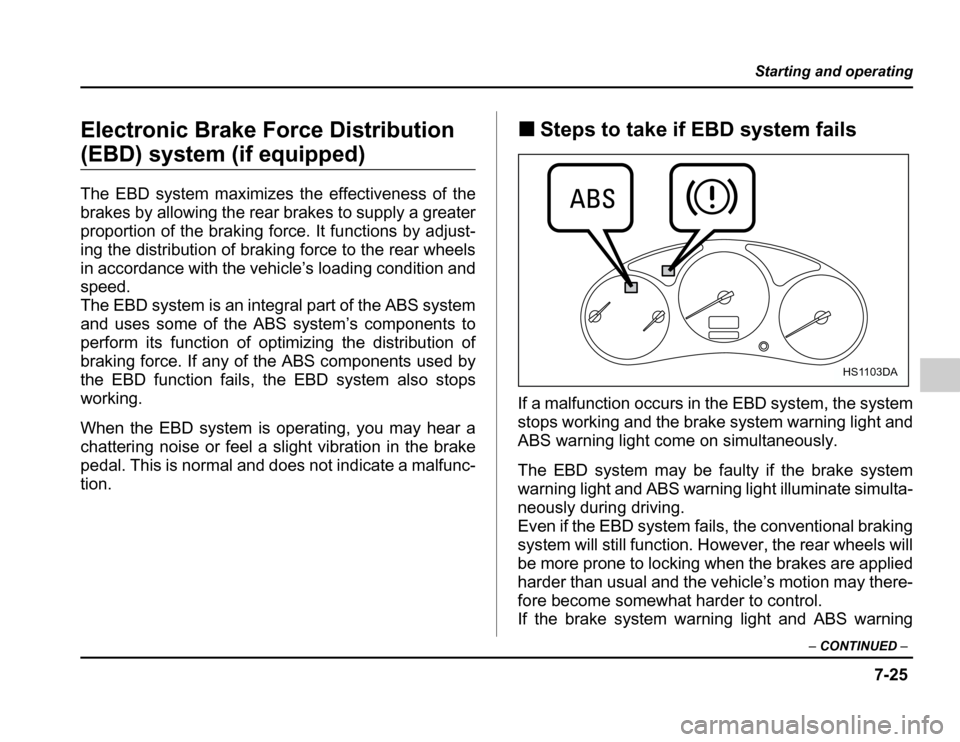
If a malfunction occurs in the EBD system, the system
stops working and the brake system warning light and
ABS warning light come on simultaneously.
The EBD system may be faulty if the brake system
warning light and ABS warning light illuminate simulta-
neously during driving.
Even if the EBD system fails, the conventional braking
system will still function. However, the rear wheels will
be more prone to locking when the brakes are applied
harder than usual and the vehicle’s motion may there-
fore become somewhat harder to control.
If the brake system warning light and ABS warning
HS1103DA
Page 267 of 420
7-34
Starting and operating
Self-leveling rear suspension (if
equipped)
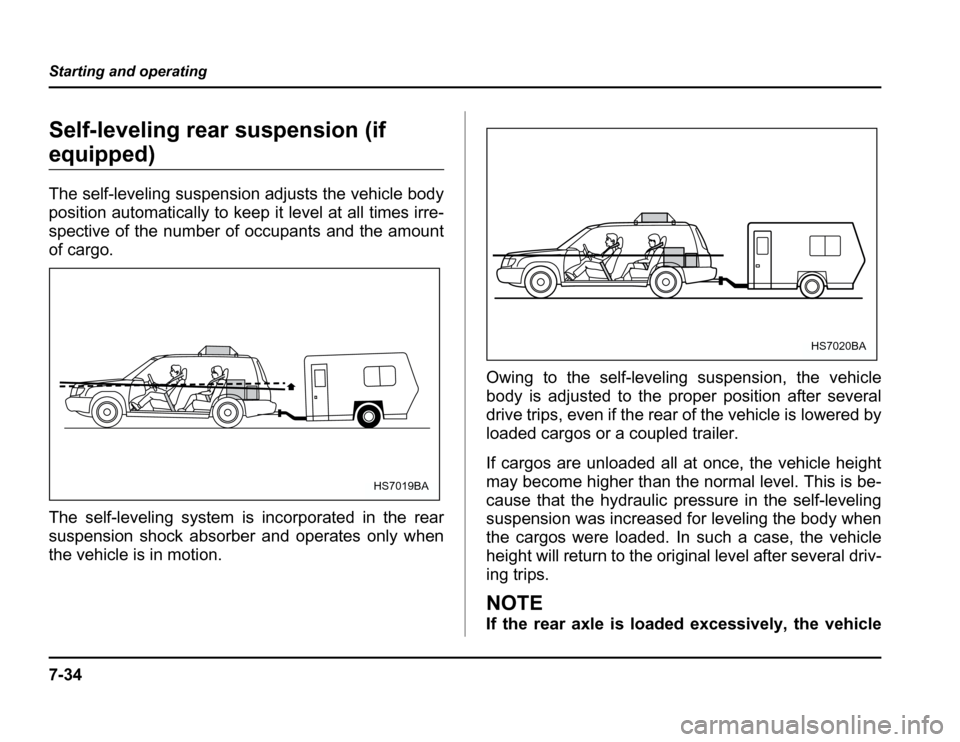
The self-leveling suspension adjusts the vehicle body
position automatically to keep it level at all times irre-
spective of the number of occupants and the amount
of cargo.
The self-leveling system is incorporated in the rear
suspension shock absorber and operates only when
the vehicle is in motion.
Owing to the self-leveling suspension, the vehicle
body is adjusted to the proper position after several
drive trips, even if the rear of the vehicle is lowered by
loaded cargos or a coupled trailer.
If cargos are unloaded all at once, the vehicle height
may become higher than the normal level. This is be-
cause that the hydraulic pressure in the self-leveling
suspension was increased for leveling the body when
the cargos were loaded. In such a case, the vehicle
height will return to the origi
nal level after several driv-
ing trips.
NOTE
If the rear axle is loaded excessively, the vehicle
HS7019BA
HS7020BA
Page 279 of 420

8-10
Driving tips
starting.
Keep the door locks from freezing by squirting them
with deicer or glycerin.
Forcing a frozen door open may damage or separate
the rubber weather strips around the door. If the door
is frozen, use hot water to melt the ice, and afterwards
thoroughly wipe the water away.
Use a windshield washer fluid that contains an anti-
freeze solution. Do not use engine antifreeze or other
substitutes because they may damage the paint of the
vehicle.
Before driving your vehicle
Before entering the vehicle, remove any snow or ice
from your shoes because that could make the pedals
slippery and dangerous.
While warming up the vehicle before driving, check
that the accelerator pedal, brake pedal, and all other
controls operate smoothly.
Clear away ice and snow that has accumulated under
the fenders to avoid making steering difficult. During
severe winter driving, stop when and where it is safe
to do so and check under the fenders periodically.
Parkingincoldweather
Do not use the parking brake when parking for long
periods in cold weather since it could freeze in that po-
sition. Instead, observe the following:
1. Place the shift lever in “1” or “R” for manual trans-
mission vehicles, and in “P” for automatic transmission
vehicles.
2. Use tire stops under the tires to prevent the vehicle
from moving.
When the vehicle is parked in snow or when it snows,
raise the wiper blades off the glass to prevent damage
to them.
When the vehicle has been left parked after use on
roads heavily covered with snow, or has been left
parked during a snowstorm, icing may develop on the
brake system, which could cause poor braking action.
Check for snow or ice buildup on the suspension, disc
brakes and brake hoses underneath the vehicle.
If there is caked snow or ice, remove it, being careful
not to damage the disc brakes and brake hoses and
ABS harness.
Snow can trap dangerous exhaust gases under
your vehicle. Keep snow clear of the exhaust
Page 280 of 420
8-11
Driving tips
– CONTINUED –
pipe and from around your vehicle if you park
the vehicle in snow with the engine running.
Refuelingincoldweather
To help prevent moisture from forming in the fuel sys-
tem and the risk of its freezing, use of an antifreeze ad-
ditive in the fuel tank is recommended during cold
weather.
Use only additives that are specifically designed for
this purpose. When an antifreeze additive is used, its
effect lasts longer if the tank is refilled whenever the
fuel level reaches half empty.
If your SUBARU is not going to be used for an extend-
ed period, it is best to have the fuel tank filled to capac-
ity. Drivingonsnowyandicyroads
To prevent skidding and slipping, avoid sudden brak-
ing, abrupt acceleration, high-speed driving, and
sharp turning when driving on snowy or icy roads.
Always maintain ample distance between your vehicle
and the vehicle ahead of you to avoid the need for sud-
den braking.
To supplement the foot brake, use the engine brake
effectively to control the vehicle speed. (Shift into a lower gear when necessary.)
Avoid shifting down abruptly. Such behavior can
cause the wheels to lock, possibly leading to loss of
vehicle control.
An anti-lock brake system (ABS) enhances your vehi-
cle’s braking performance on snowy and icy roads.
Refer to the “ABS (Anti-lock Brake System)” section in
chapter 7 for information on braking on slippery sur-
faces.
Do not use the cruise control on slippery roads
such as snowy or icy roads. This may cause
loss of vehicle control.
Wiper operation when snowing
Before driving in cold weather, make sure the wiper
blades are not frozen to the windshield or rear window.
If the wiper blades are frozen to the windshield or rear
window, use the defroster with the airflow control but-
ton/dial in the “ ” position and the temperature con-
trol dial set for maximum warmth until the wiper blades
are completely thawed out. If your vehicle is equipped
with a wiper deicer, it is helpful to thaw the windshield
wiper blades. To thaw out the rear wiper blade, use the
Page 303 of 420
8-34
Driving tips
ally.
When passing other vehicles, considerable dis-
tance is required because of the added weight and
length caused by attaching the trailer to your vehicle.
1) Left turn
2) Right turn
Backing up with a trailer is difficult and takes prac-
tice. When backing up with a trailer, never accelerate
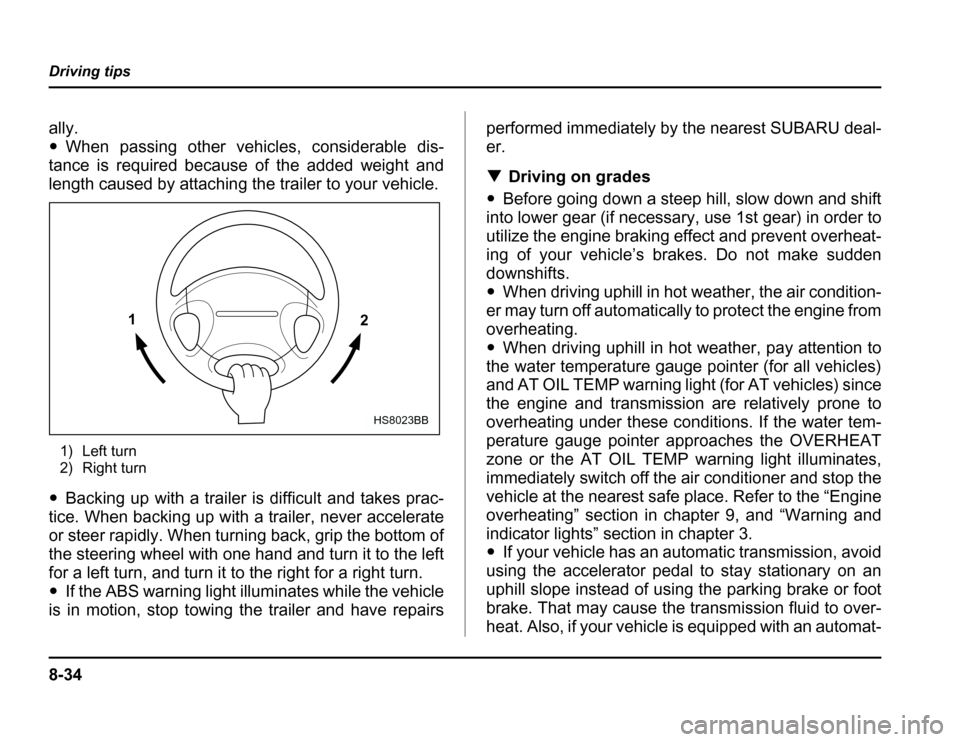
or steer rapidly. When turning back, grip the bottom of
the steering wheel with one hand and turn it to the left
for a left turn, and turn it to the right for a right turn. If the ABS warning light illuminates while the vehicle
is in motion, stop towing the trailer and have repairs performed immediately by the nearest SUBARU deal- er.
Driving on grades
Before going down a steep hill, slow down and shift
into lower gear (if necessary, use 1st gear) in order to
utilize the engine braking effect and prevent overheat-
ing of your vehicle’s brakes. Do not make sudden
downshifts. When driving uphill in hot weather, the air condition-
er may turn off automatically to protect the engine from
overheating. When driving uphill in hot weather, pay attention to
the water temperature gauge pointer (for all vehicles)
and AT OIL TEMP warning light (for AT vehicles) since
the engine and transmission are relatively prone to
overheating under these conditions. If the water tem-
perature gauge pointer approaches the OVERHEAT
zone or the AT OIL TEMP warning light illuminates,
immediately switch off the air conditioner and stop the
vehicle at the nearest safe place. Refer to the “Engine
overheating” section in chapter 9, and “Warning and
indicator lights” section in chapter 3. If your vehicle has an automatic transmission, avoid
using the accelerator pedal to stay stationary on an
uphill slope instead of using the parking brake or foot
brake. That may cause the transmission fluid to over-
heat. Also, if your vehicle is equipped with an automat-
1 2
HS8023BB
Page 304 of 420

8-35
Driving tips
– CONTINUED –
ic transmission, avoid driving with the gear selector
lever in “D” when towing a heavy trailer to prevent fluid
overheating. A lower gear should be used. Parking on a grade
Always block the wheels under both vehicle and trailer
when parking. Apply the parking brake firmly. You
should not park on a hill or slope. But if parking on a
hill or slope cannot be avoided, you should take the
following steps:
1. Apply the brakes and hold the pedal down.
2. Have someone place wheel blocks under both the
vehicle and trailer wheels.
3. When the wheel blocks are in place, release the
regular brakes slowly until the blocks absorb the load.
4. Apply the regular brakes and then apply the park-
ing brake; slowly release the regular brakes.
5. Shift into 1st or reverse gear (manual transmission)
or “P” (automatic transmi ssion) and shut off the en-
gine.
Page 310 of 420
9-5
In case of emergency
–CONTINUED –
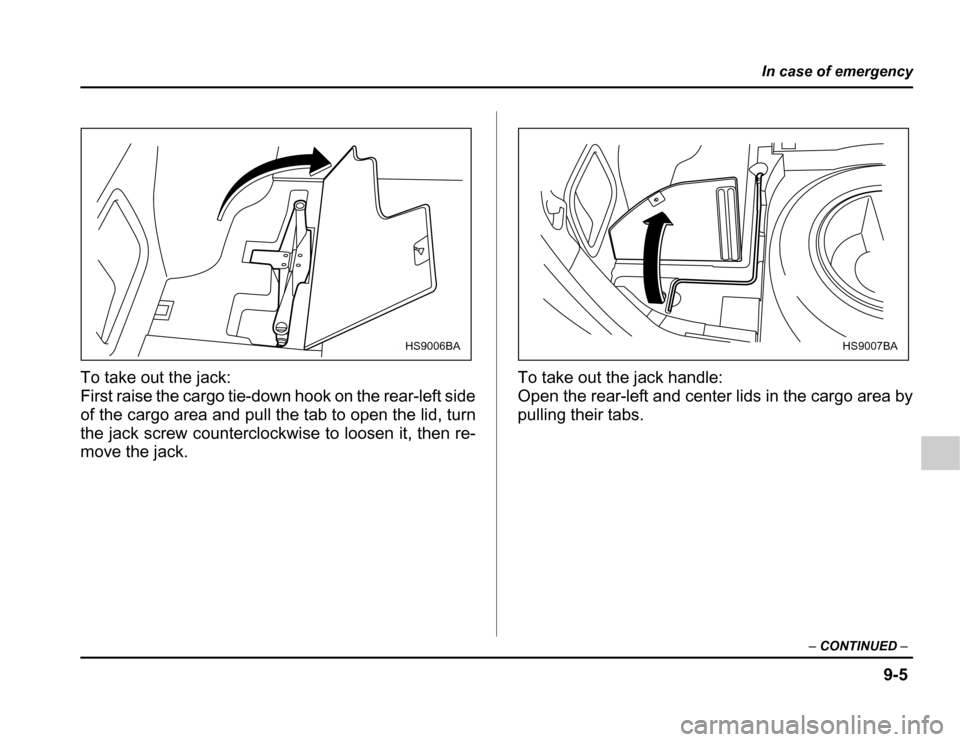
To take out the jack:
First raise the cargo tie-down hook on the rear-left side
of the cargo area and pull the tab to open the lid, turn
the jack screw counterclockwise to loosen it, then re-
move the jack. To take out the jack handle:
Open the rear-left and center lids in the cargo area by
pulling their tabs.
HS9006BAHS9007BA
Page 362 of 420
11 -3 1
Maintenance and service
–CONTINUED –
Brake fluid absorbs moisture from the air.
Any absorbed moisture can cause a dangerous
loss of braking performance. If the vehicle requires freq uent refilling, there
may be a leak. If you suspect a problem, have
the vehicle checked at your SUBARU dealer.
Never use different brands of brake fluid to-
gether. When adding brake fluid, be careful not to al-
low any dirt into the reservoir. Never splash the brake fluid over painted sur-
faces or rubber parts. Alcohol contained in the
brake fluid may damage them.
Recommended brake fluid
FMVSS No. 116, fresh DOT 3 or 4 brake fluid
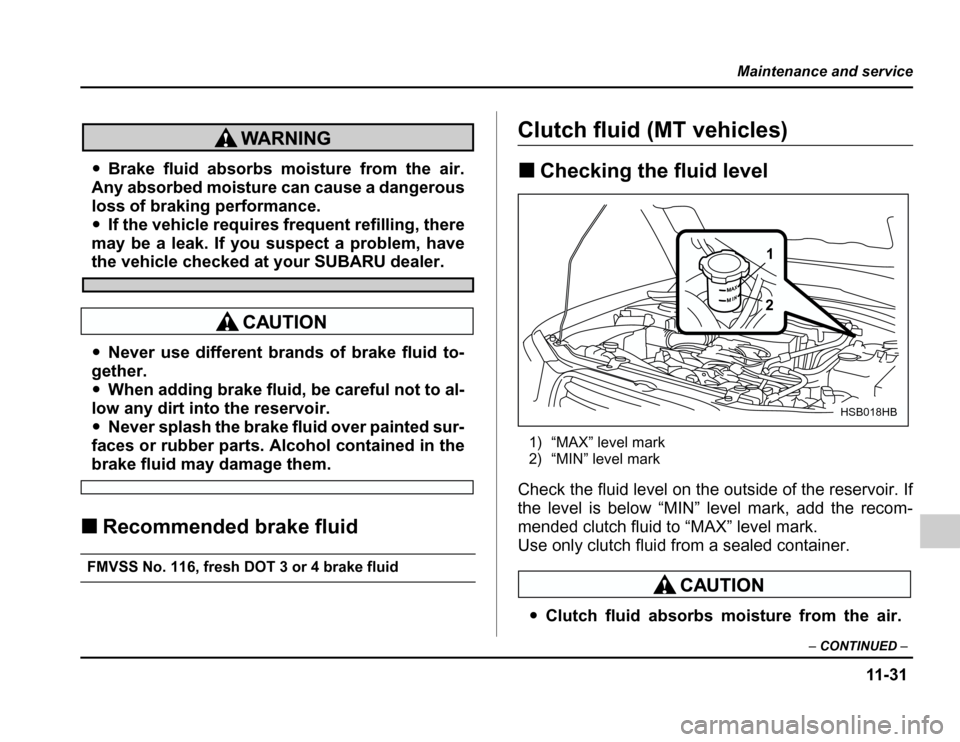
Clutch fluid (MT vehicles) Checking the fluid level
1) “MAX” level mark
2) “MIN” level mark
Check the fluid level on the outside of the reservoir. If
the level is below “MIN” level mark, add the recom-
mended clutch fluid to “MAX” level mark.
Use only clutch fluid from a sealed container.
Clutch fluid absorbs moisture from the air.
HSB018HB
MAXMIN
1
2
Page 363 of 420

11 - 3 2
Maintenance and service
Any absorbed moisture can cause improper
clutch operation.
If the vehicle requires frequent refilling, there
may be a leak. If you suspect a problem, have
the vehicle checked at your SUBARU dealer. Never use different brands of clutch fluid to-
gether. When clutch fluid is added, be careful not to
allow any dirt into the tank.
Recommended clutch fluid
FMVSS No. 116, fresh DOT 3 or 4 brake fluid
Brake booster
If the brake booster does not operate as described be-
low, have it checked by your SUBARU dealer.
1. With the engine off, depress the brake pedal sever-
al times, applying the same pedal force each time. The
distance the pedal travels should not vary.
2. With the brake pedal depressed, start the engine.
The pedal should move slightly down to the floor.
3. With the brake pedal depressed, stop the engine
and keep the pedal depressed for 30 seconds. The
pedal height should not change.
4. Start the engine again and run for about one minute
then turn it off. Depress the brake pedal several times
to check the brake booster. Brake booster operates
properly if the pedal stroke decreases with each de-
pression.
Page 391 of 420
11 - 6 0
Maintenance and service
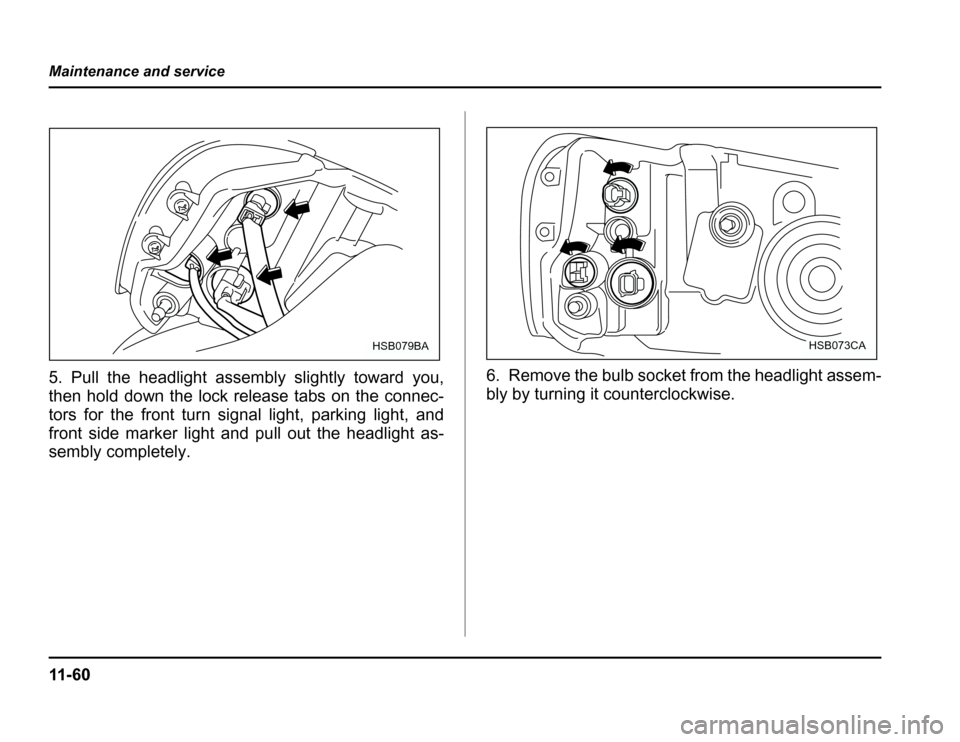
5. Pull the headlight assembly slightly toward you,
then hold down the lock release tabs on the connec-
tors for the front turn signal light, parking light, and
front side marker light and pull out the headlight as-
sembly completely.
6. Remove the bulb socket from the headlight assem-
bly by turning it counterclockwise.
HSB079BAHSB073CA