wheel SUBARU FORESTER 2003 SG / 2.G Owner's Guide
[x] Cancel search | Manufacturer: SUBARU, Model Year: 2003, Model line: FORESTER, Model: SUBARU FORESTER 2003 SG / 2.GPages: 420, PDF Size: 4.4 MB
Page 261 of 420
7-28
Starting and operating
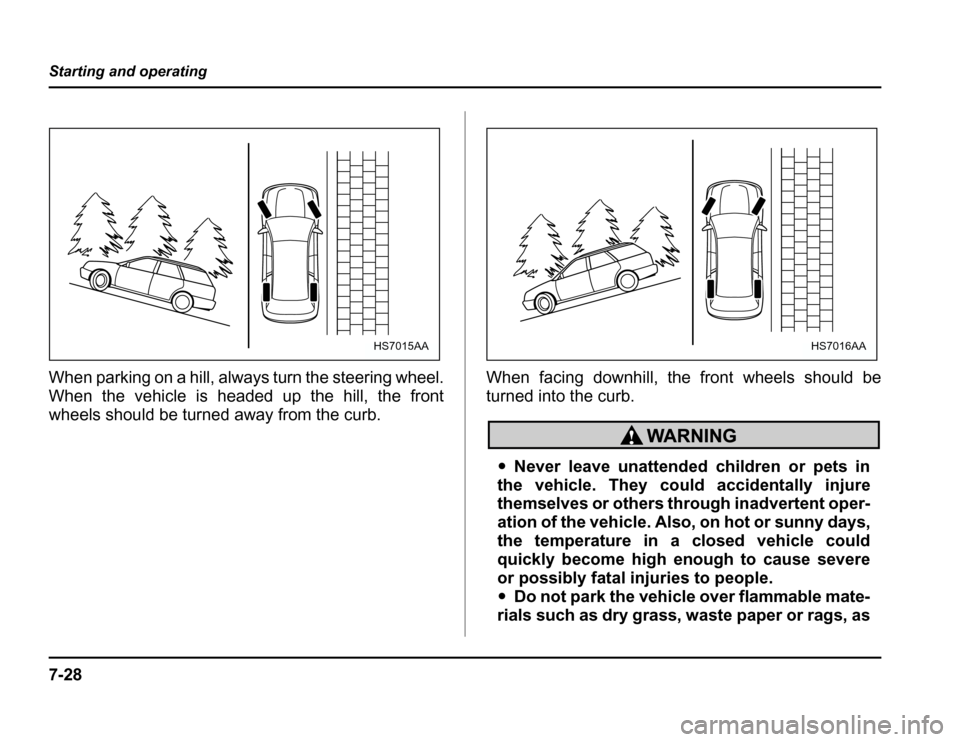
When parking on a hill, always turn the steering wheel.
When the vehicle is headed up the hill, the front
wheels should be turned away from the curb.
When facing downhill, the front wheels should be
turned into the curb.
Never leave unattended children or pets in
the vehicle. They could accidentally injure
themselves or others through inadvertent oper-
ation of the vehicle. Also, on hot or sunny days,
the temperature in a closed vehicle could
quickly become high enough to cause severe
or possibly fatal injuries to people. Do not park the vehicle over flammable mate-
rials such as dry grass, waste paper or rags, as
HS7015AAHS7016AA
Page 271 of 420

8-2
Driving tips
Driving tips
New vehicle break-in driving – the
first 1,000 miles (1,600 km)
The performance and long life of your vehicle are de-
pendent on how you handle and care for your vehicle
while it is new. Follow these instructions during the
first 1,000 miles (1,600 km):
Do not race the engine. And do not allow engine
speed to exceed 4,000 rpm except in an emergency. Do not drive at one constant engine or vehicle
speed for a long time, either fast or slow. Avoid starting suddenly and rapid acceleration, ex-
cept in an emergency. Avoid hard braking, except in an emergency.
The same break-in procedures should be applied to
an overhauled engine, newly mounted engine or when
brake pads or brake linings are replaced with new
ones.
Fuel economy hints
The following suggestions will help to save your fuel. Select the proper gear position for the speed and
road conditions. Avoid sudden acceleration or deceleration. Always
accelerate gently until you reach the desired speed.
Then try to maintain that speed for as long as possible. Do not pump the accelerator and avoid racing the
engine. Avoid unnecessary engine idling.
Keep the engine properly tuned.
Keep the tires inflated to the correct pressure shown
on the tire placard, which is located under the door
latch on the driver’s side. Low pressure will increase
tire wear and fuel consumption. Use the air conditioner only when necessary.
Keep the front and rear wheels in proper alignment.
Avoid carrying unnecessary cargo.
Page 275 of 420
8-6
Driving tips
Driving tips for AWD vehicles
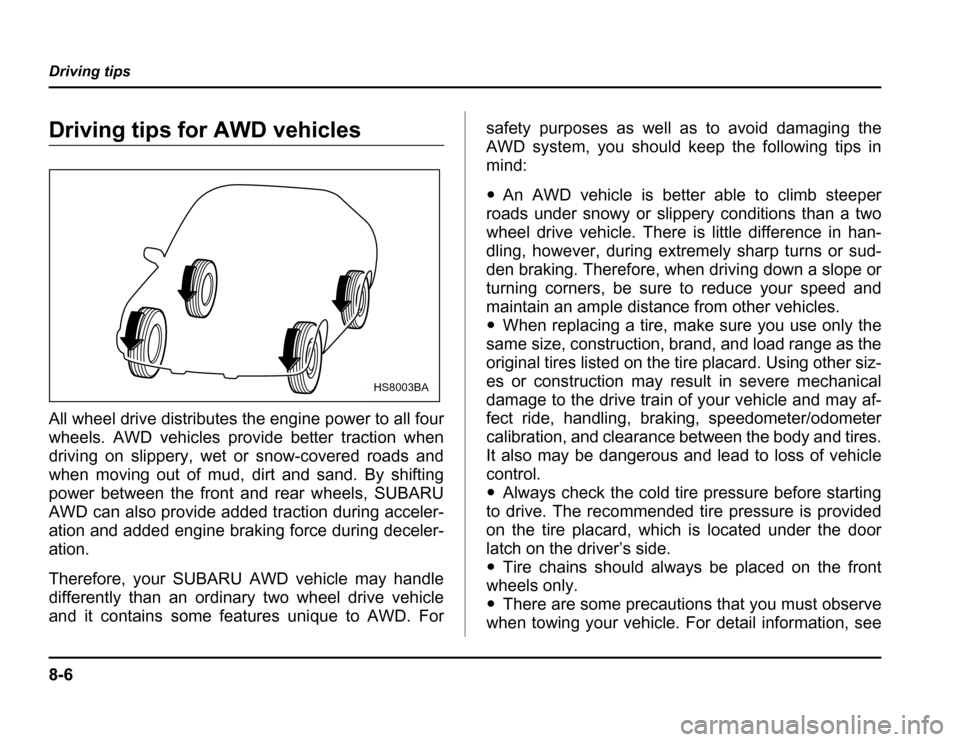
All wheel drive distributes the engine power to all four
wheels. AWD vehicles provide better traction when
driving on slippery, wet or snow-covered roads and
when moving out of mud, dirt and sand. By shifting
power between the front and rear wheels, SUBARU
AWD can also provide added traction during acceler-
ation and added engine braking force during deceler-
ation.
Therefore, your SUBARU AWD vehicle may handle
differently than an ordinary two wheel drive vehicle
and it contains some features unique to AWD. For
safety purposes as well as to avoid damaging the
AWD system, you should keep the following tips inmind:
An AWD vehicle is better able to climb steeper
roads under snowy or slippery conditions than a two
wheel drive vehicle. There is little difference in han-
dling, however, during extremely sharp turns or sud-
den braking. Therefore, when driving down a slope or
turning corners, be sure to reduce your speed and
maintain an ample distance from other vehicles. When replacing a tire, make sure you use only the
same size, construction, brand, and load range as the
original tires listed on the tire placard. Using other siz-
es or construction may result in severe mechanical
damage to the drive train of your vehicle and may af-
fect ride, handling, braking, speedometer/odometer
calibration, and clearance between the body and tires.
It also may be dangerous and lead to loss of vehicle control. Always check the cold tire pressure before starting
to drive. The recommended tire pressure is provided
on the tire placard, which is located under the door
latch on the driver’s side. Tire chains should always be placed on the front
wheels only. There are some precautions that you must observe
when towing your vehicle. For detail information, see
HS8003BA
Page 276 of 420

8-7
Driving tips
– CONTINUED –
the “Towing” section in chapter 9.
Always maintain a safe driving speed accord-
ing to the road and weather conditions in order
to avoid having an accident on a sharp turn,
during sudden braking or under other similar
conditions. Always use the utmost care in driving – over-
confidence because you are driving an all
wheel drive vehicle could easily lead to a seri-
ous accident.
Off road driving
Because of the AWD feature and higher ground clear-
ance, your Subaru can be driven on ordinary roads or
off-road. But please keep in mind that an AWD
SUBARU is a passenger car and is neither a conven-
tional off-road vehicle nor an all-terrain vehicle. If you
do take your Subaru off-road, certain common sense
precautions such as the following should be taken: Make certain that you and all of your passengers
are wearing seat belts. Carry some emergency equipment, such as a tow-
ing rope or chain, a shovel, wheel blocks, first aid kit
and portable phone or citizens band radio. Drive carefully. Do not take unnecessary risks by
driving in dangerous areas or over rough terrain. Slow down and employ extra caution at all times.
When driving off-road, you will not have the benefit of
marked traffic lanes, banked curves, traffic signs and
the like. Do not drive across steep slopes. Instead, drive ei-
ther straight up or straight down the slopes. A vehicle
can much more easily tip over sideways than it can
end over end. Avoid driving straight up or down slopes
that are too steep. Avoid sharp turning maneuvers, especially at higher
speeds.
Page 277 of 420

8-8
Driving tips
Do not grip the inside or spokes of the steering
wheel. A bad bump could jerk the wheel and injure
your hands. Instead drive with your fingers and
thumbs on the outside of the rim. If driving through water, such as when crossing
shallow streams, first check the depth of the water and
the bottom of the stream bed for firmness and ensure
that the bed of the stream is flat. Drive slowly and com-
pletely through the stream. The water should be shal-
low enough that it does not reach the vehicle’s
undercarriage. Water entering the engine air intake or
the exhaust pipe or water splashing onto electrical
parts may damage your vehicle and may cause it to
stall. Never attempt to drive through rushing water; re-
gardless of its depth, it can wash away the ground
from under your tires, resulting in possible loss of trac-
tion and even vehicle rollover. Always check your brakes for effectiveness immedi-
ately after driving in sand, mud or water. Do this by
driving slowly and stepping on the brake pedal. Re-
peat that process several times to dry out the brake
discs and brake pads. Do not drive or park over or near flammable materi-
als such as dry grass or fallen leaves, as they may
burn easily. The exhaust system is very hot while the
engine is running and right after the engine stops. This
could create a fire hazard.
After driving through tall grass, mud, rock, sand, riv-
ers, etc., check that there is no grass, bush, paper,
rags, stones, sand, etc. adhering to or trapped on the
underbody. Clear off any such matter from the under-
body. If the vehicle is use d with these materials
trapped or adhering to the underbody, a mechanical
breakdown or fire could occur. Secure all cargo carried inside the vehicle and make
certain that it is not piled higher than the seatbacks.
During sudden stops or jolts, unsecured cargo could
be thrown around in the vehicle and cause injury. Do
not pile heavy loads on the roof. Those loads raise the
vehicle’s center of gravity and make it more prone to
tip over. If you must rock the vehicle to free it from sand or
mud, depress the accelerator pedal slightly and move
the selector lever back and forth between “D” and “R”
repeatedly. Do not race the engine. For the best pos-
sible traction, avoid spinning the wheels when trying to
free the vehicle.
When the road surface is extremely slippery, you can
obtain better traction by starting the vehicle with the
transmission in 2nd than 1st (both for MT and AT). Never equip your vehicle with tires larger than those
specified in this manual. Frequent driving of an AWD vehicle under hard-driv-
ing conditions such as rough roads or off roads will ne-
Page 278 of 420
8-9
Driving tips
– CONTINUED –
cessitate more frequent replacement of engine oil,
brake fluid and transmission oil than that specified in
the maintenance schedule described in the “Warranty
and Maintenance Booklet”.
Remember that damage done to your Subaru while
operating it off-road and not using common sense pre-
cautions such as those listed above is not eligible for
warranty coverage.
Always maintain a safe driving speed accord-
ing to the road and weather conditions in order
to avoid having an accident on a sharp turn,
during sudden braking or under other similar
conditions. Always use the utmost care in driving – over-
confidence because you are driving an all
wheel drive vehicle could easily lead to a seri-
ous accident.
Winter driving Operation during cold weather
Carry some emergency equipment, such as tire
chains, a window scraper, a bag of sand, flares, a
small shovel, and jumper cables.
Check the battery and cables. Cold temperatures re-
duce battery capacity. The battery must be in good
condition to provide enough power for cold winterstarts.
Use an engine oil of proper grade and viscosity for
cold weather. Heavy summer oil will cause harder
HS8004AA
Page 280 of 420
8-11
Driving tips
– CONTINUED –
pipe and from around your vehicle if you park
the vehicle in snow with the engine running.
Refuelingincoldweather
To help prevent moisture from forming in the fuel sys-
tem and the risk of its freezing, use of an antifreeze ad-
ditive in the fuel tank is recommended during cold
weather.
Use only additives that are specifically designed for
this purpose. When an antifreeze additive is used, its
effect lasts longer if the tank is refilled whenever the
fuel level reaches half empty.
If your SUBARU is not going to be used for an extend-
ed period, it is best to have the fuel tank filled to capac-
ity. Drivingonsnowyandicyroads
To prevent skidding and slipping, avoid sudden brak-
ing, abrupt acceleration, high-speed driving, and
sharp turning when driving on snowy or icy roads.
Always maintain ample distance between your vehicle
and the vehicle ahead of you to avoid the need for sud-
den braking.
To supplement the foot brake, use the engine brake
effectively to control the vehicle speed. (Shift into a lower gear when necessary.)
Avoid shifting down abruptly. Such behavior can
cause the wheels to lock, possibly leading to loss of
vehicle control.
An anti-lock brake system (ABS) enhances your vehi-
cle’s braking performance on snowy and icy roads.
Refer to the “ABS (Anti-lock Brake System)” section in
chapter 7 for information on braking on slippery sur-
faces.
Do not use the cruise control on slippery roads
such as snowy or icy roads. This may cause
loss of vehicle control.
Wiper operation when snowing
Before driving in cold weather, make sure the wiper
blades are not frozen to the windshield or rear window.
If the wiper blades are frozen to the windshield or rear
window, use the defroster with the airflow control but-
ton/dial in the “ ” position and the temperature con-
trol dial set for maximum warmth until the wiper blades
are completely thawed out. If your vehicle is equipped
with a wiper deicer, it is helpful to thaw the windshield
wiper blades. To thaw out the rear wiper blade, use the
Page 282 of 420

8-13
Driving tips
– CONTINUED –
equate measure of traction, handling and braking
performance in year-round driving. In winter, it may be
possible to enhance performance through use of tires
designed specifically for winter driving conditions.
When you choose to install winter tires on your vehi-
cle, be sure to use the correct tire size and type. You
must install four winter tires that are of the same size,
construction, brand and load range and you should
never mix radial, belted bias or bias tires since this
may result in dangerous handling characteristics.
When you choose a tire, make sure that there is
enough clearance between the tire and vehicle body.
Remember to drive with care at all times regardless of
the type of tires on your vehicle. Tire chains
Driving on snowy grades or icy roads may require the
use of tire chains, in which case put the chains on the
front wheels only. Use only SAE class S type chains
that are of the correct size for your tires so as not to
damage the vehicle body or suspension.
When driving with tire chains, drive at speeds below
19 mph (30 km/h).
Always use the utmost care when driving with tire
chains — overconfidence because you are driving
with tire chains could easily lead to a serious accident.
Rocking the vehicle
If you must rock the vehicle to free it from snow, sand,
or mud, depress the accelerator pedal slightly and
move the selector lever back and forth between “D”
and “R” repeatedly. Do not race the engine. For the
best possible traction, avoid spinning the wheels when
trying to free the vehicle.
When the road surface is extremely slippery, you can
obtain better traction by starting the vehicle with the
transmission in 2nd than 1st (both for MT and AT).
Refer to the “Automatic transmission” section in chap-
ter 7 for information on holding the transmission in 2nd
position.
Page 285 of 420
8-16
Driving tips
The load capacity of your vehicle is determined by
weight, not by available cargo space. The maximum
load you can carry in your vehicle is shown as the Ve-
hicle Capacity Weight on the tire information label at-
tached to the driver’s side door jamb. It includes the
total weight of driver and all passengers and their be-
longings, any optional equipment such as a trailer
hitch, roof rack or bike carrier, etc., and the tongue
load of a trailer.
The tire information label also shows recommended
tire inflation pressure under full loading and trailer tow-
ing conditions. Adjust tire inflation pressures accord-
ing to the loading conditions. For the tire inflation
pressures, refer to the “Tires and wheels” section in
Chapter 11.
GVWR and GAWR (Gross Vehicle
Weight Rating and Gross Axle Weight
Rating)
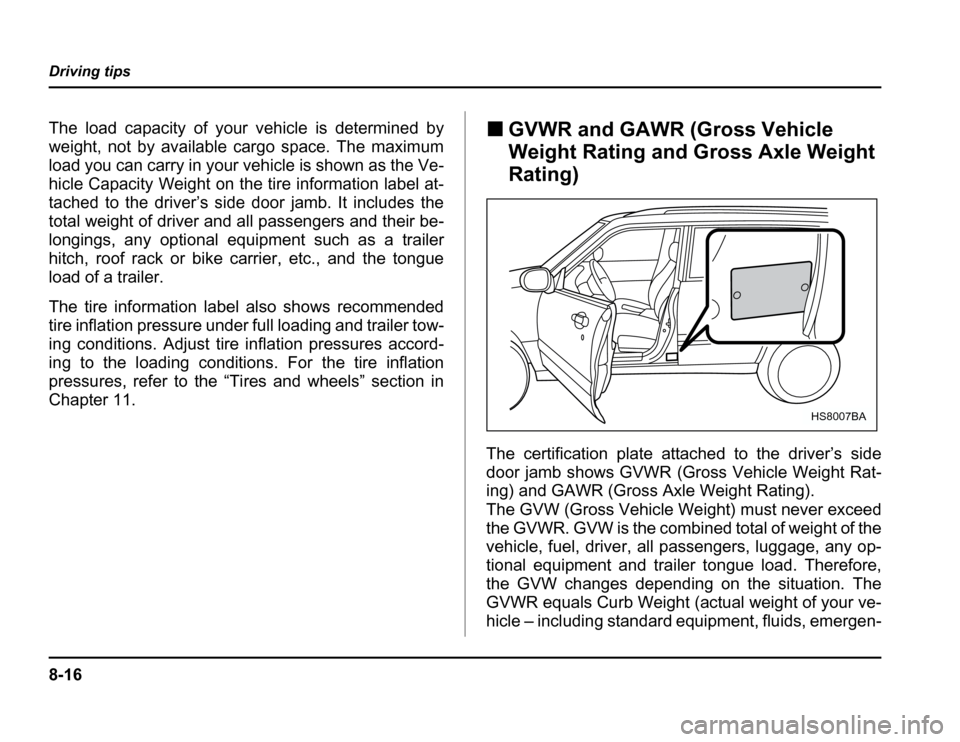
The certification plate attached to the driver’s side
door jamb shows GVWR (Gross Vehicle Weight Rat-
ing) and GAWR (Gross Axle Weight Rating).
The GVW (Gross Vehicle Weight) must never exceed
the GVWR. GVW is the combined total of weight of the
vehicle, fuel, driver, all passengers, luggage, any op-
tional equipment and trailer tongue load. Therefore,
the GVW changes depending on the situation. The
GVWR equals Curb Weight (actual weight of your ve-
hicle – including standard equipment, fluids, emergen-
HS8007BA
Page 294 of 420
8-25
Driving tips
– CONTINUED –
Trailer towing
Your car is designed and intended to be used primarily
as a passenger-carrying vehicle. Towing a trailer puts
additional loads on your car’s engine, drivetrain,
brakes, tires and suspension and has an adverse ef-
fect on fuel economy.
If you do decide to tow a trailer, your safety and satis-
faction depend upon proper use of correct equipment
and cautious operation of your vehicle. Seek the ad-
vice of your SUBARU dealer to assist you in purchas-
ing a hitch and other necessary towing equipment
appropriate for your vehicle. In addition, be sure to fol-
low the instructions on correct installation and use pro-
vided by the trailer and other towing equipment manufacturers.
SUBARU assumes no responsibility for injuries or ve-
hicle damage that result from trailer towing equipment,
or from any errors or omissions in the instructions ac-
companying such equipment or for your failure to fol-
low the proper instructions. Warranties and maintenance
SUBARU warranties do not apply to vehicle damage
or malfunction caused by trailer towing. If you use your
vehicle to tow a trailer, more frequent maintenance will
be required due to the additional load. (Refer to “Main- tenance schedule under severe driving conditions” in
the “Warranty and Maintenance Booklet”.)
Under no circumstances should a trailer be towed with
a new vehicle or a vehicle with any new powertrain
component (engine, transmission, differential, wheel
bearings, etc.) for the first 1,000 miles (1,600 km) of
driving.
Maximum load limits
Never exceed the maximum load limits ex-
plained below. Exceeding the maximum load
limits could cause personal injury and/or vehi-
cle damage.
Adequate size trailer brakes are required
when the trailer and its cargo exceed 1,000 lbs
(453 kg) total weight. Before towing a trailer, check the trailer total
weight, GVW, GAWs and tongue load. Make
sure the load and its distribution in your vehicle