ignition SUBARU FORESTER 2004 Service Repair Manual
[x] Cancel search | Manufacturer: SUBARU, Model Year: 2004, Model line: FORESTER, Model: SUBARU FORESTER 2004Pages: 2870, PDF Size: 38.67 MB
Page 701 of 2870

PC-2
PRECAUTION
Precaution
1. Precaution
A: PRECAUTION
Please clearly understand and adhere to the follow-
ing general precautions. They must be strictly fol-
lowed to avoid minor or serious injury to the person
doing the work or people in the area.
1. ABS
Handle the ABS as a total system. Do not disas-
semble or attempt to repair individual parts. Doing
so could prevent the ABS system from operating
when needed or cause it to operate incorrectly and
result in injury.
2. BRAKE FLUID
If brake fluid gets in your eyes or on your skin, do
the following:
Wash out your eyes and seek immediate medical
attention.
Wash your skin with soap and then rinse thor-
oughly with water.
3. RADIATOR FAN
The radiator fan may rotate without warning, even
when the engine is not on. Do not place your hand,
cloth, tools, or other items near the fan at any time.
4. ROAD TESTS
Always conduct road tests in accordance with traf-
fic rules and regulations to avoid bodily injury and
interrupting traffic.
5. AIRBAG
To prevent bodily injury from unexpected deploy-
ment of airbags and unnecessary maintenance, fol-
low the instructions in this manual when performing
maintenance on airbag components or nearby, and
airbag wiring harnesses or nearby.
To prevent unexpected deployment, perform the
steps below and then wait at least 20 seconds to
discharge electricity before beginning work.
Step 1: Turn the ignition switch OFF.
Step 2: Disconnect the ground cable from bat-
tery.
6. AIRBAG DISPOSAL
To prevent bodily injury from unexpected airbag
deployment, do not dispose airbag modules in the
same way as other refuse. Follow all government
regulations concerning disposal of refuse.
7. AIRBAG MODULE
Adhere to the following when handling and storing
the airbag module to prevent bodily injury from un-
expected deployment:
Do not hold the harnesses or connectors to carry
module.
Do not face the bag in the direction that it opens
towards yourself or other people.
Do not face the bag in the direction that it opens
towards the floor or walls.
8. AIRBAG SPECIAL TOOLS
To prevent unexpected deployment, only use spe-
cial tools.
9. WINDOW
Always wear safety glasses when working around
any glass to prevent glass fragments from damag-
ing your eyes.
10.WINDOW ADHESIVE
Always use the recommended or alternative adhe-
sive when attaching glass to prevent it from coming
loose and falling, resulting in accidents and injury.
Page 703 of 2870

NT-2
NOTE
Note
1. Note
A: NOTE
This is information that can improve efficiency of
maintenance and assure sound work.
1. FASTENER NOTICE
Fasteners are used to prevent parts from damage
and dislocation due to looseness. Fasteners must
be tightened to the specified torque.
Do not apply paint, lubricant, rust retardant, or oth-
er substances to the surface around bolts, fasten-
ers, etc. Doing so will make it difficult to obtain the
correct torque and result in looseness and other
problems.
2. STATIC ELECTRICITY DAMAGE
Do not touch the control unit, connectors, logic
boards, and other such parts when there is a risk of
static electricity. Always use a static electricity pre-
vention cord or touch grounded metal before con-
ducting work.
3. BATTERY
When removing the battery cables, always be sure
to turn the ignition switch off to prevent electrical
damage to the control unit from rush current.
4. SERVICE PARTS
Use authentic service parts for maximum perfor-
mance and maintenance, when conducting repairs.
Subaru/FHI will not be responsible for poor perfor-
mance resulting from the use of parts not specified
by a genuine dealer.
5. PROTECTING VEHICLE UNDER MAIN-
TENANCE
Make sure to attach the fender cover, seat covers,
etc. before work.
6. ENSURING SAFETY DURING WORK
When working in a group of two or more, perform
the work with calling each other to ensure mutual
safety.
Page 729 of 2870
PI-6
PRE-DELIVERY INSPECTION
Pre-delivery Inspection
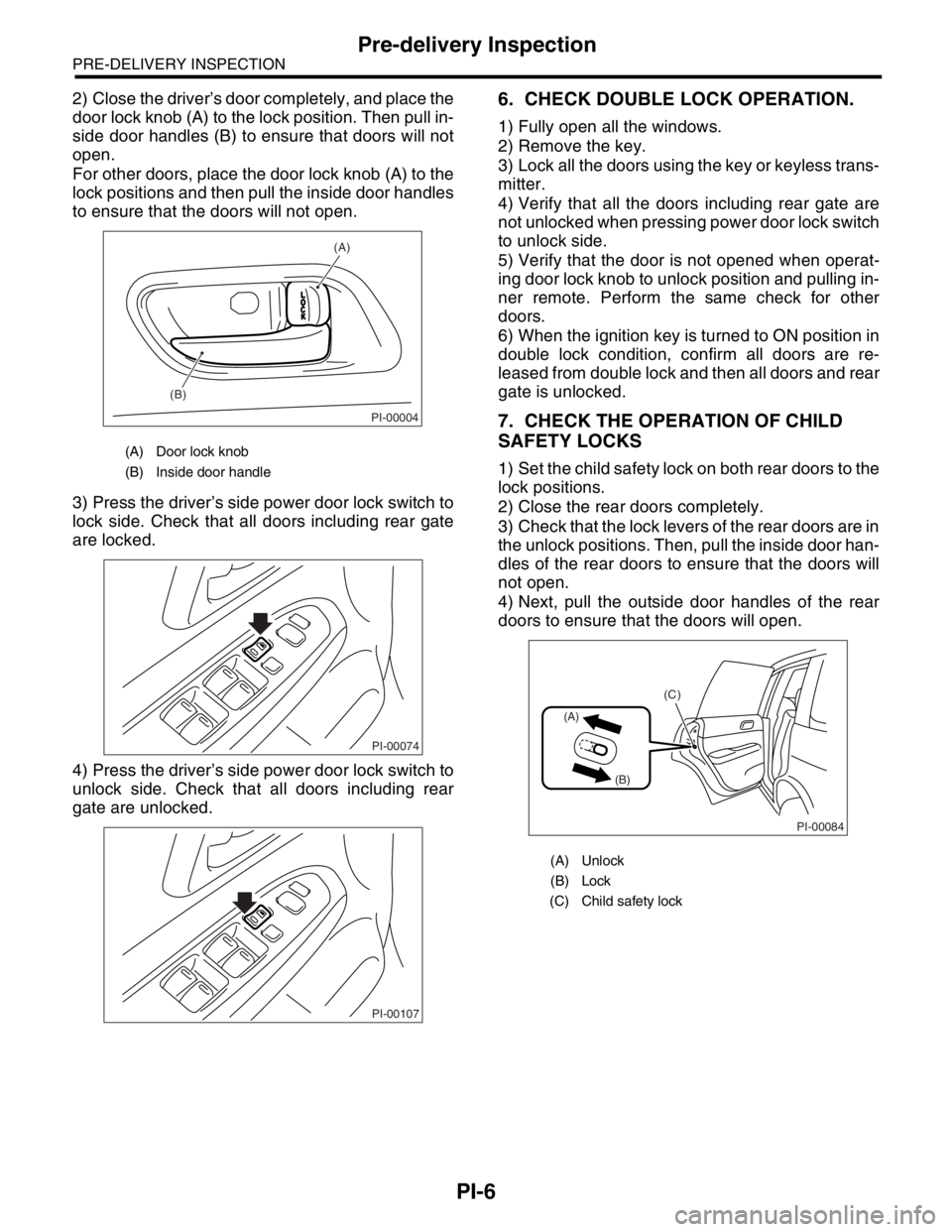
2) Close the driver’s door completely, and place the
door lock knob (A) to the lock position. Then pull in-
side door handles (B) to ensure that doors will not
open.
For other doors, place the door lock knob (A) to the
lock positions and then pull the inside door handles
to ensure that the doors will not open.
3) Press the driver’s side power door lock switch to
lock side. Check that all doors including rear gate
are locked.
4) Press the driver’s side power door lock switch to
unlock side. Check that all doors including rear
gate are unlocked.6. CHECK DOUBLE LOCK OPERATION.
1) Fully open all the windows.
2) Remove the key.
3) Lock all the doors using the key or keyless trans-
mitter.
4) Verify that all the doors including rear gate are
not unlocked when pressing power door lock switch
to unlock side.
5) Verify that the door is not opened when operat-
ing door lock knob to unlock position and pulling in-
ner remote. Perform the same check for other
doors.
6) When the ignition key is turned to ON position in
double lock condition, confirm all doors are re-
leased from double lock and then all doors and rear
gate is unlocked.
7. CHECK THE OPERATION OF CHILD
SAFETY LOCKS
1) Set the child safety lock on both rear doors to the
lock positions.
2) Close the rear doors completely.
3) Check that the lock levers of the rear doors are in
the unlock positions. Then, pull the inside door han-
dles of the rear doors to ensure that the doors will
not open.
4) Next, pull the outside door handles of the rear
doors to ensure that the doors will open.
(A) Door lock knob
(B) Inside door handle
PI-00004
(A)
(B)
PI-00074
PI-00107
(A) Unlock
(B) Lock
(C) Child safety lock
PI-00084
(A)
(B)
(C)
Page 733 of 2870
PI-10
PRE-DELIVERY INSPECTION
Pre-delivery Inspection
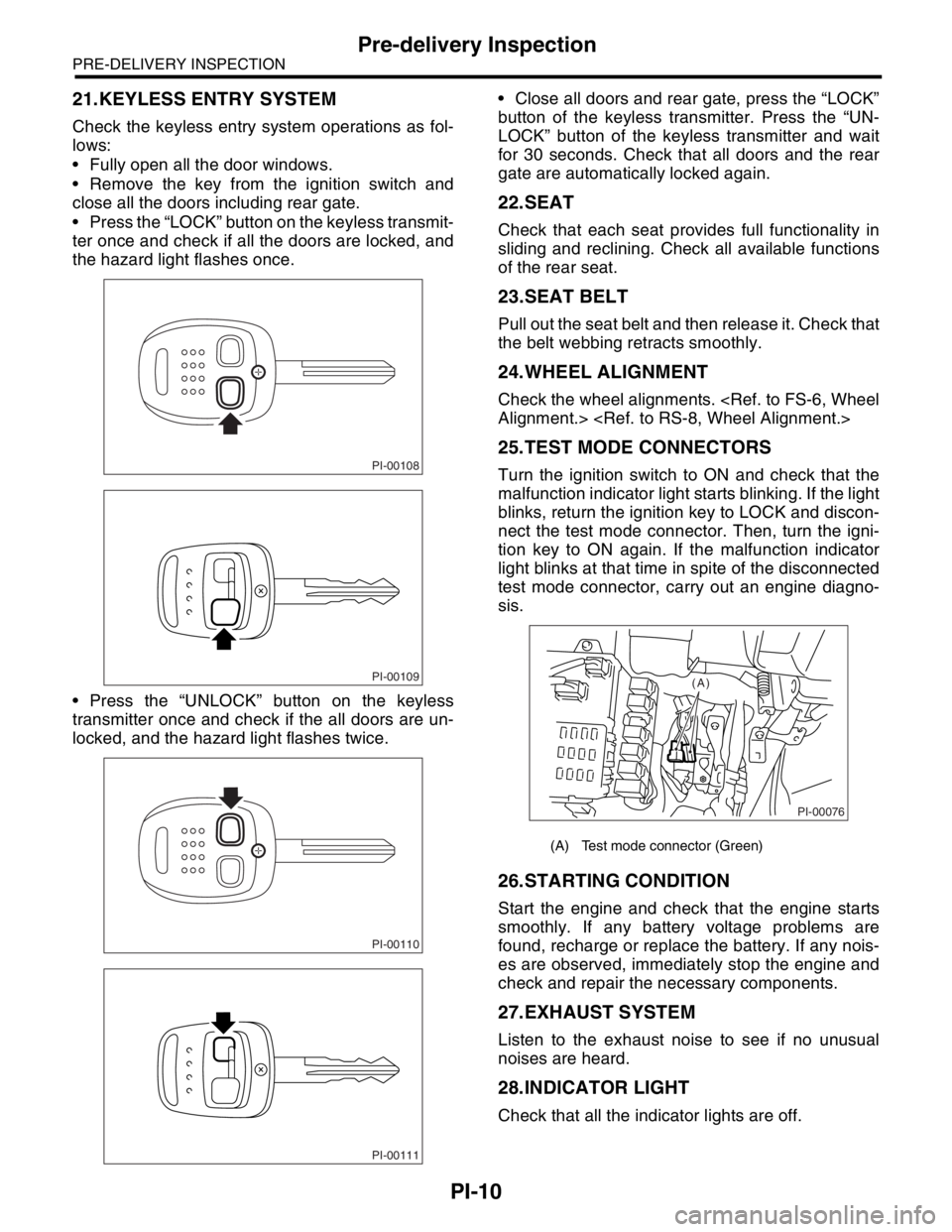
21.KEYLESS ENTRY SYSTEM
Check the keyless entry system operations as fol-
lows:
Fully open all the door windows.
Remove the key from the ignition switch and
close all the doors including rear gate.
Press the “LOCK” button on the keyless transmit-
ter once and check if all the doors are locked, and
the hazard light flashes once.
Press the “UNLOCK” button on the keyless
transmitter once and check if the all doors are un-
locked, and the hazard light flashes twice. Close all doors and rear gate, press the “LOCK”
button of the keyless transmitter. Press the “UN-
LOCK” button of the keyless transmitter and wait
for 30 seconds. Check that all doors and the rear
gate are automatically locked again.
22.SEAT
Check that each seat provides full functionality in
sliding and reclining. Check all available functions
of the rear seat.
23.SEAT BELT
Pull out the seat belt and then release it. Check that
the belt webbing retracts smoothly.
24.WHEEL ALIGNMENT
Check the wheel alignments.
25.TEST MODE CONNECTORS
Turn the ignition switch to ON and check that the
malfunction indicator light starts blinking. If the light
blinks, return the ignition key to LOCK and discon-
nect the test mode connector. Then, turn the igni-
tion key to ON again. If the malfunction indicator
light blinks at that time in spite of the disconnected
test mode connector, carry out an engine diagno-
sis.
26.STARTING CONDITION
Start the engine and check that the engine starts
smoothly. If any battery voltage problems are
found, recharge or replace the battery. If any nois-
es are observed, immediately stop the engine and
check and repair the necessary components.
27.EXHAUST SYSTEM
Listen to the exhaust noise to see if no unusual
noises are heard.
28.INDICATOR LIGHT
Check that all the indicator lights are off.
PI-00108
PI-00109
PI-00110
PI-00111
(A) Test mode connector (Green)
PI-00076
(A)
Page 734 of 2870
PI-11
PRE-DELIVERY INSPECTION
Pre-delivery Inspection
29.CLOCK
Check the clock for normal operations and enough
accuracy.
30.RADIO
Check the radio for full functionality and normal
noise level. Also check the CD unit operations.
31.FRONT ACCESSORY POWER SUPPLY
SOCKET
Check the front accessory power supply socket op-
erations.
32.LIGHTING SYSTEM
Check the headlight operations.
Check the brake light operations.
Check the other lights for normal operations.
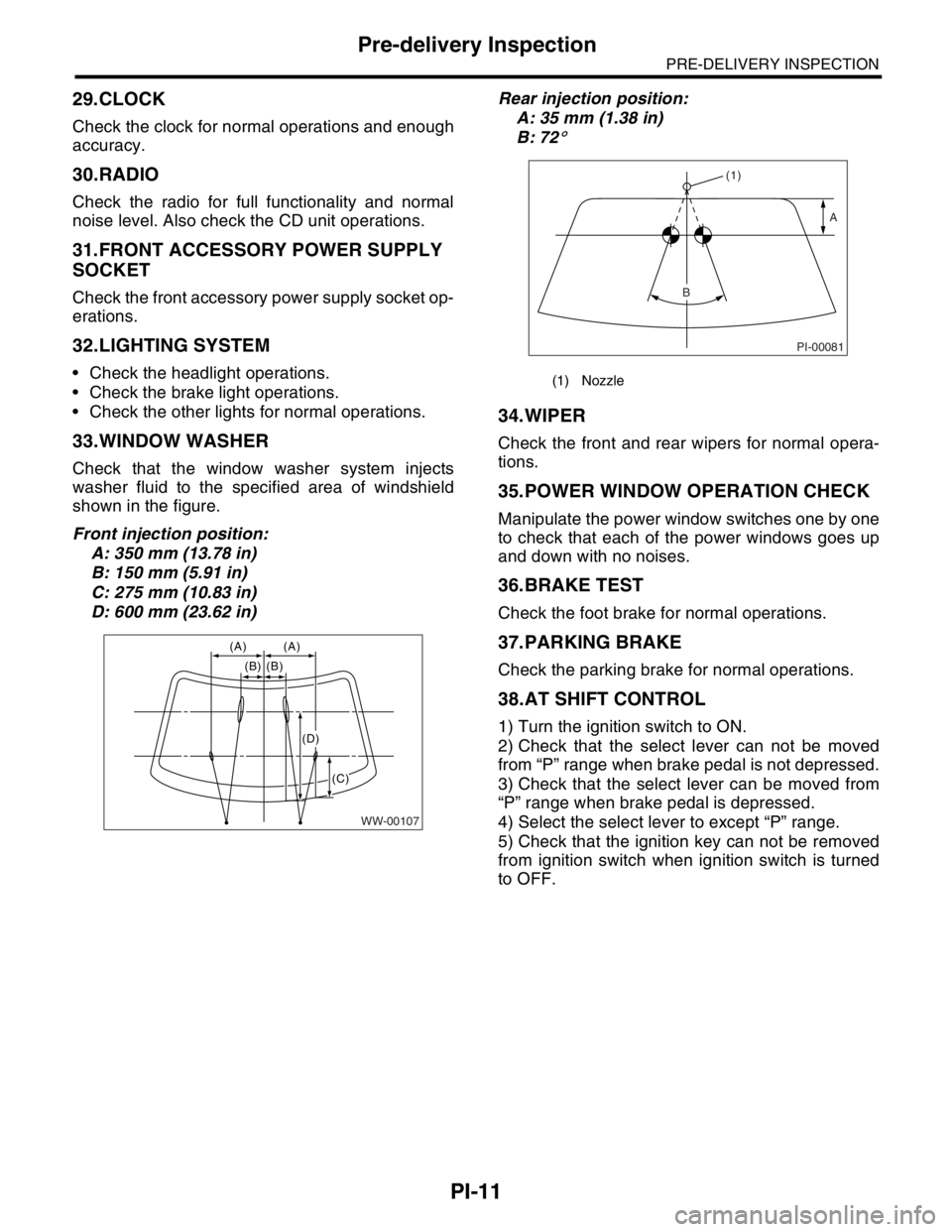
33.WINDOW WASHER
Check that the window washer system injects
washer fluid to the specified area of windshield
shown in the figure.
Front injection position:
A: 350 mm (13.78 in)
B: 150 mm (5.91 in)
C: 275 mm (10.83 in)
D: 600 mm (23.62 in)Rear injection position:
A: 35 mm (1.38 in)
B: 72
°
34.WIPER
Check the front and rear wipers for normal opera-
tions.
35.POWER WINDOW OPERATION CHECK
Manipulate the power window switches one by one
to check that each of the power windows goes up
and down with no noises.
36.BRAKE TEST
Check the foot brake for normal operations.
37.PARKING BRAKE
Check the parking brake for normal operations.
38.AT SHIFT CONTROL
1) Turn the ignition switch to ON.
2) Check that the select lever can not be moved
from “P” range when brake pedal is not depressed.
3) Check that the select lever can be moved from
“P” range when brake pedal is depressed.
4) Select the select lever to except “P” range.
5) Check that the ignition key can not be removed
from ignition switch when ignition switch is turned
to OFF.
WW-00107
(A) (A)
(B) (B)
(C)
(D)
(1) Nozzle
PI-00081
(1)
A
B
Page 782 of 2870
FUJI HEAVY INDUSTRIES LTD. G8080GE2
2004 FORESTER SERVICE MANUAL QUICK REFERENCE INDEX
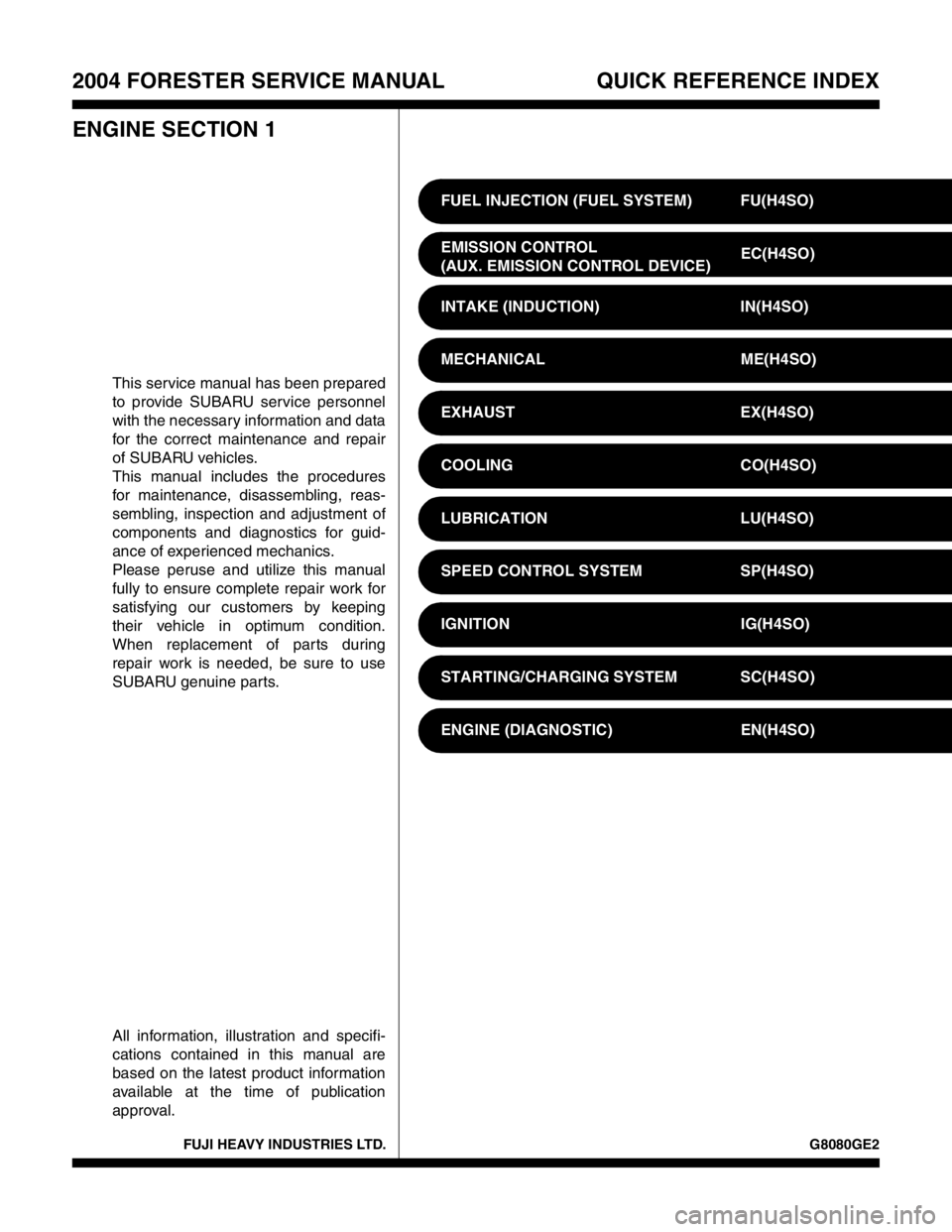
ENGINE SECTION 1
This service manual has been prepared
to provide SUBARU service personnel
with the necessary information and data
for the correct maintenance and repair
of SUBARU vehicles.
This manual includes the procedures
for maintenance, disassembling, reas-
sembling, inspection and adjustment of
components and diagnostics for guid-
ance of experienced mechanics.
Please peruse and utilize this manual
fully to ensure complete repair work for
satisfying our customers by keeping
their vehicle in optimum condition.
When replacement of parts during
repair work is needed, be sure to use
SUBARU genuine parts.
All information, illustration and specifi-
cations contained in this manual are
based on the latest product information
available at the time of publication
approval.FUEL INJECTION (FUEL SYSTEM) FU(H4SO)
EMISSION CONTROL
(AUX. EMISSION CONTROL DEVICE)EC(H4SO)
INTAKE (INDUCTION) IN(H4SO)
MECHANICAL ME(H4SO)
EXHAUST EX(H4SO)
COOLING CO(H4SO)
LUBRICATION LU(H4SO)
SPEED CONTROL SYSTEM SP(H4SO)
IGNITION IG(H4SO)
STARTING/CHARGING SYSTEM SC(H4SO)
ENGINE (DIAGNOSTIC) EN(H4SO)
Page 801 of 2870
FU(H4SO)-19
FUEL INJECTION (FUEL SYSTEM)
Intake Manifold
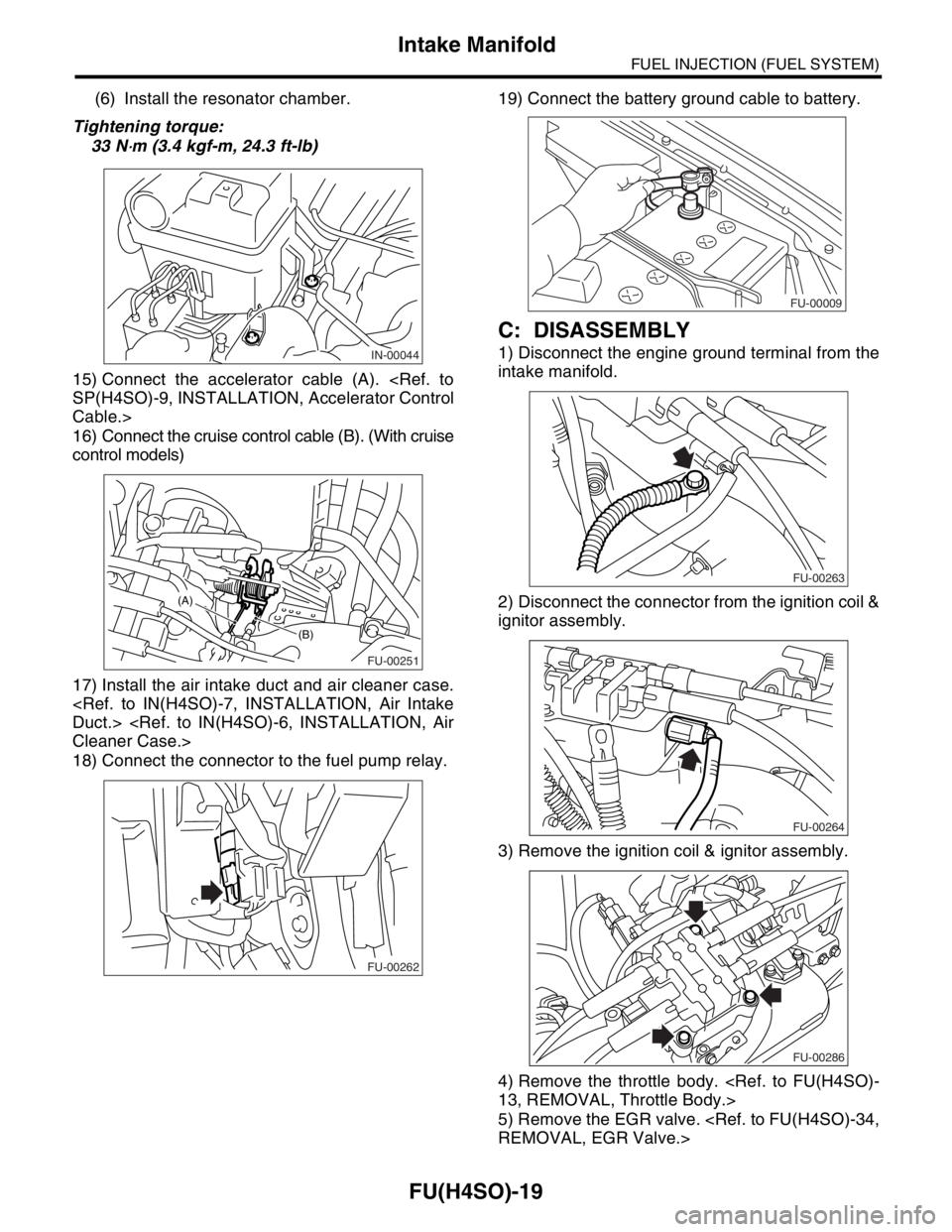
(6) Install the resonator chamber.
Tightening torque:
33 N
⋅m (3.4 kgf-m, 24.3 ft-lb)
15) Connect the accelerator cable (A).
Cable.>
16) Connect the cruise control cable (B). (With cruise
control models)
17) Install the air intake duct and air cleaner case.
18) Connect the connector to the fuel pump relay.19) Connect the battery ground cable to battery.
C: DISASSEMBLY
1) Disconnect the engine ground terminal from the
intake manifold.
2) Disconnect the connector from the ignition coil &
ignitor assembly.
3) Remove the ignition coil & ignitor assembly.
4) Remove the throttle body.
5) Remove the EGR valve.
FU-00251
(B)
(A)
FU-00262
FU-00009
FU-00263
FU-00264
FU-00286
Page 806 of 2870
FU(H4SO)-24
FUEL INJECTION (FUEL SYSTEM)
Intake Manifold
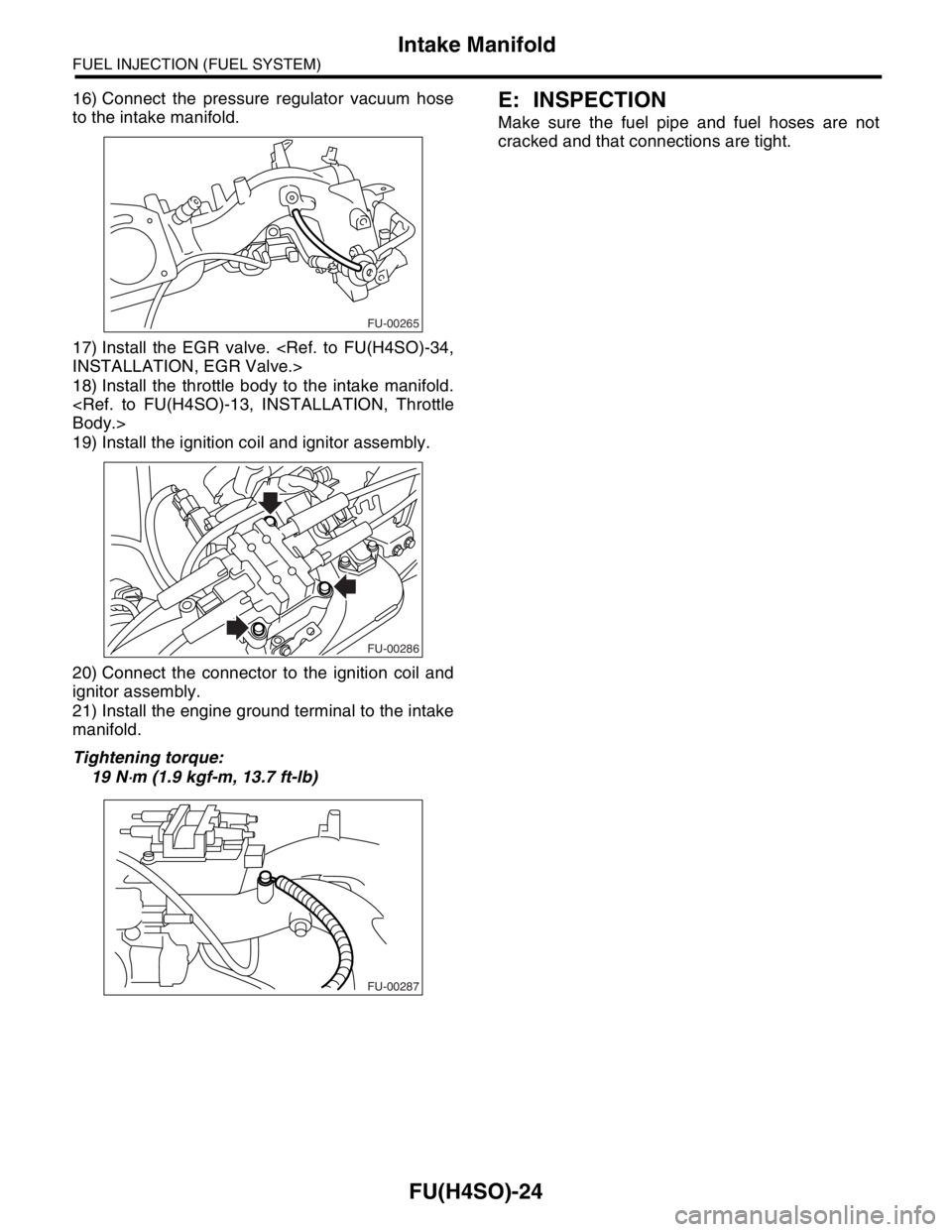
16) Connect the pressure regulator vacuum hose
to the intake manifold.
17) Install the EGR valve.
18) Install the throttle body to the intake manifold.
19) Install the ignition coil and ignitor assembly.
20) Connect the connector to the ignition coil and
ignitor assembly.
21) Install the engine ground terminal to the intake
manifold.
Tightening torque:
19 N
⋅m (1.9 kgf-m, 13.7 ft-lb)
E: INSPECTION
Make sure the fuel pipe and fuel hoses are not
cracked and that connections are tight.
FU-00265
FU-00286
FU-00287
Page 811 of 2870
FU(H4SO)-29
FUEL INJECTION (FUEL SYSTEM)
Throttle Position Sensor
8. Throttle Position Sensor
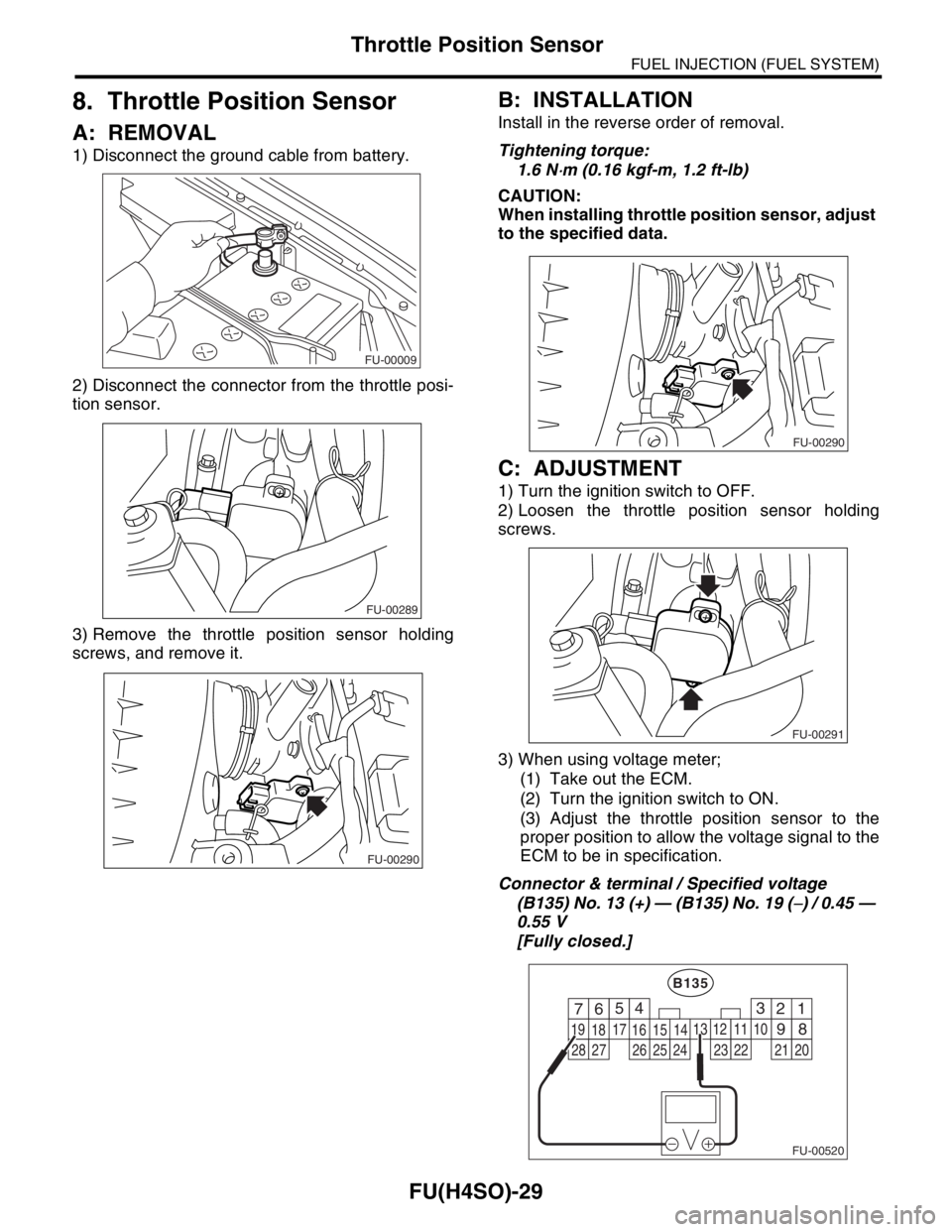
A: REMOVAL
1) Disconnect the ground cable from battery.
2) Disconnect the connector from the throttle posi-
tion sensor.
3) Remove the throttle position sensor holding
screws, and remove it.
B: INSTALLATION
Install in the reverse order of removal.
Tightening torque:
1.6 N
⋅m (0.16 kgf-m, 1.2 ft-lb)
CAUTION:
When installing throttle position sensor, adjust
to the specified data.
C: ADJUSTMENT
1) Turn the ignition switch to OFF.
2) Loosen the throttle position sensor holding
screws.
3) When using voltage meter;
(1) Take out the ECM.
(2) Turn the ignition switch to ON.
(3) Adjust the throttle position sensor to the
proper position to allow the voltage signal to the
ECM to be in specification.
Connector & terminal / Specified voltage
(B135) No. 13 (+) — (B135) No. 19 (
−) / 0.45 —
0.55 V
[Fully closed.]
FU-00009
FU-00289
FU-00290
FU-00290
FU-00291
FU-00520
4
1 526
18 1516
7
891011
17
19
20121314
B135
3
2122232425262728
Page 812 of 2870
FU(H4SO)-30
FUEL INJECTION (FUEL SYSTEM)
Throttle Position Sensor
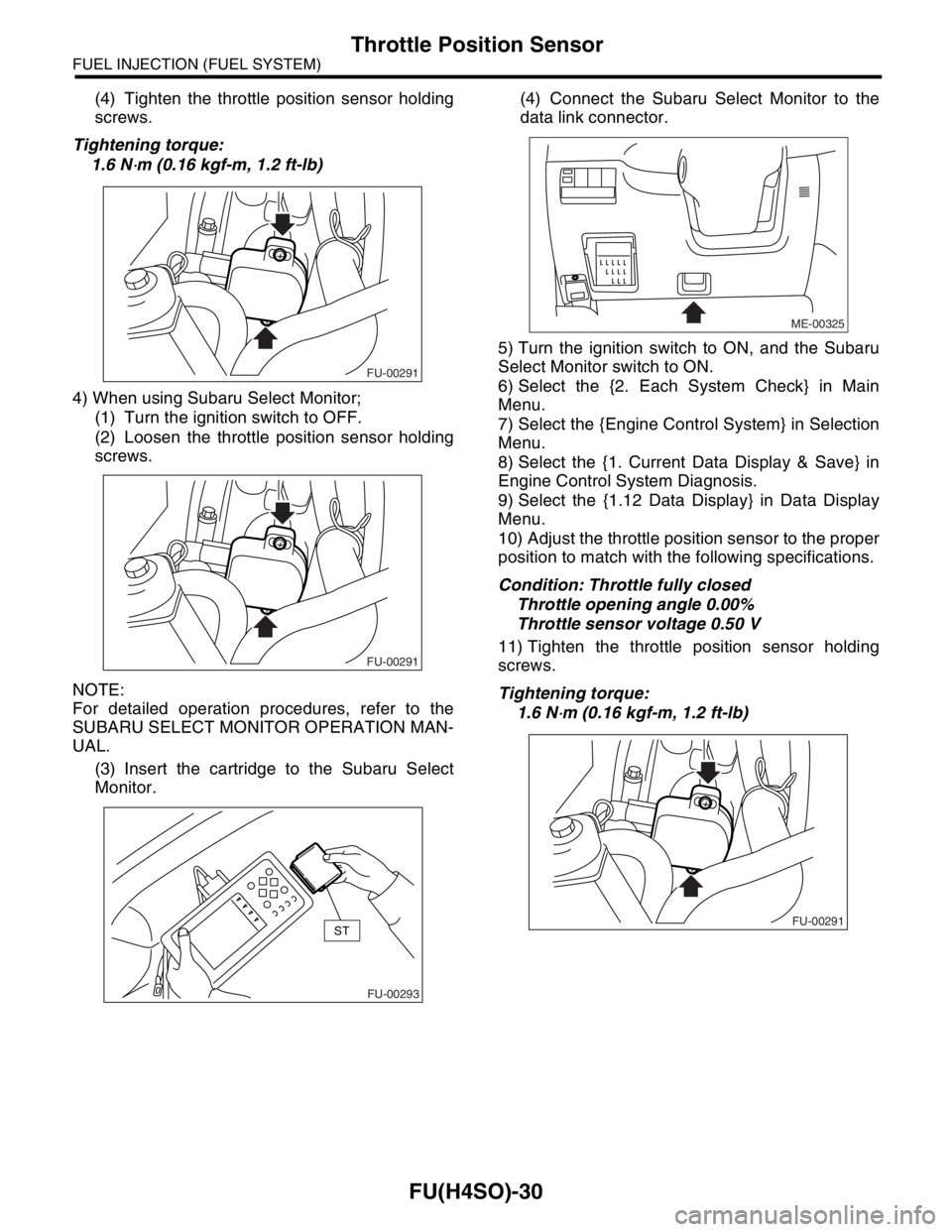
(4) Tighten the throttle position sensor holding
screws.
Tightening torque:
1.6 N
⋅m (0.16 kgf-m, 1.2 ft-lb)
4) When using Subaru Select Monitor;
(1) Turn the ignition switch to OFF.
(2) Loosen the throttle position sensor holding
screws.
NOTE:
For detailed operation procedures, refer to the
SUBARU SELECT MONITOR OPERATION MAN-
UAL.
(3) Insert the cartridge to the Subaru Select
Monitor.(4) Connect the Subaru Select Monitor to the
data link connector.
5) Turn the ignition switch to ON, and the Subaru
Select Monitor switch to ON.
6) Select the {2. Each System Check} in Main
Menu.
7) Select the {Engine Control System} in Selection
Menu.
8) Select the {1. Current Data Display & Save} in
Engine Control System Diagnosis.
9) Select the {1.12 Data Display} in Data Display
Menu.
10) Adjust the throttle position sensor to the proper
position to match with the following specifications.
Condition: Throttle fully closed
Throttle opening angle 0.00%
Throttle sensor voltage 0.50 V
11) Tighten the throttle position sensor holding
screws.
Tightening torque:
1.6 N
⋅m (0.16 kgf-m, 1.2 ft-lb)
FU-00291
FU-00291
FU-00293
ST
ME-00325
FU-00291