lights SUBARU FORESTER 2004 Service User Guide
[x] Cancel search | Manufacturer: SUBARU, Model Year: 2004, Model line: FORESTER, Model: SUBARU FORESTER 2004Pages: 2870, PDF Size: 38.67 MB
Page 895 of 2870
ME(H4SO)-26
MECHANICAL
Idle Speed
3. Idle Speed
A: INSPECTION
1) Before checking idle speed, check the following:
(1) Ensure the air cleaner element is free from
clogging, ignition timing is correct, spark plugs
are in good condition, and the hoses are con-
nected properly.
(2) Ensure the malfunction indicator light does
not illuminate.
2) Warm-up the engine.
3) Stop the engine, and then turn the ignition switch
to OFF.
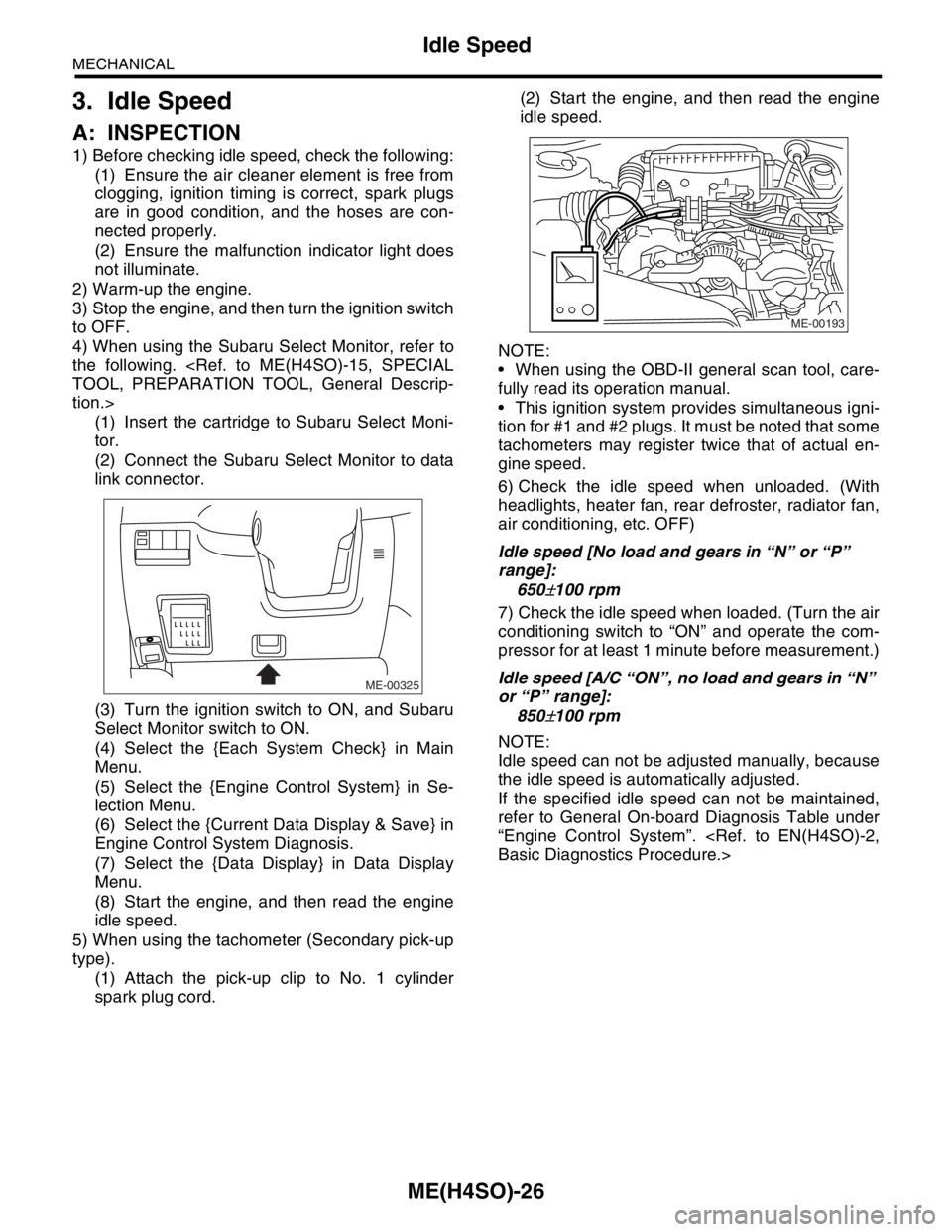
4) When using the Subaru Select Monitor, refer to
the following.
tion.>
(1) Insert the cartridge to Subaru Select Moni-
tor.
(2) Connect the Subaru Select Monitor to data
link connector.
(3) Turn the ignition switch to ON, and Subaru
Select Monitor switch to ON.
(4) Select the {Each System Check} in Main
Menu.
(5) Select the {Engine Control System} in Se-
lection Menu.
(6) Select the {Current Data Display & Save} in
Engine Control System Diagnosis.
(7) Select the {Data Display} in Data Display
Menu.
(8) Start the engine, and then read the engine
idle speed.
5) When using the tachometer (Secondary pick-up
type).
(1) Attach the pick-up clip to No. 1 cylinder
spark plug cord.(2) Start the engine, and then read the engine
idle speed.
NOTE:
When using the OBD-II general scan tool, care-
fully read its operation manual.
This ignition system provides simultaneous igni-
tion for #1 and #2 plugs. It must be noted that some
tachometers may register twice that of actual en-
gine speed.
6) Check the idle speed when unloaded. (With
headlights, heater fan, rear defroster, radiator fan,
air conditioning, etc. OFF)
Idle speed [No load and gears in “N” or “P”
range]:
650
±100 rpm
7) Check the idle speed when loaded. (Turn the air
conditioning switch to “ON” and operate the com-
pressor for at least 1 minute before measurement.)
Idle speed [A/C “ON”, no load and gears in “N”
or “P” range]:
850
±100 rpm
NOTE:
Idle speed can not be adjusted manually, because
the idle speed is automatically adjusted.
If the specified idle speed can not be maintained,
refer to General On-board Diagnosis Table under
“Engine Control System”.
ME-00325
ME-00193
Page 1037 of 2870

LU(H4SO)-9
LUBRICATION
Oil Pressure System
B: INSPECTION
Step Check Yes No
1 CHECK COMBINATION METER.
1) Turn the ignition switch to ON. (engine
OFF)
2) Check other warning lights.Does the warning lights illumi-
nate?Go to step 2.Repair or replace
the combination
meter.
Combination
Meter System.>
2 CHECK HARNESS CONNECTOR BETWEEN
COMBINATION METER AND OIL PRES-
SURE SWITCH.
1) Turn the ignition switch to OFF.
2) Disconnect the connector from oil pressure
switch.
3) Turn the ignition switch to ON.
4) Measure the voltage of harness between
the combination meter connector and chassis
ground.
Connector & terminal
(E11) No. 1 (+) — Chassis ground (
−):Is the voltage more than 10 V? Replace the oil
pressure switch.Go to step 3.
3 CHECK COMBINATION METER.
1) Turn the ignition switch to OFF.
2) Remove the combination meter.
3) Measure the resistance of combination
meter.
Te r m i n a l
No. B9 — No. A3:Is the resistance less than 10
Ω?Replace the har-
ness connector
between combina-
tion meter and oil
pressure switch.Repair or replace
the combination
meter and the oil
pressure switch
warning light bulb.
Page 1103 of 2870

EN(H4SO)-5
ENGINE (DIAGNOSTIC)
Check List for Interview
2. CHECK LIST No. 2
Check the following items about the vehicle’s state when malfunction indicator light turns on.
NOTE:
Use copies of this page for interviewing customers.
a) Other warning lights or indicators turn on. ❏ Yes / ❏ No
❏ Low fuel warning light
❏ Charge indicator light
❏ AT diagnostic indicator light
❏ ABS Warning light
❏ Oil pressure indicator light
b) Fuel level
Lack of gasoline: ❏ Yes / ❏ No
Indicator position of fuel gauge:
Experienced running out of fuel: ❏ Ye s / ❏ No
c) Intentional connecting or disconnecting of harness connectors or spark plug cords: ❏ Yes / ❏ No
What:
d) Intentional connecting or disconnecting of hoses: ❏ Ye s / ❏ No
What:
e) Installing of other parts except genuine parts: ❏ Ye s / ❏ No
What:
Where:
f) Occurrence of noise: ❏ Yes / ❏ No
From where:
What kind:
g) Occurrence of smell: ❏ Yes / ❏ No
From where:
What kind:
h) Intrusion of water into engine compartment or passenger compartment: ❏ Yes / ❏ No
i) Troubles occurred
❏ Engine does not start.
❏ Engine stalls during idling.
❏ Engine stalls while driving.
❏ Engine speed decreases.
❏ Engine speed does not decrease.
❏ Rough idling
❏ Poor acceleration
❏ Back fire
❏ After fire
❏ Does not shift.
❏ Excessive shift shock
Page 1304 of 2870
EN(H4SO)-206
ENGINE (DIAGNOSTIC)
Diagnostic Procedure with Diagnostic Trouble Code (DTC)
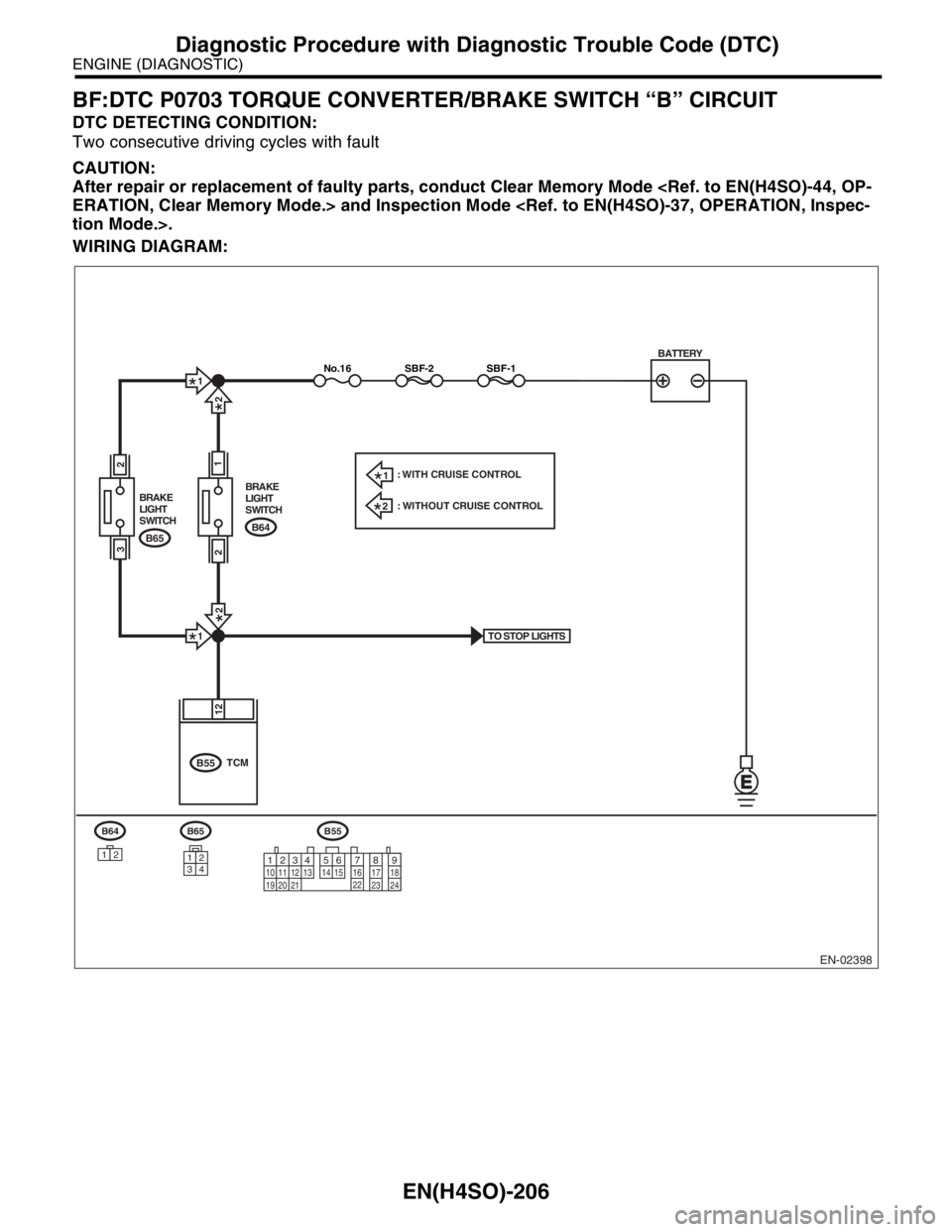
BF:DTC P0703 TORQUE CONVERTER/BRAKE SWITCH “B” CIRCUIT
DTC DETECTING CONDITION:
Two consecutive driving cycles with fault
CAUTION:
After repair or replacement of faulty parts, conduct Clear Memory Mode
WIRING DIAGRAM:
EN-02398
BATTERY
B65
34
12
TO STOP LIGHTS
SBF-1SBF-2No.16
B65 BRAKE
LIGHT
SWITCH
2
3
B64 BRAKE
LIGHT
SWITCH
1
B64
12
B55
B55
12
TCM
2
1
2
2
1
2
1: WITH CRUISE CONTROL
: WITHOUT CRUISE CONTROL
12
789 56 3410 11 12
19 20 2113 14 15 16 17 18
22
23
24
Page 1488 of 2870

ME(H4DOTC)-32
MECHANICAL
Idle Speed
3. Idle Speed
A: INSPECTION
1. USING SUBARU SELECT MONITOR
1) Before checking the idle speed, check the fol-
lowing:
(1) Ensure the air cleaner element is free from
clogging, ignition timing is correct, spark plugs
are in good condition, and that the hoses are
connected properly.
(2) Ensure the malfunction indicator light does
not illuminate.
2) Warm-up the engine.
3) Stop the engine, and then turn the ignition switch
to OFF.
4) Insert the cartridge to Subaru Select Monitor.
5) Connect the Subaru Select Monitor to data link
connector.
6) Turn the ignition switch to ON, and Subaru Se-
lect Monitor switch to ON.
7) Select the {2. Each System Check} in Main
Menu.
8) Select the {Engine Control System} in Selection
Menu.
9) Select the {1. Current Data Display & Save} in
Engine Control System Diagnosis.
10) Select the {1.12 Data Display} in Data Display
Menu.
11) Start the engine, and then read the engine idle
speed.
12) Check the idle speed when unloaded. (With
headlights, heater fan, rear defroster, radiator fan,
air conditioning, etc. OFF)
Idle speed [No load and gears in neutral]:
700
±100 rpm
13) Check the idle speed when loaded. (Turn the
air conditioning switch to “ON” and operate the
compressor for at least 1 minute before measure-
ment.)
Idle speed [A/C “ON”, no load and gears in neu-
tral]:
A/C Refrigerant pressure (LOW)
MT: 725
±100 rpm
AT: 750
±100 rpm
A/C Refrigerant pressure (HIGH)
MT: 800
±100 rpm
AT: 825
±100 rpm
NOTE:
As idle speed is controlled by the automatic adjust-
ment type, it can not be adjusted manually. If the
idle speed is out of specifications, refer to General
On-board Diagnosis Table under “Engine Control
System”.
Page 1635 of 2870

EN(H4DOTC)-5
ENGINE (DIAGNOSTIC)
Check List for Interview
2. CHECK LIST NO. 2
Check the following items about the vehicle’s state when malfunction indicator light turns on.
NOTE:
Use copies of this page for interviewing customers.
a) Other warning lights or indicators turn on. ❏ Yes / ❏ No
❏ Low fuel warning light
❏ Charge indicator light
❏ AT diagnostic indicator light
❏ ABS Warning Light
❏ Oil pressure indicator light
b) Fuel level
Lack of gasoline: ❏ Yes / ❏ No
Indicator position of fuel gauge:
Had run out of gas before: ❏ Ye s / ❏ No
c) Intentional connecting or disconnecting of harness connectors or spark plug cords: ❏ Yes / ❏ No
What:
d) Intentional connecting or disconnecting of hoses: ❏ Ye s / ❏ No
What:
e) Installing of other parts except genuine parts: ❏ Ye s / ❏ No
What:
Where:
f) Occurrence of noise: ❏ Yes / ❏ No
From where:
What kind:
g) Occurrence of smell: ❏ Yes / ❏ No
From where:
What kind:
h) Intrusion of water into engine compartment or passenger compartment: ❏ Yes / ❏ No
i) Troubles occurred
❏ Engine does not start.
❏ Engine stalls during idling.
❏ Engine stalls while driving.
❏ Engine speed decreases.
❏ Engine speed does not decrease.
❏ Rough idling
❏ Poor acceleration
❏ Back fire
❏ After fire
❏ Does not shift.
❏ Excessive shift shock
Page 2028 of 2870

EN(H4DOTC 2.5)-4
ENGINE (DIAGNOSTIC)
Check List for Interview
2. CHECK LIST No. 2
Check the following items about the vehicle’s state when malfunction indicator light turns on.
NOTE:
Use copies of this page for interviewing customers.
a) Other warning lights or indicators turn on. ❏ Ye s / ❏ No
❏ Low fuel warning light
❏ Charge indicator light
❏ AT diagnostic indicator light
❏ ABS Warning Light
❏ Oil pressure indicator light
b) Fuel level
Lack of gasoline: ❏ Yes / ❏ No
Indicator position of fuel gauge:
Experienced running out of fuel: ❏ Ye s / ❏ No
c) Intentional connecting or disconnecting of harness connectors or spark plug cords: ❏ Yes / ❏ No
What:
d) Intentional connecting or disconnecting of hoses: ❏ Ye s / ❏ No
What:
e) Installing of other parts except genuine parts: ❏ Ye s / ❏ No
What:
Where:
f) Occurrence of noise: ❏ Yes / ❏ No
From where:
What kind:
g) Occurrence of smell: ❏ Yes / ❏ No
From where:
What kind:
h) Intrusion of water into engine compartment or passenger compartment: ❏ Yes / ❏ No
i) Troubles occurred
❏ Engine does not start
❏ Engine stalls during idling
❏ Engine stalls while driving
❏ Engine speed decreases
❏ Engine speed does not decrease
❏ Rough idling
❏ Poor acceleration
❏ Back fire
❏ After fire
❏ Does not shift
❏ Excessive shift shock
Page 2487 of 2870

4AT(H4SO)-28
AUTOMATIC TRANSMISSION (DIAGNOSTIC)
Power Indicator Light Display
Step Check Yes No
1 CHECK POWER INDICATOR LIGHT.
Turn the ignition switch to ON (engine OFF).Does the POWER indicator
light illuminate?Go to step 3.Go to step 2.
2 CHECK POWER INDICATOR LIGHT.
1) Turn the ignition switch to OFF.
2) Remove the combination meter.
3) Remove the POWER indicator light bulb
from combination meter.Is the POWER indicator light
bulb OK?Go to step 4.Replace the
POWER indicator
light bulb.
3 CHECK POWER INDICATOR LIGHT.
Perform “Read Diagnostic Trouble Code
(DTC)”.
light blink?A temporary poor
contact of the con-
nector or harness
may be the cause.
Repair the har-
ness or connector
in TCM, inhibitor
switch and combi-
nation meter.Go to step 9.
4 CHECK FUSE (No. 14).
Remove the fuse (No. 14).Is the fuse (No. 14) blown out? Replace the fuse
(No. 14). If
replaced fuse (No.
14) is blown out
easily, repair short
circuit in harness
between fuse (No.
14) and combina-
tion meter.Go to step 5.
5 CHECK HARNESS CONNECTOR BETWEEN
COMBINATION METER AND IGNITION
SWITCH.
1) Turn the ignition switch to ON (engine
OFF).
2) Measure the voltage between combination
meter connector and chassis ground.
Connector & terminal
(i10) No. 9 (+) — Chassis ground (
−):Is the voltage more than 9 V? Go to step 6.Repair the open
circuit in harness
between combina-
tion meter and bat-
tery.
6 CHECK COMBINATION METER.
Measure the voltage between combination
meter connector and chassis ground.
Connector & terminal
(i11) No. 2 (+) — Chassis ground (
−):Is the voltage less than 9 V? Repair the combi-
nation meter.
Meter Assembly.>Go to step 7.
7 CHECK OPEN CIRCUIT OF HARNESS.
1) Turn the ignition switch to OFF.
2) Disconnect the connector from combination
meter connector.
3) Measure the resistance of harness
between combination meter.
Connector & terminal
(B56) No. 11 — (i11) No. 2:Is the resistance less than 1
Ω?Go to step 8.Repair the open
circuit in harness
between TCM and
combination
meter, and poor
contact in cou-
pling connector.
8 CHECK INPUT SIGNAL FOR TCM.
1) Connect the connector to TCM and combi-
nation meter.
2) Turn the ignition switch to ON (engine
OFF).
3) Measure the voltage between TCM con-
nector and chassis ground.
Connector & terminal
(B56) No. 11 (+) — Chassis ground (
−):Is the voltage less than 1 V? Even if the
POWER indicator
lights up, the cir-
cuit has returned
to a normal condi-
tion at this time. A
temporary poor
contact of the con-
nector or harness
may be the cause.
Repair the har-
ness or connector
in TCM.Replace the TCM.
trol Module
(TCM).>
Page 2509 of 2870

4AT(H4SO)-50
AUTOMATIC TRANSMISSION (DIAGNOSTIC)
Diagnostic Procedure with Diagnostic Trouble Code (DTC)
Step Check Yes No
1 CHECK TORQUE CONVERTER TURBINE
SPEED SENSOR.
1) Turn the ignition switch to OFF.
2) Disconnect the connector from transmis-
sion.
3) Measure the resistance between transmis-
sion connector receptacle’s terminals.
Connector & terminal
(T4) No. 14 — No. 15:Is the resistance 450 — 650
Ω?Go to step 2.Replace the tur-
bine speed sensor.
Turbine Speed
Sensor.>
2 CHECK HARNESS CONNECTOR BETWEEN
TCM AND TRANSMISSION.
1) Disconnect the connector from TCM.
2) Measure the resistance of harness
between TCM and transmission connector.
Connector & terminal
(B55) No. 8 — (B11) No. 14:Is the resistance less than 1
Ω?Go to step 3.Repair the open
circuit in harness
between TCM and
transmission con-
nector.
3 CHECK HARNESS CONNECTOR BETWEEN
TCM AND TRANSMISSION.
Measure the resistance of harness between
TCM and transmission connector.
Connector & terminal
(B55) No. 9 — (B11) No. 15:Is the resistance less than 1
Ω?Go to step 4.Repair the open
circuit in harness
between TCM and
transmission con-
nector, and poor
contact in cou-
pling connector.
4 CHECK HARNESS CONNECTOR BETWEEN
TCM AND TRANSMISSION.
Measure the resistance of harness between
TCM and chassis ground.
Connector & terminal
(B55) No. 9 — Chassis ground:Is the resistance more than 1
MΩ?Go to step 5.Repair the short
circuit in harness
between TCM and
transmission con-
nector.
5 CHECK HARNESS CONNECTOR BETWEEN
TCM AND TRANSMISSION.
Measure the resistance of harness between
TCM and chassis ground.
Connector & terminal
(B55) No. 8 — Chassis ground:Is the resistance more than 1
MΩ?Go to step 6.Repair the short
circuit in harness
between TCM and
transmission con-
nector, and poor
contact in cou-
pling connector.
6 PREPARE OSCILLOSCOPE.Do you have an oscilloscope? Go to step 10.Go to step 7.
7 PREPARE SUBARU SELECT MONITOR.Do you have a Subaru Select
Monitor?Go to step 9.Go to step 8.
8 CHECK INPUT SIGNAL FOR TCM.
1) Connect the connectors to TCM and trans-
mission.
2) Start the engine and move select lever to
“P” or “N” range.
3) Measure the voltage between TCM con-
nector terminals.
Connector & terminal
(B55) No. 8 (+) — No. 9 (
−):Is the voltage more than AC 1
V?Even if the
POWER indicator
lights up, the cir-
cuit has returned
to a normal condi-
tion at this time. A
temporary poor
contact of the con-
nector or harness
may be the cause.
Repair the har-
ness or connector
in TCM and trans-
mission.Go to step 11.