sensor SUBARU FORESTER 2004 Service Owner's Manual
[x] Cancel search | Manufacturer: SUBARU, Model Year: 2004, Model line: FORESTER, Model: SUBARU FORESTER 2004Pages: 2870, PDF Size: 38.67 MB
Page 93 of 2870
AC-37
HVAC SYSTEM (AUTO A/C)(DIAGNOSTIC)
Diagnostic Procedure for Sensors
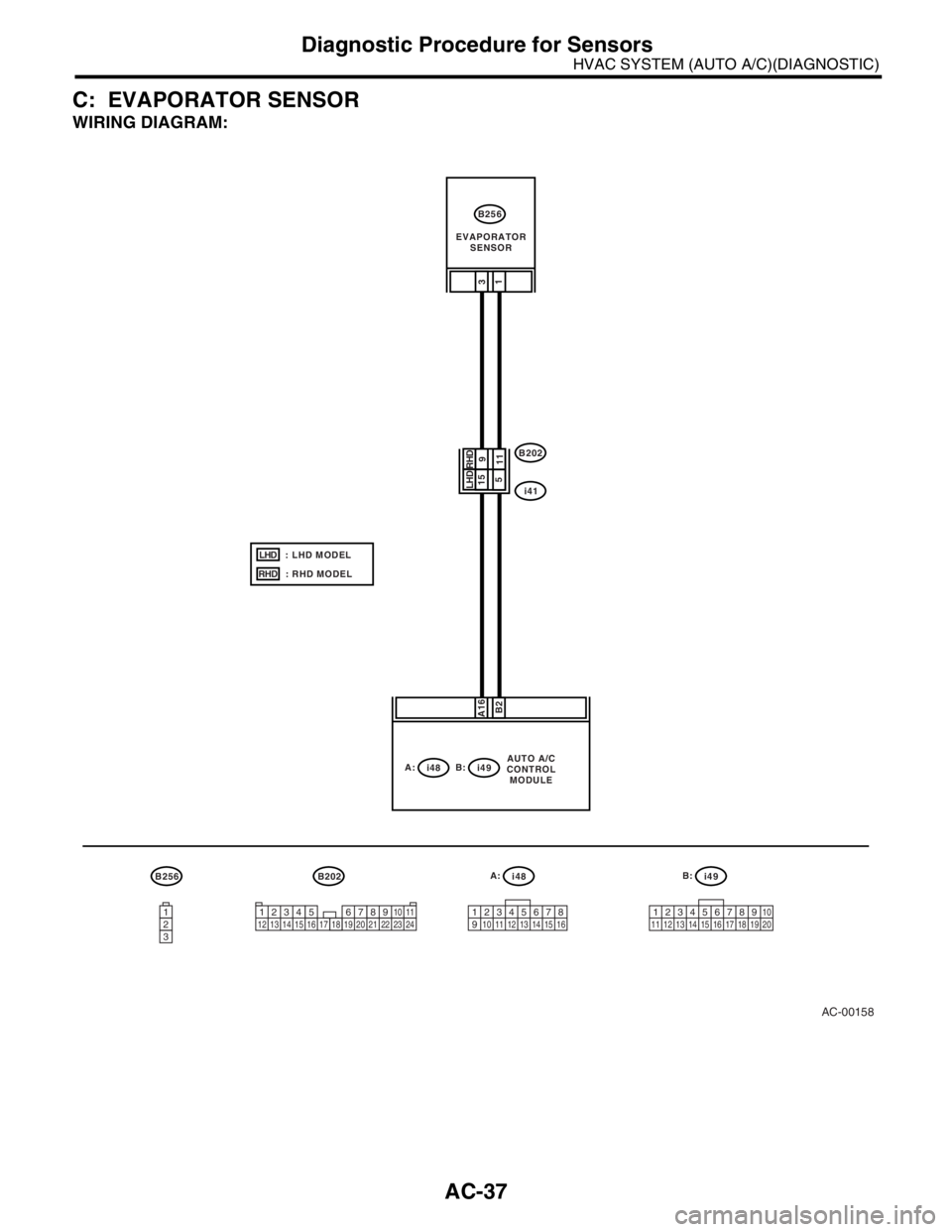
C: EVAPORATOR SENSOR
WIRING DIAGRAM:
AC-00158
A:
i48B:
i49B256
12345678
910 11 12 13 14 15 1612345678910
11 12 13 14 15 16 17 18 19 203
4 128910 11
12 13 14 15 16 17 18 19 20 21 22 23 24567
B202
B202
i41
B256
A:
i48B:
i49
A16
5
1
B23
15
123
EVAPORATOR
SENSOR
AUTO A/C
CONTROL
MODULE
119RHD LHD
: LHD MODEL
: RHD MODELLHD
RHD
Page 94 of 2870

AC-38
HVAC SYSTEM (AUTO A/C)(DIAGNOSTIC)
Diagnostic Procedure for Sensors
Step Check Yes No
1 CHECK EVAPORATOR SENSOR.
1) Turn the ignition switch to OFF.
2) Remove the glove box.
3) Disconnect the connector from evaporator
sensor.
4) Measure the resistance between connector
terminals of evaporator sensor.
Te r m i n a l s
No. 1 — No. 2:Is the resistance approx. 2.7
kΩ at 20°C (68°F)?Go to step 2.Replace the evap-
orator sensor.
2 CHECK INPUT SIGNAL FOR EVAPORATOR
SENSOR.
1) Turn the ignition switch to ON.
2) Measure the voltage between connector
(B256) terminal and chassis ground.
Connector & terminal
(B256) No. 1 (+) — Chassis ground (
−):Is the voltage approx. 5 V? Go to step 5.Go to step 3.
3 CHECK AUTO A/C CONTROL MODULE
OUTPUT SIGNAL.
1) Turn the ignition switch to OFF.
2) Remove the auto A/C control module.
3) Turn the ignition switch to ON.
4) Measure the voltage between connector
terminals of auto A/C control module.
Connector & terminal
(i49) No. 2 (+) — (i48) No. 16 (
−):Is the voltage approx. 5 V? Go to step 4.Go to step 6.
4 CHECK HARNESS CONNECTOR BETWEEN
AUTO A/C CONTROL MODULE AND EVAP-
ORATOR SENSOR.
1) Turn the ignition switch to OFF.
2) Disconnect the connector from auto A/C
control module.
3) Measure the resistance in harness
between auto A/C control module and evapo-
rator sensor.
Connector & terminal
(B256) No. 1 — (i49) No. 2:Is the resistance less than 1Ω? Go to step 5.Repair the open
circuit in harness
between auto A/C
control module
and evaporator
sensor.
5 CHECK HARNESS CONNECTOR BETWEEN
AUTO A/C CONTROL MODULE AND EVAP-
ORATOR SENSOR.
Measure the resistance in harness between
auto A/C control module and evaporator sen-
sor.
Connector & terminal
(B256) No. 3 — (i48) No. 16:Is the resistance less than 1
Ω?Go to step 6.Repair the open
circuit in harness
between auto A/C
control module
and evaporator
sensor.
6 CHECK POOR CONTACT.
Check poor contact in auto A/C control module
connector.Is there poor contact in con-
nector?Repair the con-
nector.Replace the auto
A/C control mod-
ule.
Page 95 of 2870
AC-39
HVAC SYSTEM (AUTO A/C)(DIAGNOSTIC)
Diagnostic Procedure for Sensors
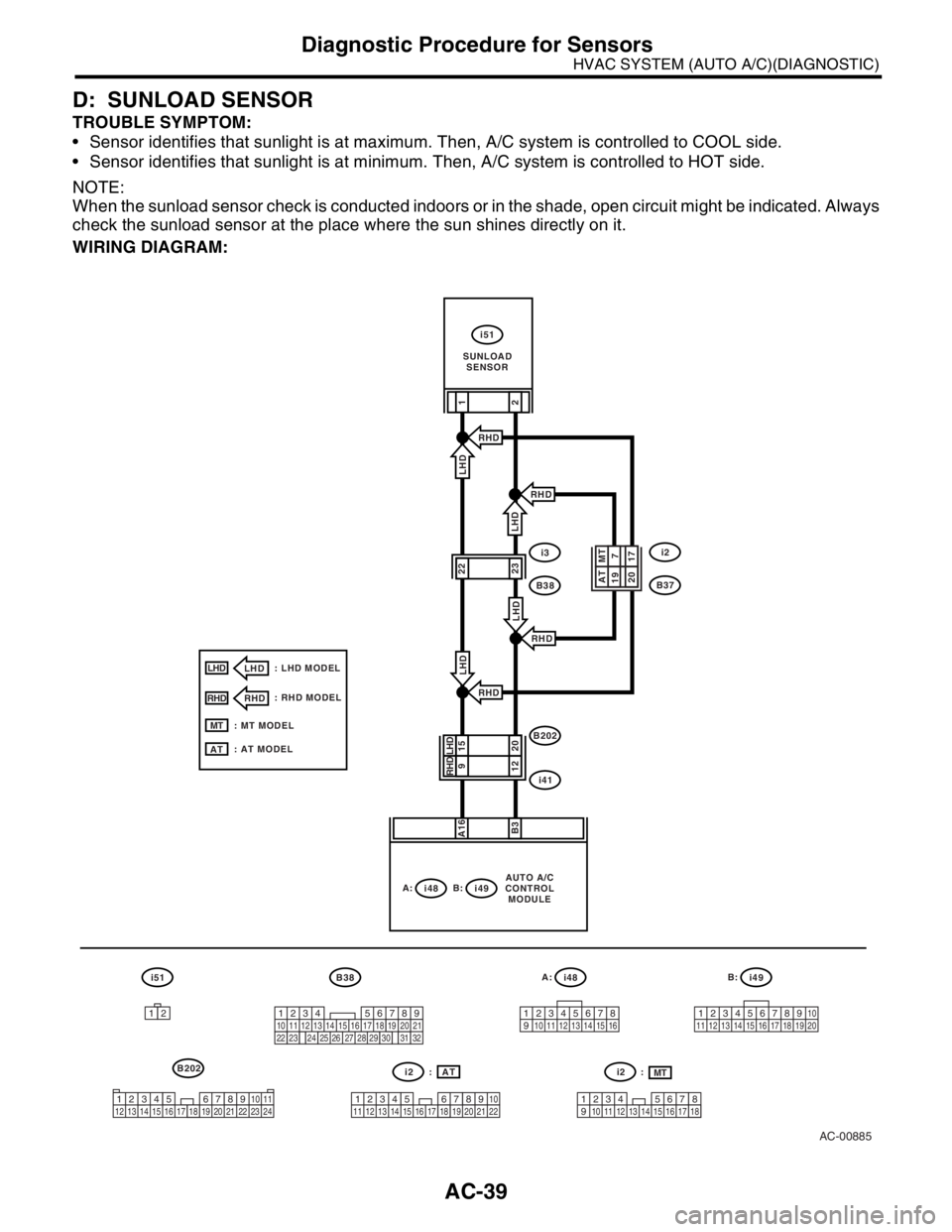
D: SUNLOAD SENSOR
TROUBLE SYMPTOM:
Sensor identifies that sunlight is at maximum. Then, A/C system is controlled to COOL side.
Sensor identifies that sunlight is at minimum. Then, A/C system is controlled to HOT side.
NOTE:
When the sunload sensor check is conducted indoors or in the shade, open circuit might be indicated. Always
check the sunload sensor at the place where the sun shines directly on it.
WIRING DIAGRAM:
AC-00885
A:
i48B:
i49
12345678
910 11 12 13 14 15 1612345678910
11 12 13 14 15 16 17 18 19 20
3
4 128910 11
12 13 14 15 16 17 18 19 20 21 22 23 24567
B202
B202
i41
i51
A:
i48B:
i49
A16
9
2
B31
12
2223
i3
B38
i51
12
SUNLOAD
SENSOR
AUTO A/C
CONTROL
MODULE
B38
219
32
1234 5610 11 12 13 14 15716
23 3019 20
22 26 27 28 29817
24 3118
25
RHD
1520LHD
LHD
LHD
RHD
RHD
LHD
RHD
LHD
RHD
2019
177i2
B37
: LHD MODEL
: RHD MODEL
LHD
RHD
LHD
RHD
3
4 128910
11 12 13 14 15 16 17 18 19 20 21 22567
i2 :
3
4 128
910 11 12 13 14 15 16 17 18567
i2 :ATMT
AT
: MT MODEL
: AT MODEL
ATMT
MT
Page 96 of 2870

AC-40
HVAC SYSTEM (AUTO A/C)(DIAGNOSTIC)
Diagnostic Procedure for Sensors
Step Check Yes No
1 CHECK POWER SUPPLY VOLTAGE FOR
SUNLOAD SENSOR.
1) Turn the ignition switch to OFF.
2) Disconnect the connector from sunload
sensor.
3) Turn the ignition switch to ON.
4) Measure the power supply voltage for sun-
load sensor.
Connector & terminal
(i51) No. 2 (+) — Chassis ground (
−):Is the voltage approx. 5 V? Go to step 4.Go to step 2.
2 CHECK AUTO A/C CONTROL MODULE
OUTPUT SIGNAL.
1) Turn the ignition switch to OFF.
2) Remove the auto A/C control module.
3) Turn the ignition switch to ON.
4) Measure the voltage between connector
terminals of auto A/C control module.
Connector & terminal
(i49) No. 3 (+) — (i48) No. 16 (
−):Is the voltage approx. 5 V? Go to step 3.Go to step 6.
3 CHECK HARNESS CONNECTOR BETWEEN
AUTO A/C CONTROL MODULE AND SUN-
LOAD SENSOR.
1) Turn the ignition switch to OFF.
2) Disconnect the connector from auto A/C
control module.
3) Measure the resistance in harness
between auto A/C control module and sunload
sensor.
Connector & terminal
(i51) No. 2 — (i49) No. 3:Is the resistance less than 1
Ω?Go to step 4.Repair the har-
ness between auto
A/C control mod-
ule and sunload
sensor.
4 CHECK HARNESS CONNECTOR BETWEEN
AUTO A/C CONTROL MODULE AND SUN-
LOAD SENSOR.
Measure the resistance in harness between
auto A/C control module and sunload sensor.
Connector & terminal
(i51) No. 1 — (i48) No. 16:Is the resistance less than 1
Ω?Go to step 5.Repair the har-
ness between auto
A/C control mod-
ule and sunload
sensor.
5 CHECK INPUT VOLTAGE FOR AUTO A/C
CONTROL MODULE.
1) Connect the connector of auto A/C control
module.
2) Turn the ignition switch to ON.
3) Measure the voltage between connector
terminals of auto A/C control module.
Connector & terminal
(i49) No. 3 (+) — (i48) No. 16 (
−):Is the voltage approx. 2.5 V? Go to step 6.Replace the sun-
load sensor.
6 CHECK POOR CONTACT.
Check poor contact in auto A/C control module
connector.Is there poor contact in con-
nector?Repair the con-
nector.Replace the auto
A/C control mod-
ule.
Page 97 of 2870

AC-41
HVAC SYSTEM (AUTO A/C)(DIAGNOSTIC)
General Diagnostic Table
9. General Diagnostic Table
A: INSPECTION
Symptom Problem parts
A/C system fails to operate.Fuse
Connector (Poor contact)
Ground
Auto A/C control module
Blower fan motor
Blower fan relay
A/C Relay
Compressor (Magnet clutch)
Evaporator sensor
Fuse is blown out.Fuse
Connector (Poor contact)
Illumination cannot dim.Fuse
Connector (Poor contact)
Auto A/C control module
Blower fan does not rotate or fan speed cannot be controlled.Fuse
Connector (Poor contact)
Ground
Auto A/C control module
Blower fan motor
Blower fan relay
Unable to switch suction vents. Connector (Poor contact)
Auto A/C control module
Intake door actuator
Unable to switch blow vents. Connector (Poor contact)
Auto A/C control module
Mode door actuator
Compartment temperature does not increase. (No hot air is dis-
charged.) Connector (Poor contact)
Auto A/C control module
Air mix door actuator
In-vehicle sensor, ambient sensor, evaporator sensor and
sunload sensor
In-vehicle sensor aspirator hose
Compartment temperature does not decrease. (No cool air is
discharged.) Connector (Poor contact)
Auto A/C control module
Air mix door actuator
A/C Relay
Compressor (Magnet clutch)
Radiator fan motor
Radiator fan relay
In-vehicle sensor, ambient sensor, evaporator sensor and
sunload sensor
In-vehicle sensor aspirator hose
Compartment temperature is higher or lower than setting tem-
perature. Auto A/C control module
Air mix door actuator
In-vehicle sensor, ambient sensor, evaporator sensor and
sunload sensor
In-vehicle sensor aspirator hose
Compartment temperature does not quickly respond to setting
temperature. Air mix door actuator
In-vehicle sensor, ambient sensor, evaporator sensor and
sunload sensor
In-vehicle sensor aspirator hose
Radiator fan does not rotate during A/C operation. Radiator fan motor
Radiator fan relay
Page 101 of 2870

AIRBAG SYSTEM
AB
Page
1. General Description ....................................................................................2
2. Airbag Connector ........................................................................................9
3. Inspection Locations After a Collision .......................................................12
4. Driver’s Airbag Module ..............................................................................14
5. Passenger’s Airbag Module ......................................................................15
6. Side Airbag Module ...................................................................................16
7. Airbag Control Module ..............................................................................18
8. Side Airbag Sensor ...................................................................................19
9. Roll Connector ..........................................................................................20
10. Front Sub Sensor ......................................................................................21
11. Airbag Module Disposal (Deployment Processing On Vehicle) ................22
12. Disposal of Airbag Module (Deploying After Removal from Vehicle) ........26
Page 102 of 2870
AB-2
AIRBAG SYSTEM
General Description
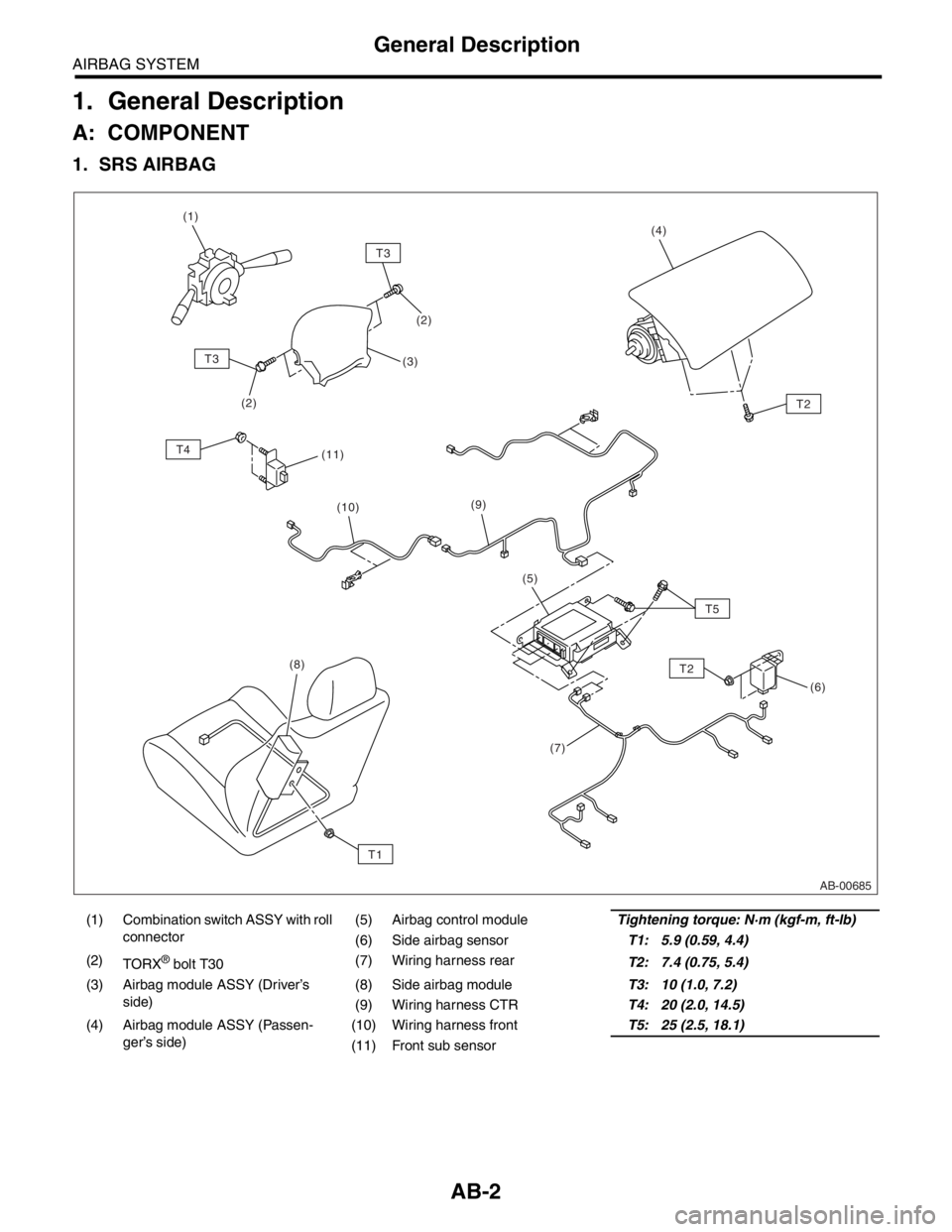
1. General Description
A: COMPONENT
1. SRS AIRBAG
(1) Combination switch ASSY with roll
connector(5) Airbag control moduleTightening torque: N·m (kgf-m, ft-lb)
(6) Side airbag sensorT1: 5.9 (0.59, 4.4)
(2)
TORX
® bolt T30(7) Wiring harness rear
T2: 7.4 (0.75, 5.4)
(3) Airbag module ASSY (Driver’s
side)(8) Side airbag moduleT3: 10 (1.0, 7.2)
(9) Wiring harness CTRT4: 20 (2.0, 14.5)
(4) Airbag module ASSY (Passen-
ger’s side)(10) Wiring harness frontT5: 25 (2.5, 18.1)
(11) Front sub sensor
AB-00685
T3
T2
T5
T3
T4(2)(4)
(3) (1)
(2)
(10)
(11)
(9)
(7)(6) (5)
(8)T2
T1
Page 103 of 2870
AB-3
AIRBAG SYSTEM
General Description
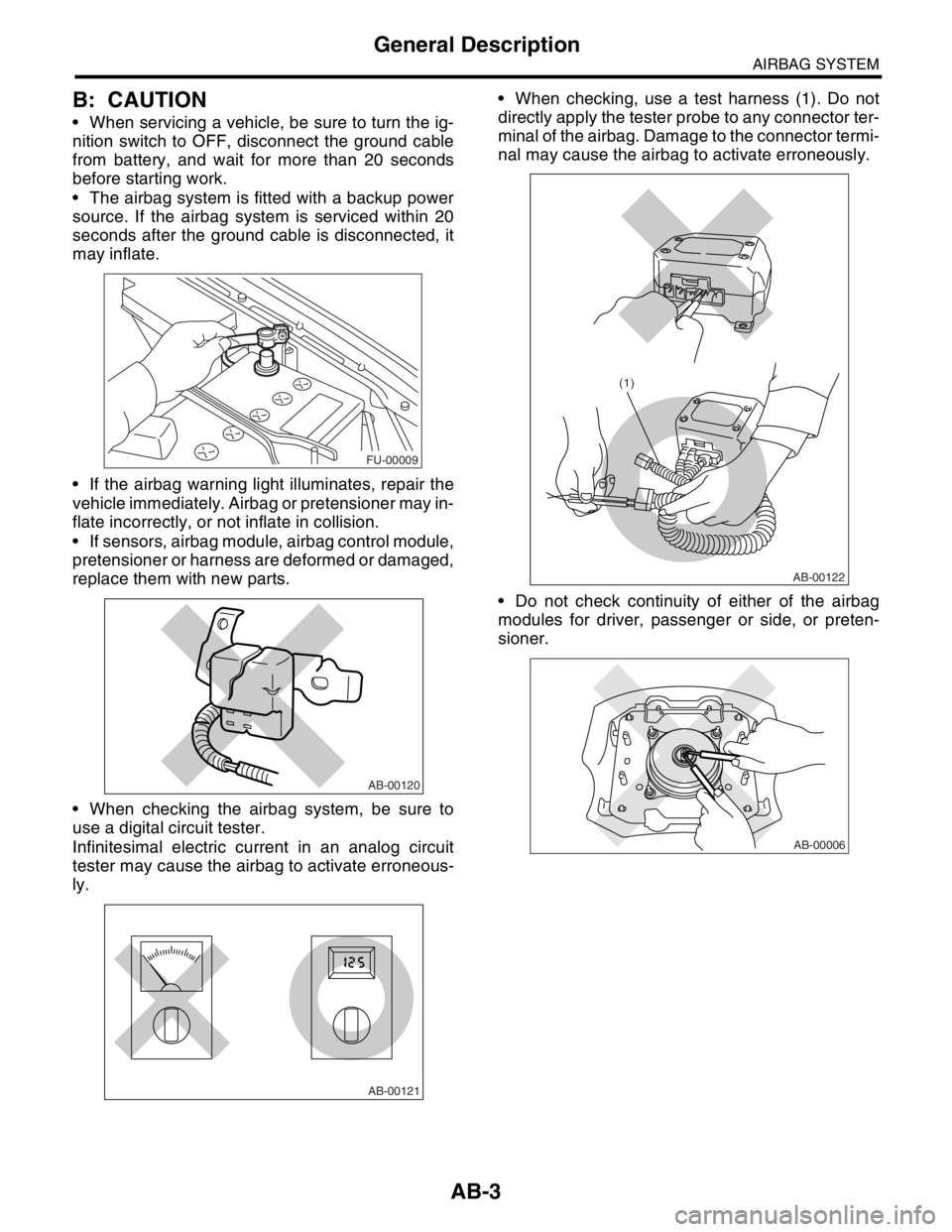
B: CAUTION
When servicing a vehicle, be sure to turn the ig-
nition switch to OFF, disconnect the ground cable
from battery, and wait for more than 20 seconds
before starting work.
The airbag system is fitted with a backup power
source. If the airbag system is serviced within 20
seconds after the ground cable is disconnected, it
may inflate.
If the airbag warning light illuminates, repair the
vehicle immediately. Airbag or pretensioner may in-
flate incorrectly, or not inflate in collision.
If sensors, airbag module, airbag control module,
pretensioner or harness are deformed or damaged,
replace them with new parts.
When checking the airbag system, be sure to
use a digital circuit tester.
Infinitesimal electric current in an analog circuit
tester may cause the airbag to activate erroneous-
ly. When checking, use a test harness (1). Do not
directly apply the tester probe to any connector ter-
minal of the airbag. Damage to the connector termi-
nal may cause the airbag to activate erroneously.
Do not check continuity of either of the airbag
modules for driver, passenger or side, or preten-
sioner.
FU-00009
AB-00120
AB-00121
AB-00122
(1)
AB-00006
Page 104 of 2870
AB-4
AIRBAG SYSTEM
General Description
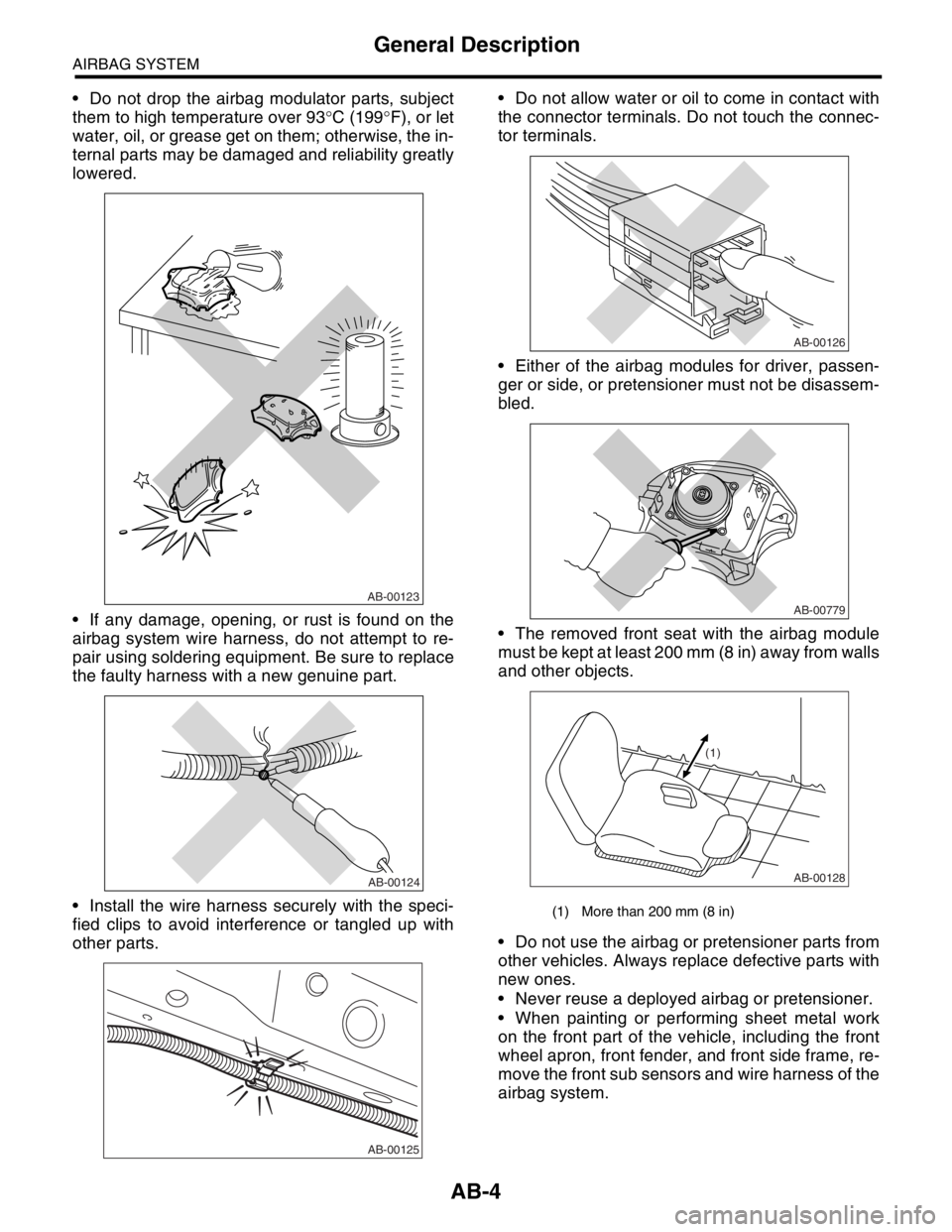
Do not drop the airbag modulator parts, subject
them to high temperature over 93°C (199°F), or let
water, oil, or grease get on them; otherwise, the in-
ternal parts may be damaged and reliability greatly
lowered.
If any damage, opening, or rust is found on the
airbag system wire harness, do not attempt to re-
pair using soldering equipment. Be sure to replace
the faulty harness with a new genuine part.
Install the wire harness securely with the speci-
fied clips to avoid interference or tangled up with
other parts. Do not allow water or oil to come in contact with
the connector terminals. Do not touch the connec-
tor terminals.
Either of the airbag modules for driver, passen-
ger or side, or pretensioner must not be disassem-
bled.
The removed front seat with the airbag module
must be kept at least 200 mm (8 in) away from walls
and other objects.
Do not use the airbag or pretensioner parts from
other vehicles. Always replace defective parts with
new ones.
Never reuse a deployed airbag or pretensioner.
When painting or performing sheet metal work
on the front part of the vehicle, including the front
wheel apron, front fender, and front side frame, re-
move the front sub sensors and wire harness of the
airbag system.
AB-00123
AB-00124
AB-00125
(1) More than 200 mm (8 in)
AB-00126
AB-00779
AB-00128
(1)
Page 105 of 2870
AB-5
AIRBAG SYSTEM
General Description
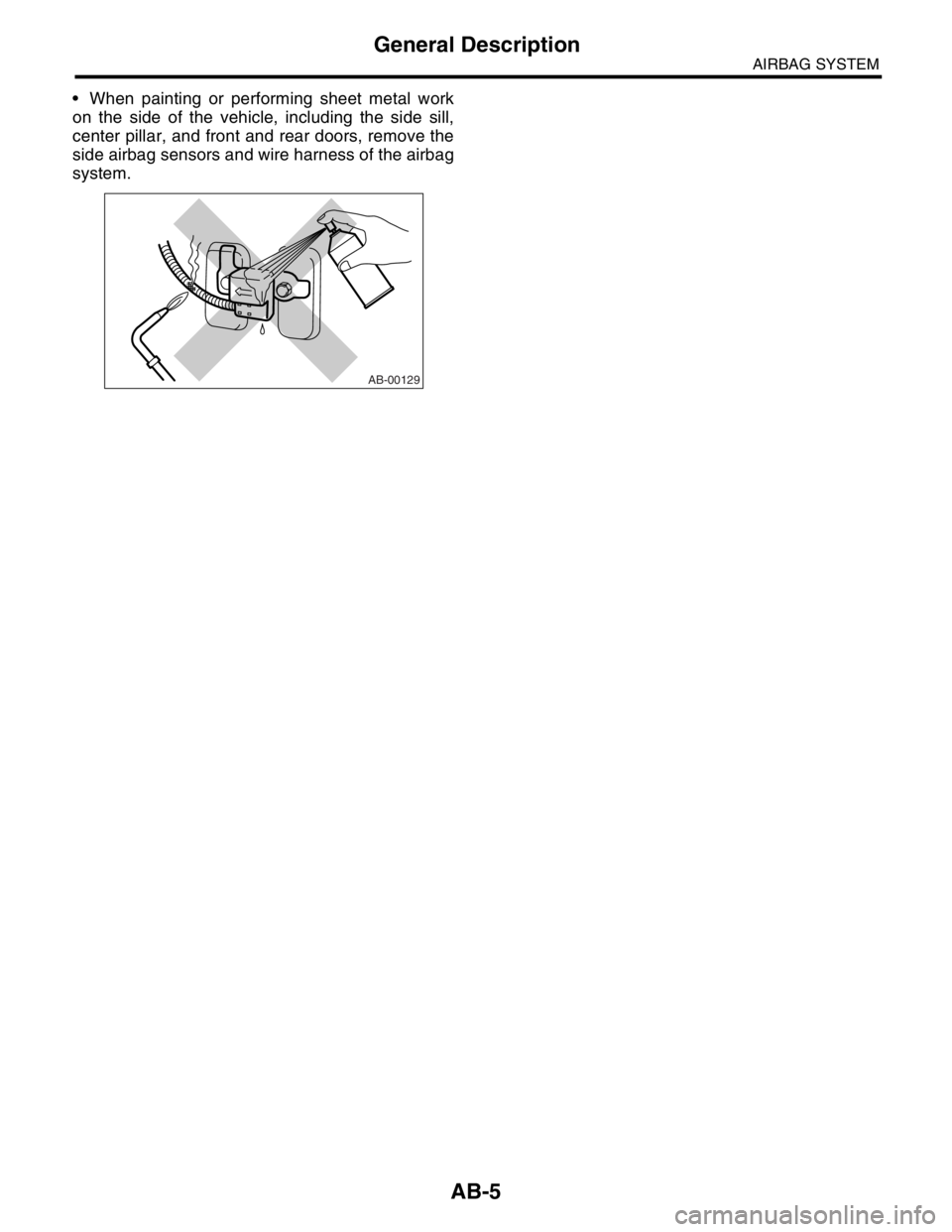
When painting or performing sheet metal work
on the side of the vehicle, including the side sill,
center pillar, and front and rear doors, remove the
side airbag sensors and wire harness of the airbag
system.
AB-00129