lights SUBARU FORESTER 2006 Owner's Guide
[x] Cancel search | Manufacturer: SUBARU, Model Year: 2006, Model line: FORESTER, Model: SUBARU FORESTER 2006Pages: 355, PDF Size: 5.49 MB
Page 203 of 355
7-8
Starting and operating1) Turn the ignition switch to the “OFF”
position and wait for at least 10 sec-
onds. After checking that the parking
brake is firmly set, turn the ignition
switch to the “START” position while de-
pressing the accelerator pedal slightly
(about a quarter of the full stroke). Re-
lease the accelerator pedal as soon as
the engine starts.
2) If this fails to start the engine, turn the
ignition switch back to the “OFF” posi-
tion and wait for at least 10 seconds.
Then fully depress the accelerator ped-
al and turn the ignition switch to the
“START” position. If the engine starts,
quickly release the accelerator pedal.
3) If this fails to start the engine, turn the
ignition switch again to the “OFF” posi-
tion. After waiting for 10 seconds or
longer, turn the ignition switch to the
“START” position without depressing
the accelerator pedal.
4) If the engine still refuses to start, con-
tact your nearest SUBARU dealer for
assistance.
6. Confirm that all warning and indicator
lights have gone out after the engine has
started. The fuel injection system auto-
matically lowers the idle speed as the en-
gine warms up.
While the engine is warming up, make
sure that the selector lever is at the “P” or “N” position and that the parking brake is
applied.
NOTEThe engine may be difficult to start
when the battery has been disconnect-
ed and reconnected (for maintenance
or other purposes). This difficulty is
caused by the electronically controlled
throttle’s self-diagnosis function. To
overcome it, keep the ignition switch in
the “ON” position for approximately 10
seconds before starting the engine.
Stopping the engineThe ignition switch should be turned off
only when the vehicle is stopped and the
engine is idling.
If you restart the engine while the
vehicle is moving, shift the selector
lever into the “N” position. Do not
attempt to place the selector lever of
a moving vehicle into the “P” posi-
tion.
Do not stop the engine when the ve-
hicle is moving. This will cause loss
of power to the power steering and
the brake booster, making steering
and braking more difficult. It could
also result in accidental activation
of the “LOCK” position on the igni-
tion switch, causing the steering
wheel to lock.
ProCarManuals.com
Page 213 of 355
7-18
Starting and operating
Electronic Brake Force Dis-
tribution (EBD) system (if equipped)The EBD system maximizes the effective-
ness of the brakes by allowing the rear
brakes to supply a greater proportion of
the braking force. It functions by adjusting
the distribution of braking force to the rear
wheels in accordance with the vehicle’s
loading condition and speed.
The EBD system is an integral part of the
ABS system and uses some of the ABS
system’s components to perform its func-
tion of optimizing the distribution of brak-
ing force. If any of the ABS components
used by the EBD function fails, the EBD
system also stops working.
When the EBD system is operating, you
may hear a chattering noise or feel a slight
vibration in the brake pedal. This is normal
and does not indicate a malfunction.
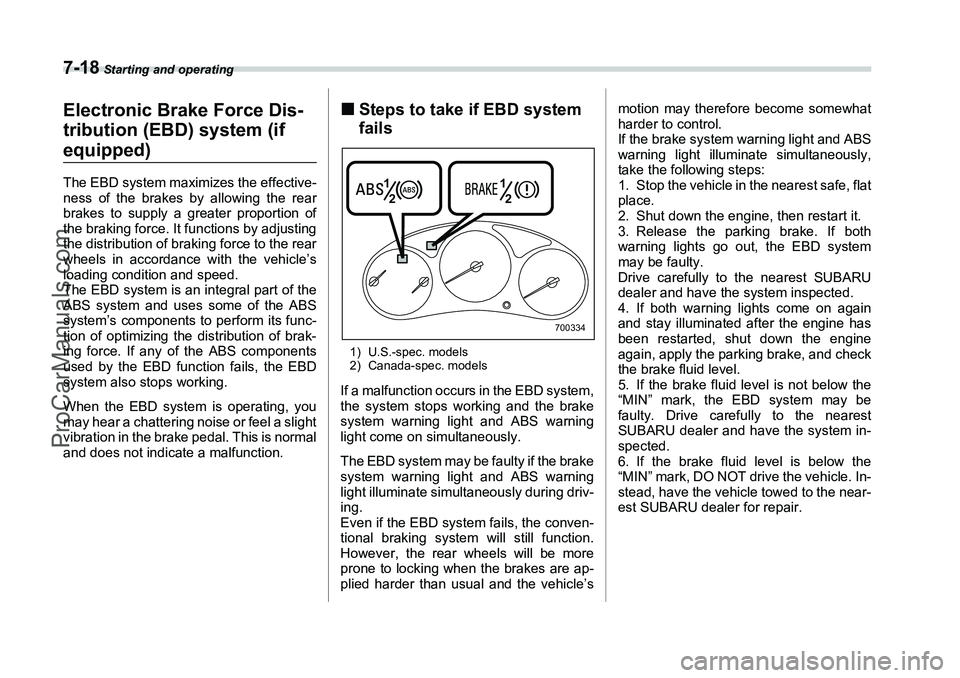
„Steps to take if EBD system
fails1) U.S.-spec. models
2) Canada-spec. modelsIf a malfunction occurs in the EBD system,
the system stops working and the brake
system warning light and ABS warning
light come on simultaneously.
The EBD system may be faulty if the brake
system warning light and ABS warning
light illuminate simultaneously during driv-
ing.
Even if the EBD system fails, the conven-
tional braking system will still function.
However, the rear wheels will be more
prone to locking when the brakes are ap-
plied harder than usual and the vehicle’s motion may therefore become somewhat
harder to control.
If the brake system warning light and ABS
warning light illuminate simultaneously,
take the following steps:
1. Stop the vehicle in the nearest safe, flat
place.
2. Shut down the engine, then restart it.
3. Release the parking brake. If both
warning lights go out, the EBD system
may be faulty.
Drive carefully to the nearest SUBARU
dealer and have the system inspected.
4. If both warning lights come on again
and stay illuminated after the engine has
been restarted, shut down the engine
again, apply the parking brake, and check
the brake fluid level.
5. If the brake fluid level is not below the
“MIN” mark, the EBD system may be
faulty. Drive carefully to the nearest
SUBARU dealer and have the system in-
spected.
6. If the brake fluid level is below the
“MIN” mark, DO NOT drive the vehicle. In-
stead, have the vehicle towed to the near-
est SUBARU dealer for repair.
1
2 1
2
700334
ProCarManuals.com
Page 219 of 355
7-24
Starting and operating
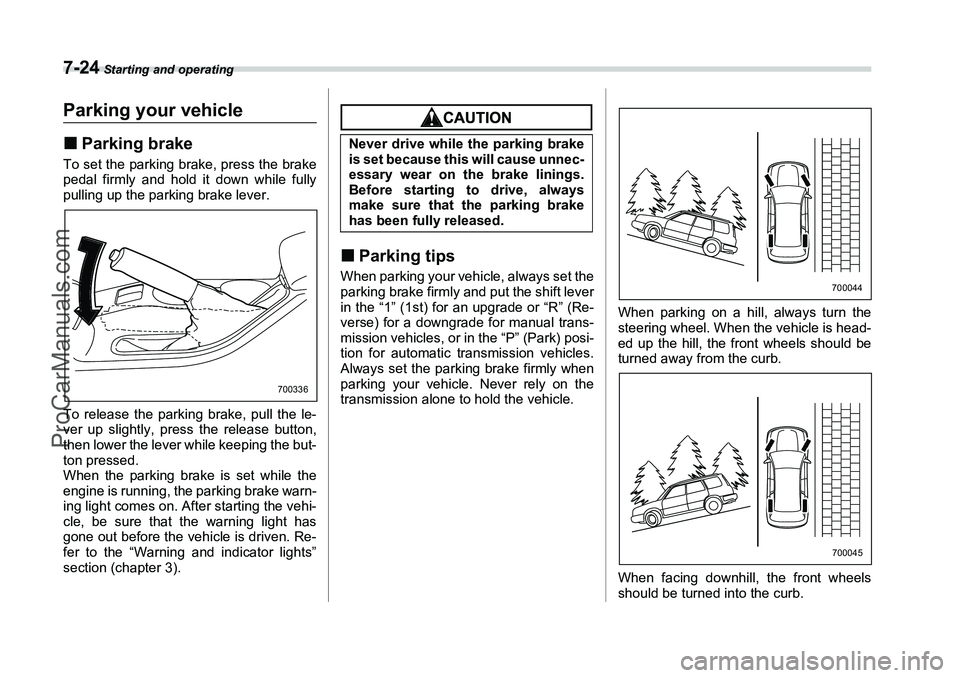
Parking your vehicle„Parking brakeTo set the parking brake, press the brake
pedal firmly and hold it down while fully
pulling up the parking brake lever.
To release the parking brake, pull the le-
ver up slightly, press the release button,
then lower the lever while keeping the but-
ton pressed.
When the parking brake is set while the
engine is running, the parking brake warn-
ing light comes on. After starting the vehi-
cle, be sure that the warning light has
gone out before the vehicle is driven. Re-
fer to the “Warning and indicator lights”
section (chapter 3).
„Parking tipsWhen parking your vehicle, always set the
parking brake firmly and put the shift lever
in the “1” (1st) for an upgrade or “R” (Re-
verse) for a downgrade for manual trans-
mission vehicles, or in the “P” (Park) posi-
tion for automatic transmission vehicles.
Always set the parking brake firmly when
parking your vehicle. Never rely on the
transmission alone to hold the vehicle. When parking on a hill, always turn the
steering wheel. When the vehicle is head-
ed up the hill, the front wheels should be
turned away from the curb.
When facing downhill, the front wheels
should be turned into the curb.
700336
Never drive while the parking brake
is set because this will cause unnec-
essary wear on the brake linings.
Before starting to drive, always
make sure that the parking brake
has been fully released.
700044700045
ProCarManuals.com
Page 242 of 355
Driving tips
8-17
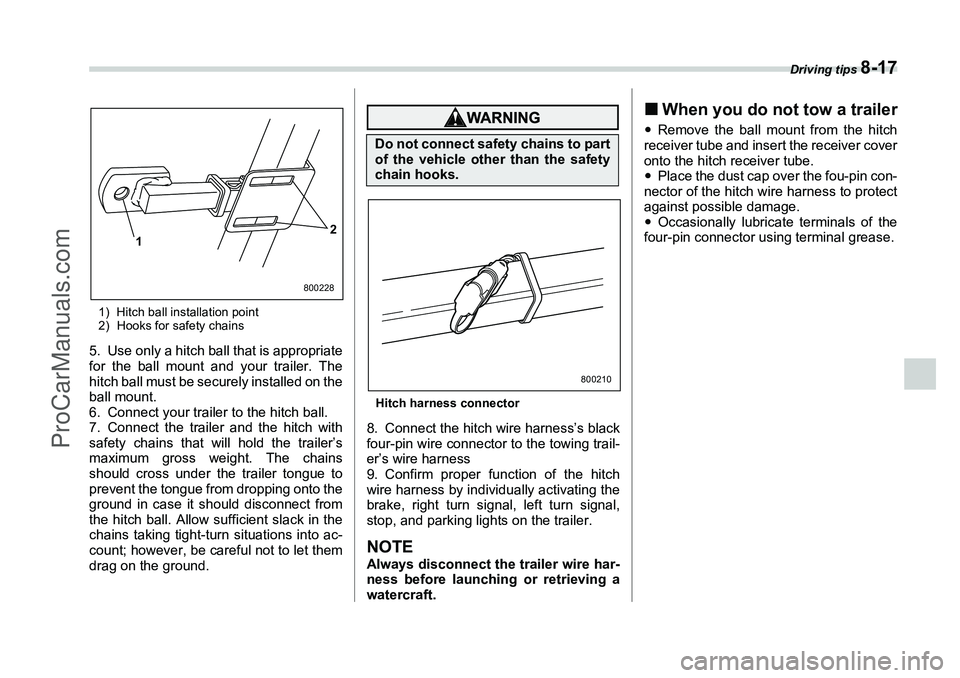
1) Hitch ball installation point
2) Hooks for safety chains5. Use only a hitch ball that is appropriate
for the ball mount and your trailer. The
hitch ball must be securely installed on the
ball mount.
6. Connect your trailer to the hitch ball.
7. Connect the trailer and the hitch with
safety chains that will hold the trailer’s
maximum gross weight. The chains
should cross under the trailer tongue to
prevent the tongue from dropping onto the
ground in case it should disconnect from
the hitch ball. Allow sufficient slack in the
chains taking tight-turn situations into ac-
count; however, be careful not to let them
drag on the ground.
Hitch harness connector8. Connect the hitch wire harness’s black
four-pin wire connector to the towing trail-
er’s wire harness
9. Confirm proper function of the hitch
wire harness by individually activating the
brake, right turn signal, left turn signal,
stop, and parking lights on the trailer.NOTEAlways disconnect the trailer wire har-
ness before launching or retrieving a
watercraft.
„When you do not tow a traileryRemove the ball mount from the hitch
receiver tube and insert the receiver cover
onto the hitch receiver tube.
y Place the dust cap over the fou-pin con-
nector of the hitch wire harness to protect
against possible damage.
y Occasionally lubricate terminals of the
four-pin connector using terminal grease.
1 2
800228
Do not connect safety chains to part
of the vehicle other than the safety
chain hooks.
800210
ProCarManuals.com
Page 247 of 355
8-22
Driving tips
„Connecting a trailerT Trailer brakes
If your trailer’s total weight (trailer weight
plus its cargo weight) exceeds 1,000 lbs
(453 kg), the trailer is required to be
equipped with its own brake system. Elec-
tric brakes or surge brakes are recom-
mended, and must be installed properly.
Check that your trailer’s brakes conform
with Federal, state/province and/or other
applicable regulations. Your SUBARU’s
brake system is not designed to be tapped
into the trailer’s hydraulic brake system.
Please ask your SUBARU dealer and pro-
fessional trailer supplier for more informa-
tion about the trailer’s brake system.
T Trailer safety chains
In case the trailer hitch connector or hitch
ball should break or become disconnect-
ed, the trailer could get loose and create a
traffic safety hazard.
For safety, always connect the towing ve-
hicle and trailer with trailer safety chains.
Pass the chains crossing each other un-
der the trailer tongue to prevent the trailer
from dropping onto the ground in case the
trailer tongue should disconnect from the
hitch ball. Allow sufficient slack in the
chains taking tight-turn situations into ac-
count; however, be careful not to let them
drag on the ground.
For more information about the safety
chain connection, refer to the instructions
for your hitch and trailer.
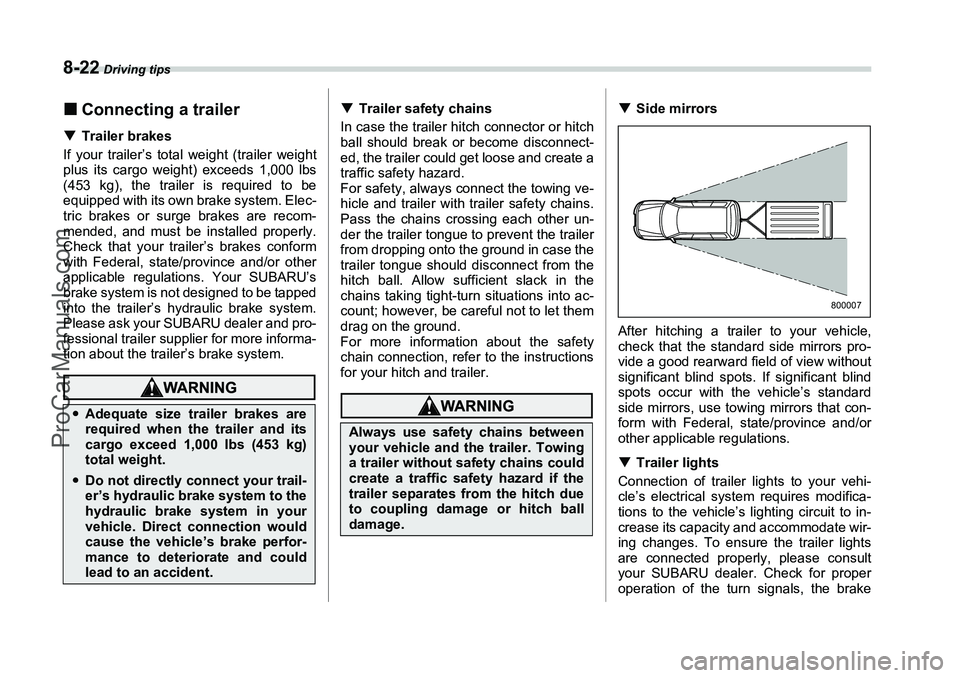
T Side mirrors
After hitching a trailer to your vehicle,
check that the standard side mirrors pro-
vide a good rearward field of view without
significant blind spots. If significant blind
spots occur with the vehicle’s standard
side mirrors, use towing mirrors that con-
form with Federal, state/province and/or
other applicable regulations.
T Trailer lights
Connection of trailer lights to your vehi-
cle’s electrical system requires modifica-
tions to the vehicle’s lighting circuit to in-
crease its capacity and accommodate wir-
ing changes. To ensure the trailer lights
are connected properly, please consult
your SUBARU dealer. Check for proper
operation of the turn signals, the brake
y Adequate size trailer brakes are
required when the trailer and its
cargo exceed 1,000 lbs (453 kg)
total weight.yDo not directly connect your trail-
er’s hydraulic brake system to the
hydraulic brake system in your
vehicle. Direct connection would
cause the vehicle’s brake perfor-
mance to deteriorate and could
lead to an accident.
Always use safety chains between
your vehicle and the trailer. Towing
a trailer without safety chains could
create a traffic safety hazard if the
trailer separates from the hitch due
to coupling damage or hitch ball
damage.
800007
ProCarManuals.com
Page 248 of 355
Driving tips
8-23
– CONTINUED –
lights and parking lights each time you
hitch up.TTires
Make sure that all the tires on your vehicle
are properly inflated to the pressure spec-
ified on the tire placard located on the driv-
er’s side center pillar.
Trailer tire condition, size, load rating and
proper inflation pressure should be in ac-
cordance with the trailer manufacturer’s
specifications.„ Trailer towing tips
T Before starting out on a trip
y Check that the vehicle and vehicle-to-
hitch mounting are in good condition. If
any problems are apparent, do not tow the
trailer.
y Check that the vehicle sits horizontally
with the trailer attached. If the vehicle is
tipped sharply up at the front and down at
the rear, check the total trailer weight,
GVW, GAWs and tongue load again, then
confirm that the load and its distribution
are acceptable.
y Check that the tire pressures are cor-
rect.
y Check that the vehicle and trailer are
connected properly. Confirm that – the trailer tongue is connected prop-
erly to the hitch ball.
– the trailer lights connector is connect-
ed properly and trailer’s brake lights illu-
minate when the vehicle’s brake pedal
is pressed, and that the trailer’s turn sig- nal lights flash when the vehicle’s turn
signal lever is operated.
– the safety chains are connected prop-
erly.
– all cargo in the trailer is secured safe-
ty in position.
– the side mirrors provide a good rear-
ward field of view without a significant
blind spot.
y Sufficient time should be taken to learn
the “feel” of the vehicle/trailer combination
before starting out on a trip. In an area free
of traffic, practice turning, stopping and
backing up.
T Driving with a trailer
y You should allow for considerably more
stopping distance when towing a trailer.
Avoid sudden braking because it may re-
sult in skidding or jackknifing and loss of
control.
y Avoid abrupt starts and sudden acceler-
ations. If your vehicle has a manual trans-
mission, always start out in first gear and
release the clutch at moderate engine rev-
olution.
y Avoid uneven steering, sharp turns and
rapid lane changes.
y Slow down before turning. Make a long-
er than normal turning radius because the
trailer wheels will be closer than the vehi-
cle wheels to the inside of the turn. In a
Direct splicing or other improper
connection of trailer lights may
damage your vehicle’s electrical
system and cause a malfunction of
your vehicle’s lighting system.
y
Never exceed 45 mph (72 km/h)
when towing a trailer in hilly coun-
try on hot days.yWhen towing a trailer, steering,
stability, stopping distance and
braking performance will be dif-
ferent from normal operation. For
safety’s sake, you should employ
extra caution when towing a trail-
er and you should never speed.
You should also keep the follow-
ing tips in mind:
ProCarManuals.com
Page 249 of 355
8-24
Driving tips
tight turn, the trailer could hit your vehicle.
yCrosswinds will adversely affect the
handling of your vehicle and trailer, caus-
ing sway. Crosswinds can be due to
weather conditions or the passing of large
trucks or buses. If swaying occurs, firmly
grip the steering wheel and slow down im-
mediately but gradually.
y When passing other vehicles, consider-
able distance is required because of the
added weight and length caused by at-
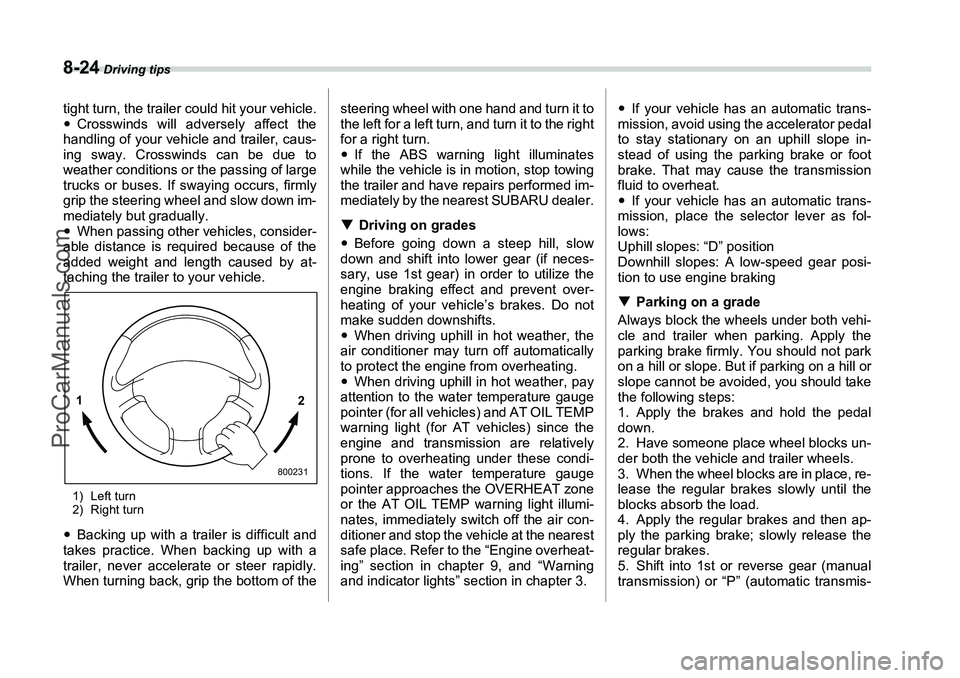
taching the trailer to your vehicle.1) Left turn
2) Right turny Backing up with a trailer is difficult and
takes practice. When backing up with a
trailer, never accelerate or steer rapidly.
When turning back, grip the bottom of the steering wheel with one hand and turn it to
the left for a left turn, and turn it to the right
for a right turn.
y
If the ABS warning light illuminates
while the vehicle is in motion, stop towing
the trailer and have repairs performed im-
mediately by the nearest SUBARU dealer.
T Driving on grades
y Before going down a steep hill, slow
down and shift into lower gear (if neces-
sary, use 1st gear) in order to utilize the
engine braking effect and prevent over-
heating of your vehicle’s brakes. Do not
make sudden downshifts.
y When driving uphill in hot weather, the
air conditioner may turn off automatically
to protect the engine from overheating.
y When driving uphill in hot weather, pay
attention to the water temperature gauge
pointer (for all vehicles) and AT OIL TEMP
warning light (for AT vehicles) since the
engine and transmission are relatively
prone to overheating under these condi-
tions. If the water temperature gauge
pointer approaches the OVERHEAT zone
or the AT OIL TEMP warning light illumi-
nates, immediately switch off the air con-
ditioner and stop the vehicle at the nearest
safe place. Refer to the “Engine overheat-
ing” section in chapter 9, and “Warning
and indicator lights” section in chapter 3. y
If your vehicle has an automatic trans-
mission, avoid using the accelerator pedal
to stay stationary on an uphill slope in-
stead of using the parking brake or foot
brake. That may cause the transmission
fluid to overheat.
y If your vehicle has an automatic trans-
mission, place the selector lever as fol-
lows:
Uphill slopes: “D” position
Downhill slopes: A low-speed gear posi-
tion to use engine braking
T Parking on a grade
Always block the wheels under both vehi-
cle and trailer when parking. Apply the
parking brake firmly. You should not park
on a hill or slope. But if parking on a hill or
slope cannot be avoided, you should take
the following steps:
1. Apply the brakes and hold the pedal
down.
2. Have someone place wheel blocks un-
der both the vehicle and trailer wheels.
3. When the wheel blocks are in place, re-
lease the regular brakes slowly until the
blocks absorb the load.
4. Apply the regular brakes and then ap-
ply the parking brake; slowly release the
regular brakes.
5. Shift into 1st or reverse gear (manual
transmission) or “P” (automatic transmis-1 2
800231
ProCarManuals.com
Page 259 of 355
9-8
In case of emergency
„How to jump start1. Make sure the booster battery is 12
volts and the negative terminal is ground-
ed.
2. If the booster battery is in another vehi-
cle, do not let the two vehicles touch.
3. Turn off all unnecessary lights and ac-
cessories.
4. Connect the jumper cables exactly in
the sequence illustrated.
ProCarManuals.com
Page 275 of 355
Maintenance and serviceReplacement of brake pad and lining ............... 11-28
Breaking-in of new brake pads and linings ......... 11-28
Parking brake stroke .......................................... 11-29
Tires and wheels ................................................ 11-29
Types of tires .......................................................... 11-29
Tire inspection ........................................................ 11-30
Tire pressures and wear ........................................ 11-30
Wheel balance ........................................................ 11-32
Wear indicators ....................................................... 11-32
Tire rotation ............................................................. 11-32
Tire replacement ..................................................... 11-33
Wheel replacement ................................................. 11-33
Aluminum wheels (if equipped) ........................ 11-34
Windshield washer fluid .................................... 11-34
Replacement of wiper blades ............................ 11-36
Windshield wiper blades ........................................ 11-36
Rear window wiper blade ....................................... 11-37
Battery ................................................................\
. 11-39
Fuses ..................................................................\
. 11-40
Main fuse ............................................................. 11-41
Installation of accessories ................................ 11-42
Replacing bulbs .................................................. 11-43
Headlights (Canada-spec. 2.5XT) .......................... 11-44
Headlights (Except Canada-spec. 2.5XT) ............. 11-45
Rear combination lights ......................................... 11-46
License plate light .................................................. 11-47
Dome light and map light ....................................... 11-47
High mount stop light ............................................ 11-48
ProCarManuals.com
Page 314 of 355
Maintenance and service
11 - 4 1
in the main fuse box cover in the engine
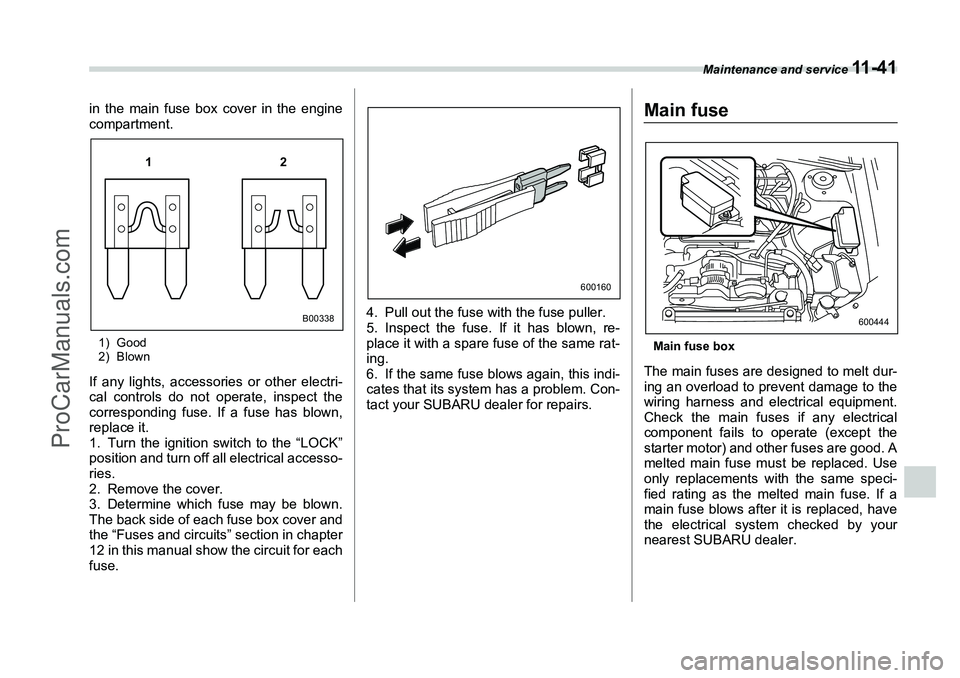
compartment.1) Good
2) BlownIf any lights, accessories or other electri-
cal controls do not operate, inspect the
corresponding fuse. If a fuse has blown,
replace it.
1. Turn the ignition switch to the “LOCK”
position and turn off all electrical accesso-
ries.
2. Remove the cover.
3. Determine which fuse may be blown.
The back side of each fuse box cover and
the “Fuses and circuits” section in chapter
12 in this manual show the circuit for each
fuse.4. Pull out the fuse with the fuse puller.
5. Inspect the fuse. If it has blown, re-
place it with a spare fuse of the same rat-
ing.
6. If the same fuse blows again, this indi-
cates that its system has a problem. Con-
tact your SUBARU dealer for repairs.
Main fuseMain fuse boxThe main fuses are designed to melt dur-
ing an overload to prevent damage to the
wiring harness and electrical equipment.
Check the main fuses if any electrical
component fails to operate (except the
starter motor) and other fuses are good. A
melted main fuse must be replaced. Use
only replacements with the same speci-
fied rating as the melted main fuse. If a
main fuse blows after it is replaced, have
the electrical system checked by your
nearest SUBARU dealer.
12
B00338
600160
600444
ProCarManuals.com