stop start SUBARU FORESTER 2006 Owner's Guide
[x] Cancel search | Manufacturer: SUBARU, Model Year: 2006, Model line: FORESTER, Model: SUBARU FORESTER 2006Pages: 355, PDF Size: 5.49 MB
Page 238 of 355
Driving tips
8-13
– CONTINUED –
In addition, the total weight applied to
each axle (GAW) must never exceed the
GAWR. The front and rear GAWs can be
adjusted by relocating luggage inside the
vehicle.
Even if the total weight of your luggage is
lower than the vehicle capacity weight, ei-
ther front or rear GAW may exceed the
GAWR, depending on the distribution of
the luggage.
When possible, the load should be evenly
distributed throughout the vehicle.
If you carry heavy loads in the vehicle, you
should confirm that GVW and front and
rear GAWs are within the GVWR and
GAWR by putting your vehicle on a vehi-
cle scale, found at a commercial weighing
station.
Do not use replacement tires with a lower
load range than the originals because
they may lower the GVWR and GAWR
limitations. Replacement tires with a high-
er load range than the originals do not in-
crease the GVWR and GAWR limitations.„Roof rail and crossbar (if
equipped)The roof rail is not designed to carry cargo
by itself. Cargo can be carried after secur-
ing the roof crossbar kit to the roof rail and
installing the appropriate carrying attach- ment. When installing the roof crossbar
kit, follow the manufacturer’s instructions.
When you carry cargo on the roof using
the roof crossbar kit and a carrying attach-
ment, never exceed the maximum load
limit explained in the following. You should
also be careful that your vehicle does not
exceed the Gross Vehicle Weight Rating
(GVWR) and front and rear Gross Axle
Weight Rating (GAWR). See the “Loading
your vehicle” section in this chapter for in-
formation on loading cargo into or onto
your vehicle. The maximum load limit of
the cargo, crossbars and carrying attach-
ment must not exceed
150 lbs (68 kg).
Place the heaviest load at the bottom,
nearest the roof, and evenly distribute the
cargo. Always properly secure all cargo.
T Installing carrying attachments on
the crossbars
When installing any carrying attachment
such as a bike carrier, ski carrier, kayak
carrier, cargo basket, etc. on the cross-
bars, follow the manufacturer’s instruc-
tions and make sure that the attachment is
securely fixed to the crossbars. Use only
attachments designed specifically for the
crossbars. A set of crossbars is designed
to carry loads (cargo and attachment) of
not more than 150 lbs (68 kg) . Before op-
erating the vehicle, make sure that the
cargo is properly secured on the attach-
ment.NOTERemember that the vehicle’s center of
gravity is altered with the weight of the
load on the roof, thus affecting the
driving characteristics.
Drive carefully. Avoid rapid starts, hard
cornering and abrupt stops. Crosswind
effects will be increased.
y
For cargo carrying purposes, the
roof rail must be used together
with a roof crossbar kit and the
appropriate carrying attachment.
The roof rail must never be used
alone to carry cargo. Otherwise,
damage to the roof or paint or a
dangerous road hazard due to
loss of cargo could result.yWhen using the roof crossbar kit,
make sure that the total weight of
the crossbars, carrying attach-
ment and cargo does not exceed
the maximum load limit. Overload-
ing may cause damage to the ve-
hicle and create a safety hazard.
ProCarManuals.com
Page 240 of 355
Driving tips
8-15
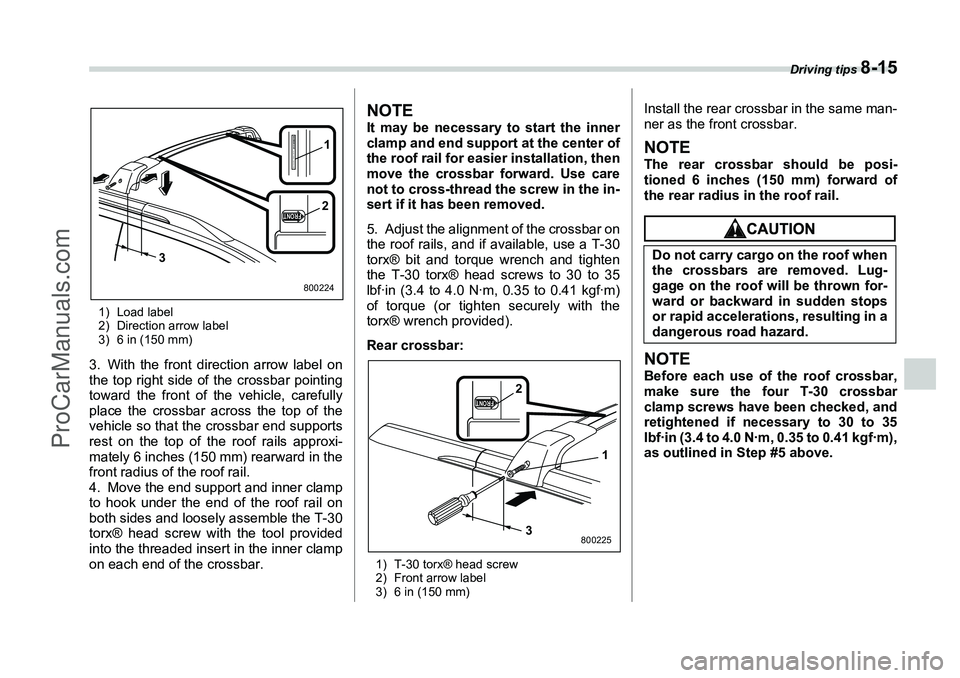
1) Load label
2) Direction arrow label
3) 6 in (150 mm)3. With the front direction arrow label on
the top right side of the crossbar pointing
toward the front of the vehicle, carefully
place the crossbar across the top of the
vehicle so that the crossbar end supports
rest on the top of the roof rails approxi-
mately 6 inches (150 mm) rearward in the
front radius of the roof rail.
4. Move the end support and inner clamp
to hook under the end of the roof rail on
both sides and loosely assemble the T-30
torx® head screw with the tool provided
into the threaded insert in the inner clamp
on each end of the crossbar.
NOTEIt may be necessary to start the inner
clamp and end support at the center of
the roof rail for easier installation, then
move the crossbar forward. Use care
not to cross-thread the screw in the in-
sert if it has been removed.
5. Adjust the alignment of the crossbar on
the roof rails, and if available, use a T-30
torx® bit and torque wrench and tighten
the T-30 torx® head screws to 30 to 35
lbf·in (3.4 to 4.0 N·m, 0.35 to 0.41 kgf·m)
of torque (or tighten securely with the
torx® wrench provided).
Rear crossbar:1) T-30 torx® head screw
2) Front arrow label
3) 6 in (150 mm)
Install the rear crossbar in the same man-
ner as the front crossbar.NOTEThe rear crossbar should be posi-
tioned 6 inches (150 mm) forward of
the rear radius in the roof rail.NOTEBefore each use of the roof crossbar,
make sure the four T-30 crossbar
clamp screws have been checked, and
retightened if necessary to 30 to 35
lbf·in (3.4 to 4.0 N·m, 0.35 to 0.41 kgf·m),
as outlined in Step #5 above.
FRONTMAXIMUM LOAD100 LBS. EVENLY DISTRIBUTED
31
2
800224
FRONT
1
2
3
800225
Do not carry cargo on the roof when
the crossbars are removed. Lug-
gage on the roof will be thrown for-
ward or backward in sudden stops
or rapid accelerations, resulting in a
dangerous road hazard.
ProCarManuals.com
Page 248 of 355
Driving tips
8-23
– CONTINUED –
lights and parking lights each time you
hitch up.TTires
Make sure that all the tires on your vehicle
are properly inflated to the pressure spec-
ified on the tire placard located on the driv-
er’s side center pillar.
Trailer tire condition, size, load rating and
proper inflation pressure should be in ac-
cordance with the trailer manufacturer’s
specifications.„ Trailer towing tips
T Before starting out on a trip
y Check that the vehicle and vehicle-to-
hitch mounting are in good condition. If
any problems are apparent, do not tow the
trailer.
y Check that the vehicle sits horizontally
with the trailer attached. If the vehicle is
tipped sharply up at the front and down at
the rear, check the total trailer weight,
GVW, GAWs and tongue load again, then
confirm that the load and its distribution
are acceptable.
y Check that the tire pressures are cor-
rect.
y Check that the vehicle and trailer are
connected properly. Confirm that – the trailer tongue is connected prop-
erly to the hitch ball.
– the trailer lights connector is connect-
ed properly and trailer’s brake lights illu-
minate when the vehicle’s brake pedal
is pressed, and that the trailer’s turn sig- nal lights flash when the vehicle’s turn
signal lever is operated.
– the safety chains are connected prop-
erly.
– all cargo in the trailer is secured safe-
ty in position.
– the side mirrors provide a good rear-
ward field of view without a significant
blind spot.
y Sufficient time should be taken to learn
the “feel” of the vehicle/trailer combination
before starting out on a trip. In an area free
of traffic, practice turning, stopping and
backing up.
T Driving with a trailer
y You should allow for considerably more
stopping distance when towing a trailer.
Avoid sudden braking because it may re-
sult in skidding or jackknifing and loss of
control.
y Avoid abrupt starts and sudden acceler-
ations. If your vehicle has a manual trans-
mission, always start out in first gear and
release the clutch at moderate engine rev-
olution.
y Avoid uneven steering, sharp turns and
rapid lane changes.
y Slow down before turning. Make a long-
er than normal turning radius because the
trailer wheels will be closer than the vehi-
cle wheels to the inside of the turn. In a
Direct splicing or other improper
connection of trailer lights may
damage your vehicle’s electrical
system and cause a malfunction of
your vehicle’s lighting system.
y
Never exceed 45 mph (72 km/h)
when towing a trailer in hilly coun-
try on hot days.yWhen towing a trailer, steering,
stability, stopping distance and
braking performance will be dif-
ferent from normal operation. For
safety’s sake, you should employ
extra caution when towing a trail-
er and you should never speed.
You should also keep the follow-
ing tips in mind:
ProCarManuals.com
Page 258 of 355
In case of emergency
9-7
– CONTINUED –
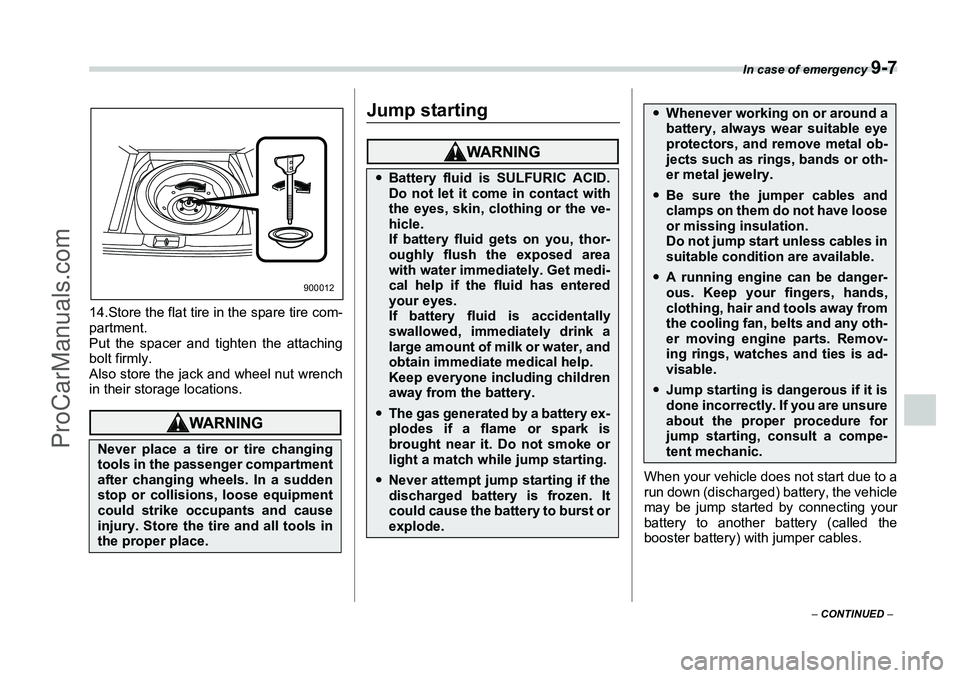
14.Store the flat tire in the spare tire com-
partment.
Put the spacer and tighten the attaching
bolt firmly.
Also store the jack and wheel nut wrench
in their storage locations.
Jump starting
When your vehicle does not start due to a
run down (discharged) battery, the vehicle
may be jump started by connecting your
battery to another battery (called the
booster battery) with jumper cables.
Never place a tire or tire changing
tools in the passenger compartment
after changing wheels. In a sudden
stop or collisions, loose equipment
could strike occupants and cause
injury. Store the tire and all tools in
the proper place.
900012
yBattery fluid is SULFURIC ACID.
Do not let it come in contact with
the eyes, skin, clothing or the ve-
hicle.
If battery fluid gets on you, thor-
oughly flush the exposed area
with water immediately. Get medi-
cal help if the fluid has entered
your eyes.
If battery fluid is accidentally
swallowed, immediately drink a
large amount of milk or water, and
obtain immediate medical help.
Keep everyone including children
away from the battery.yThe gas generated by a battery ex-
plodes if a flame or spark is
brought near it. Do not smoke or
light a match while jump starting.yNever attempt jump starting if the
discharged battery is frozen. It
could cause the battery to burst or
explode.
yWhenever working on or around a
battery, always wear suitable eye
protectors, and remove metal ob-
jects such as rings, bands or oth-
er metal jewelry.yBe sure the jumper cables and
clamps on them do not have loose
or missing insulation.
Do not jump start unless cables in
suitable condition are available.yA running engine can be danger-
ous. Keep your fingers, hands,
clothing, hair and tools away from
the cooling fan, belts and any oth-
er moving engine parts. Remov-
ing rings, watches and ties is ad-
visable.yJump starting is dangerous if it is
done incorrectly. If you are unsure
about the proper procedure for
jump starting, consult a compe-
tent mechanic.
ProCarManuals.com
Page 283 of 355
11 - 1 0
Maintenance and service
The oil quantity indicated above is only a
guideline. The necessary quantity of oil
depends on the quantity of oil that has
been drained. The quantity of drained oil
differs slightly depending on the tempera-
ture of the oil and the time the oil is left
flowing out. After pouring oil into the en-
gine, therefore, you must use the dipstick
to confirm that the level is correct.
13.Start the engine and make sure that no
oil leaks appear around the filter’s rubber
seal.
14.Run the engine until it reaches the nor-
mal operating temperature. Then stop the
engine and wait a few minutes to allow the
oil drain back. Check the oil level again
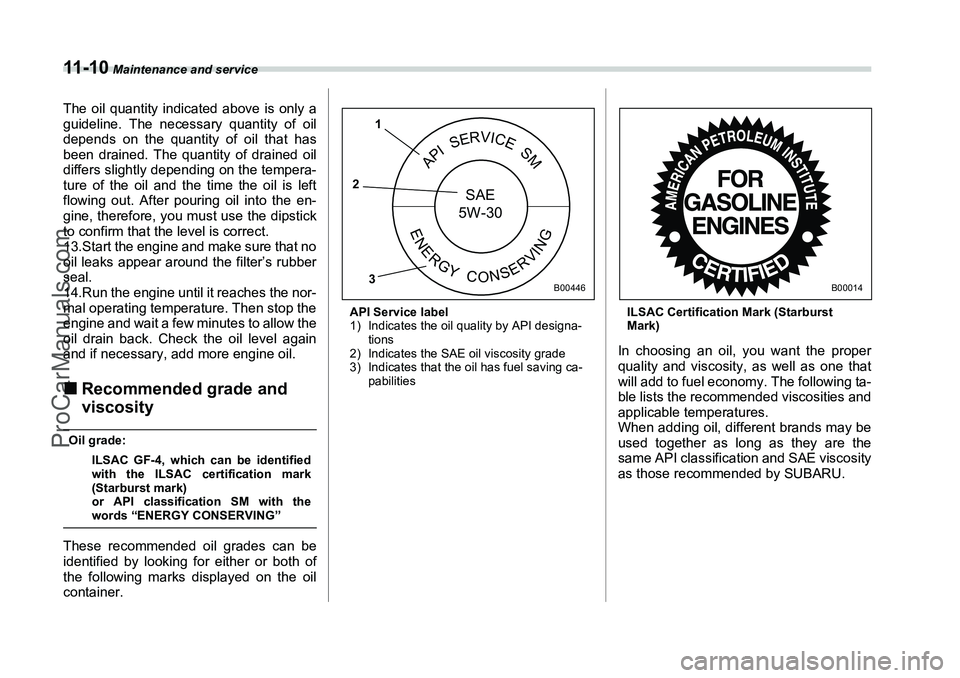
and if necessary, add more engine oil.„Recommended grade and
viscosityOil grade:
ILSAC GF-4, which can be identified
with the ILSAC certification mark
(Starburst mark)
or API classification SM with the
words “ENERGY CONSERVING”
These recommended oil grades can be
identified by looking for either or both of
the following marks displayed on the oil
container.
API Service label
1) Indicates the oil quality by API designa-tions
2) Indicates the SAE oil viscosity grade
3) Indicates that the oil has fuel saving ca- pabilities ILSAC Certification Mark (Starburst
Mark)
In choosing an oil, you want the proper
quality and viscosity, as well as one that
will add to fuel economy. The following ta-
ble lists the recommended viscosities and
applicable temperatures.
When adding oil, different brands may be
used together as long as they are the
same API classification and SAE viscosity
as those recommended by SUBARU.
APISERVICESM
ENERGY
CONSERVING
SAE
5W-30
1
2
3
B00446
B00014
ProCarManuals.com
Page 287 of 355
11 - 1 4
Maintenance and service
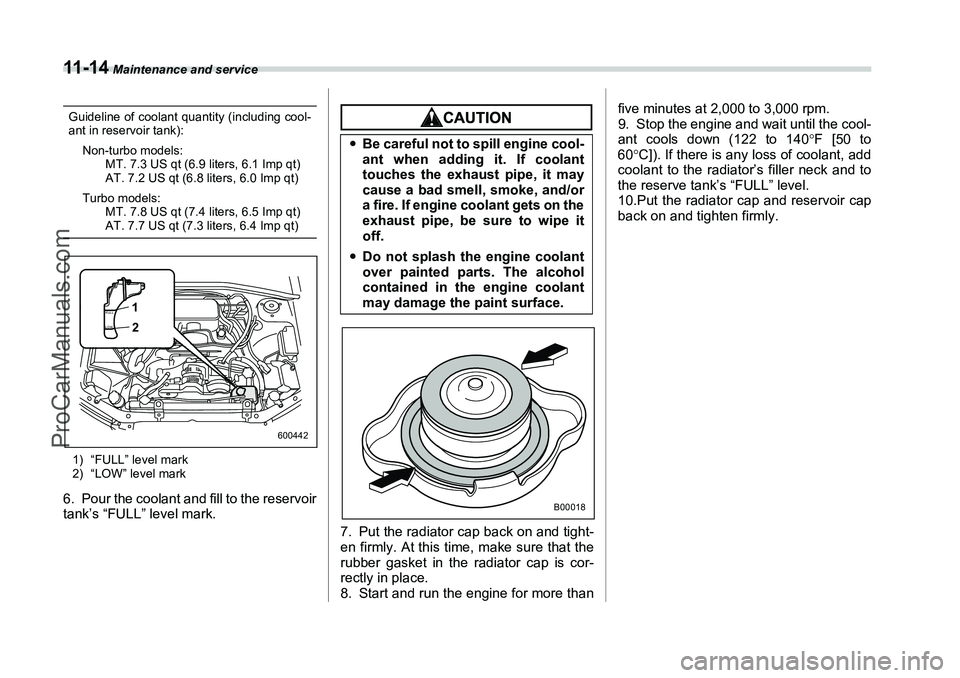
Guideline of coolant quantity (including cool-
ant in reservoir tank):Non-turbo models: MT. 7.3 US qt (6.9 liters, 6.1 Imp qt)
AT. 7.2 US qt (6.8 liters, 6.0 Imp qt)
Turbo models: MT. 7.8 US qt (7.4 liters, 6.5 Imp qt)
AT. 7.7 US qt (7.3 liters, 6.4 Imp qt)
1) “FULL” level mark
2) “LOW” level mark
6. Pour the coolant and fill to the reservoir
tank’s “FULL” level mark.
7. Put the radiator cap back on and tight-
en firmly. At this time, make sure that the
rubber gasket in the radiator cap is cor-
rectly in place.
8. Start and run the engine for more than five minutes at 2,000 to 3,000 rpm.
9. Stop the engine and wait until the cool-
ant cools down (122 to 140
°F [50 to
60° C]). If there is any loss of coolant, add
coolant to the radiator’s filler neck and to
the reserve tank’s “FULL” level.
10.Put the radiator cap and reservoir cap
back on and tighten firmly.
FULL
LOW
1 2
600442
y Be careful not to spill engine cool-
ant when adding it. If coolant
touches the exhaust pipe, it may
cause a bad smell, smoke, and/or
a fire. If engine coolant gets on the
exhaust pipe, be sure to wipe it
off.
y Do not splash the engine coolant
over painted parts. The alcohol
contained in the engine coolant
may damage the paint surface.
B00018
ProCarManuals.com
Page 299 of 355
11 - 2 6
Maintenance and service
„Recommended clutch fluidFMVSS No. 116, fresh DOT 3 or DOT 4brake fluid
Brake boosterIf the brake booster does not operate as
described in the following, have it checked
by your SUBARU dealer.
1. With the engine off, depress the brake
pedal several times, applying the same
pedal force each time. The distance the
pedal travels should not vary.
2. With the brake pedal depressed, start
the engine. The pedal should move slight-
ly down to the floor.
3. With the brake pedal depressed, stop
the engine and keep the pedal depressed
for 30 seconds. The pedal height should
not change.
4. Start the engine again and run for ap-
proximately one minute then turn it off.
Depress the brake pedal several times to
check the brake booster. The brake boost-
er operates properly if the pedal stroke de-
creases with each depression.
Brake pedalCheck the brake pedal free play and re-
serve distance according to the mainte-
nance schedule in the “Warranty and
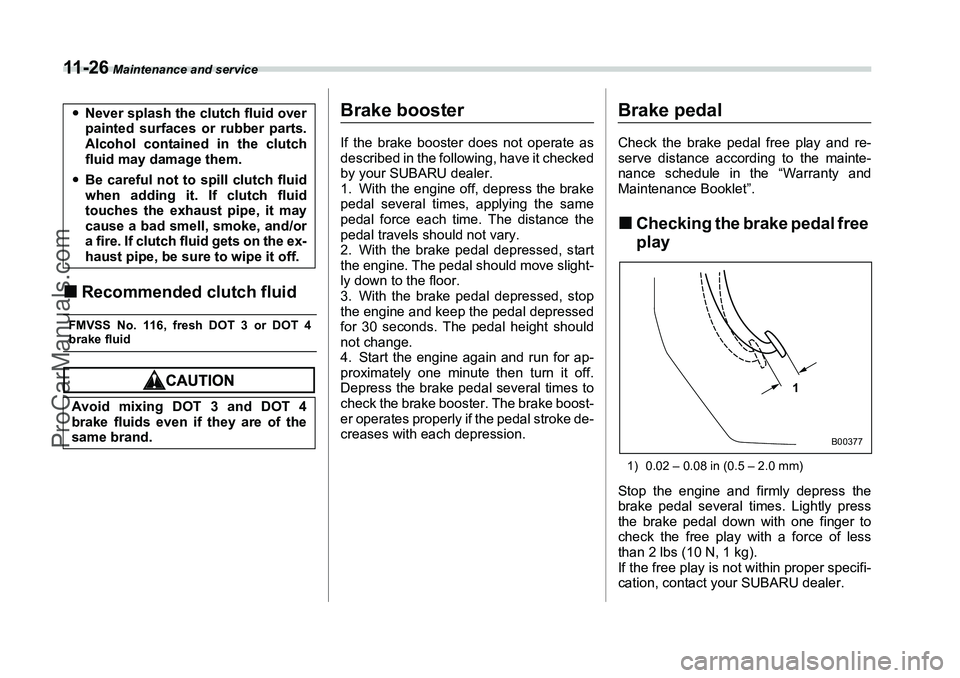
Maintenance Booklet”.„Checking the brake pedal free
play1) 0.02 – 0.08 in (0.5 – 2.0 mm)Stop the engine and firmly depress the
brake pedal several times. Lightly press
the brake pedal down with one finger to
check the free play with a force of less
than 2 lbs (10 N, 1 kg).
If the free play is not within proper specifi-
cation, contact your SUBARU dealer.
y
Never splash the clutch fluid over
painted surfaces or rubber parts.
Alcohol contained in the clutch
fluid may damage them.
y Be careful not to spill clutch fluid
when adding it. If clutch fluid
touches the exhaust pipe, it may
cause a bad smell, smoke, and/or
a fire. If clutch fluid gets on the ex-
haust pipe, be sure to wipe it off.
Avoid mixing DOT 3 and DOT 4
brake fluids even if they are of the
same brand.
1
B00377
ProCarManuals.com
Page 301 of 355
11 - 2 8
Maintenance and service
Hill holder (MT vehicles – if equipped)Ensure that the hill holder operates prop-
erly under the following circumstances:
1. Stop the vehicle on an uphill grade by
depressing the brake pedal and clutch
pedal, with the engine running.
2. Make sure that the vehicle does not
move backward even after the brake ped-
al is released.
3. Then make sure the vehicle starts
climbing the grade by following the normal
starting procedures.
If the hill holder does not operate as de-
scribed above, contact with your SUBARU
dealer.
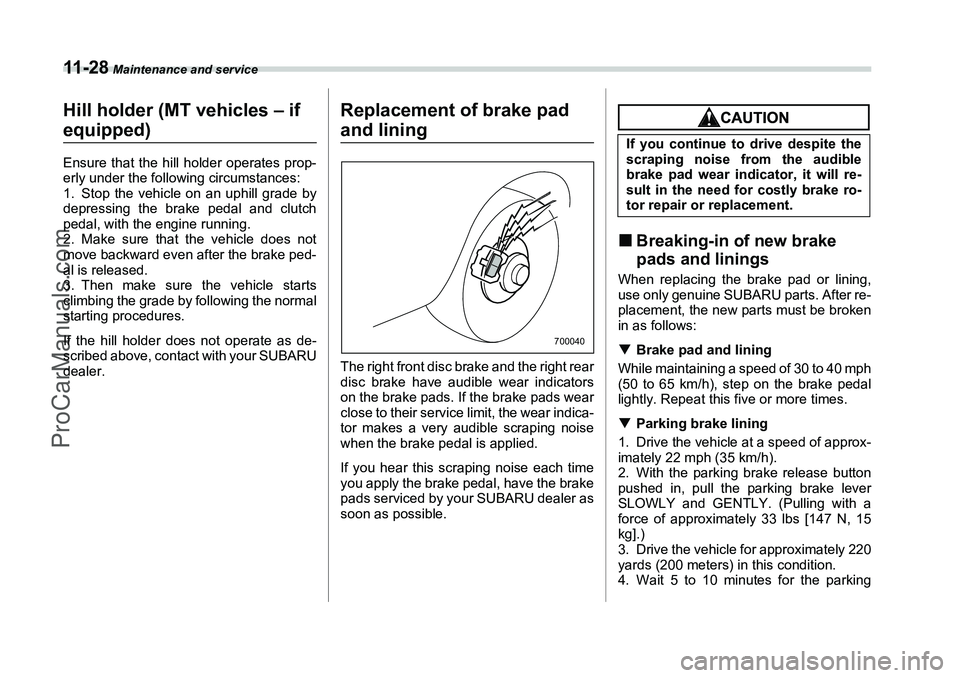
Replacement of brake pad and liningThe right front disc brake and the right rear
disc brake have audible wear indicators
on the brake pads. If the brake pads wear
close to their service limit, the wear indica-
tor makes a very audible scraping noise
when the brake pedal is applied.
If you hear this scraping noise each time
you apply the brake pedal, have the brake
pads serviced by your SUBARU dealer as
soon as possible.
„Breaking-in of new brake
pads and liningsWhen replacing the brake pad or lining,
use only genuine SUBARU parts. After re-
placement, the new parts must be broken
in as follows:
T Brake pad and lining
While maintaining a speed of 30 to 40 mph
(50 to 65 km/h), step on the brake pedal
lightly. Repeat this five or more times.
T Parking brake lining
1. Drive the vehicle at a speed of approx-
imately 22 mph (35 km/h).
2. With the parking brake release button
pushed in, pull the parking brake lever
SLOWLY and GENTLY. (Pulling with a
force of approximately 33 lbs [147 N, 15
kg].)
3. Drive the vehicle for approximately 220
yards (200 meters) in this condition.
4. Wait 5 to 10 minutes for the parking
700040
If you continue to drive despite the
scraping noise from the audible
brake pad wear indicator, it will re-
sult in the need for costly brake ro-
tor repair or replacement.
ProCarManuals.com
Page 348 of 355
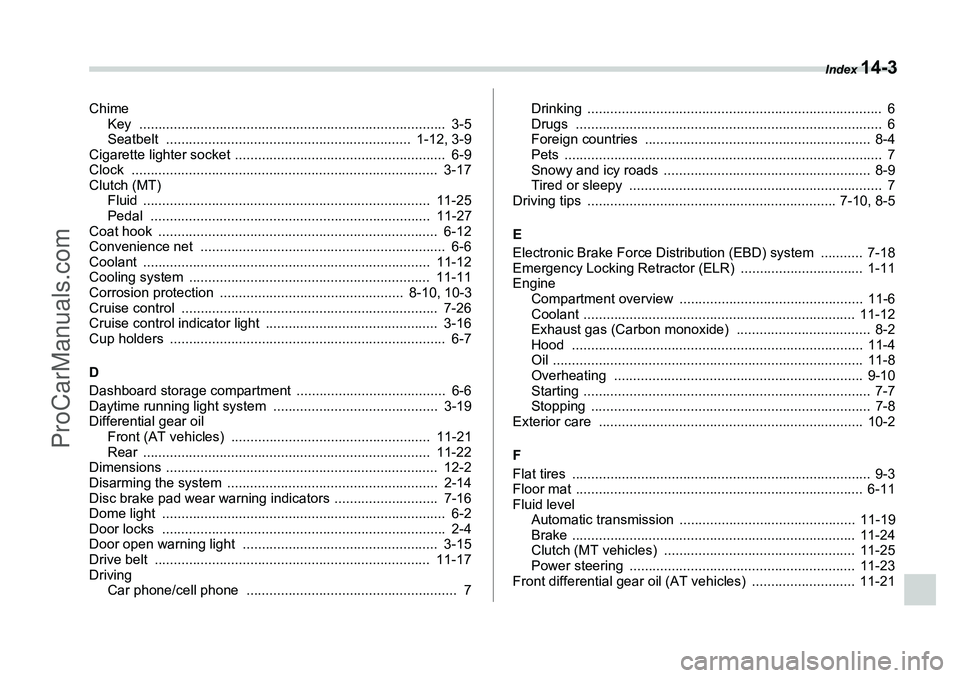
Index
14-3
ChimeKey ................................................................................ 3-5
Seatbelt ................................................................ 1-12, 3-9
Cigarette lighter socket ....................................................... 6-9
Clock ................................................................................ 3-17
Clutch (MT) Fluid ........................................................................... 11-25
Pedal ..................................................................\
....... 11-27
Coat hook ......................................................................... 6-12
Convenience net ................................................................ 6-6
Coolant ........................................................................... 11-12
Cooling system ............................................................... 11-11
Corrosion protection ................................................ 8-10, 10-3
Cruise control ................................................................... 7-26
Cruise control indicator light ............................................. 3-16
Cup holders ........................................................................ 6-7
D
Dashboard storage compartment ....................................... 6-6
Daytime running light system ........................................... 3-19
Differential gear oil
Front (AT vehicles) .................................................... 11-21
Rear ........................................................................... 11-22
Dimensions ....................................................................... 12-2
Disarming the system ....................................................... 2-14
Disc brake pad wear warning indicators ........................... 7-16
Dome light .......................................................................... 6-2
Door locks ........................................................................\
.. 2-4
Door open warning light ................................................... 3-15
Drive belt ........................................................................ 11-17
Driving Car phone/cell phone ....................................................... 7 Drinking ............................................................................. 6
Drugs ................................................................................ 6
Foreign countries ........................................................... 8-4
Pets ................................................................................... 7
Snowy and icy roads ...................................................... 8-9
Tired or sleepy .................................................................. 7
Driving tips ................................................................. 7-10, 8-5
E
Electronic Brake Force Distribution (EBD) system ........... 7-18
Emergency Locking Retractor (ELR) ................................ 1-11
Engine
Compartment overview ................................................ 11-6
Coolant ....................................................................... 11-12
Exhaust gas (Carbon monoxide) ................................... 8-2
Hood ...................................................................\
......... 11-4
Oil ................................................................................. 11-8
Overheating ................................................................. 9-10
Starting ........................................................................... 7-7
Stopping ...............................................................\
.......... 7-8
Exterior care ..................................................................... 10-2
F
Flat tires .............................................................................. 9-3
Floor mat ........................................................................... 6-11
Fluid level
Automatic transmission .............................................. 11-19
Brake .......................................................................... 11-24
Clutch (MT vehicles) .................................................. 11-25
Power steering ........................................................... 11-23
Front differential gear oil (AT vehicles) ........................... 11-21
ProCarManuals.com