phone SUBARU FORESTER 2006 Owners Manual
[x] Cancel search | Manufacturer: SUBARU, Model Year: 2006, Model line: FORESTER, Model: SUBARU FORESTER 2006Pages: 355, PDF Size: 5.49 MB
Page 10 of 355
7
– CONTINUED –
have a medical condition that requires you
to take drugs, please consult with your
doctor.
Never drive if you are under the influence
of any illicit mind-altering drugs. For your
own health and well-being, we urge you
not to take illegal drugs in the first place
and to seek treatment if you are addicted
to those drugs.„Driving when tired or sleepyPlease do not continue to drive but in-
stead find a safe place to rest if you are
tired or sleepy. On long trips, you should
make periodic rest stops to refresh your-
self before continuing on your journey.
When possible, you should share the driv-
ing with others.
„Modification of your vehicle„Car phone/cell phone and
driving„Driving with petsUnrestrained pets can interfere with your
driving and distract your attention from driving. In a collision or sudden stop, unre-
strained pets or cages can be thrown
around inside the vehicle and hurt you or
your passengers. Besides, the pets can
be hurt under these situations. It is also for
their own safety that pets should be prop-
erly restrained in your vehicle. Restrain a
pet with a special traveling harness which
can be secured to the rear seat with a
seatbelt or use a pet carrier which can be
secured to the rear seat by routing a seat-
belt through the carrier’s handle. Never re-
strain pets or pet carriers in the front pas-
senger’s seat. For further information,
consult your veterinarian, local animal
protection society or pet shop.
„
Tire pressuresCheck and, if necessary, adjust the pres-
sure of each tire (including the spare) at
least once a month and before any long
journey.
Check the tire pressure when the tires are
cold. Use a pressure gauge to adjust the
tire pressures to the values shown on the
tire placard.
Refer to the “Tires and wheels” section in
chapter 11 for detailed information.
When you are tired or sleepy, your
reaction will be delayed and your
perception, judgment and attentive-
ness will be impaired. If you drive
when tired or sleepy, your, your pas-
sengers’ and other persons’ chanc-
es of being involved in a serious ac-
cident may increase.
Your vehicle should not be modi-
fied. Modification could affect its
performance, safety or durability,
and may even violate governmental
regulations. In addition, damage or
performance problems resulting
from modification may not be cov-
ered under warranties.
Do not use a car phone/cell phone
while driving; it may distract your at-
tention from driving and can lead to
an accident. If you use a car phone/
cell phone, pull off the road and park
in a safe place before using your
phone. In some States/Provinces,
only hands-free phones may legally
be used while driving.
ProCarManuals.com
Page 81 of 355
1-52
Seat, seatbelt and SRS airbags
of driver’s/driver’s and front passenger’s
SRS frontal airbag(s). If the vehicle strikes
an object, such as a telephone pole or
sign pole, or if it slides under a truck’s load
bed, or if it sustains an oblique offset fron-
tal impact, the driver’s/driver’s and front
passenger’s SRS frontal airbag(s) may
not deploy depending on the level of acci-
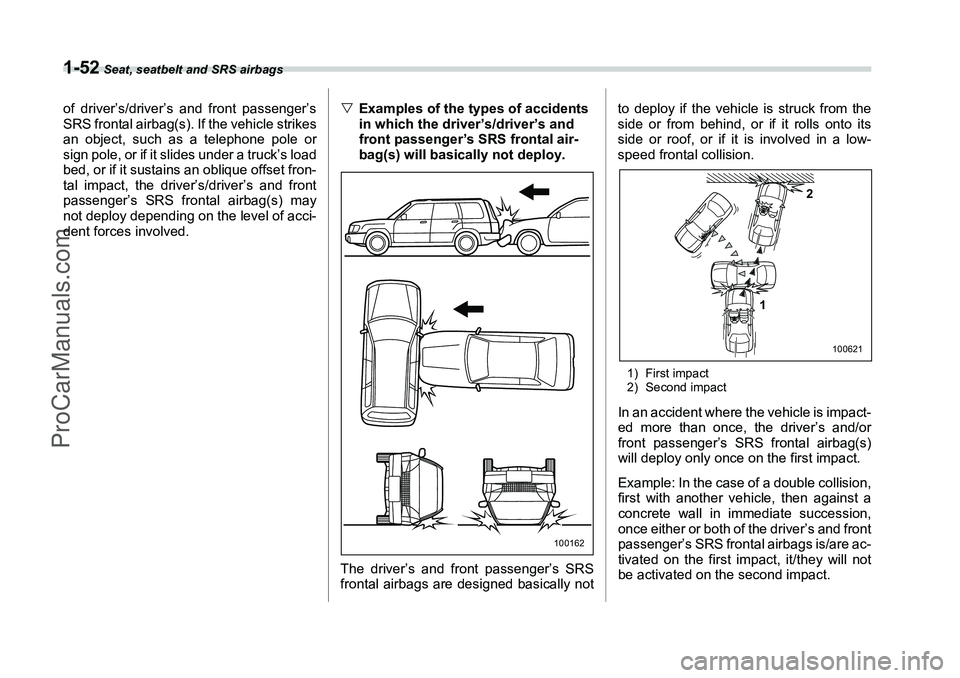
dent forces involved.V
Examples of the types of accidents
in which the driver’s/driver’s and
front passenger’s SRS frontal air-
bag(s) will basically not deploy.
The driver’s and front passenger’s SRS
frontal airbags are designed basically not to deploy if the vehicle is struck from the
side or from behind, or if it rolls onto its
side or roof, or if it is involved in a low-
speed frontal collision.
1) First impact
2) Second impactIn an accident where the vehicle is impact-
ed more than once, the driver’s and/or
front passenger’s SRS frontal airbag(s)
will deploy only once on the first impact.
Example: In the case of a double collision,
first with another vehicle, then against a
concrete wall in immediate succession,
once either or both of the driver’s and front
passenger’s SRS frontal airbags is/are ac-
tivated on the first impact, it/they will not
be activated on the second impact.
100162
2
1
100621
ProCarManuals.com
Page 86 of 355
Seat, seatbelt and SRS airbags
1-57
– CONTINUED –
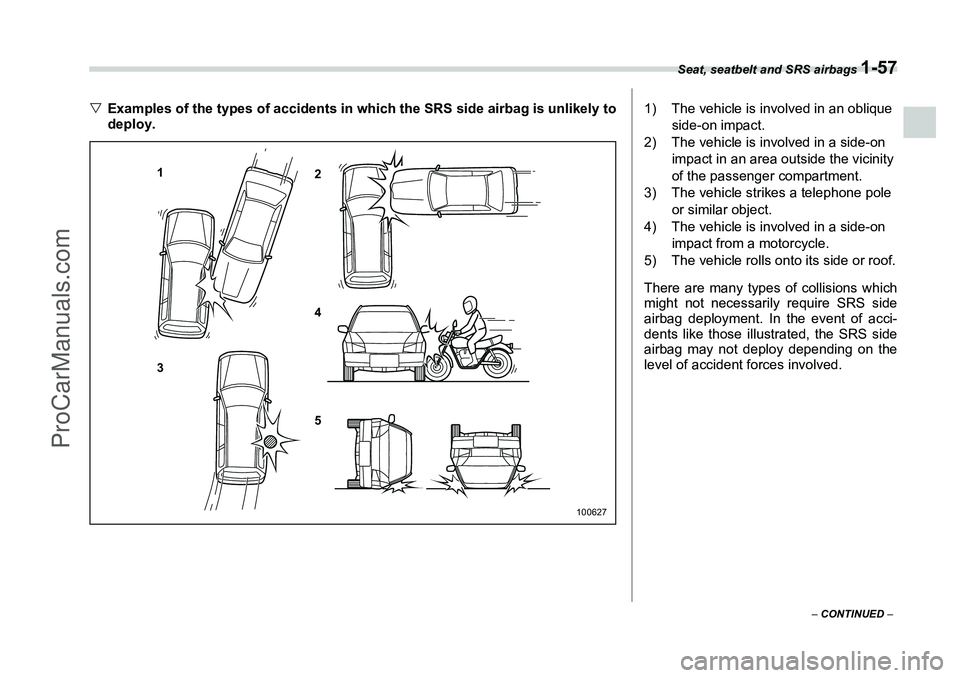
VExamples of the types of accidents in which the SRS side airbag is unlikely to
deploy.
1
3 2
4
5
100627
1) The vehicle is involved in an oblique
side-on impact.
2) The vehicle is involved in a side-on impact in an area outside the vicinity
of the passenger compartment.
3) The vehicle strikes a telephone pole or similar object.
4) The vehicle is involved in a side-on impact from a motorcycle.
5) The vehicle rolls onto its side or roof.
There are many types of collisions which
might not necessarily require SRS side
airbag deployment. In the event of acci-
dents like those illustrated, the SRS side
airbag may not deploy depending on the
level of accident forces involved.
ProCarManuals.com
Page 163 of 355
5-6
Audio
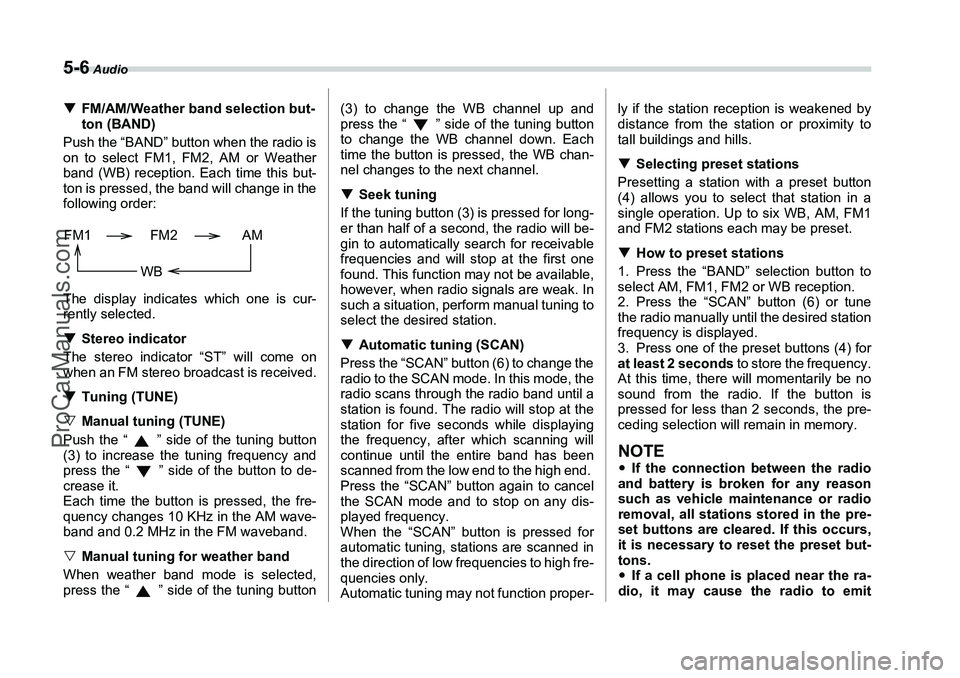
TFM/AM/Weather band selection but-
ton (BAND)
Push the “BAND” button when the radio is
on to select FM1, FM2, AM or Weather
band (WB) reception. Each time this but-
ton is pressed, the band will change in the
following order:
The display indicates which one is cur-
rently selected.
T Stereo indicator
The stereo indicator “ST” will come on
when an FM stereo broadcast is received.
T Tuning (TUNE)
V Manual tuning (TUNE)
Push the “ ” side of the tuning button
(3) to increase the tuning frequency and
press the “ ” side of the button to de-
crease it.
Each time the button is pressed, the fre-
quency changes 10 KHz in the AM wave-
band and 0.2 MHz in the FM waveband.
V Manual tuning for weather band
When weather band mode is selected,
press the “ ” side of the tuning button (3) to change the WB channel up and
press the “ ” side of the tuning button
to change the WB channel down. Each
time the button is pressed, the WB chan-
nel changes to the next channel.
T
Seek tuning
If the tuning button (3) is pressed for long-
er than half of a second, the radio will be-
gin to automatically search for receivable
frequencies and will stop at the first one
found. This function may not be available,
however, when radio signals are weak. In
such a situation, perform manual tuning to
select the desired station.
T Automatic tuning (SCAN)
Press the “SCAN” button (6) to change the
radio to the SCAN mode. In this mode, the
radio scans through the radio band until a
station is found. The radio will stop at the
station for five seconds while displaying
the frequency, after which scanning will
continue until the entire band has been
scanned from the low end to the high end.
Press the “SCAN” button again to cancel
the SCAN mode and to stop on any dis-
played frequency.
When the “SCAN” button is pressed for
automatic tuning, stations are scanned in
the direction of low frequencies to high fre-
quencies only.
Automatic tuning may not function proper- ly if the station reception is weakened by
distance from the station or proximity to
tall buildings and hills.
T
Selecting preset stations
Presetting a station with a preset button
(4) allows you to select that station in a
single operation. Up to six WB, AM, FM1
and FM2 stations each may be preset.
T How to preset stations
1. Press the “BAND” selection button to
select AM, FM1, FM2 or WB reception.
2. Press the “SCAN” button (6) or tune
the radio manually until the desired station
frequency is displayed.
3. Press one of the preset buttons (4) for
at least 2 seconds to store the frequency.
At this time, there will momentarily be no
sound from the radio. If the button is
pressed for less than 2 seconds, the pre-
ceding selection will remain in memory.
NOTEy If the connection between the radio
and battery is broken for any reason
such as vehicle maintenance or radio
removal, all stations stored in the pre-
set buttons are cleared. If this occurs,
it is necessary to reset the preset but-
tons.
y If a cell phone is placed near the ra-
dio, it may cause the radio to emit
FM1 FM2 AM
WB
ProCarManuals.com
Page 172 of 355
Audio
5-15
– CONTINUED –
select the desired station.
TAutomatic tuning (SCAN)
Press the “SCAN” button (1) to change the
radio to the SCAN mode. In this mode, the
radio scans through the radio band until a
station is found. The radio will stop at the
station for five seconds while displaying
the frequency, after which scanning will
continue until the entire band has been
scanned from the low end to the high end.
Press the “SCAN” button again to cancel
the SCAN mode and to stop on any dis-
played frequency.
When the “SCAN” button is pressed for
automatic tuning, stations are scanned in
the direction of low frequencies to high fre-
quencies only.
Automatic tuning may not function proper-
ly if the station reception is weakened by
distance from the station or proximity to
tall buildings and hills.
T Selecting preset stations
Presetting a station with a preset button
(7) allows you to select that station in a
single operation. Up to six AM, FM1, FM2
and WB stations each may be preset.
T How to preset stations
1. Press the “FM/AM” selection button to
select AM, FM1 or FM2 reception.
OR
Press the “WB” button (3) to select the
weather band.
2. Press the “SCAN” button (1) or tune
the radio manually until the desired station
frequency is displayed.
3. Press one of the preset buttons (7) for
at least 1.5 seconds to store the frequen-
cy. The frequency of the station will flash
once on the display at this time.
NOTEy If the connection between the radio
and battery is broken for any reason
such as vehicle maintenance or radio
removal, all stations stored in the pre-
set buttons are cleared. If this occurs,
it is necessary to reset the preset but-
tons.
y If a cell phone is placed near the ra-
dio, it may cause the radio to emit
noise when it receives calls. This noise
does not indicate a radio fault.
ProCarManuals.com
Page 188 of 355
Interior equipment
6-9
– CONTINUED –
NOTEWhen the lid of the center console is
closed, an opening remains between
the center console and the lid to allow
the power outlet in the center console
to be used. Pass the electrical appli-
ance’s cord through this opening.
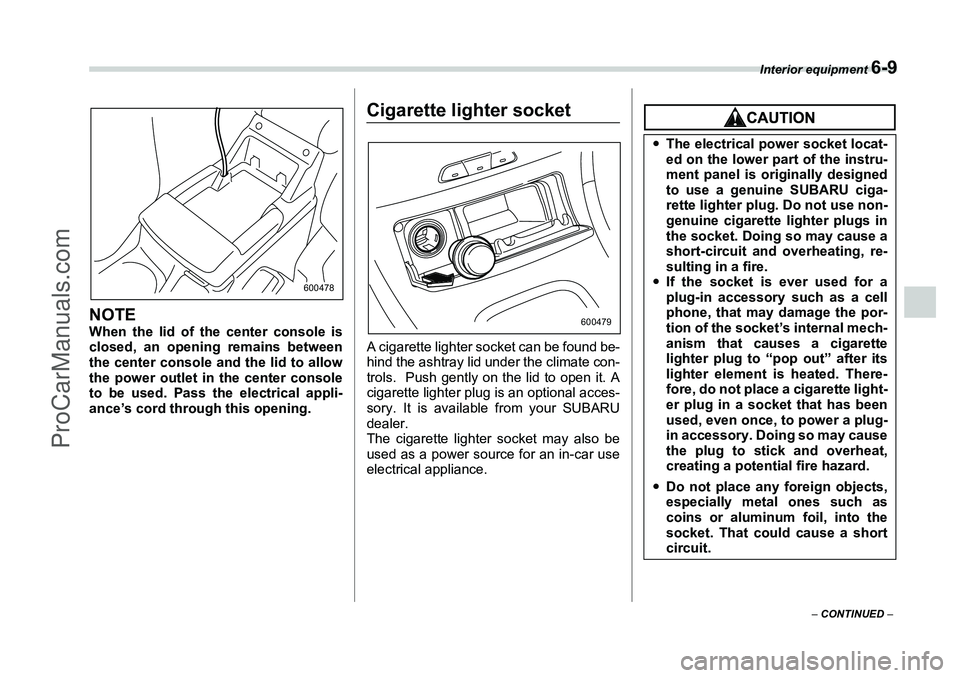
Cigarette lighter socketA cigarette lighter socket can be found be-
hind the ashtray lid under the climate con-
trols. Push gently on the lid to open it. A
cigarette lighter plug is an optional acces-
sory. It is available from your SUBARU
dealer.
The cigarette lighter socket may also be
used as a power source for an in-car use
electrical appliance.
600478
600479
yThe electrical power socket locat-
ed on the lower part of the instru-
ment panel is originally designed
to use a genuine SUBARU ciga-
rette lighter plug. Do not use non-
genuine cigarette lighter plugs in
the socket. Doing so may cause a
short-circuit and overheating, re-
sulting in a fire.
y If the socket is ever used for a
plug-in accessory such as a cell
phone, that may damage the por-
tion of the socket’s internal mech-
anism that causes a cigarette
lighter plug to “pop out” after its
lighter element is heated. There-
fore, do not place a cigarette light-
er plug in a socket that has been
used, even once, to power a plug-
in accessory. Doing so may cause
the plug to stick and overheat,
creating a potential fire hazard.
y Do not place any foreign objects,
especially metal ones such as
coins or aluminum foil, into the
socket. That could cause a short
circuit.
ProCarManuals.com
Page 231 of 355
8-6
Driving tips
Off road drivingBecause of the AWD feature and higher
ground clearance, your SUBARU can be
driven on ordinary roads or off-road. But
please keep in mind that an AWD
SUBARU is a passenger car and is nei-
ther a conventional off-road vehicle nor an
all-terrain vehicle. If you do take your
SUBARU off-road, certain common sense
precautions such as the following should
be taken:
yMake certain that you and all of your
passengers are wearing seatbelts.
y Carry some emergency equipment,
such as a towing rope or chain, a shovel,
wheel blocks, first aid kit and cell phone or
citizens band radio.
y Drive carefully. Do not take unneces-
sary risks by driving in dangerous areas or
over rough terrain.
y Slow down and employ extra caution at
all times. When driving off-road, you will
not have the benefit of marked traffic
lanes, banked curves, traffic signs and the
like.
y Do not drive across steep slopes. In-
stead, drive either straight up or straight
down the slopes. A vehicle can much
more easily tip over sideways than it can
end over end. Avoid driving straight up or down slopes that are too steep.
y
Avoid sharp turning maneuvers, espe-
cially at higher speeds.
y Do not grip the inside or spokes of the
steering wheel. A bad bump could jerk the
wheel and injure your hands. Instead drive
with your fingers and thumbs on the out-
side of the rim.
y If driving through water, such as when
crossing shallow streams, first check the
depth of the water and the bottom of the
stream bed for firmness and ensure that
the bed of the stream is flat. Drive slowly
and completely through the stream. The
water should be shallow enough that it
does not reach the vehicle’s undercar-
riage. Water entering the engine air intake
or the exhaust pipe or water splashing
onto electrical parts may damage your ve-
hicle and may cause it to stall. Never at-
tempt to drive through rushing water; re-
gardless of its depth, it can wash away the
ground from under your tires, resulting in
possible loss of traction and even vehicle
rollover.
y Always check your brakes for effective-
ness immediately after driving in sand,
mud or water. Do this by driving slowly
and stepping on the brake pedal. Repeat
that process several times to dry out the
brake discs and brake pads.
y Do not drive or park over or near flam- mable materials such as dry grass or fall-
en leaves, as they may burn easily. The
exhaust system is very hot while the en-
gine is running and right after the engine
stops. This could create a fire hazard.
y
After driving through tall grass, mud,
rocks, sand, rivers, etc., check that there
is no grass, bush, paper, rags, stones,
sand, etc. adhering to or trapped on the
underbody. Clear off any such matter from
the underbody. If the vehicle is used with
these materials trapped or adhering to the
underbody, a mechanical breakdown or
fire could occur.
y Secure all cargo carried inside the vehi-
cle and make certain that it is not piled
higher than the seatbacks. During sudden
stops or jolts, unsecured cargo could be
thrown around in the vehicle and cause in-
jury. Do not pile heavy loads on the roof.
Those loads raise the vehicle’s center of
gravity and make it more prone to tip over.
y If you must rock the vehicle to free it
from sand or mud, depress the accelera-
tor pedal slightly and move the selector le-
ver back and forth between “D” and “R” re-
peatedly. Do not race the engine. For the
best possible traction, avoid spinning the
wheels when trying to free the vehicle.
When the road surface is extremely slip-
pery, you can obtain better traction by
starting the vehicle with the transmission
ProCarManuals.com
Page 348 of 355
Index
14-3
ChimeKey ................................................................................ 3-5
Seatbelt ................................................................ 1-12, 3-9
Cigarette lighter socket ....................................................... 6-9
Clock ................................................................................ 3-17
Clutch (MT) Fluid ........................................................................... 11-25
Pedal ..................................................................\
....... 11-27
Coat hook ......................................................................... 6-12
Convenience net ................................................................ 6-6
Coolant ........................................................................... 11-12
Cooling system ............................................................... 11-11
Corrosion protection ................................................ 8-10, 10-3
Cruise control ................................................................... 7-26
Cruise control indicator light ............................................. 3-16
Cup holders ........................................................................ 6-7
D
Dashboard storage compartment ....................................... 6-6
Daytime running light system ........................................... 3-19
Differential gear oil
Front (AT vehicles) .................................................... 11-21
Rear ........................................................................... 11-22
Dimensions ....................................................................... 12-2
Disarming the system ....................................................... 2-14
Disc brake pad wear warning indicators ........................... 7-16
Dome light .......................................................................... 6-2
Door locks ........................................................................\
.. 2-4
Door open warning light ................................................... 3-15
Drive belt ........................................................................ 11-17
Driving Car phone/cell phone ....................................................... 7 Drinking ............................................................................. 6
Drugs ................................................................................ 6
Foreign countries ........................................................... 8-4
Pets ................................................................................... 7
Snowy and icy roads ...................................................... 8-9
Tired or sleepy .................................................................. 7
Driving tips ................................................................. 7-10, 8-5
E
Electronic Brake Force Distribution (EBD) system ........... 7-18
Emergency Locking Retractor (ELR) ................................ 1-11
Engine
Compartment overview ................................................ 11-6
Coolant ....................................................................... 11-12
Exhaust gas (Carbon monoxide) ................................... 8-2
Hood ...................................................................\
......... 11-4
Oil ................................................................................. 11-8
Overheating ................................................................. 9-10
Starting ........................................................................... 7-7
Stopping ...............................................................\
.......... 7-8
Exterior care ..................................................................... 10-2
F
Flat tires .............................................................................. 9-3
Floor mat ........................................................................... 6-11
Fluid level
Automatic transmission .............................................. 11-19
Brake .......................................................................... 11-24
Clutch (MT vehicles) .................................................. 11-25
Power steering ........................................................... 11-23
Front differential gear oil (AT vehicles) ........................... 11-21
ProCarManuals.com