recommended oil SUBARU FORESTER 2006 Owners Manual
[x] Cancel search | Manufacturer: SUBARU, Model Year: 2006, Model line: FORESTER, Model: SUBARU FORESTER 2006Pages: 355, PDF Size: 5.49 MB
Page 100 of 355
Keys and doors
2-9
– CONTINUED –
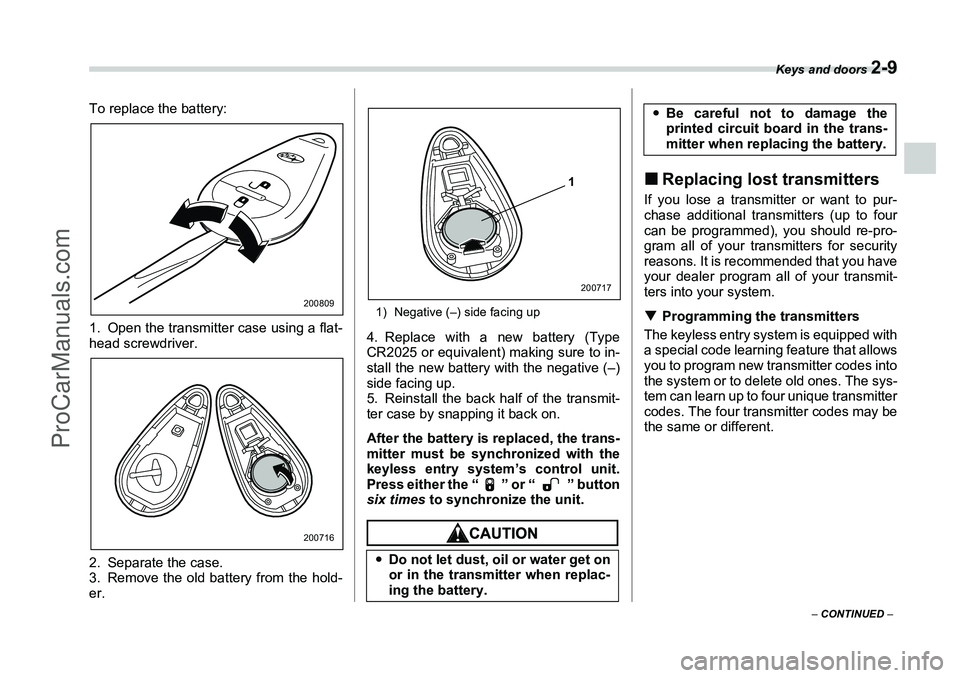
To replace the battery:
0
1. Open the transmitter case using a flat-
head screwdriver.
2. Separate the case.
3. Remove the old battery from the hold-
er.
1) Negative (–) side facing up4. Replace with a new battery (Type
CR2025 or equivalent) making sure to in-
stall the new battery with the negative (–)
side facing up.
5. Reinstall the back half of the transmit-
ter case by snapping it back on.
After the battery is replaced, the trans-
mitter must be synchronized with the
keyless entry system’s control unit.
Press either the “ ” or “ ” button
six times to synchronize the unit.
„Replacing lost transmittersIf you lose a transmitter or want to pur-
chase additional transmitters (up to four
can be programmed), you should re-pro-
gram all of your transmitters for security
reasons. It is recommended that you have
your dealer program all of your transmit-
ters into your system.
T Programming the transmitters
The keyless entry system is equipped with
a special code learning feature that allows
you to program new transmitter codes into
the system or to delete old ones. The sys-
tem can learn up to four unique transmitter
codes. The four transmitter codes may be
the same or different.
200809200716
y Do not let dust, oil or water get on
or in the transmitter when replac-
ing the battery.
1200717
yBe careful not to damage the
printed circuit board in the trans-
mitter when replacing the battery.
ProCarManuals.com
Page 155 of 355
4-12
Climate control
low outside air to circulate into the heated
interior. This results in quicker cooling by
the air conditioner. Keep the windows
closed during the operation of the air con-
ditioner for maximum cooling efficiency.„Lubrication oil circulation in
the refrigerant circuitOperate the air conditioner compressor at
a low engine speed (at idle or low driving
speeds) a few minutes each month during
the off-season to circulate its oil.„Checking air conditioning
system before summer sea-
sonCheck the air conditioner unit for refriger-
ant leaks, hose conditions, and proper op-
eration each spring. This check is best
performed by your SUBARU dealer.„Cooling and dehumidifying in
high humidity and low tem-
perature weather conditionsUnder certain weather conditions (high
relative humidity, low temperatures, etc.)
a small amount of water vapor emission
from the air outlets may be noticed. This
condition is normal and does not indicate any problem with the air conditioning sys-
tem.
„
Air conditioner compressor
shut-off when engine is
heavily loadedTo improve acceleration and gas mileage,
the air conditioner compressor is de-
signed to temporarily shut off during air
conditioner operation whenever the accel-
erator is fully depressed such as during
rapid acceleration or when driving on a
steep upgrade.„Refrigerant for your climate
control systemYour air conditioner uses ozone friendly
refrigerant HFC134a. Therefore, the
method of adding, changing or checking
the refrigerant is different from the method
for CFC12 (freon). Consult your SUBARU
dealer for service. Repairs needed as a
result of using the wrong refrigerant are
not covered under warranty.
Air filtration system (if equipped)If your vehicle’s air conditioning system is
equipped with an air filtration system, re-
place the filter element according to the
replacement schedule shown in the fol-
lowing. This schedule should be followed
to maintain the filter’s dust collection abili-
ty. Under extremely dusty conditions, the
filter should be replaced more frequently.
It is recommended that you have your fil-
ter checked or replaced by your SUBARU
dealer. For replacement, use only a genu-
ine SUBARU air filter kit.Replacement schedule:
Every 12 months or 7,500 miles (12,000
km) whichever comes first
ProCarManuals.com
Page 274 of 355
11
Maintenance and service
Maintenance schedule ....................................... 11-3
Maintenance precautions .................................. 11-3
Before checking or servicing in the engine compartment ........................................................ 11-4
When you do checking or servicing in the
engine compartment while the engine is
running ................................................................\
.. 11-4
Engine hood ....................................................... 11-4
Engine compartment overview ......................... 11-6
Non-turbo models ................................................... 11-6
Turbo models .......................................................... 11-7
Engine oil ............................................................ 11-8
Checking the oil level ............................................. 11-8
Changing the oil and oil filter ................................ 11-8
Recommended grade and viscosity ..................... 11-10
Recommended grade and viscosity under severe driving conditions .................................... 11-11
Synthetic oil ............................................................ 11-11
Cooling system .................................................. 11-11
Cooling fan, hose and connections ...................... 11-12
Engine coolant ........................................................ 11-12
Air cleaner element ............................................ 11-15
Replacing the air cleaner element ......................... 11-15
Spark plugs ......................................................... 11-17
Recommended spark plugs ................................... 11-17
Drive belts ........................................................... 11-17
Manual transmission oil .................................... 11-18
Checking the oil level ............................................. 11-18 Recommended grade and viscosity ..................... 11-19
Automatic transmission fluid ............................ 11-19
Checking the fluid level .......................................... 11-19
Recommended fluid ............................................... 11-20
Front differential gear oil (AT vehicles) ............ 11-21
Checking the oil level ............................................. 11-21
Recommended grade and viscosity ..................... 11-21
Rear differential gear oil .................................... 11-22
Checking the gear oil level .................................... 11-22
Recommended grade and viscosity ..................... 11-22
Power steering fluid ........................................... 11-23
Checking the fluid level .......................................... 11-23
Recommended fluid ............................................... 11-24
Brake fluid ........................................................... 11-24
Checking the fluid level .......................................... 11-24
Recommended brake fluid ..................................... 11-25
Clutch fluid (MT vehicles) .................................. 11-25
Checking the fluid level .......................................... 11-25
Recommended clutch fluid .................................... 11-26
Brake booster ..................................................... 11-26
Brake pedal ......................................................... 11-26
Checking the brake pedal free play ...................... 11-26
Checking the brake pedal reserve distance ......... 11-27
Clutch pedal (MT vehicles) ................................ 11-27
Checking the clutch function ................................ 11-27
Checking the clutch pedal free play ..................... 11-27
Hill holder (MT vehicles – if equipped) ............. 11-28
ProCarManuals.com
Page 283 of 355
11 - 1 0
Maintenance and service
The oil quantity indicated above is only a
guideline. The necessary quantity of oil
depends on the quantity of oil that has
been drained. The quantity of drained oil
differs slightly depending on the tempera-
ture of the oil and the time the oil is left
flowing out. After pouring oil into the en-
gine, therefore, you must use the dipstick
to confirm that the level is correct.
13.Start the engine and make sure that no
oil leaks appear around the filter’s rubber
seal.
14.Run the engine until it reaches the nor-
mal operating temperature. Then stop the
engine and wait a few minutes to allow the
oil drain back. Check the oil level again
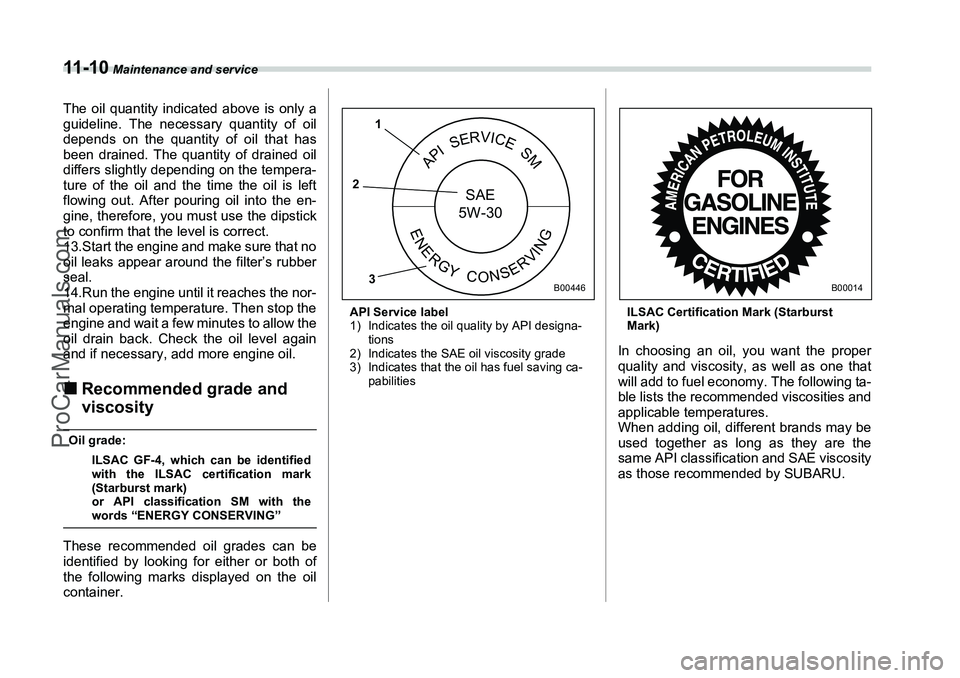
and if necessary, add more engine oil.„Recommended grade and
viscosityOil grade:
ILSAC GF-4, which can be identified
with the ILSAC certification mark
(Starburst mark)
or API classification SM with the
words “ENERGY CONSERVING”
These recommended oil grades can be
identified by looking for either or both of
the following marks displayed on the oil
container.
API Service label
1) Indicates the oil quality by API designa-tions
2) Indicates the SAE oil viscosity grade
3) Indicates that the oil has fuel saving ca- pabilities ILSAC Certification Mark (Starburst
Mark)
In choosing an oil, you want the proper
quality and viscosity, as well as one that
will add to fuel economy. The following ta-
ble lists the recommended viscosities and
applicable temperatures.
When adding oil, different brands may be
used together as long as they are the
same API classification and SAE viscosity
as those recommended by SUBARU.
APISERVICESM
ENERGY
CONSERVING
SAE
5W-30
1
2
3
B00446
B00014
ProCarManuals.com
Page 284 of 355
Maintenance and service
11 - 11
– CONTINUED –
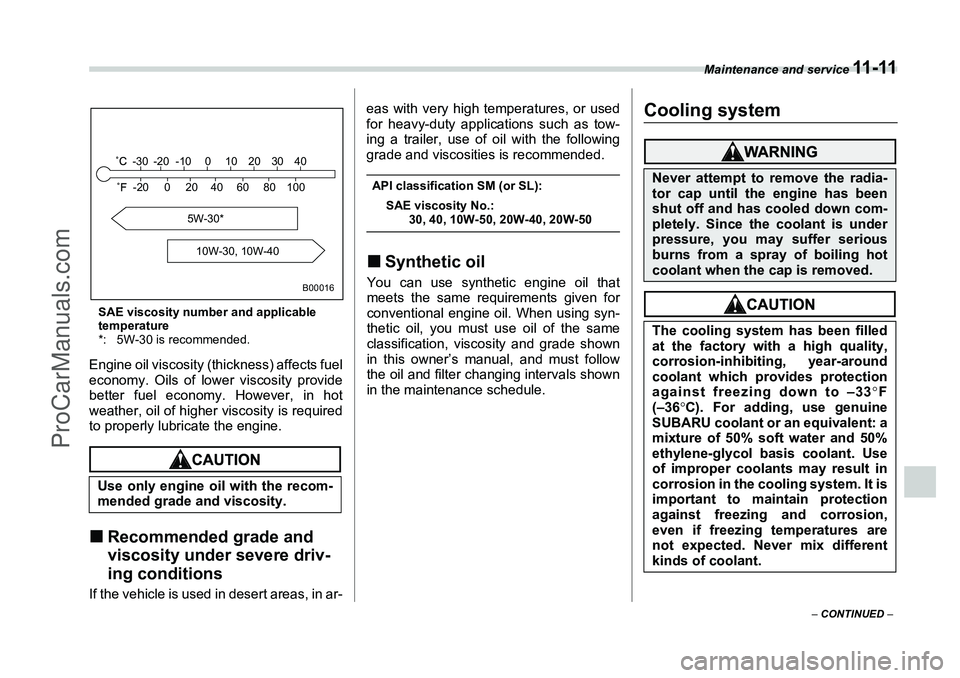
SAE viscosity number and applicable
temperature
*: 5W-30 is recommended.Engine oil viscosity (thickness) affects fuel
economy. Oils of lower viscosity provide
better fuel economy. However, in hot
weather, oil of higher viscosity is required
to properly lubricate the engine.„Recommended grade and
viscosity under severe driv-
ing conditionsIf the vehicle is used in desert areas, in ar- eas with very high temperatures, or used
for heavy-duty applications such as tow-
ing a trailer, use of oil with the following
grade and viscosities is recommended.
API classification SM (or SL):
SAE viscosity No.:
30, 40, 10W-50, 20W-40, 20W-50
„Synthetic oilYou can use synthetic engine oil that
meets the same requirements given for
conventional engine oil. When using syn-
thetic oil, you must use oil of the same
classification, viscosity and grade shown
in this owner’s manual, and must follow
the oil and filter changing intervals shown
in the maintenance schedule.
Cooling system
Use only engine oil with the recom-
mended grade and viscosity.
5W-30*
10W-30, 10W-40
-30 -20 -10 0 10 20 30 40
-20 0 60 20 80 10040
B00016
Never attempt to remove the radia-
tor cap until the engine has been
shut off and has cooled down com-
pletely. Since the coolant is under
pressure, you may suffer serious
burns from a spray of boiling hot
coolant when the cap is removed.
The cooling system has been filled
at the factory with a high quality,
corrosion-inhibiting, year-around
coolant which provides protection
against freezing down to –33 °F
(–36 °C). For adding, use genuine
SUBARU coolant or an equivalent: a
mixture of 50% soft water and 50%
ethylene-glycol basis coolant. Use
of improper coolants may result in
corrosion in the cooling system. It is
important to maintain protection
against freezing and corrosion,
even if freezing temperatures are
not expected. Never mix different
kinds of coolant.
ProCarManuals.com
Page 292 of 355
Maintenance and service
11 - 1 9
– CONTINUED –
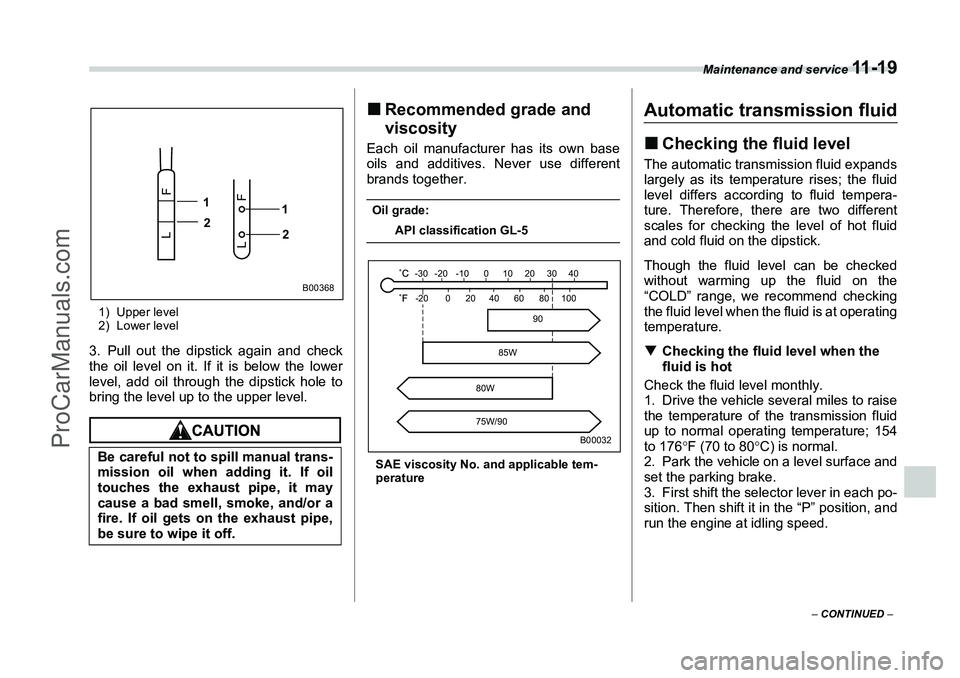
1) Upper level
2) Lower level3. Pull out the dipstick again and check
the oil level on it. If it is below the lower
level, add oil through the dipstick hole to
bring the level up to the upper level.
„Recommended grade and
viscosityEach oil manufacturer has its own base
oils and additives. Never use different
brands together.Oil grade:
API classification GL-5
SAE viscosity No. and applicable tem-
perature
Automatic transmission fluid„ Checking the fluid levelThe automatic transmission fluid expands
largely as its temperature rises; the fluid
level differs according to fluid tempera-
ture. Therefore, there are two different
scales for checking the level of hot fluid
and cold fluid on the dipstick.
Though the fluid level can be checked
without warming up the fluid on the
“COLD” range, we recommend checking
the fluid level when the fluid is at operating
temperature.
T Checking the fluid level when the
fluid is hot
Check the fluid level monthly.
1. Drive the vehicle several miles to raise
the temperature of the transmission fluid
up to normal operating temperature; 154
to 176 °F (70 to 80 °C) is normal.
2. Park the vehicle on a level surface and
set the parking brake.
3. First shift the selector lever in each po-
sition. Then shift it in the “P” position, and
run the engine at idling speed.
Be careful not to spill manual trans-
mission oil when adding it. If oil
touches the exhaust pipe, it may
cause a bad smell, smoke, and/or a
fire. If oil gets on the exhaust pipe,
be sure to wipe it off.
L
F
FL
1
2 1
2
B00368
-30 -20 -10 0 10 20 30 40
-20 0 60 20
80W
75W/90 80 100
40
85W 90
B00032
ProCarManuals.com
Page 293 of 355
11 - 2 0
Maintenance and service
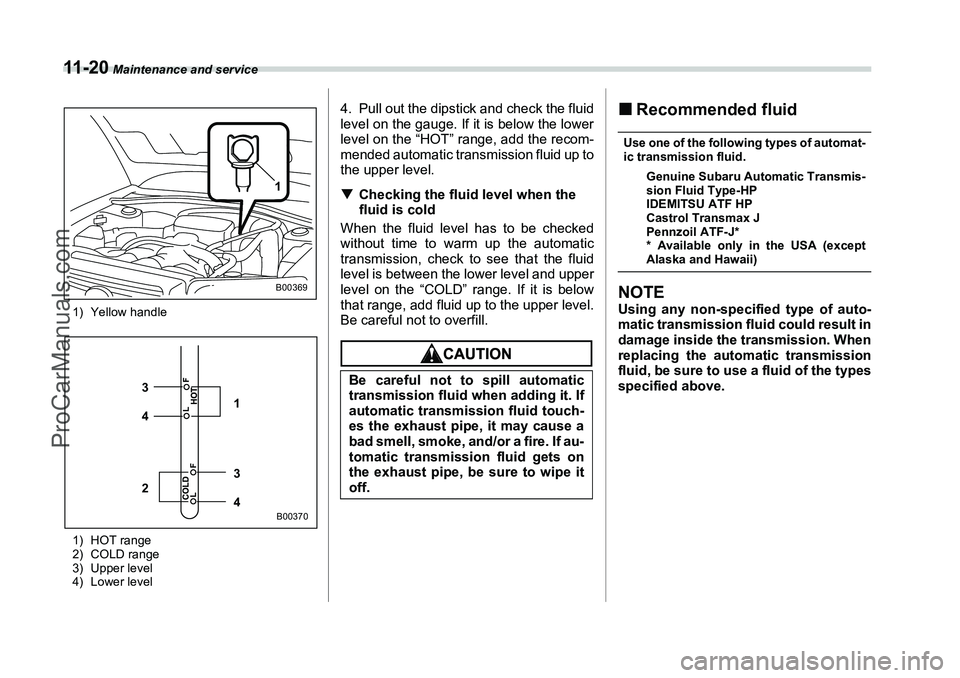
1) Yellow handle
1) HOT range
2) COLD range
3) Upper level
4) Lower level
4. Pull out the dipstick and check the fluid
level on the gauge. If it is below the lower
level on the “HOT” range, add the recom-
mended automatic transmission fluid up to
the upper level.
TChecking the fluid level when the
fluid is cold
When the fluid level has to be checked
without time to warm up the automatic
transmission, check to see that the fluid
level is between the lower level and upper
level on the “COLD” range. If it is below
that range, add fluid up to the upper level.
Be careful not to overfill.
„ Recommended fluidUse one of the following types of automat-
ic transmission fluid.
Genuine Subaru Automatic Transmis-
sion Fluid Type-HP
IDEMITSU ATF HP
Castrol Transmax J
Pennzoil ATF-J*
* Available only in the USA (except
Alaska and Hawaii)
NOTEUsing any non-specified type of auto-
matic transmission fluid could result in
damage inside the transmission. When
replacing the automatic transmission
fluid, be sure to use a fluid of the types
specified above.
1B00369
3
4
3
4
2
1
B00370
Be careful not to spill automatic
transmission fluid when adding it. If
automatic transmission fluid touch-
es the exhaust pipe, it may cause a
bad smell, smoke, and/or a fire. If au-
tomatic transmission fluid gets on
the exhaust pipe, be sure to wipe it
off.
ProCarManuals.com
Page 294 of 355
Maintenance and service
11 - 2 1
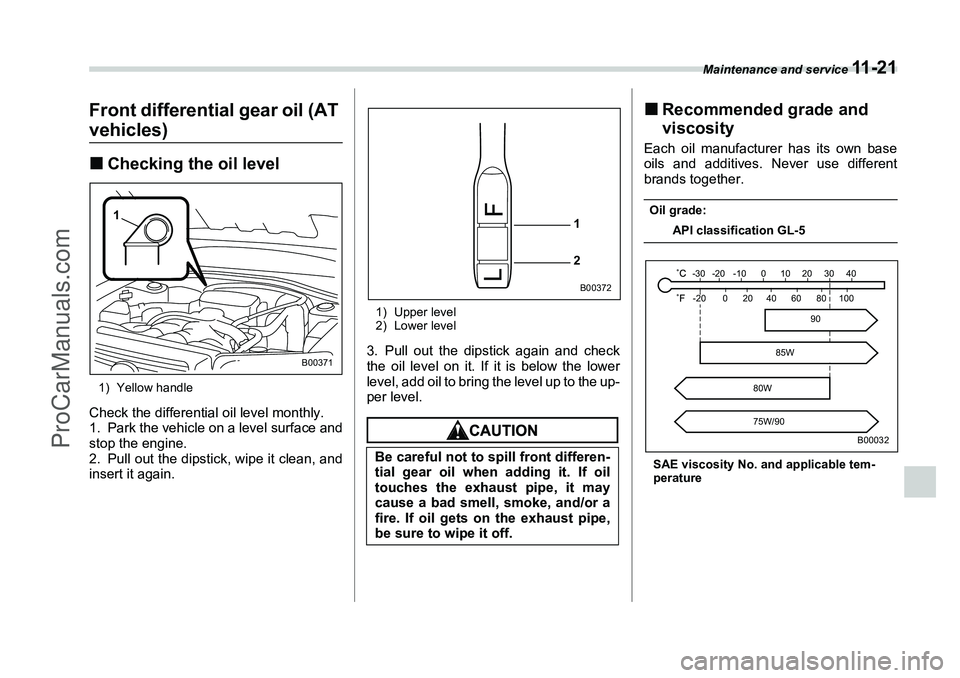
Front differential gear oil (AT vehicles)„Checking the oil level1) Yellow handleCheck the differential oil level monthly.
1. Park the vehicle on a level surface and
stop the engine.
2. Pull out the dipstick, wipe it clean, and
insert it again.
1) Upper level
2) Lower level3. Pull out the dipstick again and check
the oil level on it. If it is below the lower
level, add oil to bring the level up to the up-
per level.
„Recommended grade and
viscosityEach oil manufacturer has its own base
oils and additives. Never use different
brands together.Oil grade:
API classification GL-5
SAE viscosity No. and applicable tem-
perature
1
B00371
Be careful not to spill front differen-
tial gear oil when adding it. If oil
touches the exhaust pipe, it may
cause a bad smell, smoke, and/or a
fire. If oil gets on the exhaust pipe,
be sure to wipe it off.
1
2B00372
-30 -20 -10 0 10 20 30 40 -20 0 60 20
80W
75W/90 80 100
40
85W 90
B00032
ProCarManuals.com
Page 295 of 355
11 - 2 2
Maintenance and service
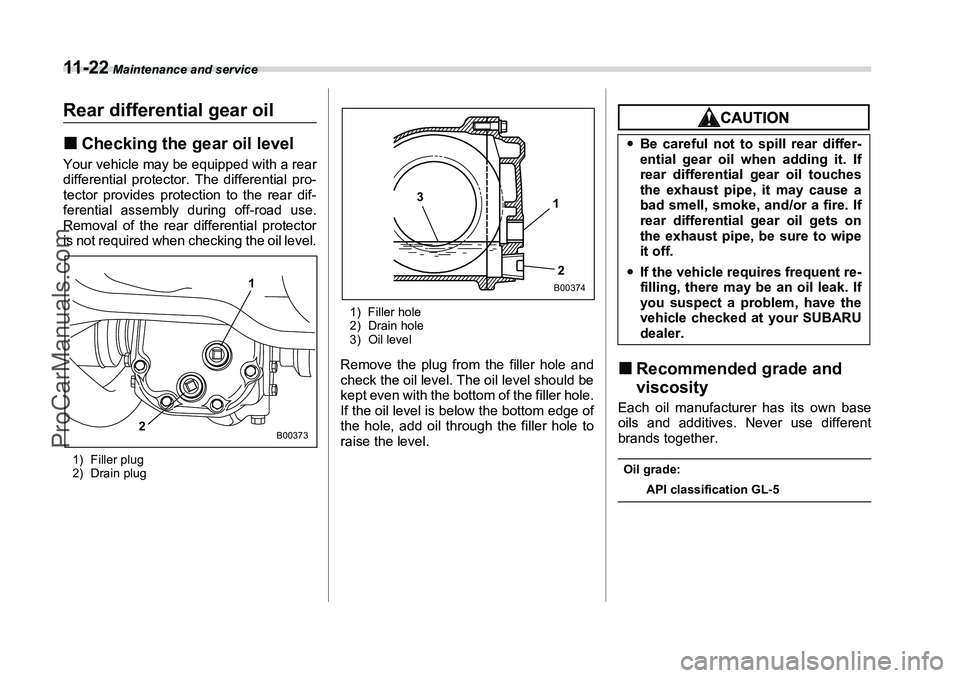
Rear differential gear oil„Checking the gear oil levelYour vehicle may be equipped with a rear
differential protector. The differential pro-
tector provides protection to the rear dif-
ferential assembly during off-road use.
Removal of the rear differential protector
is not required when checking the oil level.1) Filler plug
2) Drain plug 1) Filler hole
2) Drain hole
3) Oil level
Remove the plug from the filler hole and
check the oil level. The oil level should be
kept even with the bottom of the filler hole.
If the oil level is below the bottom edge of
the hole, add oil through the filler hole to
raise the level.
„
Recommended grade and
viscosityEach oil manufacturer has its own base
oils and additives. Never use different
brands together.Oil grade:
API classification GL-5
2 1
B00373
3
1
2
B00374
y Be careful not to spill rear differ-
ential gear oil when adding it. If
rear differential gear oil touches
the exhaust pipe, it may cause a
bad smell, smoke, and/or a fire. If
rear differential gear oil gets on
the exhaust pipe, be sure to wipe
it off.
y If the vehicle requires frequent re-
filling, there may be an oil leak. If
you suspect a problem, have the
vehicle checked at your SUBARU
dealer.
ProCarManuals.com
Page 296 of 355
Maintenance and service
11 - 2 3
– CONTINUED –
SAE viscosity No. and applicable tem-
perature
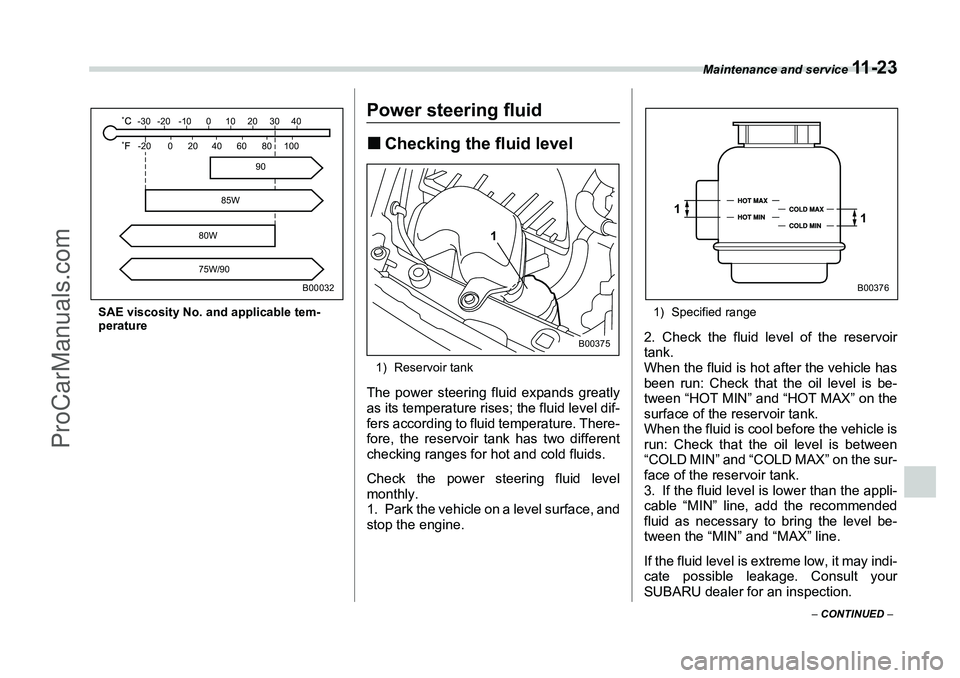
Power steering fluid„Checking the fluid level1) Reservoir tankThe power steering fluid expands greatly
as its temperature rises; the fluid level dif-
fers according to fluid temperature. There-
fore, the reservoir tank has two different
checking ranges for hot and cold fluids.
Check the power steering fluid level
monthly.
1. Park the vehicle on a level surface, and
stop the engine.
1) Specified range2. Check the fluid level of the reservoir
tank.
When the fluid is hot after the vehicle has
been run: Check that the oil level is be-
tween “HOT MIN” and “HOT MAX” on the
surface of the reservoir tank.
When the fluid is cool before the vehicle is
run: Check that the oil level is between
“COLD MIN” and “COLD MAX” on the sur-
face of the reservoir tank.
3. If the fluid level is lower than the appli-
cable “MIN” line, add the recommended
fluid as necessary to bring the level be-
tween the “MIN” and “MAX” line.
If the fluid level is extreme low, it may indi-
cate possible leakage. Consult your
SUBARU dealer for an inspection.
-30 -20 -10 0 10 20 30 40
-20 0 60 20
80W
75W/90 80 100
40
85W 90
B00032
1
B00375
1
1
B00376
ProCarManuals.com