light SUBARU FORESTER 2007 SG / 2.G Owners Manual
[x] Cancel search | Manufacturer: SUBARU, Model Year: 2007, Model line: FORESTER, Model: SUBARU FORESTER 2007 SG / 2.GPages: 356, PDF Size: 5.89 MB
Page 277 of 356
Maintenance and service 11-5
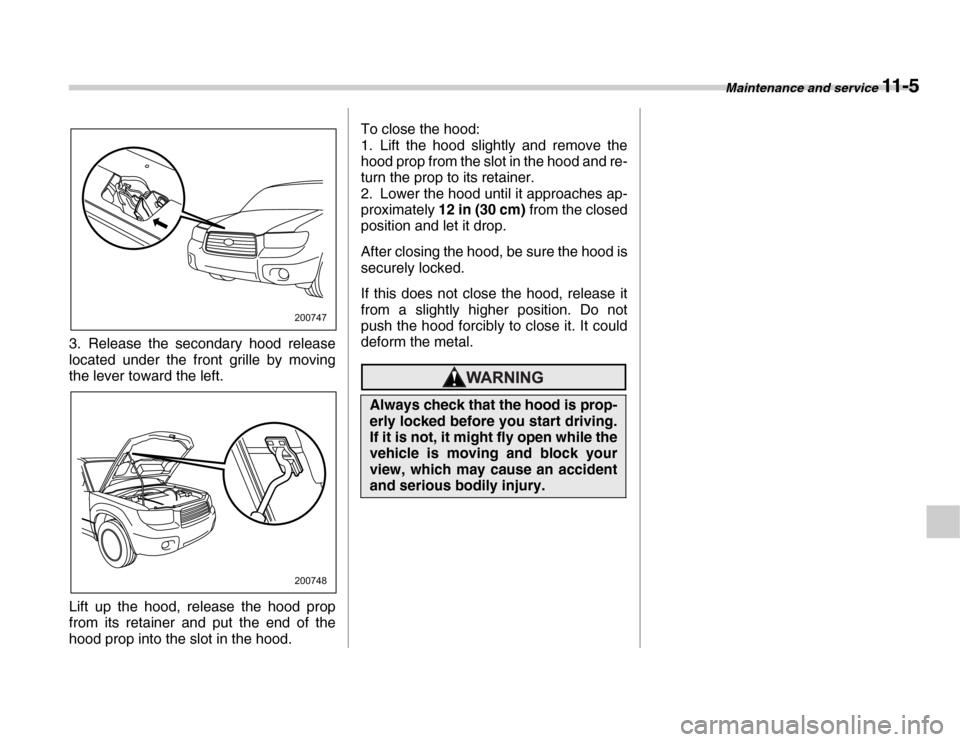
3. Release the secondary hood release
located under the front grille by moving
the lever toward the left.
Lift up the hood, release the hood prop
from its retainer and put the end of the
hood prop into the slot in the hood.To close the hood:
1. Lift the hood slightly and remove the
hood prop from the slot in the hood and re-
turn the prop to its retainer.
2. Lower the hood until it approaches ap-
proximately
12 in (30 cm) from the closed
position and let it drop.
After closing the hood, be sure the hood is
securely locked.
If this does not close the hood, release it
from a slightly higher position. Do not
push the hood forcibly to close it. It could
deform the metal.
200747
200748
Always check that the hood is prop-
erly locked before you start driving.
If it is not, it might fly open while the
vehicle is moving and block your
view, which may cause an accident
and serious bodily injury.
Page 282 of 356
11 - 1 0 Maintenance and service
The oil quantity indicated above is only a
guideline. The necessary quantity of oil
depends on the quantity of oil that has
been drained. The quantity of drained oil
differs slightly depending on the tempera-
ture of the oil and the time the oil is left
flowing out. After pouring oil into the en-
gine, therefore, you must use the dipstick
to confirm that the level is correct.
13.Start the engine and make sure that no
oil leaks appear around the filter’s rubber
seal.
14.Run the engine until it reaches the nor-
mal operating temperature. Then stop the
engine and wait a few minutes to allow the
oil drain back. Check the oil level again
and if necessary, add more engine oil. „Recommended grade and
viscosity
Oil grade:
ILSAC GF-4, which can be identified
with the ILSAC certification mark
(Starburst mark)
or API classification SM with the
words “ENERGY CONSERVING”
These recommended oil grades can be
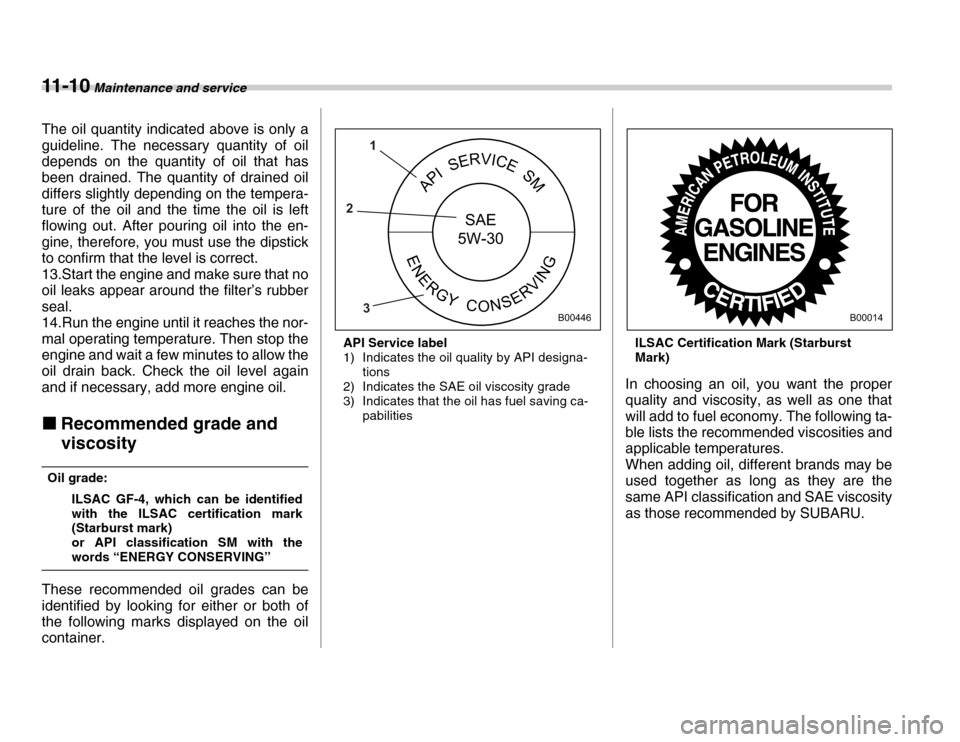
identified by looking for either or both of
the following marks displayed on the oil
container. API Service label
1) Indicates the oil quality by API designa-
tions
2) Indicates the SAE oil viscosity grade
3) Indicates that the oil has fuel saving ca- pabilities ILSAC Certification Mark (Starburst
Mark)
In choosing an oil, you want the proper
quality and viscosity, as well as one that
will add to fuel economy. The following ta-
ble lists the recommended viscosities and
applicable temperatures.
When adding oil, different brands may be
used together as long as they are the
same API classification and SAE viscosity
as those recommended by SUBARU.
APISERVICESM
ENERGYCONSERVING
SAE
5W-30
1
2
3
B00446B00014
Page 299 of 356
Maintenance and service 11 - 27
Brake booster
If the brake booster does not operate as
described in the following, have it checked
by your SUBARU dealer.
1. With the engine off, depress the brake
pedal several times, applying the same
pedal force each time. The distance the
pedal travels should not vary.
2. With the brake pedal depressed, start
the engine. The pedal should move slight-
ly down to the floor.
3. With the brake pedal depressed, stop
the engine and keep the pedal depressed
for 30 seconds. The pedal height should
not change.
4. Start the engine again and run for ap-
proximately one minute then turn it off.
Depress the brake pedal several times to
check the brake booster. The brake boost-
er operates properly if the pedal stroke de-
creases with each depression.Brake pedal
Check the brake pedal free play and re-
serve distance according to the mainte-
nance schedule in the “Warranty and
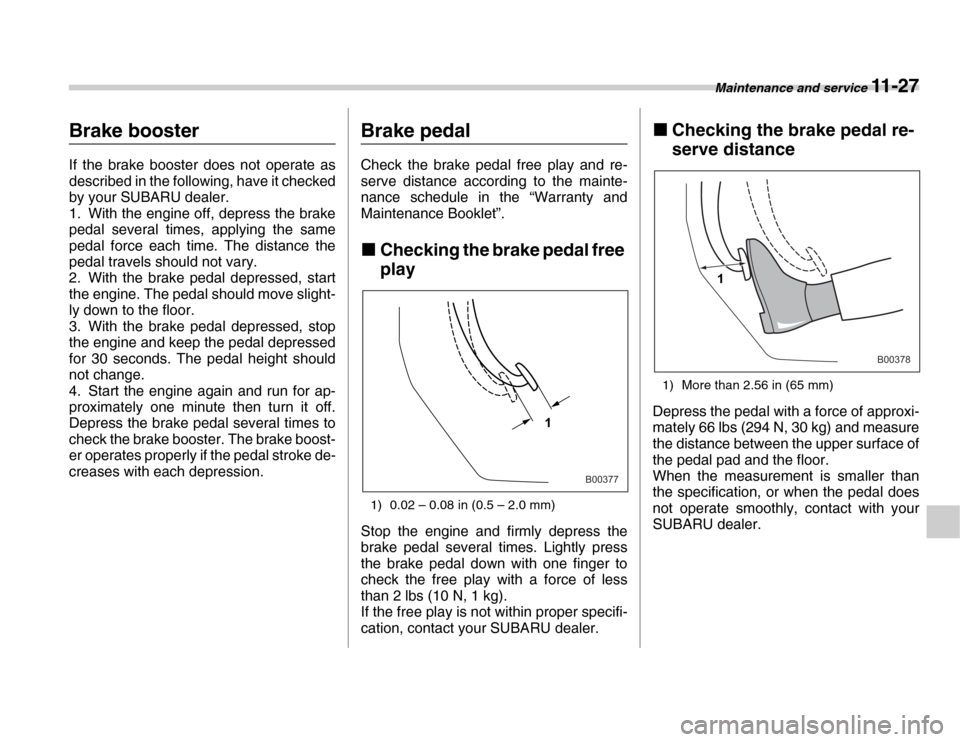
Maintenance Booklet”. „Checking the brake pedal free
play
1) 0.02 – 0.08 in (0.5 – 2.0 mm)
Stop the engine and firmly depress the
brake pedal several times. Lightly press
the brake pedal down with one finger to
check the free play with a force of less
than 2 lbs (10 N, 1 kg).
If the free play is not within proper specifi-
cation, contact your SUBARU dealer. „
Checking the brake pedal re-
serve distance
1) More than 2.56 in (65 mm)
Depress the pedal with a force of approxi-
mately 66 lbs (294 N, 30 kg) and measure
the distance between the upper surface of
the pedal pad and the floor.
When the measurement is smaller than
the specification, or when the pedal does
not operate smoothly, contact with your
SUBARU dealer.
1
B00377
1
B00378
Page 300 of 356
11 - 2 8 Maintenance and service
Clutch pedal (MT vehicles)
Check the clutch pedal free play and re-
serve distance according to the mainte-
nance schedule in the “Warranty and
Maintenance Booklet”. „Checking the clutch function
Check the clutch engagement and disen-
gagement.
1. With the engine idling, check that there
are no abnormal noises when the clutch
pedal is depressed, and that shifting into
1st or reverse feels smooth.
2. Start the vehicle by releasing the pedal
slowly to check that the engine and trans-
mission smoothly couple without any sign
of slippage. „
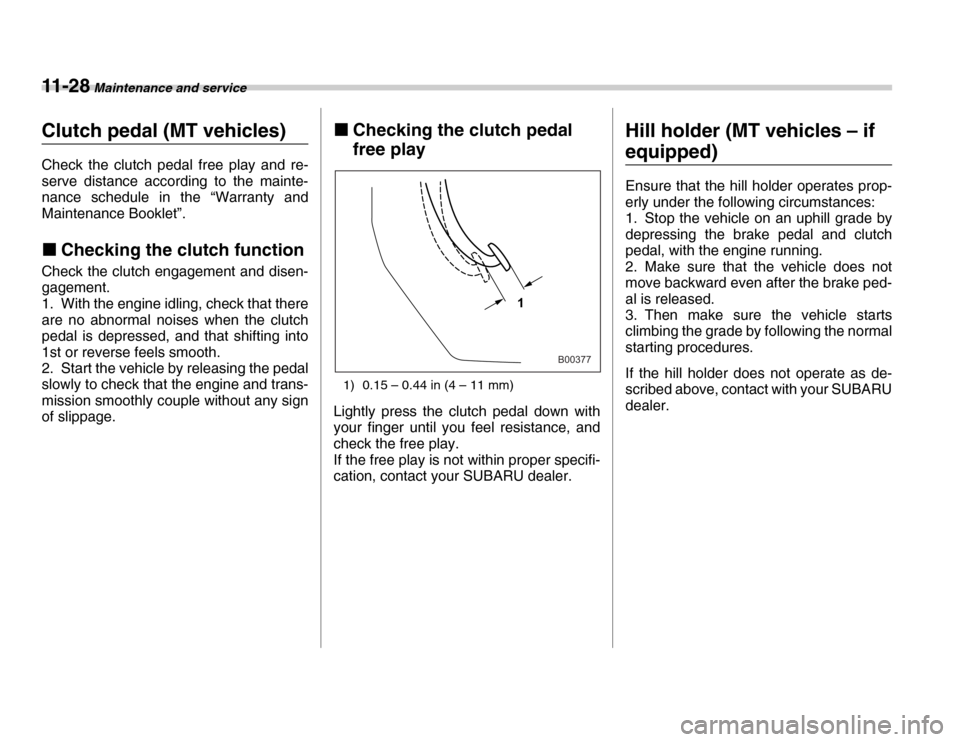
Checking the clutch pedal
free play
1) 0.15 – 0.44 in (4 – 11 mm)
Lightly press the clutch pedal down with
your finger until you feel resistance, and
check the free play.
If the free play is not within proper specifi-
cation, contact your SUBARU dealer. Hill holder (MT vehicles – if
equipped)
Ensure that the hill holder operates prop-
erly under the following circumstances:
1. Stop the vehicle on an uphill grade by
depressing the brake pedal and clutch
pedal, with the engine running.
2. Make sure that the vehicle does not
move backward even after the brake ped-
al is released.
3. Then make sure the vehicle starts
climbing the grade by following the normal
starting procedures.
If the hill holder does not operate as de-
scribed above, contact with your SUBARU
dealer.
1
B00377
Page 301 of 356
Maintenance and service 11 - 29
Replacement of brake pad
and lining
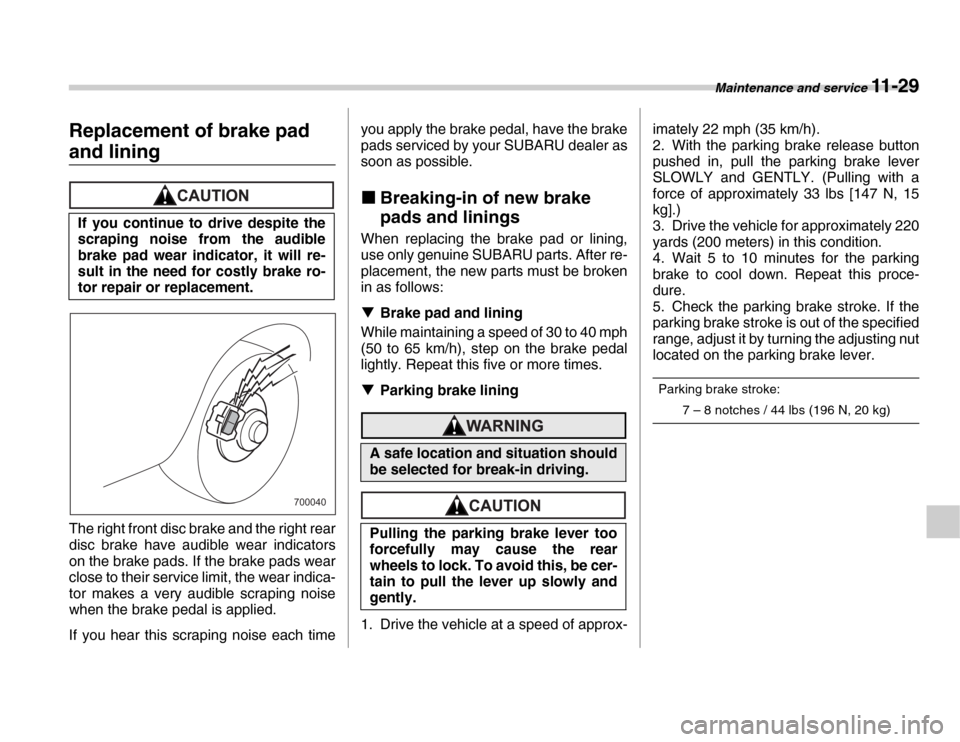
The right front disc brake and the right rear
disc brake have audible wear indicators
on the brake pads. If the brake pads wear
close to their service limit, the wear indica-
tor makes a very audible scraping noise
when the brake pedal is applied.
If you hear this scraping noise each timeyou apply the brake pedal, have the brake
pads serviced by your SUBARU dealer as
soon as possible.
„ Breaking-in of new brake
pads and linings
When replacing the brake pad or lining,
use only genuine SUBARU parts. After re-
placement, the new parts must be broken
in as follows: T Brake pad and lining
While maintaining a speed of 30 to 40 mph
(50 to 65 km/h), step on the brake pedal
lightly. Repeat this five or more times. T Parking brake lining
1. Drive the vehicle at a speed of approx- imately 22 mph (35 km/h).
2. With the parking brake release button
pushed in, pull the parking brake lever
SLOWLY and GENTLY. (Pulling with a
force of approximately 33 lbs [147 N, 15
kg].)
3. Drive the vehicle for approximately 220
yards (200 meters) in this condition.
4. Wait 5 to 10 minutes for the parking
brake to cool down. Repeat this proce-
dure.
5. Check the parking brake stroke. If the
parking brake stroke is out of the specified
range, adjust it by turning the adjusting nut
located on the parking brake lever.
Parking brake stroke:
7 – 8 notches / 44 lbs (196 N, 20 kg)
If you continue to drive despite the
scraping noise from the audible
brake pad wear indicator, it will re-
sult in the need for costly brake ro-
tor repair or replacement.
700040
A safe location and situation should
be selected for break-in driving.
Pulling the parking brake lever too
forcefully may cause the rear
wheels to lock. To avoid this, be cer-
tain to pull the lever up slowly and
gently.
Page 304 of 356
11 - 3 2 Maintenance and service
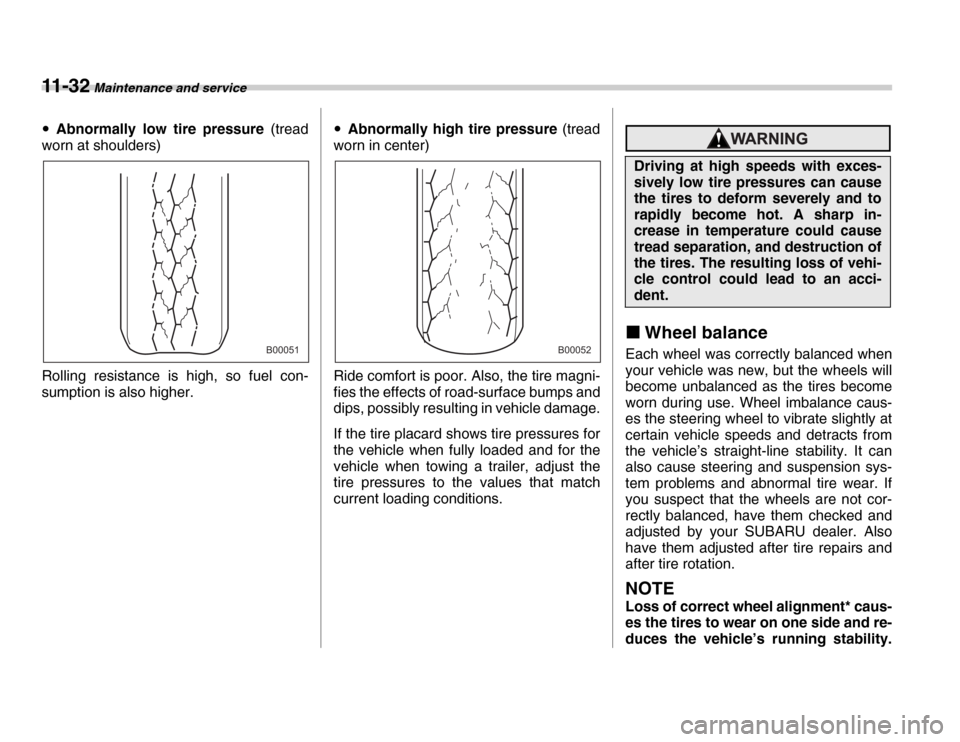
yAbnormally low tire pressure (tread
worn at shoulders)
Rolling resistance is high, so fuel con-
sumption is also higher. y
Abnormally high tire pressure (tread
worn in center)
Ride comfort is poor. Also, the tire magni-
fies the effects of road-surface bumps and
dips, possibly resulting in vehicle damage.
If the tire placard shows tire pressures for
the vehicle when fully loaded and for the
vehicle when towing a trailer, adjust the
tire pressures to the values that match
current loading conditions.
„ Wheel balance
Each wheel was correctly balanced when
your vehicle was new, but the wheels will
become unbalanced as the tires become
worn during use. Wheel imbalance caus-
es the steering wheel to vibrate slightly at
certain vehicle speeds and detracts from
the vehicle’s straight-line stability. It can
also cause steering and suspension sys-
tem problems and abnormal tire wear. If
you suspect that the wheels are not cor-
rectly balanced, have them checked and
adjusted by your SUBARU dealer. Also
have them adjusted after tire repairs and
after tire rotation.
NOTE
Loss of correct wheel alignment* caus-
es the tires to wear on one side and re-
duces the vehicle’s running stability.
B00051B00052
Driving at high speeds with exces-
sively low tire pressures can cause
the tires to deform severely and to
rapidly become hot. A sharp in-
crease in temperature could cause
tread separation, and destruction of
the tires. The resulting loss of vehi-
cle control could lead to an acci-
dent.
Page 312 of 356
11 - 4 0 Maintenance and service
ber is not retained properly, the wiper may
scratch the rear window glass.
8. Install the wiper blade assembly to the
wiper arm. Make sure that it locks in place.
9. Lower the wiper arm.Battery
yBefore beginning work on or near
any battery, be sure to extinguish
all cigarettes, matches, and light-
ers. Never expose a battery to an
open flame or electric sparks. Bat-
teries give off a gas which is high-
ly flammable and explosive.
yFor safety, in case an explosion
does occur, wear eye protection
or shield your eyes when working
near any battery. Never lean over
a battery.
yDo not let battery fluid contact
eyes, skin, fabrics, or paint be-
cause battery fluid is a corrosive
acid. If battery fluid gets on your
skin or in your eyes, immediately
flush the area with water thor-
oughly. Seek medical help imme-
diately if acid has entered the
eyes.
If battery fluid is accidentally
swallowed, immediately drink a
large amount of milk or water, and
seek medical attention immediate-
ly.
yTo lessen the risk of sparks, re-
move rings, metal watchbands,
and other metal jewelry. Never al-
low metal tools to contact the pos-
itive battery terminal and anything
connected to it WHILE you are at
the same time in contact with any
other metallic portion of the vehi-
cle because a short circuit will re-
sult.
yKeep everyone including children
away from the battery.
yCharge the battery in a well-venti-
lated area.
yBattery posts, terminals and relat-
ed accessories contain lead and
lead compounds, chemicals
known to the State of California to
cause cancer and reproductive
harm. Batteries also contain other
chemicals known to the State of
California to cause cancer. Wash
hands after handling.
Never use more than 10 amperes
when charging the battery because
it will shorten battery life.
Page 314 of 356
11 - 4 2 Maintenance and service
in the main fuse box cover in the engine
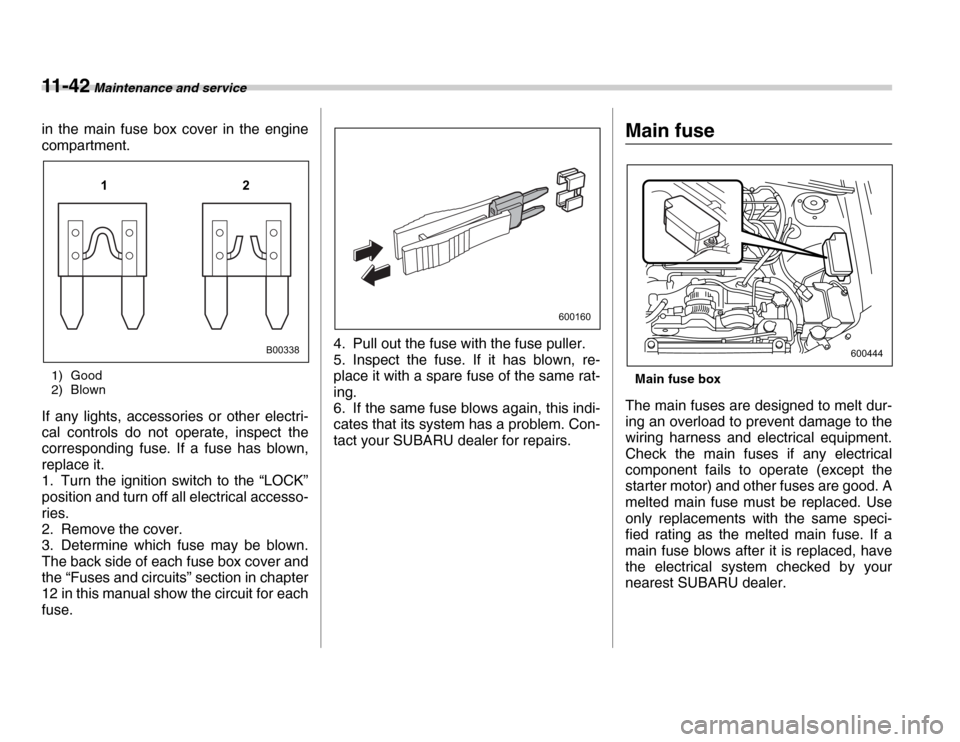
compartment.1) Good
2) Blown
If any lights, accessories or other electri-
cal controls do not operate, inspect the
corresponding fuse. If a fuse has blown,
replace it.
1. Turn the ignition switch to the “LOCK”
position and turn off all electrical accesso-
ries.
2. Remove the cover.
3. Determine which fuse may be blown.
The back side of each fuse box cover and
the “Fuses and circuits” section in chapter
12 in this manual show the circuit for each
fuse. 4. Pull out the fuse with the fuse puller.
5. Inspect the fuse. If it has blown, re-
place it with a spare fuse of the same rat-
ing.
6. If the same fuse blows again, this indi-
cates that its system has a problem. Con-
tact your SUBARU dealer for repairs.Main fuse
Main fuse box
The main fuses are designed to melt dur-
ing an overload to prevent damage to the
wiring harness and electrical equipment.
Check the main fuses if any electrical
component fails to operate (except the
starter motor) and other fuses are good. A
melted main fuse must be replaced. Use
only replacements with the same speci-
fied rating as the melted main fuse. If a
main fuse blows after it is replaced, have
the electrical system checked by your
nearest SUBARU dealer.
12
B00338
600160
600444
Page 315 of 356

Maintenance and service 11 - 43
Installation of accessories
Always consult your SUBARU dealer be-
fore installing fog lights or any other elec-
trical equipment in your vehicle. Such ac-
cessories may cause the electronic sys-
tem to malfunction if they are incorrectly
installed or if they are not suited for the ve-
hicle.
Page 317 of 356
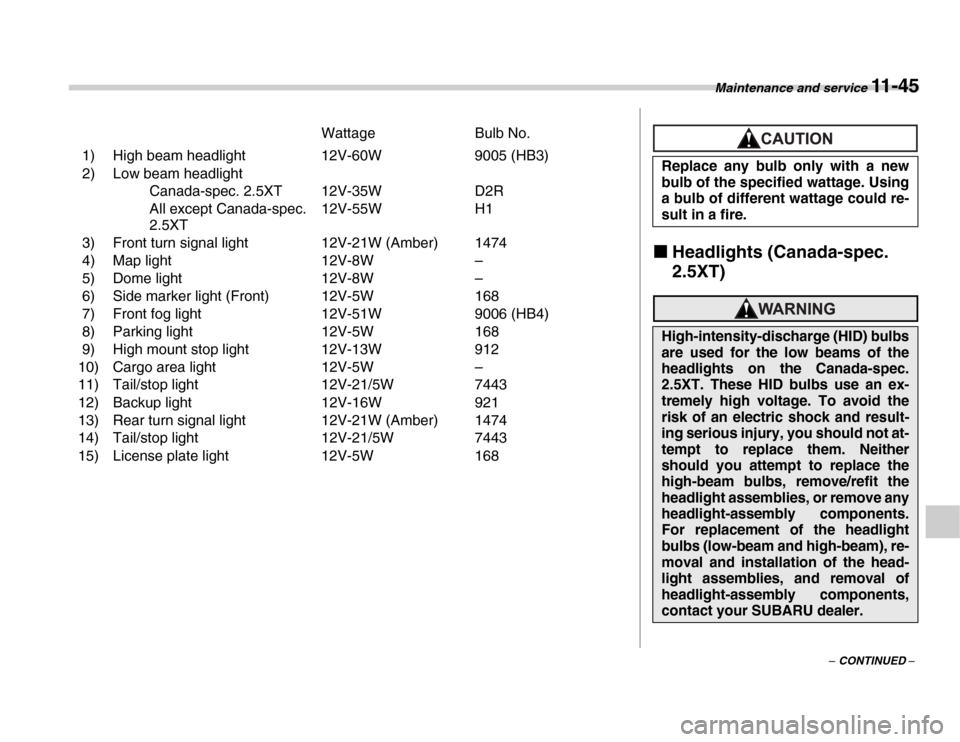
Maintenance and service 11 - 45
– CONTINUED –
Wattage Bulb No.
1) High beam headlight 12V-60W 9005 (HB3)
2) Low beam headlight Canada-spec. 2.5XT 12V-35W D2R
All except Canada-spec.
2.5XT 12V-55W H1
3) Front turn signal light 12V-21W (Amber) 1474
4) Map light 12V-8W –
5) Dome light 12V-8W –
6) Side marker light (Front) 12V-5W 168
7) Front fog light 12V-51W 9006 (HB4)
8) Parking light 12V-5W 168
9) High mount stop light 12V-13W 912
10) Cargo area light 12V-5W –
11) Tail/stop light 12V-21/5W 7443
12) Backup light 12V-16W 921
13) Rear turn signal light 12V-21W (Amber) 1474
14) Tail/stop light 12V-21/5W 7443
15) License plate light 12V-5W 168
„ Headlights (Canada-spec.
2.5XT)
Replace any bulb only with a new
bulb of the specified wattage. Using
a bulb of different wattage could re-
sult in a fire.
High-intensity-discharge (HID) bulbs
are used for the low beams of the
headlights on the Canada-spec.
2.5XT. These HID bulbs use an ex-
tremely high voltage. To avoid the
risk of an electric shock and result-
ing serious injury, you should not at-
tempt to replace them. Neither
should you attempt to replace the
high-beam bulbs, remove/refit the
headlight assemblies, or remove any
headlight-assembly components.
For replacement of the headlight
bulbs (low-beam and high-beam), re-
moval and installation of the head-
light assemblies, and removal of
headlight-assembly components,
contact your SUBARU dealer.