Model SUBARU FORESTER 2007 SG / 2.G Owner's Manual
[x] Cancel search | Manufacturer: SUBARU, Model Year: 2007, Model line: FORESTER, Model: SUBARU FORESTER 2007 SG / 2.GPages: 356, PDF Size: 5.89 MB
Page 202 of 356
7-4 Starting and operating
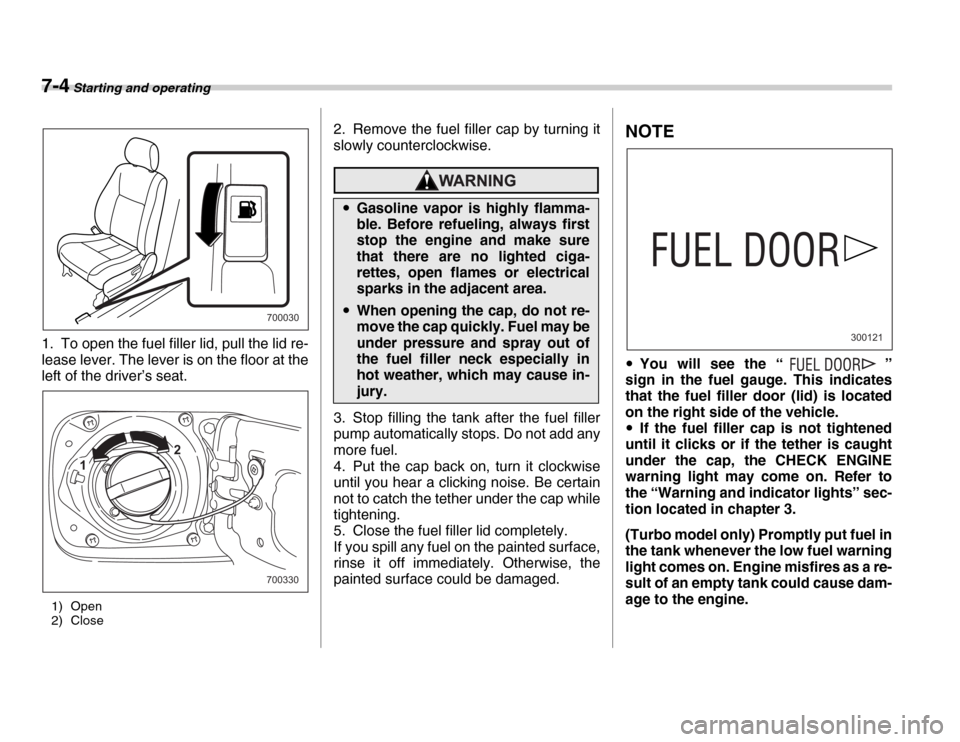
1. To open the fuel filler lid, pull the lid re-
lease lever. The lever is on the floor at the
left of the driver’s seat.1) Open
2) Close 2. Remove the fuel filler cap by turning it
slowly counterclockwise.
3. Stop filling the tank after the fuel filler
pump automatically stops. Do not add any
more fuel.
4. Put the cap back on, turn it clockwise
until you hear a clicking noise. Be certain
not to catch the tether under the cap while
tightening.
5. Close the fuel filler lid completely.
If you spill any fuel on the painted surface,
rinse it off immediately. Otherwise, the
painted surface could be damaged.
NOTE y
You will see the “ ”
sign in the fuel gauge. This indicates
that the fuel filler door (lid) is located
on the right side of the vehicle. y If the fuel filler cap is not tightened
until it clicks or if the tether is caught
under the cap, the CHECK ENGINE
warning light may come on. Refer to
the “Warning and indicator lights” sec-
tion located in chapter 3.
(Turbo model only) Promptly put fuel in
the tank whenever the low fuel warning
light comes on. Engine misfires as a re-
sult of an empty tank could cause dam-
age to the engine.
700030
1 2
700330
y
Gasoline vapor is highly flamma-
ble. Before refueling, always first
stop the engine and make sure
that there are no lighted ciga-
rettes, open flames or electrical
sparks in the adjacent area.
yWhen opening the cap, do not re-
move the cap quickly. Fuel may be
under pressure and spray out of
the fuel filler neck especially in
hot weather, which may cause in-
jury.
300121
Page 204 of 356
7-6 Starting and operating
not damage an AWD SUBARU vehicle.
Under no circumstances should the rear
wheels be jacked off the ground, nor
should the driveshaft be disconnected for
state emission testing.
The EPA has issued regulations for in-
specting the On-Board Diagnostic (OBD)
system as part of the state emissions in-
spection. The OBD system is designed to
detect engine and transmission problems
that might cause vehicle emissions to ex-
ceed allowable limits. These inspections
apply to all 1996 model year and newer
passenger cars and light trucks. Over 30
states plus the District of Columbia have
implemented the OBD system inspection. yThe inspection of the OBD system con-
sists of a visual operational check of the
“CHECK ENGINE” warning light/mal-
function indicator lamp (MIL) and an ex-
amination of the OBD system with an
electronic scan tool while the engine is
running y A vehicle passes
the OBD system in-
spection if proper the “CHECK ENGINE”
warning light/MIL illumination is observed,
there is no stored diagnostic trouble
codes, and the OBD system readiness
monitors are complete. y A vehicle fails
the OBD inspection if the “CHECK ENGINE”
warning light/MIL is
not properly operating or there is one or
more diagnostic trouble codes stored in
vehicle’s computer with the “CHECK EN-
GINE” warning light/MIL illuminated.
y A state emission inspection may reject
(not pass or fail) a vehicle if the number of
OBD system readiness monitors “Not
Ready” is greater than one. Under this
condition, the vehicle operator should be
instructed to drive his/her vehicle for a few
days to set the monitors and return for an
emission re-inspection. y Owners of rejected or failing vehicles
should contact their SUBARU Dealer for
service.
Preparing to drive
You should perform the following checks
and adjustments every day before you
start driving.
1. Check that all windows, mirrors, and
lights are clean and unobstructed.
2. Check the appearance and condition of
the tires. Also check tires for proper infla-
tion.
3. Look under the vehicle for any sign of
leaks.
4. Check that the hood and rear gate are
fully closed.
5. Check the adjustment of the seat.
6. Check the adjustment of the inside and
outside mirrors.
7. Fasten your seatbelt. Check that your
passengers have fastened their seatbelts.
8. Check the operation of the warning and
indicator lights when the ignition switch is
turned to the “ON” position.
9. Check the gauges, indicator and warn-
ing lights after starting the engine.
NOTE
Engine oil, engine coolant, brake fluid,
washer fluid and other fluid levels
should be checked daily, weekly or at
fuel stops.
Page 208 of 356
7-10 Starting and operating
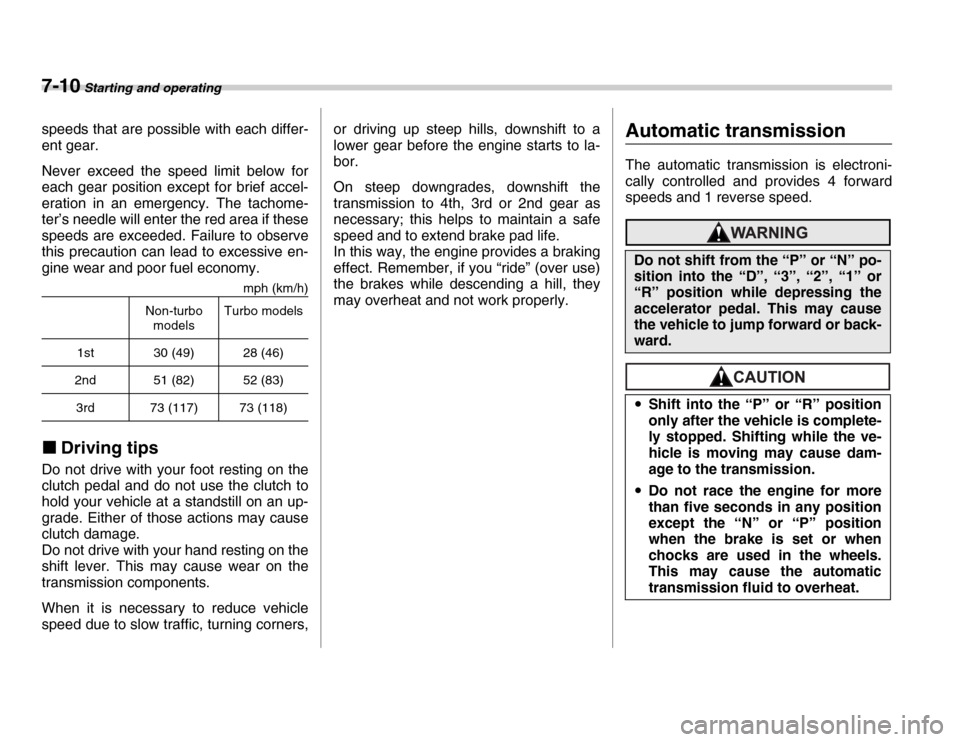
speeds that are possible with each differ-
ent gear.
Never exceed the speed limit below for
each gear position except for brief accel-
eration in an emergency. The tachome-
ter’s needle will enter the red area if these
speeds are exceeded. Failure to observe
this precaution can lead to excessive en-
gine wear and poor fuel economy.mph (km/h)
„ Driving tips
Do not drive with your foot resting on the
clutch pedal and do not use the clutch to
hold your vehicle at a standstill on an up-
grade. Either of those actions may cause
clutch damage.
Do not drive with your hand resting on the
shift lever. This may cause wear on the
transmission components.
When it is necessary to reduce vehicle
speed due to slow traffic, turning corners, or driving up steep hills, downshift to a
lower gear before the engine starts to la- bor.
On steep downgrades, downshift the
transmission to 4th, 3rd or 2nd gear as
necessary; this helps to maintain a safe
speed and to extend brake pad life.
In this way, the engine provides a braking
effect. Remember, if you “ride” (over use)
the brakes while descending a hill, they
may overheat and not work properly.Automatic transmission
The automatic transmission is electroni-
cally controlled and provides 4 forward
speeds and 1 reverse speed.
Non-turbo
models Turbo models
1st 30 (49) 28 (46)
2nd 51 (82) 52 (83)
3rd 73 (117) 73 (118)
Do not shift from the “P” or “N” po-
sition into the “D”, “3”, “2”, “1” or
“R” position while depressing the
accelerator pedal. This may cause
the vehicle to jump forward or back-
ward. y Shift into the “P” or “R” position
only after the vehicle is complete-
ly stopped. Shifting while the ve-
hicle is moving may cause dam-
age to the transmission.
y Do not race the engine for more
than five seconds in any position
except the “N” or “P” position
when the brake is set or when
chocks are used in the wheels.
This may cause the automatic
transmission fluid to overheat.
Page 211 of 356
Starting and operating 7-13
– CONTINUED –
shortly after the vehicle has been
parked for an extended period of time.
When the ATF temperature has risen to
a certain level, automatic downshift
normally takes place. In the meantime,
downshift manually for engine braking
as required.
Also, downshifting when braking
downhill will not occur at speeds
above approximately 48 mph (78 km/h). T
3 (Third)
This position is for using engine braking
when going down a hill or for climbing a
grade.
The transmission automatically shifts into
a suitable gear from 1st to 3rd according
to the vehicle speed and the acceleration
you require.
When more acceleration is required in this
position, press the accelerator pedal fully
to the floor and hold that position. The
transmission will automatically downshift
to 2nd or 1st gear. When you release the
pedal, the transmission will return to the
original gear position. T 2 (Second)
This position is for using engine braking
when going down a hill or for climbing a
steep grade.
In this position, the transmission holds in the 2nd gear.
Use this position when starting off from a
standstill on slippery road surfaces such
as mud or snow. It will ensure greater trac-
tion. T
1 (First)
This position is for driving up or down very
steep grades, or driving through mud or
sand, or on slippery surfaces. In this posi-
tion, the transmission holds in the 1st
gear. T Maximum speeds
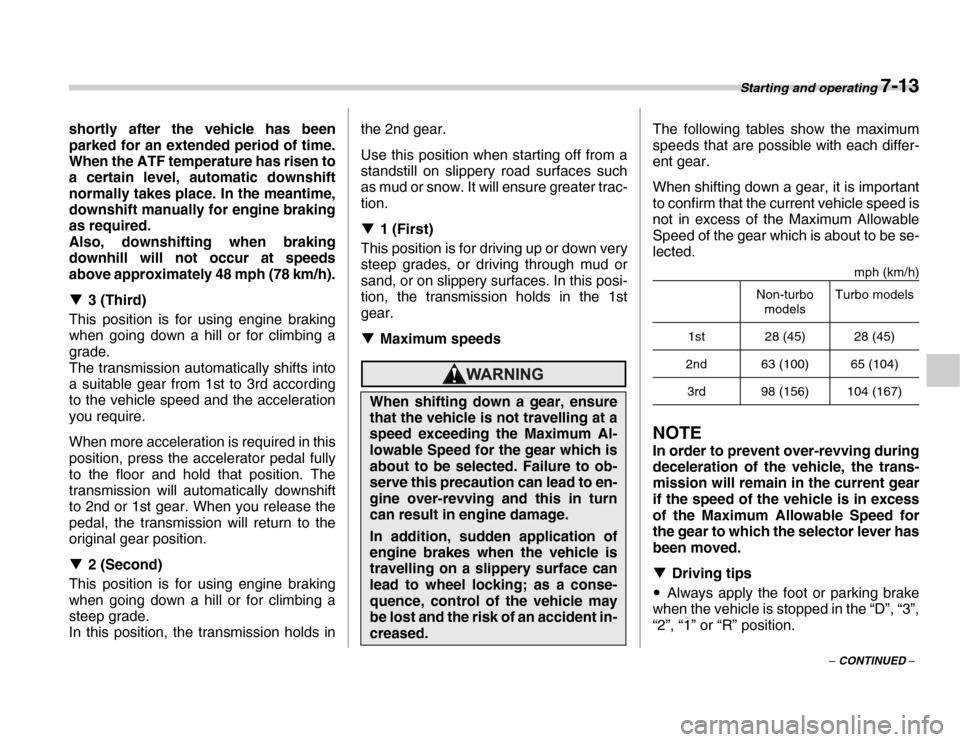
The following tables show the maximum
speeds that are possible with each differ-
ent gear.
When shifting down a gear, it is important
to confirm that the current vehicle speed is
not in excess of the Maximum Allowable
Speed of the gear which is about to be se-
lected.
mph (km/h)
NOTE
In order to prevent over-revving during
deceleration of the vehicle, the trans-
mission will remain in the current gear
if the speed of the vehicle is in excess
of the Maximum Allowable Speed for
the gear to which the selector lever has
been moved. T Driving tips
y Always apply the foot or parking brake
when the vehicle is stopped in the “D”, “3”,
“2”, “1” or “R” position.
When shifting down a gear, ensure
that the vehicle is not travelling at a
speed exceeding the Maximum Al-
lowable Speed for the gear which is
about to be selected. Failure to ob-
serve this precaution can lead to en-
gine over-revving and this in turn
can result in engine damage.
In addition, sudden application of
engine brakes when the vehicle is
travelling on a slippery surface can
lead to wheel locking; as a conse-
quence, control of the vehicle may
be lost and the risk of an accident in-
creased.
Non-turbo models Turbo models
1st 28 (45) 28 (45)
2nd 63 (100) 65 (104) 3rd 98 (156) 104 (167)
Page 215 of 356
Starting and operating 7-17
– CONTINUED –
The ABS system prevents the lock-up of
wheels which may occur during sudden
braking or braking on slippery road surfac-
es. This helps prevent the loss of steering
control and directional stability caused by
wheel lock-up.
When the ABS system is operating, you
may hear a chattering noise or feel a slight
vibration in the brake pedal. This is normal
when the ABS operates.
The ABS system will not operate when the
vehicle speed is below approximately 6
mph (10 km/h). „
ABS system self-check
You may feel a slight shock in the brake
pedal and hear the operating sound of
ABS from the engine compartment just af-
ter the vehicle is started. This is caused by
an automatic functional test of the ABS
system being carried out and does not in-
dicate any abnormal condition. „
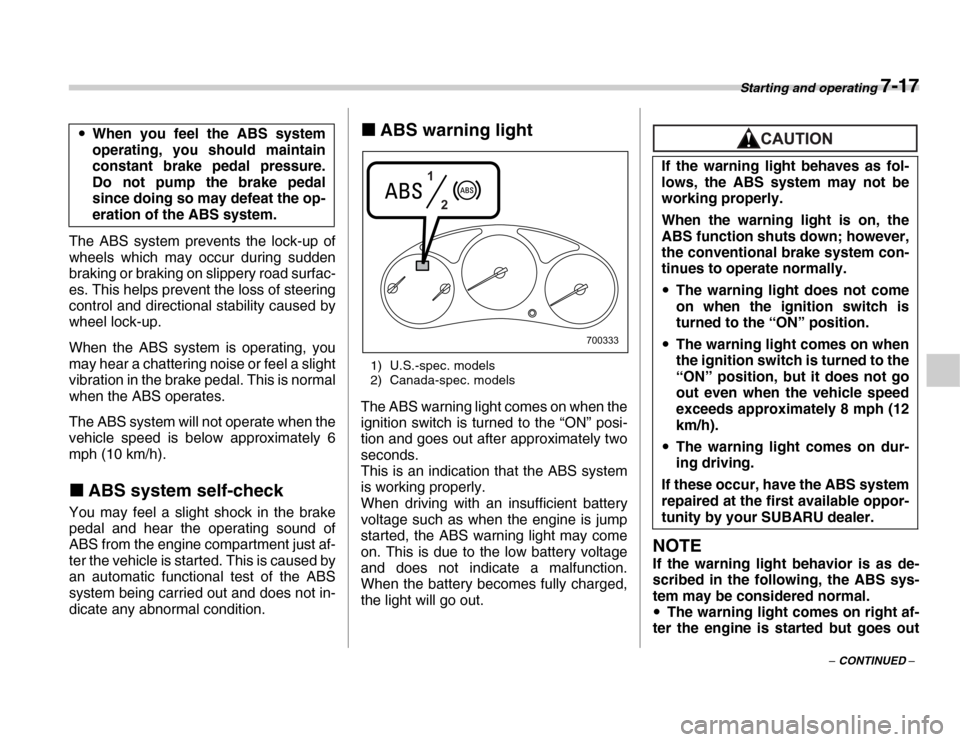
ABS warning light
1) U.S.-spec. models
2) Canada-spec. models
The ABS warning light comes on when the
ignition switch is turned to the “ON” posi-
tion and goes out after approximately two
seconds.
This is an indication that the ABS system
is working properly.
When driving with an insufficient battery
voltage such as when the engine is jump
started, the ABS warning light may come
on. This is due to the low battery voltage
and does not indicate a malfunction.
When the battery becomes fully charged,
the light will go out.
NOTE
If the warning light behavior is as de-
scribed in the following, the ABS sys-
tem may be considered normal. y The warning light comes on right af-
ter the engine is started but goes out
y
When you feel the ABS system
operating, you should maintain
constant brake pedal pressure.
Do not pump the brake pedal
since doing so may defeat the op-
eration of the ABS system.
1
2
700333 If the warning light behaves as fol-
lows, the ABS system may not be
working properly.
When the warning light is on, the
ABS function shuts down; however,
the conventional brake system con-
tinues to operate normally. y
The warning light does not come
on when the ignition switch is
turned to the “ON” position.
y The warning light comes on when
the ignition switch is turned to the
“ON” position, but it does not go
out even when the vehicle speed
exceeds approximately 8 mph (12
km/h).
y The warning light comes on dur-
ing driving.
If these occur, have the ABS system
repaired at the first available oppor-
tunity by your SUBARU dealer.
Page 216 of 356
7-18 Starting and operating
immediately, remaining off. yThe warning light remains on after
the engine has been started, but it goes
out when the vehicle speed reaches
approximately 8 mph (12 km/h). y The warning light comes on during
driving, but it goes out immediately
and remains off. Electronic Brake Force Dis-
tribution (EBD) system
The EBD system maximizes the effective-
ness of the brakes by allowing the rear
brakes to supply a greater proportion of
the braking force. It functions by adjusting
the distribution of braking force to the rear
wheels in accordance with the vehicle’s
loading condition and speed.
The EBD system is an integral part of the
ABS system and uses some of the ABS
system’s components to perform its func-
tion of optimizing the distribution of brak-
ing force. If any of the ABS components
used by the EBD function fails, the EBD
system also stops working.
When the EBD system is operating, you
may hear a chattering noise or feel a slight
vibration in the brake pedal. This is normal
and does not indicate a malfunction.„
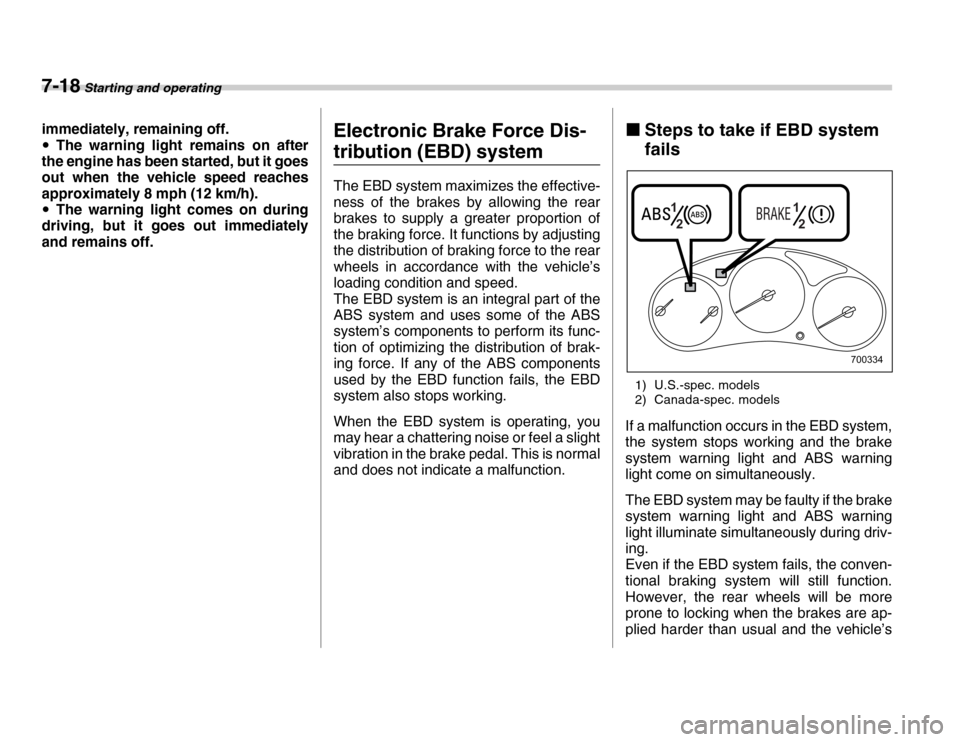
Steps to take if EBD system
fails
1) U.S.-spec. models
2) Canada-spec. models
If a malfunction occurs in the EBD system,
the system stops working and the brake
system warning light and ABS warning
light come on simultaneously.
The EBD system may be faulty if the brake
system warning light and ABS warning
light illuminate simultaneously during driv-
ing.
Even if the EBD system fails, the conven-
tional braking system will still function.
However, the rear wheels will be more
prone to locking when the brakes are ap-
plied harder than usual and the vehicle’s
1 2 1
2
700334
Page 227 of 356
Driving tips 8-3
– CONTINUED –
NOTE
Due to the expansion and contraction
of the metals used in the manufacture
of the exhaust system, you may hear a
crackling sound coming from the ex-
haust system for a short time after the
engine has been shut off. This sound is
normal.
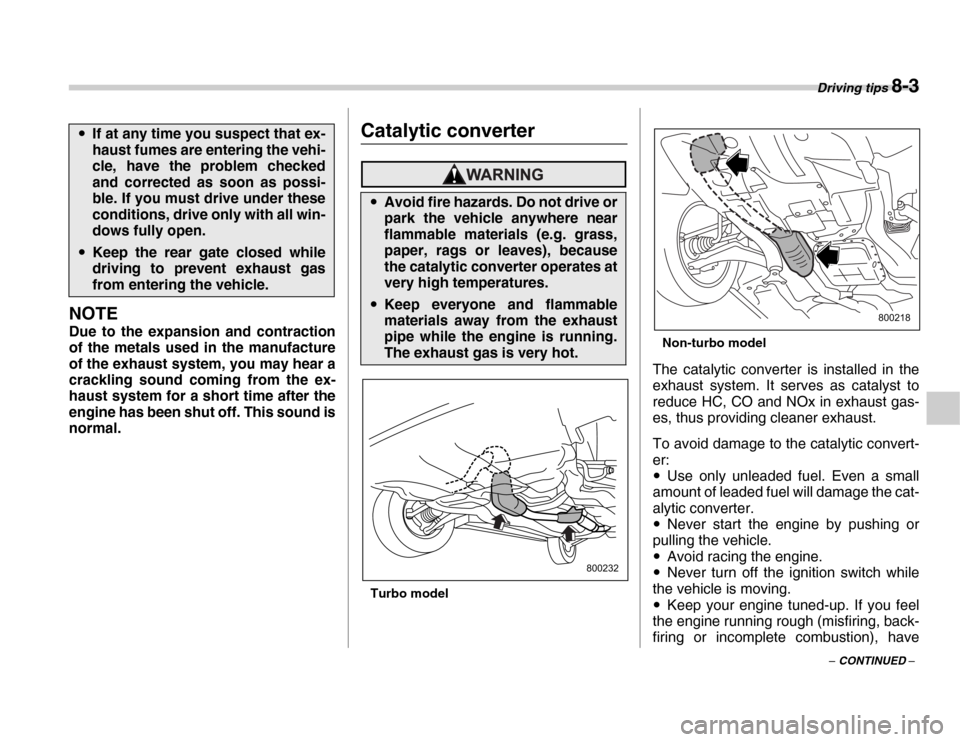
Catalytic converter
Turbo model Non-turbo model
The catalytic converter is installed in the
exhaust system. It serves as catalyst to
reduce HC, CO and NOx in exhaust gas-
es, thus providing cleaner exhaust.
To avoid damage to the catalytic convert- er: y Use only unleaded fuel. Even a small
amount of leaded fuel will damage the cat-
alytic converter. y Never start the engine by pushing or
pulling the vehicle. y Avoid racing the engine.
y Never turn off the ignition switch while
the vehicle is moving.y Keep your engine tuned-up. If you feel
the engine running rough (misfiring, back-
firing or incomplete combustion), have
y If at any time you suspect that ex-
haust fumes are entering the vehi-
cle, have the problem checked
and corrected as soon as possi-
ble. If you must drive under these
conditions, drive only with all win-
dows fully open.
yKeep the rear gate closed while
driving to prevent exhaust gas
from entering the vehicle.
y Avoid fire hazards. Do not drive or
park the vehicle anywhere near
flammable materials (e.g. grass,
paper, rags or leaves), because
the catalytic converter operates at
very high temperatures.
yKeep everyone and flammable
materials away from the exhaust
pipe while the engine is running.
The exhaust gas is very hot.
800232
800218
Page 243 of 356
Driving tips 8-19
– CONTINUED –
T
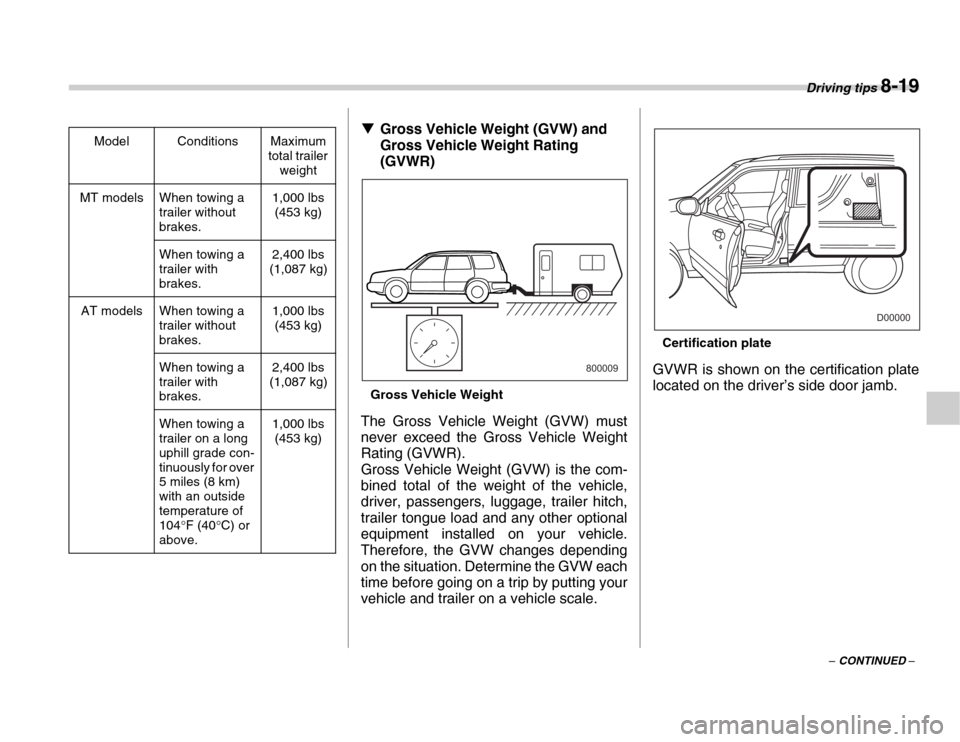
Gross Vehicle Weight (GVW) and
Gross Vehicle Weight Rating (GVWR)
Gross Vehicle Weight
The Gross Vehicle Weight (GVW) must
never exceed the Gross Vehicle Weight
Rating (GVWR).
Gross Vehicle Weight (GVW) is the com-
bined total of the weight of the vehicle,
driver, passengers, luggage, trailer hitch,
trailer tongue load and any other optional
equipment installed on your vehicle.
Therefore, the GVW changes depending
on the situation. Determine the GVW each
time before going on a trip by putting your
vehicle and trailer on a vehicle scale. Certification plate
GVWR is shown on the certification plate
located on the driver’s side door jamb.
Model Conditions Maximum
total trailer
weight
MT models When towing a trailer without
brakes. 1,000 lbs
(453 kg)
When towing a
trailer with
brakes. 2,400 lbs
(1,087 kg)
AT models When towing a trailer without
brakes. 1,000 lbs
(453 kg)
When towing a
trailer with
brakes. 2,400 lbs
(1,087 kg)
When towing a
trailer on a long
uphill grade con-
tinuously for over
5 miles (8 km)
with an outside
temperature of 104 qF (40 qC) or
above. 1,000 lbs
(453 kg)
800009
D00000
Page 253 of 356
In case of emergency 9-3
– CONTINUED –
ready for use. The correct pressure is
60
psi (420 kPa, 4.2 kg/cm 2
).
When using the temporary spare tire, note
the following. y Do not exceed 50 mph (80 km/h).
y Do not put a tire chain on the temporary
spare tire. Because of the smaller tire
size, a tire chain will not fit properly. y Do not use two or more temporary
spare tires at the same time. y Do not drive over obstacles. This tire
has a smaller diameter, so road clearance
is reduced.
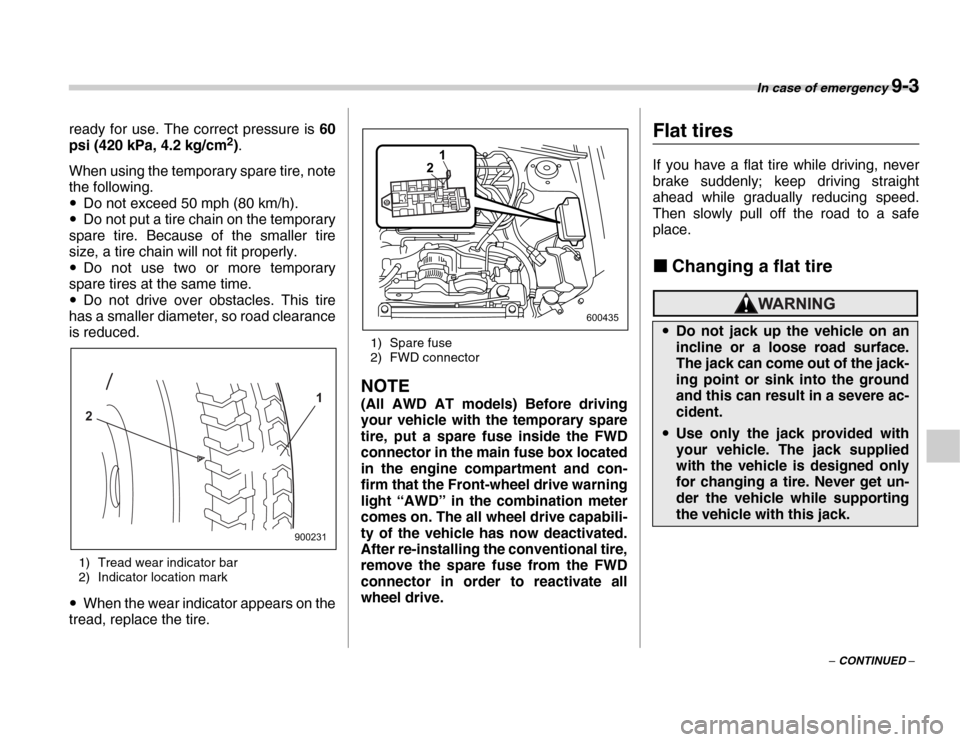
1) Tread wear indicator bar
2) Indicator location mark
y When the wear indicator appears on the
tread, replace the tire. 1) Spare fuse
2) FWD connector
NOTE
(All AWD AT models) Before driving
your vehicle with the temporary spare
tire, put a spare fuse inside the FWD
connector in the main fuse box located
in the engine compartment and con-
firm that the Front-wheel drive warning
light “AWD” in the combination meter
comes on. The all wheel drive capabili-
ty of the vehicle has now deactivated.
After re-installing the conventional tire,
remove the spare fuse from the FWD
connector in order to reactivate all
wheel drive.
Flat tires
If you have a flat tire while driving, never
brake suddenly; keep driving straight
ahead while gradually reducing speed.
Then slowly pull off the road to a safe
place. „ Changing a flat tire
900231
1
2
1
2
600435
y Do not jack up the vehicle on an
incline or a loose road surface.
The jack can come out of the jack-
ing point or sink into the ground
and this can result in a severe ac-
cident.
yUse only the jack provided with
your vehicle. The jack supplied
with the vehicle is designed only
for changing a tire. Never get un-
der the vehicle while supporting
the vehicle with this jack.
Page 254 of 356
9-4 In case of emergency
1. Park on a hard, level surface, whenev-
er possible, then stop the engine.
2. Set the parking brake securely and
shift a manual transmission vehicle in re-
verse or an automatic transmission vehi-
cle in the “P” (Park) position.
3. Turn on the hazard warning flasher and
have everyone get out of the vehicle.
4. Put wheel blocks at the front and rear
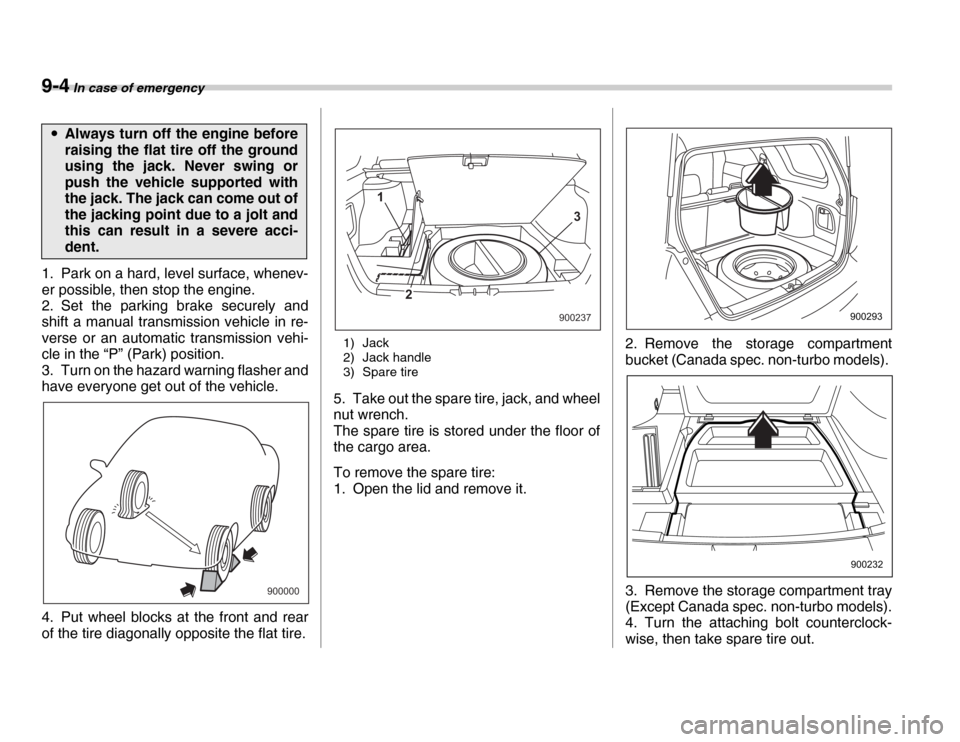
of the tire diagonally opposite the flat tire.1) Jack
2) Jack handle
3) Spare tire
5. Take out the spare tire, jack, and wheel
nut wrench.
The spare tire is stored under the floor of
the cargo area.
To remove the spare tire:
1. Open the lid and remove it. 2. Remove the storage compartment
bucket (Canada spec. non-turbo models).
3. Remove the storage compartment tray
(Except Canada spec. non-turbo models).
4. Turn the attaching bolt counterclock-
wise, then take spare tire out.
y
Always turn off the engine before
raising the flat tire off the ground
using the jack. Never swing or
push the vehicle supported with
the jack. The jack can come out of
the jacking point due to a jolt and
this can result in a severe acci-
dent.
900000
1
3
2
900237900293
900232