tire SUBARU FORESTER 2007 SG / 2.G Owner's Manual
[x] Cancel search | Manufacturer: SUBARU, Model Year: 2007, Model line: FORESTER, Model: SUBARU FORESTER 2007 SG / 2.GPages: 356, PDF Size: 5.89 MB
Page 204 of 356

7-6 Starting and operating
not damage an AWD SUBARU vehicle.
Under no circumstances should the rear
wheels be jacked off the ground, nor
should the driveshaft be disconnected for
state emission testing.
The EPA has issued regulations for in-
specting the On-Board Diagnostic (OBD)
system as part of the state emissions in-
spection. The OBD system is designed to
detect engine and transmission problems
that might cause vehicle emissions to ex-
ceed allowable limits. These inspections
apply to all 1996 model year and newer
passenger cars and light trucks. Over 30
states plus the District of Columbia have
implemented the OBD system inspection. yThe inspection of the OBD system con-
sists of a visual operational check of the
“CHECK ENGINE” warning light/mal-
function indicator lamp (MIL) and an ex-
amination of the OBD system with an
electronic scan tool while the engine is
running y A vehicle passes
the OBD system in-
spection if proper the “CHECK ENGINE”
warning light/MIL illumination is observed,
there is no stored diagnostic trouble
codes, and the OBD system readiness
monitors are complete. y A vehicle fails
the OBD inspection if the “CHECK ENGINE”
warning light/MIL is
not properly operating or there is one or
more diagnostic trouble codes stored in
vehicle’s computer with the “CHECK EN-
GINE” warning light/MIL illuminated.
y A state emission inspection may reject
(not pass or fail) a vehicle if the number of
OBD system readiness monitors “Not
Ready” is greater than one. Under this
condition, the vehicle operator should be
instructed to drive his/her vehicle for a few
days to set the monitors and return for an
emission re-inspection. y Owners of rejected or failing vehicles
should contact their SUBARU Dealer for
service.
Preparing to drive
You should perform the following checks
and adjustments every day before you
start driving.
1. Check that all windows, mirrors, and
lights are clean and unobstructed.
2. Check the appearance and condition of
the tires. Also check tires for proper infla-
tion.
3. Look under the vehicle for any sign of
leaks.
4. Check that the hood and rear gate are
fully closed.
5. Check the adjustment of the seat.
6. Check the adjustment of the inside and
outside mirrors.
7. Fasten your seatbelt. Check that your
passengers have fastened their seatbelts.
8. Check the operation of the warning and
indicator lights when the ignition switch is
turned to the “ON” position.
9. Check the gauges, indicator and warn-
ing lights after starting the engine.
NOTE
Engine oil, engine coolant, brake fluid,
washer fluid and other fluid levels
should be checked daily, weekly or at
fuel stops.
Page 213 of 356
Starting and operating 7-15
– CONTINUED –
Rear viscous limited slip dif-
ferential (LSD) (if equipped)
The LSD provides optimum distribution of
power according to the difference in revo-
lutions between the right and left rear
wheels that may be caused by certain
driving conditions, thereby improving driv-
ing stability on snow-covered, muddy or
other slippery roads.
Power steering
The power steering system operates only
when the engine is running.
If you lose power steering assist because
the engine stops or the system fails to
function, you can steer but it will take
much more effort.
NOTE
Right after the engine has been started
and before it has warmed up, you may
hear a noise coming from areas adja-
cent to the power steering pump which
is located at the right-front area of the
engine compartment. This noise is nor-
mal. It does not indicate power steering
system trouble.
Braking „
Braking tips
TWhen the brakes get wet
When driving in rain or after washing the
vehicle, the brakes may get wet. As a re-
sult, brake stopping distance will be long-
er. To dry the brakes, drive the vehicle at
a safe speed while lightly depressing the
brake pedal to heat up the brakes. T Use of engine braking
Remember to make use of engine braking
in addition to foot braking. When descend-
ing a grade, if only the foot brake is used,
the brakes may start working improperly
because of brake fluid overheating,
caused by overheated brake pads. To
help prevent this, shift into a lower gear to
get stronger engine braking. T Braking when a tire is punctured
Do not depress the brake pedal suddenly
y
Never start the engine while a tire
on one side is jacked up, as the
vehicle may move.
y If one rear tire is spinning in mud,
avoid continued spinning at high
speed as this could adversely af-
fect the LSD.
y If a different size rear tire is tem-
porarily used (as in an emergen-
cy), it will adversely affect the
LSD. Always replace it with a reg-
ular size tire as soon as possible.
Do not hold the steering wheel at the
fully locked position left or right for
more than five seconds. This may
damage the power steering pump.
Never rest your foot on the brake
pedal while driving. This can cause
dangerous overheating of the
brakes and needless wear on the
brake pads and linings.
Page 214 of 356
7-16 Starting and operating
when a tire is punctured. This could cause
a loss of control of the vehicle. Keep driv-
ing straight ahead while gradually reduc-
ing speed. Then slowly pull off the road to
a safe place. „Brake system
T Two separate circuits
Your vehicle has two separate circuit
brake systems. Each circuit works diago-
nally across the vehicle. If one circuit of
the brake system should fail, the other half
of the system still works. If one circuit fails,
the brake pedal will go down much closer
to the floor than usual and you will need to
press it down much harder. And a much
longer distance will be needed to stop the
vehicle. T Brake booster
The brake booster uses engine manifold
vacuum to assist braking force. Do not
turn off the engine while driving because
that will turn off the brake booster, result-
ing in poor braking power.
The brakes will continue to work even
when the brake booster completely stops
functioning. If this happens, however, you
will have to push the pedal much harder
than normal and the braking distance will
increase. „
Disc brake pad wear warning
indicators
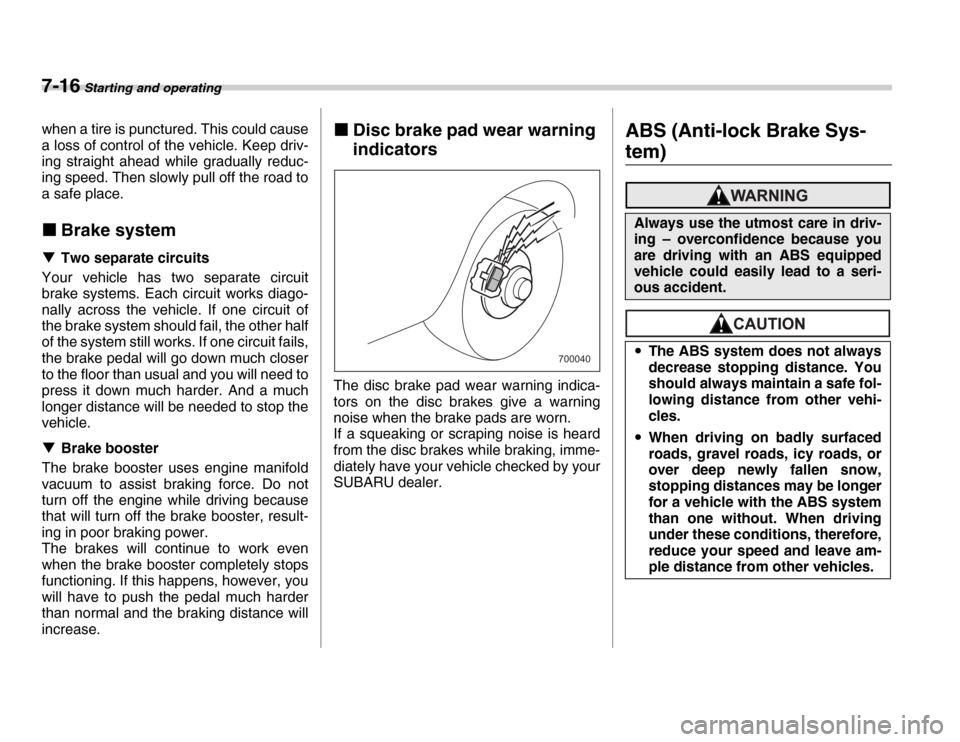
The disc brake pad wear warning indica-
tors on the disc brakes give a warning
noise when the brake pads are worn.
If a squeaking or scraping noise is heard
from the disc brakes while braking, imme-
diately have your vehicle checked by your
SUBARU dealer. ABS (Anti-lock Brake Sys-
tem)
700040
Always use the utmost care in driv-
ing – overconfidence because you
are driving with an ABS equipped
vehicle could easily lead to a seri-
ous accident. y
The ABS system does not always
decrease stopping distance. You
should always maintain a safe fol-
lowing distance from other vehi-
cles.
y When driving on badly surfaced
roads, gravel roads, icy roads, or
over deep newly fallen snow,
stopping distances may be longer
for a vehicle with the ABS system
than one without. When driving
under these conditions, therefore,
reduce your speed and leave am-
ple distance from other vehicles.
Page 225 of 356

8
Driving tips
New vehicle break-in driving – the first 1,000 miles (1,600 km) .................................... 8-2
Fuel economy hints ........................................... 8-2
Engine exhaust gas (Carbon monoxide) ........ 8-2
Catalytic converter ............................................. 8-3
Periodic inspections .......................................... 8-4
Driving in foreign countries .............................. 8-4
Driving tips for AWD vehicles ........................... 8-5
Off road driving .................................................. 8-6
Winter driving ..................................................... 8-7 Operation during cold weather .............................. 8-7
Driving on snowy and icy roads ............................ 8-9
Corrosion protection .............................................. 8-10
Snow tires ............................................................... 8-10
Tire chains ............................................................... 8-10
Rocking the vehicle ................................................ 8-11
Loading your vehicle ......................................... 8-11 Vehicle capacity weight ......................................... 8-12
GVWR and GAWR (Gross Vehicle Weight Rating and Gross Axle Weight Rating) ........................... 8-12
Roof rail and crossbar (if equipped) ..................... 8-13
Trailer hitch (if equipped) .................................. 8-16 Connecting a trailer ................................................ 8-16
When you do not tow a trailer ............................... 8-17
Trailer towing ...................................................... 8-18 Warranties and maintenance ................................. 8-18
Maximum load limits .............................................. 8-18 Trailer hitches ......................................................... 8-21
Connecting a trailer ................................................ 8-22
Trailer towing tips ................................................... 8-23
Page 226 of 356
8-2 Driving tips
Driving tipsNew vehicle break-in driving
– the first 1,000 miles (1,600
km)
The performance and long life of your ve-
hicle are dependent on how you handle
and care for your vehicle while it is new.
Follow these instructions during the first
1,000 miles (1,600 km):yDo not race the engine. And do not al-
low engine speed to exceed 4,000 rpm ex-
cept in an emergency. y Do not drive at one constant engine or
vehicle speed for a long time, either fast or
slow.y Avoid starting suddenly and rapid accel-
eration, except in an emergency. y Avoid hard braking, except in an emer-
gency.
The same break-in procedures should be
applied to an overhauled engine, newly
mounted engine or when brake pads or
brake linings are replaced with new ones.
Fuel economy hints
The following suggestions will help to
save your fuel. y Select the proper gear position for the
speed and road conditions. y Avoid sudden acceleration or decelera-
tion. Always accelerate gently until you
reach the desired speed. Then try to main-
tain that speed for as long as possible. y Do not pump the accelerator and avoid
racing the engine. y Avoid unnecessary engine idling.
y Keep the engine properly tuned.
y Keep the tires inflated to the correct
pressure shown on the tire placard, which
is located under the door latch on the driv-
er’s side. Low pressure will increase tire
wear and fuel consumption. y Use the air conditioner only when nec-
essary. y Keep the front and rear wheels in prop-
er alignment.y Avoid carrying unnecessary cargo. Engine exhaust gas (Carbon
monoxide)
y
Never inhale engine exhaust gas.
Engine exhaust gas contains car-
bon monoxide, a colorless and
odorless gas which is dangerous,
or even lethal, if inhaled.
yAlways properly maintain the en-
gine exhaust system to prevent
engine exhaust gas from entering
the vehicle.
yNever run the engine in a closed
space, such as a garage, except
for the brief time needed to drive
the vehicle in or out of it.
yAvoid remaining in a parked vehi-
cle for a lengthy time while the en-
gine is running. If that is unavoid-
able, then use the ventilation fan
to force fresh air into the vehicle.
yAlways keep the front ventilator
inlet grille free from snow, leaves
or other obstructions to ensure
that the ventilation system always
works properly.
Page 229 of 356
Driving tips 8-5
Driving tips for AWD vehicles
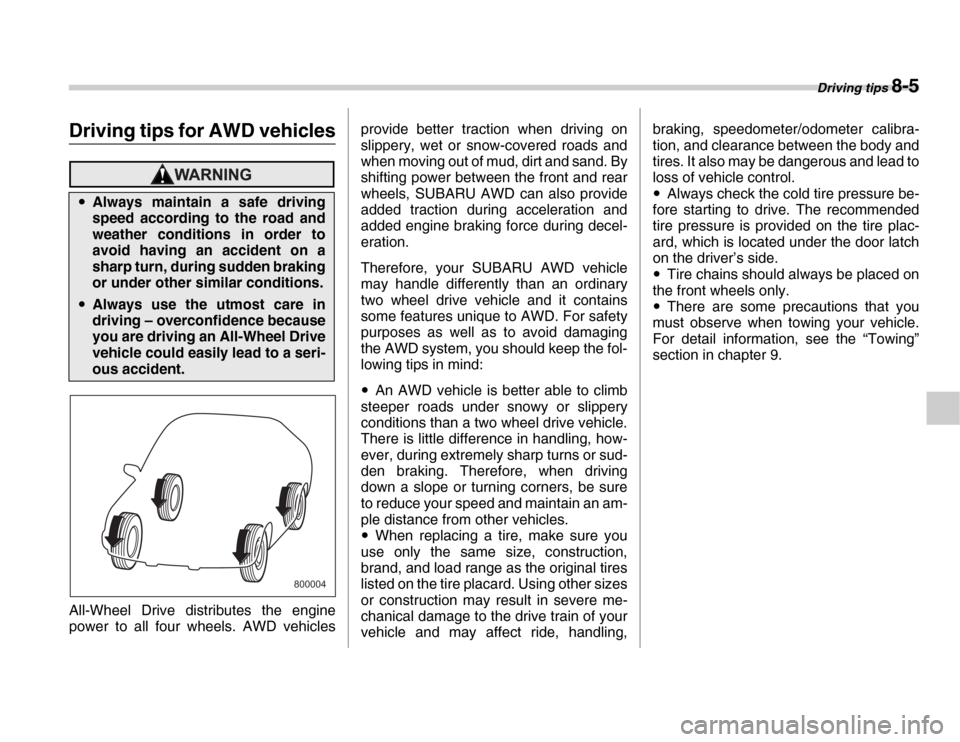
All-Wheel Drive distributes the engine
power to all four wheels. AWD vehiclesprovide better traction when driving on
slippery, wet or snow-covered roads and
when moving out of mud, dirt and sand. By
shifting power between the front and rear
wheels, SUBARU AWD can also provide
added traction during acceleration and
added engine braking force during decel-
eration.
Therefore, your SUBARU AWD vehicle
may handle differently than an ordinary
two wheel drive vehicle and it contains
some features unique to AWD. For safety
purposes as well as to avoid damaging
the AWD system, you should keep the fol-
lowing tips in mind: y
An AWD vehicle is better able to climb
steeper roads under snowy or slippery
conditions than a two wheel drive vehicle.
There is little difference in handling, how-
ever, during extremely sharp turns or sud-
den braking. Therefore, when driving
down a slope or turning corners, be sure
to reduce your speed and maintain an am-
ple distance from other vehicles. y When replacing a tire, make sure you
use only the same size, construction,
brand, and load range as the original tires
listed on the tire placard. Using other sizes
or construction may result in severe me-
chanical damage to the drive train of your
vehicle and may affect ride, handling, braking, speedometer/odometer calibra-
tion, and clearance between the body and
tires. It also may be dangerous and lead to
loss of vehicle control. y
Always check the cold tire pressure be-
fore starting to drive. The recommended
tire pressure is provided on the tire plac-
ard, which is located under the door latch
on the driver’s side. y Tire chains should always be placed on
the front wheels only. y There are some precautions that you
must observe when towing your vehicle.
For detail information, see the “Towing”
section in chapter 9.
y Always maintain a safe driving
speed according to the road and
weather conditions in order to
avoid having an accident on a
sharp turn, during sudden braking
or under other similar conditions.
yAlways use the utmost care in
driving – overconfidence because
you are driving an All-Wheel Drive
vehicle could easily lead to a seri-
ous accident.
800004
Page 230 of 356
8-6 Driving tips
Off road driving
Because of the AWD feature and higher
ground clearance, your SUBARU can be
driven on ordinary roads or off-road. But
please keep in mind that an AWD SUBA-
RU is a passenger car and is neither a
conventional off-road vehicle nor an all-
terrain vehicle. If you do take your SUBA-
RU off-road, certain common sense pre-
cautions such as the following should be
taken: yMake certain that you and all of your
passengers are wearing seatbelts. y Carry some emergency equipment,
such as a towing rope or chain, a shovel,
wheel blocks, first aid kit and cell phone or citizens band radio. y
Drive carefully. Do not take unneces-
sary risks by driving in dangerous areas or
over rough terrain. y Slow down and employ extra caution at
all times. When driving off-road, you will
not have the benefit of marked traffic
lanes, banked curves, traffic signs and the
like. y Do not drive across steep slopes. In-
stead, drive either straight up or straight
down the slopes. A vehicle can much
more easily tip over sideways than it can
end over end. Avoid driving straight up or
down slopes that are too steep. y Avoid sharp turning maneuvers, espe-
cially at higher speeds. y Do not grip the inside or spokes of the
steering wheel. A bad bump could jerk the
wheel and injure your hands. Instead drive
with your fingers and thumbs on the out-
side of the rim. y If driving through water, such as when
crossing shallow streams, first check the
depth of the water and the bottom of the
stream bed for firmness and ensure that
the bed of the stream is flat. Drive slowly
and completely through the stream. The
water should be shallow enough that it
does not reach the vehicle’s undercar-
riage. Water entering the engine air intake
or the exhaust pipe or water splashing onto electrical parts may damage your ve-
hicle and may cause it to stall. Never at-
tempt to drive through rushing water; re-
gardless of its depth, it can wash away the
ground from under your tires, resulting in
possible loss of traction and even vehicle
rollover. y
Always check your brakes for effective-
ness immediately after driving in sand,
mud or water. Do this by driving slowly
and stepping on the brake pedal. Repeat
that process several times to dry out the
brake discs and brake pads. y Do not drive or park over or near flam-
mable materials such as dry grass or fall-
en leaves, as they may burn easily. The
exhaust system is very hot while the en-
gine is running and right after the engine
stops. This could create a fire hazard. y After driving through tall grass, mud,
rocks, sand, rivers, etc., check that there
is no grass, bush, paper, rags, stones,
sand, etc. adhering to or trapped on the
underbody. Clear off any such matter from
the underbody. If the vehicle is used with
these materials trapped or adhering to the
underbody, a mechanical breakdown or
fire could occur. y Secure all cargo carried inside the vehi-
cle and make certain that it is not piled
higher than the seatbacks. During sudden
stops or jolts, unsecured cargo could be
y Always maintain a safe driving
speed according to the road and
weather conditions in order to
avoid having an accident on a
sharp turn, during sudden braking
or under other similar conditions.
yAlways use the utmost care in
driving – overconfidence because
you are driving an All-Wheel Drive
vehicle could easily lead to a seri-
ous accident.
Page 231 of 356
Driving tips 8-7
– CONTINUED –
thrown around in the vehicle and cause in-
jury. Do not pile heavy loads on the roof.
Those loads raise the vehicle’s center of
gravity and make it more prone to tip over. y
If you must rock the vehicle to free it
from sand or mud, depress the accelera-
tor pedal slightly and move the selector le-
ver back and forth between “D” and “R” re-
peatedly. Do not race the engine. For the
best possible traction, avoid spinning the
wheels when trying to free the vehicle.
When the road surface is extremely slip-
pery, you can obtain better traction by
starting the vehicle with the transmission
in 2nd than 1st (both for MT and AT). y Never equip your vehicle with tires larg-
er than those specified in this manual.y Frequent driving of an AWD vehicle un-
der hard-driving conditions such as rough
roads or off roads will necessitate more
frequent replacement of engine oil, brake
fluid and transmission oil than that speci-
fied in the maintenance schedule de-
scribed in the “Warranty and Maintenance
Booklet”.
Remember that damage done to your
SUBARU while operating it off-road and
not using common sense precautions
such as those listed above is not eligible
for warranty coverage.y Wash the vehicle’s underbody after off-
road driving. Suspension components are particularly prone to dirt buildup, so they
need to be washed thoroughly.
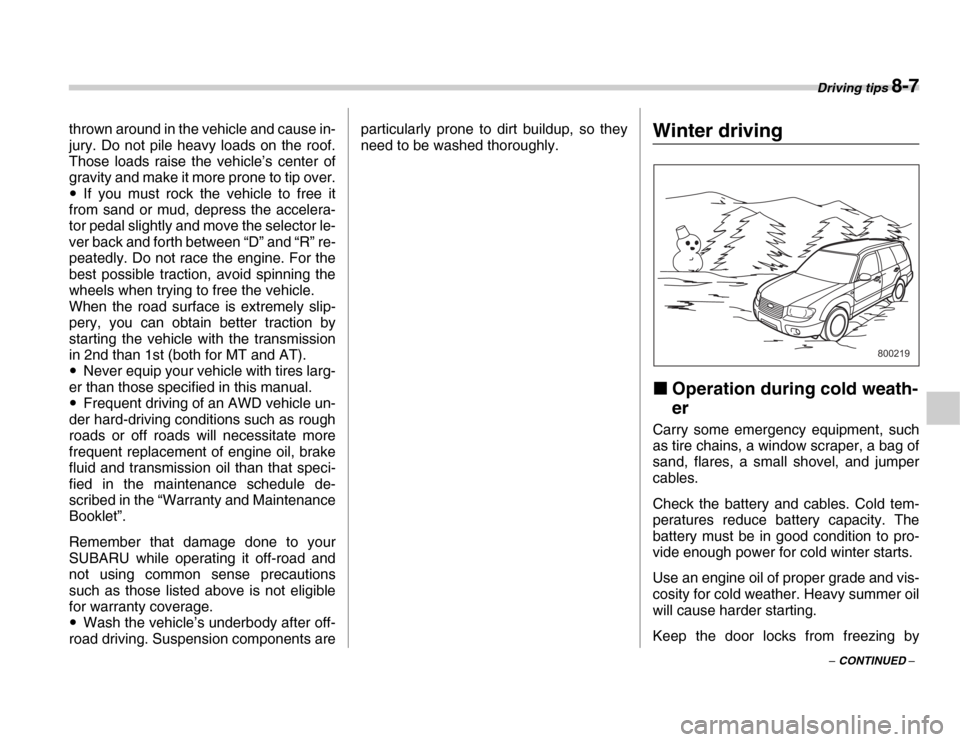
Winter driving „
Operation during cold weath- er
Carry some emergency equipment, such
as tire chains, a window scraper, a bag of
sand, flares, a small shovel, and jumper
cables.
Check the battery and cables. Cold tem-
peratures reduce battery capacity. The
battery must be in good condition to pro-
vide enough power for cold winter starts.
Use an engine oil of proper grade and vis-
cosity for cold weather. Heavy summer oil
will cause harder starting.
Keep the door locks from freezing by
800219
Page 232 of 356
8-8 Driving tips
squirting them with deicer or glycerin.
Forcing a frozen door open may damage
or separate the rubber weather strips
around the door. If the door is frozen, use
hot water to melt the ice, and afterwards
thoroughly wipe the water away.
Use a windshield washer fluid that con-
tains an antifreeze solution. Do not use
engine antifreeze or other substitutes be-
cause they may damage the paint of the
vehicle.
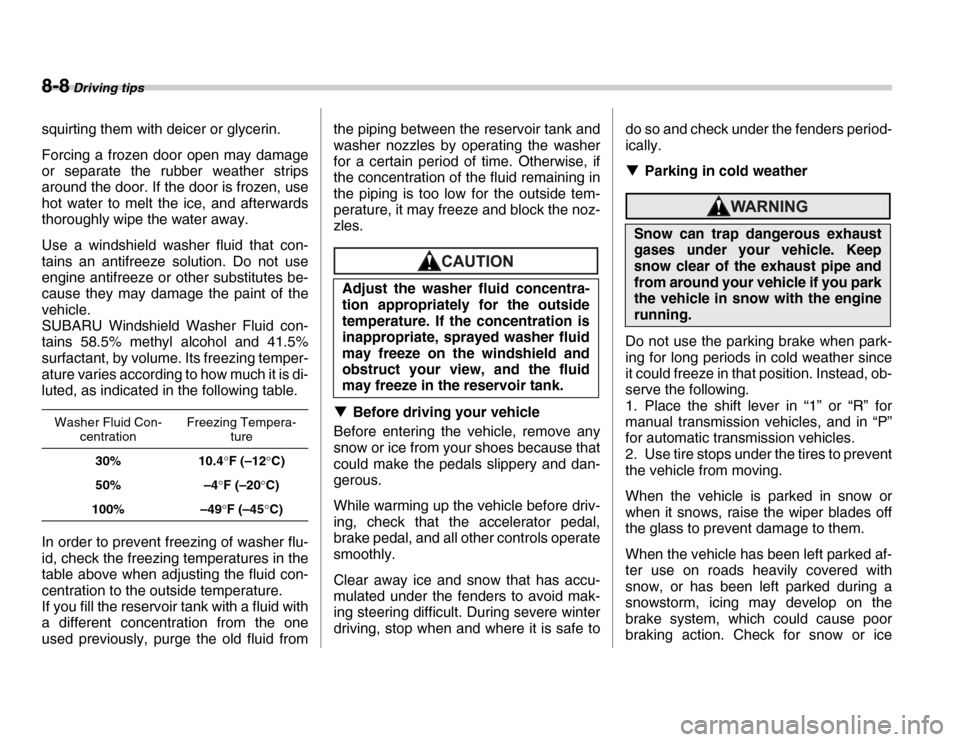
SUBARU Windshield Washer Fluid con-
tains 58.5% methyl alcohol and 41.5%
surfactant, by volume. Its freezing temper-
ature varies according to how much it is di-
luted, as indicated in the following table.
In order to prevent freezing of washer flu-
id, check the freezing temperatures in the
table above when adjusting the fluid con-
centration to the outside temperature.
If you fill the reservoir tank with a fluid with
a different concentration from the one
used previously, purge the old fluid fromthe piping between the reservoir tank and
washer nozzles by operating the washer
for a certain period of time. Otherwise, if
the concentration of the fluid remaining in
the piping is too low for the outside tem-
perature, it may freeze and block the noz-
zles.
T
Before driving your vehicle
Before entering the vehicle, remove any
snow or ice from your shoes because that
could make the pedals slippery and dan-
gerous.
While warming up the vehicle before driv-
ing, check that the accelerator pedal,
brake pedal, and all other controls operate
smoothly.
Clear away ice and snow that has accu-
mulated under the fenders to avoid mak-
ing steering difficult. During severe winter
driving, stop when and where it is safe to do so and check under the fenders period-
ically. T
Parking in cold weather
Do not use the parking brake when park-
ing for long periods in cold weather since
it could freeze in that position. Instead, ob-
serve the following.
1. Place the shift lever in “1” or “R” for
manual transmission vehicles, and in “P”
for automatic transmission vehicles.
2. Use tire stops under the tires to prevent
the vehicle from moving.
When the vehicle is parked in snow or
when it snows, raise the wiper blades off
the glass to prevent damage to them.
When the vehicle has been left parked af-
ter use on roads heavily covered with
snow, or has been left parked during a
snowstorm, icing may develop on the
brake system, which could cause poor
braking action. Check for snow or ice
Washer Fluid Con-
centration Freezing Tempera-
ture
30% 10.4 qF (–12 qC)
50% –4 qF (–20 qC)
100% –49 qF (–45 qC)
Adjust the washer fluid concentra-
tion appropriately for the outside
temperature. If the concentration is
inappropriate, sprayed washer fluid
may freeze on the windshield and
obstruct your view, and the fluid
may freeze in the reservoir tank.
Snow can trap dangerous exhaust
gases under your vehicle. Keep
snow clear of the exhaust pipe and
from around your vehicle if you park
the vehicle in snow with the engine
running.
Page 234 of 356
8-10 Driving tips
zero temperatures. Blades of this type
give superior wiping performance in
snowy conditions. Be sure to use blades
that are suitable for your vehicle.
NOTE
When the season requiring non-freez-
ing type wiper blades is over, replace
them with standard wiper blades. „Corrosion protection
Refer to the “Corrosion protection” section
(chapter 10). „
Snow tires
Your vehicle is equipped with “all season
tires” as original equipment, which are de-
signed to provide an adequate measure of
traction, handling and braking perfor-
mance in year-round driving. In winter, it
may be possible to enhance performance
through use of tires designed specifically
for winter driving conditions.
When you choose to install winter tires on
your vehicle, be sure to use the correct tire
size and type. You must install four winter
tires that are of the same size, construc-
tion, brand and load range and you should
never mix radial, belted bias or bias tires
since this may result in dangerous han-
dling characteristics. When you choose a
tire, make sure that there is enough clear-
ance between the tire and vehicle body.
Remember to drive with care at all times
regardless of the type of tires on your ve-
hicle. „Tire chains
Driving on snowy grades or icy roads may
require the use of tire chains, in which
case put the chains on the front wheels
only. Use only SAE class S type chains
that are of the correct size for your tires so
as not to damage the vehicle body or sus-
pension.
When driving with tire chains, drive at
During high-speed driving, non-
freezing type wiper blades may not
perform as well as standard wiper
blades. If this happens, reduce the
vehicle speed.
y
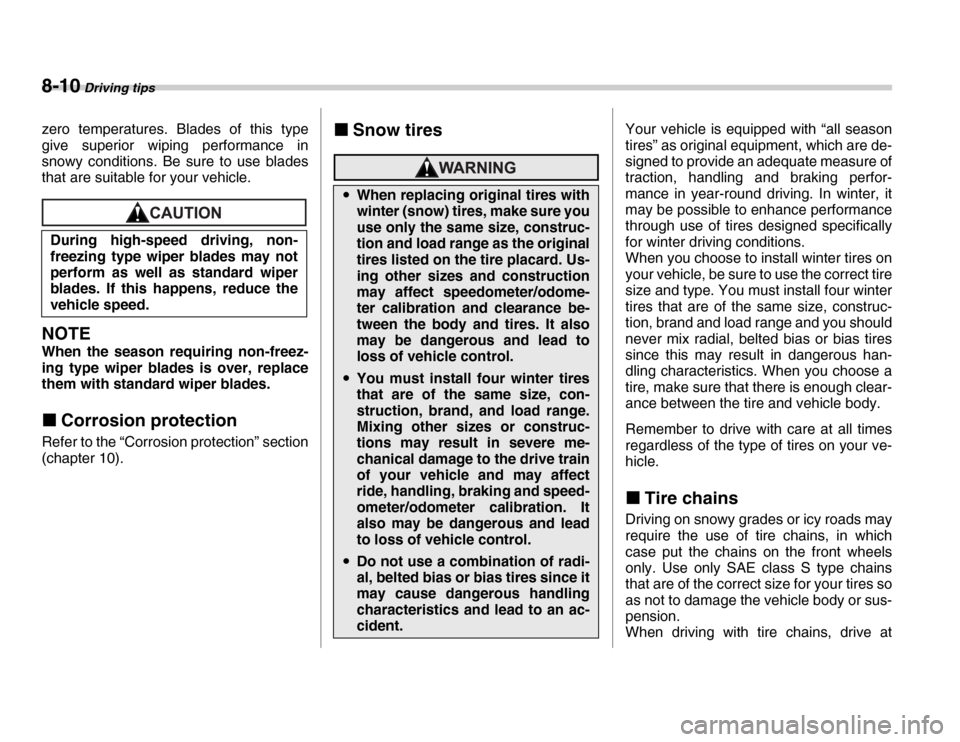
When replacing original tires with
winter (snow) tires, make sure you
use only the same size, construc-
tion and load range as the original
tires listed on the tire placard. Us-
ing other sizes and construction
may affect speedometer/odome-
ter calibration and clearance be-
tween the body and tires. It also
may be dangerous and lead to
loss of vehicle control.
yYou must install four winter tires
that are of the same size, con-
struction, brand, and load range.
Mixing other sizes or construc-
tions may result in severe me-
chanical damage to the drive train
of your vehicle and may affect
ride, handling, braking and speed-
ometer/odometer calibration. It
also may be dangerous and lead
to loss of vehicle control.
yDo not use a combination of radi-
al, belted bias or bias tires since it
may cause dangerous handling
characteristics and lead to an ac-
cident.