ignition SUBARU FORESTER 2007 SG / 2.G Repair Manual
[x] Cancel search | Manufacturer: SUBARU, Model Year: 2007, Model line: FORESTER, Model: SUBARU FORESTER 2007 SG / 2.GPages: 356, PDF Size: 5.89 MB
Page 206 of 356
7-8 Starting and operating
1) Turn the ignition switch to the “OFF”
position and wait for at least 10 sec-
onds. After checking that the parking
brake is firmly set, turn the ignition
switch to the “START” position while de-
pressing the accelerator pedal slightly
(about a quarter of the full stroke). Re-
lease the accelerator pedal as soon as
the engine starts.
2) If this fails to start the engine, turn the
ignition switch back to the “OFF” posi-
tion and wait for at least 10 seconds.
Then fully depress the accelerator ped-
al and turn the ignition switch to the
“START” position. If the engine starts,
quickly release the accelerator pedal.
3) If this fails to start the engine, turn the
ignition switch again to the “OFF” posi-
tion. After waiting for 10 seconds or
longer, turn the ignition switch to the
“START” position without depressing
the accelerator pedal.
4) If the engine still refuses to start, con-
tact your nearest SUBARU dealer for
assistance.
6. Confirm that all warning and indicator
lights have gone out after the engine has
started. The fuel injection system auto-
matically lowers the idle speed as the en-
gine warms up.
While the engine is warming up, make
sure that the selector lever is at the “P” or “N” position and that the parking brake is
applied.
NOTE
The engine may be difficult to start
when the battery has been disconnect-
ed and reconnected (for maintenance
or other purposes). This difficulty is
caused by the electronically controlled
throttle’s self-diagnosis function. To
overcome it, keep the ignition switch in
the “ON” position for approximately 10
seconds before starting the engine.
Stopping the engine
The ignition switch should be turned off
only when the vehicle is stopped and the
engine is idling.
If you restart the engine while the
vehicle is moving, shift the selector
lever into the “N” position. Do not
attempt to place the selector lever of
a moving vehicle into the “P” posi-
tion.
Do not stop the engine when the ve-
hicle is moving. This will cause loss
of power to the power steering and
the brake booster, making steering
and braking more difficult. It could
also result in accidental activation
of the “LOCK” position on the igni-
tion switch, causing the steering
wheel to lock.
Page 210 of 356
7-12 Starting and operating
sure safe starting of the vehicle.
To shift the selector lever from the “P” to
the any other position, you have to de-
press the brake pedal fully when the igni-
tion switch is in the “ON” position. This
prevents the vehicle from lurching when it
is started.
If the shift lever does not move from the
“P” position with the brake pedal de-
pressed, refer to the “Shift lock release”
section in this chapter. TR (Reverse)
This position is for backing the vehicle.
To shift from the “N” to “R” position, first
stop the vehicle completely then move the
lever to the “R” position. T N (Neutral)
This position is for restarting a stalled en-
gine.
In this position the wheels and transmis-
sion are not locked. In this position, the
transmission is neutral; the vehicle will roll
freely, even on the slightest incline unless
the parking brake or foot brake is on.
Avoid coasting with the transmission neu-
tral.
During coasting, there is no engine brak-
ing effect.NOTE
If you stop the engine with the selector
lever in the “N” position, move the se-
lector lever to the “P” position immedi-
ately. Otherwise, you may find that the
selector lever soon cannot be moved
to the “P” position. If you find that the
selector lever cannot be moved from
the “N” position to the “P” position,
turn the ignition switch to the “ON” po-
sition and try again.
T D (Drive)
This position is for normal driving.
The transmission automatically shifts into
a suitable gear from 1st to 4th according to
the vehicle speed and the acceleration
you require.
When more acceleration is required in this
position, press the accelerator pedal fully
to the floor and hold that position. The
transmission will automatically downshift
to 3rd, 2nd or 1st gear. When you release
the pedal, the transmission will return to the original gear position. V
While climbing a grade
When driving up hill, undesired upshift to
4th gear is prevented from taking place
when the accelerator pedal is released.
This minimizes the chances of subse-
quent downshifting to a lower gear when
accelerating again. This prevents repeat-
ed upshifting and downshifting resulting in
a smoother operation of the vehicle.
NOTE
The transmission may downshift to
2nd or 1st gear, depending on the way
the accelerator pedal is pressed to ac-
celerate the vehicle again. V While going down a hill
When descending a steep hill, depressing
the brake pedal will cause the transmis-
sion to downshift to 3rd gear, thus apply-
ing engine braking. Reacceleration for a
short time will cause the transmission to
upshift normally.
NOTE
In some cases, depressing the brake
pedal on a downhill grade does not re-
sult in an automatic downshift to 3rd
gear. This can happen when the auto-
matic transmission fluid temperature is
very low, for example, during driving
Do not drive the vehicle with the se-
lector lever in the “N” (neutral) posi-
tion. Engine braking has no effect in
this condition and the risk of an ac-
cident is consequently increased.
Page 212 of 356
7-14 Starting and operating
yAlways set the parking brake when
parking your vehicle. Do not hold the vehi-
cle with only the transmission. y Do not keep the vehicle in a stationary
position on an uphill grade by using the
“D”, “3”, “2”, or “1” position. Use the brake
instead. „ Shift lock release
If the selector lever does not move from
the “P” position with the brake pedal de-
pressed and the ignition switch in the “ON”
position, perform the following steps:
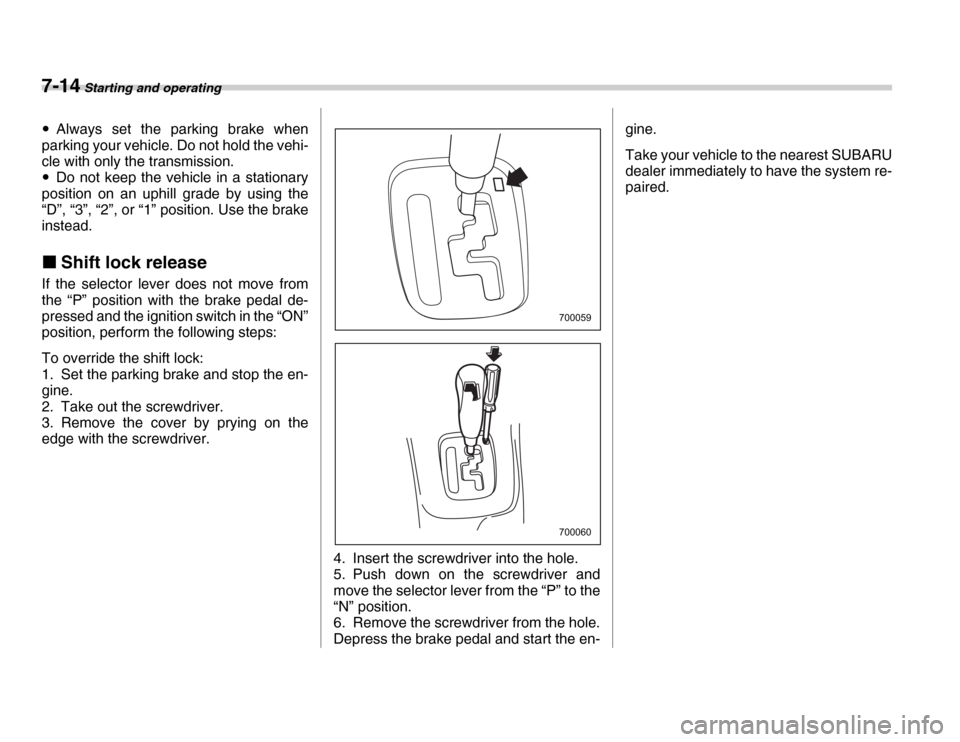
To override the shift lock:
1. Set the parking brake and stop the en-
gine.
2. Take out the screwdriver.
3. Remove the cover by prying on the
edge with the screwdriver.
4. Insert the screwdriver into the hole.
5. Push down on the screwdriver and
move the selector lever from the “P” to the
“N” position.
6. Remove the screwdriver from the hole.
Depress the brake pedal and start the en- gine.
Take your vehicle to the nearest SUBARU
dealer immediately to have the system re-
paired.
700059
700060
Page 215 of 356
Starting and operating 7-17
– CONTINUED –
The ABS system prevents the lock-up of
wheels which may occur during sudden
braking or braking on slippery road surfac-
es. This helps prevent the loss of steering
control and directional stability caused by
wheel lock-up.
When the ABS system is operating, you
may hear a chattering noise or feel a slight
vibration in the brake pedal. This is normal
when the ABS operates.
The ABS system will not operate when the
vehicle speed is below approximately 6
mph (10 km/h). „
ABS system self-check
You may feel a slight shock in the brake
pedal and hear the operating sound of
ABS from the engine compartment just af-
ter the vehicle is started. This is caused by
an automatic functional test of the ABS
system being carried out and does not in-
dicate any abnormal condition. „
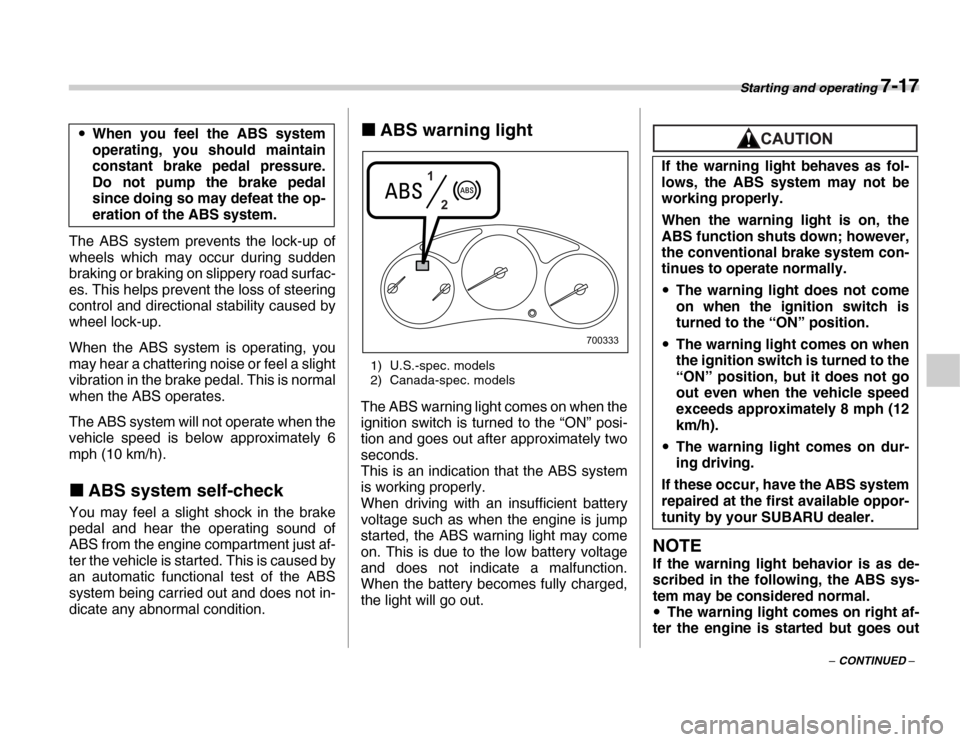
ABS warning light
1) U.S.-spec. models
2) Canada-spec. models
The ABS warning light comes on when the
ignition switch is turned to the “ON” posi-
tion and goes out after approximately two
seconds.
This is an indication that the ABS system
is working properly.
When driving with an insufficient battery
voltage such as when the engine is jump
started, the ABS warning light may come
on. This is due to the low battery voltage
and does not indicate a malfunction.
When the battery becomes fully charged,
the light will go out.
NOTE
If the warning light behavior is as de-
scribed in the following, the ABS sys-
tem may be considered normal. y The warning light comes on right af-
ter the engine is started but goes out
y
When you feel the ABS system
operating, you should maintain
constant brake pedal pressure.
Do not pump the brake pedal
since doing so may defeat the op-
eration of the ABS system.
1
2
700333 If the warning light behaves as fol-
lows, the ABS system may not be
working properly.
When the warning light is on, the
ABS function shuts down; however,
the conventional brake system con-
tinues to operate normally. y
The warning light does not come
on when the ignition switch is
turned to the “ON” position.
y The warning light comes on when
the ignition switch is turned to the
“ON” position, but it does not go
out even when the vehicle speed
exceeds approximately 8 mph (12
km/h).
y The warning light comes on dur-
ing driving.
If these occur, have the ABS system
repaired at the first available oppor-
tunity by your SUBARU dealer.
Page 220 of 356
7-22 Starting and operating
Cruise control
Cruise control enables you to maintain a
constant vehicle speed without holding
your foot on the accelerator pedal and it is
operative when the vehicle speed is 25
mph (40 km/h) or more. Make sure the
main switch is turned “OFF” when the
cruise control is not in use to avoid unin-
tentionally setting the cruise control.
NOTE
If you move the cruise control lever or
press the main switch button while
turning the ignition switch “ON”, the
cruise control function is deactivated
and the “CRUISE” indicator light flash-
es. To reactivate the cruise control
function, turn the ignition switch back
to the “ACC” or “LOCK” position, and
then turn it again to the “ON” position. „
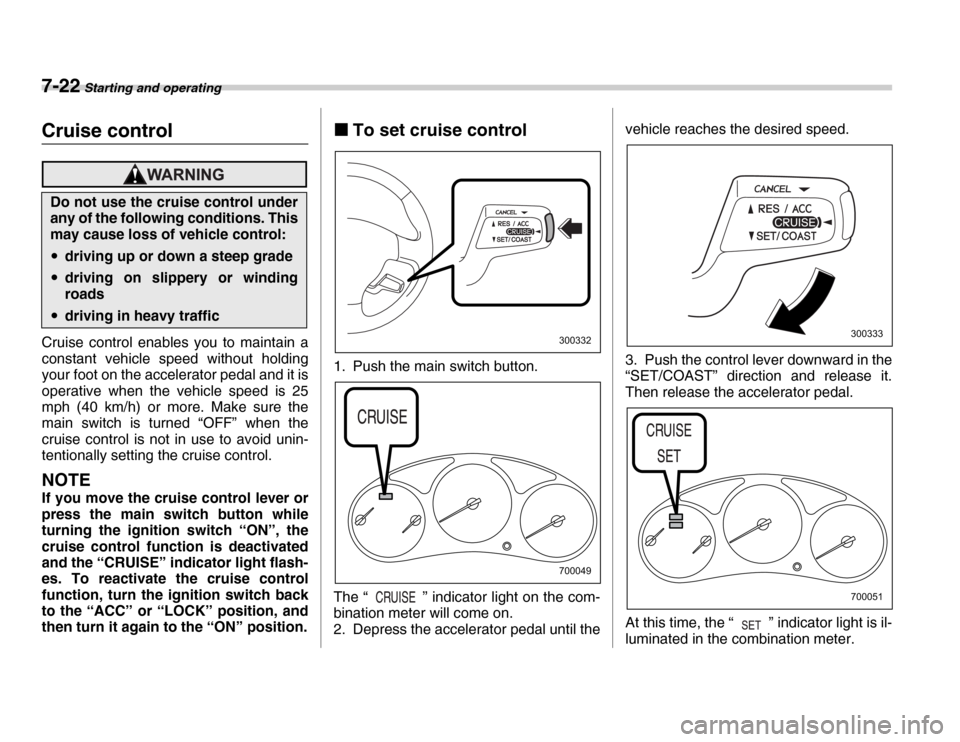
To set cruise control
0
1. Push the main switch button.
The “ ” indicator light on the com-
bination meter will come on.
2. Depress the accelerator pedal until the vehicle reaches the desired speed.
3. Push the control lever downward in the
“SET/COAST” direction and release it.
Then release the accelerator pedal.
At this time, the “ ” indicator light is il-
luminated in the combination meter.
Do not use the cruise control under
any of the following conditions. This
may cause loss of vehicle control:
y
driving up or down a steep grade
ydriving on slippery or winding
roads
ydriving in heavy traffic
300332
700049
300333
700051
Page 221 of 356
Starting and operating 7-23
– CONTINUED –
The vehicle will maintain the desired
speed.
Vehicle speed can be temporarily in-
creased while driving with the cruise con-
trol activated. Simply depress the acceler-
ator pedal to accelerate the vehicle. When
the accelerator pedal is released, the ve-
hicle will return to and maintain the previ-
ous cruising speed. „
To temporarily cancel the
cruise control
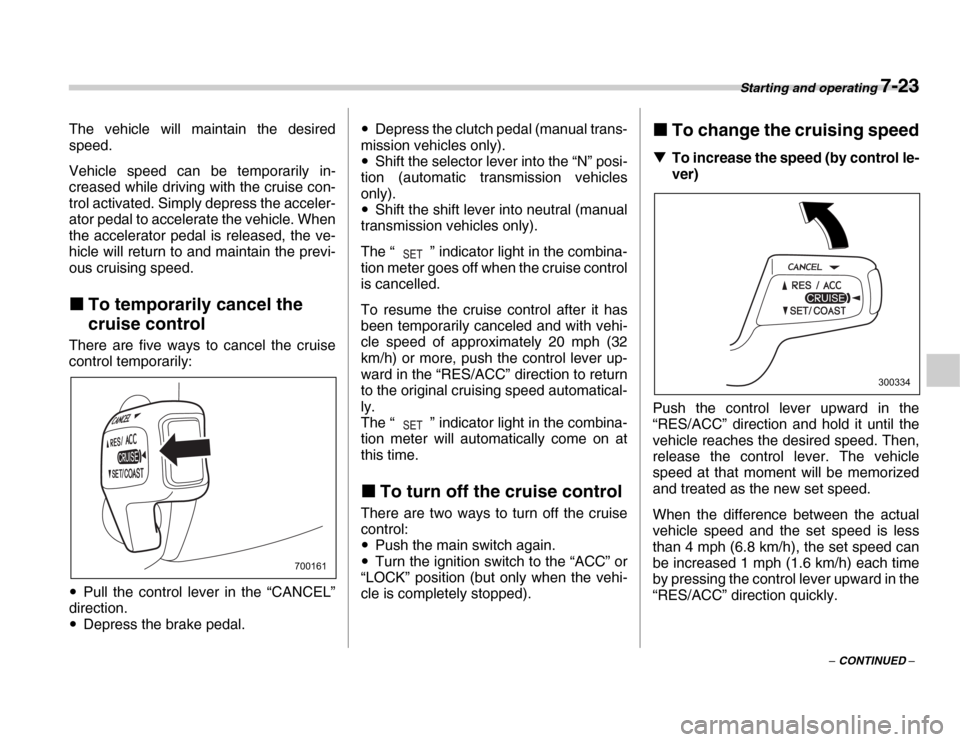
There are five ways to cancel the cruise
control temporarily: y Pull the control lever in the “CANCEL”
direction. y Depress the brake pedal. y
Depress the clutch pedal (manual trans-
mission vehicles only). y Shift the selector lever into the “N” posi-
tion (automatic transmission vehicles
only). y Shift the shift lever into neutral (manual
transmission vehicles only).
The “ ” indicator light in the combina-
tion meter goes off when the cruise control
is cancelled.
To resume the cruise control after it has
been temporarily canceled and with vehi-
cle speed of approximately 20 mph (32
km/h) or more, push the control lever up-
ward in the “RES/ACC” direction to return
to the original cruising speed automatical-
ly.
The “ ” indicator light in the combina-
tion meter will automatically come on at
this time.
„ To turn off the cruise control
There are two ways to turn off the cruise
control: y Push the main switch again.
y Turn the ignition switch to the “ACC” or
“LOCK” position (but only when the vehi-
cle is completely stopped). „
To change the cruising speed
T To increase the speed (by control le-
ver)
Push the control lever upward in the
“RES/ACC” direction and hold it until the
vehicle reaches the desired speed. Then,
release the control lever. The vehicle
speed at that moment will be memorized
and treated as the new set speed.
When the difference between the actual
vehicle speed and the set speed is less
than 4 mph (6.8 km/h), the set speed can
be increased 1 mph (1.6 km/h) each time
by pressing the control lever upward in the
“RES/ACC” direction quickly.
700161
300334
Page 227 of 356
Driving tips 8-3
– CONTINUED –
NOTE
Due to the expansion and contraction
of the metals used in the manufacture
of the exhaust system, you may hear a
crackling sound coming from the ex-
haust system for a short time after the
engine has been shut off. This sound is
normal.
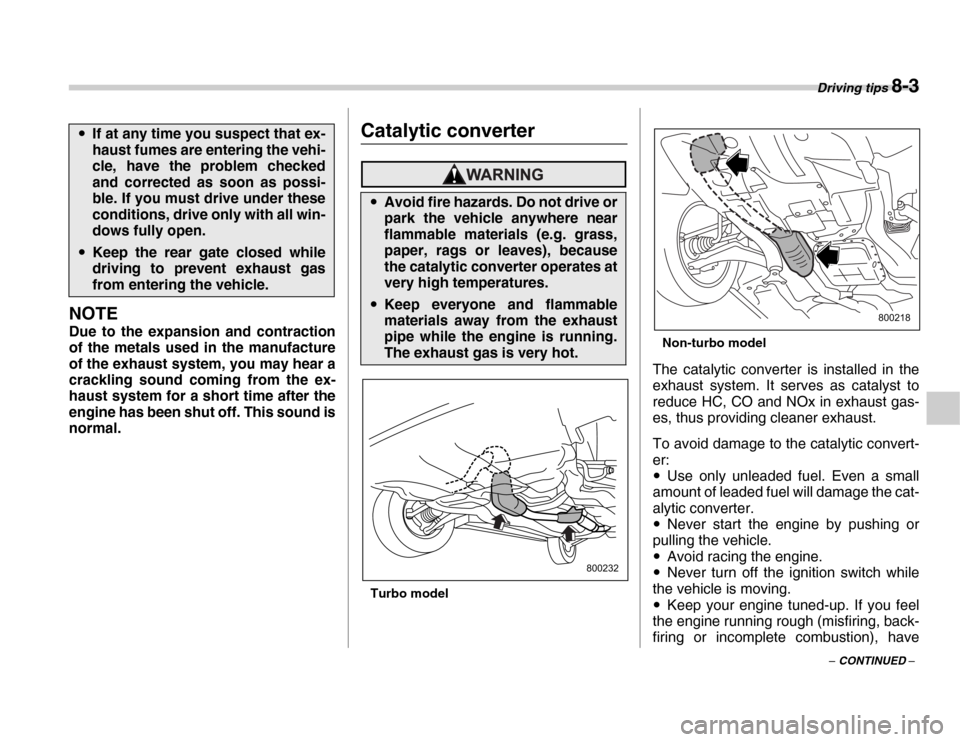
Catalytic converter
Turbo model Non-turbo model
The catalytic converter is installed in the
exhaust system. It serves as catalyst to
reduce HC, CO and NOx in exhaust gas-
es, thus providing cleaner exhaust.
To avoid damage to the catalytic convert- er: y Use only unleaded fuel. Even a small
amount of leaded fuel will damage the cat-
alytic converter. y Never start the engine by pushing or
pulling the vehicle. y Avoid racing the engine.
y Never turn off the ignition switch while
the vehicle is moving.y Keep your engine tuned-up. If you feel
the engine running rough (misfiring, back-
firing or incomplete combustion), have
y If at any time you suspect that ex-
haust fumes are entering the vehi-
cle, have the problem checked
and corrected as soon as possi-
ble. If you must drive under these
conditions, drive only with all win-
dows fully open.
yKeep the rear gate closed while
driving to prevent exhaust gas
from entering the vehicle.
y Avoid fire hazards. Do not drive or
park the vehicle anywhere near
flammable materials (e.g. grass,
paper, rags or leaves), because
the catalytic converter operates at
very high temperatures.
yKeep everyone and flammable
materials away from the exhaust
pipe while the engine is running.
The exhaust gas is very hot.
800232
800218
Page 252 of 356
9-2 In case of emergency
In c ase of e me rge ncyIf you park your vehicle in
case of an emergency
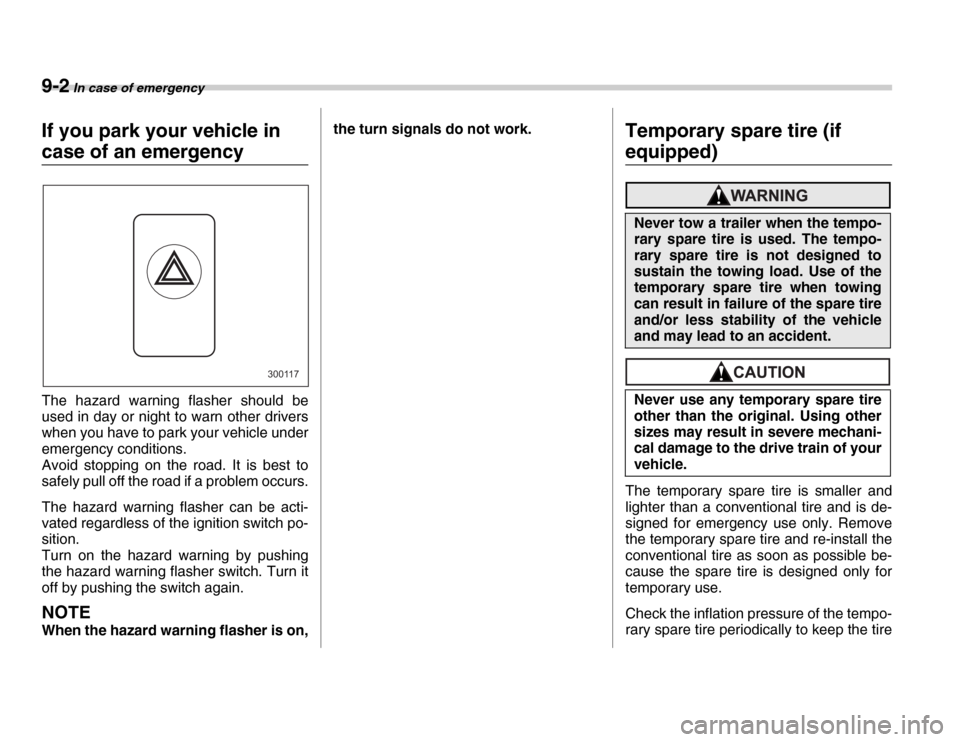
The hazard warning flasher should be
used in day or night to warn other drivers
when you have to park your vehicle under
emergency conditions.
Avoid stopping on the road. It is best to
safely pull off the road if a problem occurs.
The hazard warning flasher can be acti-
vated regardless of the ignition switch po-
sition.
Turn on the hazard warning by pushing
the hazard warning flasher switch. Turn it
off by pushing the switch again.
NOTE
When the hazard warning flasher is on, the turn signals do not work.
Temporary spare tire (if
equipped)
The temporary spare tire is smaller and
lighter than a conventional tire and is de-
signed for emergency use only. Remove
the temporary spare tire and re-install the
conventional tire as soon as possible be-
cause the spare tire is designed only for
temporary use.
Check the inflation pressure of the tempo-
rary spare tire periodically to keep the tire
300117
Never tow a trailer when the tempo-
rary spare tire is used. The tempo-
rary spare tire is not designed to
sustain the towing load. Use of the
temporary spare tire when towing
can result in failure of the spare tire
and/or less stability of the vehicle
and may lead to an accident.
Never use any temporary spare tire
other than the original. Using other
sizes may result in severe mechani-
cal damage to the drive train of your
vehicle.
Page 262 of 356
9-12 In case of emergency
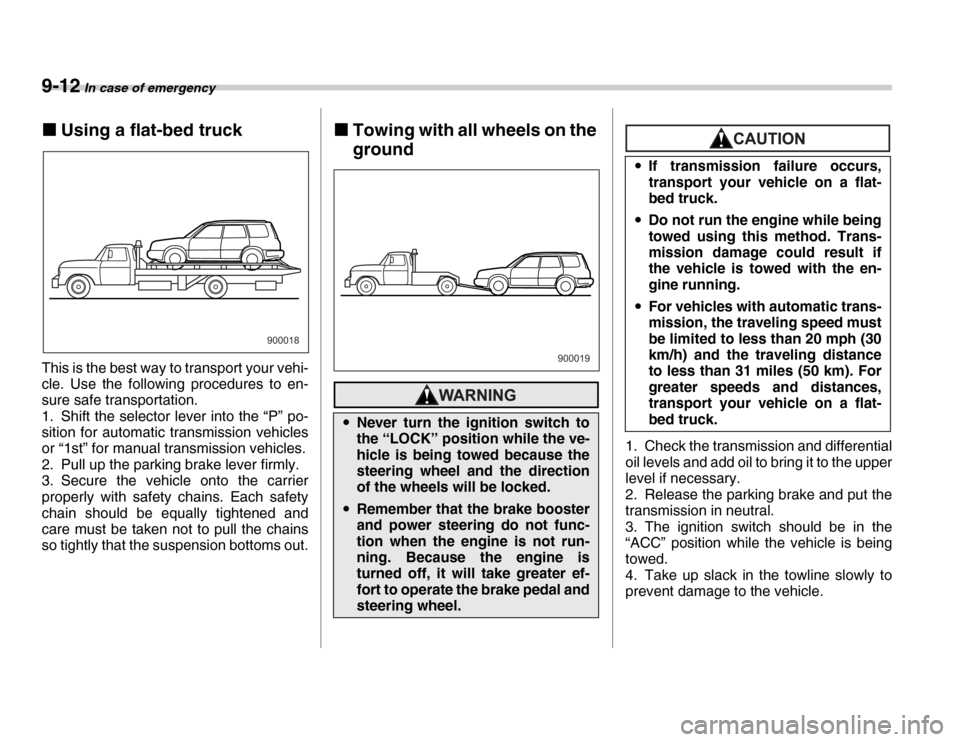
„Using a flat-bed truck
This is the best way to transport your vehi-
cle. Use the following procedures to en-
sure safe transportation.
1. Shift the selector lever into the “P” po-
sition for automatic transmission vehicles
or “1st” for manual transmission vehicles.
2. Pull up the parking brake lever firmly.
3. Secure the vehicle onto the carrier
properly with safety chains. Each safety
chain should be equally tightened and
care must be taken not to pull the chains
so tightly that the suspension bottoms out. „
Towing with all wheels on the ground
1. Check the transmission and differential
oil levels and add oil to bring it to the upper
level if necessary.
2. Release the parking brake and put the
transmission in neutral.
3. The ignition switch should be in the
“ACC” position while the vehicle is being
towed.
4. Take up slack in the towline slowly to
prevent damage to the vehicle.
900018
yNever turn the ignition switch to
the “LOCK” position while the ve-
hicle is being towed because the
steering wheel and the direction
of the wheels will be locked.
yRemember that the brake booster
and power steering do not func-
tion when the engine is not run-
ning. Because the engine is
turned off, it will take greater ef-
fort to operate the brake pedal and
steering wheel.
900019
yIf transmission failure occurs,
transport your vehicle on a flat-
bed truck.
y Do not run the engine while being
towed using this method. Trans-
mission damage could result if
the vehicle is towed with the en-
gine running.
y For vehicles with automatic trans-
mission, the traveling speed must
be limited to less than 20 mph (30
km/h) and the traveling distance
to less than 31 miles (50 km). For
greater speeds and distances,
transport your vehicle on a flat-
bed truck.
Page 276 of 356
11 - 4 Maintenance and service
„Before checking or servicing
in the engine compartment
„When you do checking or ser-
vicing in the engine compart-
ment while the engine is run-ning
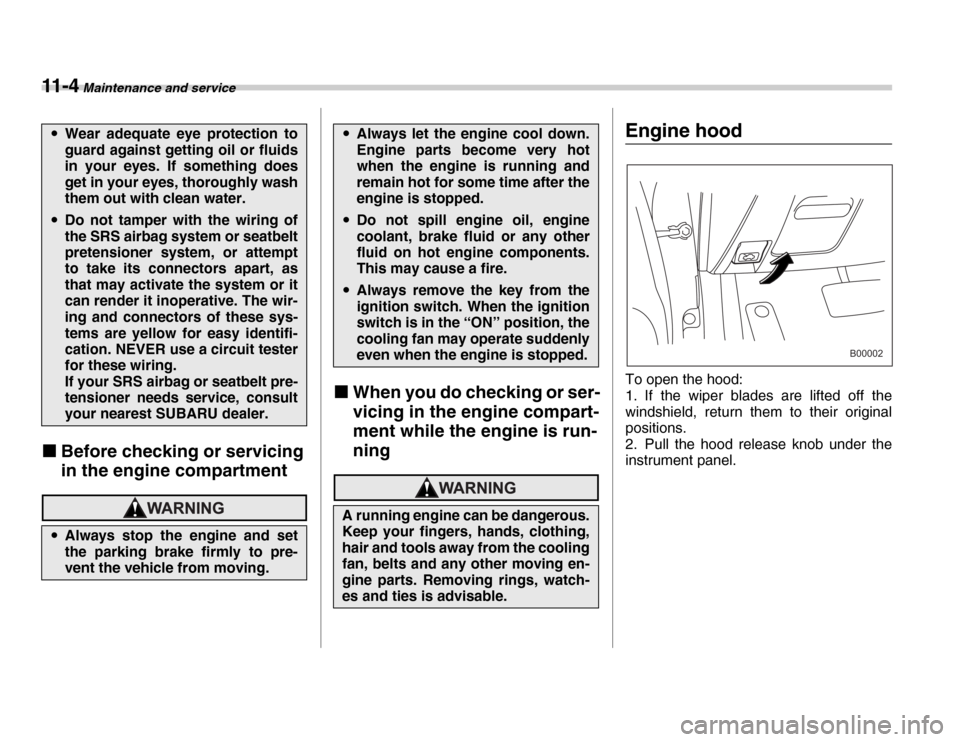
Engine hood
0
To open the hood:
1. If the wiper blades are lifted off the
windshield, return them to their original
positions.
2. Pull the hood release knob under the
instrument panel.
yWear adequate eye protection to
guard against getting oil or fluids
in your eyes. If something does
get in your eyes, thoroughly wash
them out with clean water.
yDo not tamper with the wiring of
the SRS airbag system or seatbelt
pretensioner system, or attempt
to take its connectors apart, as
that may activate the system or it
can render it inoperative. The wir-
ing and connectors of these sys-
tems are yellow for easy identifi-
cation. NEVER use a circuit tester
for these wiring.
If your SRS airbag or seatbelt pre-
tensioner needs service, consult
your nearest SUBARU dealer.
yAlways stop the engine and set
the parking brake firmly to pre-
vent the vehicle from moving.
yAlways let the engine cool down.
Engine parts become very hot
when the engine is running and
remain hot for some time after the
engine is stopped.
yDo not spill engine oil, engine
coolant, brake fluid or any other
fluid on hot engine components.
This may cause a fire.
yAlways remove the key from the
ignition switch. When the ignition
switch is in the “ON” position, the
cooling fan may operate suddenly
even when the engine is stopped.
A running engine can be dangerous.
Keep your fingers, hands, clothing,
hair and tools away from the cooling
fan, belts and any other moving en-
gine parts. Removing rings, watch-
es and ties is advisable.
B00002