belt SUBARU FORESTER 2007 SG / 2.G Manual PDF
[x] Cancel search | Manufacturer: SUBARU, Model Year: 2007, Model line: FORESTER, Model: SUBARU FORESTER 2007 SG / 2.GPages: 356, PDF Size: 5.89 MB
Page 120 of 356
3-10 Instruments and controls
6 seconds later, the warning light will re-
main lit for 15 seconds. If the driver’s seat-
belt is still not fastened even 15 seconds
later (21 seconds after turning ON the ig-
nition switch), the warning lights will alter-
nate between flashing and steady illumi-
nation at 15-second intervals, and the
chime will sound while the warning light is
flashing.
Alternate flashing and steady illumination
of the warning lights and sounding of the
chime will continue until the driver fastens
the seatbelt.
NOTE
y If the driver unfastens the seatbelt af-
ter fastening, the seatbelt warning de-
vice operates as follows according to
the vehicle speed. yAt speeds lower than approximate-
ly 9 mph (15 km/h)
The warning light will alternate be-
tween flashing and steady illumina-
tion at 15-second intervals. The
chime will not sound.y At speeds higher than approxi-
mately 9 mph (15 km/h)
The warning light will alternate be-
tween flashing and steady illumina-
tion at 15-second intervals and the
chime will sound while the warning
light is flashing.
y It is possible to cancel the warning operation that follows the 6-second
warning after turning ON the ignition
switch. When the ignition switch is
turned ON next time, however, the
complete sequence of warning opera-
tion resumes. For further details about
canceling the warning operation,
please contact your SUBARU dealer.
„ SRS airbag system warn-
ing light
When the ignition switch is turned to the
“ON” position, the SRS airbag system
warning light will come on for approxi-
mately 6 seconds and go out. This shows
the SRS frontal airbag and SRS side air-
bag and seatbelt pretensioners are in nor-
mal operation.
If the warning light exhibits any of
the following conditions, there may
be a malfunction in the seatbelt pre-
tensioners and/or SRS airbag sys-
tem. Immediately take your vehicle
to your nearest SUBARU dealer to
have the system checked. Unless
checked and properly repaired, the
seatbelt pretensioners and/or SRS
airbags will operate improperly (e.g.
SRS airbags may inflate in a very mi-
nor collision or not inflate in a se-
vere collision), which may increase
the risk of injury.
y Flashing or flickering of the warn-
ing light
yNo illumination of the warning
light when the ignition switch is
first turned to the “ON” position
yContinuous illumination of the
warning light
yIllumination of the warning light
while driving
Page 122 of 356
3-12 Instruments and controls
You should have your vehicle checked by
an authorized SUBARU dealer immedi-
ately.
NOTE
This light also comes on when the fuel
filler cap is not tightened until it clicks.
If you have recently refueled your vehicle,
the cause of the CHECK ENGINE warning
light/malfunction indicator lamp coming on
could be a loose or missing fuel filler cap.
Remove the cap and retighten it until it
clicks. Make sure nothing is interfering
with the sealing of the cap. Tightening the
cap will not make the CHECK ENGINE
warning light turn off immediately. It may
take several driving trips. If the light does
not go out, take your vehicle to your au-
thorized SUBARU dealer immediately. T If the light is blinking:
If the light is blinking while driving, an en-
gine misfire condition has been detected
which may damage the emission control
system.
To prevent serious damage to the emis-
sion control system, you should do the fol-
lowing. y Reduce vehicle speed.
y Avoid hard acceleration.
y Avoid steep uphill grades.
y Reduce the amount of cargo, if possi- ble.y
Stop towing a trailer as soon as possi-
ble.
The CHECK ENGINE warning light may
stop blinking and come on steadily after
several driving trips. You should have
your vehicle checked by an authorized
SUBARU dealer immediately.
„ Charge warning light
If this light comes on when the engine is
running, it may indicate that the charging
system is not working properly.
If the light comes on while driving or does
not go out after the engine starts, stop the
engine at the first safe opportunity and
check the alternator belt. If the belt is
loose, broken or if the belt is in good con-
dition but the light remains on, contact
your nearest SUBARU dealer immediate-
ly. „ Oil pressure warning
light
If this light comes on when the engine is
running, it may indicate that the engine oil
pressure is low and the lubricating system
is not working properly.
If the light comes on while driving or does
not go out after the engine starts, stop the
engine at the first safe opportunity and
check the engine oil level. If the oil level is
low, add oil immediately. If the engine oil
is at the proper level but the light remains
on, contact your nearest SUBARU dealer
immediately. „AT OIL TEMPerature
warning light (AT vehi-
cles)
The AT oil temperature warning light
comes on when the ignition switch is
turned to the “ON” position and goes out
after the engine has started.
If this light comes on when the engine is
running, it may indicate that the automatic
transmission fluid temperature is too hot.
If the light comes on while driving, it is un-
necessary to stop the vehicle, but avoid
driving up steep grades or in stop and go
traffic. T Automatic transmission control
system warning
If the light flashes after the engine starts,
Do not operate the engine with the
oil pressure warning light on. This
may cause serious engine damage.
Page 204 of 356
7-6 Starting and operating
not damage an AWD SUBARU vehicle.
Under no circumstances should the rear
wheels be jacked off the ground, nor
should the driveshaft be disconnected for
state emission testing.
The EPA has issued regulations for in-
specting the On-Board Diagnostic (OBD)
system as part of the state emissions in-
spection. The OBD system is designed to
detect engine and transmission problems
that might cause vehicle emissions to ex-
ceed allowable limits. These inspections
apply to all 1996 model year and newer
passenger cars and light trucks. Over 30
states plus the District of Columbia have
implemented the OBD system inspection. yThe inspection of the OBD system con-
sists of a visual operational check of the
“CHECK ENGINE” warning light/mal-
function indicator lamp (MIL) and an ex-
amination of the OBD system with an
electronic scan tool while the engine is
running y A vehicle passes
the OBD system in-
spection if proper the “CHECK ENGINE”
warning light/MIL illumination is observed,
there is no stored diagnostic trouble
codes, and the OBD system readiness
monitors are complete. y A vehicle fails
the OBD inspection if the “CHECK ENGINE”
warning light/MIL is
not properly operating or there is one or
more diagnostic trouble codes stored in
vehicle’s computer with the “CHECK EN-
GINE” warning light/MIL illuminated.
y A state emission inspection may reject
(not pass or fail) a vehicle if the number of
OBD system readiness monitors “Not
Ready” is greater than one. Under this
condition, the vehicle operator should be
instructed to drive his/her vehicle for a few
days to set the monitors and return for an
emission re-inspection. y Owners of rejected or failing vehicles
should contact their SUBARU Dealer for
service.
Preparing to drive
You should perform the following checks
and adjustments every day before you
start driving.
1. Check that all windows, mirrors, and
lights are clean and unobstructed.
2. Check the appearance and condition of
the tires. Also check tires for proper infla-
tion.
3. Look under the vehicle for any sign of
leaks.
4. Check that the hood and rear gate are
fully closed.
5. Check the adjustment of the seat.
6. Check the adjustment of the inside and
outside mirrors.
7. Fasten your seatbelt. Check that your
passengers have fastened their seatbelts.
8. Check the operation of the warning and
indicator lights when the ignition switch is
turned to the “ON” position.
9. Check the gauges, indicator and warn-
ing lights after starting the engine.
NOTE
Engine oil, engine coolant, brake fluid,
washer fluid and other fluid levels
should be checked daily, weekly or at
fuel stops.
Page 230 of 356
8-6 Driving tips
Off road driving
Because of the AWD feature and higher
ground clearance, your SUBARU can be
driven on ordinary roads or off-road. But
please keep in mind that an AWD SUBA-
RU is a passenger car and is neither a
conventional off-road vehicle nor an all-
terrain vehicle. If you do take your SUBA-
RU off-road, certain common sense pre-
cautions such as the following should be
taken: yMake certain that you and all of your
passengers are wearing seatbelts. y Carry some emergency equipment,
such as a towing rope or chain, a shovel,
wheel blocks, first aid kit and cell phone or citizens band radio. y
Drive carefully. Do not take unneces-
sary risks by driving in dangerous areas or
over rough terrain. y Slow down and employ extra caution at
all times. When driving off-road, you will
not have the benefit of marked traffic
lanes, banked curves, traffic signs and the
like. y Do not drive across steep slopes. In-
stead, drive either straight up or straight
down the slopes. A vehicle can much
more easily tip over sideways than it can
end over end. Avoid driving straight up or
down slopes that are too steep. y Avoid sharp turning maneuvers, espe-
cially at higher speeds. y Do not grip the inside or spokes of the
steering wheel. A bad bump could jerk the
wheel and injure your hands. Instead drive
with your fingers and thumbs on the out-
side of the rim. y If driving through water, such as when
crossing shallow streams, first check the
depth of the water and the bottom of the
stream bed for firmness and ensure that
the bed of the stream is flat. Drive slowly
and completely through the stream. The
water should be shallow enough that it
does not reach the vehicle’s undercar-
riage. Water entering the engine air intake
or the exhaust pipe or water splashing onto electrical parts may damage your ve-
hicle and may cause it to stall. Never at-
tempt to drive through rushing water; re-
gardless of its depth, it can wash away the
ground from under your tires, resulting in
possible loss of traction and even vehicle
rollover. y
Always check your brakes for effective-
ness immediately after driving in sand,
mud or water. Do this by driving slowly
and stepping on the brake pedal. Repeat
that process several times to dry out the
brake discs and brake pads. y Do not drive or park over or near flam-
mable materials such as dry grass or fall-
en leaves, as they may burn easily. The
exhaust system is very hot while the en-
gine is running and right after the engine
stops. This could create a fire hazard. y After driving through tall grass, mud,
rocks, sand, rivers, etc., check that there
is no grass, bush, paper, rags, stones,
sand, etc. adhering to or trapped on the
underbody. Clear off any such matter from
the underbody. If the vehicle is used with
these materials trapped or adhering to the
underbody, a mechanical breakdown or
fire could occur. y Secure all cargo carried inside the vehi-
cle and make certain that it is not piled
higher than the seatbacks. During sudden
stops or jolts, unsecured cargo could be
y Always maintain a safe driving
speed according to the road and
weather conditions in order to
avoid having an accident on a
sharp turn, during sudden braking
or under other similar conditions.
yAlways use the utmost care in
driving – overconfidence because
you are driving an All-Wheel Drive
vehicle could easily lead to a seri-
ous accident.
Page 234 of 356
8-10 Driving tips
zero temperatures. Blades of this type
give superior wiping performance in
snowy conditions. Be sure to use blades
that are suitable for your vehicle.
NOTE
When the season requiring non-freez-
ing type wiper blades is over, replace
them with standard wiper blades. „Corrosion protection
Refer to the “Corrosion protection” section
(chapter 10). „
Snow tires
Your vehicle is equipped with “all season
tires” as original equipment, which are de-
signed to provide an adequate measure of
traction, handling and braking perfor-
mance in year-round driving. In winter, it
may be possible to enhance performance
through use of tires designed specifically
for winter driving conditions.
When you choose to install winter tires on
your vehicle, be sure to use the correct tire
size and type. You must install four winter
tires that are of the same size, construc-
tion, brand and load range and you should
never mix radial, belted bias or bias tires
since this may result in dangerous han-
dling characteristics. When you choose a
tire, make sure that there is enough clear-
ance between the tire and vehicle body.
Remember to drive with care at all times
regardless of the type of tires on your ve-
hicle. „Tire chains
Driving on snowy grades or icy roads may
require the use of tire chains, in which
case put the chains on the front wheels
only. Use only SAE class S type chains
that are of the correct size for your tires so
as not to damage the vehicle body or sus-
pension.
When driving with tire chains, drive at
During high-speed driving, non-
freezing type wiper blades may not
perform as well as standard wiper
blades. If this happens, reduce the
vehicle speed.
y
When replacing original tires with
winter (snow) tires, make sure you
use only the same size, construc-
tion and load range as the original
tires listed on the tire placard. Us-
ing other sizes and construction
may affect speedometer/odome-
ter calibration and clearance be-
tween the body and tires. It also
may be dangerous and lead to
loss of vehicle control.
yYou must install four winter tires
that are of the same size, con-
struction, brand, and load range.
Mixing other sizes or construc-
tions may result in severe me-
chanical damage to the drive train
of your vehicle and may affect
ride, handling, braking and speed-
ometer/odometer calibration. It
also may be dangerous and lead
to loss of vehicle control.
yDo not use a combination of radi-
al, belted bias or bias tires since it
may cause dangerous handling
characteristics and lead to an ac-
cident.
Page 257 of 356
In case of emergency 9-7
– CONTINUED –
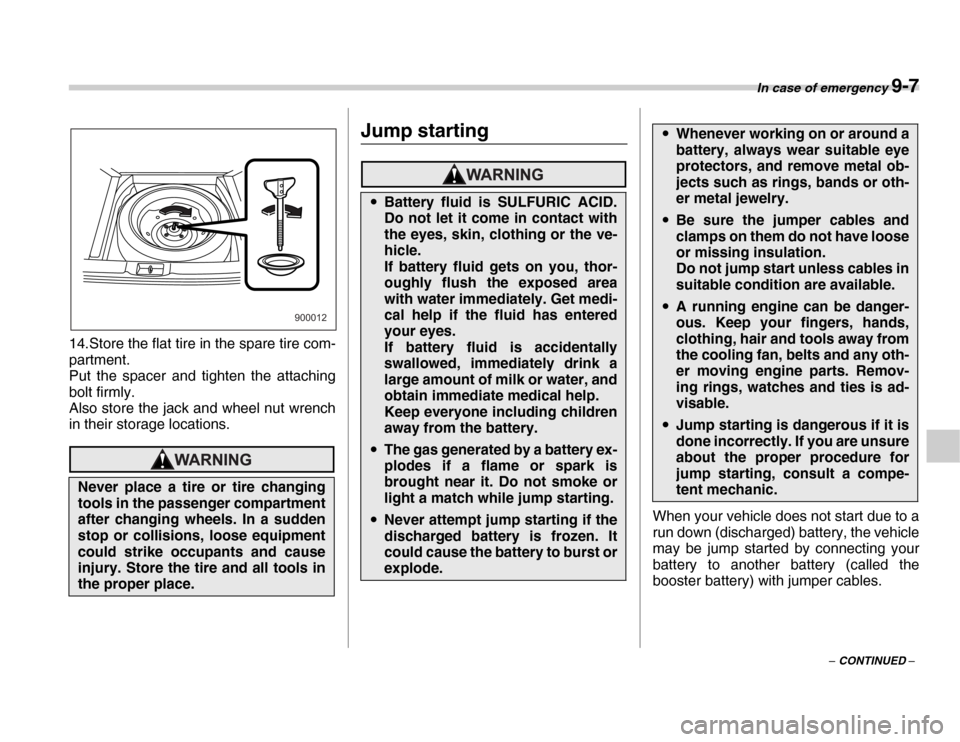
14.Store the flat tire in the spare tire com-
partment.
Put the spacer and tighten the attaching
bolt firmly.
Also store the jack and wheel nut wrench
in their storage locations.
Jump starting
When your vehicle does not start due to a
run down (discharged) battery, the vehicle
may be jump started by connecting your
battery to another battery (called the
booster battery) with jumper cables.
Never place a tire or tire changing
tools in the passenger compartment
after changing wheels. In a sudden
stop or collisions, loose equipment
could strike occupants and cause
injury. Store the tire and all tools in
the proper place.
900012
y
Battery fluid is SULFURIC ACID.
Do not let it come in contact with
the eyes, skin, clothing or the ve-
hicle.
If battery fluid gets on you, thor-
oughly flush the exposed area
with water immediately. Get medi-
cal help if the fluid has entered
your eyes.
If battery fluid is accidentally
swallowed, immediately drink a
large amount of milk or water, and
obtain immediate medical help.
Keep everyone including children
away from the battery.
yThe gas generated by a battery ex-
plodes if a flame or spark is
brought near it. Do not smoke or
light a match while jump starting.
yNever attempt jump starting if the
discharged battery is frozen. It
could cause the battery to burst or
explode.
yWhenever working on or around a
battery, always wear suitable eye
protectors, and remove metal ob-
jects such as rings, bands or oth-
er metal jewelry.
yBe sure the jumper cables and
clamps on them do not have loose
or missing insulation.
Do not jump start unless cables in
suitable condition are available.
yA running engine can be danger-
ous. Keep your fingers, hands,
clothing, hair and tools away from
the cooling fan, belts and any oth-
er moving engine parts. Remov-
ing rings, watches and ties is ad-
visable.
yJump starting is dangerous if it is
done incorrectly. If you are unsure
about the proper procedure for
jump starting, consult a compe-
tent mechanic.
Page 273 of 356

11
Maintenance and service
Maintenance schedule ....................................... 11-3
Maintenance precautions .................................. 11-3Before checking or servicing in the engine compartment ........................................................ 11-4
When you do checking or servicing in the
engine compartment while the engine is
running .................................................................. 11-4
Engine hood ....................................................... 11-4
Engine compartment overview ......................... 11-6 Non-turbo models ................................................... 11-6
Turbo models .......................................................... 11-7
Engine oil ............................................................ 11-8 Checking the oil level ............................................. 11-8
Changing the oil and oil filter ................................ 11-8
Recommended grade and viscosity ..................... 11-10
Recommended grade and viscosity under severe driving conditions .................................... 11-11
Synthetic oil ............................................................ 11-11
Cooling system .................................................. 11-11 Cooling fan, hose and connections ...................... 11-12
Engine coolant ........................................................ 11-12
Air cleaner element ............................................ 11-15 Replacing the air cleaner element ......................... 11-15
Spark plugs ......................................................... 11-17 Recommended spark plugs ................................... 11-17
Drive belts ........................................................... 11-18
Manual transmission oil .................................... 11-18 Checking the oil level ............................................. 11-18 Recommended grade and viscosity ..................... 11-19
Automatic transmission fluid ............................ 11-20 Checking the fluid level .......................................... 11-20
Recommended fluid ............................................... 11-21
Front differential gear oil (AT vehicles) ............ 11-21 Checking the oil level ............................................. 11-21
Recommended grade and viscosity ..................... 11-22
Rear differential gear oil .................................... 11-22 Checking the gear oil level .................................... 11-22
Recommended grade and viscosity ..................... 11-23
Power steering fluid ........................................... 11-23 Checking the fluid level .......................................... 11-23
Recommended fluid ............................................... 11-24
Brake fluid ........................................................... 11-25 Checking the fluid level .......................................... 11-25
Recommended brake fluid ..................................... 11-25
Clutch fluid (MT vehicles) .................................. 11-26 Checking the fluid level .......................................... 11-26
Recommended clutch fluid .................................... 11-26
Brake booster ..................................................... 11-27
Brake pedal ......................................................... 11-27 Checking the brake pedal free play ...................... 11-27
Checking the brake pedal reserve distance ......... 11-27
Clutch pedal (MT vehicles) ................................ 11-28 Checking the clutch function ................................ 11-28
Checking the clutch pedal free play ..................... 11-28
Hill holder (MT vehicles – if equipped) ............. 11-28
Page 276 of 356
11 - 4 Maintenance and service
„Before checking or servicing
in the engine compartment
„When you do checking or ser-
vicing in the engine compart-
ment while the engine is run-ning
Engine hood
0
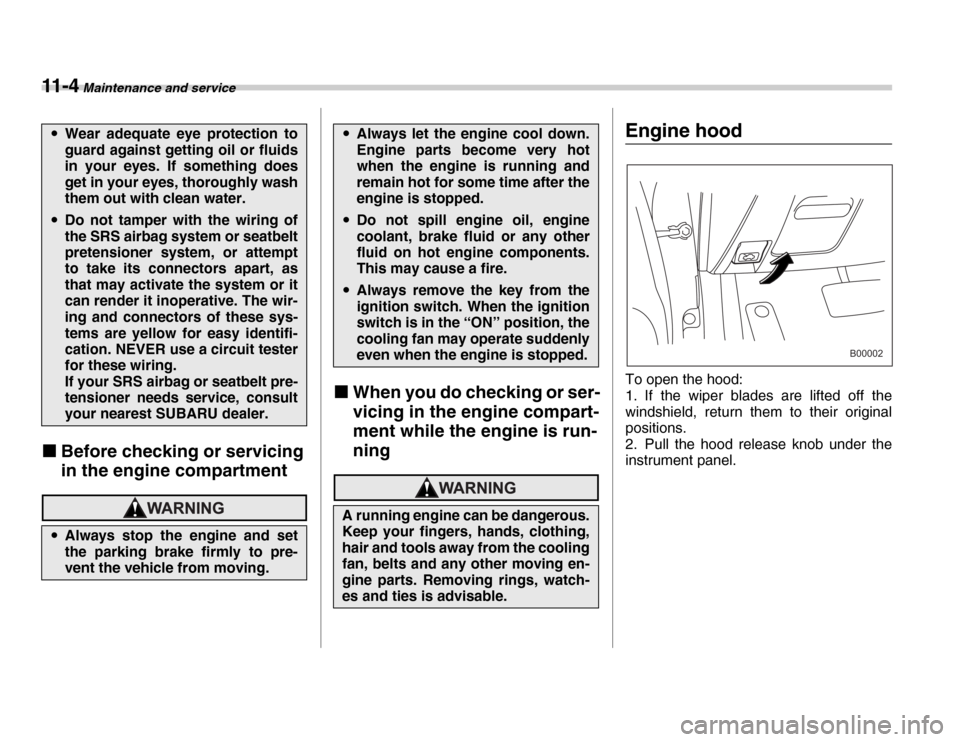
To open the hood:
1. If the wiper blades are lifted off the
windshield, return them to their original
positions.
2. Pull the hood release knob under the
instrument panel.
yWear adequate eye protection to
guard against getting oil or fluids
in your eyes. If something does
get in your eyes, thoroughly wash
them out with clean water.
yDo not tamper with the wiring of
the SRS airbag system or seatbelt
pretensioner system, or attempt
to take its connectors apart, as
that may activate the system or it
can render it inoperative. The wir-
ing and connectors of these sys-
tems are yellow for easy identifi-
cation. NEVER use a circuit tester
for these wiring.
If your SRS airbag or seatbelt pre-
tensioner needs service, consult
your nearest SUBARU dealer.
yAlways stop the engine and set
the parking brake firmly to pre-
vent the vehicle from moving.
yAlways let the engine cool down.
Engine parts become very hot
when the engine is running and
remain hot for some time after the
engine is stopped.
yDo not spill engine oil, engine
coolant, brake fluid or any other
fluid on hot engine components.
This may cause a fire.
yAlways remove the key from the
ignition switch. When the ignition
switch is in the “ON” position, the
cooling fan may operate suddenly
even when the engine is stopped.
A running engine can be dangerous.
Keep your fingers, hands, clothing,
hair and tools away from the cooling
fan, belts and any other moving en-
gine parts. Removing rings, watch-
es and ties is advisable.
B00002
Page 290 of 356
11 - 1 8 Maintenance and service
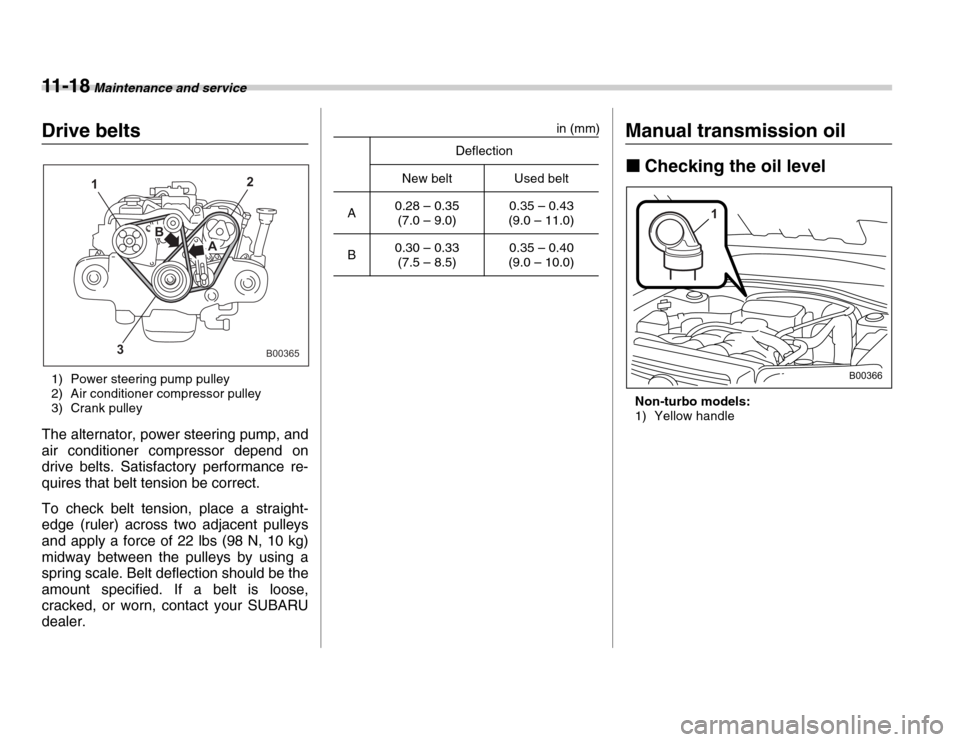
Drive belts1) Power steering pump pulley
2) Air conditioner compressor pulley
3) Crank pulley
The alternator, power steering pump, and
air conditioner compressor depend on
drive belts. Satisfactory performance re-
quires that belt tension be correct.
To check belt tension, place a straight-
edge (ruler) across two adjacent pulleys
and apply a force of 22 lbs (98 N, 10 kg)
midway between the pulleys by using a
spring scale. Belt deflection should be the
amount specified. If a belt is loose,
cracked, or worn, contact your SUBARU
dealer. in (mm)Manual transmission oil „
Checking the oil level
Non-turbo models:
1) Yellow handle
A
B
2
3
1
B00365
Deflection
New belt Used belt
A 0.28 – 0.35
(7.0 – 9.0) 0.35 – 0.43
(9.0 – 11.0)
B 0.30 – 0.33
(7.5 – 8.5) 0.35 – 0.40
(9.0 – 10.0)
1
B00366
Page 307 of 356
Maintenance and service 11 - 35
– CONTINUED –
„
Wheel replacement
When replacing wheels due, for example,
to damage, make sure the replacement
wheels match the specifications of the
wheels that are fitted as standard equip-
ment. Replacement wheels are available
from SUBARU dealers.
Aluminum wheels
(if equipped)
Aluminum wheels can be scratched and
damaged easily. Handle them carefully to
maintain their appearance, performance,
and safety. y When any of the wheels is removed and
replaced for tire rotation or to change a
flat, always check the tightness of the
wheel nuts after driving approximately 600
miles (1,000 km). If any nut is loose, tight-
en it to the specified torque. y Never apply oil to the threaded parts,
wheel nuts, or tapered surface of the
wheel. y Never let the wheel rub against sharp
protrusions or curbs. y Be sure to fit tire chains on uniformly
and completely around the tire, otherwise
the chains may scratch the wheel. y When wheel nuts, balance weights, or
the center cap is replaced, be sure to re-
place them with genuine SUBARU parts
designed for aluminum wheels.
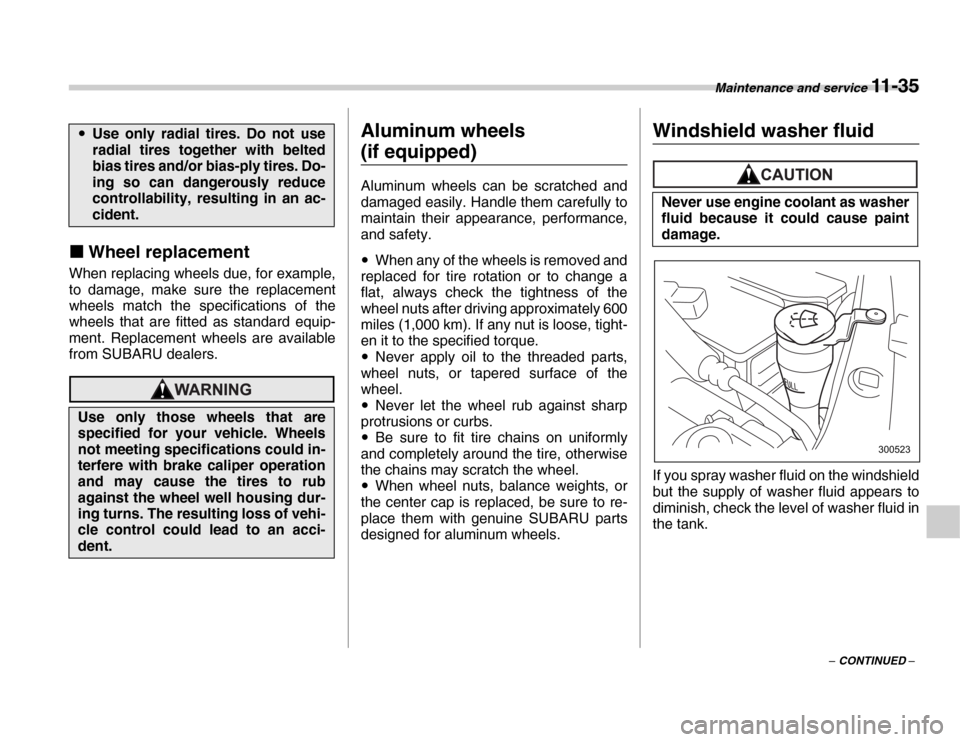
Windshield washer fluid
If you spray washer fluid on the windshield
but the supply of washer fluid appears to
diminish, check the level of washer fluid in
the tank.
y Use only radial tires. Do not use
radial tires together with belted
bias tires and/or bias-ply tires. Do-
ing so can dangerously reduce
controllability, resulting in an ac-
cident.
Use only those wheels that are
specified for your vehicle. Wheels
not meeting specifications could in-
terfere with brake caliper operation
and may cause the tires to rub
against the wheel well housing dur-
ing turns. The resulting loss of vehi-
cle control could lead to an acci-
dent.
Never use engine coolant as washer
fluid because it could cause paint
damage.
300523