roof SUBARU FORESTER 2009 SH / 3.G Owner's Manual
[x] Cancel search | Manufacturer: SUBARU, Model Year: 2009, Model line: FORESTER, Model: SUBARU FORESTER 2009 SH / 3.GPages: 384, PDF Size: 13.91 MB
Page 260 of 384
&GVWR and GAWR (Gross
Vehicle Weight Rating and
Gross Axle Weight Rating)
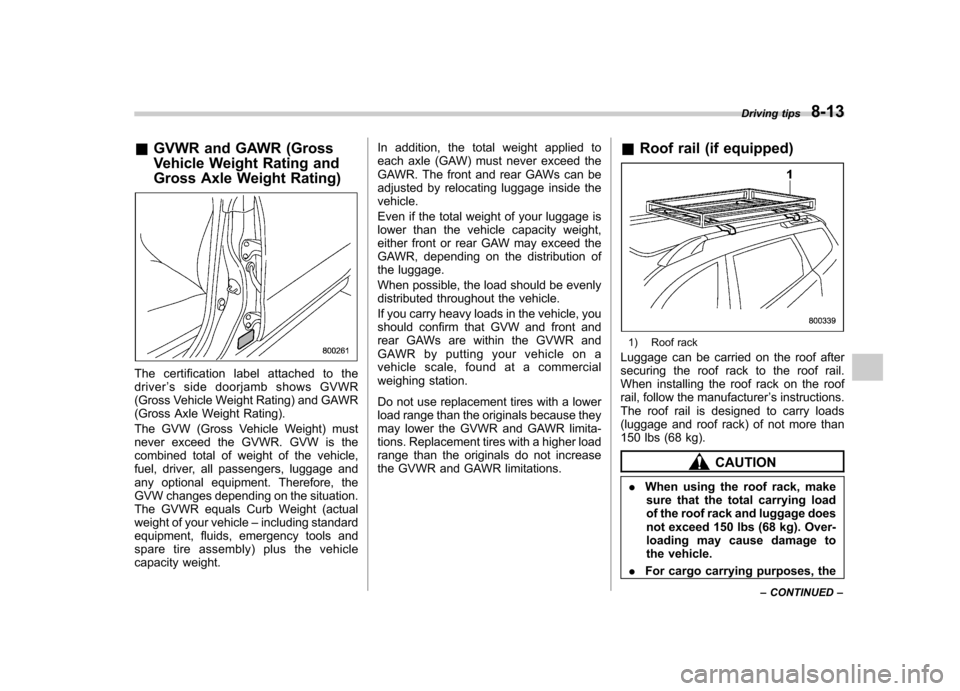
The certification label attached to the driver ’s side doorjamb shows GVWR
(Gross Vehicle Weight Rating) and GAWR
(Gross Axle Weight Rating).
The GVW (Gross Vehicle Weight) must
never exceed the GVWR. GVW is the
combined total of weight of the vehicle,
fuel, driver, all passengers, luggage and
any optional equipment. Therefore, the
GVW changes depending on the situation.
The GVWR equals Curb Weight (actual
weight of your vehicle –including standard
equipment, fluids, emergency tools and
spare tire assembly) plus the vehicle
capacity weight. In addition, the total weight applied to
each axle (GAW) must never exceed the
GAWR. The front and rear GAWs can be
adjusted by relocating luggage inside thevehicle.
Even if the total weight of your luggage is
lower than the vehicle capacity weight,
either front or rear GAW may exceed the
GAWR, depending on the distribution of
the luggage.
When possible, the load should be evenly
distributed throughout the vehicle.
If you carry heavy loads in the vehicle, you
should confirm that GVW and front and
rear GAWs are within the GVWR and
GAWR by putting your vehicle on a
vehicle scale, found at a commercial
weighing station.
Do not use replacement tires with a lower
load range than the originals because they
may lower the GVWR and GAWR limita-
tions. Replacement tires with a higher load
range than the originals do not increase
the GVWR and GAWR limitations.
&
Roof rail (if equipped)
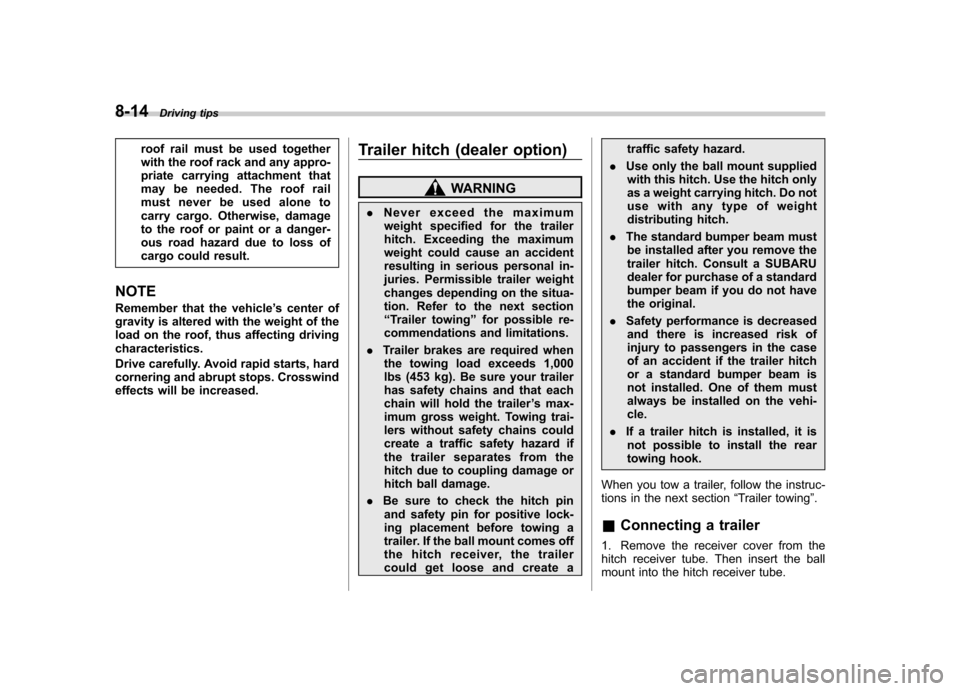
1) Roof rack
Luggage can be carried on the roof after
securing the roof rack to the roof rail.
When installing the roof rack on the roof
rail, follow the manufacturer ’s instructions.
The roof rail is designed to carry loads
(luggage and roof rack) of not more than
150 lbs (68 kg).
CAUTION
. When using the roof rack, make
sure that the total carrying load
of the roof rack and luggage does
not exceed 150 lbs (68 kg). Over-
loading may cause damage to
the vehicle.
. For cargo carrying purposes, the Driving tips
8-13
– CONTINUED –
Page 261 of 384
8-14Driving tips
roof rail must be used together
with the roof rack and any appro-
priate carrying attachment that
may be needed. The roof rail
must never be used alone to
carry cargo. Otherwise, damage
to the roof or paint or a danger-
ous road hazard due to loss of
cargo could result.
NOTE
Remember that the vehicle ’s center of
gravity is altered with the weight of the
load on the roof, thus affecting drivingcharacteristics.
Drive carefully. Avoid rapid starts, hard
cornering and abrupt stops. Crosswind
effects will be increased. Trailer hitch (dealer option)
WARNING
. Never exceed the maximum
weight specified for the trailer
hitch. Exceeding the maximum
weight could cause an accident
resulting in serious personal in-
juries. Permissible trailer weight
changes depending on the situa-
tion. Refer to the next section“ Trailer towing ”for possible re-
commendations and limitations.
. Trailer brakes are required when
the towing load exceeds 1,000
lbs (453 kg). Be sure your trailer
has safety chains and that each
chain will hold the trailer ’s max-
imum gross weight. Towing trai-
lers without safety chains could
create a traffic safety hazard if
the trailer separates from the
hitch due to coupling damage or
hitch ball damage.
. Be sure to check the hitch pin
and safety pin for positive lock-
ing placement before towing a
trailer. If the ball mount comes off
the hitch receiver, the trailer
could get loose and create a traffic safety hazard.
. Use only the ball mount supplied
with this hitch. Use the hitch only
as a weight carrying hitch. Do not
use with any type of weight
distributing hitch.
. The standard bumper beam must
be installed after you remove the
trailer hitch. Consult a SUBARU
dealer for purchase of a standard
bumper beam if you do not have
the original.
. Safety performance is decreased
and there is increased risk of
injury to passengers in the case
of an accident if the trailer hitch
or a standard bumper beam is
not installed. One of them must
always be installed on the vehi-cle.
. If a trailer hitch is installed, it is
not possible to install the rear
towing hook.
When you tow a trailer, follow the instruc-
tions in the next section “Trailer towing ”.
& Connecting a trailer
1. Remove the receiver cover from the
hitch receiver tube. Then insert the ball
mount into the hitch receiver tube.
Page 272 of 384
If you park your vehicle in case of anemergency ........................................................ 9-2
Temporary spare tire (if equipped) .................... 9-2
Precautions for AWD vehicles with automatic transmission ..................................................... 9-3
Flat tires ............................................................... 9-4
Changing a flat tire .............................................. 9-4
Tire pressure monitoring system (TPMS) (U.S.-spec. models) ........................................... 9-8
Jump starting ...................................................... 9-9
How to jump start ............................................... 9-10
Engine overheating ............................................ 9-11
If steam is coming from the engine compartment .................................................... 9-11 If no steam is coming from the engine
compartment ................................................... 9-11
Towing ................................................................ 9-12
Towing and tie-down hooks. ............................... 9-12
Using a flat-bed truck. ........................................ 9-15
Towing with all wheels on the ground ................. 9-15
Rear gate –if the rear gate cannot be
opened ............................................................. 9-16
Moonroof –if the moonroof cannot be
closed .............................................................. 9-17
Maintenance tools ............................................. 9-17
Jack handle ....................................................... 9-17
Jack and other maintenance tools ...................... 9-18
In case of emergency
9
Page 277 of 384
9-6In case of emergency
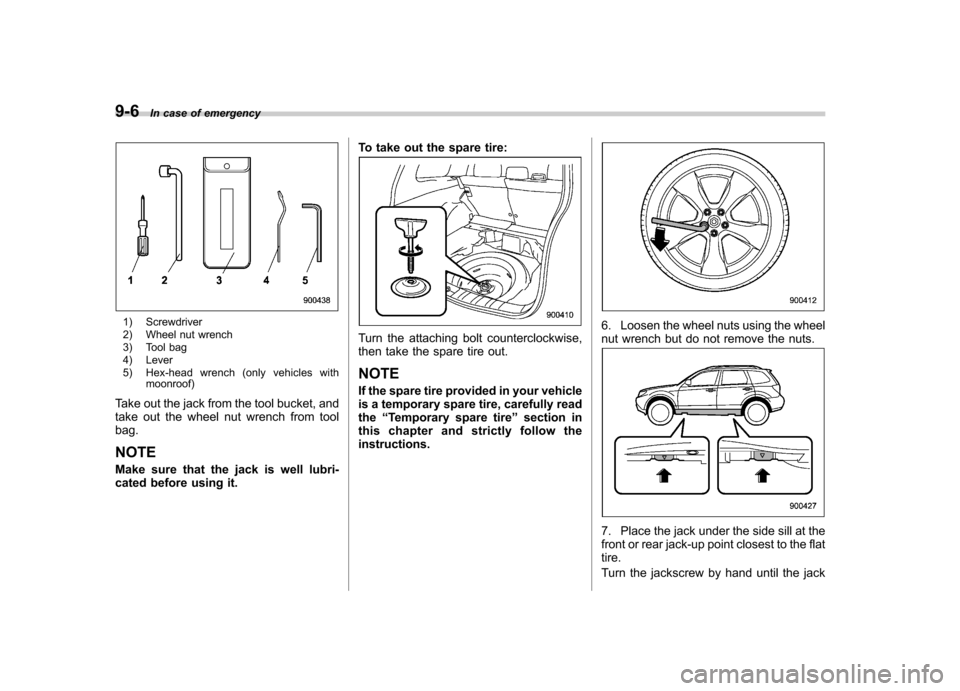
1) Screwdriver
2) Wheel nut wrench
3) Tool bag
4) Lever
5) Hex-head wrench (only vehicles with
moonroof)
Take out the jack from the tool bucket, and
take out the wheel nut wrench from tool bag. NOTE
Make sure that the jack is well lubri-
cated before using it. To take out the spare tire:
Turn the attaching bolt counterclockwise,
then take the spare tire out. NOTE
If the spare tire provided in your vehicle
is a temporary spare tire, carefully readthe
“Temporary spare tire ”section in
this chapter and strictly follow the instructions.6. Loosen the wheel nuts using the wheel
nut wrench but do not remove the nuts.
7. Place the jack under the side sill at the
front or rear jack-up point closest to the flattire.
Turn the jackscrew by hand until the jack
Page 288 of 384
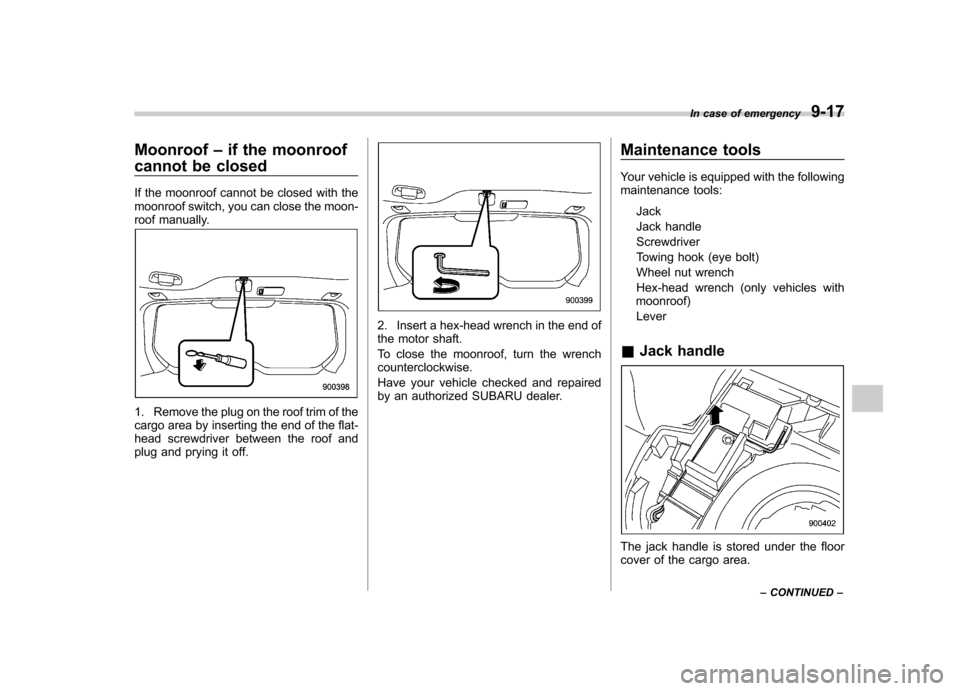
Moonroof–if the moonroof
cannot be closed
If the moonroof cannot be closed with the
moonroof switch, you can close the moon-
roof manually.
1. Remove the plug on the roof trim of the
cargo area by inserting the end of the flat-
head screwdriver between the roof and
plug and prying it off.
2. Insert a hex-head wrench in the end of
the motor shaft.
To close the moonroof, turn the wrench counterclockwise.
Have your vehicle checked and repaired
by an authorized SUBARU dealer. Maintenance tools
Your vehicle is equipped with the following
maintenance tools:
Jack
Jack handleScrewdriver
Towing hook (eye bolt)
Wheel nut wrench
Hex-head wrench (only vehicles with
moonroof)
Lever
& Jack handle
The jack handle is stored under the floor
cover of the cargo area. In case of emergency
9-17
– CONTINUED –
Page 289 of 384

9-18In case of emergency
& Jack and other maintenance tools
1) Jack
2) Towing hook
1) Screwdriver
2) Wheel nut wrench
3) Tool bag
4) Lever
5) Hex-head wrench (only vehicles with
moonroof)
The jack and towing hook are stored in the
tool bucket that is located in the recess of
the spare tire wheel under the floor of the
cargo area.
The screwdriver and wheel nut wrench are
stored in the tool bag.
For how to use the jack, refer to the “Flat
tires ”section in this chapter.
Page 346 of 384
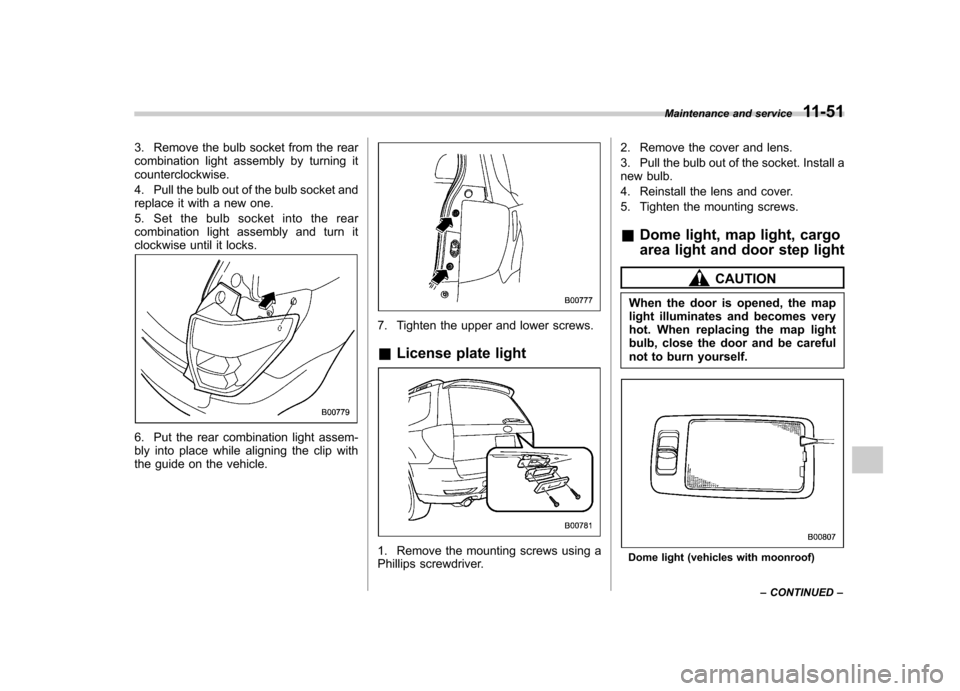
3. Remove the bulb socket from the rear
combination light assembly by turning itcounterclockwise.
4. Pull the bulb out of the bulb socket and
replace it with a new one.
5. Set the bulb socket into the rear
combination light assembly and turn it
clockwise until it locks.
6. Put the rear combination light assem-
bly into place while aligning the clip with
the guide on the vehicle.
7. Tighten the upper and lower screws. &License plate light
1. Remove the mounting screws using a
Phillips screwdriver. 2. Remove the cover and lens.
3. Pull the bulb out of the socket. Install a
new bulb.
4. Reinstall the lens and cover.
5. Tighten the mounting screws. &
Dome light, map light, cargo
area light and door step light
CAUTION
When the door is opened, the map
light illuminates and becomes very
hot. When replacing the map light
bulb, close the door and be careful
not to burn yourself.
Dome light (vehicles with moonroof) Maintenance and service
11-51
– CONTINUED –
Page 347 of 384

11-52Maintenance and service
Dome light (vehicles without moonroof)
Map light
Cargo area light
Door step light
1. Remove the lens by prying the edge of
the lens with a flat-head screwdriver.
2. Pull the bulb out of the socket. Install a
new bulb. 3. Reinstall the lens. &
Other bulbs
Other bulbs may be difficult to replace.
Have the bulbs replaced by your
SUBARU dealer if necessary.
Page 349 of 384

12-2Specifications
Specifications
These specifications are subject to change without notice. &Dimensions
in (mm)
Item 2.5-liter non-turbo 2.5-liter turbo
2.5X 2.5X Premium 2.5X Touring 2.5X
LLBean 2.5X
Limited 2.5XT2.5XT
Limited
Drive system AWD
Transmission type AT MT AT MT AT MT AT AT AT AT
Overall length 179.5 (4,560)
Overall width 70.1 (1,780)
Overall height without roof rail 65.9 (1,675)
with roof rail 66.9 (1,700)
Wheel base 103.0 (2,615)
Tread Front 60.2 (1,530)
Rear 60.2 (1,530)
Ground clearance*
18.7 (220) 8.9 (225)
*1: Measured with vehicle empty
AT: Automatic transmission
MT: Manual transmission
Page 365 of 384
13-8Consumer information and Reporting safety defects
tires every 7,500 miles (12,000 km).
Rotating the tires involves switch-
ing the front and rear tires on the
right-hand side of the vehicle and
similarly switching the front and
rear tires on the left-hand side of
the vehicle. (Each tire must be kept
on its original side of the vehicle.)
Replace any damaged or unevenly
worn tires at the time of rotation.
After tire rotation, adjust the tire
pressures and make sure the wheel
nuts are correctly tightened. A
tightening torque specification and
a tightening sequence specification
for the wheel nuts can be found inthe “Flat tires
”section in chapter 9.
& Vehicle load limit –how to
determine
The load capacity of your vehicle is
determined by weight, not by avail-
able cargo space. The load limit of
your vehicle is shown on the
vehicle placard attached to the
driver ’s side B-pillar. Locate the
statement “The combined weight of occupants and cargo should
never exceed XXX kg or XXX lbs
”
on your vehicle ’s placard.
Thevehicleplacardalsoshows
seating capacity of your vehicle.
The total load capacity includes the
total weight of driver and all pas-
sengers and their belongings, any
cargo, any optional equipment such
as a trailer hitch, roof rack or bike
carrier, etc., and the tongue load of
a trailer. Therefore cargo capacity
can be calculated by the followingmethod.
Cargo capacity = Load limit (total
weight of occupants + total weight
of optional equipment + tongue
load of a trailer (if applicable))
For information about vehicle load-
ing, refer to the “Loading your
vehicle ”section in chapter 8.
! Calculating total and load ca-
pacities varying seating con-
figurations
Calculate the available load capa-
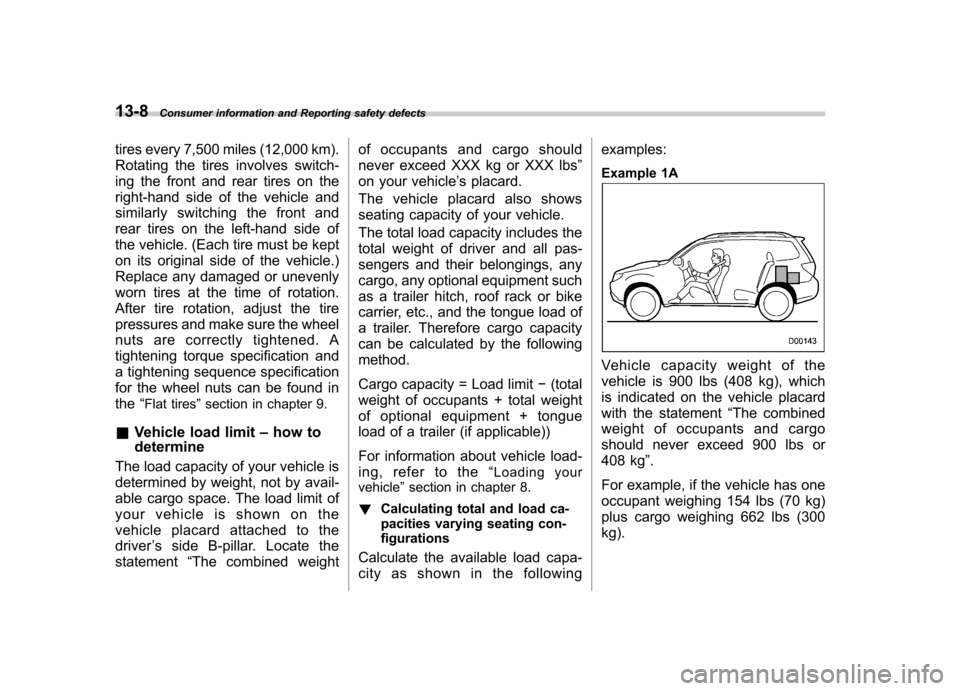
city as shown in the following examples:
Example 1A
Vehicle capacity weight of the
vehicle is 900 lbs (408 kg), which
is indicated on the vehicle placard
with the statement
“The combined
weight of occupants and cargo
should never exceed 900 lbs or
408 kg ”.
For example, if the vehicle has one
occupant weighing 154 lbs (70 kg)
plus cargo weighing 662 lbs (300kg).