overheating SUBARU FORESTER 2009 SH / 3.G Owners Manual
[x] Cancel search | Manufacturer: SUBARU, Model Year: 2009, Model line: FORESTER, Model: SUBARU FORESTER 2009 SH / 3.GPages: 384, PDF Size: 13.91 MB
Page 5 of 384
2
Chapter 4: Climate control
This chapter informs you how to operate
the climate control.
Chapter 5: Audio
This chapter informs you how to operate
your audio system.
Chapter 6: Interior equipment
This chapter informs you how to operate
interior equipment.
Chapter 7: Starting and operating
This chapter informs you how to start and
operate your SUBARU.
Chapter 8: Driving tips
This chapter informs you how to drive your
SUBARU in various conditions and ex-
plains some safety tips on driving.
Chapter 9: In case of emergency
This chapter informs you what to do if you
have a problem while driving, such as a
flat tire or engine overheating.
Chapter 10: Appearance care
This chapter informs you how to keep your
SUBARU looking good.
Chapter 11: Maintenance and service
This chapter informs you when you need
to take your SUBARU to the dealer for
scheduled maintenance and informs you
how to keep your SUBARU running
properly.Chapter 12: Specifications
This chapter informs you about dimen-
sions and capacities of your SUBARU.
Chapter 13: Consumer information and
Reporting safety defects
This chapter informs you about Uniform
tire quality grading standards and Report-
ing safety defects.
Chapter 14: Index
This is an alphabetical listing of all that
’sin
this manual. You can use it to quickly find
something you want to read.
& Safety warnings
You will find a number of WARNINGs,
CAUTIONs and NOTEs in this manual.
These safety warnings alert you to poten-
tial hazards that could result in injury to
you or others.
Please read these safety warnings as well
as all other portions of this manual care-
fully in order to gain a better understand-
ing of how to use your SUBARU vehicle
safely.
WARNING
A WARNING indicates a situation in
which serious injury or death could
result if the warning is ignored.
CAUTION
A CAUTION indicates a situation in
which injury or damage to your
vehicle, or both, could result if the
caution is ignored.
NOTE
A NOTE gives information or sugges-
tions how to make better use of yourvehicle. & Safety symbol
You will find a circle with a slash through it
in this manual. This symbol means “Do
not ”, “Do not do this ”,or “Do not let this
happen ”, depending upon the context.
Page 124 of 384

&Coolant temperature
low indicator light/Cool-
ant temperature high
warning light
CAUTION
. After turning the ignition switch
to the “ON ”position, if this
indicator light/warning light re-
mains illuminated in RED for
approximately more than 2 sec-
onds, the electrical system may
be malfunctioning. Immediately
contact your SUBARU dealer for
an inspection.
. If this indicator light/warning light
illuminates in RED while driving,
safely stop the vehicle as soon
as possible, and refer to the
emergency steps for the case of
engine overheating. After that,
have the system checked by your
nearest SUBARU dealer. Refer to“ In case of emergency ”in chap-
ter 9.
This coolant temperature low indicator
light/coolant temperature high warning
light has the following two functions: . Illumination in BLUEindicates insuffi-
cient warming up of the engine .
Illumination in REDindicates overheat-
ing condition of the engine
For the system check, this indicator light/
warning light illuminates in red for approxi-
mately 2 seconds when the ignition switch
is turned to the “ON ”position. After that,
this indicator light/warning light changes to
blue and maintains illumination in blue.
This blue illuminated light turns off when
the engine is warmed up sufficiently.
If the engine is overheated, this indicator
light/warning light illuminates in red im-
mediately. At this time, safely stop the
vehicle as soon as possible, and refer to
the emergency steps for the case of
engine overheating. Refer to “In case of
emergency ”in chapter 9. After that, have
the system checked by your nearest
SUBARU dealer. NOTE
If the engine is restarted after a certain
driving condition, this indicator light/
warning light may illuminate in red.
However, this is not a malfunction if the
indicator light/warning light turns off
after a short time. &
Charge warning light
If this light illuminates when the engine is
running, it may indicate that the charging
system is not working properly.
If the light illuminates while driving or does
not turn off after the engine starts, stop the
engine at the first safe opportunity and
check the alternator belt. If the belt is
loose, broken or if the belt is in good
condition but the light remains on, contact
your nearest SUBARU dealer immedi-
ately. &Oil pressure warning light
If this light illuminates when the engine is
running, it may indicate that the engine oil
pressure is low and the lubricating system
is not working properly.
If the light illuminates while driving or does
not turn off after the engine starts, stop the
engine at the first safe opportunity and
check the engine oil level. If the oil level is
low, add oil immediately. If the engine oil is
at the proper level but the light remains on,
contact your nearest SUBARU dealer
immediately. Instruments and controls
3-13
– CONTINUED –
Page 139 of 384
3-28Instruments and controls
Wiper and washer
WARNING
In freezing weather, do not use the
windshield washer until the wind-
shield is sufficiently warmed by the
defroster.
Otherwise the washer fluid can
freeze on the windshield, blocking
your view.
CAUTION
. Do not operate the washer con-
tinuously for more than 10 sec-
onds, or when the washer fluid
tank is empty. This may cause
overheating of the washer motor.
Check the washer fluid level
frequently, such as at fuel stops.
. Do not operate the wipers when
the windshield or rear window is
dry. This may scratch the glass,
damage the wiper blades and
cause the wiper motor to burn
out. Before operating the wiper
on a dry windshield or rear
window, always use the wind-
shield washer. .
In freezing weather, be sure that
the wiper blades are not frozen to
the windshield or rear window
before switching on the wipers.
Attempting to operate the wiper
with the blades frozen to the
window glass could cause not
only the wiper blades to be
damaged but also the wiper mo-
tor to burn out. If the wiper
blades are frozen to the window
glass, be sure to operate the
defroster, windshield wiper dei-
cer (if equipped) or rear window
defogger before turning on the
wiper.
. If the wipers stop during opera-
tion because of ice or some other
obstruction on the window, the
wiper motor could burn out even
if the wiper switch is turned off. If
this occurs, promptly stop the
vehicle in a safe place, turn the
ignition switch to the “LOCK ”
position and clean the window
glass to allow proper wiper op-eration.
. Use clean water if windshield
washer fluid is unavailable. In
areas where water freezes in
winter, use SUBARU Windshield
Washer Fluid or the equivalent. Refer to the
“Windshield washer
fluid ”section in chapter 11.
Also, when driving the vehicle
when there are freezing tempera-
tures, use non-freezing type wi-
per blades.
. Do not clean the wiper blades
with gasoline or a solvent, such
as paint thinner or benzine. This
will cause deterioration of the
wiper blades.
NOTE . The wiper operates only when the
ignition switch is in the “ON ”or “Acc ”
position. . The front wiper motor is protected
against overloads by a circuit breaker.
If the motor operates continuously
under an unusually heavy load, the
circuit breaker may trip to stop the
motor temporarily. If this happens, park
your vehicle in a safe place, turn off the
wiper switch, and wait for approxi-
mately 10 minutes. The circuit breaker
will reset itself, and the wipers will
again operate normally.. Clean your wiper blades and win-
dow glass periodically with a washer
solution to prevent streaking, and to
remove accumulations of road salt or
Page 205 of 384
6-10Interior equipment
ance is either too loose or too
tight for the accessory power
outlet, this can result in a poor
contact or cause the plug to get
stuck. Only use plugs that fit
properly.
. Use of an electric appliance in the
accessory power outlet for a long
period of time while the engine is
not running can cause batterydischarge.
. Before driving your vehicle, make
sure that the plug and the cord
on your electrical appliance will
not interfere with your shifting
gears and operating the accel-
erator and brake pedals. If they
do, do not use the electrical
appliance while driving.
& Use with a cigarette lighter
(dealer option)
To use the accessory power outlet below
the climate controls as a cigarette lighter
socket, purchase the cigarette lighter plug,
which is an optional accessory.
A cigarette lighter plug is available from
your SUBARU dealer.
The cigarette lighter operates only when
the ignition switch is in the “ON ”or “Acc ” position.
To use the cigarette lighter, push in the
knob and wait a few moments. It will
automatically spring up when ready foruse.
WARNING
To avoid being burned, never grasp
the lighter by the end with the
heating element. Doing so could
result in injury and could also
damage the heating element.
CAUTION
. Do not hold the lighter pushed in,
because it will overheat.
. The electrical power socket lo-
cated below the climate controls
is originally designed to use a
genuine SUBARU cigarette light-
er plug. Do not use a non-genu-
ine cigarette lighter plug in the
socket. Doing so may cause a
short-circuit and overheating, re-
sulting in a fire.
. If the socket is ever used for a
plug-in accessory such as a cell
phone, that may damage the
portion of the socket ’s internal mechanism that causes a cigar-
ette lighter plug to
“pop out ”
after its lighter element is heated.
Therefore, do not place a cigar-
ette lighter plug in a socket that
has been used, even once, to
power a plug-in accessory. Doing
so may cause the plug to stick
and overheat, creating a potential
fire hazard.
Page 230 of 384
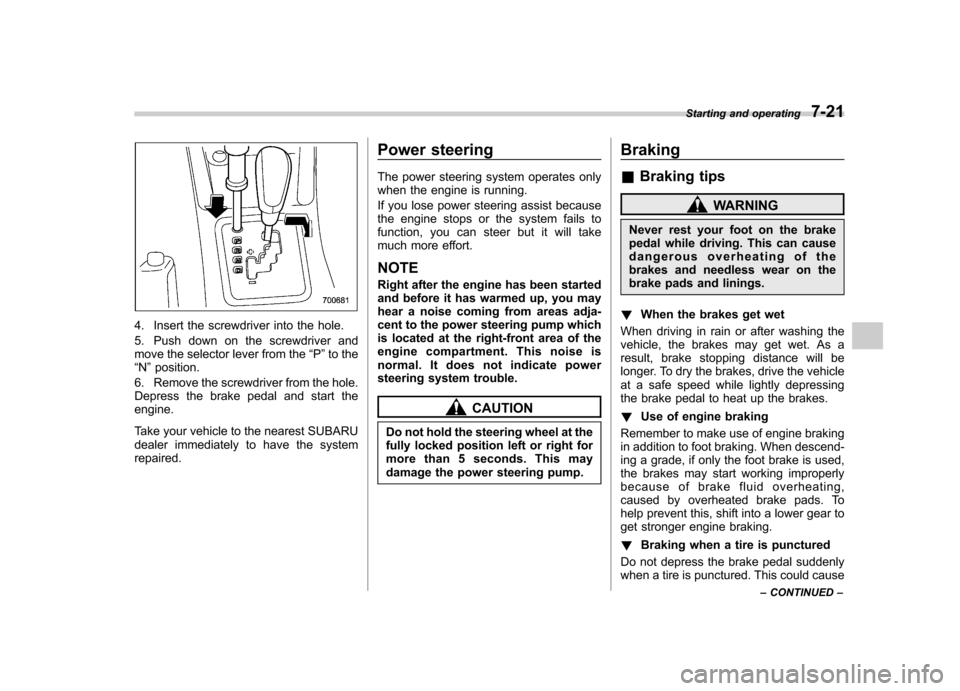
4. Insert the screwdriver into the hole.
5. Push down on the screwdriver and
move the selector lever from the“P ”to the
“ N ”position.
6. Remove the screwdriver from the hole.
Depress the brake pedal and start theengine.
Take your vehicle to the nearest SUBARU
dealer immediately to have the systemrepaired. Power steering
The power steering system operates only
when the engine is running.
If you lose power steering assist because
the engine stops or the system fails to
function, you can steer but it will take
much more effort. NOTE
Right after the engine has been started
and before it has warmed up, you may
hear a noise coming from areas adja-
cent to the power steering pump which
is located at the right-front area of the
engine compartment. This noise is
normal. It does not indicate power
steering system trouble.
CAUTION
Do not hold the steering wheel at the
fully locked position left or right for
more than 5 seconds. This may
damage the power steering pump. Braking &
Braking tips
WARNING
Never rest your foot on the brake
pedal while driving. This can cause
dangerous overheating of the
brakes and needless wear on the
brake pads and linings.
! When the brakes get wet
When driving in rain or after washing the
vehicle, the brakes may get wet. As a
result, brake stopping distance will be
longer. To dry the brakes, drive the vehicle
at a safe speed while lightly depressing
the brake pedal to heat up the brakes. ! Use of engine braking
Remember to make use of engine braking
in addition to foot braking. When descend-
ing a grade, if only the foot brake is used,
the brakes may start working improperly
because of brake fluid overheating,
caused by overheated brake pads. To
help prevent this, shift into a lower gear to
get stronger engine braking. ! Braking when a tire is punctured
Do not depress the brake pedal suddenly
when a tire is punctured. This could cause Starting and operating
7-21
– CONTINUED –
Page 270 of 384

!Driving on grades
. Before going down a steep hill, slow
down and shift into lower gear (if neces-
sary, use 1st gear) in order to utilize the
engine braking effect and prevent over-
heating of your vehicle ’s brakes. Do not
make sudden downshifts. . When driving uphill in hot weather, the
air conditioner may turn off automatically
to protect the engine from overheating. . When driving uphill in hot weather, pay
attention to the coolant temperature high
warning light (for all vehicles) and AT OIL
TEMP warning light (for AT vehicles) since
the engine and transmission are relatively
prone to overheating under these condi-
tions. If the coolant temperature high
warning light or the AT OIL TEMP warning
light illuminates, immediately switch off the
air conditioner and stop the vehicle at the
nearest safe place. Refer to the “Engine
overheating ”section in chapter 9, and
“ Warning and indicator lights ”section in
chapter 3. . If your vehicle has an automatic trans-
mission, avoid using the accelerator pedal
to stay stationary on an uphill slope
instead of using the parking brake or foot
brake. That may cause the transmission
fluid to overheat. . If your vehicle has an automatic trans-
mission, place the selector lever as follows:
Uphill slopes:
“D ”position
Downhill slopes: A low-speed gear posi-
tion to use engine braking ! Parking on a grade
Always block the wheels under both
vehicle and trailer when parking. Apply
the parking brake firmly. You should not
park on a hill or slope. But if parking on a
hill or slope cannot be avoided, you
should take the following steps:
1. Apply the brakes and hold the pedal down.
2. Have someone place wheel blocks
under both the vehicle and trailer wheels.
3. When the wheel blocks are in place,
release the regular brakes slowly until the
blocks absorb the load.
4. Apply the regular brakes and then
apply the parking brake; slowly release
the regular brakes.
5. Shift into 1st or reverse gear (manual
transmission) or “P ” (automatic transmis-
sion) and shut off the engine. Driving tips
8-23
Page 272 of 384
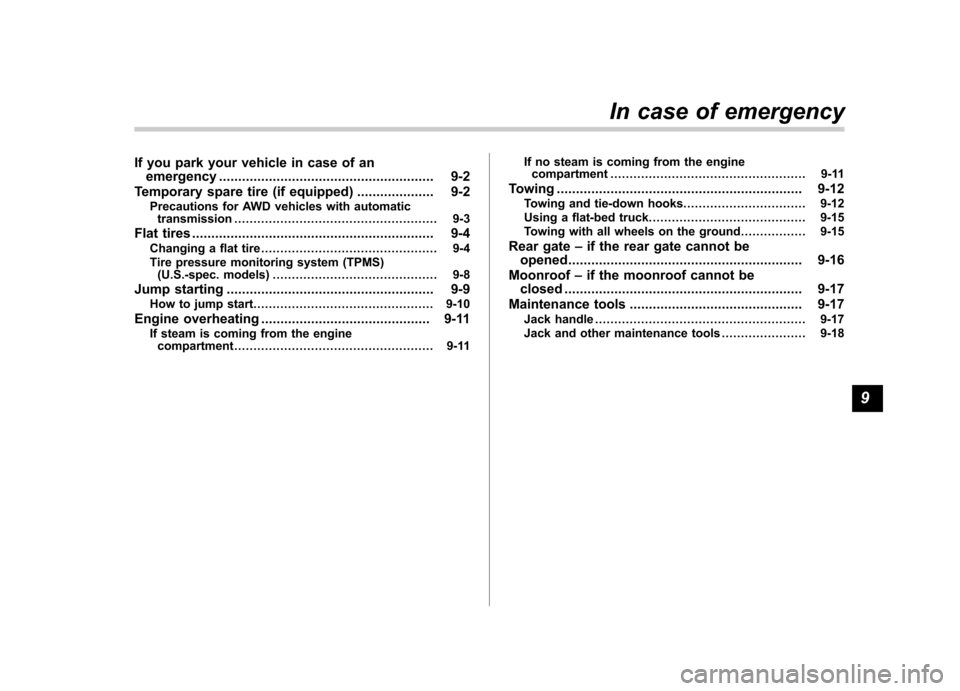
If you park your vehicle in case of anemergency ........................................................ 9-2
Temporary spare tire (if equipped) .................... 9-2
Precautions for AWD vehicles with automatic transmission ..................................................... 9-3
Flat tires ............................................................... 9-4
Changing a flat tire .............................................. 9-4
Tire pressure monitoring system (TPMS) (U.S.-spec. models) ........................................... 9-8
Jump starting ...................................................... 9-9
How to jump start ............................................... 9-10
Engine overheating ............................................ 9-11
If steam is coming from the engine compartment .................................................... 9-11 If no steam is coming from the engine
compartment ................................................... 9-11
Towing ................................................................ 9-12
Towing and tie-down hooks. ............................... 9-12
Using a flat-bed truck. ........................................ 9-15
Towing with all wheels on the ground ................. 9-15
Rear gate –if the rear gate cannot be
opened ............................................................. 9-16
Moonroof –if the moonroof cannot be
closed .............................................................. 9-17
Maintenance tools ............................................. 9-17
Jack handle ....................................................... 9-17
Jack and other maintenance tools ...................... 9-18
In case of emergency
9
Page 282 of 384
Make sure that the cables are not near
any moving parts and that the cable
clamps are not in contact with any othermetal.
5. Start the engine of the vehicle with the
booster battery and run it at moderate
speed. Then start the engine of the vehicle
that has the discharged battery.
6. When finished, carefully disconnect
the cables in exactly the reverse order.Engine overheating
WARNING
Never attempt to remove the radia-
tor cap until the engine has been
shut off and has fully cooled down.
When the engine is hot, the coolant
is under pressure. Removing the
cap while the engine is still hot
could release a spray of boiling hot
coolant, which could burn you very
seriously.
If the engine overheats, safely pull off the
road and stop the vehicle in a safe place. & If steam is coming from the
engine compartment
Turn off the engine and get everyone
away from the vehicle until it cools down. & If no steam is coming from
the engine compartment
1. Keep the engine running at idling speed.
2. Open the hood to ventilate the engine compartment.
Confirm that the cooling fan is turning. If
the fan is not turning, immediately turn off the engine and contact your authorized
dealer for repair.
3. After the engine coolant temperature
has dropped, turn off the engine.
If the coolant temperature high warning
light illuminates, turn off the engine.
4. After the engine has fully cooled down,
check the coolant level in the reservetank.
If the coolant level is below the
“LOW ”
mark, add coolant up to the “FULL ”mark.
5. If there is no coolant in the reserve
tank, add coolant to the reserve tank.
Then remove the radiator cap and fill the
radiator with coolant.
If you remove the radiator cap from a hot
radiator, first wrap a thick cloth around the
radiator cap, then turn the cap counter-
clockwise slowly without pressing down
until it stops. Release the pressure from
the radiator. After the pressure has been
fully released, remove the cap by pressing
down and turning it. In case of emergency
9-11
Page 375 of 384

14-4Index
D
Daytime running light system ....................................... 3-25
Differential gear oil
Front ................................................................... 11-21
Rear .................................................................... 11-22
Dimensions ............................................................... 12-2
Disarming the alarm system ........................................ 2-16
Disc brake pad wear warning indicators ........................ 7-22
Dome light .................................................................. 6-2
Door Locks ..................................................................... 2-4
Open warning light ................................................. 3-17
Drive belts. ............................................................... 11-18
Driving All-Wheel Drive warning light ................................... 3-17
Car phone/cell phone .................................................. 7
Drinking ..................................................................... 6
Drugs ........................................................................ 6
Foreign countries ..................................................... 8-4
Pets .......................................................................... 7
Snowy and icy roads ................................................ 8-9
Tips................................................................ 7-14, 8-5
Tired or sleepy. ........................................................... 7
E
Electrical system ........................................................ 12-3
Electronic Brake Force Distribution (EBD) system ........................................................... 3-16, 7-24
Emergency Locking Retractor (ELR) ............................. 1-11
Engine
Compartment overview ........................................... 11-6 Coolant
............................................................... 11-13
Exhaust gas (carbon monoxide) ............................. 5, 8-2
Hood .................................................................... 11-5
Oil ........................................................................ 11-8Overheating ........................................................... 9-11
Starting .................................................................. 7-7
Stopping ................................................................. 7-9
Exterior care .............................................................. 10-2
F
Flat tires ..................................................................... 9-4
Floor mat ................................................................... 6-11
Fluid level
Automatic transmission ......................................... 11-20
Brake .................................................................. 11-25
Clutch ................................................................. 11-26
Power steering ..................................................... 11-24
Fog light Indicator light ......................................................... 3-21
Switch ................................................................... 3-27
Front Differential gear oil ................................................ 11-21
Seatbelt pretensioners ............................................ 1-19
Seats ..................................................................... 1-2
Turn signal light .................................................... 11-50
Front fog light Indicator light ......................................................... 3-21
Front seats Forward and backward adjustment ... ......................... 1-3
Reclining ................................................................ 1-3
Seat height adjustment (driver ’s seat) ........................ 1-4
Page 377 of 384

14-6Index
K Key Number .................................................................. 2-2
Reminder chime. ...................................................... 3-5
Replacement ........................................................... 2-4
Keyless entry system ................................................... 2-7
Keys .......................................................................... 2-2
L
Leather seat materials ................................................ 10-5
License plate light ..................................................... 11-51
Light Cargo area .............................................................. 6-3
Control switch ........................................................ 3-24
Dome ..................................................................... 6-2
Front fog ............................................................... 3-27
Ignition switch .......................................................... 3-5
License plate ........................................................ 11-51
Map ....................................................................... 6-3
Rear combination .................................................. 11-50
Loading your vehicle .................................................. 8-11
Low fuel warning light ........................................... 3-8, 3-17
Low tire pressure warning light .................................... 3-14
Lower and tether anchorage ........................................ 1-29
M
Main fuse ................................................................. 11-45
Maintenance Precautions ........................................................... 11-3
Schedule .............................................................. 11-3
Seatbelt ................................................................ 1-19 Tools
..................................................................... 9-17
Malfunction indicator lamp (check engine warning light)... 3-12 Manual
Climate control system ............................................. 4-3
Seat ....................................................................... 1-3
Transmission ......................................................... 7-13
Transmission oil ................................................... 11-19
Map light .................................................................... 6-3
Maximum load limits ................................................... 8-16
Meters and gauges ...................................................... 3-5
Mirrors ...................................................................... 3-33
Moonroof ................................................................... 2-22
N
New vehicle break-in driving ......................................... 8-2
O
Odometer/Trip meter .................................................... 3-6
Oil filter ..................................................................... 11-9
Oil level Engine .................................................................. 11-8
Front differential gear ............................................ 11-21
Manual transmission ............................................. 11-19
Rear differential .................................................... 11-22
Oil pressure warning light ............................................ 3-13
On-pavement and off-road driving .................................. 8-6
Outside mirrors .......................................................... 3-35
Outside temperature indicator ...................................... 3-22
Overhead console ....................................................... 6-6
Overheating engine .................................................... 9-11