warning SUBARU FORESTER 2012 SH / 3.G User Guide
[x] Cancel search | Manufacturer: SUBARU, Model Year: 2012, Model line: FORESTER, Model: SUBARU FORESTER 2012 SH / 3.GPages: 438, PDF Size: 15.31 MB
Page 23 of 438

20 !Type B (except U.S.-spec. models)
1) Tachometer (page 3-10)
2) Speedometer (page 3-8)
3) Fuel gauge (page 3-10)
4) Trip meter A/B selection and trip meter
reset knob (page 3-6)
5) Odometer/Trip meter (page 3-8)
6) Select lever and gear position indicator (AT models) (page 3-24)
7) Coolant temperature low indicator light/ Coolant temperature high warning light
(page 3-16)
Page 24 of 438
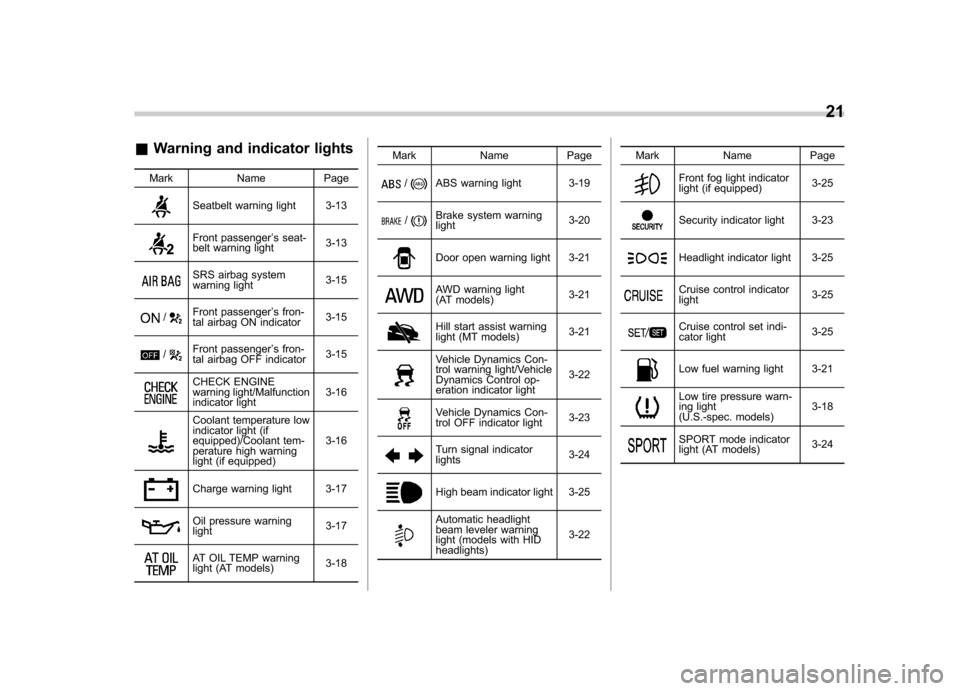
&Warning and indicator lights
Mark Name Page
Seatbelt warning light 3-13
Front passenger ’s seat-
belt warning light 3-13
SRS airbag system
warning light3-15
/Front passenger
’s fron-
tal airbag ON indicator 3-15
/Front passenger
’s fron-
tal airbag OFF indicator 3-15
CHECK ENGINE
warning light/Malfunction
indicator light3-16
Coolant temperature low
indicator light (if
equipped)/Coolant tem-
perature high warning
light (if equipped)3-16
Charge warning light 3-17
Oil pressure warning light
3-17
AT OIL TEMP warning
light (AT models)3-18Mark Name Page
/ABS warning light 3-19
/Brake system warning light
3-20
Door open warning light 3-21
AWD warning light
(AT models)
3-21
Hill start assist warning
light (MT models)
3-21
Vehicle Dynamics Con-
trol warning light/Vehicle
Dynamics Control op-
eration indicator light3-22
Vehicle Dynamics Con-
trol OFF indicator light
3-23
Turn signal indicator lights
3-24
High beam indicator light 3-25
Automatic headlight
beam leveler warning
light (models with HID headlights)3-22Mark Name Page
Front fog light indicator
light (if equipped)
3-25
Security indicator light 3-23
Headlight indicator light 3-25
Cruise control indicator light3-25
Cruise control set indi-
cator light
3-25
Low fuel warning light 3-21
Low tire pressure warn-
ing light
(U.S.-spec. models)3-18
SPORT mode indicator
light (AT models)
3-2421
Page 25 of 438

22
Function settings
A SUBARU dealer can change the settings of the functions shown in the following table to meet your personal requirements. Contact
the nearest SUBARU dealer for details. If your vehicle is equipped with the genuine SUBARU DVD navigation system, the settings for
some of these functions can be changed using the navigation monitor. For details, please refer to the Owner’s Manual supplement for
the navigation system.
Item Function Possible settings Default setting
Alarm system Alarm system Operation/Non-operation Operation
Monitoring start delay time (after closure of doors) 0 second/30 seconds 30 seconds
Impact sensor operation (only models with
shock sensors [dealer option]) Operation/Non-operation Non-operation
Passive arming Operation/Non-operation Non-operation
Dome light/map lights illumination ON/OFF OFF
Remote keyless entry system Hazard warning flasher Operation/Non-operation Operation
Audible signal Operation/Non-operation Operation
Key lock-in prevention Key lock-in prevention Operation/Non-operation Operation
Remote engine start system
(dealer option) Horn chirp confirmation ON/OFF ON
Defogger and deicer system for
models with the automatic cli-
mate control system Rear window defogger, outside mirror de-
fogger and windshield wiper deicer
Operation for 15 minutes/
Continuous operationOperation for 15 minutes
Map light/Dome light Operation of map light/dome light OFF delay timer OFF/Short/Normal/Long Long
Battery drainage prevention function Battery drainage prevention function* Operation/Non-operation Operation
Seatbelt warning Sounds a chime while driving Operation/Non-operation Operation
*: The setting can only be changed at a SUBARU dealer.
Page 26 of 438
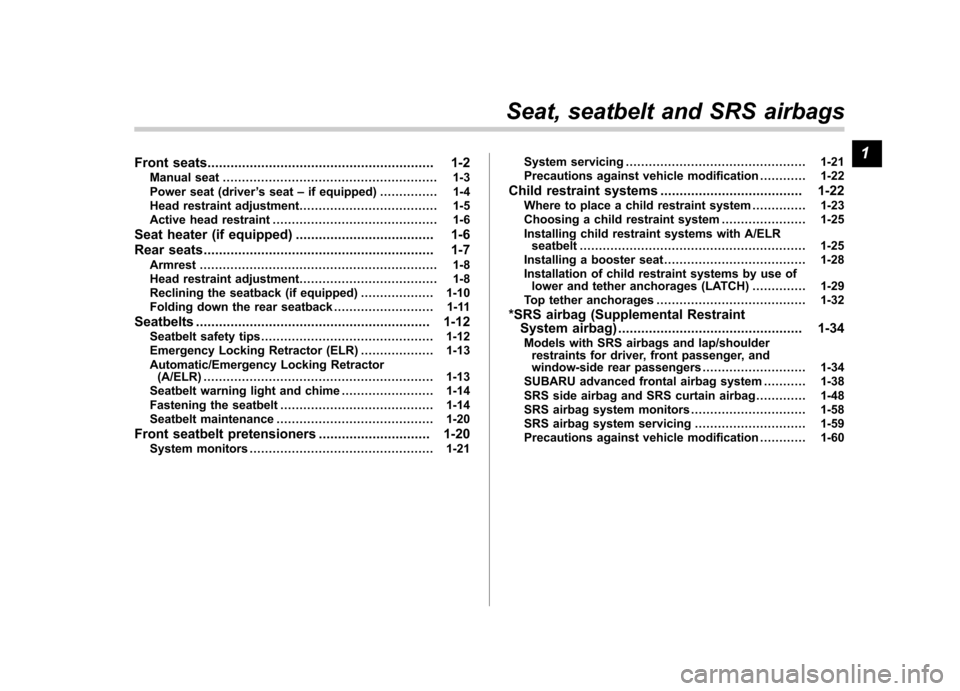
Front seats........................................................... 1-2
Manual seat ........................................................ 1-3
Power seat (driver ’s seat –if equipped) ... ............ 1-4
Head restraint adjustment .................................... 1-5
Active head restraint ........................................... 1-6
Seat heater (if equipped) .................................... 1-6
Rear seats ............................................................ 1-7
Armrest .............................................................. 1-8
Head restraint adjustment .................................... 1-8
Reclining the seatback (if equipped) ................... 1-10
Folding down the rear seatback .......................... 1-11
Seatbelts ............................................................. 1-12
Seatbelt safety tips ............................................. 1-12
Emergency Locking Retractor (ELR) ................... 1-13
Automatic/Emergency Locking Retractor (A/ELR) ............................................................ 1-13
Seatbelt warning light and chime ........................ 1-14
Fastening the seatbelt ........................................ 1-14
Seatbelt maintenance ......................................... 1-20
Front seatbelt pretensioners ............................. 1-20
System monitors ................................................ 1-21 System servicing
............................................... 1-21
Precautions against vehicle modification ............ 1-22
Child restraint systems ..................................... 1-22
Where to place a child restraint system .............. 1-23
Choosing a child restraint system ...................... 1-25
Installing child restraint systems with A/ELR seatbelt ........................................................... 1-25
Installing a booster seat ..................................... 1-28
Installation of child restraint systems by use of lower and tether anchorages (LATCH) .............. 1-29
Top tether anchorages ....................................... 1-32
*SRS airbag (Supplemental Restraint System airbag) ................................................ 1-34
Models with SRS airbags and lap/shoulder restraints for driver, front passenger, and
window-side rear passengers . .......................... 1-34
SUBARU advanced frontal airbag system ........... 1-38
SRS side airbag and SRS curtain airbag ............. 1-48
SRS airbag system monitors .............................. 1-58
SRS airbag system servicing ... .......................... 1-59
Precautions against vehicle modification ............ 1-60
Seat, seatbelt and SRS airbags1
Page 27 of 438
1-2Seat, seatbelt and SRS airbags
Front seats
WARNING
. Never adjust the seat while driv-
ing to avoid loss of vehicle con-
trol and personal injury.
. Before adjusting the seat, make
sure the hands and feet of rear
seat passengers and cargo are
clear of the adjusting mechan-ism.
. After adjusting the seat, push it
slightly to make sure it is se-
curely locked. If the seat is not
securely locked, it may move or
the seatbelt may not operate
properly.
. Do not put objects under the front
seats. They may interfere with
front seat locking and cause anaccident.
. Seatbelts provide maximum re-
straint when the occupant sits
well back and upright in the seat.
To reduce the risk of sliding
under the seatbelt in a collision,
the front seatbacks should be
always used in the upright posi-
tion while the vehicle is running.
If the front seatbacks are not used in the upright position in a
collision, the risk of sliding under
the lap belt and of the lap belt
sliding up over the abdomen will
increase, and both can result in
serious internal injury or death.
. The SRS airbags deploy with
considerable speed and force.
Occupants who are out of proper
position when the SRS airbag
deploys could suffer very serious
injuries. Because the SRS airbag
needs enough space for deploy-
ment, the driver should always
sit upright and well back in the
seat as far from the steering
wheel as practical while still
maintaining full vehicle control
and the front passenger should
move the seat as far back as
possible and sit upright and well
back in the seat.
WARNING
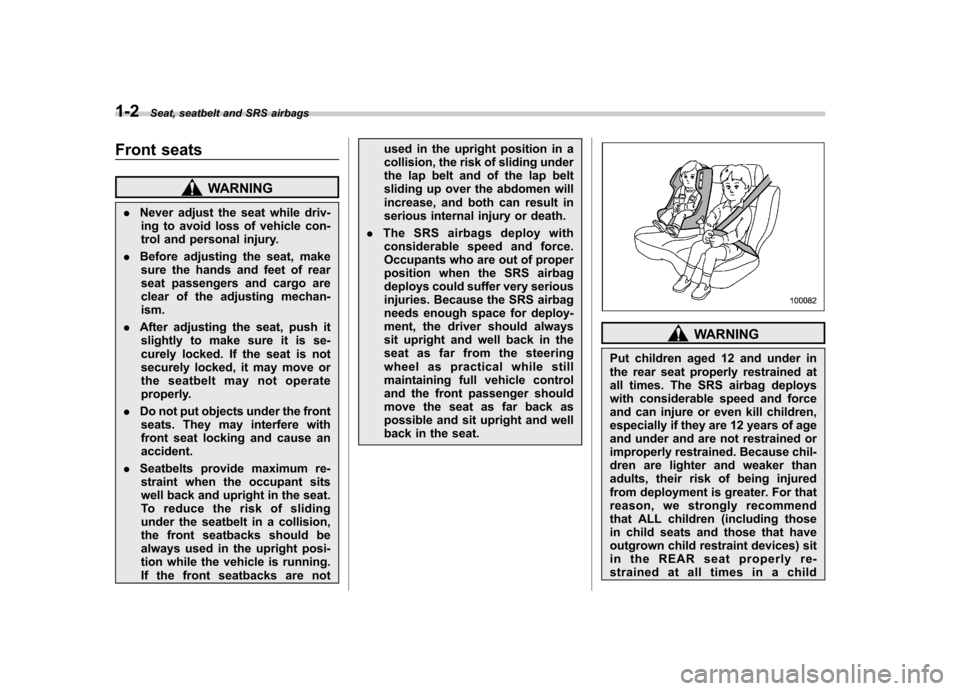
Put children aged 12 and under in
the rear seat properly restrained at
all times. The SRS airbag deploys
with considerable speed and force
and can injure or even kill children,
especially if they are 12 years of age
and under and are not restrained or
improperly restrained. Because chil-
dren are lighter and weaker than
adults, their risk of being injured
from deployment is greater. For that
reason, we strongly recommend
that ALL children (including those
in child seats and those that have
outgrown child restraint devices) sit
in the REAR seat properly re-
strained at all times in a child
Page 29 of 438
1-4Seat, seatbelt and SRS airbags
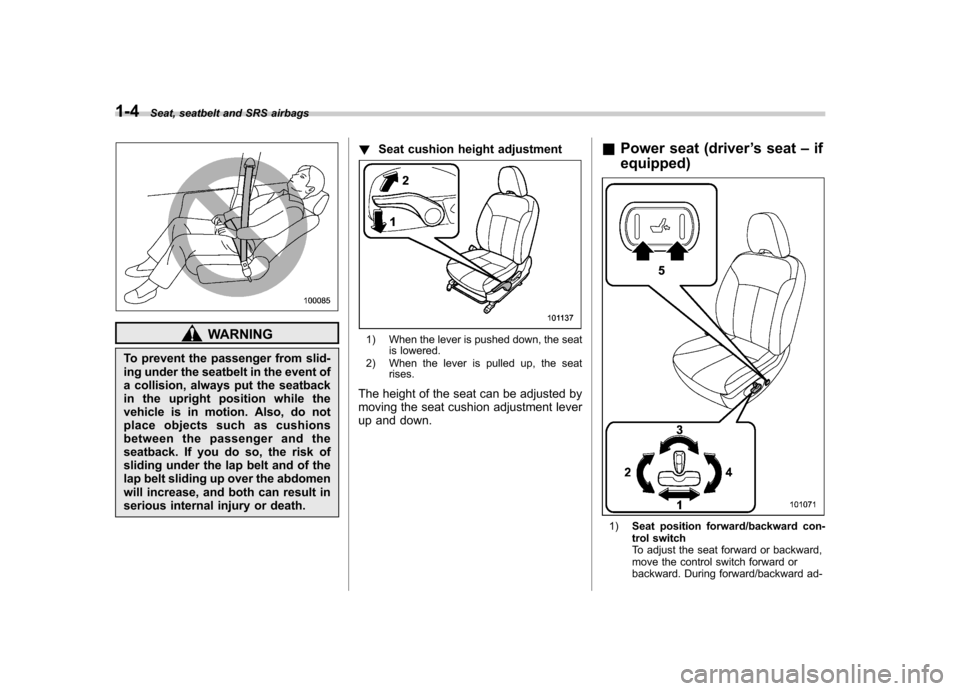
WARNING
To prevent the passenger from slid-
ing under the seatbelt in the event of
a collision, always put the seatback
in the upright position while the
vehicle is in motion. Also, do not
place objects such as cushions
between the passenger and the
seatback. If you do so, the risk of
sliding under the lap belt and of the
lap belt sliding up over the abdomen
will increase, and both can result in
serious internal injury or death. !
Seat cushion height adjustment1) When the lever is pushed down, the seat
is lowered.
2) When the lever is pulled up, the seat rises.
The height of the seat can be adjusted by
moving the seat cushion adjustment lever
up and down. &
Power seat (driver ’s seat –if
equipped)
1) Seat position forward/backward con-
trol switch
To adjust the seat forward or backward,
move the control switch forward or
backward. During forward/backward ad-
Page 30 of 438
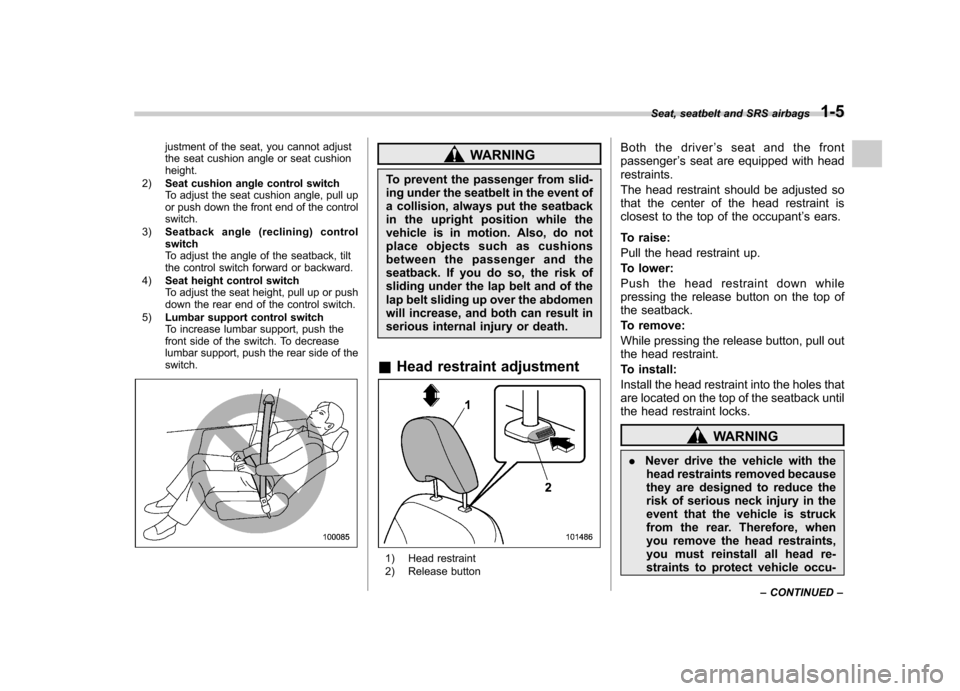
justment of the seat, you cannot adjust
the seat cushion angle or seat cushion height.
2) Seat cushion angle control switch
To adjust the seat cushion angle, pull up
or push down the front end of the control switch.
3) Seatback angle (reclining) controlswitch
To adjust the angle of the seatback, tilt
the control switch forward or backward.
4) Seat height control switch
To adjust the seat height, pull up or push
down the rear end of the control switch.
5) Lumbar support control switch
To increase lumbar support, push the
front side of the switch. To decrease
lumbar support, push the rear side of the switch.WARNING
To prevent the passenger from slid-
ing under the seatbelt in the event of
a collision, always put the seatback
in the upright position while the
vehicle is in motion. Also, do not
place objects such as cushions
between the passenger and the
seatback. If you do so, the risk of
sliding under the lap belt and of the
lap belt sliding up over the abdomen
will increase, and both can result in
serious internal injury or death.
& Head restraint adjustment
1) Head restraint
2) Release button Both the driver
’s seat and the front
passenger ’s seat are equipped with head
restraints.
The head restraint should be adjusted so
that the center of the head restraint is
closest to the top of the occupant ’s ears.
To raise:
Pull the head restraint up.
To lower:
Push the head restraint down while
pressing the release button on the top of
the seatback.
To remove:
While pressing the release button, pull out
the head restraint.
To install:
Install the head restraint into the holes that
are located on the top of the seatback until
the head restraint locks.
WARNING
. Never drive the vehicle with the
head restraints removed because
they are designed to reduce the
risk of serious neck injury in the
event that the vehicle is struck
from the rear. Therefore, when
you remove the head restraints,
you must reinstall all head re-
straints to protect vehicle occu- Seat, seatbelt and SRS airbags
1-5
– CONTINUED –
Page 32 of 438
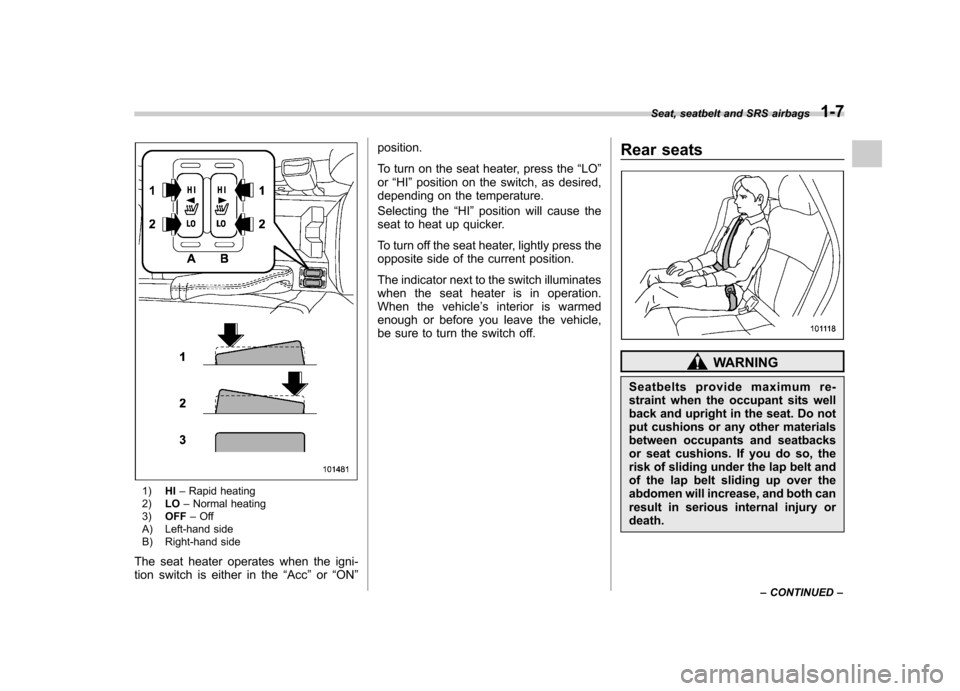
1)HI–Rapid heating
2) LO–Normal heating
3) OFF –Off
A) Left-hand side
B) Right-hand side
The seat heater operates when the igni-
tion switch is either in the “Acc ”or “ON ” position.
To turn on the seat heater, press the
“LO ”
or “HI ”position on the switch, as desired,
depending on the temperature.
Selecting the “HI ”position will cause the
seat to heat up quicker.
To turn off the seat heater, lightly press the
opposite side of the current position.
The indicator next to the switch illuminates
when the seat heater is in operation.
When the vehicle ’s interior is warmed
enough or before you leave the vehicle,
be sure to turn the switch off. Rear seats
WARNING
Seatbelts provide maximum re-
straint when the occupant sits well
back and upright in the seat. Do not
put cushions or any other materials
between occupants and seatbacks
or seat cushions. If you do so, the
risk of sliding under the lap belt and
of the lap belt sliding up over the
abdomen will increase, and both can
result in serious internal injury ordeath. Seat, seatbelt and SRS airbags
1-7
– CONTINUED –
Page 33 of 438
1-8Seat, seatbelt and SRS airbags
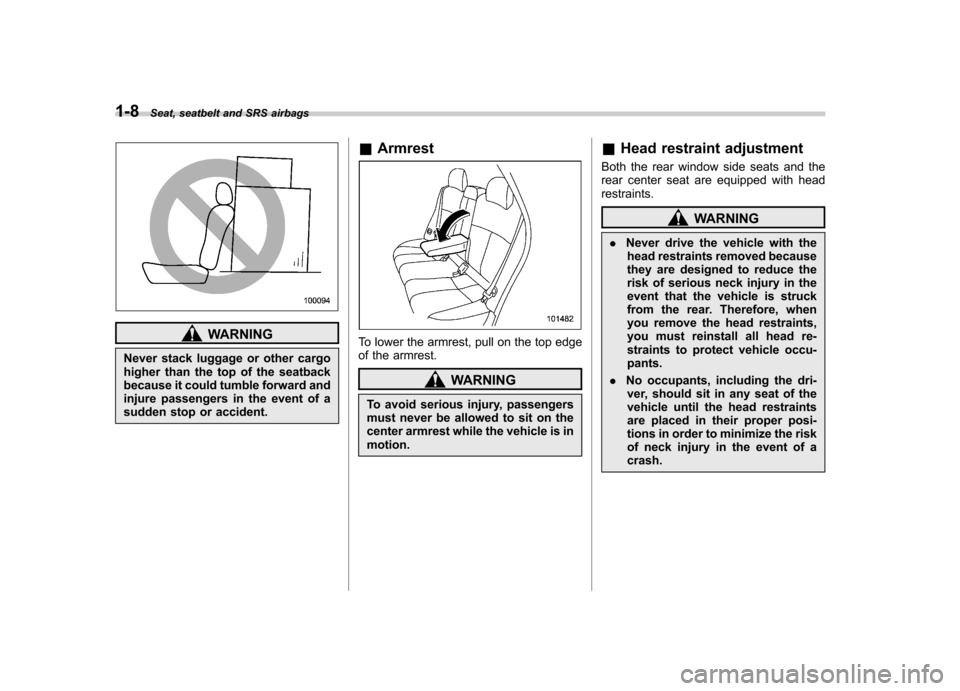
WARNING
Never stack luggage or other cargo
higher than the top of the seatback
because it could tumble forward and
injure passengers in the event of a
sudden stop or accident. &
ArmrestTo lower the armrest, pull on the top edge
of the armrest.
WARNING
To avoid serious injury, passengers
must never be allowed to sit on the
center armrest while the vehicle is inmotion. &
Head restraint adjustment
Both the rear window side seats and the
rear center seat are equipped with headrestraints.
WARNING
. Never drive the vehicle with the
head restraints removed because
they are designed to reduce the
risk of serious neck injury in the
event that the vehicle is struck
from the rear. Therefore, when
you remove the head restraints,
you must reinstall all head re-
straints to protect vehicle occu-pants.
. No occupants, including the dri-
ver, should sit in any seat of the
vehicle until the head restraints
are placed in their proper posi-
tions in order to minimize the risk
of neck injury in the event of acrash.
Page 35 of 438
1-10Seat, seatbelt and SRS airbags
To lower:
Push the head restraint down while
pressing the release button on the top of
the seatback.
To remove:
While pressing the release button, pull out
the head restraint.
To install:
Install the head restraint into the holes that
are located on the top of the seatback until
the head restraint locks.
When the rear-center seating position is
occupied, raise the head restraint to the
extended position.
When the rear center seating position is
not occupied, lower the head restraint to
improve rearward visibility. &
Reclining the seatback (if equipped)
WARNING
To prevent the passenger from slid-
ing under the seatbelt in the event of
a collision, always put the seatback
in the upright position while the
vehicle is in motion. Also, do not
place objects such as cushions
between the passenger and the
seatback. If you do so, the risk of
sliding under the lap belt and of the
lap belt sliding up over the abdomen
will increase, and both can result in
serious internal injury or death.
CAUTION
If the vehicle is equipped with a
cargo area cover, observe the fol-
lowing precautions. . Be careful not to pinch your hand
between the head restraint and
the cargo area cover when you
recline the rear seat.
. Move the front cover of the cargo
area cover backward so that the
cover is not damaged by the
reclined seatback. Refer to “Car-
go area cover (dealer option) ”
F 6-14.
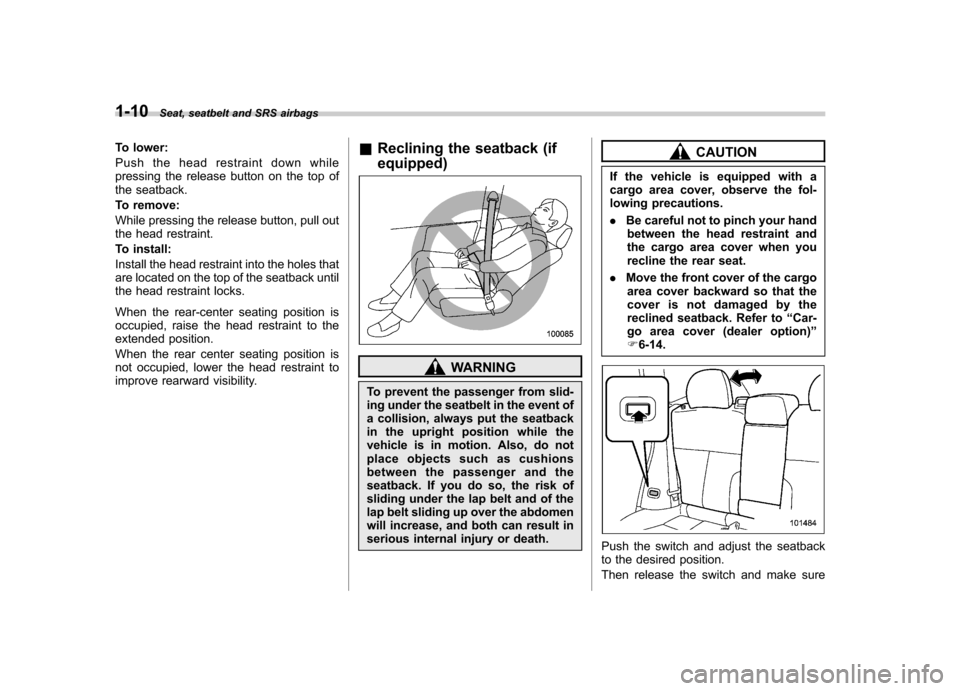
Push the switch and adjust the seatback
to the desired position.
Then release the switch and make sure