roof SUBARU FORESTER 2012 SH / 3.G Owners Manual
[x] Cancel search | Manufacturer: SUBARU, Model Year: 2012, Model line: FORESTER, Model: SUBARU FORESTER 2012 SH / 3.GPages: 438, PDF Size: 15.31 MB
Page 15 of 438

12
Illustrated index &Exterior1) Engine hood (page 11-5)
2) Headlight switch (page 3-30)
3) Replacing bulbs (page 11-45)
4) Wiper switch (page 3-34)
5) Moonroof (page 2-24)
6) Roof rail (page 8-14)
7) Door locks (page 2-4)
8) Tire pressure (page 11-31)
9) Flat tires (page 9-6)
10) Tire chains (page 8-11)
11) Front fog light switch (page 3-32)
12) Tie-down hooks (page 9-14)
13) Towing hook (page 9-14)
Page 73 of 438
1-48Seat, seatbelt and SRS airbags
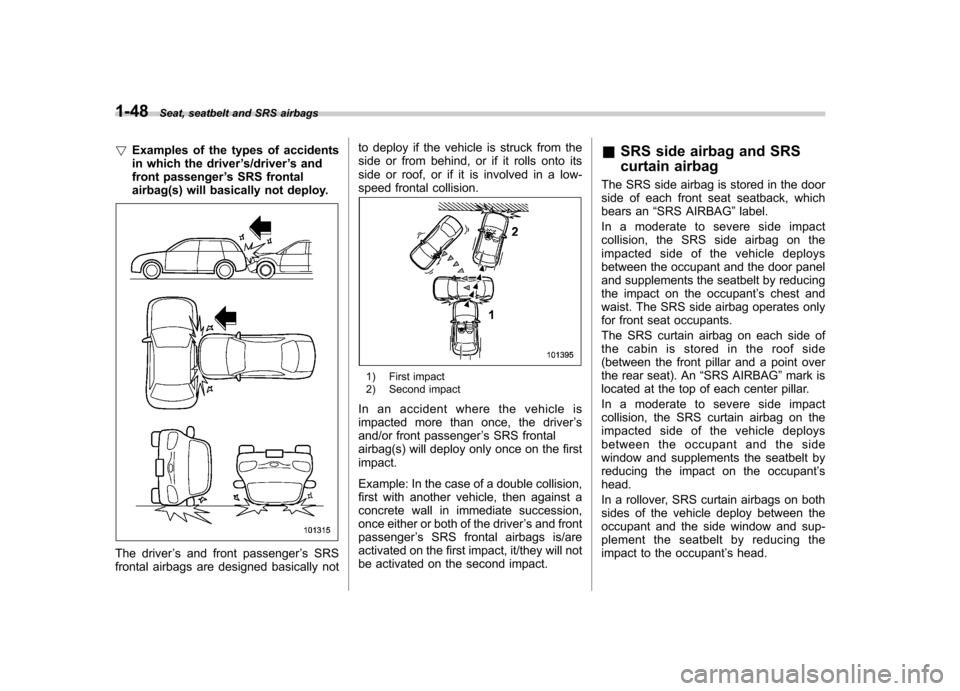
! Examples of the types of accidents
in which the driver ’s/driver ’s and
front passenger ’s SRS frontal
airbag(s) will basically not deploy.
The driver ’s and front passenger ’s SRS
frontal airbags are designed basically not to deploy if the vehicle is struck from the
side or from behind, or if it rolls onto its
side or roof, or if it is involved in a low-
speed frontal collision.
1) First impact
2) Second impact
In an accident where the vehicle is
impacted more than once, the driver ’s
and/or front passenger ’s SRS frontal
airbag(s) will deploy only once on the firstimpact.
Example: In the case of a double collision,
first with another vehicle, then against a
concrete wall in immediate succession,
once either or both of the driver ’s and front
passenger ’s SRS frontal airbags is/are
activated on the first impact, it/they will not
be activated on the second impact. &
SRS side airbag and SRS
curtain airbag
The SRS side airbag is stored in the door
side of each front seat seatback, which
bears an “SRS AIRBAG ”label.
Inamoderatetoseveresideimpact
collision, the SRS side airbag on the
impacted side of the vehicle deploys
between the occupant and the door panel
and supplements the seatbelt by reducing
the impact on the occupant ’s chest and
waist. The SRS side airbag operates only
for front seat occupants.
The SRS curtain airbag on each side of
the cabin is stored in the roof side
(between the front pillar and a point over
the rear seat). An “SRS AIRBAG ”mark is
located at the top of each center pillar.
Inamoderatetoseveresideimpact
collision, the SRS curtain airbag on the
impacted side of the vehicle deploys
between the occupant and the side
window and supplements the seatbelt by
reducing the impact on the occupant ’s
head.
In a rollover, SRS curtain airbags on both
sides of the vehicle deploy between the
occupant and the side window and sup-
plement the seatbelt by reducing the
impact to the occupant ’s head.
Page 74 of 438
WARNING
The SRS side airbag and SRS
curtain airbag are designed as only
a supplement to the primary protec-
tion provided by the seatbelt. They
do not do away with the need to
fasten seatbelts. It is also important
to wear your seatbelt to help avoid
injuries that can result when an
occupant is not seated in a proper
upright position.
WARNING
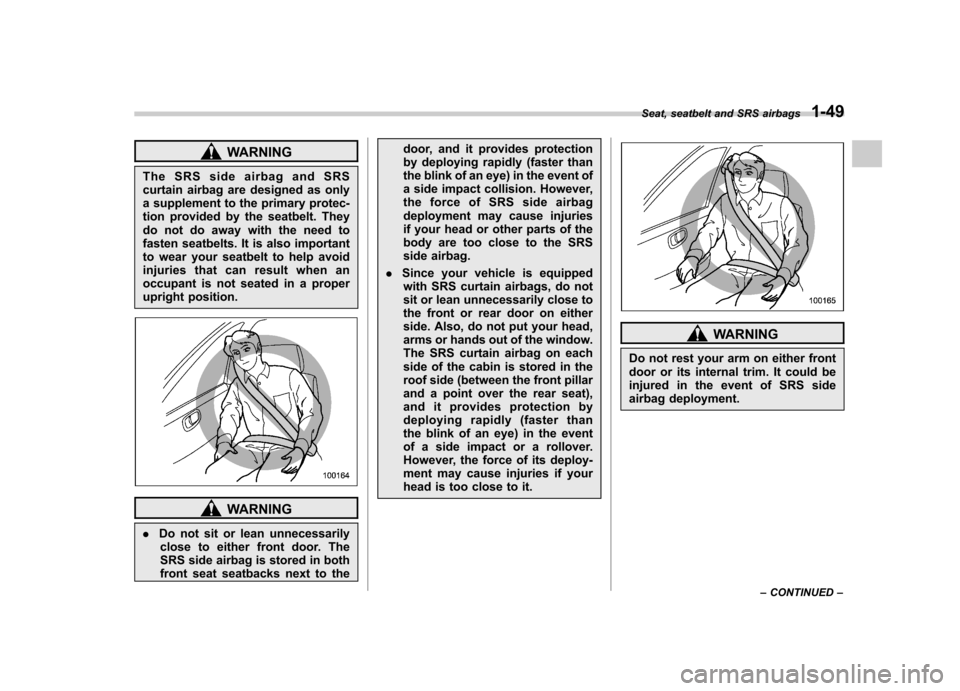
. Do not sit or lean unnecessarily
close to either front door. The
SRS side airbag is stored in both
front seat seatbacks next to the door, and it provides protection
by deploying rapidly (faster than
the blink of an eye) in the event of
a side impact collision. However,
theforceofSRSsideairbag
deployment may cause injuries
if your head or other parts of the
body are too close to the SRS
side airbag.
. Since your vehicle is equipped
with SRS curtain airbags, do not
sit or lean unnecessarily close to
the front or rear door on either
side. Also, do not put your head,
arms or hands out of the window.
The SRS curtain airbag on each
side of the cabin is stored in the
roof side (between the front pillar
and a point over the rear seat),
and it provides protection by
deploying rapidly (faster than
the blink of an eye) in the event
of a side impact or a rollover.
However, the force of its deploy-
ment may cause injuries if your
head is too close to it.
WARNING
Do not rest your arm on either front
door or its internal trim. It could be
injured in the event of SRS side
airbag deployment. Seat, seatbelt and SRS airbags
1-49
– CONTINUED –
Page 77 of 438

1-52Seat, seatbelt and SRS airbags
the SRS curtain airbag on the impacted
side to inflate.
If the rollover sensor detects rollover of the
vehicle, the control module inflates the
curtain airbags.
After the deployment, the SRS side airbag
immediately starts to deflate. The time
required from detection of an impact to
deflation of an SRS side airbag after
deployment is shorter than the blink of
an eye. The SRS curtain airbags remain
inflated for a while following deployment
then slowly deflates.
The SRS side airbag and SRS curtain
airbags deploy even when no one occu-
pies the seat on the side on which an
impact is applied.
When the SRS side airbag and SRS
curtain airbags deploy, a sudden, fairly
loud inflation noise will be heard and some
smoke will be released. These occur-
rences are a normal result of the deploy-
ment. This smoke does not indicate a fire
in the vehicle.
CAUTION
Do not touch the SRS side airbag
system components around the
front seat seatback with bare hands
right after deployment. Doing so can
cause burns because the compo- nents can be very hot as a result ofdeployment.
After deployment, do not touch any
part of the SRS curtain airbag
system (from the front pillar to the
part of the roof side over the rear
seat). Doing so can cause burns
because the components can be
very hot as a result of deployment.
The SRS side airbag and SRS curtain
airbags are designed to deploy in the
event of an accident involving a moderate
to severe side impact collision. Also, in the
case of a rollover, the SRS curtain airbags
deploy. They are basically not designed to
deploy in a lesser side impact. Also, they
are basically not designed to deploy in
frontal or rear impacts because SRS side
airbag and SRS curtain airbag deploy-
ment would not help the occupant in thosesituations.
Each SRS side airbag and SRS curtain
airbags are designed to function on a one-
time-only basis.
SRS side airbag and SRS curtain airbag
deployment depend on the level of force
experienced in the passenger compart-
ment during a side impact collision. That
level differs from one type of collision to
another, and it may have no bearing on the visible damage done to the vehicle
itself. Also, the SRS curtain airbags
deploy depending on the vehicle
’s position
and inclination at the time of the rollover. ! Example of the type of accident in
which the SRS side airbag will most
likely deploy.
A severe side impact near the front seat
activates the SRS side airbag and SRS
curtain airbag.
Page 78 of 438

!Examples of the types of accidents in which the SRS curtain airbag will most
likely deploy.1) A severe side impact near the front seat
or the rear seat activates the SRS curtain airbag.
2) The vehicle rolls onto its side or the roof.
3) If the angle of vehicle tip-up is marginal or if the skidding vehicle ’s tires hit a
curbstone laterally.
Seat, seatbelt and SRS airbags
1-53
– CONTINUED –
Page 80 of 438

!Examples of the types of accidents in which the SRS side airbag is unlikely to
deploy.1) The vehicle is involved in an oblique
side-on impact.
2) The vehicle is involved in a side-on impact in an area outside the vicinity of
the passenger compartment.
3) The vehicle strikes a telephone pole or similar object.
4) The vehicle is involved in a side-on impact from a motorcycle.
5) The vehicle rolls onto its side or roof.
There are many types of collisions which
might not necessarily require SRS side
airbag deployment. In the event of acci-
dents like those illustrated, the SRS side
airbag may not deploy depending on the
level of accident forces involved. Seat, seatbelt and SRS airbags
1-55
– CONTINUED –
Page 84 of 438
.No illumination of the warning
light when the ignition switch is
first turned to the “ON ”position
. Continuous illumination of the
warning light
. Illumination of the warning light
while driving
& SRS airbag system servicing
WARNING
. When discarding an airbag mod-
ule or scrapping the entire vehi-
cle damaged by a collision, con-
sult your SUBARU dealer.
. The SRS airbag has no user-
serviceable parts. Do not use
electrical test equipment on any
circuit related to the SRS airbag
system. For required servicing of
the SRS airbag, consult your
nearest SUBARU dealer. Tamper-
ing with or disconnecting thesystem ’s wiring could result in
accidental inflation of the SRS
airbag or could make the system
inoperative, which may result in
serious injury.
CAUTION
If you need service or repair in areas
indicated in the following list, have
the work performed by an author-
ized SUBARU dealer. The SRS air-
bag control module, impact sensors
and airbag modules are stored in
these areas. . Under the center console
. On both the right and left sides at
the front of the vehicle
. Steering wheel and column and
nearby areas
. Top of the dashboard on front
passenger ’s side and nearby
areas
. Each front seat and nearby area
. Inside each center pillar
. In each roof side (from the front
pillar to a point over the rear seat)
. Between the rear seat cushion
and rear wheel house on each side
. Under the rear center seat
In the event that the SRS airbag is
deployed, replacement of the system
should be performed only by an author-
ized SUBARU dealer. When the compo- nents of the SRS airbag system are
replaced, use only genuine SUBARUparts.
NOTE
In the following cases, contact your
SUBARU dealer as soon as possible. . The front part of the vehicle was
damaged in an accident in which either
or both of the frontal airbags did not
deploy.. The pad of the steering wheel, the
cover over the front passenger ’s SRS
frontal airbag, or either roof side (from
the front pillar to a point over the rear
seat) is scratched, cracked, or other-
wise damaged.. Center pillar, rear wheel house or
rear sub frame, or an area near these
parts, was involved in an accident in
which the SRS side airbag and SRS
curtain airbag did not deploy.. The fabric or leather of either front
seatback is cut, frayed, or otherwisedamaged.. The rear part of the vehicle was
involved in an accident in which no
SRS airbag deployed. Seat, seatbelt and SRS airbags
1-59
– CONTINUED –
Page 86 of 438

Keys..................................................................... 2-2
Key number plate and security ID plate ................ 2-2
Immobilizer .......................................................... 2-3
Security indicator light ........................................ 2-3
Key replacement ................................................. 2-3
Door locks ........................................................... 2-4
Locking and unlocking from the outside .. ............ 2-4
Locking and unlocking from the inside ................ 2-5
Battery drainage prevention function ................... 2-5
Power door locking switches ............................. 2-6
Key lock-in prevention function ........................... 2-7
Remote keyless entry system ............................ 2-7
Locking the doors ............................................... 2-8
Unlocking the doors ............................................ 2-9
Unlocking the rear gate ....................................... 2-9
Illuminated entry ................................................. 2-9
Vehicle finder function ......................................... 2-9
Sounding a panic alarm ...................................... 2-10
Selecting turn signal lights operation .................. 2-10
Selecting audible signal operation ...................... 2-10
Replacing the battery ......................................... 2-10
Replacing lost transmitters ................................. 2-11 Alarm system
..................................................... 2-14
System operation ............................................... 2-14
Activating and deactivating the alarm system ..... 2-15
If you have accidentally triggered the alarm system ............................................................ 2-15
Arming the system ............................................ 2-15
Disarming the system ........................................ 2-17
Valet mode ........................................................ 2-17
Passive arming .................................................. 2-17
Tripped sensor identification .............................. 2-18
Shock sensors (dealer option).. .......................... 2-19
Child safety locks .............................................. 2-19
Windows ............................................................. 2-20
Power window operation by driver ..................... 2-20
Power window operation by passengers ............. 2-22
Initialization of power window (type A) ............... 2-23
Rear gate ............................................................ 2-23
Moonroof (if equipped) ...................................... 2-24
To open the moonroof ....................................... 2-25
To close the moonroof ....................................... 2-25
Anti-entrapment function .................................... 2-25
Sun shade ......................................................... 2-26 Keys and doors
2
Page 88 of 438

Immobilizer
CAUTION
FCC WARNING
Changes or modifications not ex-
pressly approved by the party re-
sponsible for compliance could void
the user ’s authority to operate the
equipment.
The immobilizer system is designed to
prevent an unauthorized person from
starting the engine. Only keys registered
with your vehicle ’s immobilizer system can
be used to operate your vehicle. Even if
an unregistered key fits into the ignition
switch and can be turned to the “START ”
position, the engine will not start or will
stop after several seconds.
Each immobilizer key contains a trans-
ponder in which the key ’s ID code is
stored. When a key is inserted into the
ignition switch and turned to the “ON ”
position, the transponder transmits thekey ’s ID code to the immobilizer system ’s
receiver. If the transmitted ID code
matches the ID code registered in the
immobilizer system, the system allows the
engine to be started. Since the ID code is
transmitted and acted upon almost in- stantly, the immobilizer system does not
impede normal starting of the engine.
If the engine fails to start, pull out the key
once before trying again. Refer to
“Ignition
switch ”F 3-3.
This device complies with Part 15 of
the FCC Rules and RSS-Gen of IC
Rules. Operation is subject to the
following two conditions: (1) this de-
vice may not cause harmful interfer-
ence, and (2) this device must accept
any interference received, including
interference that may cause undesiredoperation.
CAUTION
. Do not place the key under direct
sunlight or anywhere it may
become hot.
. Do not get the key wet. If the key
gets wet, wipe it dry with a cloth
immediately.
NOTE
To protect your vehicle from theft,
please pay close attention to the fol-
lowing security precautions. . Never leave your vehicle unattended
with its keys inside. . Before leaving your vehicle, close all windows and the moonroof, and lock
the doors and rear gate..
Do not leave spare keys or any
record of your key number in thevehicle. & Security indicator light
Refer to “Security indicator light ”F 3-23.
& Key replacement
Your key number plate and security ID
plate are required if you need a new
replacement key. Any new key must be
registered to your vehicle ’s immobilizer
system. Up to four keys can be registered
for use with one vehicle.
For security, all the keys must be re-
registered to your vehicle ’s immobilizer
system when registering a new key.
Therefore, all of your vehicle ’s keys must
be presented when a new key is regis-
tered. Any key that is not re-registered
cannot be used after the other keys are re-
registered. For information on replace-
ment keys and on the registration of keys
with your immobilizer system, contact your
SUBARU dealer.
NOTE
A vehicle that is equipped with the
remote engine start system as a dealer Keys and doors
2-3
– CONTINUED –
Page 100 of 438

to 30 seconds.
The alarm is triggered by: .Opening any of the doors or the rear
gate. Physical impact to the vehicle, such as
forced entry (only vehicles with shock
sensors (dealer option)) NOTE
The alarm system can be set to trigger
the illumination of the following interiorlights. . Dome light (illuminates only when
the dome light switch is in the “DOOR ”
position) . Map lights (illuminate only when the
door interlock switch is in the “DOOR ”
position)
The notifications regarding the dome
light and the map lights are deactivated
as the factory setting. A SUBARU
dealer can activate the system. Contact
your SUBARU dealer for details. &
Activating and deactivating
the alarm system
To change the setting of your vehicle ’s
alarm system for activation or deactiva-
tion, do the following.
1. Disarm the alarm system. Refer to “ Disarming the system ”F 2-17.
2. Sit in the driver ’s seat and shut all
doors and the rear gate.
3. Turn the ignition switch to the “ON ”
position.
4. Hold down the UNLOCK side of the driver ’s power door locking switch, open
the driver ’s door within the following 1
second, and wait 10 seconds without
releasing the switch. The setting will then
be changed as follows.
If the system was previously activated:
The odometer/trip meter screen displays “ AL oF ”and the horn sounds twice,
indicating that the system is now deacti-vated.
If the system was previously deacti- vated:
The odometer/trip meter screen displays “ AL on ”and the horn sounds once,
indicating that the system is now acti-vated. NOTE
You may have the above setting
change done by your SUBARU dealer. &
If you have accidentally trig-
gered the alarm system
! To stop the alarm
Do any of the following operations: . Press any button on the remote trans-
mitter.. Turn the ignition switch to the “ON ”
position. & Arming the system
! To arm the system using remote transmitter
1. Close all windows and the moonroof (ifequipped).
2. Remove the key from the ignition switch.
3. Open the doors and get out of the vehicle.
4. Make sure that the engine hood is locked.
5. Close all doors and the rear gate. Keys and doors
2-15
– CONTINUED –