check engine SUBARU FORESTER 2013 SH / 3.G Workshop Manual
[x] Cancel search | Manufacturer: SUBARU, Model Year: 2013, Model line: FORESTER, Model: SUBARU FORESTER 2013 SH / 3.GPages: 436, PDF Size: 15.3 MB
Page 363 of 436
11-26Maintenance and service
.You might feel that the brake pedal
is applied by lighter force and gener-
ates a greater braking force.. You might hear the sound of ABS
operating from the engine compart-ment. Brake pedal
Check the brake pedal free play and
reserve distance according to the main-
tenance schedule in the
“Warranty and
Maintenance Booklet ”.
& Checking the brake pedal
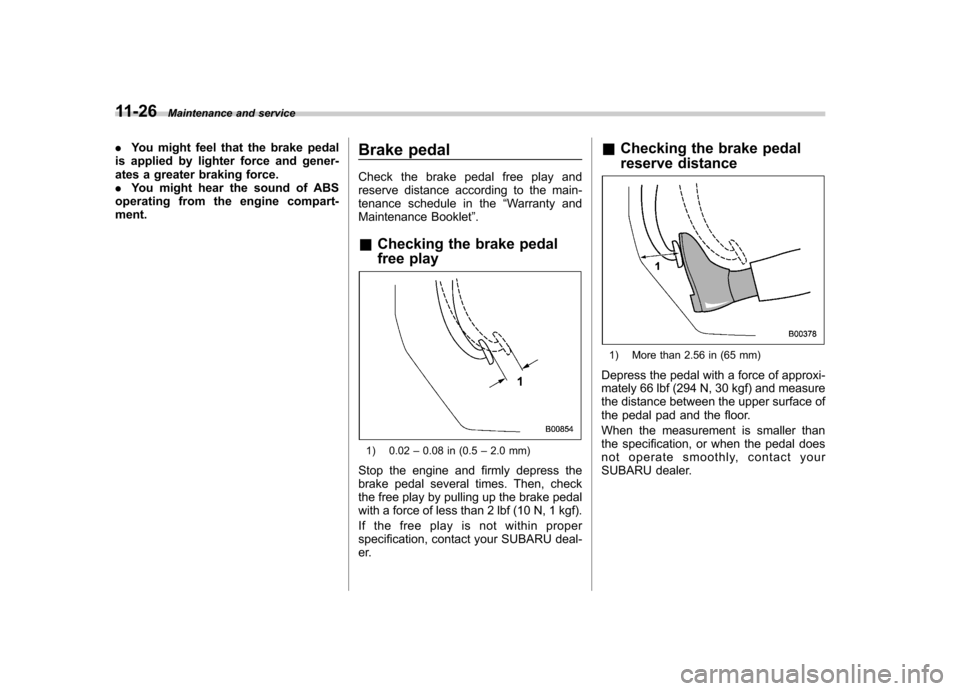
free play
1) 0.02 –0.08 in (0.5 –2.0 mm)
Stop the engine and firmly depress the
brake pedal several times. Then, check
the free play by pulling up the brake pedal
with a force of less than 2 lbf (10 N, 1 kgf).
If the free play is not within proper
specification, contact your SUBARU deal-
er. &
Checking the brake pedal
reserve distance
1) More than 2.56 in (65 mm)
Depress the pedal with a force of approxi-
mately 66 lbf (294 N, 30 kgf) and measure
the distance between the upper surface of
the pedal pad and the floor.
When the measurement is smaller than
the specification, or when the pedal does
not operate smoothly, contact your
SUBARU dealer.
Page 364 of 436
Clutch pedal (MT models)
Check the clutch pedal free play according
to the maintenance schedule in the“Warranty and Maintenance Booklet ”.
& Checking the clutch function
Check the clutch engagement and disen-gagement.
1. With the engine idling, check that there
are no abnormal noises when the clutch
pedal is depressed, and that shifting into
1st or reverse feels smooth.
2. Start the vehicle by releasing the pedal
slowly to check that the engine and
transmission smoothly couple without
any sign of slippage. &
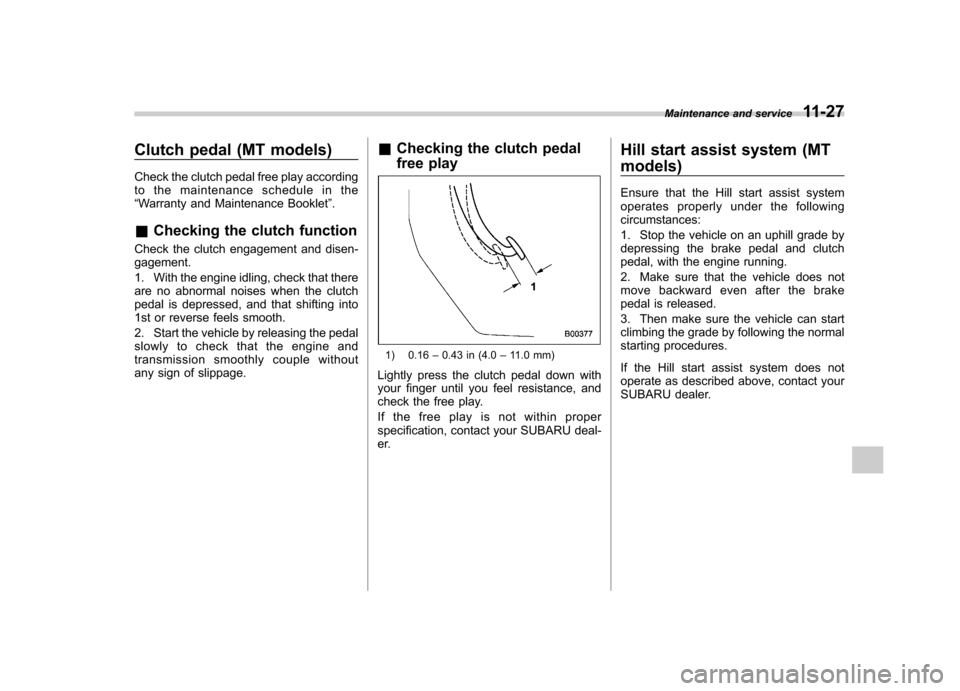
Checking the clutch pedal
free play
1) 0.16 –0.43 in (4.0 –11.0 mm)
Lightly press the clutch pedal down with
your finger until you feel resistance, and
check the free play.
If the free play is not within proper
specification, contact your SUBARU deal-
er. Hill start assist system (MT
models)
Ensure that the Hill start assist system
operates properly under the followingcircumstances:
1. Stop the vehicle on an uphill grade by
depressing the brake pedal and clutch
pedal, with the engine running.
2. Make sure that the vehicle does not
move backward even after the brake
pedal is released.
3. Then make sure the vehicle can start
climbing the grade by following the normal
starting procedures.
If the Hill start assist system does not
operate as described above, contact your
SUBARU dealer.
Maintenance and service
11-27
Page 375 of 436
11-38Maintenance and service
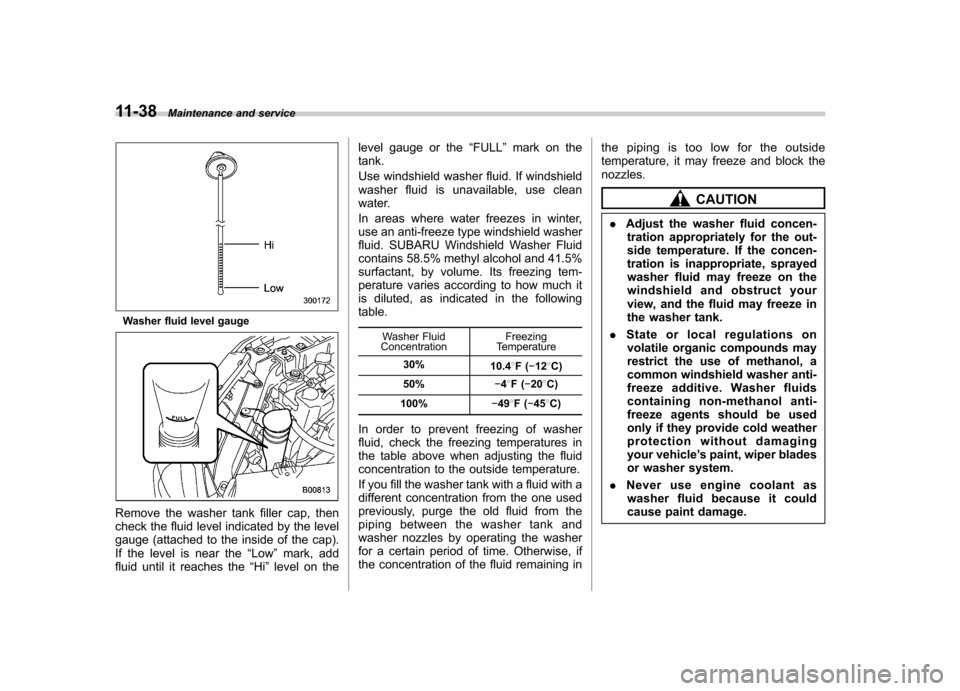
Washer fluid level gauge
Remove the washer tank filler cap, then
check the fluid level indicated by the level
gauge (attached to the inside of the cap).
If the level is near the “Low ”mark, add
fluid until it reaches the “Hi ”level on the level gauge or the
“FULL ”mark on the
tank.
Use windshield washer fluid. If windshield
washer fluid is unavailable, use clean
water.
In areas where water freezes in winter,
use an anti-freeze type windshield washer
fluid. SUBARU Windshield Washer Fluid
contains 58.5% methyl alcohol and 41.5%
surfactant, by volume. Its freezing tem-
perature varies according to how much it
is diluted, as indicated in the followingtable.
Washer Fluid
Concentration Freezing
Temperature
30% 10.48F( 12 8C)
50% 48F( 20 8C)
100% 49 8F( 45 8C)
In order to prevent freezing of washer
fluid, check the freezing temperatures in
the table above when adjusting the fluid
concentration to the outside temperature.
If you fill the washer tank with a fluid with a
different concentration from the one used
previously, purge the old fluid from the
piping between the washer tank and
washer nozzles by operating the washer
for a certain period of time. Otherwise, if
the concentration of the fluid remaining in the piping is too low for the outside
temperature, it may freeze and block thenozzles.
CAUTION
. Adjust the washer fluid concen-
tration appropriately for the out-
side temperature. If the concen-
tration is inappropriate, sprayed
washer fluid may freeze on the
windshield and obstruct your
view, and the fluid may freeze in
the washer tank.
. State or local regulations on
volatile organic compounds may
restrict the use of methanol, a
common windshield washer anti-
freeze additive. Washer fluids
containing non-methanol anti-
freeze agents should be used
only if they provide cold weather
protection without damaging
your vehicle ’s paint, wiper blades
or washer system.
. Never use engine coolant as
washer fluid because it could
cause paint damage.
Page 394 of 436

&Engine oil
For the checking, adding and replacing procedure or other details, refer to “Engine oil ”F 11-9.
NOTE
The procedure for changing the engine oil and oil filter should be performed by a properly-trained expert. It is recommended
that you have this service performed by your SUBARU dealer. ! Approved engine oil
Always use the SUBARU approved engine oil. For further details, please contact your SUBARU dealer.
If the approved engine oil is unavailable, use the alternative engine oil described on the next page. Specifications
12-5
– CONTINUED –
Page 398 of 436

&Fluids
NOTE
Each quantity indicated here is only a guideline. The necessary quantity for replacement may differ slightly depending on the
temperature and other factors.
Fluid Fluid type Fluid capacity
Automatic transmission fluid (AT models) · SUBARU ATF
· IDEMITSU ATF HP 9.8 US qt (9.3 liters, 8.2 Imp qt)
Power steering fluid · SUBARU ATF
· IDEMITSU ATF HP ·
“Dexron III ”Type Automatic Transmission Fluid 0.7 US qt (0.7 liter, 0.6 Imp qt)
Brake fluid FMVSS No. 116, fresh DOT 3 or DOT 4 brake fluid –
Clutch fluid (MT models) –
For the checking procedure, or other details, refer to “Automatic transmission fluid ”F 11-20, “Power steering fluid ”F 11-22, “Brake fluid ”F 11-23 or
“ Clutch fluid (MT models) ”F 11-24.
& Engine coolant
NOTE
Each quantity indicated here is only a guideline. The necessary quantity for replacement may differ slightly depending on the
temperature and other factors.
Model Coolant capacity Coolant type
Non-turbo Manual transmission 7.5 US qt (7.1 liters, 6.2 Imp qt)
SUBARU Super Coolant
Automatic transmission 7.4 US qt (7.0 liters, 6.2 Imp qt)
Turbo 8.5 US qt (8.0 liters, 7.0 Imp qt)
For the checking, adding and replacing procedure, or other details, refer to “Cooling system ”F 11-13. Specifications
12-9
– CONTINUED –
Page 412 of 436
crease in temperature could cause
tread separation, and failure of the
tire(s). Possible resulting loss of
vehicle control could lead to anaccident. !Measuring and adjusting air
pressure to achieve proper in-
flation
Check and, if necessary, adjust the
pressure of each tire (including the
spare) at least once a month and
before any long journey. Check the
tire pressures when the tires are
cold. Use a pressure gauge to
adjust the tire pressures to the
specific values. Driving even a
short distance warms up the tires
and increases the tire pressures.
Also, the tire pressures are affected
by the outside temperature. It is
best to check tire pressure out-
doors before driving the vehicle.
When a tire becomes warm, the air
inside it expands, causing the tire
pressure to increase. Be careful not
to mistakenly release air from a
warm tire to reduce its pressure. &
Glossary of tire terminology
. Accessory weight
The combined weight (in excess of
those standard items which may be
replaced) of automatic transmis-
sion, power steering, power brakes,
power windows, power seats, radio,
and heater, to the extent that these
items are available as factory-in-
stalled equipment (whether in-
stalled or not). . Bead
The part of the tire that is made of
steel wires, wrapped or reinforced
by ply cords and that is shaped to fit
the rim.. Bead separation
A breakdown of the bond between
components in the bead.. Bias ply tire
A pneumatic tire in which the ply
cords that extend to the beads are
laid at alternate angles substantially
less than 90 degrees to the center-
line of the tread. . Carcass
The tire structure, except tread and sidewall rubber which, when in-
flated, bears the load. .
Chunking
The breaking away of pieces of the
tread or sidewall.. Cold tire pressure
The pressure in a tire that has been
driven less than 1 mile or has been
standing for three hours or more.. Cord
The strands forming the plies in the tire. . Cord separation
The parting of cords from adjacent
rubber compounds.. Cracking
Any parting within the tread, side-
wall, or inner liner of the tire
extending to cord material. . Curb weight
The weight of a motor vehicle with
standard equipment including the
maximum capacity of fuel, oil and
coolant, and if so equipped, air
conditioning and additional weight
optional engine.
Consumer information and Reporting safety defects
13-5
– CONTINUED –
Page 426 of 436

Fluid............................................................ 11-23, 12-9
Pad and lining ...................................................... 11-28
Parking ........................................................ 7-29, 11-29
Pedal .................................................................. 11-26
System ................................................................. 7-22
Brake pedal
Free play ............................................................. 11-26
Reserve distance .................................................. 11-26
Brake system ............................................................ 7-22
Warning light ......................................................... 3-20
Braking ..................................................................... 7-22
Tips...................................................................... 7-22
Breaking-in of new brake pads and linings ................... 11-28
Bulb Chart .................................................................. 12-15
Replacing ............................................................. 11-45
C
Cargo area Cover ................................................................... 6-14
Light ............................................................. 6-3, 11-50
Tie-down hooks ..................................................... 6-15
Cargo tray ................................................................. 10-6
Catalytic converter ....................................................... 8-3
Center Console .................................................................. 6-5
Changing
Flat tire ................................................................... 9-6
Oil and oil filter ..................................................... 11-11
Charge warning light .................................................. 3-17 CHECK ENGINE warning light/Malfunction indicator
light ....................................................................... 3-15
Checking
Brake pedal free play ............................................ 11-26
Brake pedal reserve distance ................................. 11-26
Clutch function ..................................................... 11-27
Clutch pedal free play ........................................... 11-27
Coolant level ........................................................ 11-14
Fluid level (automatic transmission fluid) .................. 11-20
Fluid level (brake fluid) .......................................... 11-23
Fluid level (clutch fluid) .......................................... 11-24
Fluid level (power steering fluid) .. ........................... 11-22
Fluid level (washer fluid) ........................................ 11-37
Oil level (engine oil) ................................................ 11-9
Oil level (front differential gear oil) .......................... 11-21
Oil level (manual transmission oil) .......................... 11-19
Child restraint systems ................................................ 1-22
Installation of a booster seat .................................... 1-28
Installation with A/ELR seatbelt ... ............................. 1-25
Lower and tether anchorages ................................... 1-29
Top tether anchorages ............................................ 1-32
Child safety ................................................................... 5
Locks .................................................................... 2-19
Chime Key........................................................................ 3-5Light ..................................................................... 3-29
Seatbelt. ................................................................ 3-13
Cigarette lighter .......................................................... 6-10
Cleaning
Aluminum wheels ................................................... 10-3
Interior .................................................................. 10-5 Index
14-3
Page 430 of 436

Door step............................................................. 11-50
Front fog ............................................................... 3-32
Front side marker ................................................. 12-15
Ignition switch .......................................................... 3-5
License plate ........................................................ 11-49
Map ............................................................. 6-3, 11-50 Parking ................................................................ 11-48
Rear combination .................................................. 11-48
Stop light ............................................................. 11-48
Tail light ............................................................... 11-48
Turn signal ................................................... 3-31, 11-48
Loading your vehicle .................................................. 8-12
Low fuel warning light ................................................. 3-21
Low tire pressure warning light .................................... 3-18
Lower and tether anchorage ........................................ 1-29
M Maintenance Precautions ........................................................... 11-3
Schedule .............................................................. 11-3
Seatbelt ................................................................ 1-19
Tools ...................................................................... 9-4
Malfunction indicator light (check engine warning light) ... 3-15 Manual
Climate control system ............................................. 4-8
Seat ....................................................................... 1-3
Transmission ......................................................... 7-13
Transmission oil ............................................ 11-19, 12-8
Map light ........................................................... 6-3, 11-50
Maximum load limits ................................................... 8-18
Meters and gauges ...................................................... 3-6 Mirror defogger
.......................................................... 3-44
Mirrors ...................................................................... 3-36
Moonroof ................................................................... 2-24
N
New vehicle break-in driving ......................................... 8-2
O
Odometer/Trip meter .................................................... 3-8
Oil filter ................................................................... 11-11
Oil level
Engine .................................................................. 11-9
Front differential gear ............................................ 11-21
Manual transmission ............................................. 11-19
Rear differential gear ............................................ 11-22
Oil pressure warning light ............................................ 3-17
On-road and off-road driving ...................................... 9, 8-6
Outside
Mirror defogger ...................................................... 3-44
Mirrors .................................................................. 3-43
Temperature indicator .............................................. 3-27
Overhead console ....................................................... 6-6
Overheating engine .................................................... 9-13
PParking Brake .................................................................... 7-29
Brake stroke ........................................................ 11-29
Light ................................................................... 11-48
Tips ...................................................................... 7-29
Periodic inspections ..................................................... 8-4 Index
14-7
Page 434 of 436

Warning lightABS ..................................................................... 3-19
All-Wheel Drive ...................................................... 3-21
AT OIL TEMP ........................................................ 3-17
Automatic headlight beam leveler ............................. 3-21
Brake system ........................................................ 3-20
Charge ................................................................. 3-17
CHECK ENGINE ................................................... 3-15
Coolant temperature high ........................................ 3-16
Door open ............................................................. 3-21
Hill start assist ....................................................... 3-21
Low fuel ................................................................ 3-21
Low tire pressure ................................................... 3-18
Oil pressure .......................................................... 3-17
Seatbelt ................................................................ 3-13
SRS airbag system ................................................ 3-14
Vehicle Dynamics Control ....................................... 3-22
Warranties ..................................................................... 1
Warranties and maintenance ....................................... 8-18
Washing ................................................................... 10-2
Waxing and polishing ................................................. 10-3
Wear indicators ......................................................... 11-34
Wheel Aluminum ............................................................. 11-37
Balance ............................................................... 11-33
Covers ................................................................. 11-36
Nut tightening torque ...................................... 9-6, 12-10
Replacement ........................................................ 11-36
Windows ................................................................... 2-20
Windshield Washer fluid ......................................................... 11-37 Wiper and washer switches
..................................... 3-34
Wiper blades ........................................................ 11-39
Wiper deicer .......................................................... 3-44
Winter Driving ................................................................... 8-8
Tires ........................................................... 8-11, 11-29
Wiper and washer ...................................................... 3-33
Wiper deicer .............................................................. 3-44 Index
14-11
Page 436 of 436

GAS STATION REFERENCE
& Fuel:
! Non-turbo models
Use only unleaded gasoline with an octane rating of 87 AKI
(90 RON) or higher .
! Turbo models
Use premium unleaded gasoline with an octane rating of 91
AKI (95 RON) or higher . If premium unleaded gasoline with an
octane rating of 91 AKI (95 RON) is not available, regular
unleaded gasoline with octane rating of 87 AKI (90 RON) or
higher may be temporarily used. For optimum engine perfor-
mance and driveability, it is required that you use premium
grade unleaded gasoline with an octane rating of 91 AKI (95
RON) or higher. & Fuel octane rating:
This octane rating is the average of the Research Octane and
Motor Octane numbers and is commonly referred to as the Anti
Knock Index (AKI). Refer to “Fuel octane rating ”F 7-2.
& Fuel capacity:
16.9 US gal (64 liters, 14.1 Imp gal) &
Engine oil:
Use only the following oils.. API classification SM or SN with the words “ENERGY
CONSERVING ”or “RESOURCE CONSERVING ”
. or ILSAC GF-4 or GF-5, which can be identified with the
ILSAC certification mark (Starburst mark)
For the complete viscosity requirements, refer to “Engine oil ”
F 12-5.
& Engine oil capacity:
Non-turbo models: 5.5 US qt (5.2 liters, 4.6 Imp qt)
Turbo models: 4.4 US qt (4.2 liters, 3.7 Imp qt)
The indicated oil quantity is only a guideline and is estimated
based on a case when the engine oil is changed with an oil
filter. After refilling the engine with oil, the oil level should be
checked using the oil level gauge. For more details about
maintenance and service, refer to “Engine oil ”F 11-9.
& Cold tire pressure:
Refer to “Tires ”F 12-10.