Door handle SUBARU FORESTER 2017 SJ / 4.G User Guide
[x] Cancel search | Manufacturer: SUBARU, Model Year: 2017, Model line: FORESTER, Model: SUBARU FORESTER 2017 SJ / 4.GPages: 634, PDF Size: 11.77 MB
Page 479 of 634
Driving tips/New vehicle break–in driving –the first 1,000 miles (1,600 km)
New vehicle break-in driving
– the first 1,000 miles (1,600
km)
The performance and long life of your
vehicle are dependent on how you handle
and care for your vehicle while it is new.
Follow these instructions during the first
1,000 miles (1,600 km):
. Do not race the engine. And do not
allow engine speed to exceed 4,000 rpm
except in an emergency.
. Do not drive at one constant engine or
vehicle speed for a long time, either fast or
slow.
. Avoid starting suddenly and rapid
acceleration, except in an emergency.
. Avoid hard braking, except in an
emergency.
The same break-in procedures should be
applied to an overhauled engine, newly
mounted engine or when brake pads or
brake linings are replaced with new ones.
Fuel economy hints
The following suggestions will help to save
fuel.
. Select the proper gear position for the
speed and road conditions.
. Avoid sudden acceleration or decelera-
tion. Always accelerate gently until you
reach the desired speed. Then try to
maintain that speed for as long as
possible.
. Do not pump the accelerator and avoid
racing the engine.
. Avoid unnecessary engine idling.
. Keep the engine properly tuned.
. Keep the tires inflated to the correct
pressure shown on the tire placard, which
is located under the door latch on the
driver ’s side. Low pressure will increase
tire wear and fuel consumption.
. Use the air conditioner only when
necessary.
. Keep the front and rear wheels in
proper alignment.
. Avoid carrying unnecessary luggage or
cargo.
Engine exhaust gas (carbon
monoxide)
WARNING
. Never inhale engine exhaust gas.
Engine exhaust gas contains
carbon monoxide, a colorless
and odorless gas which is dan-
gerous, or even lethal, if inhaled.
. Always properly maintain the en-
gine exhaust system to prevent
engine exhaust gas from enter-
ing the vehicle.
. Never run the engine in a closed
space, such as a garage, except
for the brief time needed to drive
the vehicle in or out of it.
. Avoid remaining in a parked
vehicle for a lengthy time while
the engine is running. If that is
unavoidable, then use the venti-
lation fan to force fresh air into
the vehicle.
. Always keep the front ventilator
inlet grille free from snow, leaves
or other obstructions to ensure
that the ventilation system al-
ways works properly.
. If at any time you suspect that
8-2
Page 482 of 634
Driving tips for AWD models
WARNING
.Always maintain a safe driving
speed according to the road and
weather conditions in order to
avoid having an accident on a
sharp turn, during sudden brak-
ing or under other similar condi-
tions.
. Always use the utmost care in
driving –overconfidence be-
cause you are driving an All-
Wheel Drive vehicle could easily
lead to a serious accident.
. When replacing or installing tire
(s), all four tires must be the
same for the following items.
(a) Size
(b) Circumference
(c) Speed symbol
(d) Load index
(e) Construction
(f) Manufacturer
(g) Brand (tread pattern)
(h) Degrees of wear
For the items (a) to (d), you must
obey the specification that is printed on the tire placard. The
tire placard is located on the
bottom of driver
’s door pillar.
If all of four tires are not the same
in items (a) to (h), it may lead to
serious mechanical damage to
the drive train of your car and
affect the following factors.
— Ride
— Handling
— Braking
— Speedometer/Odometer
calibration
— Clearance between the body
and tires
It also may be dangerous and
lead to loss of vehicle control,
and it can lead to an accident.
CAUTION
If you use a temporary spare tire to
replace a flat tire, be sure to use the
original temporary spare tire stored
in the vehicle. Using other sizes may
result in severe mechanical damage
to the drive train of your vehicle.
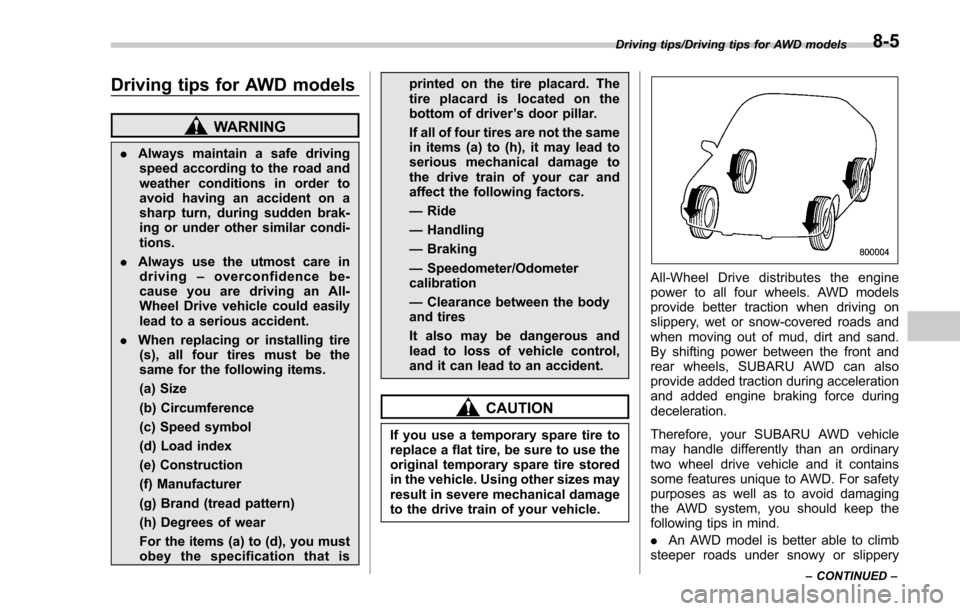
All-Wheel Drive distributes the engine
power to all four wheels. AWD models
provide better traction when driving on
slippery, wet or snow-covered roads and
when moving out of mud, dirt and sand.
By shifting power between the front and
rear wheels, SUBARU AWD can also
provide added traction during acceleration
and added engine braking force during
deceleration.
Therefore, your SUBARU AWD vehicle
may handle differently than an ordinary
two wheel drive vehicle and it contains
some features unique to AWD. For safety
purposes as well as to avoid damaging
the AWD system, you should keep the
following tips in mind.
. An AWD model is better able to climb
steeper roads under snowy or slippery
Driving tips/Driving tips for AWD models
–CONTINUED –8-5
Page 622 of 634
J
Jack and jack handle.................................................... 9-4
Jack-up point ............................................................... 9-5
Jump starting. .............................................................. 9-9
K
Key ........................................................................\
.... 2-3 Number plate ........................................................... 2-3
Reminder chime. ...................................................... 3-5
Replacement ........................................................... 2-4
Keyless access entry function ...................................... 2-13
Keyless access with push-button start system .. ............... 2-9
Disabling keyless access functions ........................... 2-17
Locking and unlocking doors ................................... 2-13
Opening rear gate .................................................. 2-15
Warning chimes and warning light ............................ 3-25
When access key does not operate properly ............. 9-17
Keyless entry system ................................................. 2-21
L
Lap belt pretensioner .................................................. 1-26
LCA ........................................................................\
. 7-59
Leather seat materials ................................................ 10-5
License plate light ..................................................... 11-44
Light Backup ................................................................ 11-42
Cargo area .............................................................. 6-2
Control switch ........................................................ 3-93
Daytime running. .................................................... 3-98
Dome ..................................................................... 6-2
Front fog .................................................... 3- 102, 11-42Front side marker
....................................... 11-41, 12-16
Ignition switch ......................................................... 3-6
License plate ....................................................... 11-44
Map ....................................................................... 6-3
Rear combination ................................................. 11-42
Stop .................................................................... 11-42
Tail ..................................................................... 11-42
Turn signal ....................................... 3- 100, 11-41, 11-42
Vanity mirror ........................................................... 6-5
Loading your vehicle ................................................... 8-12
Low fuel warning light ................................................. 3-22
Low tire pressure warning light ..................................... 3-19
Lower and tether anchorage ........................................ 1-37
M
Maintenance Precautions ........................................................... 11-3
Schedule ............................................................... 11-3
Seatbelt. ................................................................ 1-24
Tips ...................................................................... 11-5
Tools ...................................................................... 9-3
Malfunction indicator light (check engine warning light) .... 3-16
Manual Climate control ........................................................ 4-7
Mode (continuously variable transmission) ................. 7-27
Seat ....................................................................... 1-4
Transmission ......................................................... 7-22
Transmission oil ........................................... 11-17, 12-7
Map light .................................................................... 6-3
Maximum load limits ................................................... 8-19
Meters and gauges ......................................................
3-9
Index14-7