ESP SUBARU FORESTER 2017 SJ / 4.G User Guide
[x] Cancel search | Manufacturer: SUBARU, Model Year: 2017, Model line: FORESTER, Model: SUBARU FORESTER 2017 SJ / 4.GPages: 634, PDF Size: 11.77 MB
Page 62 of 634
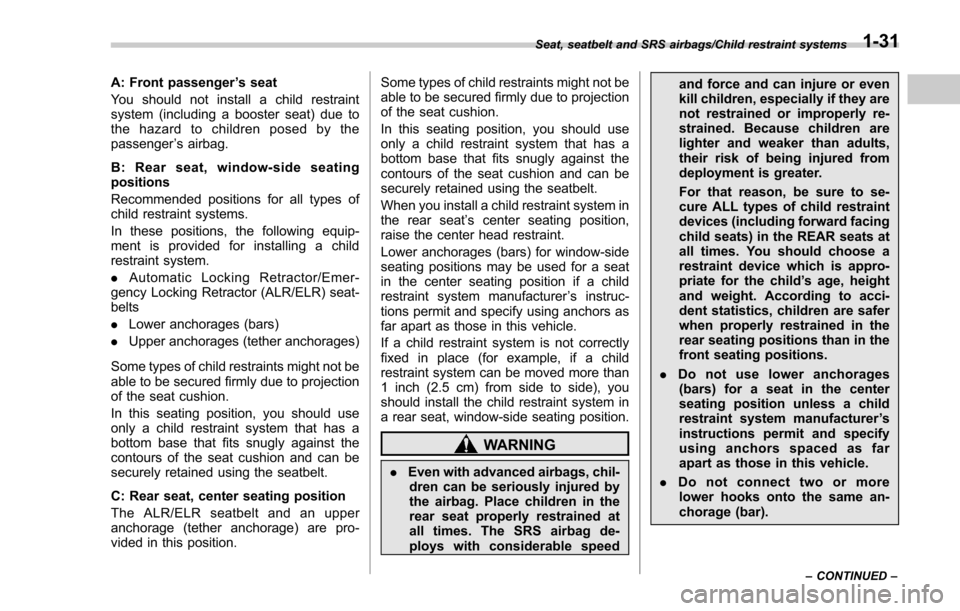
A: Front passenger’s seat
You should not install a child restraint
system (including a booster seat) due to
the hazard to children posed by the
passenger ’s airbag.
B: Rear seat, window-side seating
positions
Recommended positions for all types of
child restraint systems.
In these positions, the following equip-
ment is provided for installing a child
restraint system.
. Automatic Locking Retractor/Emer-
gency Locking Retractor (ALR/ELR) seat-
belts
. Lower anchorages (bars)
. Upper anchorages (tether anchorages)
Some types of child restraints might not be
able to be secured firmly due to projection
of the seat cushion.
In this seating position, you should use
only a child restraint system that has a
bottom base that fits snugly against the
contours of the seat cushion and can be
securely retained using the seatbelt.
C: Rear seat, center seating position
The ALR/ELR seatbelt and an upper
anchorage (tether anchorage) are pro-
vided in this position. Some types of child restraints might not be
able to be secured firmly due to projection
of the seat cushion.
In this seating position, you should use
only a child restraint system that has a
bottom base that fits snugly against the
contours of the seat cushion and can be
securely retained using the seatbelt.
When you install a child restraint system in
the rear seat
’s center seating position,
raise the center head restraint.
Lower anchorages (bars) for window-side
seating positions may be used for a seat
in the center seating position if a child
restraint system manufacturer ’s instruc-
tions permit and specify using anchors as
far apart as those in this vehicle.
If a child restraint system is not correctly
fixed in place (for example, if a child
restraint system can be moved more than
1 inch (2.5 cm) from side to side), you
should install the child restraint system in
a rear seat, window-side seating position.
WARNING
. Even with advanced airbags, chil-
dren can be seriously injured by
the airbag. Place children in the
rear seat properly restrained at
all times. The SRS airbag de-
ploys with considerable speed and force and can injure or even
kill children, especially if they are
not restrained or improperly re-
strained. Because children are
lighter and weaker than adults,
their risk of being injured from
deployment is greater.
For that reason, be sure to se-
cure ALL types of child restraint
devices (including forward facing
child seats) in the REAR seats at
all times. You should choose a
restraint device which is appro-
priate for the child
’s age, height
and weight. According to acci-
dent statistics, children are safer
when properly restrained in the
rear seating positions than in the
front seating positions.
. Do not use lower anchorages
(bars) for a seat in the center
seating position unless a child
restraint system manufacturer ’s
instructions permit and specify
using anchors spaced as far
apart as those in this vehicle.
. Do not connect two or more
lower hooks onto the same an-
chorage (bar).
Seat, seatbelt and SRS airbags/Child restraint systems
–CONTINUED –1-31
Page 76 of 634
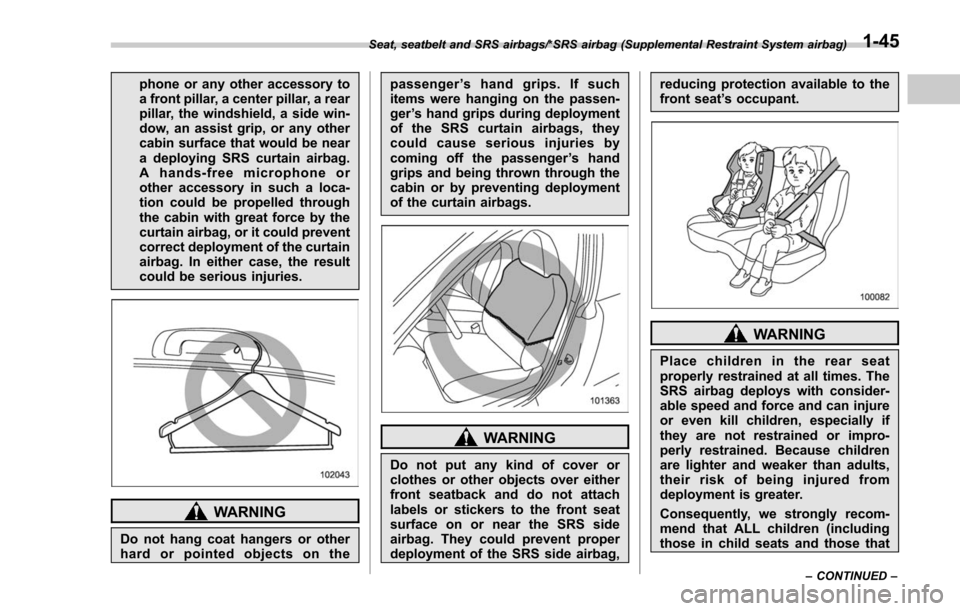
phone or any other accessory to
a front pillar, a center pillar, a rear
pillar, the windshield, a side win-
dow, an assist grip, or any other
cabin surface that would be near
a deploying SRS curtain airbag.
A hands-free microphone or
other accessory in such a loca-
tion could be propelled through
the cabin with great force by the
curtain airbag, or it could prevent
correct deployment of the curtain
airbag. In either case, the result
could be serious injuries.
WARNING
Do not hang coat hangers or other
hard or pointed objects on thepassenger
’s hand grips. If such
items were hanging on the passen-
ger ’s hand grips during deployment
of the SRS curtain airbags, they
could cause serious injuries by
coming off the passenger ’s hand
grips and being thrown through the
cabin or by preventing deployment
of the curtain airbags.
WARNING
Do not put any kind of cover or
clothes or other objects over either
front seatback and do not attach
labels or stickers to the front seat
surface on or near the SRS side
airbag. They could prevent proper
deployment of the SRS side airbag, reducing protection available to the
front seat
’s occupant.
WARNING
Place children in the rear seat
properly restrained at all times. The
SRS airbag deploys with consider-
able speed and force and can injure
or even kill children, especially if
they are not restrained or impro-
perly restrained. Because children
are lighter and weaker than adults,
their risk of being injured from
deployment is greater.
Consequently, we strongly recom-
mend that ALL children (including
those in child seats and those that
Seat, seatbelt and SRS airbags/*SRS airbag (Supplemental Restraint System airbag)
–CONTINUED –1-45
Page 84 of 634
and OFF indicators do not work properly
even when the front passenger’s seat is
dry, do not allow anyone to sit on the front
passenger ’s seat and have the occupant
detection system checked by your
SUBARU dealer.
Also, if luggage or electronic devices are
placed on the front passenger ’s seat, this
may adversely affect the ability of the
system to determine deployment. This
may prevent the front passenger ’s frontal
airbag ON and OFF indicators from work-
ing properly. Check that the indicators
work properly.
When the OFF indicator turns off and the
ON indicator illuminates, the front passen-
ger ’s frontal airbag may deploy during a
collision. Remove luggage and electronic
devices from the front passenger ’s seat.
CAUTION
Electrical devices, such as cell
phones, laptops, portable music
players, or electronic games, espe-
cially when connected to the acces-
sory power outlet and placed on the
front passenger ’s seat or used by
the person sitting in the front pas-
senger ’s seat, may affect the opera-
tion of the occupant detection sys-
tem. If either of the following situa- tions occurs when using an electro-
nic device in the vehicle, at first try
to relocate that device to avoid it
creating any interference.
.
The SRS airbag system warning
light illuminates.
. The front passenger ’s frontal air-
bag ON and OFF indicators oper-
ate erratically.
If the device continues to cause
interference, the use of that device
in the vehicle should be discontin-
ued.
! Conditions in which front passen-
ger’s SRS frontal airbag is not
activated
The front passenger ’s SRS frontal airbag
will not be activated when any of the
following conditions are met regarding the
front passenger ’s seat:
. The seat is empty.
. The seat is equipped with an appro-
priate child restraint system and an infant
is restrained in it. (See WARNING that
follows.)
. The front passenger ’s occupant detec-
tion system is malfunctioning.
WARNING
NEVER INSTALL A FORWARD OR
REARWARD FACING CHILD SEAT
IN THE FRONT PASSENGER ’S SEAT
EVEN IF THE FRONT PASSEN-
GER ’S SRS FRONTAL AIRBAG IS
DEACTIVATED. Be sure to install it
in the REAR seat in a correct
manner. Also, it is strongly recom-
mended that any forward facing
child seat or booster seat be in-
stalled in the REAR seat, and that
even children who have outgrown a
child restraint system be also
seated in the REAR seat. This is
because children sitting in the front
passenger ’s seat may be killed or
severely injured should the front
passenger ’s SRS frontal airbag de-
ploy. REAR seats are the safest
place for children.
CAUTION
When the front passenger ’s seat is
occupied by an infant in an appro-
priate child restraint system, ob-
serve the following precautions.
Failure to do so may interfere with
the proper operation of the occu-
pant detection system, activating
Seat, seatbelt and SRS airbags/*SRS airbag (Supplemental Restraint System airbag)
–CONTINUED –1-53
Page 85 of 634
Seat, seatbelt and SRS airbags/*SRS airbag (Supplemental Restraint System airbag)
the front passenger’s SRS frontal
airbag even though that seat is
occupied by the infant in the child
restraint system.
. Do not place any article (includ-
ing electronic devices) on the
seat other than the infant in the
child restraint system.
. Do not place more than one
infant in the child restraint sys-
tem.
! If the front passenger ’s frontal
airbag ON indicator illuminates
and the OFF indicator turns off
even when an infant or a small
child is in a child restraint sys-
tem (including booster seat)
1. Turn the ignition switch to the “LOCK” /
“OFF ”position.
2. Remove the child restraint system
from the seat.
3. By referring to the child restraint
manufacturer ’s recommendations as well
as the child restraint system installation
procedures in “Child restraint systems ”
F 1-29, correctly install the child restraint
system.
4. Turn the ignition switch to the “ON”
position and make sure that the front
passenger ’s frontal airbag ON indicator turns off and the OFF indicator illuminates.
If still the ON indicator remains illuminated
while the OFF indicator turns off, take the
following actions.
.
Ensure that no article is placed on the
seat other than the child restraint system
and the child occupant.
. Ensure that the backward-forward po-
sition and seatback of front passenger ’s
seat are locked into place securely by
moving the seat back and forth.
If the ON indicator still remains illuminated
while the OFF indicator turns off after
taking relevant corrective actions de-
scribed above, relocate the child restraint
system to the rear seat and immediately
contact your SUBARU dealer for an
inspection.
NOTE
When a child who has outgrown a child
restraint system or a small adult is
seated in the front passenger ’s seat,
the SUBARU advanced frontal airbag
system may or may not activate the
front passenger ’s SRS frontal airbag
depending on the occupant’ s seating
posture. Children should always wear a
seatbelt when sitting in the seat irre-
spective of whether the airbag is
deactivated or activated. If the front passenger
’s SRS frontal airbag is acti-
vated (the ON indicator remains illumi-
nated while the OFF indicator turns off),
take the following action.
. Ensure that no article is placed on
the seat other than the occupant.
If the ON indicator still remains illumi-
nated while the OFF indicator turns off
despite the fact that the actions noted
above have been taken, seat the child/
small adult in the rear seat and im-
mediately contact your SUBARU dealer
for an inspection. Even if the system
has passed the dealer inspection, it is
recommended that on subsequent trips
the child/small adult always take the
rear seat.
Children who have outgrown a child
restraint system should always wear the
seatbelt irrespective of whether the airbag
is deactivated or activated.
! Conditions in which front passen-
ger’s SRS frontal airbag is activated
The front passenger ’s SRS frontal airbag
will be activated for deployment upon
impact when any of the following condi-
tions are met regarding the front passen-
ger ’s seat.
. When the seat is occupied by an adult.
. When certain items (e.g. jug of water)
1-54
Page 110 of 634
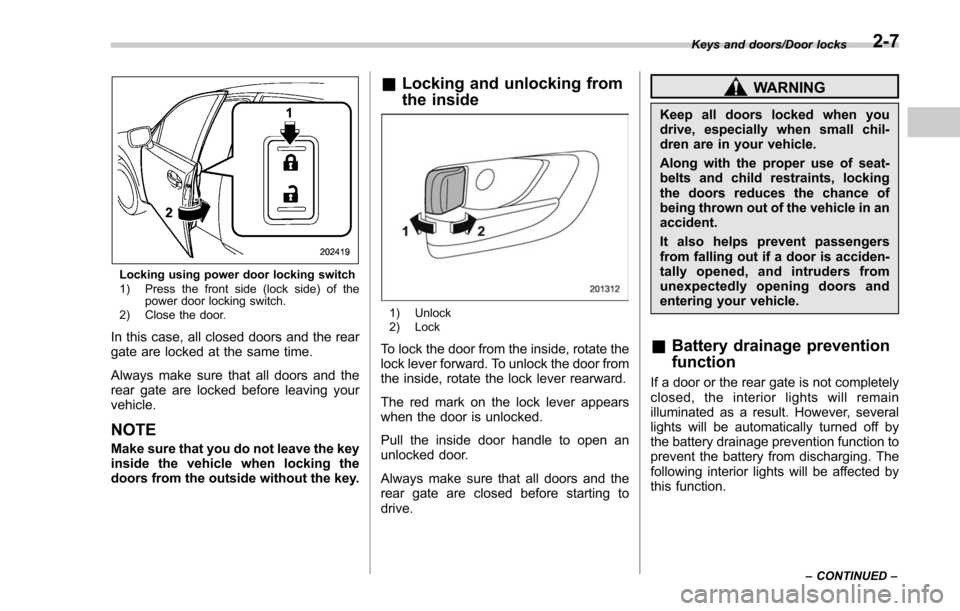
Locking using power door locking switch
1) Press the front side (lock side) of thepower door locking switch.
2) Close the door.
In this case, all closed doors and the rear
gate are locked at the same time.
Always make sure that all doors and the
rear gate are locked before leaving your
vehicle.
NOTE
Make sure that you do not leave the key
inside the vehicle when locking the
doors from the outside without the key.
& Locking and unlocking from
the inside
1) Unlock
2) Lock
To lock the door from the inside, rotate the
lock lever forward. To unlock the door from
the inside, rotate the lock lever rearward.
The red mark on the lock lever appears
when the door is unlocked.
Pull the inside door handle to open an
unlocked door.
Always make sure that all doors and the
rear gate are closed before starting to
drive.
WARNING
Keep all doors locked when you
drive, especially when small chil-
dren are in your vehicle.
Along with the proper use of seat-
belts and child restraints, locking
the doors reduces the chance of
being thrown out of the vehicle in an
accident.
It also helps prevent passengers
from falling out if a door is acciden-
tally opened, and intruders from
unexpectedly opening doors and
entering your vehicle.
&Battery drainage prevention
function
If a door or the rear gate is not completely
closed, the interior lights will remain
illuminated as a result. However, several
lights will be automatically turned off by
the battery drainage prevention function to
prevent the battery from discharging. The
following interior lights will be affected by
this function.
Keys and doors/Door locks
–CONTINUED –2-7
Page 116 of 634
&Locking and unlocking with
“keyless access ”entry func-
tion
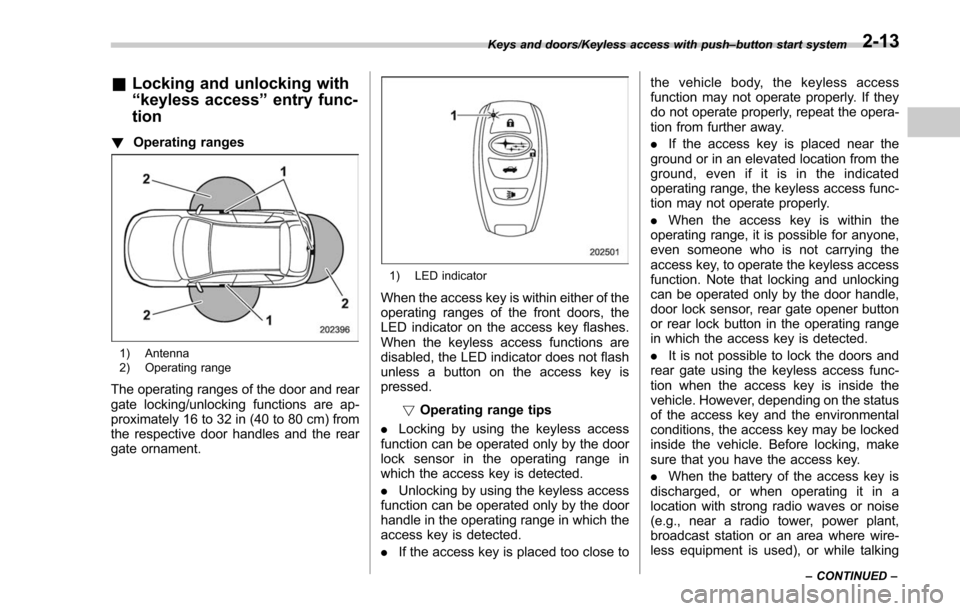
! Operating ranges
1) Antenna
2) Operating range
The operating ranges of the door and rear
gate locking/unlocking functions are ap-
proximately 16 to 32 in (40 to 80 cm) from
the respective door handles and the rear
gate ornament.
1) LED indicator
When the access key is within either of the
operating ranges of the front doors, the
LED indicator on the access key flashes.
When the keyless access functions are
disabled, the LED indicator does not flash
unless a button on the access key is
pressed.
!Operating range tips
. Locking by using the keyless access
function can be operated only by the door
lock sensor in the operating range in
which the access key is detected.
. Unlocking by using the keyless access
function can be operated only by the door
handle in the operating range in which the
access key is detected.
. If the access key is placed too close to the vehicle body, the keyless access
function may not operate properly. If they
do not operate properly, repeat the opera-
tion from further away.
.
If the access key is placed near the
ground or in an elevated location from the
ground, even if it is in the indicated
operating range, the keyless access func-
tion may not operate properly.
. When the access key is within the
operating range, it is possible for anyone,
even someone who is not carrying the
access key, to operate the keyless access
function. Note that locking and unlocking
can be operated only by the door handle,
door lock sensor, rear gate opener button
or rear lock button in the operating range
in which the access key is detected.
. It is not possible to lock the doors and
rear gate using the keyless access func-
tion when the access key is inside the
vehicle. However, depending on the status
of the access key and the environmental
conditions, the access key may be locked
inside the vehicle. Before locking, make
sure that you have the access key.
. When the battery of the access key is
discharged, or when operating it in a
location with strong radio waves or noise
(e.g., near a radio tower, power plant,
broadcast station or an area where wire-
less equipment is used), or while talking
Keys and doors/Keyless access with push –button start system
–CONTINUED –2-13
Page 124 of 634
&Unlocking
Perform steps 1 to 5 described in “Regis-
tration ”.
NOTE
. You cannot unlock by PIN Code
Access in the following cases.
–when the access key is within the
operating ranges
– when the ignition switch is in the
“ ACC ”or “ON ”position
. If you make an operation error
during the unlocking procedure, start
over with the unlocking procedure after
waiting for 5 seconds or longer.
. To protect your vehicle from theft, a
buzzer will sound if incorrect PIN codes
are entered five times continuously. If
this occurs, you cannot unlock the
doors by PIN Code Access for 5
minutes.
Remote keyless entry system
CAUTION
. Do not expose the remote trans-
mitter to severe shocks, such as
those experienced as a result of
dropping or throwing.
. Do not take the remote transmit-
ter apart except when replacing
the battery.
. Do not get the remote transmitter
wet. If it gets wet, wipe it dry with
a cloth immediately.
. When you carry the remote trans-
mitteronanairplane,donot
press the button of the remote
transmitter while in the airplane.
When any button of the remote
transmitter is pressed, radio
waves are sent and may affect
the operation of the airplane.
When you carry the remote trans-
mitter in a bag on an airplane,
take measures to prevent the
buttons of the remote transmitter
from being pressed.
. FCC WARNING
Changes or modifications not
expressly approved by the party responsible for compliance
could void the user
’s authority
to operate the equipment.
FCC ID: CWTWB1U811
FCC ID: CWTWD1U781
This device complies with Part 15 of
the FCC Rules. Operation is subject to
the following two conditions: (1) This
device may not cause harmful inter-
ference, and (2) this device must
accept any interference received, in-
cluding interference that may cause
undesired operation.
NOTE
This device complies with Industry
Canada licence-exempt RSS standard
(s). Operation is subject to the follow-
ing two conditions: (1) this device may
not cause interference, and (2) this
device must accept any interference,
including interference that may cause
undesired operation of the device.
NOTE
Le présent appareil est conforme aux
CNR d’ Industrie Canada applicables
aux appareils radio exempts de licence.
L ’exploitation est autorisée aux deux
conditions suivantes: (1) l ’appareil ne
doit pas produire de brouillage, et (2)
Keys and doors/Remote keyless entry system
–CONTINUED –2-21
Page 126 of 634
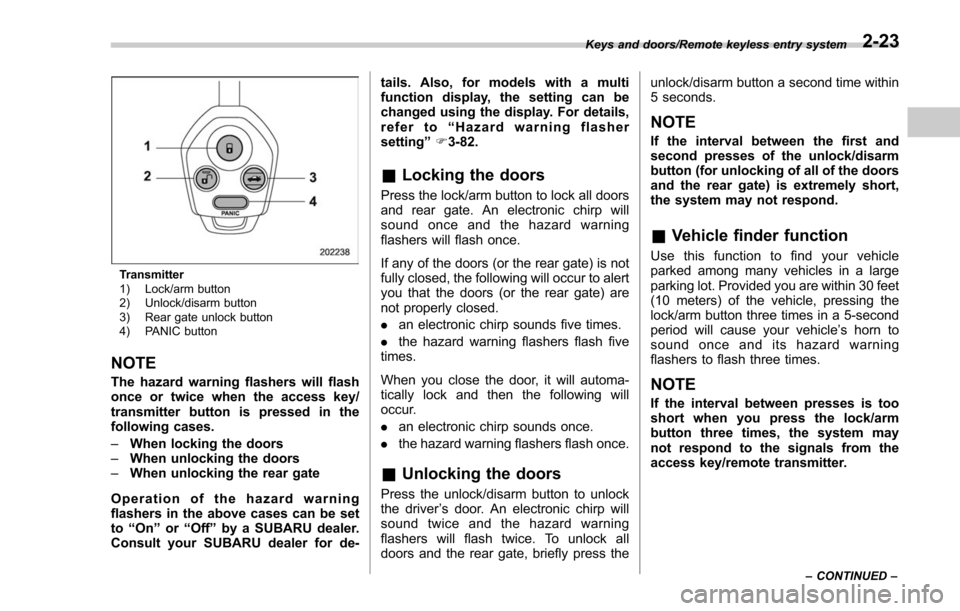
Transmitter
1) Lock/arm button
2) Unlock/disarm button
3) Rear gate unlock button
4) PANIC button
NOTE
The hazard warning flashers will flash
once or twice when the access key/
transmitter button is pressed in the
following cases.
–When locking the doors
– When unlocking the doors
– When unlocking the rear gate
Operation of the hazard warning
flashers in the above cases can be set
to “On ”or “Off ”by a SUBARU dealer.
Consult your SUBARU dealer for de- tails. Also, for models with a multi
function display, the setting can be
changed using the display. For details,
refer to
“Hazard warning flasher
setting ”F 3-82.
& Locking the doors
Press the lock/arm button to lock all doors
and rear gate. An electronic chirp will
sound once and the hazard warning
flashers will flash once.
If any of the doors (or the rear gate) is not
fully closed, the following will occur to alert
you that the doors (or the rear gate) are
not properly closed.
. an electronic chirp sounds five times.
. the hazard warning flashers flash five
times.
When you close the door, it will automa-
tically lock and then the following will
occur.
. an electronic chirp sounds once.
. the hazard warning flashers flash once.
&Unlocking the doors
Press the unlock/disarm button to unlock
the driver ’s door. An electronic chirp will
sound twice and the hazard warning
flashers will flash twice. To unlock all
doors and the rear gate, briefly press the unlock/disarm button a second time within
5 seconds.
NOTE
If the interval between the first and
second presses of the unlock/disarm
button (for unlocking of all of the doors
and the rear gate) is extremely short,
the system may not respond.
&
Vehicle finder function
Use this function to find your vehicle
parked among many vehicles in a large
parking lot. Provided you are within 30 feet
(10 meters) of the vehicle, pressing the
lock/arm button three times in a 5-second
period will cause your vehicle’ s horn to
sound once and its hazard warning
flashers to flash three times.
NOTE
If the interval between presses is too
short when you press the lock/arm
button three times, the system may
not respond to the signals from the
access key/remote transmitter.
Keys and doors/Remote keyless entry system
–CONTINUED –2-23
Page 135 of 634
Keys and doors/Child safety locks
Child safety locks
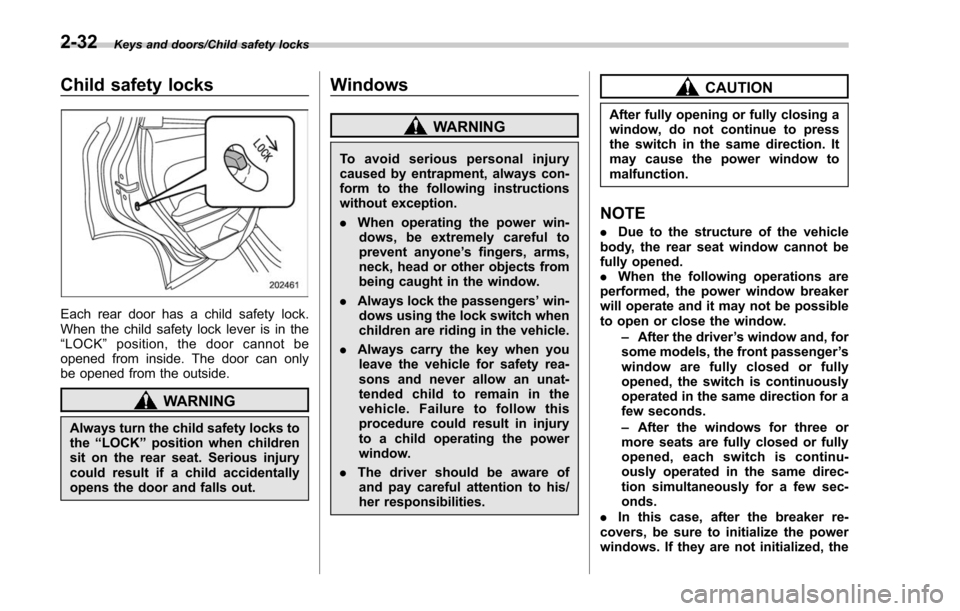
Each rear door has a child safety lock.
When the child safety lock lever is in the
“LOCK ”position, the door cannot be
opened from inside. The door can only
be opened from the outside.
WARNING
Always turn the child safety locks to
the “LOCK ”position when children
sit on the rear seat. Serious injury
could result if a child accidentally
opens the door and falls out.
Windows
WARNING
To avoid serious personal injury
caused by entrapment, always con-
form to the following instructions
without exception.
. When operating the power win-
dows, be extremely careful to
prevent anyone ’s fingers, arms,
neck, head or other objects from
being caught in the window.
. Always lock the passengers ’win-
dows using the lock switch when
children are riding in the vehicle.
. Always carry the key when you
leave the vehicle for safety rea-
sons and never allow an unat-
tended child to remain in the
vehicle. Failure to follow this
procedure could result in injury
to a child operating the power
window.
. The driver should be aware of
and pay careful attention to his/
her responsibilities.
CAUTION
After fully opening or fully closing a
window, do not continue to press
the switch in the same direction. It
may cause the power window to
malfunction.
NOTE
. Due to the structure of the vehicle
body, the rear seat window cannot be
fully opened.
. When the following operations are
performed, the power window breaker
will operate and it may not be possible
to open or close the window.
–After the driver ’s window and, for
some models, the front passenger ’s
window are fully closed or fully
opened, the switch is continuously
operated in the same direction for a
few seconds.
– After the windows for three or
more seats are fully closed or fully
opened, each switch is continu-
ously operated in the same direc-
tion simultaneously for a few sec-
onds.
. In this case, after the breaker re-
covers, be sure to initialize the power
windows. If they are not initialized, the
2-32
Page 142 of 634
WARNING
.To prevent dangerous exhaust
gas from entering the vehicle,
always keep the rear gate closed
while driving.
. Do not attempt to shut the rear
gate while holding the recessed
grip. Also avoid closing the rear
gate by pulling on the recessed
grip from inside the cargo space.
There is a danger of your hand
being caught and injured.
CAUTION
. Do not jam a plastic bag in or
place cellophane tape on the rear
gate stays or scratch the stays
while loading or unloading cargo.
That could cause leakage of gas
from the stays, which may result
in their inability to hold the rear
gate open.
. Be careful not to hit your head or
face on the rear gate when open-
ing or closing the rear gate and
when loading or unloading car-
go.
& Power rear gate (if equipped)
WARNING
. When opening the rear gate,
make sure there are no people
around it. If the rear gate, by any
chance, should hit a part of the
body, this may result in an injury.
. When closing the rear gate, be
extremely careful to prevent any-
one ’s fingers, arms, neck, head
or other objects from being
caught in the rear gate. Other-
wise, serious personal injury
may be caused by entrapment.
. If either of the operating condi-
tions has not been satisfied while
operating the power rear gate, an
electronic chirp will sound and
the power rear gate will be deac-
tivated. In this case, the rear gate
may open or close suddenly. Be
careful to prevent anyone ’s body
or any objects from being hit
against the rear gate or being
caught in the rear gate.
. After opening the rear gate on a
slope by using the power rear
gate feature, the rear gate may
close. Make sure that the rear
gate has stopped completely after opening it.
. Always carry the key when you
leave the vehicle for safety rea-
sons and never allow an unat-
tended child to remain in the
vehicle. Failure to follow this
procedure could result in injury
to a child operating the power
rear gate.
. The driver should be aware of
and pay careful attention to his/
her responsibilities.
. The power rear gate button
should only be used to open
and close the rear gate when
the area around the rear gate is
clearly visible and when you
have checked that there is no
danger of people being caught in
the gate.
CAUTION
When closing the rear gate after
opening it by using the memory
function, make sure to use the
power rear gate. If you close the
rear gate manually with extra force,
the power rear gate may be da-
maged.
Keys and doors/Rear gate
–CONTINUED –2-39