Jack SUBARU FORESTER 2017 SJ / 4.G User Guide
[x] Cancel search | Manufacturer: SUBARU, Model Year: 2017, Model line: FORESTER, Model: SUBARU FORESTER 2017 SJ / 4.GPages: 634, PDF Size: 11.77 MB
Page 509 of 634
In case of emergency/Flat tires
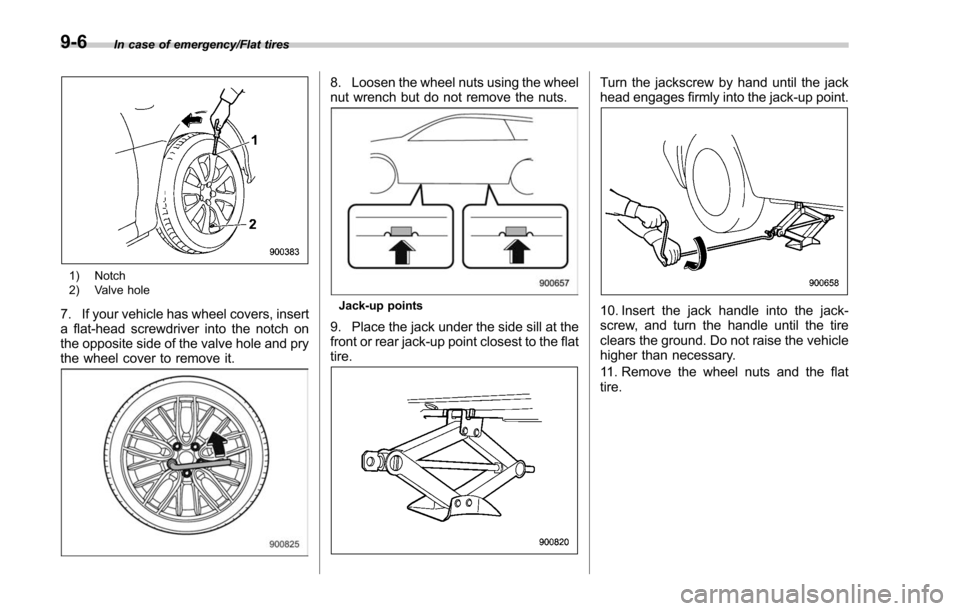
1) Notch
2) Valve hole
7. If your vehicle has wheel covers, insert
a flat-head screwdriver into the notch on
the opposite side of the valve hole and pry
the wheel cover to remove it.
8. Loosen the wheel nuts using the wheel
nut wrench but do not remove the nuts.
Jack-up points
9. Place the jack under the side sill at the
front or rear jack-up point closest to the flat
tire.
Turn the jackscrew by hand until the jack
head engages firmly into the jack-up point.
10. Insert the jack handle into the jack-
screw, and turn the handle until the tire
clears the ground. Do not raise the vehicle
higher than necessary.
11. Remove the wheel nuts and the flat
tire.
9-6
Page 510 of 634
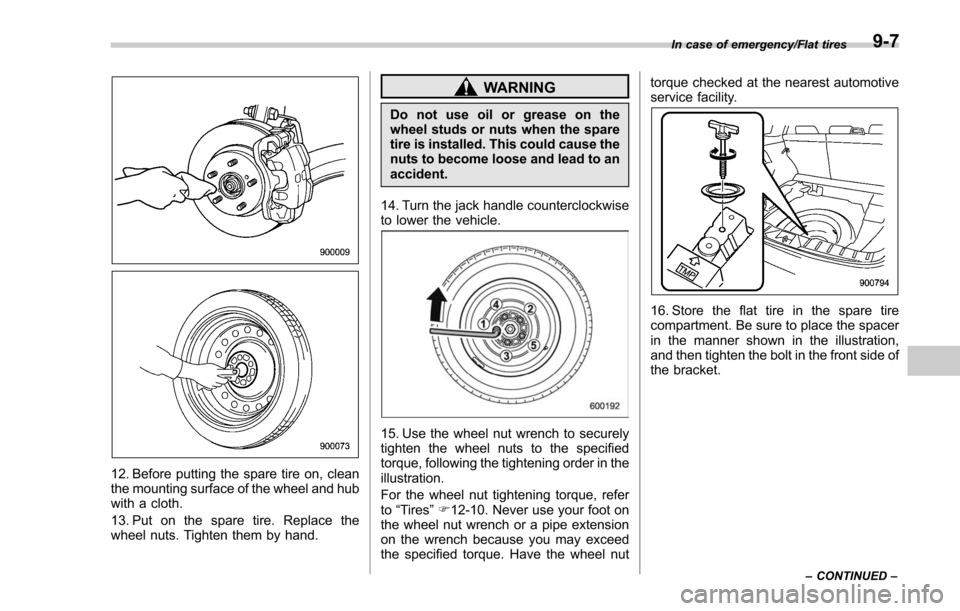
12. Before putting the spare tire on, clean
the mounting surface of the wheel and hub
with a cloth.
13. Put on the spare tire. Replace the
wheel nuts. Tighten them by hand.
WARNING
Do not use oil or grease on the
wheel studs or nuts when the spare
tire is installed. This could cause the
nuts to become loose and lead to an
accident.
14. Turn the jack handle counterclockwise
to lower the vehicle.
15. Use the wheel nut wrench to securely
tighten the wheel nuts to the specified
torque, following the tightening order in the
illustration.
For the wheel nut tightening torque, refer
to “Tires ”F 12-10. Never use your foot on
the wheel nut wrench or a pipe extension
on the wrench because you may exceed
the specified torque. Have the wheel nut torque checked at the nearest automotive
service facility.
16. Store the flat tire in the spare tire
compartment. Be sure to place the spacer
in the manner shown in the illustration,
and then tighten the bolt in the front side of
the bracket.
In case of emergency/Flat tires
–CONTINUED –9-7
Page 516 of 634
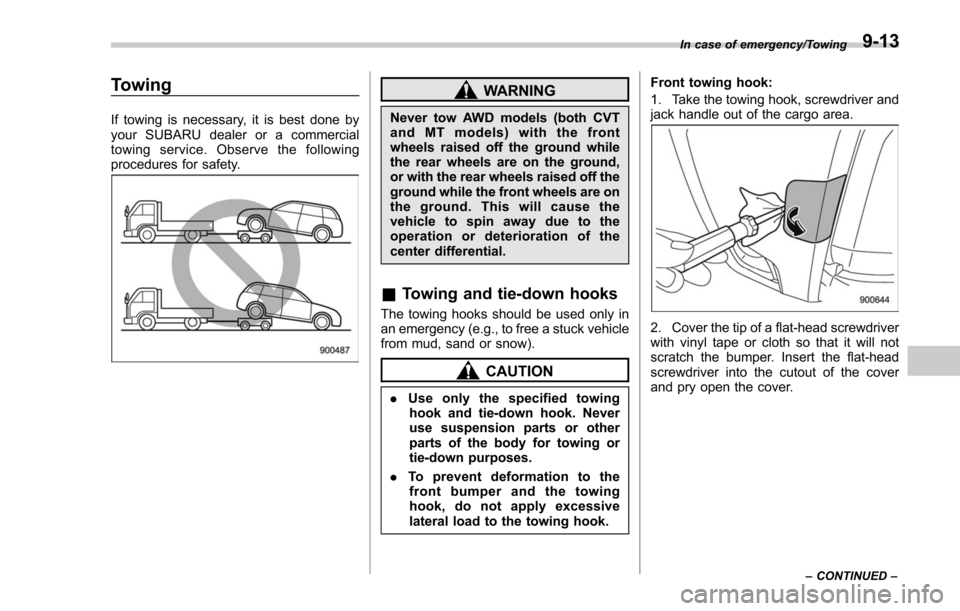
Towing
If towing is necessary, it is best done by
your SUBARU dealer or a commercial
towing service. Observe the following
procedures for safety.
WARNING
Never tow AWD models (both CVT
and MT models) with the front
wheels raised off the ground while
the rear wheels are on the ground,
or with the rear wheels raised off the
ground while the front wheels are on
the ground. This will cause the
vehicle to spin away due to the
operation or deterioration of the
center differential.
&Towing and tie-down hooks
The towing hooks should be used only in
an emergency (e.g., to free a stuck vehicle
from mud, sand or snow).
CAUTION
. Use only the specified towing
hook and tie-down hook. Never
use suspension parts or other
parts of the body for towing or
tie-down purposes.
. To prevent deformation to the
front bumper and the towing
hook, do not apply excessive
lateral load to the towing hook. Front towing hook:
1. Take the towing hook, screwdriver and
jack handle out of the cargo area.
2. Cover the tip of a flat-head screwdriver
with vinyl tape or cloth so that it will not
scratch the bumper. Insert the flat-head
screwdriver into the cutout of the cover
and pry open the cover.
In case of emergency/Towing
–CONTINUED –9-13
Page 517 of 634
In case of emergency/Towing
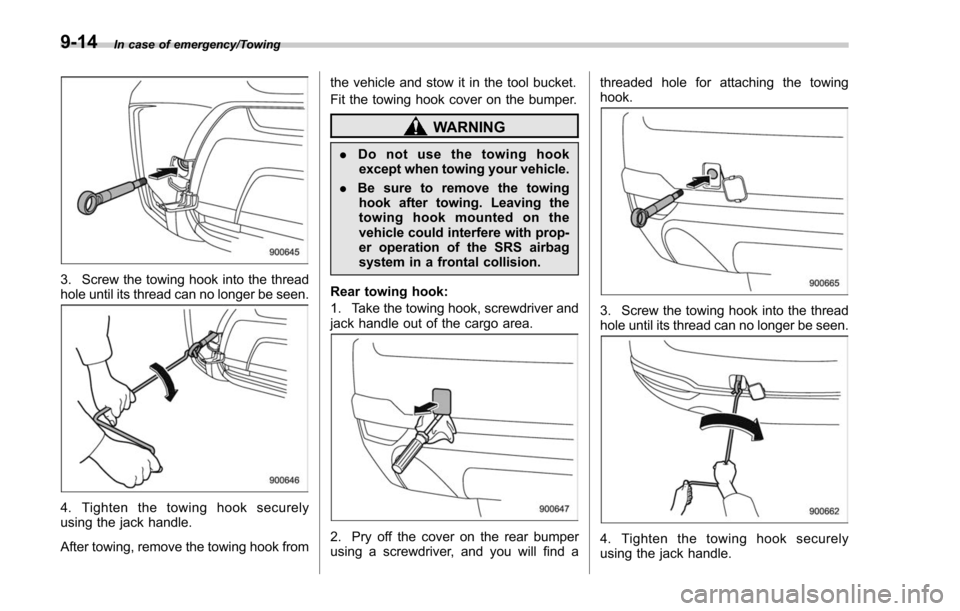
3. Screw the towing hook into the thread
hole until its thread can no longer be seen.
4. Tighten the towing hook securely
using the jack handle.
After towing, remove the towing hook fromthe vehicle and stow it in the tool bucket.
Fit the towing hook cover on the bumper.
WARNING
.
Do not use the towing hook
except when towing your vehicle.
. Be sure to remove the towing
hook after towing. Leaving the
towing hook mounted on the
vehicle could interfere with prop-
er operation of the SRS airbag
system in a frontal collision.
Rear towing hook:
1. Take the towing hook, screwdriver and
jack handle out of the cargo area.
2. Pry off the cover on the rear bumper
using a screwdriver, and you will find a threaded hole for attaching the towing
hook.
3. Screw the towing hook into the thread
hole until its thread can no longer be seen.
4. Tighten the towing hook securely
using the jack handle.
9-14
Page 518 of 634
After towing, remove the towing hook from
the vehicle and stow it in the tool bucket.
Fit the towing hook cover on the bumper.
WARNING
.Do not use the towing hook
except when towing your vehicle.
. Be sure to remove the towing
hook after towing. Leaving the
towing hook mounted on the
vehicle could interfere with prop-
er operation of the fuel pump
shut off function when the vehi-
cle is struck from behind.
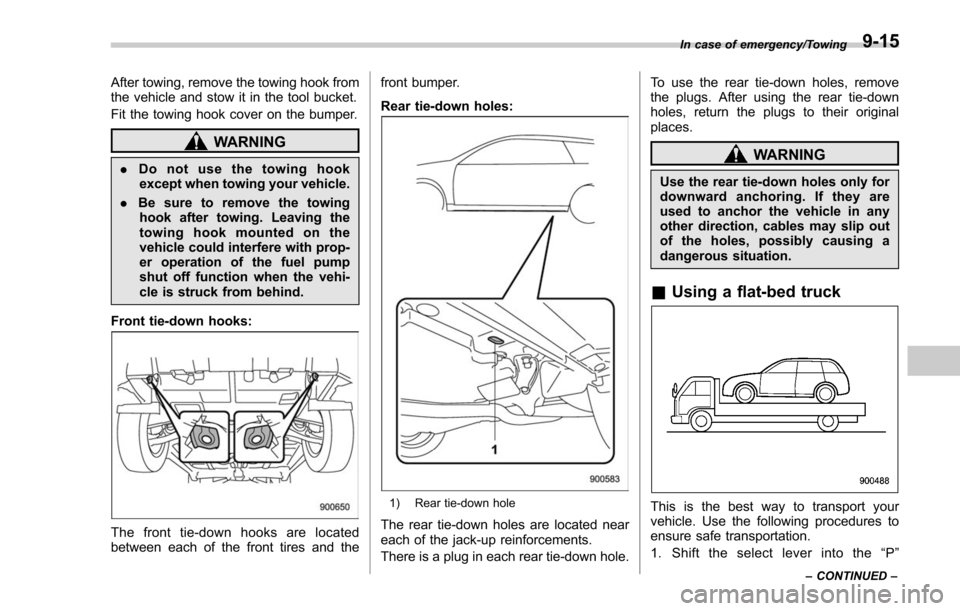
Front tie-down hooks:
The front tie-down hooks are located
between each of the front tires and the front bumper.
Rear tie-down holes:
1) Rear tie-down hole
The rear tie-down holes are located near
each of the jack-up reinforcements.
There is a plug in each rear tie-down hole.To use the rear tie-down holes, remove
the plugs. After using the rear tie-down
holes, return the plugs to their original
places.
WARNING
Use the rear tie-down holes only for
downward anchoring. If they are
used to anchor the vehicle in any
other direction, cables may slip out
of the holes, possibly causing a
dangerous situation.
&
Using a flat-bed truck
This is the best way to transport your
vehicle. Use the following procedures to
ensure safe transportation.
1. Shift the select lever into the “P ”
In case of emergency/Towing
–CONTINUED –9-15
Page 534 of 634
Maintenance schedule
U.S. models
The scheduled maintenance items re-
quired to be serviced at regular intervals
are shown in the“Warranty and Main-
tenance Booklet ”. For details, read the
separate “Warranty and Maintenance
Booklet ”.
Canada models
The scheduled maintenance items re-
quired to be serviced at regular intervals
are shown in the “Warranty and Service
Booklet ”. For details, read the separate
“Warranty and Service Booklet ”.
Except for U.S. and Canada models
Some items of your vehicle are required to
be serviced at scheduled intervals. For
details about your maintenance schedule,
read the separate “Warranty and Main-
tenance Booklet ”.
NOTE
For models with a multi function dis-
play, you can set a reminder to be
displayed when a scheduled mainte-
nance item is almost due. For details,
refer to“Maintenance settings ”F 3-76.
Maintenance precautions
When maintenance and service are re-
quired, it is recommended that all work be
done by an authorized SUBARU dealer.
If you perform maintenance and service
by yourself, you should familiarize yourself
with the information provided in this
section on general maintenance and
service for your SUBARU.
Incorrect or incomplete service could
cause improper or unsafe vehicle opera-
tion. Any problems caused by improper
maintenance and service performed by
you are not eligible for warranty coverage.
WARNING
. Always select a safe area when
performing maintenance on your
vehicle.
. Always be very careful to avoid
injury when working on the vehi-
cle. Remember that some of the
materials in the vehicle may be
hazardous if improperly used or
handled, for example, battery
acid.
. Your vehicle should only be ser-
viced by persons fully competent
to do so. Serious personal injury may result to persons not experi-
enced in servicing vehicles.
. Always use the proper tools and
make certain that they are well
maintained.
. Never get under the vehicle sup-
ported only by a jack. Always use
safety stands to support the
vehicle.
. Never keep the engine running in
a poorly ventilated area, such as
a garage or other closed areas.
. Do not smoke or allow open
flames around the fuel or battery.
This will cause a fire.
. Because the fuel system is under
pressure, replacement of the fuel
filter should be performed only
by your SUBARU dealer.
. Wear adequate eye protection to
guard against getting oil or fluids
in your eyes. If something does
get in your eyes, thoroughly
wash them out with clean water.
. Do not tamper with the wiring of
the SRS airbag system or seat-
belt pretensioner system, or at-
tempt to take its connectors
apart, as that may activate the
system or it can render it inop-
Maintenance and service/Maintenance schedule
–CONTINUED –11-3
Page 622 of 634
J
Jack and jack handle.................................................... 9-4
Jack-up point ............................................................... 9-5
Jump starting. .............................................................. 9-9
K
Key ........................................................................\
.... 2-3 Number plate ........................................................... 2-3
Reminder chime. ...................................................... 3-5
Replacement ........................................................... 2-4
Keyless access entry function ...................................... 2-13
Keyless access with push-button start system .. ............... 2-9
Disabling keyless access functions ........................... 2-17
Locking and unlocking doors ................................... 2-13
Opening rear gate .................................................. 2-15
Warning chimes and warning light ............................ 3-25
When access key does not operate properly ............. 9-17
Keyless entry system ................................................. 2-21
L
Lap belt pretensioner .................................................. 1-26
LCA ........................................................................\
. 7-59
Leather seat materials ................................................ 10-5
License plate light ..................................................... 11-44
Light Backup ................................................................ 11-42
Cargo area .............................................................. 6-2
Control switch ........................................................ 3-93
Daytime running. .................................................... 3-98
Dome ..................................................................... 6-2
Front fog .................................................... 3- 102, 11-42Front side marker
....................................... 11-41, 12-16
Ignition switch ......................................................... 3-6
License plate ....................................................... 11-44
Map ....................................................................... 6-3
Rear combination ................................................. 11-42
Stop .................................................................... 11-42
Tail ..................................................................... 11-42
Turn signal ....................................... 3- 100, 11-41, 11-42
Vanity mirror ........................................................... 6-5
Loading your vehicle ................................................... 8-12
Low fuel warning light ................................................. 3-22
Low tire pressure warning light ..................................... 3-19
Lower and tether anchorage ........................................ 1-37
M
Maintenance Precautions ........................................................... 11-3
Schedule ............................................................... 11-3
Seatbelt. ................................................................ 1-24
Tips ...................................................................... 11-5
Tools ...................................................................... 9-3
Malfunction indicator light (check engine warning light) .... 3-16
Manual Climate control ........................................................ 4-7
Mode (continuously variable transmission) ................. 7-27
Seat ....................................................................... 1-4
Transmission ......................................................... 7-22
Transmission oil ........................................... 11-17, 12-7
Map light .................................................................... 6-3
Maximum load limits ................................................... 8-19
Meters and gauges ......................................................
3-9
Index14-7