RAB SUBARU FORESTER 2017 SJ / 4.G Owner's Guide
[x] Cancel search | Manufacturer: SUBARU, Model Year: 2017, Model line: FORESTER, Model: SUBARU FORESTER 2017 SJ / 4.GPages: 634, PDF Size: 11.77 MB
Page 520 of 634
Access key–if access key
does not operate properly
CAUTION
Keep metallic objects, magnetic
sources and signal transmitters
away from the area between the
access key and the push-button
ignition switch. They may interfere
with the communication between
the access key and the push-button
ignition switch.
The following functions may be inoperable
because of strong radio signals in the
surrounding area or the access key
battery being low.
. Locking/unlocking doors including the
rear gate
. Switching power status
. Starting the engine
In such cases, perform the following
procedure. When the battery of the access
key is discharged, replace it with a new
one. Refer to “Replacing battery of access
key ”F 11-45.
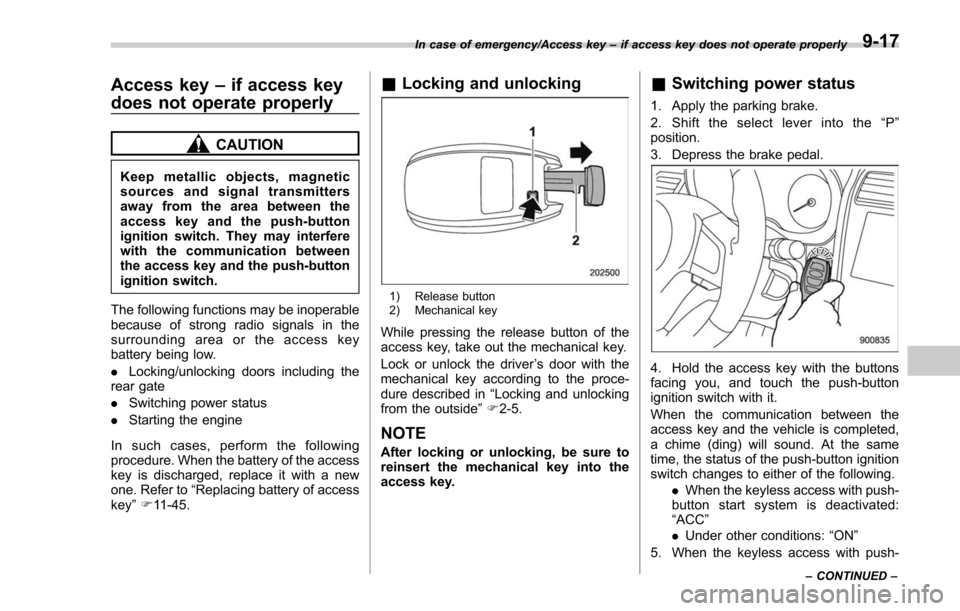
& Locking and unlocking
1) Release button
2) Mechanical key
While pressing the release button of the
access key, take out the mechanical key.
Lock or unlock the driver ’s door with the
mechanical key according to the proce-
dure described in “Locking and unlocking
from the outside ”F 2-5.
NOTE
After locking or unlocking, be sure to
reinsert the mechanical key into the
access key.
& Switching power status
1. Apply the parking brake.
2. Shift the select lever into the “P ”
position.
3. Depress the brake pedal.
4. Hold the access key with the buttons
facing you, and touch the push-button
ignition switch with it.
When the communication between the
access key and the vehicle is completed,
a chime (ding) will sound. At the same
time, the status of the push-button ignition
switch changes to either of the following.
.When the keyless access with push-
button start system is deactivated:
“ACC ”
. Under other conditions: “ON ”
5. When the keyless access with push-
In case of emergency/Access key –if access key does not operate properly
–CONTINUED –9-17
Page 529 of 634
Appearance care/Corrosion protection
washing device.
.Clean the vehicle (including the alumi-
num wheels) with water as soon as
possible when it has been splashed with
sea water, exposed to sea breezes, or
driven on roads treated with salt or other
agents.Corrosion protection
Your SUBARU has been designed and
built to resist corrosion. Special materials
and protective finishes have been used on
most parts of the vehicle to help maintain
fine appearance, strength, and reliable
operation.
& Most common causes of
corrosion
The most common causes of corrosion
are:
1. The accumulation of moisture retain-
ing dirt and debris in body panel sections,
cavities, and other areas.
2. Damage to paint and other protective
coatings caused by gravel and stone
chips or minor accidents.
Corrosion is accelerated on the vehicle
when:
1. It is exposed to road salt or dust
control chemicals, or used in coastal
areas where there is more salt in the air,
or in areas where there is considerable
industrial pollution.
2. It is driven in areas of high humidity,
especially when temperatures range just
above freezing.
3. Dampness in certain parts of the vehicle remains for a long time, even
though other parts of the vehicle may be
dry.
4. High temperatures will cause corro-
sion to parts of the vehicle which cannot
dry quickly due to lack of proper ventila-
tion.
&
To help prevent corrosion
Wash the vehicle regularly to prevent
corrosion of the body and suspension
components. Also, wash the vehicle
promptly after driving on any of the
following surfaces.
. roads that have been salted to prevent
them from freezing in winter
. mud, sand, or gravel
. coastal roads
After the winter has ended, it is recom-
mended that the underbody be given a
very thorough washing.
Before the beginning of winter, check the
condition of underbody components, such
as the exhaust system, fuel and brake
lines, brake cables, suspension, steering
system, floor pan, and fenders. If any of
them are found to be rusted, they should
be given an appropriate rust prevention
treatment or should be replaced. Contact
your SUBARU dealer to perform this kind
10-4
Page 633 of 634
GAS STATION REFERENCE
&
Fuel:
! Non-turbo models
Use only unleaded gasoline with an octane rating of 87 AKI
(90 RON) or higher .
! Turbo models
Unleaded gasoline with an octane rating of 93 AKI (98 RON)
or higher is recommended. Unleaded gasoline with an octane
rating of 91 AKI (95 RON) or higher may be used with no
detriment to engine durability or driveability. However, you may
notice a slight decrease in maximum engine performance while
using 91 AKI (95 RON) fuel. If unleaded gasoline with an octane
rating of 91 AKI (95 RON) is not available, refer to “Fuel
requirements ”F 7-3.
&Fuel octane rating:
! RON
This octane rating is the Research Octane Number.
! AKI
This octane rating is the average of the Research Octane and
Motor Octane numbers and is commonly referred to as the Anti
Knock Index (AKI).
&Fuel capacity:
15.9 US gal (60 liters, 13.2 Imp gal)
&Engine oil:
Use only the following oils.
. API classification SN with the words “RESOURCE CON-
SERVING ”
. or ILSAC GF-5, which can be identified with the ILSAC
certification mark (Starburst mark)
For the complete viscosity requirements, refer to “Engine oil”
F 12-4.
&Engine oil capacity:
Non-turbo models: 5.1 US qt (4.8 liters, 4.2 Imp qt)
Turbo models: 5.4 US qt (5.1 liters, 4.5 Imp qt)
The indicated oil quantity is only a guideline and is estimated
based on a case when the engine oil is changed with an oil
filter. After refilling the engine with oil, the oil level should be
checked using the oil level gauge. For more details about
maintenance and service, refer to “Engine oil”F 11-10.
&Cold tire pressure:
Refer to “Tires ”F 12-10.