check engine SUBARU FORESTER 2017 SJ / 4.G Workshop Manual
[x] Cancel search | Manufacturer: SUBARU, Model Year: 2017, Model line: FORESTER, Model: SUBARU FORESTER 2017 SJ / 4.GPages: 634, PDF Size: 11.77 MB
Page 547 of 634
Maintenance and service/Spark plugs
the air cleaner element.
3. Clean the inside of the air cleaner case
(both front and rear) with a damp cloth and
install a new air cleaner element.
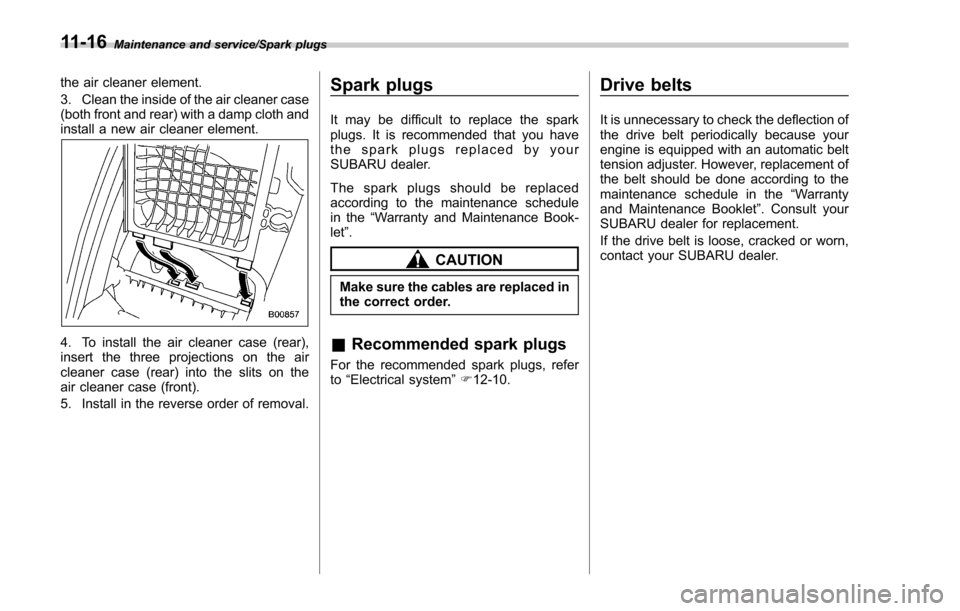
4. To install the air cleaner case (rear),
insert the three projections on the air
cleaner case (rear) into the slits on the
air cleaner case (front).
5. Install in the reverse order of removal.
Spark plugs
It may be difficult to replace the spark
plugs. It is recommended that you have
the spark plugs replaced by your
SUBARU dealer.
The spark plugs should be replaced
according to the maintenance schedule
in the“Warranty and Maintenance Book-
let ”.
CAUTION
Make sure the cables are replaced in
the correct order.
& Recommended spark plugs
For the recommended spark plugs, refer
to“Electrical system ”F 12-10.
Drive belts
It is unnecessary to check the deflection of
the drive belt periodically because your
engine is equipped with an automatic belt
tension adjuster. However, replacement of
the belt should be done according to the
maintenance schedule in the “Warranty
and Maintenance Booklet ”. Consult your
SUBARU dealer for replacement.
If the drive belt is loose, cracked or worn,
contact your SUBARU dealer.
11-16
Page 551 of 634
Maintenance and service/Brake booster
Brake booster
If the brake booster does not operate as
described in the following, have it checked
by your SUBARU dealer.
1. With the engine off, depress the brake
pedal several times, applying the same
pedal force each time. The distance the
pedal travels should not vary.
2. With the brake pedal depressed, start
the engine. The pedal should move
slightly down to the floor.
3. With the brake pedal depressed, stop
the engine and keep the pedal depressed
for 30 seconds. The pedal height should
not change.
4. Start the engine again and run for
approximately one minute then turn it off.
Depress the brake pedal several times to
check the brake booster. The brake
booster operates properly if the pedal
stroke decreases with each depression.
Brake pedal
Check the brake pedal free play and
reserve distance according to the main-
tenance schedule in the“Warranty and
Maintenance Booklet ”.
&Checking the brake pedal
free play
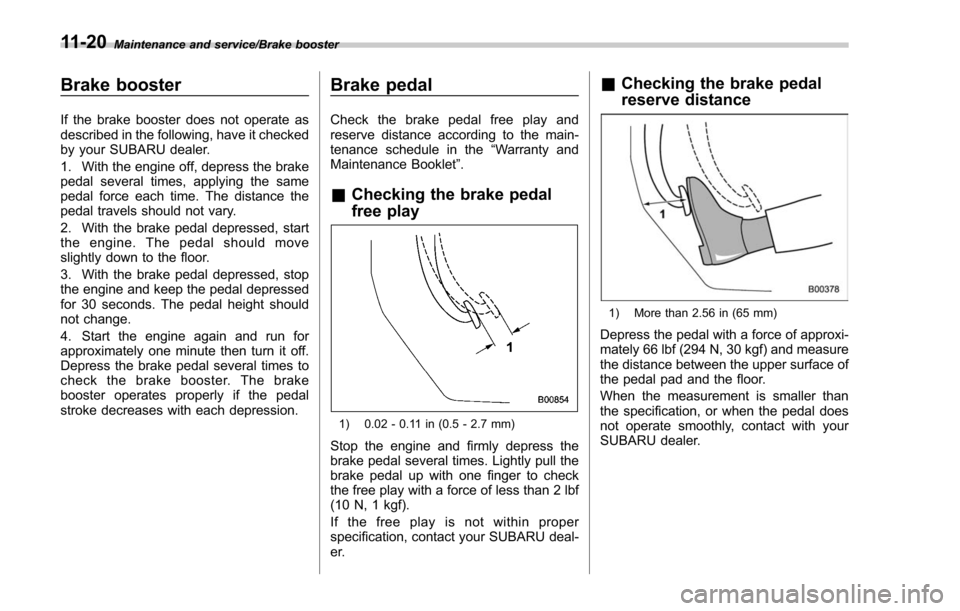
1) 0.02 - 0.11 in (0.5 - 2.7 mm)
Stop the engine and firmly depress the
brake pedal several times. Lightly pull the
brake pedal up with one finger to check
the free play with a force of less than 2 lbf
(10 N, 1 kgf).
If the free play is not within proper
specification, contact your SUBARU deal-
er.
&Checking the brake pedal
reserve distance
1) More than 2.56 in (65 mm)
Depress the pedal with a force of approxi-
mately 66 lbf (294 N, 30 kgf) and measure
the distance between the upper surface of
the pedal pad and the floor.
When the measurement is smaller than
the specification, or when the pedal does
not operate smoothly, contact with your
SUBARU dealer.
11-20
Page 552 of 634
Clutch pedal (MT models)
Check the clutch pedal free play according
to the maintenance schedule in the
“Warranty and Maintenance Booklet”.
& Checking the clutch function
Check the clutch engagement and disen-
gagement.
1. With the engine idling, check that there
are no abnormal noises when the clutch
pedal is depressed, and that shifting into
1st or reverse feels smooth.
2. Start the vehicle by releasing the pedal
slowly to check that the engine and
transmission smoothly couple without
any sign of slippage.
&Checking the clutch pedal
free play
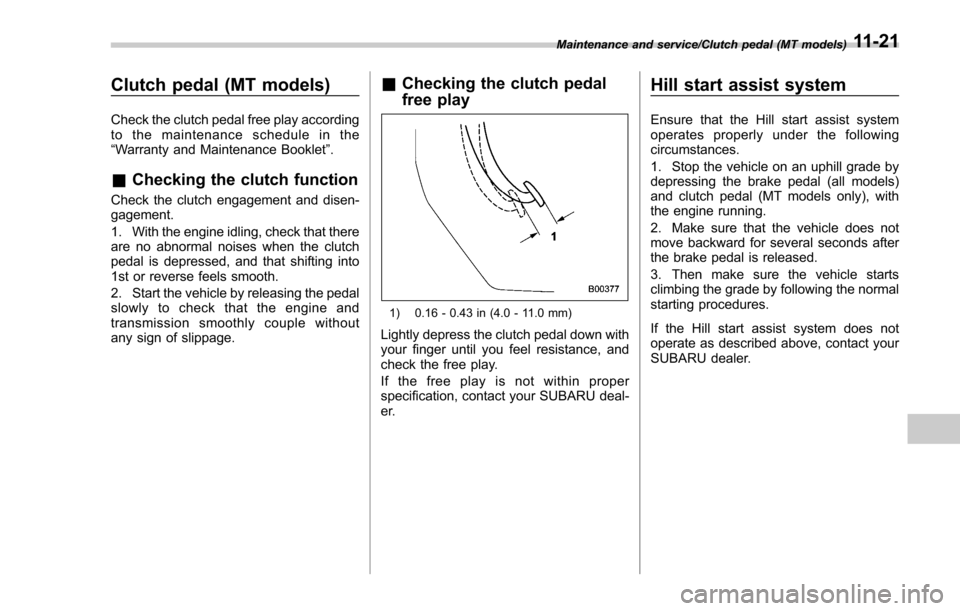
1) 0.16 - 0.43 in (4.0 - 11.0 mm)
Lightly depress the clutch pedal down with
your finger until you feel resistance, and
check the free play.
If the free play is not within proper
specification, contact your SUBARU deal-
er.
Hill start assist system
Ensure that the Hill start assist system
operates properly under the following
circumstances.
1. Stop the vehicle on an uphill grade by
depressing the brake pedal (all models)
and clutch pedal (MT models only), with
the engine running.
2. Make sure that the vehicle does not
move backward for several seconds after
the brake pedal is released.
3. Then make sure the vehicle starts
climbing the grade by following the normal
starting procedures.
If the Hill start assist system does not
operate as described above, contact your
SUBARU dealer.
Maintenance and service/Clutch pedal (MT models)11-21
Page 561 of 634
Maintenance and service/Aluminum wheels
&Wheel replacement
When replacing wheels due, for example,
to damage, make sure the replacement
wheels match the specifications of the
wheels that are fitted as standard equip-
ment. Replacement wheels are available
from SUBARU dealers.
WARNING
Use only those wheels that are
specified for your vehicle. Wheels
not meeting specifications could
interfere with brake caliper opera-
tion and may cause the tires to rub
against the wheel well housing dur-
ing turns. The resulting loss of
vehicle control could lead to an
accident.
NOTE
When any of the wheels are removed
and replaced for tire rotation or to
change a flat tire, always check the
tightness of the wheel nuts after driv-
ing approximately 600 miles (1,000 km).
If any nut is loose, tighten it to the
specified torque.
Aluminum wheels
Aluminum wheels can be scratched and
damaged easily. Handle them carefully to
maintain their appearance, performance,
and safety.
. When any of the wheels are removed
and replaced for tire rotation or to change
a flat tire, always check the tightness of
the wheel nuts after driving approximately
600 miles (1,000 km). If any nut is loose,
tighten it to the specified torque.
. Never apply oil to the threaded parts,
wheel nuts, or tapered surface of the
wheel.
. Never let the wheel rub against sharp
protrusions or curbs.
. When wheel nuts, balance weights, or
the center cap is replaced, be sure to
replace them with genuine SUBARU parts
designed for aluminum wheels.
Windshield washer fluid
CAUTION
Never use engine coolant as washer
fluid because it could cause paint
damage.
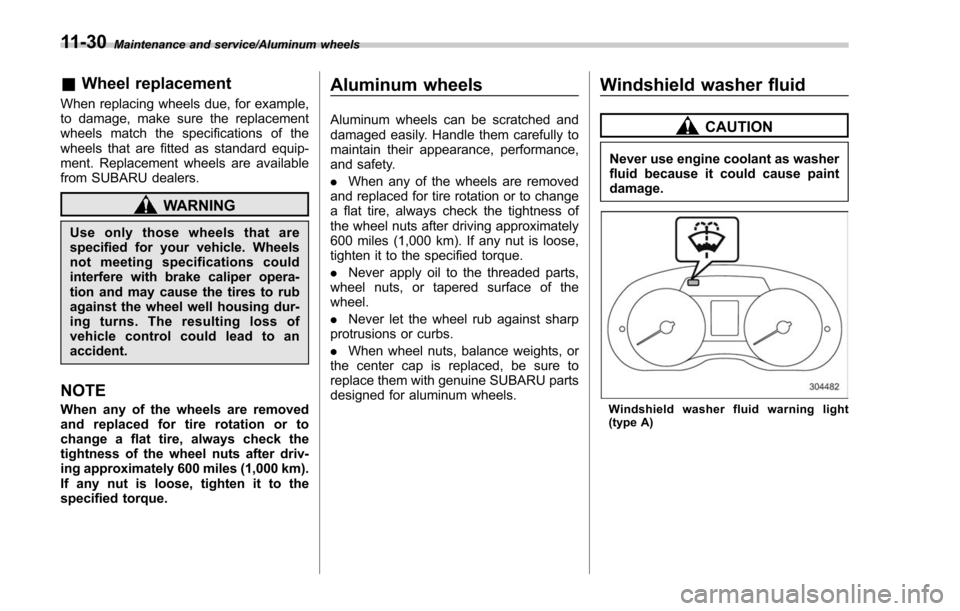
Windshield washer fluid warning light
(type A)
11-30
Page 568 of 634
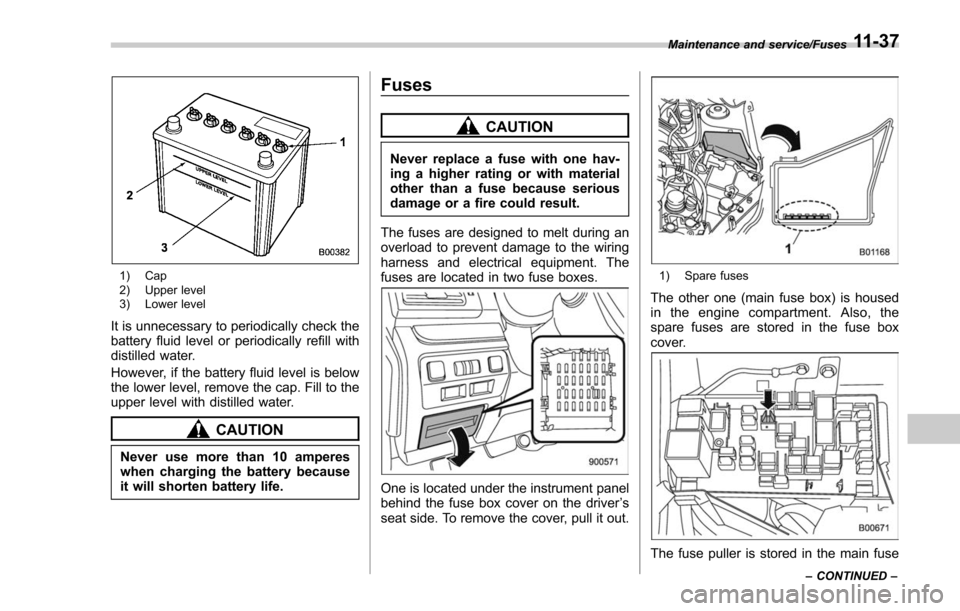
1) Cap
2) Upper level
3) Lower level
It is unnecessary to periodically check the
battery fluid level or periodically refill with
distilled water.
However, if the battery fluid level is below
the lower level, remove the cap. Fill to the
upper level with distilled water.
CAUTION
Never use more than 10 amperes
when charging the battery because
it will shorten battery life.
Fuses
CAUTION
Never replace a fuse with one hav-
ing a higher rating or with material
other than a fuse because serious
damage or a fire could result.
The fuses are designed to melt during an
overload to prevent damage to the wiring
harness and electrical equipment. The
fuses are located in two fuse boxes.
One is located under the instrument panel
behind the fuse box cover on the driver ’s
seat side. To remove the cover, pull it out.
1) Spare fuses
The other one (main fuse box) is housed
in the engine compartment. Also, the
spare fuses are stored in the fuse box
cover.
The fuse puller is stored in the main fuse
Maintenance and service/Fuses
–CONTINUED –11-37
Page 583 of 634
Specifications/Specifications
&Engine oil
For the checking, adding and replacing procedure or other details, refer to “Engine oil ”F 11-10.
NOTEThe procedure for changing the engine oil and oil filter should be performed by a properly-trained expert. It is recommended
that you have this service performed by your SUBARU dealer.
! Approved engine oil
We recommend that you always use the SUBARU approved engine oil. For further details, please contact your SUBARU dealer.
If the approved engine oil is unavailable, use the alternative engine oil described on the next page.
12-4
Page 604 of 634
crease in temperature could cause
tread separation, and failure of the
tire(s). Possible resulting loss of
vehicle control could lead to an
accident.
!Measuring and adjusting air
pressure to achieve proper in-
flation
Check and, if necessary, adjust the
pressure of each tire (including the
spare) at least once a month and
before any long journey. Check the
tire pressures when the tires are
cold. Use a pressure gauge to
adjust the tire pressures to the
specific values. Driving even a
short distance warms up the tires
and increases the tire pressures.
Also, the tire pressures are affected
by the outside temperature. It is
best to check tire pressure out-
doors before driving the vehicle.
When a tire becomes warm, the air
inside it expands, causing the tire
pressure to increase. Be careful not
to mistakenly release air from a
warm tire to reduce its pressure.
&Glossary of tire terminology
.Accessory weight
The combined weight (in excess of
those standard items which may be
replaced) of automatic transmis-
sion, power steering, power brakes,
power windows, power seats, radio,
and heater, to the extent that these
items are available as factory-in-
stalled equipment (whether in-
stalled or not).
.Bead
The part of the tire that is made of
steel wires, wrapped or reinforced
by ply cords and that is shaped to fit
the rim.
.Bead separation
A breakdown of the bond between
components in the bead.
.Bias ply tire
A pneumatic tire in which the ply
cords that extend to the beads are
laid at alternate angles substantially
less than 90 degrees to the center-
line of the tread.
.Carcass
The tire structure, except tread and sidewall rubber which, when in-
flated, bears the load.
.Chunking
The breaking away of pieces of the
tread or sidewall.
.Cold tire pressure
The pressure in a tire that has been
driven less than 1 mile or has been
standing for three hours or more.
.Cord
The strands forming the plies in the
tire.
.Cord separation
The parting of cords from adjacent
rubber compounds.
.Cracking
Any parting within the tread, side-
wall, or inner liner of the tire
extending to cord material.
.Curb weight
The weight of a motor vehicle with
standard equipment including the
maximum capacity of fuel, oil and
coolant, and if so equipped, air
conditioning and additional weight
optional engine.
Consumer information and Reporting safety defects/Tire information
–CONTINUED –13-5
Page 618 of 634
Bottle holder................................................................ 6-9
Brake Assist ................................................................... 7-36
Booster ........................................................ 7-36, 11-20
Disc .................................................................... 12-11
Fluid ............................................................ 11-18, 12-9
Pad and lining ...................................................... 11-22
Parking ........................................................ 7-47, 11-23
Pedal .................................................................. 11-20
System ................................................................. 7-36
Brake pedal Free play ............................................................. 11-20
Reserve distance .................................................. 11-20
Brake system ............................................................ 7-36
Warning light ......................................................... 3-21
Braking ..................................................................... 7-35
Tips...................................................................... 7-35
Breaking-in of new brake pads and linings ................... 11-22
BSD/RCTA ................................................................ 7-58
Approach indicator light/warning buzzer .................... 7-61
OFF indicator ................................................ 3-34, 7-64
OFF switch ........................................................... 7-64
Warning indicator ........................................... 3-33, 7-63
Warning volume ............................................. 3-43, 7-62
Bulb Chart .................................................................. 12-16
Replacing ............................................................. 11-39
C
Cargo area Cover ................................................................... 6-14 Light
...................................................................... 6-2
Tie-down hooks ...................................................... 6-16
Catalytic converter ....................................................... 8-3
Center console ............................................................ 6-6
Changing Coolant ............................................................... 11-14
Flat tire .................................................................. 9-5
Oil and oil filter ..................................................... 11-11
Charge warning light ................................................... 3-18
CHECK ENGINE warning light/Malfunction indicator light ....................................................................... 3-16
Checking Brake pedal free play ............................................ 11-20
Brake pedal reserve distance ................................. 11-20
Clutch function ..................................................... 11-21
Clutch pedal free play ........................................... 11-21
Coolant level ........................................................ 11-13
Fluid level (brake fluid) .......................................... 11-18
Fluid level (clutch fluid) .......................................... 11-19
Fluid level (washer fluid) ........................................ 11-30
Oil level (engine oil) .............................................. 11-10
Child restraint systems ................................................ 1-29
Installation of a booster seat .................................... 1-36
Installation with ALR/ELR seatbelt ............................ 1-32
Lower and tether anchorages ................................... 1-37
Top tether anchorages ............................................
1-40
Child safety ................................................................... 4
Locks .................................................................... 2-32
Chime
Key........................................................................\
3-5
Light ..................................................................... 3-93
Index14-3
Page 622 of 634
J
Jack and jack handle.................................................... 9-4
Jack-up point ............................................................... 9-5
Jump starting. .............................................................. 9-9
K
Key ........................................................................\
.... 2-3 Number plate ........................................................... 2-3
Reminder chime. ...................................................... 3-5
Replacement ........................................................... 2-4
Keyless access entry function ...................................... 2-13
Keyless access with push-button start system .. ............... 2-9
Disabling keyless access functions ........................... 2-17
Locking and unlocking doors ................................... 2-13
Opening rear gate .................................................. 2-15
Warning chimes and warning light ............................ 3-25
When access key does not operate properly ............. 9-17
Keyless entry system ................................................. 2-21
L
Lap belt pretensioner .................................................. 1-26
LCA ........................................................................\
. 7-59
Leather seat materials ................................................ 10-5
License plate light ..................................................... 11-44
Light Backup ................................................................ 11-42
Cargo area .............................................................. 6-2
Control switch ........................................................ 3-93
Daytime running. .................................................... 3-98
Dome ..................................................................... 6-2
Front fog .................................................... 3- 102, 11-42Front side marker
....................................... 11-41, 12-16
Ignition switch ......................................................... 3-6
License plate ....................................................... 11-44
Map ....................................................................... 6-3
Rear combination ................................................. 11-42
Stop .................................................................... 11-42
Tail ..................................................................... 11-42
Turn signal ....................................... 3- 100, 11-41, 11-42
Vanity mirror ........................................................... 6-5
Loading your vehicle ................................................... 8-12
Low fuel warning light ................................................. 3-22
Low tire pressure warning light ..................................... 3-19
Lower and tether anchorage ........................................ 1-37
M
Maintenance Precautions ........................................................... 11-3
Schedule ............................................................... 11-3
Seatbelt. ................................................................ 1-24
Tips ...................................................................... 11-5
Tools ...................................................................... 9-3
Malfunction indicator light (check engine warning light) .... 3-16
Manual Climate control ........................................................ 4-7
Mode (continuously variable transmission) ................. 7-27
Seat ....................................................................... 1-4
Transmission ......................................................... 7-22
Transmission oil ........................................... 11-17, 12-7
Map light .................................................................... 6-3
Maximum load limits ................................................... 8-19
Meters and gauges ......................................................
3-9
Index14-7
Page 626 of 634

Tires and wheels....................................................... 11-23
Tools ........................................................................\
.. 9-3
Top tether anchorages ........................................ 1-37, 1-40
Towing ...................................................................... 9-13
All wheels on the ground ........................................ 9-16
Flat-bed truck ........................................................ 9-15
Hooks ................................................................... 9-13
Weight.................................................................. 8-19
Trailer
Connecting ............................................................ 8-17
Hitch ............................................................ 8-16, 8-22
Towing .................................................................. 8-19
Towing tips ............................................................ 8-23
Trip meter ................................................................. 3-10
Turn signal Indicator lights ....................................................... 3-32
Lever .................................................................. 3-100
U
Under-floor storage compartment ................................. 6-17
V
Valet mode ................................................................ 2-29
Vanity mirror .......................................................... 6-5, 6-5
Vehicle Capacity weight ..................................................... 8-13
Identification ........................................................ 12-19
Symbols .................................................................... 3
Vehicle Dynamics Control OFF indicator light .................................................. 3-25
OFF switch ........................................................... 7-41 Operation indicator light
........................................... 3-25
System .................................................................. 7-39
Warning light .......................................................... 3-24
Ventilator .................................................................... 4-2
Voice command system operation ... ............................. 5-80
W
Warning and indicator lights ......................................... 3-13
Warning chimes Keyless access with push-button start system .... ........ 3-25
Seatbelt. ................................................................ 3-14
Warning light ABS...................................................................... 3-21
Access key ............................................................ 3-25
All-Wheel Drive ...................................................... 3-23
AT OIL TEMP ......................................................... 3-19
Automatic headlight beam leveler ............................. 3-32
Brake system ......................................................... 3-21
Charge .................................................................. 3-18
CHECK ENGINE .................................................... 3-16
Coolant temperature high ........................................ 3-17
Door open ............................................................. 3-23
Engine low oil level ................................................. 3-18
Hill start assist ....................................................... 3-23
Keyless access with push-button start system .... ........ 3-25
Low fuel ................................................................ 3-22
Low tire pressure .................................................... 3-19
Oil pressure ........................................................... 3-18
Power steering .......................................................
3-23
Seatbelt. ................................................................ 3-14
SRS airbag system ................................................. 3-15
Index14-11