seats SUBARU IMPREZA 2000 2.G User Guide
[x] Cancel search | Manufacturer: SUBARU, Model Year: 2000, Model line: IMPREZA, Model: SUBARU IMPREZA 2000 2.GPages: 320, PDF Size: 3.81 MB
Page 77 of 320

2-22Infants and small c hild ren should always b e p lac ed
in an infant or c hild
restraint system in the rear seat while rid ing in t he vehic le. You should
use an infant or c hild restraint system that meets Fed eral Motor Vehic le
Safety Stand ard s or Canad a Motor Vehic le Safety Sta nd ard s, is c omp at-
ib le with your vehic le and is ap p rop riate for the c hild’s ag e and size. All
c hild restraint systems are d esig ned to b e sec ured in the vehic le seats
b y lap b elts or the lap p ortion of a lap /should er b elt.
Child ren c ould b e end ang ered in an ac c id ent if thei r c hild restraints are
not p rop erly sec ured in the vehic le. When installin g the c hild restraint
system, c arefully follow the manufac turer ’s instruc tions.
Ac c ord ing to ac c id ent statistic s, c hild ren are safe r when p rop erly re-
strained in the rear seating p ositions than in the front seating p ositions.
These statistic s also ind ic ate that the safest p osi tion for a c hild restraint
system is the c enter of the rear seat.
All U.S. states and Canad ian p rovinc es req uire that infants and small
c hild ren b e restrained in an ap p roved c hild restrai nt system at all times
while the vehic le is moving .
Installing child restraint systems in the 2-point type seat belt position (Rear center seating position)
HS2002BA
1. Set the c hild restraint system in the c enter seat ing p osition.
2. Run the 2-p oint typ e seat b elt throug h or around the c hild restraint
system following the instruc tions p rovid ed b y its m anufac turer.
3. Insert the tong ue p late into the b uc kle.
Page 82 of 320
Seat, seat belt and SRS airbag2-27
–
CONTINUED –
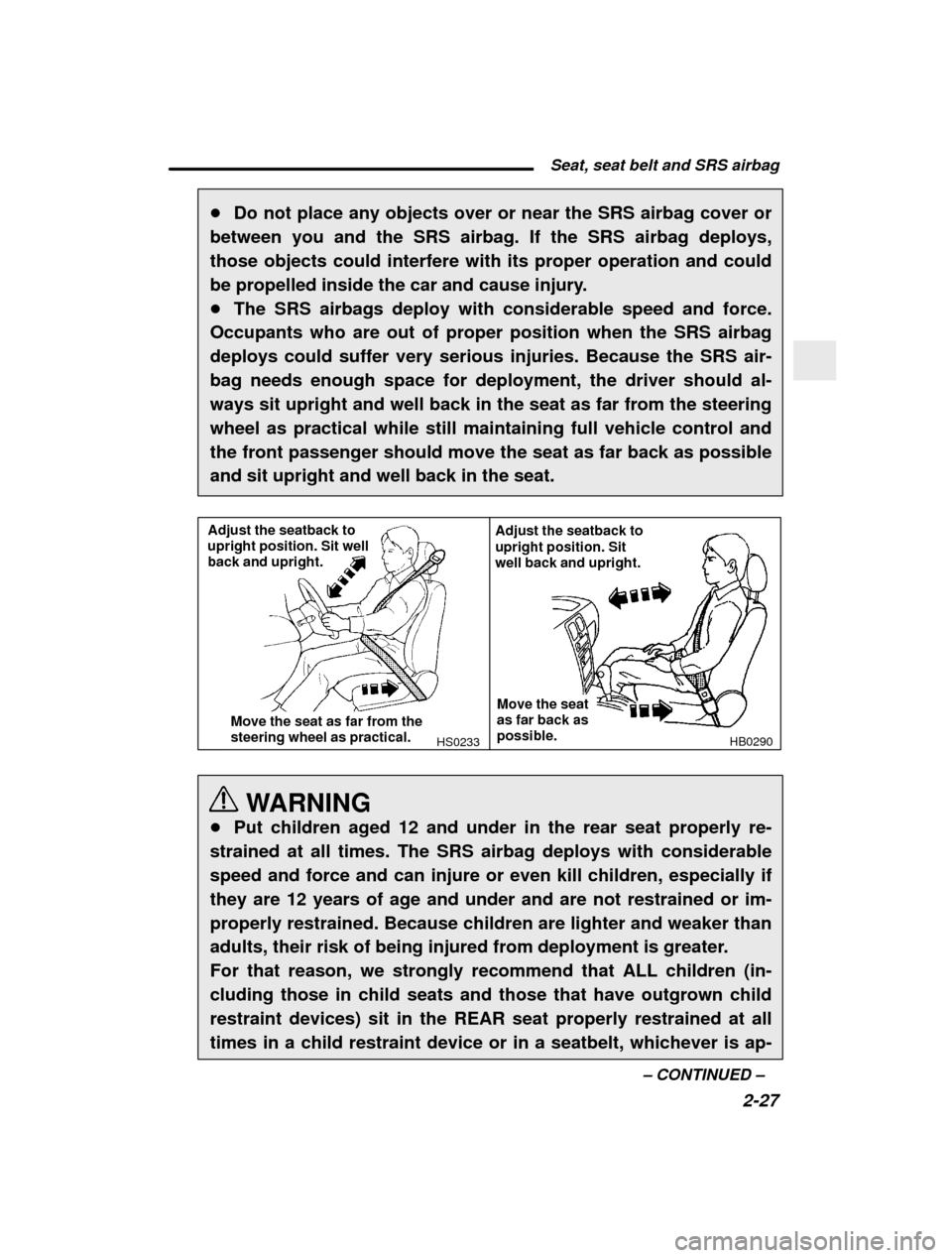
Do not place any objects over or near the SRS airbag cover or
between you and the SRS airbag. If the SRS airbag deploys, those objects could interfere with its proper operation and could
be propelled inside the car and cause injury. The SRS airbags deploy with considerable speed and force.
Occupants who are out of proper position when the SRS airbag
deploys could suffer very serious injuries. Because the SRS air-bag needs enough space for deployment, the driver should al-ways sit upright and well back in the seat as far from the steeringwheel as practical while still maintaining full vehicle control and
the front passenger should move the seat as far back as possibleand sit upright and well back in the seat.
HS0233
Adjust the seatback to upright position. Sit well back and upright.
Move the seat as far from the steering wheel as practical.HB0290
Adjust the seatback to upright position. Sit well back and upright.
Move the seat as far back as possible.
WARNING
Put children aged 12 and under in the rear seat properly re-
strained at all times. The SRS airbag deploys with considerable speed and force and can injure or even kill children, especially ifthey are 12 years of age and under and are not restrained or im-properly restrained. Because children are lighter and weaker than
adults, their risk of being injured from deployment is greater.
For that reason, we strongly recommend that ALL children (in-cluding those in child seats and those that have outgrown child
restraint devices) sit in the REAR seat properly restrained at alltimes in a child restraint device or in a seatbelt, whichever is ap-
Page 83 of 320
2-28propriate for the child
’s age, height and weight.
Secure ALL types of child restraint devices (including forward facing child seats) in the REAR seats at all times.According to accident statistics, children are safer when properlyrestrained in the rear seating positions than in the front seatingpositions.For instructions and precautions concerning the child restraint
system, see the “Child restraint systems ” section in this chapter.
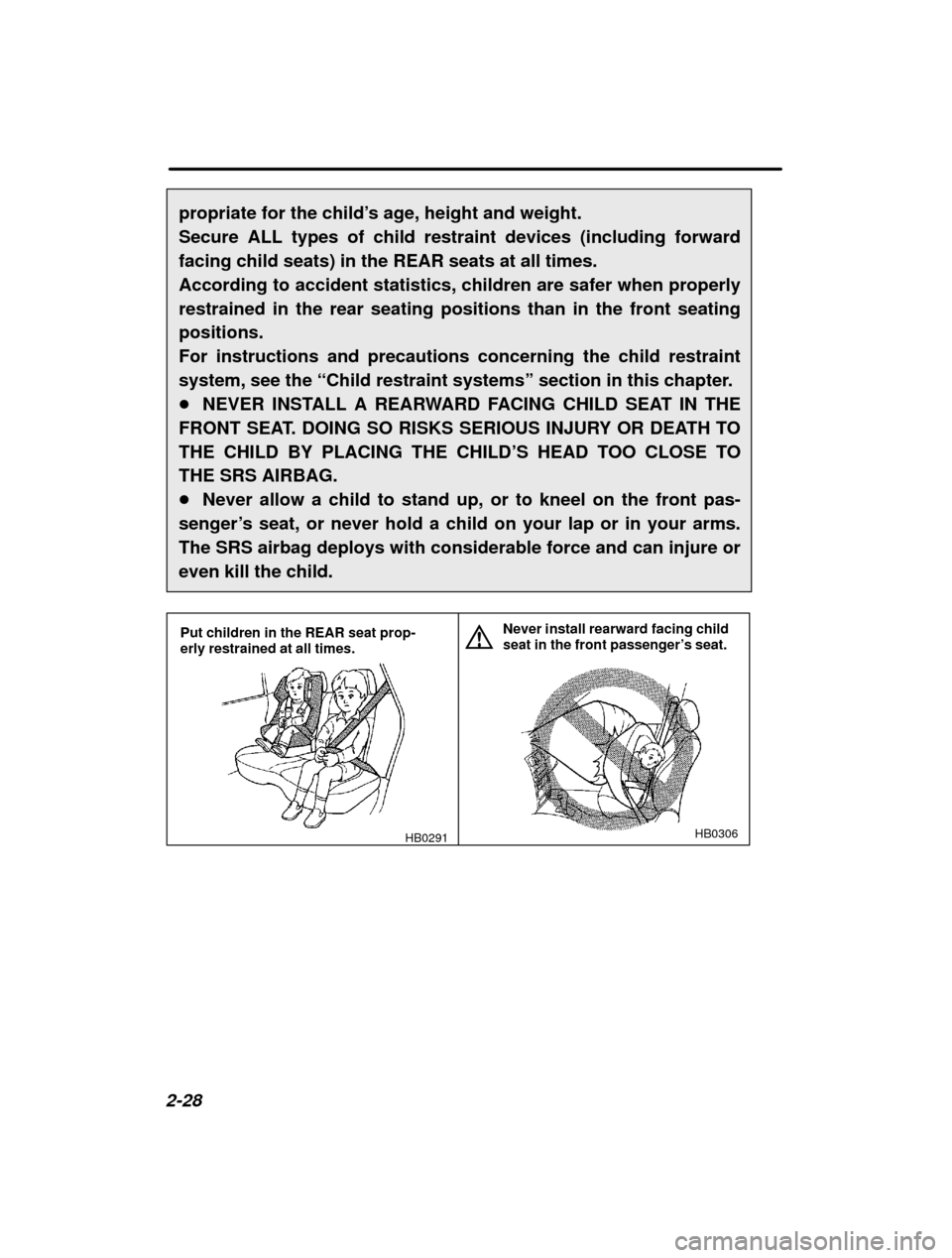
NEVER INSTALL A REARWARD FACING CHILD SEAT IN THE
FRONT SEAT. DOING SO RISKS SERIOUS INJURY OR DEATH TOTHE CHILD BY PLACING THE CHILD ’S HEAD TOO CLOSE TO
THE SRS AIRBAG. Never allow a child to stand up, or to kneel on the front pas-
senger’ s seat, or never hold a child on your lap or in your arms.
The SRS airbag deploys with considerable force and can injure oreven kill the child.
HB0306
HB0291
Put children in the REAR seat prop- erly restrained at all times.
Never install rearward facing child seat in the front passenger
’s seat.