engine coolant SUBARU IMPREZA 2003 2.G User Guide
[x] Cancel search | Manufacturer: SUBARU, Model Year: 2003, Model line: IMPREZA, Model: SUBARU IMPREZA 2003 2.GPages: 425, PDF Size: 5.75 MB
Page 340 of 425
Maintenance and service
11-17
– CONTINUED –
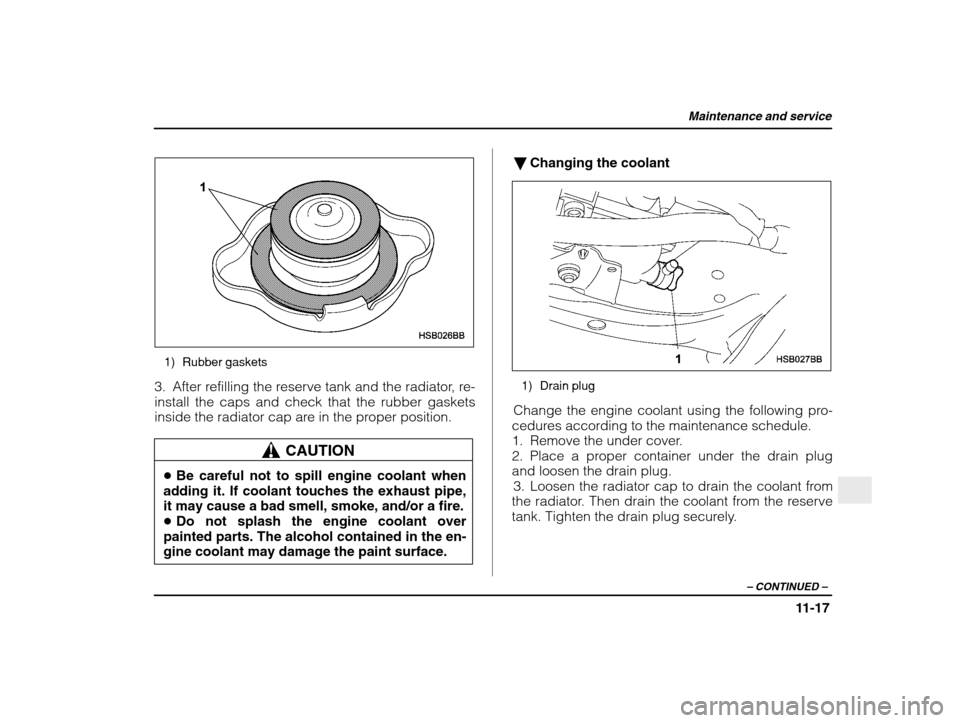
1) Rubber gaskets
3. After refilling the reserve tank and the radiator, re- install the caps and check that the rubber gaskets
inside the radiator cap are in the proper position.
CAUTION
Be careful not to spill engine coolant when
adding it. If coolant touches the exhaust pipe, it may cause a bad smell, smoke, and/or a fire. Do not splash the engine coolant over
painted parts. The alcohol contained in the en-gine coolant may damage the paint surface.
Changing the coolant
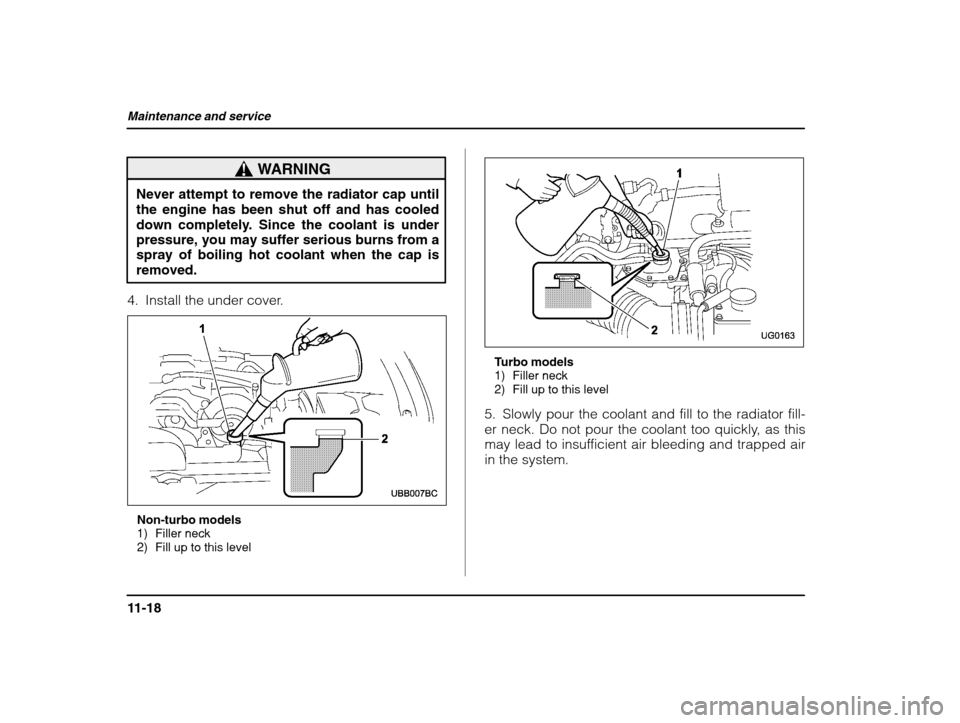
1) Drain plug
Change the engine coolant using the following pro-
cedures according to the maintenance schedule.
1. Remove the under cover.
2. Place a proper container under the drain plugand loosen the drain plug.
3. Loosen the radiator cap to drain the coolant from
the radiator. Then drain the coolant from the reserve
tank. Tighten the drain plug securely.
Page 341 of 425
Maintenance and service
11-18
WARNING
Never attempt to remove the radiator cap until the engine has been shut off and has cooled
down completely. Since the coolant is underpressure, you may suffer serious burns from a
spray of boiling hot coolant when the cap is removed.
4. Install the under cover.
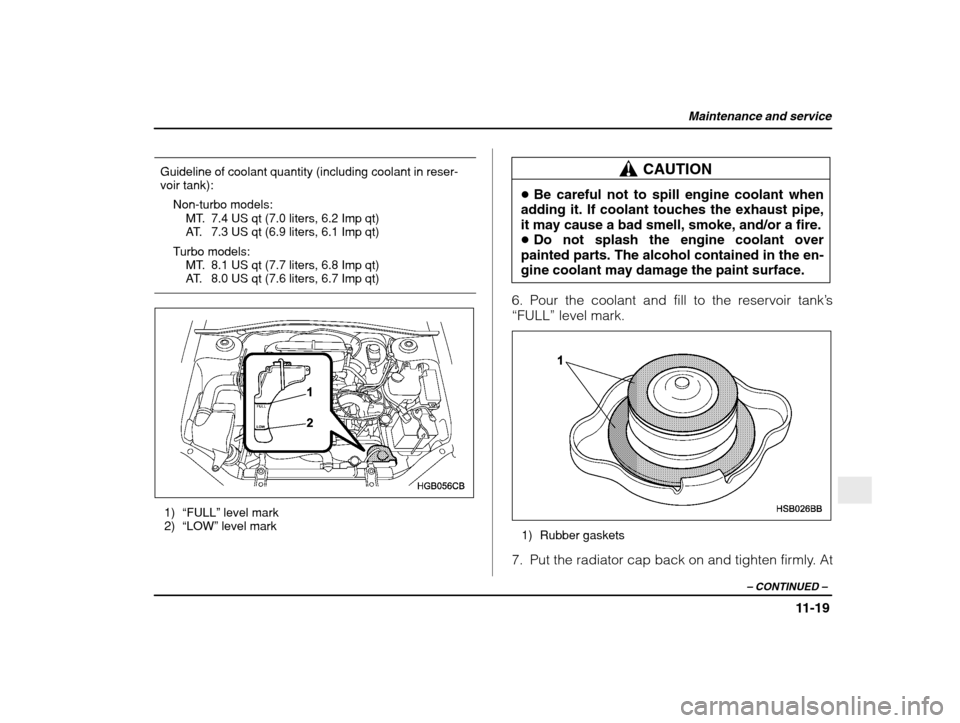
Non-turbo models
1) Filler neck
2) Fill up to this level
Turbo models
1) Filler neck
2) Fill up to this level
5. Slowly pour the coolant and fill to the radiator fill-
er neck. Do not pour the coolant too quickly, as this
may lead to insufficient air bleeding and trapped airin the system.
Page 342 of 425
Maintenance and service
11-19
– CONTINUED –
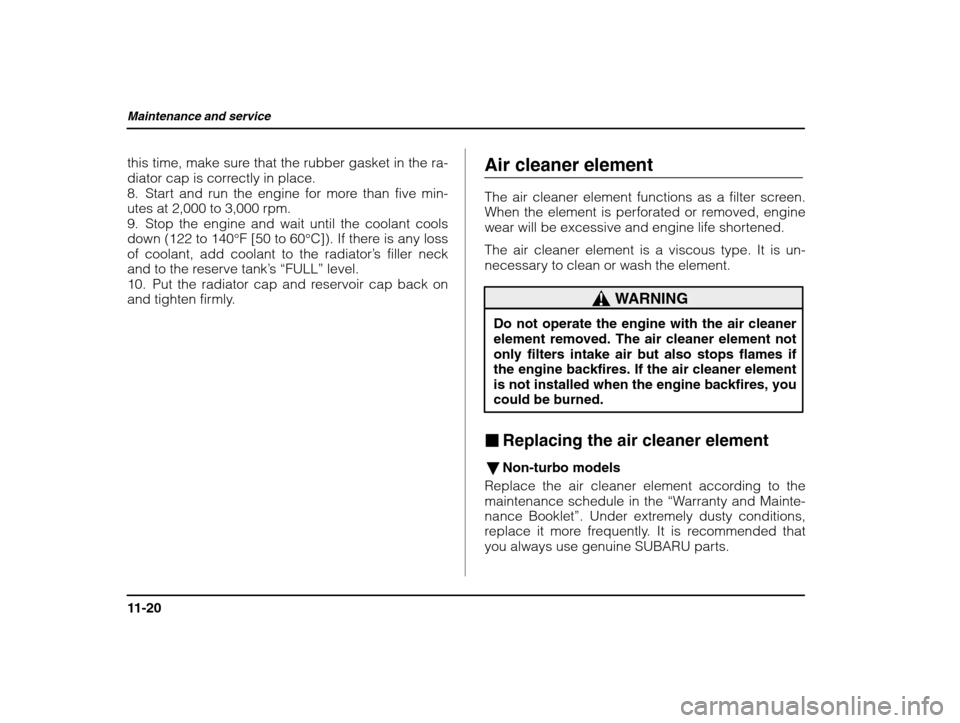
Guideline of coolant quantity (including coolant in reser- voir tank):
Non-turbo models: MT. 7.4 US qt (7.0 liters, 6.2 Imp qt)
AT. 7.3 US qt (6.9 liters, 6.1 Imp qt)
Turbo models: MT. 8.1 US qt (7.7 liters, 6.8 Imp qt)
AT. 8.0 US qt (7.6 liters, 6.7 Imp qt)
1) “FULL” level mark
2) “LOW” level mark
CAUTION
Be careful not to spill engine coolant when
adding it. If coolant touches the exhaust pipe, it may cause a bad smell, smoke, and/or a fire. Do not splash the engine coolant over
painted parts. The alcohol contained in the en-gine coolant may damage the paint surface.
6. Pour the coolant and fill to the reservoir tank ’s
“FULL” level mark.
1) Rubber gaskets
7. Put the radiator cap back on and tighten firmly. At
Page 343 of 425
Maintenance and service
11-20
this time, make sure that the rubber gasket in the ra-
diator cap is correctly in place.
8. Start and run the engine for more than five min-utes at 2,000 to 3,000 rpm.
9. Stop the engine and wait until the coolant coolsdown (122 to 140°F [50 to 60 °C]). If there is any loss
of coolant, add coolant to the radiator ’s filler neck
and to the reserve tank ’s “FULL” level.
10. Put the radiator cap and reservoir cap back on
and tighten firmly. Air cleaner element
The air cleaner element functions as a filter screen.
When the element is perforated or removed, engine
wear will be excessive and engine life shortened.
The air cleaner element is a viscous type. It is un-
necessary to clean or wash the element.
WARNING
Do not operate the engine with the air cleaner
element removed. The air cleaner element notonly filters intake air but also stops flames ifthe engine backfires. If the air cleaner elementis not installed when the engine backfires, youcould be burned.
Replacing the air cleaner element
Non-turbo models
Replace the air cleaner element according to the
maintenance schedule in the “Warranty and Mainte-
nance Booklet ”. Under extremely dusty conditions,
replace it more frequently. It is recommended that
you always use genuine SUBARU parts.
Page 374 of 425
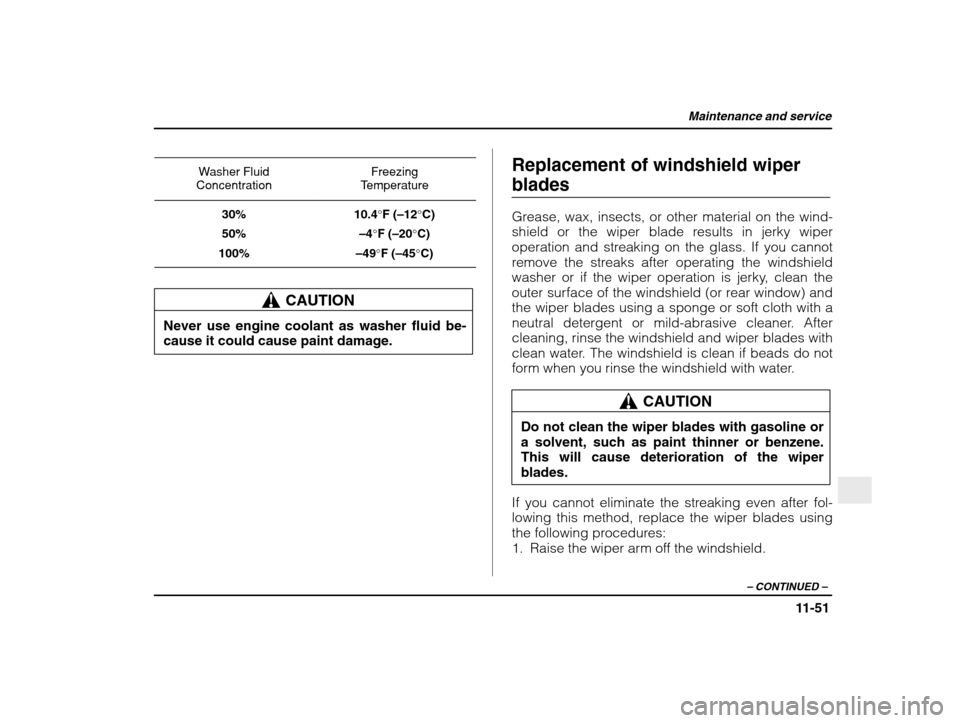
Maintenance and service
11-51
– CONTINUED –
Washer Fluid
ConcentrationFreezing
Temperature
30% 50%
100%10.4 °F ( –12 °C)
–4 °F ( –20 °C)
–49 °F ( –45 °C)
CAUTION
Never use engine coolant as washer fluid be-
cause it could cause paint damage. Replacement of windshield wiper blades
Grease, wax, insects, or other material on the wind-
shield or the wiper blade results in jerky wiper
operation and streaking on the glass. If you cannot
remove the streaks after operating the windshield
washer or if the wiper operation is jerky, clean the
outer surface of the windshield (or rear window) andthe wiper blades using a sponge or soft cloth with a
neutral detergent or mild-abrasive cleaner. After
cleaning, rinse the windshield and wiper blades with
clean water. The windshield is clean if beads do not
form when you rinse the windshield with water.
CAUTION
Do not clean the wiper blades with gasoline or a solvent, such as paint thinner or benzene. This will cause deterioration of the wiperblades.
If you cannot eliminate the streaking even after fol-
lowing this method, replace the wiper blades using
the following procedures:
1. Raise the wiper arm off the windshield.
Page 403 of 425

Specifications
12-4
Capacities
Fuel tank
15.9 US gal (60 liters, 13.2 Imp gal)
Engine oil2.5-liter engine model4.2 US qt (4.0 liters, 3.5 Imp qt)
2.0-liter turbo engine model4.8 US qt (4.5 liters, 4.0 Imp qt)
Transmission oil (MT)3.7 US qt (3.5 liters, 3.1 Imp qt)
Transmission oil (AT)10.0 US qt (9.5 liters, 8.4 Imp qt)
Power steering gear fluid0.7 US qt (0.7 liter, 0.6 Imp qt)
Engine coolant2.5-liter engine modelMT7.4 US qt (7.0 liters, 6.2 Imp qt)
AT7.3 US qt (6.9 liters, 6.1 Imp qt)
2.0-liter turbo engine modelMT8.1 US qt (7.7 liters, 6.8 Imp qt)
AT8.0 US qt (7.6 liters, 6.7 Imp qt)
AT : Automatic transmission MT : Manual transmission
Page 417 of 425

Index
14-4
Door locks 2-3
. . . . . . . . . . . . . . . . . . . . . . . . . . . . . . . . . . . . . . .
Door open warning lights 3-14 . . . . . . . . . . . . . . . . . . . . . .
Drive belts 11-24 . . . . . . . . . . . . . . . . . . . . . . . . . . . . . . . . . . . . . . .
Driving
Drinking 9
. . . . . . . . . . . . . . . . . . . . . . . . . . . . . . . . . . . . . .
Drugs 9
. . . . . . . . . . . . . . . . . . . . . . . . . . . . . . . . . . . . . . . . .
Foreign countries 8-6 . . . . . . . . . . . . . . . . . . . . . . . . . . . .
Mobile phone 10 . . . . . . . . . . . . . . . . . . . . . . . . . . . . . . . .
Pets 11
. . . . . . . . . . . . . . . . . . . . . . . . . . . . . . . . . . . . . . . . . . .
Tired or sleepy 10 . . . . . . . . . . . . . . . . . . . . . . . . . . . . . . .
Tips 7-13, 8-6 . . . . . . . . . . . . . . . . . . . . . . . . . . . . . . . . . . . . . .
Snowy and icy roads 8-12 . . . . . . . . . . . . . . . . . . . . . . . .
E
Electrical system 12-3 . . . . . . . . . . . . . . . . . . . . . . . . . . . . . . . .
Emergency Locking Retractor (ELR) 1-14 . . . . . . . . . .
Engine Compartment overview 11-8 . . . . . . . . . . . . . . . . . . . . .
Coolant 11-16 . . . . . . . . . . . . . . . . . . . . . . . . . . . . . . . . . . . . . . .
Exhaust gas (Carbon monoxide) 8, 8-3 . . . . . . . . . . .
Hood 11-5
. . . . . . . . . . . . . . . . . . . . . . . . . . . . . . . . . . . . . . . . .
Oil 11-10
. . . . . . . . . . . . . . . . . . . . . . . . . . . . . . . . . . . . . . . . . . . .
Overheating 9-17 . . . . . . . . . . . . . . . . . . . . . . . . . . . . . . . . . .
Starting 7-9
. . . . . . . . . . . . . . . . . . . . . . . . . . . . . . . . . . . . . . .
Stopping 7-11 . . . . . . . . . . . . . . . . . . . . . . . . . . . . . . . . . . . . .
Exterior care 10-2 . . . . . . . . . . . . . . . . . . . . . . . . . . . . . . . . . . . . F
Flat tires
9-5
. . . . . . . . . . . . . . . . . . . . . . . . . . . . . . . . . . . . . . . . .
Floor mat 6-13
. . . . . . . . . . . . . . . . . . . . . . . . . . . . . . . . . . . . . . . .
Fluid level Automatic transmission 11-27 . . . . . . . . . . . . . . . . . . . . .
Brake 11-34
. . . . . . . . . . . . . . . . . . . . . . . . . . . . . . . . . . . . . . . . .
Clutch 11-35
. . . . . . . . . . . . . . . . . . . . . . . . . . . . . . . . . . . . . . . .
Power steering 11-32 . . . . . . . . . . . . . . . . . . . . . . . . . . . . . .
Fog light switch 3-20 . . . . . . . . . . . . . . . . . . . . . . . . . . . . . . . .
Folding down the rear seat 1-11 . . . . . . . . . . . . . . . . . . . .
Fore and aft adjustment 1-3 . . . . . . . . . . . . . . . . . . . . . . . .
Front
Differential gear oil 11-29 . . . . . . . . . . . . . . . . . . . . . . . . . .
Fog light 11-68 . . . . . . . . . . . . . . . . . . . . . . . . . . . . . . . . . . . . .
Seatbelt pretensioners 1-27 . . . . . . . . . . . . . . . . . . . . .
Seats 1-2
. . . . . . . . . . . . . . . . . . . . . . . . . . . . . . . . . . . . . . . . .
Side marker light 11-69 . . . . . . . . . . . . . . . . . . . . . . . . . . . .
Turn signal light and parking light 11-64 . . . . . . . . . .
Front-wheel drive warning light 3-15 . . . . . . . . . . . . . . .
Fuel 7-2
. . . . . . . . . . . . . . . . . . . . . . . . . . . . . . . . . . . . . . . . . . . . . .
Economy hints 8-2 . . . . . . . . . . . . . . . . . . . . . . . . . . . . . . .
Filler lid and cap 7-4 . . . . . . . . . . . . . . . . . . . . . . . . . . . . .
Gauge 3-8
. . . . . . . . . . . . . . . . . . . . . . . . . . . . . . . . . . . . . . . .
Requirements 7-2 . . . . . . . . . . . . . . . . . . . . . . . . . . . . . . . .
Fuses 11-56
. . . . . . . . . . . . . . . . . . . . . . . . . . . . . . . . . . . . . . . . . . . .
Fuses and circuits 12-6 . . . . . . . . . . . . . . . . . . . . . . . . . . . . . .