belt SUBARU IMPREZA 2003 2.G Workshop Manual
[x] Cancel search | Manufacturer: SUBARU, Model Year: 2003, Model line: IMPREZA, Model: SUBARU IMPREZA 2003 2.GPages: 425, PDF Size: 5.75 MB
Page 68 of 425
Seat, seatbelt and SRS airbags
1-43
– CONTINUED –
SRS airbag contacts an occupant not in prop- er position such as one thrown forward during
pre-accident braking.Even when properly positioned, there remains
a possibility that an occupant may suffer mi-nor injury such as abrasions and bruises to
the face or arms because of the SRS airbag
deployment force.The SRS airbags deploy with considerable
speed and force. Occupants who are out ofproper position when the SRS airbag deploys
could suffer very serious injuries. Because the SRS airbag needs enough space for de- ployment, the driver should always sit uprightand well back in the seat as far from the steer-ing wheel as practical while still maintainingfull vehicle control and the front passengershould move the seat as far back as possible and sit upright and well back in the seat. Do not place any objects over or near the
SRS airbag cover or between you and the SRSairbag. If the SRS airbag deploys, those ob-jects could interfere with its proper operationand could be propelled inside the car and
cause injury.
WARNING
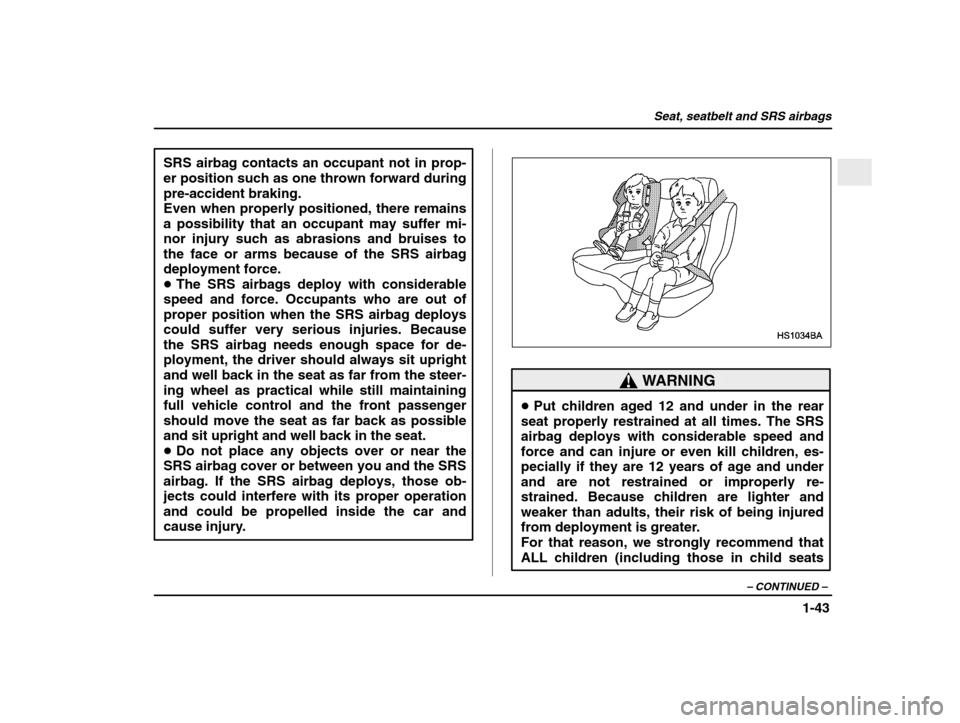
Put children aged 12 and under in the rear
seat properly restrained at all times. The SRS airbag deploys with considerable speed andforce and can injure or even kill children, es-
pecially if they are 12 years of age and under and are not restrained or improperly re- strained. Because children are lighter and
weaker than adults, their risk of being injured
from deployment is greater. For that reason, we strongly recommend thatALL children (including those in child seats
Page 69 of 425

Seat, seatbelt and SRS airbags
1-44
and those that have outgrown child restraint
devices) sit in the REAR seat properly re-strained at all times in a child restraint deviceor in a seatbelt, whichever is appropriate forthe child’s age, height and weight.
Secure ALL types of child restraint devices
(including forward facing child seats) in the
REAR seats at all times.
According to accident statistics, children are
safer when properly restrained in the rearseating positions than in the front seatingpositions. For instructions and precautions concerning the child restraint system, see the “Child re-
straint systems ” section in this chapter.
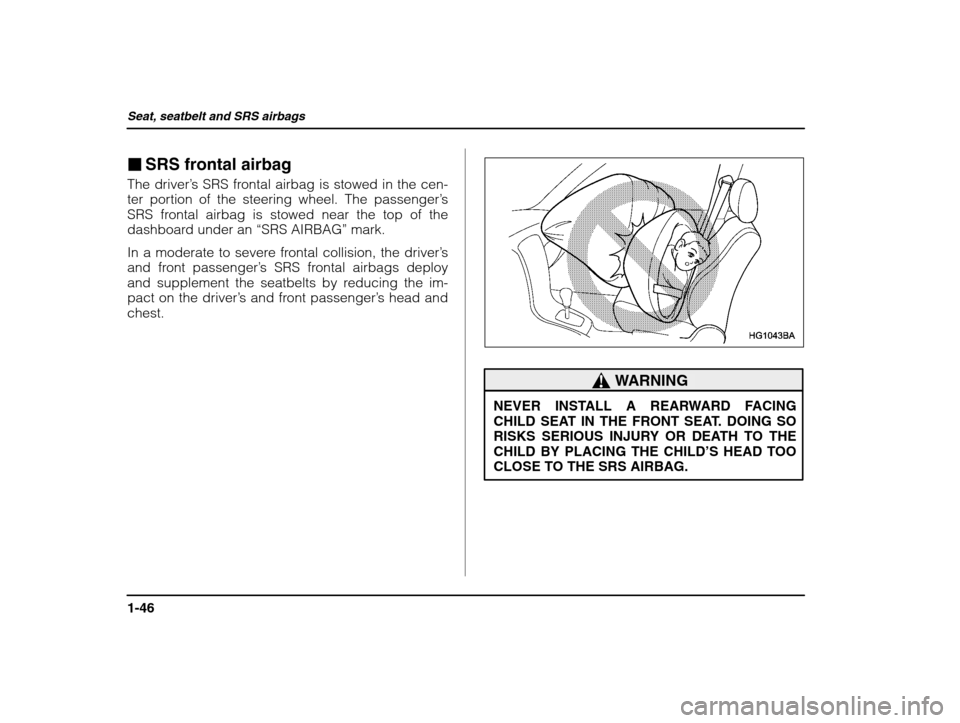
NEVER INSTALL A REARWARD FACING
CHILD SEAT IN THE FRONT SEAT. DOING SO
RISKS SERIOUS INJURY OR DEATH TO THE
CHILD BY PLACING THE CHILD ’S HEAD TOO
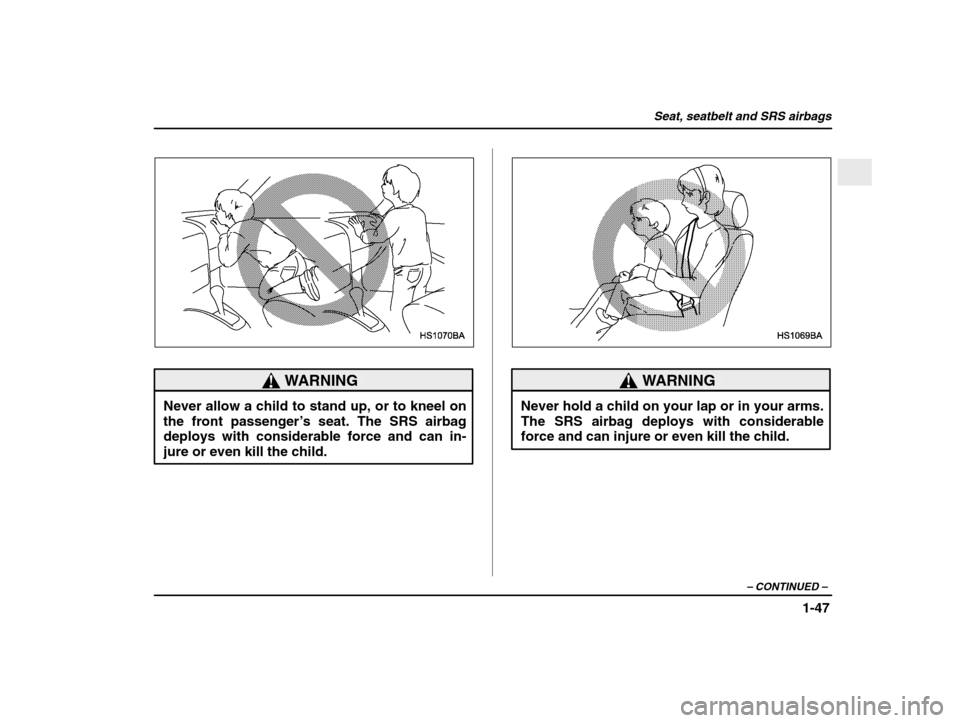
CLOSE TO THE SRS AIRBAG. Never allow a child to stand up, or to kneel
on the front passenger ’s seat, or never hold a
child on your lap or in your arms. The SRS air-bag deploys with considerable force and can injure or even kill the child.CAUTION
When the SRS airbag deploys, some smoke
will be released. This smoke could cause breathing problems for people with a history of asthma or other breathing trouble. If you oryour passengers have breathing problems af-
ter SRS airbag deploys, get fresh air promptly. A deploying SRS airbag releases hot gas.
Occupants could get burnt if they come into direct contact with the hot gas.
NOTE When you sell your vehicle, we urge you to ex- plain to the buyer that it is equipped with SRS
airbags by alerting him to the applicable sectionin this owner ’s manual.
Page 70 of 425

Seat, seatbelt and SRS airbags
1-45
– CONTINUED –
1) Airbag control module
(including impact sensors)
2) Airbag module (driver ’s side)
3) Airbag module (passenger ’s
side)
4) Front sub sensor (left hand side)
5) Front sub sensor (right hand
side)
6) Side airbag module
(driver’ s side — if equipped)
7) Side airbag module (passenger’ s side — if
equipped)
8) Side airbag sensor (driver ’s
side — if equipped)
9) Side airbag sensor (passenger’ s side — if
equipped)
10) Airbag wiring (yellow)
11) Seatbelt pretensioner (driver ’s
side)
12) Seatbelt pretensioner (passenger’ s side)
Page 71 of 425
Seat, seatbelt and SRS airbags
1-46
SRS frontal airbag
The driver ’s SRS frontal airbag is stowed in the cen-
ter portion of the steering wheel. The passenger ’s
SRS frontal airbag is stowed near the top of the
dashboard under an “SRS AIRBAG ” mark.
In a moderate to severe frontal collision, the driver ’s
and front passenger ’s SRS frontal airbags deploy
and supplement the seatbelts by reducing the im- pact on the driver ’s and front passenger ’s head and
chest.
WARNING
NEVER INSTALL A REARWARD FACING
CHILD SEAT IN THE FRONT SEAT. DOING SO
RISKS SERIOUS INJURY OR DEATH TO THE
CHILD BY PLACING THE CHILD ’S HEAD TOO
CLOSE TO THE SRS AIRBAG.
Page 72 of 425
Seat, seatbelt and SRS airbags
1-47
– CONTINUED –
WARNING
Never allow a child to stand up, or to kneel on the front passenger ’s seat. The SRS airbag
deploys with considerable force and can in- jure or even kill the child.
WARNING
Never hold a child on your lap or in your arms. The SRS airbag deploys with considerableforce and can injure or even kill the child.
Page 73 of 425
Seat, seatbelt and SRS airbags
1-48
WARNING
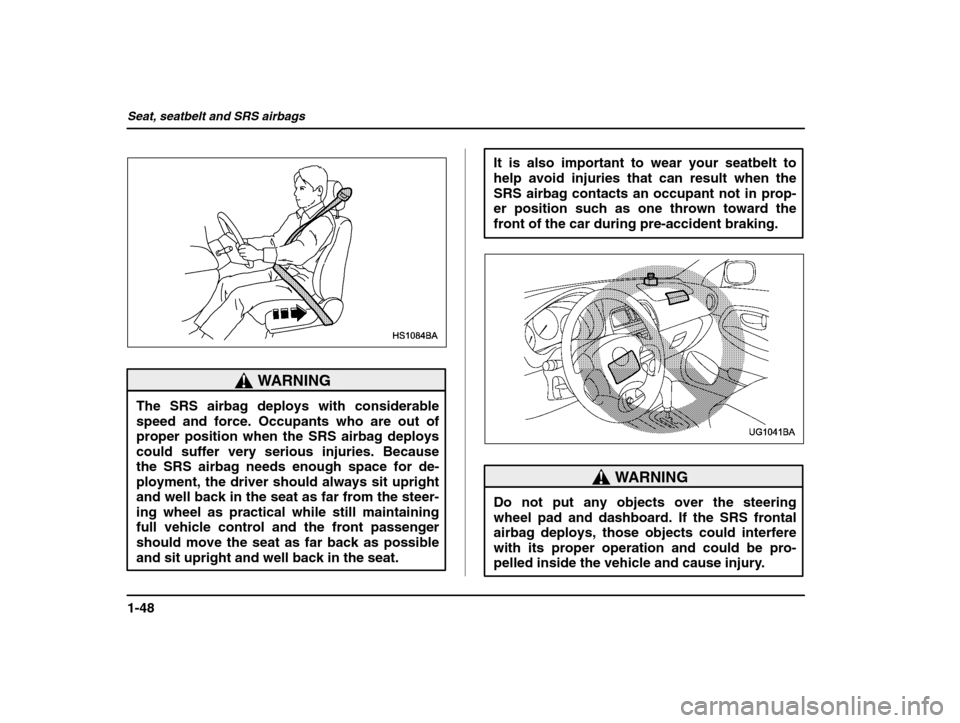
The SRS airbag deploys with considerable speed and force. Occupants who are out ofproper position when the SRS airbag deploys
could suffer very serious injuries. Becausethe SRS airbag needs enough space for de- ployment, the driver should always sit upright and well back in the seat as far from the steer-ing wheel as practical while still maintainingfull vehicle control and the front passengershould move the seat as far back as possibleand sit upright and well back in the seat.It is also important to wear your seatbelt to
help avoid injuries that can result when theSRS airbag contacts an occupant not in prop-er position such as one thrown toward thefront of the car during pre-accident braking.
WARNING
Do not put any objects over the steering wheel pad and dashboard. If the SRS frontal
airbag deploys, those objects could interferewith its proper operation and could be pro-
pelled inside the vehicle and cause injury.
Page 74 of 425

Seat, seatbelt and SRS airbags
1-49
– CONTINUED –
WARNING
Do not attach accessories to the windshield, or fit an extra-wide mirror over the rear view
mirror. If the SRS airbag deploys, those ob-jects could become projectiles that could seri-ously injure vehicle occupants.
Page 75 of 425

Seat, seatbelt and SRS airbags
1-50
Operation
A) Driver’ s side
B) Passenger’ s side
1) SRS AIRBAGs deploy as soon as a collision occurs. 2) After deployment, SRS AIRBAGs start to deflate
immediately so that the driver ’s vision is not
obstructed.
Page 76 of 425

Seat, seatbelt and SRS airbags
1-51
– CONTINUED –
The SRS airbag can function only when the ignition switch is in the “ON” position.
If the front sub sensors inside the both front fenders
and the impact sensors in the airbag control module
detect a certain predetermined amount of force dur-
ing a frontal collision, the control module sends sig-
nals to the frontal airbag modules instructing them to
inflate the SRS frontal airbags. Then both airbag
modules produce gas, which instantly inflates driv-er’ s and passenger ’s SRS frontal airbags. After the
deployment, the SRS airbags immediately start to
deflate so that the driver ’s vision is not obstructed.
The time required from detecting impact to the
deflation of the SRS airbag after deployment is
shorter than the blink of an eye.
The front passenger ’s SRS frontal airbag deploys to-
gether with driver ’s SRS frontal airbag even when no
one occupies the front passenger ’s seat.
Although it is highly unlikely that the SRS airbag would activate in a non-accident situation, should it
occur, the SRS airbag will deflate quickly, not ob-
scuring vision and will not interfere with the driver ’s
ability to maintain control of the vehicle.
When the SRS airbag deploys, a sudden, fairly loud
inflation noise will be heard and some smoke will be released. These occurrences are normal result of
the deployment. This smoke does not indicate a firein the vehicle.
CAUTION
Do not touch the SRS airbag system compo-
nents around the steering wheel and dash- board with bare hands right after deployment.
Doing so can cause burns because the com-ponents can be very hot as a result of deploy-ment.
The SRS frontal airbag is designed to deploy in the
event of an accident involving a moderate to severe
frontal collision. It is basically not designed to
deploy in lesser frontal impacts because the neces-
sary protection can be achieved by the seatbelt
alone. Also, it is basically not designed to deploy in
side or rear impacts or in roll-over accidents be-
cause deployment of the SRS frontal airbag wouldnot help the occupant in those situations. The SRS
airbag is designed to function on a one-time-onlybasis.
SRS airbag deployment depends on the level of
force experienced in the passenger compartment
during a collision. That level differs from one type of
Page 77 of 425

Seat, seatbelt and SRS airbags
1-52
collision to another, and it may have no bearing on the visible damage done to the vehicle itself.n When will the SRS frontal airbag most likelydeploy?
A head-on collision against a thick concrete wall at a
vehicle speed of 12 to 19 mph (20 to 30 km/h) or
higher activates the SRS frontal airbag. The SRS
frontal airbag will also be activated when the vehicle
is exposed to a frontal impact similar in fashion and
magnitude to the above-mentioned collision. n
At what other times might the SRS frontal air-bag deploy?
The SRS frontal airbag may be activated when the
vehicle sustains a hard impact in the undercarriage
area from the road surface (such as when the ve-