mirror SUBARU IMPREZA 2004 2.G User Guide
[x] Cancel search | Manufacturer: SUBARU, Model Year: 2004, Model line: IMPREZA, Model: SUBARU IMPREZA 2004 2.GPages: 491, PDF Size: 5.93 MB
Page 185 of 491
3-48
Instruments and controls
3. Return the selection switch to the neutral position
to prevent unintentional operation.
The mirrors can also be adjusted manually. !
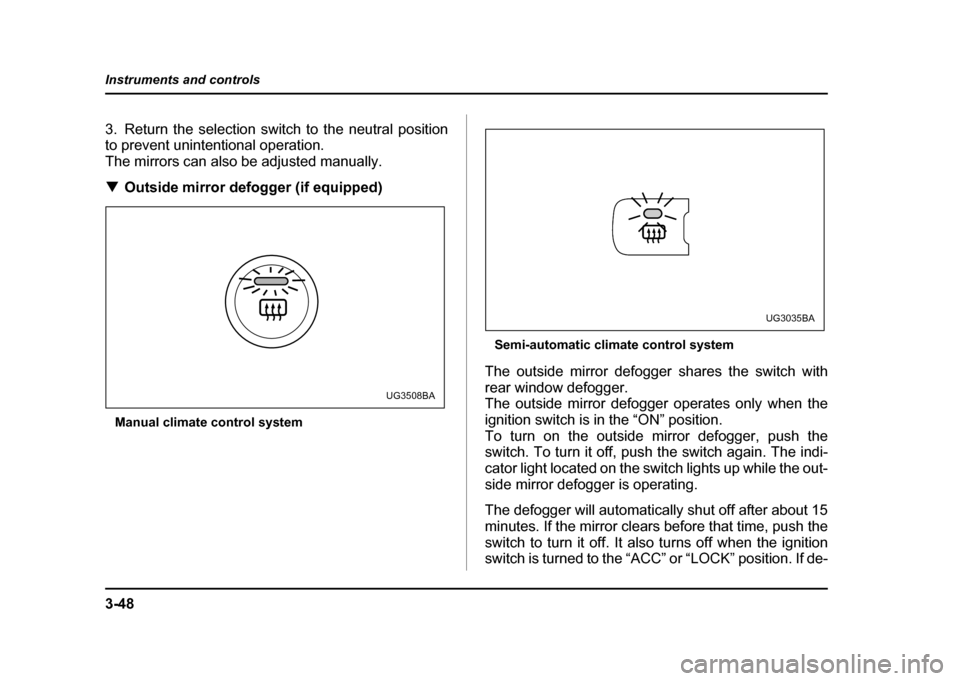
Outside mirror defogger (if equipped)
Manual climate control system Semi-automatic climate control system
The outside mirror defogger shares the switch with
rear window defogger.
The outside mirror defogger operates only when the
ignition switch is in the “ON” position.
To turn on the outside mirror defogger, push the
switch. To turn it off, push the switch again. The indi-
cator light located on the switch lights up while the out-
side mirror defogger is operating.
The defogger will automatically shut off after about 15
minutes. If the mirror clears before that time, push the
switch to turn it off. It also turns off when the ignition
switch is turned to the “ACC” or “LOCK” position. If de-
UG3508BA
UG3035BA
Page 186 of 491
3-49
Instruments and controls
– CONTINUED –
frosting or defogging is desired when you restart your
vehicle, you have to push the switch to turn it on again.
NOTE
While the outside mirror defogger is operating, the
rear window defogger also operates.
To prevent the battery from being discharged,
do not operate the defogger continuously for
any longer than necessary.
Tilt steering wheel
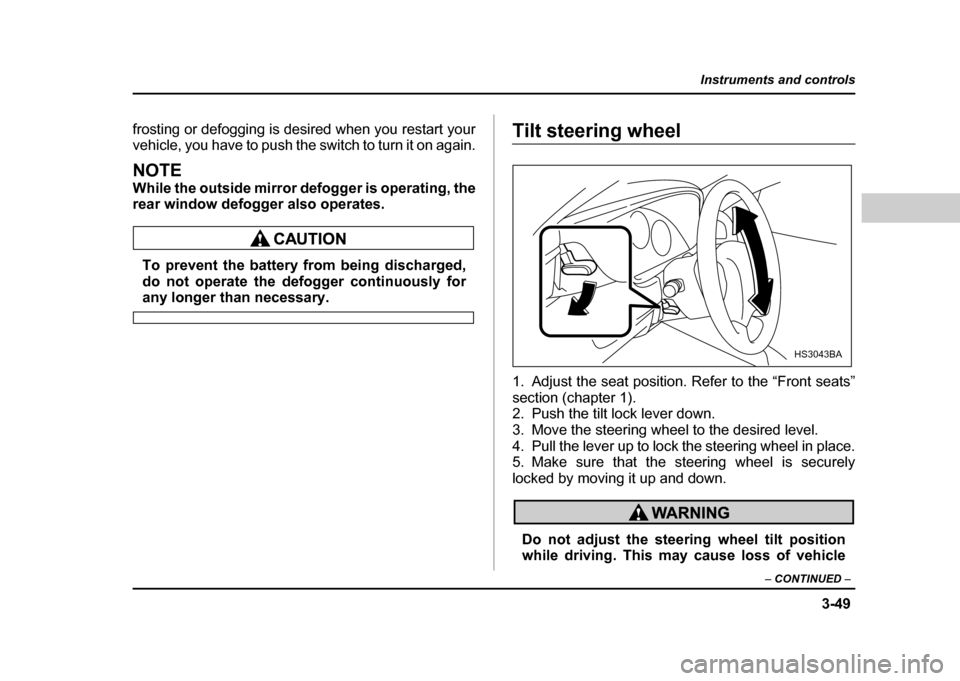
1. Adjust the seat position. Refer to the “Front seats”
section (chapter 1).
2. Push the tilt lock lever down.
3. Move the steering wheel to the desired level.
4. Pull the lever up to lock the steering wheel in place.
5. Make sure that the steering wheel is securely
locked by moving it up and down.
Do not adjust the steering wheel tilt position
while driving. This may cause loss of vehicle
HS3043BA
Page 250 of 491

6-1
6
Interior equipment
In te ri or lig ht ..... ... ... .. ... ... ... ... ... .. ... ... ... ... .. ... ... 6-2
D om e lig ht ............ ..................... ..................... ... 6-2
C argo are a lig ht (if eq uip ped) ....................... ... 6-2
Map li g h t (if e qui pp ed ) ..... ... ... .. ... ... ... ... .. ... ... 6-3
Sun visors .. ... ... ... ... .. ... ... ... ... ... .. ... ... ... ... .. ... ... 6-4
Center visor ....................................................... 6-4
Vanity mirror (if equipped) ............................... 6-5
Storage com partments .... ... ... .. ... ... ... ... .. ... ... 6-5
Gl ove b ox .............. ..................... ..................... ... 6-6
C enter con sole .......................... ..................... ... 6-6
C oin tray ............... ..................... ..................... ... 6-7
C up h older .... ... ... ... .. ... ... ... ... ... .. ... ... ... ... .. ... ... 6-7
In in stru ment pa nel ................... ..................... ... 6-7
In ce nter co nsole .. .................... ..................... ... 6-8
A cce sso ry p ow er o utlet ............................... 6-9
In t h e cargo area (if eq uip ped) .. .................... ... 6-9
C ig are tte lig hter so cket ................................ 6-10
U se with a cigarette li ght er ...... ..................... ... 6-11
U sing as an access ory power o utlet ............ ... 6-11
As htray .. ... .. ... ... ... ... .. ... ... ... ... ... .. ... ... ... ... .. ... ... 6-12
Fl oo r mat (if e qui pp ed ) .. ... ... ... .. ... ... ... ... .. ... ... 6-13
C oat hook ... ... ... ... ... .. ... ... ... ... ... .. ... ... ... ... .. ... ... 6-14
Cargo area c over ( if eq uip p ed) ... ... ... ... .. ... ... 6-15
U sing t h e cover .... ..................... ..................... ... 6-15
T o re move the c over ................. ..................... ... 6-15
Stowage of the c over ................ ..................... ... 6-16
T o in stall the co ver housi ng .... ..................... ... 6-16
Cargo tie-down hooks (if equipped) ........... 6-17 Under-floor storage compartment
(if equipped) ............................................... 6-18
Page 254 of 491
6-5
Interior equipment
– CONTINUED –
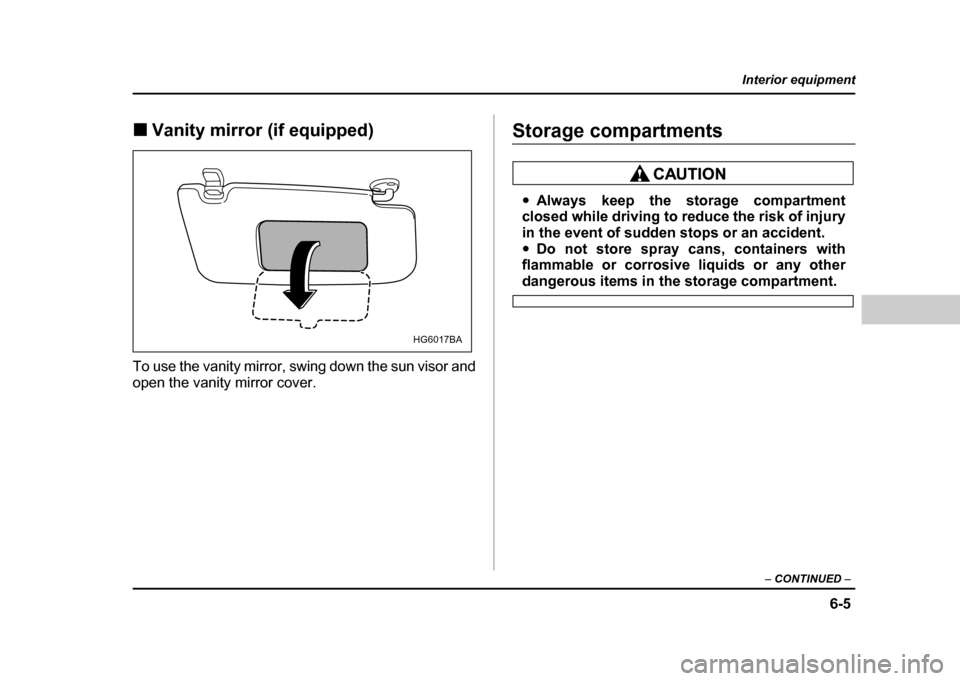
!Vanity mirror (if equipped)
To use the vanity mirror, swing down the sun visor and
open the vanity mirror cover.Storage compartments
" Always keep the storage compartment
closed while driving to reduce the risk of injury
in the event of sudden stops or an accident." Do not store spray cans, containers with
flammable or corrosive liquids or any other
dangerous items in the storage compartment.
HG6017BA
Page 278 of 491
7-9
Starting and operating
– CONTINUED –
Preparing to drive
You should perform the following checks and adjust-
ments every day before you start driving.
1. Check that all windows, mirrors, and lights are
clean and unobstructed.
2. Check the appearance and condition of the tires.
Also check tires for proper inflation.
3. Look under the vehicle for any sign of leaks.
4. Check that the hood, trunk and rear gate are fully
closed.
5. Check the adjustment of the seat.
6. Check the adjustment of the inside and outside mir-
rors.
7. Fasten your seatbelt. Check that your passengers
have fastened their seatbelts.
8. Check the operation of the warning and indicator
lights when the ignition switch is turned to the “ON” po-sition.
9. Check the gauges, indicator and warning lights af-
ter starting the engine.
NOTE
Engine oil, engine coolant, brake fluid, washer flu-
id and other fluid levels should be checked daily,
weekly or at fuel stops.
Starting the engine
Do not operate the starter motor continuously
for more than ten seconds. If the engine fails to
start after operating the starter for five to ten
seconds, wait for ten seconds or more before
trying again.
! Manual transmission vehicle
1. Apply the parking brake.
2. Turn off unnecessary lights and accessories.
3. Press the clutch pedal to the floor and shift the shift
lever into neutral. Hold the clutch pedal to the floor
while starting the engine.
The starter motor will only operate when the clutch
pedal is pressed fully to the floor.
4. Turn the ignition switch to the “ON” position and
check the operation of the warning and indicator lights.
Refer to the “Warning and indicator lights” section (chapter 3).
5. Turn the ignition switch to the “START” position
without depressing the accelerator pedal. Release
the key immediately after the engine has started.
Page 347 of 491
8-36
Driving tips
"
Adequate size trailer brakes are required
when the trailer and its cargo exceed 1,000 lbs
(453 kg) total weight." Do not directly connect your trailer’s hydrau-
lic brake system to the hydraulic brake system
in your vehicle. Direct connection would cause
the vehicle’s brake performance to deteriorate
and could lead to an accident.
! Trailer safety chains
In case the trailer hitch connector or hitch ball should
break or become disconnected, the trailer could get
loose and create a traffic safety hazard.
For safety, always connect the towing vehicle and
trailer with trailer safety chains. Pass the chains cross-
ing each other under the trailer tongue to prevent the
trailer from dropping onto the ground in case the trailer
tongue should disconnect from the hitch ball. Allow
sufficient slack in the chains taking tight-turn situations
into account; however, be careful not to let them drag
on the ground.
For more information about the safety chain connec-
tion, refer to the instructions for your hitch and trailer.
Always use safety chains between your vehicle
and the trailer. Towing a trailer without safety
chains could create a traffic safety hazard if the
trailer separates from the hitch due to coupling
damage or hitch ball damage.
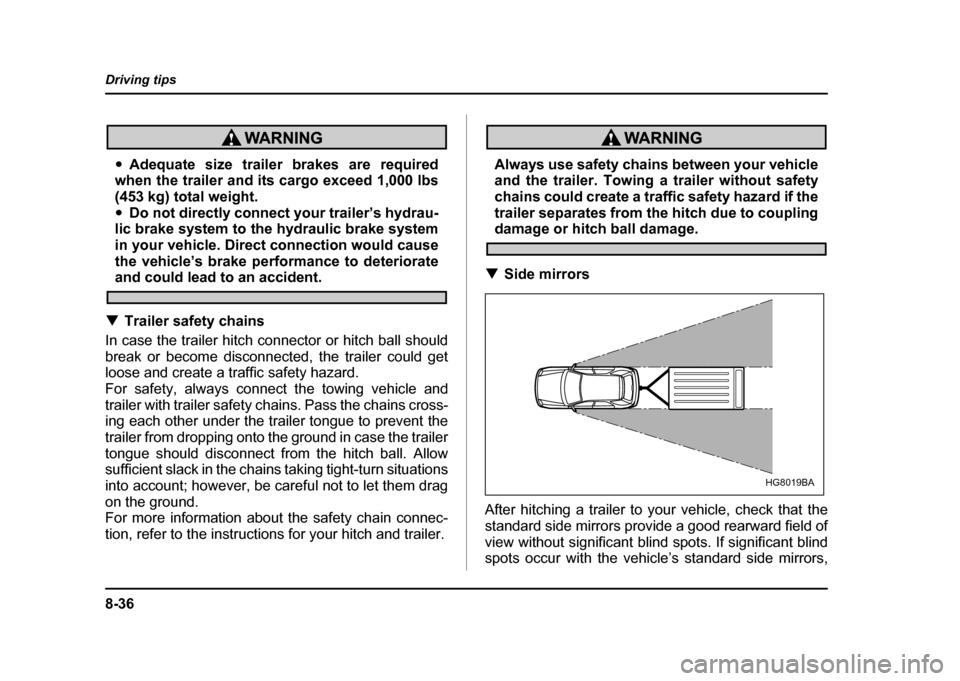
! Side mirrors
After hitching a trailer to your vehicle, check that the
standard side mirrors provide a good rearward field of
view without significant blind spots. If significant blind
spots occur with the vehicle’s standard side mirrors,
HG8019BA
Page 348 of 491
8-37
Driving tips
– CONTINUED –
use towing mirrors that conform with Federal, state/
province and/or other applicable regulations. !Trailer lights
Connection of trailer lights to your vehicle’s electrical
system requires modifications to the vehicle’s lighting
circuit to increase its capacity and accommodate wir-
ing changes. To ensure the trailer lights are connected
properly, please consult your SUBARU dealer. Check
for proper operation of the turn signals, the brake
lights and parking lights each time you hitch up.
Direct splicing or other improper connection of
trailer lights may damage your vehicle’s electri-
cal system and cause a malfunction of your ve-
hicle’s lighting system.
! Tires
Make sure that all the tires on your vehicle are properly
inflated to the pressure specified on the tire placard lo-
cated on the left center pillar of your vehicle.
Trailer tire condition, size, load rating and proper infla-
tion pressure should be in accordance with the trailer
manufacturer’s specifications. In the event your vehicle gets a flat tire when towing a
trailer, ask a commercial road service to repair the flat
tire.
If you carry a regular size spare tire in your vehicle or
trailer as a precaution against getting a flat tire, be
sure that the spare tire is firmly secured.
Never tow a trailer when the temporary spare
tire is used. The temporary spare tire is not de-
signed to sustain the towing load. Use of the
temporary spare tire when towing can result in
failure of the spare tire and/or less stability of
the vehicle.
! Trailer towing tips
"Never exceed 45 mph (72 km/h) when towing
a trailer in hilly country on hot days. " When towing a trailer, steering, stability,
stopping distance and braking performance
will be different from normal operation. For
safety’s sake, you should employ extra caution
Page 349 of 491

8-38
Driving tips
when towing a trailer and you should never
speed. You should also keep the following tips
in mind:
! Before starting out on a trip
" Check that the vehicle and vehicle-to-hitch mount-
ing are in good condition. If any problems are appar-
ent, do not tow the trailer. " Check that the vehicle sits horizontally with the trail-
er attached. If the vehicle is tipped sharply up at the
front and down at the rear, check the total trailer
weight, GVW, GAWs and tongue load again, then con-
firm that the load and its distribution are acceptable. " Check that the tire pressures are correct.
" Check that the vehicle and trailer are connected
properly. Confirm that – the trailer tongue is connected properly to the
hitch ball.
– the trailer lights connector is connected properly
and trailer’s brake lights illuminate when the vehi-
cle’s brake pedal is pressed, and that the trailer’s
turn signal lights flash when the vehicle’s turn signal
lever is operated.
– the safety chains are connected properly.
– all cargo in the trailer is secured safety in position.
– the side mirrors provide a good rearward field of view without a significant blind spot.
" Sufficient time should be taken to learn the “feel” of
the vehicle/trailer combination before starting out on a
trip. In an area free of traffic, practice turning, stopping
and backing up. ! Driving with a trailer
" You should allow for considerably more stopping
distance when towing a trailer. Avoid sudden braking
because it may result in skidding or jackknifing and
loss of control." Avoid abrupt starts and sudden accelerations. If
your vehicle has a manual transmission, always start
out in first gear and release the clutch at moderate en-
gine revolution." Avoid uneven steering, sharp turns and rapid lane
changes." Slow down before turning. Make a longer than nor-
mal turning radius because the trailer wheels will be
closer than the vehicle wheels to the inside of the turn.
In a tight turn, the trailer could hit your vehicle." Crosswinds will adversely affect the handling of
your vehicle and trailer, causing sway. Crosswinds
can be due to weather conditions or the passing of
large trucks or buses. If swaying occurs, firmly grip the
steering wheel and slow down immediately but gradu-
ally." When passing other vehicles, considerable dis-
Page 471 of 491
12-6
Specifications
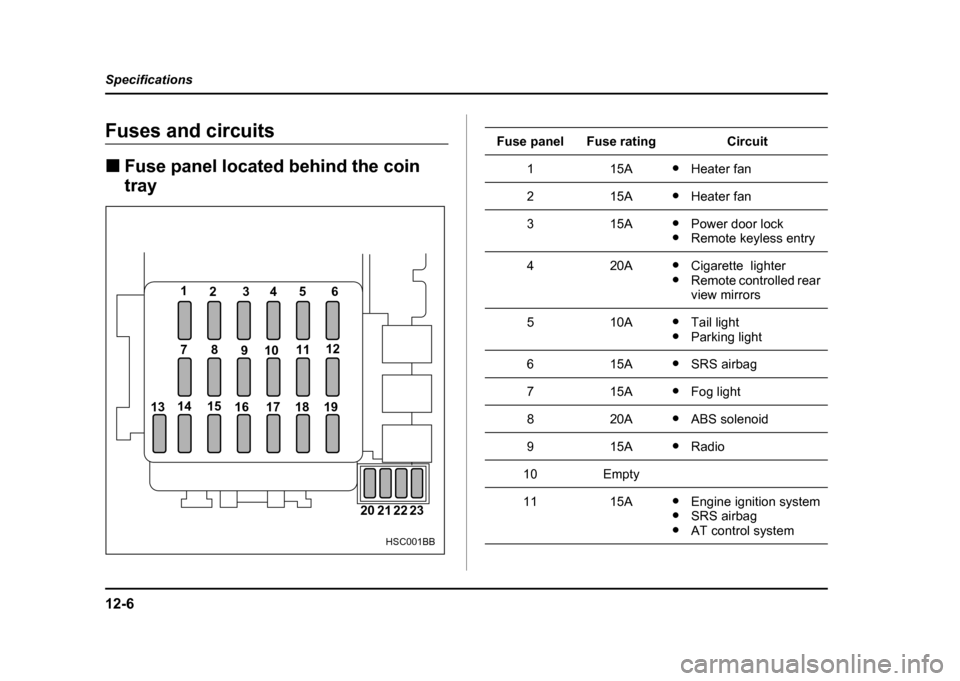
Fuses and circuits !
Fuse panel located behind the coin tray
1
23456
78 9101112
13 14 15
16 17 18 19
20 21 22 23
HSC001BB
Fuse panelFuse ratingCircuit
115A"Heater fan
215A"Heater fan
315A"Power door lock
" Remote keyless entry
420A"Cigarette lighter
" Remote controlled rear
view mirrors
510A"Tail light
" Parking light
615A"SRS airbag
715A"Fog light
820A"ABS solenoid
915A"Radio
10Empty
1115A"Engine ignition system
" SRS airbag
" AT control system
Page 472 of 491
12-7
Specifications
– CONTINUED –
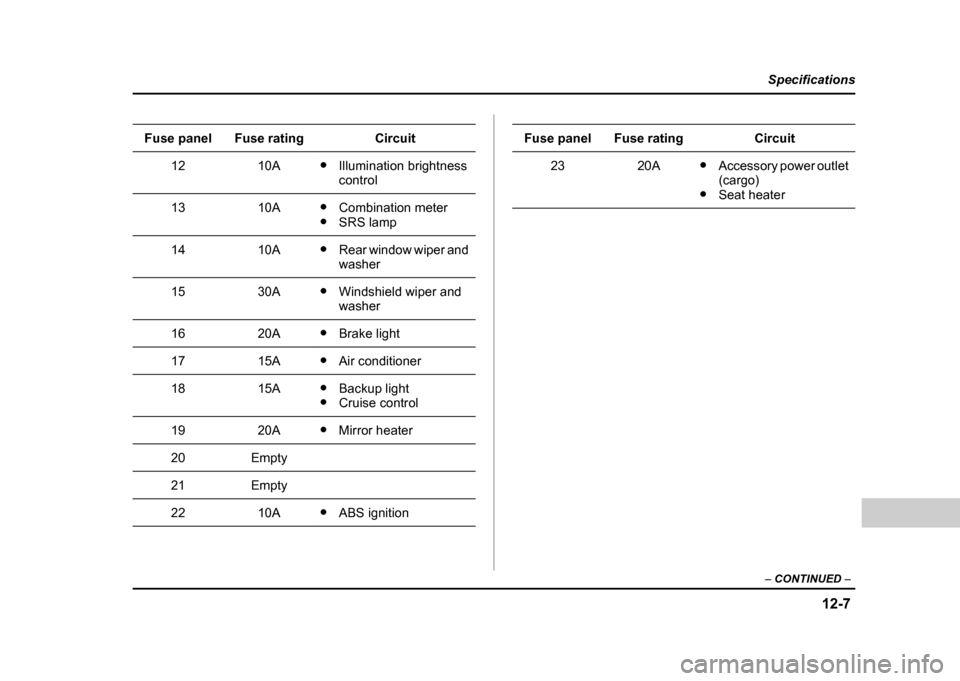
1210A"Illumination brightness
control
1310A"Combination meter
" SRS lamp
1410A"Rear window wiper and
washer
1530A"Windshield wiper and
washer
1620A"Brake light
1715A"Air conditioner
1815A"Backup light
" Cruise control
1920A"Mirror heater
20Empty
21Empty
2210A"ABS ignition
Fuse panelFuse ratingCircuit
2320A"Accessory power outlet
(cargo)
" Seat heater
Fuse panelFuse ratingCircuit