tires SUBARU IMPREZA 2004 2.G User Guide
[x] Cancel search | Manufacturer: SUBARU, Model Year: 2004, Model line: IMPREZA, Model: SUBARU IMPREZA 2004 2.GPages: 491, PDF Size: 5.93 MB
Page 319 of 491
8-8
Driving tips
latch on the driver’s side. "
Tire chains should always be placed on the front
wheels only. " There are some precautions that you must observe
when towing your vehicle. For detail information, see
the “Towing” section in chapter 9.
" Always maintain a safe driving speed accord-
ing to the road and weather conditions in order
to avoid having an accident on a sharp turn,
during sudden braking or under other similar
conditions. " Always use the utmost care in driving – over-
confidence because you are driving an all
wheel drive vehicle could easily lead to a seri-
ous accident.
Off road driving
" Always maintain a safe driving speed accord-
ing to the road and weather conditions in order
to avoid having an accident on a sharp turn,
during sudden braking or under other similar
conditions. " Always use the utmost care in driving – over-
confidence because you are driving an all
wheel drive vehicle could easily lead to a seri-
ous accident.
Do not drive on rough roads or over curbs in a
vehicle that has 17-inch or other ultra-low-pro-
file tires. The wheels and tires could be dam-
aged by shock forces, leading to abnormal vi-
bration or poor straight-line tracking. Driving
would then be more difficult.
Page 320 of 491
8-9
Driving tips
– CONTINUED –
!All AWD models except OUTBACK
SPORT and vehicles with 17 inch tires
Your AWD vehicle is neither a conventional off-road
vehicle nor an all terrain vehicle. It is a passenger car
designed primarily for on-road use. The AWD feature
gives it some limited off-road capabilities in situations
in which driving surfaces are relatively level, obstruc-
tion-free and otherwise similar to on-road driving con-
ditions. Operating it under other than those conditions
could subject the vehicle to excessive stress which
might result in damage not eligible for repair under
warranty. If you do take your SUBARU off road, you
should review the common sense precautions in the
next section (applicable to the OUTBACK SPORT) for
general guidance. But please keep in mind that your
vehicle’s off-road capabilities are more limited than
those of the OUTBACK SPORT.
Never attempt to drive through pools and puddles, or
roads flooded with water. Water entering the engine
air intake or the exhaust pipe or water splashing onto
electrical parts may damage your vehicle and may
cause it to stall. ! OUTBACK SPORT
Your Subaru can be driven on ordinary roads or off-
road. But please keep in mind that an AWD SUBARU is a passenger car and is neither a conventional off-
road vehicle nor an all-terrain vehicle. If you do take
your Subaru off-road, certain common sense precau-
tions such as the following should be taken: "
Make certain that you and all of your passengers
are wearing seat belts. " Carry some emergency equipment, such as a tow-
ing rope or chain, a shovel, wheel blocks, first aid kit
and portable phone or citizens band radio." Drive carefully. Do not take unnecessary risks by
driving in dangerous areas or over rough terrain. " Slow down and employ extra caution at all times.
When driving off-road, you will not have the benefit of
marked traffic lanes, banked curves, traffic signs and
the like. " Do not drive across steep slopes. Instead, drive ei-
ther straight up or straight down the slopes. A vehicle
can much more easily tip over sideways than it can
end over end. Avoid driving straight up or down slopes
that are too steep. " Avoid sharp turning maneuvers, especially at higher
speeds. " Do not grip the inside or spokes of the steering
wheel. A bad bump could jerk the wheel and injure
your hands. Instead drive with your fingers and
thumbs on the outside of the rim. " If driving through water, such as when crossing
Page 321 of 491
8-10
Driving tips
shallow streams, first check the depth of the water and
the bottom of the stream bed for firmness and ensure
that the bed of the stream is flat. Drive slowly and com-
pletely through the stream. The water should be shal-
low enough that it does not reach the vehicle’s under-
carriage. Water entering the engine air intake or the
exhaust pipe or water splashing onto electrical parts
may damage your vehicle and may cause it to stall.
Never attempt to drive through rushing water; regard-
less of its depth, it can wash away the ground from un-
der your tires, resulting in possible loss of traction and
even vehicle rollover. "
Always check your brakes for effectiveness immedi-
ately after driving in sand, mud or water. Do this by
driving slowly and stepping on the brake pedal. Re-
peat that process several times to dry out the brake
discs and brake pads. " Do not drive or park over or near flammable materi-
als such as dry grass or fallen leaves, as they may
burn easily. The exhaust system is very hot while the
engine is running and right after the engine stops. This
could create a fire hazard." After driving through tall grass, mud, rocks, sand,
rivers, etc., check that there is no grass, bush, paper,
rags, stones, sand, etc. adhering to or trapped on the
underbody. Clear off any such matter from the under-
body. If the vehicle is used with these materials trapped or adhering to the underbody, a mechanical
breakdown or fire could occur. "
Secure all cargo carried inside the vehicle and make
certain that it is not piled higher than the seatbacks.
During sudden stops or jolts, unsecured cargo could
be thrown around in the vehicle and cause injury. Do
not pile heavy loads on the roof. Those loads raise the
vehicle’s center of gravity and make it more prone to
tip over." If you must rock the vehicle to free it from sand or
mud, depress the accelerator pedal slightly and move
the selector lever back and forth between “D” and “R”
repeatedly. Do not race the engine. For the best pos-
sible traction, avoid spinning the wheels when trying to
free the vehicle.
When the road surface is extremely slippery, you can
obtain better traction by starting the vehicle with the
transmission in 2nd than 1st (both for MT and AT). " Never equip your vehicle with tires larger than those
specified in this manual. " Frequent driving of an AWD vehicle under hard-driv-
ing conditions such as rough roads or off roads will ne-
cessitate more frequent replacement of engine oil,
brake fluid and transmission oil than that specified in
the maintenance schedule described in the “Warranty
and Maintenance Booklet”.
Remember that damage done to your Subaru while
Page 323 of 491
8-12
Driving tips
starting.
Keep the door locks from freezing by squirting them
with deicer or glycerin.
Forcing a frozen door open may damage or separate
the rubber weather strips around the door. If the door
is frozen, use hot water to melt the ice, and afterwards
thoroughly wipe the water away.
Use a windshield washer fluid that contains an anti-
freeze solution. Do not use engine antifreeze or other
substitutes because they may damage the paint of the
vehicle. !
Before driving your vehicle
Before entering the vehicle, remove any snow or ice
from your shoes because that could make the pedals
slippery and dangerous.
While warming up the vehicle before driving, check
that the accelerator pedal, brake pedal, and all other
controls operate smoothly.
Clear away ice and snow that has accumulated under
the fenders to avoid making steering difficult. During
severe winter driving, stop when and where it is safe
to do so and check under the fenders periodically. !
Parking in cold weather
Do not use the parking brake when parking for long
periods in cold weather since it could freeze in that po-
sition. Instead, observe the following:
1. Place the shift lever in “1” or “R” for manual trans-
mission vehicles, and in “P” for automatic transmission
vehicles.
2. Use tire stops under the tires to prevent the vehicle
from moving.
When the vehicle is parked in snow or when it snows,
raise the wiper blades off the glass to prevent damageto them.
When the vehicle has been left parked after use on
roads heavily covered with snow, or has been left
parked during a snowstorm, icing may develop on the
brake system, which could cause poor braking action.
Check for snow or ice buildup on the suspension, disc
brakes and brake hoses underneath the vehicle.
If there is caked snow or ice, remove it, being careful
not to damage the disc brakes and brake hoses andABS harness.
Snow can trap dangerous exhaust gases under
your vehicle. Keep snow clear of the exhaust
Page 324 of 491
8-13
Driving tips
– CONTINUED –
pipe and from around your vehicle if you parkthe vehicle in snow with the engine running.
! Refueling in cold weather
To help prevent moisture from forming in the fuel sys-
tem and the risk of its freezing, use of an antifreeze ad-
ditive in the fuel tank is recommended during cold
weather.
Use only additives that are specifically designed for
this purpose. When an antifreeze additive is used, its
effect lasts longer if the tank is refilled whenever the
fuel level reaches half empty.
If your SUBARU is not going to be used for an extend-
ed period, it is best to have the fuel tank filled to capac-
ity. ! Driving on snowy and icy roads
To prevent skidding and slipping, avoid sudden brak-
ing, abrupt acceleration, high-speed driving, and
sharp turning when driving on snowy or icy roads.
Always maintain ample distance between your vehicle
and the vehicle ahead of you to avoid the need for sud-
den braking.
To supplement the foot brake, use the engine brake
effectively to control the vehicle speed. (Shift into a lower gear when necessary.)
Avoid shifting down abruptly. Such behavior can
cause the wheels to lock, possibly leading to loss of
vehicle control.
An anti-lock brake system (ABS) enhances your vehi-
cle’s braking performance on snowy and icy roads.
Refer to the “ABS (Anti-lock Brake System)” section in
chapter 7 for information on braking on slippery sur- faces.
NOTE
The following tires are summer tires. Compared
with winter and all-season tires, summer tires give
significantly less grip on snowy and icy road sur-
faces. Avoid driving on snowy and icy road sur-
face with summer tires."
225/45R17 tires for WRX-STi
" Optional 215/45R17 tires for WRX
Do not use the cruise control on slippery roads
such as snowy or icy roads. This may cause
loss of vehicle control.
Page 325 of 491
8-14
Driving tips
!
Wiper operation when snowing
Before driving in cold weather, make sure the wiper
blades are not frozen to the windshield or rear window.
If the wiper blades are frozen to the windshield or rear
window, use the defroster with the airflow control dial
in the “ ” position and the temperature control dial
set for maximum warmth until the wiper blades are
completely thawed out. If your vehicle is equipped with
a wiper deicer, it is helpful to thaw the windshield wiper
blades. To thaw out the rear wiper blade, use the rear
window defogger.
When driving in snow, if frozen snow starts to stick on
the surface of the windshield despite wiper operation,
use the defroster with the airflow control dial in “ ”
and the temperature control dial set for maximum
warmth. After the windshield gets warmed enough to
melt the frozen snow on it, wash it away using the
windshield washer.
Snow stuck on the wiper arm prevents the wiper from
working effectively. If snow is stuck on the wiper arm,
pull off the road to a safe place, then remove it. If you
stop the car at road side, use the hazard warning
flasher to alert other drivers.
We recommend use of non-freezing type wiper blades
(winter blades) during the seasons you could have snow and sub-zero temperatures. Blades of this type
give superior wiping performance in snowy conditions.
Be sure to use blades that are suitable for your vehi-cle. !
Corrosion protection
Refer to the “Corrosion protection” section (chapter
10). ! Snow tires
! All models except WRX-STi
"When replacing original tires with winter
(snow) tires, make sure you use only the same
size, construction and load range as the origi-
nal tires listed on the tire placard. Using other
sizes and construction may affect speedome-
ter/odometer calibration and clearance be-
tween the body and tires. It also may be danger-
ous and lead to loss of vehicle control. " You must install four winter tires that are of
the same size, construction, brand, and load
range. Mixing other sizes or constructions may
result in severe mechanical damage to the drive
Page 326 of 491
8-15
Driving tips
– CONTINUED –
train of your vehicle and may affect ride, han-
dling, braking and speedometer/odometer cali-
bration. It also may be dangerous and lead to
loss of vehicle control. "Do not use a combination of radial, belted
bias or bias tires since it may cause dangerous
handling characteristics and lead to an acci-
dent.
Your vehicle is equipped with “all season tires” as orig-
inal equipment, which are designed to provide an ad-
equate measure of traction, handling and braking per-
formance in year-round driving. In winter, it may be
possible to enhance performance through use of tires
designed specifically for winter driving conditions.
The optional 215/45R17 tires for the WRX are summer
tires. Compared with winter and all-season tires, sum-
mer tires give significantly less grip on snowy and icy
road surfaces. Therefore, use of winter tires is strongly
recommended when driving with such road conditions.
When you choose to install winter tires on your vehi-
cle, be sure to use the correct tire size and type. You
must install four winter tires that are of the same size,
construction, brand and load range and you should
never mix radial, belted bias or bias tires since this
may result in dangerous handling characteristics.
When you choose a tire, make sure that there is enough clearance between the tire and vehicle body.
Remember to drive with care at all times regardless of
the type of tires on your vehicle. !
WRX-STi"When replacing original tires with winter
(snow) tires, make sure you use only the same
size, construction and load range as the origi-
nal tires listed on the tire placard. Using other
sizes and construction may affect speedome-
ter/odometer calibration and clearance be-
tween the body and tires. It also may be danger-
ous and lead to loss of vehicle control." You must install four winter tires that are of
the same size, construction, brand, and load
range. Mixing other sizes or constructions may
result in severe mechanical damage to the drive
train of your vehicle and may affect ride, han-
dling, braking and speedometer/odometer cali-
bration. It also may be dangerous and lead to
loss of vehicle control. " Do not use a combination of radial, belted
bias or bias tires since it may cause dangerous
handling characteristics and lead to an acci-
Page 327 of 491
8-16
Driving tips
dent.
Your vehicle is equipped with “summer tires” as origi-
nal equipment, which are inadequate for driving on
slippery roads such as on snow-covered or icy roads.
Compared with winter and all-season tires, summer
tires give significantly less grip on snowy and icy road
surfaces. Therefore, use of winter tires is strongly rec-
ommended when driving with such road conditions.
When you choose to install winter tires on your vehi-
cle, be sure to use the correct tire size and type. You
must install four winter tires that are of the same size,
construction, brand and load range and you should
never mix radial, belted bias or bias tires since this
may result in dangerous handling characteristics.
When you choose a tire, make sure that there is
enough clearance between the tire and vehicle body.
Remember to drive with care at all times regardless of
the type of tires on your vehicle. ! Tire chains
Driving on snowy grades or icy roads may require the
use of tire chains, in which case put the chains on the
front wheels only. Use only SAE class S type chains
that are of the correct size for your tires so as not to damage the vehicle body or suspension.
When driving with tire chains, drive at speeds below
19 mph (30 km/h).
When a temporary spare tire is on a front wheel, re-
place the temporary spare tire with the rear tire on the
same side of the vehicle, and then fit chains on the
front tires.
Always use the utmost care when driving with tire
chains — overconfidence because you are driving
with tire chains could easily lead to a serious accident.
Tire chains cannot be used on tires listed below
because of lack of clearance between the tires
and vehicle body. "
225/45R17 tires for WRX-STi
"Optional 215/45R17 tires for WRX
! Rocking the vehicle
If you must rock the vehicle to free it from snow, sand,
or mud, depress the accelerator pedal slightly and
move the selector lever back and forth between “D”
and “R” repeatedly. Do not race the engine. For the
best possible traction, avoid spinning the wheels when
Page 330 of 491
8-19
Driving tips
– CONTINUED –
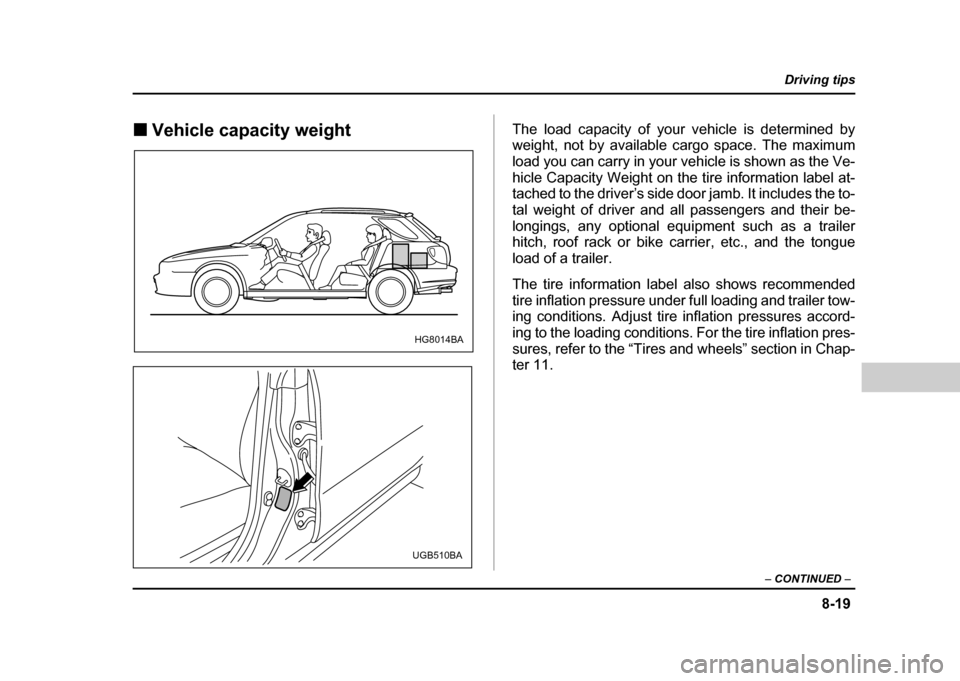
!Vehicle capacity weight The load capacity of your vehicle is determined by
weight, not by available cargo space. The maximum
load you can carry in your vehicle is shown as the Ve-
hicle Capacity Weight on the tire information label at-
tached to the driver’s side door jamb. It includes the to-
tal weight of driver and all passengers and their be-
longings, any optional equipment such as a trailer
hitch, roof rack or bike carrier, etc., and the tongue
load of a trailer.
The tire information label also shows recommended
tire inflation pressure under full loading and trailer tow-
ing conditions. Adjust tire inflation pressures accord-
ing to the loading conditions. For the tire inflation pres-
sures, refer to the “Tires and wheels” section in Chap-
ter 11.
HG8014BA
UGB510BA
Page 331 of 491
8-20
Driving tips
!
GVWR and GAWR (Gross Vehicle
Weight Rating and Gross Axle Weight Rating)
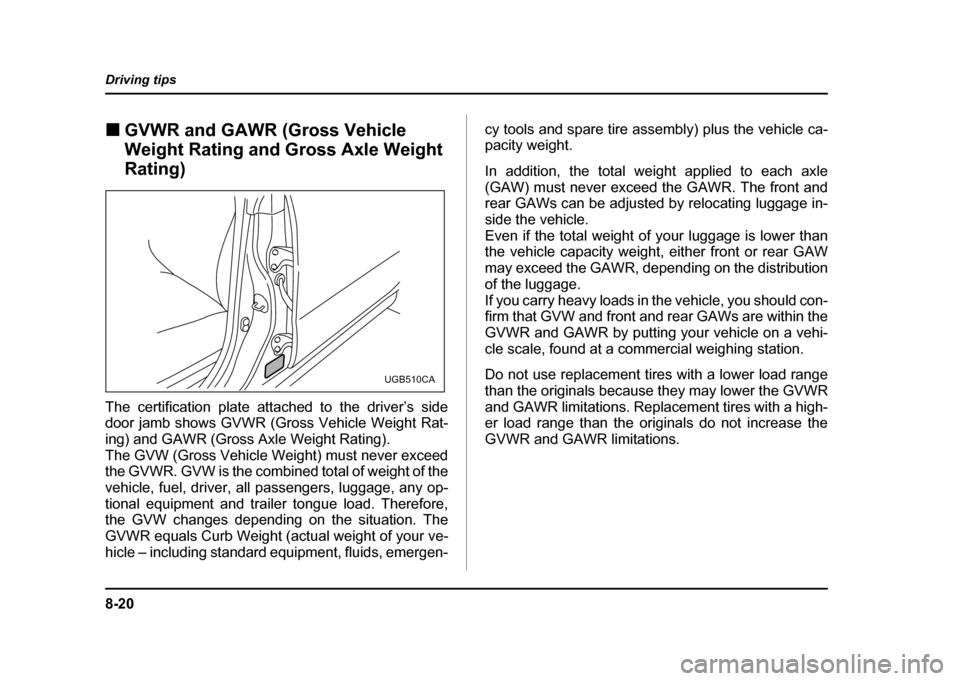
The certification plate attached to the driver’s side
door jamb shows GVWR (Gross Vehicle Weight Rat-
ing) and GAWR (Gross Axle Weight Rating).
The GVW (Gross Vehicle Weight) must never exceed
the GVWR. GVW is the combined total of weight of the
vehicle, fuel, driver, all passengers, luggage, any op-
tional equipment and trailer tongue load. Therefore,
the GVW changes depending on the situation. The
GVWR equals Curb Weight (actual weight of your ve-
hicle – including standard equipment, fluids, emergen- cy tools and spare tire assembly) plus the vehicle ca-
pacity weight.
In addition, the total weight applied to each axle
(GAW) must never exceed the GAWR. The front and
rear GAWs can be adjusted by relocating luggage in-
side the vehicle.
Even if the total weight of your luggage is lower than
the vehicle capacity weight, either front or rear GAW
may exceed the GAWR, depending on the distribution
of the luggage.
If you carry heavy loads in the vehicle, you should con-
firm that GVW and front and rear GAWs are within the
GVWR and GAWR by putting your vehicle on a vehi-
cle scale, found at a commercial weighing station.
Do not use replacement tires with a lower load range
than the originals because they may lower the GVWR
and GAWR limitations. Replacement tires with a high-
er load range than the originals do not increase the
GVWR and GAWR limitations.
UGB510CA