trunk SUBARU IMPREZA 2004 2.G User Guide
[x] Cancel search | Manufacturer: SUBARU, Model Year: 2004, Model line: IMPREZA, Model: SUBARU IMPREZA 2004 2.GPages: 491, PDF Size: 5.93 MB
Page 123 of 491
2-20
Keys and doors
In passive mode, the system will automatically
activate the alarm but WILL NOT automatically
lock the doors. In order to lock the doors you
must either lock them as indicated in step 4
above or with the key once they have been
closed. Failure to lock the doors manually will
result in a higher security risk.
! Disarming the system
To disarm the system, briefly press the “UNLOCK/
DISARM” button on the transmitter. " Tripped sensor identification
If an electronic chirp sounds four times and the turn
signal lights flash four times when you disarm the sys-
tem, this indicates that the alarm was triggered. The
number of times the indicator light flashes indicates
what sensor caused the alarm condition.
To enter identification mode:
1. Open the driver’s door and leave it open.
2. Turn the ignition switch to the “ON” position twotimes. (“LOCK” → “ON” → “LOCK” → “ON” →
“LOCK”)
3. The indicator light will start flashing. The indicator light provides the following indications.
Flashing one time:
Any door, the rear gate or the
trunk lid has been opened.
Flashing three times: The impact sensor in the sys-
tem’s unit has been activated. This may indicate that
your vehicle has been shocked or tampered with by
some outside force and/or unauthorized person.
Flashing four times: The ignition switch has been
turned on or the battery has been disconnected.
NOTE
The battery must be reconnected before the indi-
cator light will flash.
To exit this mode, close the door and turn the ignition
switch to the “ON” position.
Page 128 of 491
2-25
Keys and doors
– CONTINUED –
Trunk lid (Sedan)
"To prevent dangerous exhaust gas from en-
tering the vehicle, always keep the trunk lid
closed while driving." Help prevent young children from locking
themselves in the trunk. When leaving the vehi-
cle, either close all windows and lock all doors
or cancel the inside trunk lid release. Also make
certain that the trunk is closed.
On hot or sunny days, the temperature in the
trunk could quickly become high enough to
cause death or serious heat-related injuries in-
cluding brain damage, particularly for small
children. !
To open and close the trunk lid from
outside
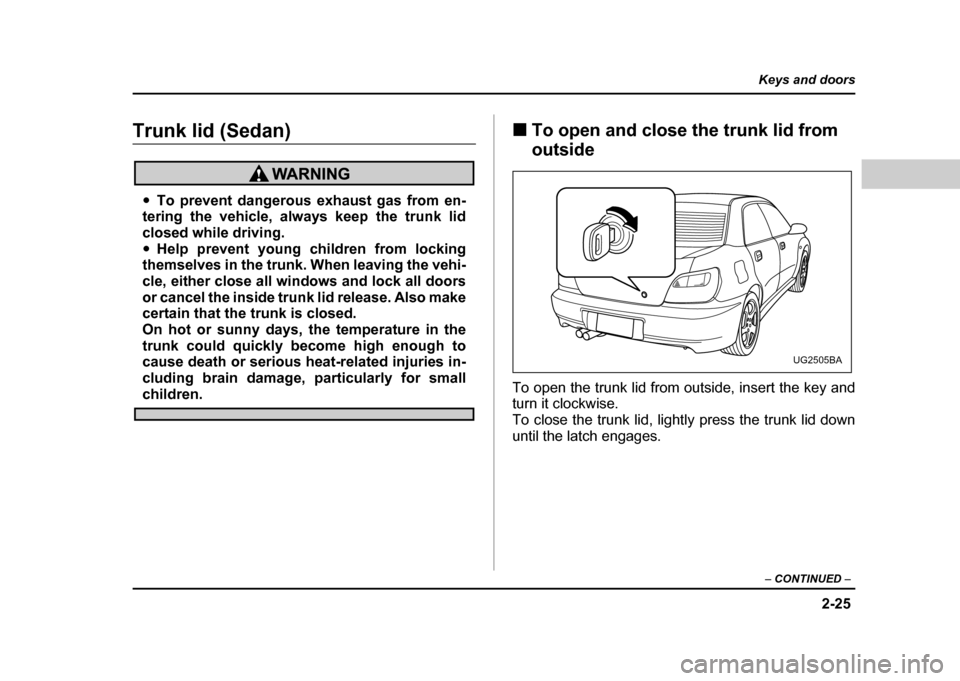
To open the trunk lid from outside, insert the key and
turn it clockwise.
To close the trunk lid, lightly press the trunk lid down
until the latch engages.
UG2505BA
Page 129 of 491
2-26
Keys and doors
!
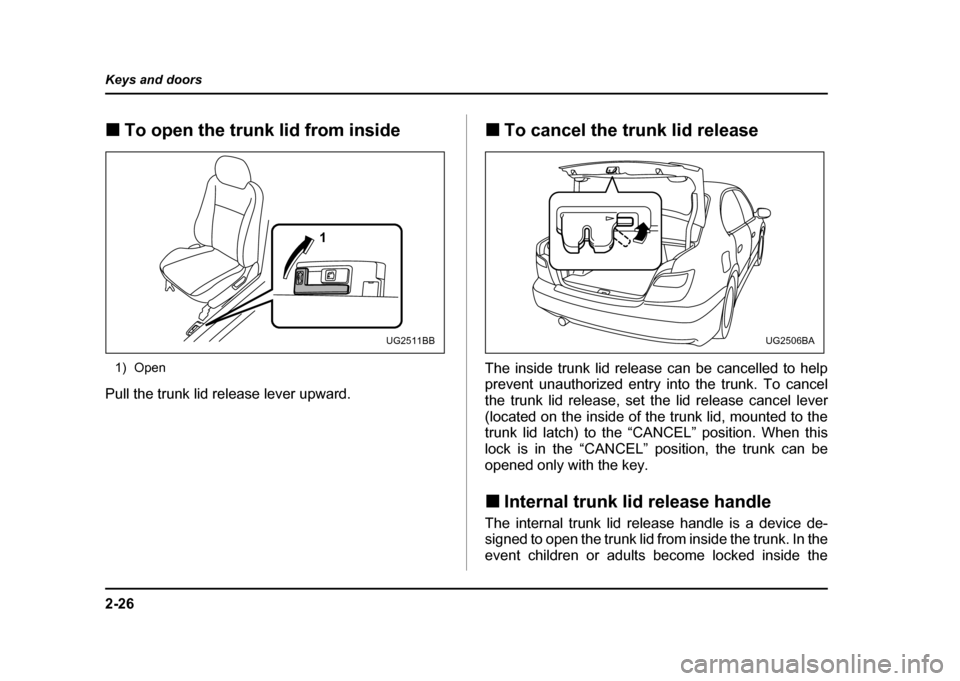
To open the trunk lid from inside
1) Open
Pull the trunk lid release lever upward. !
To cancel the trunk lid release
The inside trunk lid release can be cancelled to help
prevent unauthorized entry into the trunk. To cancel
the trunk lid release, set the lid release cancel lever
(located on the inside of the trunk lid, mounted to the
trunk lid latch) to the “CANCEL” position. When this
lock is in the “CANCEL” position, the trunk can be
opened only with the key. ! Internal trunk lid release handle
The internal trunk lid release handle is a device de-
signed to open the trunk lid from inside the trunk. In the
event children or adults become locked inside the
1
UG2511BBUG2506BA
Page 130 of 491
2-27
Keys and doors
– CONTINUED –
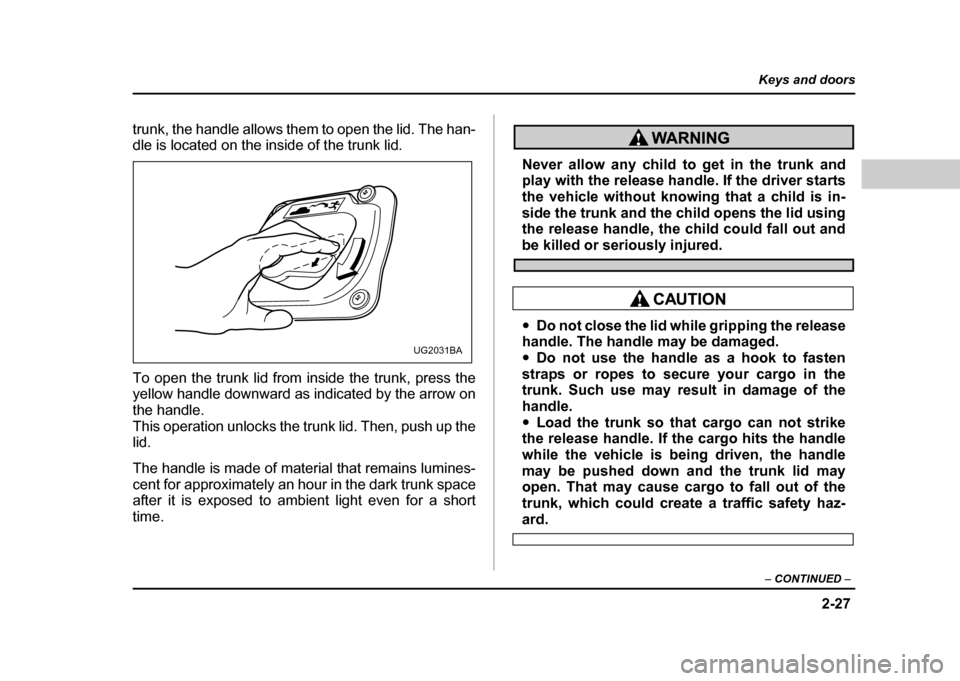
trunk, the handle allows them to open the lid. The han-
dle is located on the inside of the trunk lid.
To open the trunk lid from inside the trunk, press the
yellow handle downward as indicated by the arrow on
the handle.
This operation unlocks the trunk lid. Then, push up the
lid.
The handle is made of material that remains lumines-
cent for approximately an hour in the dark trunk space
after it is exposed to ambient light even for a short time.
Never allow any child to get in the trunk and
play with the release handle. If the driver starts
the vehicle without knowing that a child is in-
side the trunk and the child opens the lid using
the release handle, the child could fall out and
be killed or seriously injured.
"Do not close the lid while gripping the release
handle. The handle may be damaged. " Do not use the handle as a hook to fasten
straps or ropes to secure your cargo in the
trunk. Such use may result in damage of the
handle. " Load the trunk so that cargo can not strike
the release handle. If the cargo hits the handle
while the vehicle is being driven, the handle
may be pushed down and the trunk lid may
open. That may cause cargo to fall out of the
trunk, which could create a traffic safety haz-
ard.
UG2031BA
Page 131 of 491
2-28
Keys and doors
!
Inspection
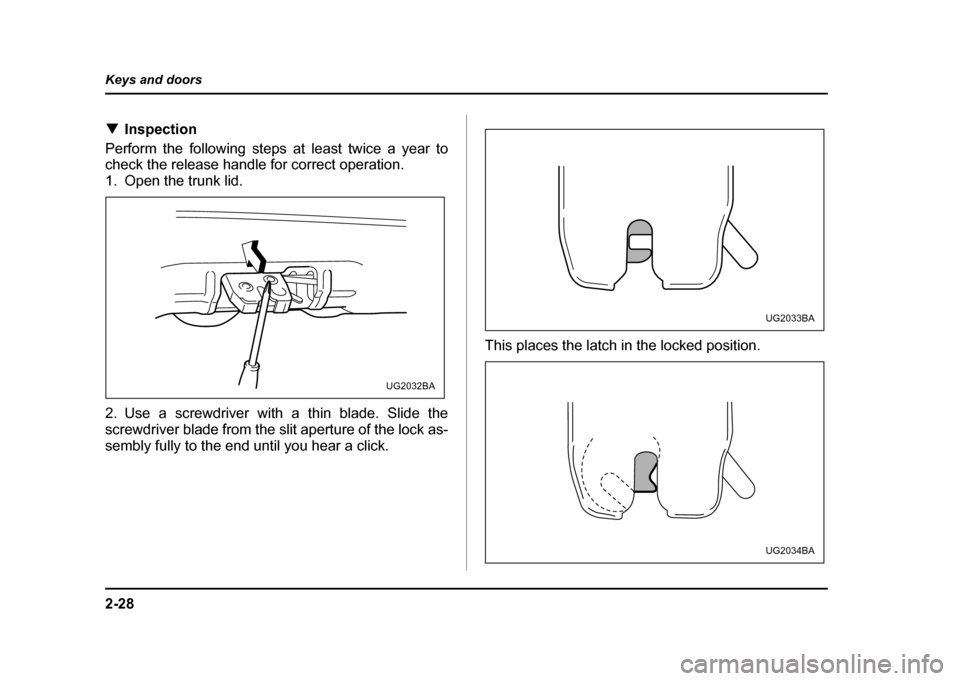
Perform the following steps at least twice a year to
check the release handle for correct operation.
1. Open the trunk lid.
2. Use a screwdriver with a thin blade. Slide the
screwdriver blade from the slit aperture of the lock as-
sembly fully to the end until you hear a click. This places the latch in the locked position.
UG2032BA
UG2033BA
UG2034BA
Page 132 of 491
2-29
Keys and doors
– CONTINUED –
3. Move the release handle, from outside the vehicle,
in the direction of the arrow to check if the latch is re-
leased.
If the latch is not released, contact your SUBARU
dealer.
In that case, use the key to release the latch, then
close the trunk lid.
Also, if the movements of the release handle feel re-
stricted or not entirely smooth during operation, or the
handle and/or handle base is cracked, contact your
SUBARU dealer.Rear gate (Wagon)
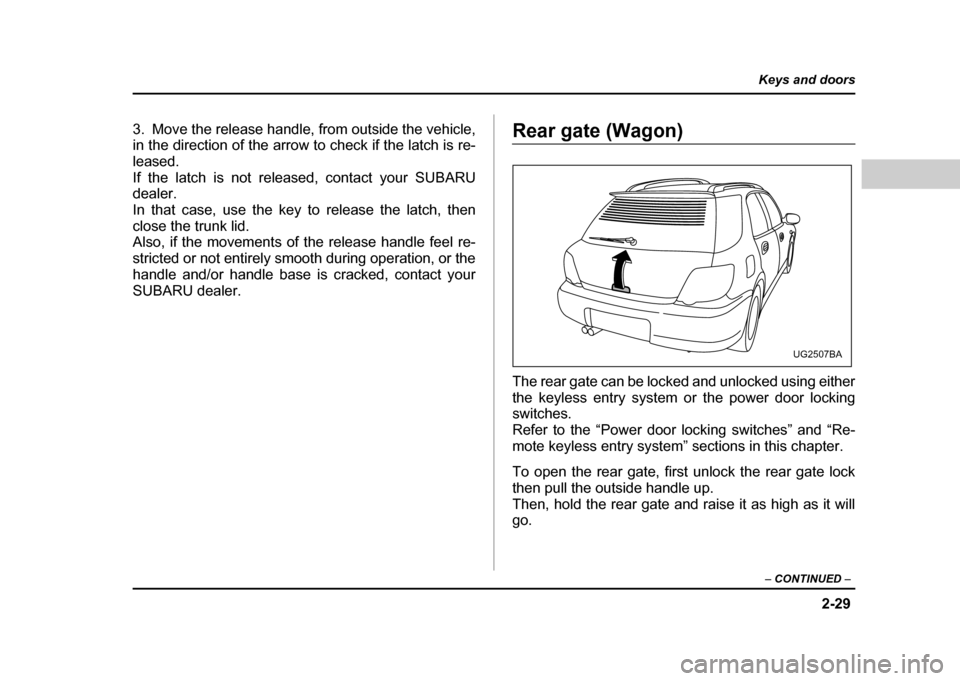
The rear gate can be locked and unlocked using either
the keyless entry system or the power door lockingswitches.
Refer to the “Power door locking switches” and “Re-
mote keyless entry system” sections in this chapter.
To open the rear gate, first unlock the rear gate lock
then pull the outside handle up.
Then, hold the rear gate and raise it as high as it willgo.
UG2507BA
Page 180 of 491
3-43
Instruments and controls
– CONTINUED –
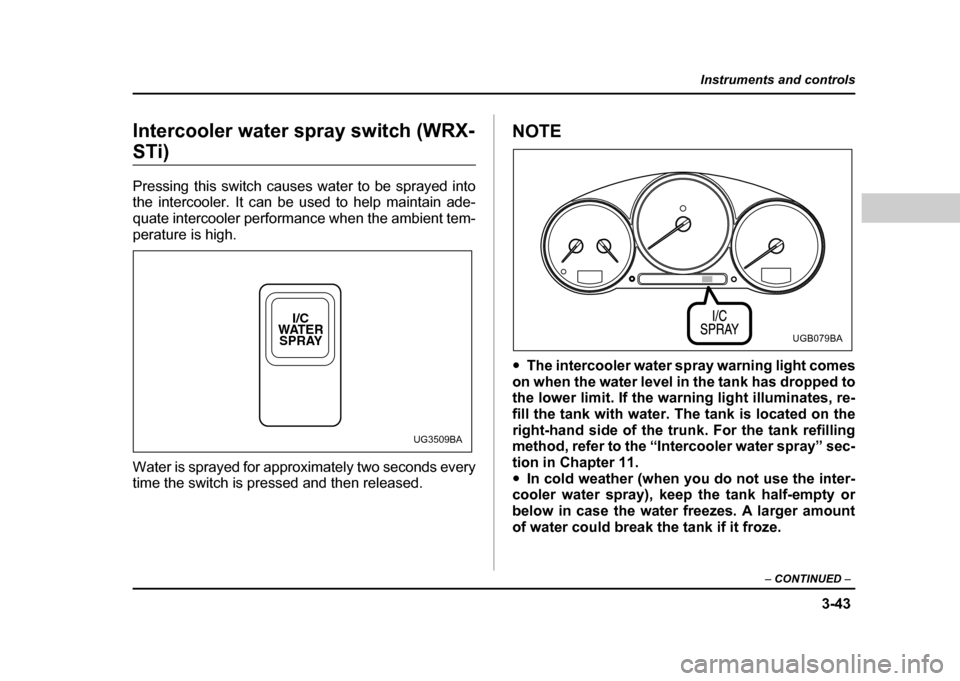
Intercooler water spray switch (WRX-
STi)
Pressing this switch causes water to be sprayed into
the intercooler. It can be used to help maintain ade-
quate intercooler performance when the ambient tem-perature is high.
Water is sprayed for approximately two seconds every
time the switch is pressed and then released.
NOTE "The intercooler water spray warning light comes
on when the water level in the tank has dropped to
the lower limit. If the warning light illuminates, re-
fill the tank with water. The tank is located on the
right-hand side of the trunk. For the tank refilling
method, refer to the “Intercooler water spray” sec-
tion in Chapter 11." In cold weather (when you do not use the inter-
cooler water spray), keep the tank half-empty or
below in case the water freezes. A larger amount
of water could break the tank if it froze.
I/C
WATER SPRAY
UG3509BA
UGB079BA
Page 278 of 491
7-9
Starting and operating
– CONTINUED –
Preparing to drive
You should perform the following checks and adjust-
ments every day before you start driving.
1. Check that all windows, mirrors, and lights are
clean and unobstructed.
2. Check the appearance and condition of the tires.
Also check tires for proper inflation.
3. Look under the vehicle for any sign of leaks.
4. Check that the hood, trunk and rear gate are fully
closed.
5. Check the adjustment of the seat.
6. Check the adjustment of the inside and outside mir-
rors.
7. Fasten your seatbelt. Check that your passengers
have fastened their seatbelts.
8. Check the operation of the warning and indicator
lights when the ignition switch is turned to the “ON” po-sition.
9. Check the gauges, indicator and warning lights af-
ter starting the engine.
NOTE
Engine oil, engine coolant, brake fluid, washer flu-
id and other fluid levels should be checked daily,
weekly or at fuel stops.
Starting the engine
Do not operate the starter motor continuously
for more than ten seconds. If the engine fails to
start after operating the starter for five to ten
seconds, wait for ten seconds or more before
trying again.
! Manual transmission vehicle
1. Apply the parking brake.
2. Turn off unnecessary lights and accessories.
3. Press the clutch pedal to the floor and shift the shift
lever into neutral. Hold the clutch pedal to the floor
while starting the engine.
The starter motor will only operate when the clutch
pedal is pressed fully to the floor.
4. Turn the ignition switch to the “ON” position and
check the operation of the warning and indicator lights.
Refer to the “Warning and indicator lights” section (chapter 3).
5. Turn the ignition switch to the “START” position
without depressing the accelerator pedal. Release
the key immediately after the engine has started.
Page 314 of 491
8-3
Driving tips
– CONTINUED –
Engine exhaust gas (Carbon monox-
ide)
"Never inhale engine exhaust gas. Engine ex-
haust gas contains carbon monoxide, a color-
less and odorless gas which is dangerous, or
even lethal, if inhaled. " Always properly maintain the engine exhaust
system to prevent engine exhaust gas from en-
tering the vehicle. " Never run the engine in a closed space, such
as a garage, except for the brief time needed to
drive the vehicle in or out of it. " Avoid remaining in a parked vehicle for a
lengthy time while the engine is running. If that
is unavoidable, then use the ventilation fan to
force fresh air into the vehicle." Always keep the front ventilator inlet grille
free from snow, leaves or other obstructions to
ensure that the ventilation system always
works properly." If at any time you suspect that exhaust fumes
are entering the vehicle, have the problem
checked and corrected as soon as possible. If
you must drive under these conditions, drive only with all windows fully open. "
Keep the trunk lid or rear gate closed while
driving to prevent exhaust gas from entering
the vehicle.
NOTE
Due to the expansion and contraction of the met-
als used in the manufacture of the exhaust sys-
tem, you may hear a crackling sound coming from
the exhaust system for a short time after the en-
gine has been shut off. This sound is normal.
Page 328 of 491
8-17
Driving tips
– CONTINUED –
trying to free the vehicle.
When the road surface is extremely slippery, you can
obtain better traction by starting the vehicle with the
transmission in 2nd than 1st (both for MT and AT).
Refer to the “Automatic transmission” section in chap-
ter 7 for information on holding the transmission in 2ndposition.Loading your vehicle
"Never allow passengers to ride on the folded
rear seatback, in the trunk or in the cargo area.
Doing so may result in serious injury." Never stack luggage or other cargo higher
than the top of the seatback because it could
tumble forward and injure passengers in the
event of a sudden stop or accident. Keep lug-
gage or cargo low, as close to the floor as pos-
sible.