ESP SUBARU IMPREZA 2004 2.G Owner's Manual
[x] Cancel search | Manufacturer: SUBARU, Model Year: 2004, Model line: IMPREZA, Model: SUBARU IMPREZA 2004 2.GPages: 491, PDF Size: 5.93 MB
Page 274 of 491
7-5
Starting and operating
– CONTINUED –
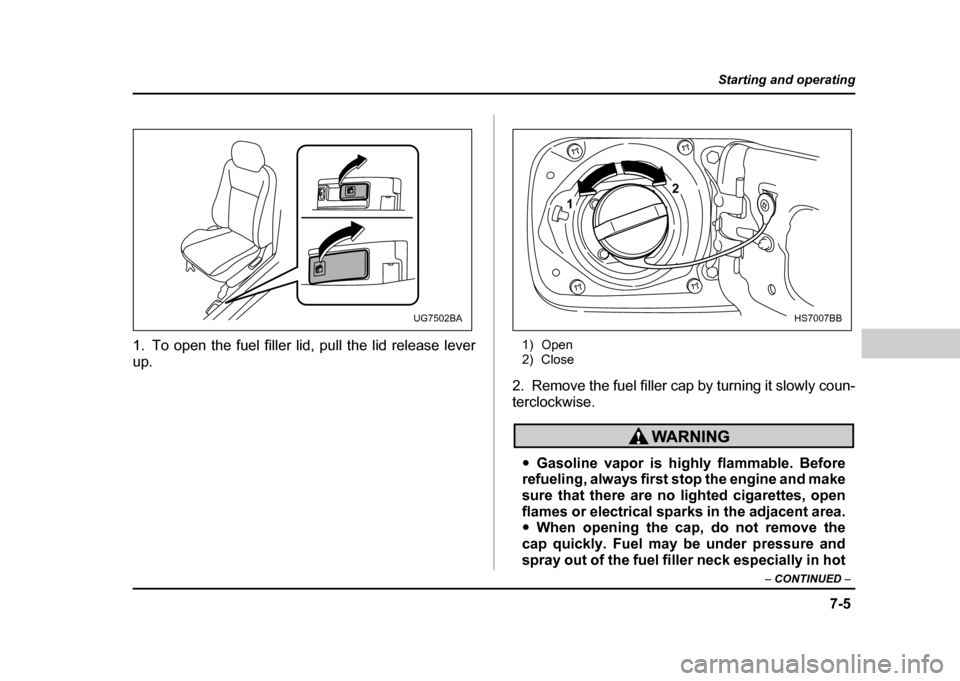
1. To open the fuel filler lid, pull the lid release lever
up. 1) Open
2) Close
2. Remove the fuel filler cap by turning it slowly coun-
terclockwise.
" Gasoline vapor is highly flammable. Before
refueling, always first stop the engine and make
sure that there are no lighted cigarettes, open
flames or electrical sparks in the adjacent area." When opening the cap, do not remove the
cap quickly. Fuel may be under pressure and
spray out of the fuel filler neck especially in hot
UG7502BA
1 2
HS7007BB
Page 276 of 491
7-7
Starting and operating
– CONTINUED –
State emission testing (U.S. only)
At state inspection time, remember to tell your in-
spection or service station in advance not to place
your Subaru AWD vehicle on a two-wheel dyna-
mometer. Otherwise, serious transmission dam-
age will result.
Some states have started using dynamometers in
their state inspection programs in order to meet their
obligation under federal law to implement stricter vehi-
cle emission standards to reduce air pollution from
cars. A dynamometer is a treadmill or roller-like testing
device that allows your car’s wheels to turn while the
car remains in one place. Depending on the severity of
a state’s air pollution problems, the states must adopt
either a “basic” or “enhanced” vehicle emission in-
spection test. Normally, a portion of the basic emission
test consists of an emission inspector inserting an an-
alyzer probe into the exhaust pipe of an idling vehicle
for a short period of time. States with more severe air
pollution problems are required to adopt an enhanced
vehicle emission test. This test simulates actual driv-
ing conditions on a dynamometer and permits more
accurate measurement of tailpipe emitted pollution
than the basic emission test.
The U.S. Environmental Protection Agency (EPA) and states using two-wheel dynamometers in their emis-
sion testing programs have
EXEMPTED Subaru AWD
vehicles from the portion of the testing program that in-
volves a two-wheel dynamometer.
There are some states that use four-wheel dynamom-
eters in their testing programs. When properly used,
that equipment will not damage an AWD Subaru vehi- cle.
Under no circumstances should the rear wheels be
jacked off the ground, nor should the driveshaft be dis-
connected for state emission testing.
Testing of an All-Wheel Drive vehicle must
NEVER be performed on a single two-wheel dy-
namometer. Attempting to do so will result in
uncontrolled vehicle movement and may cause
an accident or injuries to persons nearby.
Resultant vehicle damage due to improper test-
ing is not covered under the SUBARU Limited
Warranty and is the responsibility of the state
Page 320 of 491

8-9
Driving tips
– CONTINUED –
!All AWD models except OUTBACK
SPORT and vehicles with 17 inch tires
Your AWD vehicle is neither a conventional off-road
vehicle nor an all terrain vehicle. It is a passenger car
designed primarily for on-road use. The AWD feature
gives it some limited off-road capabilities in situations
in which driving surfaces are relatively level, obstruc-
tion-free and otherwise similar to on-road driving con-
ditions. Operating it under other than those conditions
could subject the vehicle to excessive stress which
might result in damage not eligible for repair under
warranty. If you do take your SUBARU off road, you
should review the common sense precautions in the
next section (applicable to the OUTBACK SPORT) for
general guidance. But please keep in mind that your
vehicle’s off-road capabilities are more limited than
those of the OUTBACK SPORT.
Never attempt to drive through pools and puddles, or
roads flooded with water. Water entering the engine
air intake or the exhaust pipe or water splashing onto
electrical parts may damage your vehicle and may
cause it to stall. ! OUTBACK SPORT
Your Subaru can be driven on ordinary roads or off-
road. But please keep in mind that an AWD SUBARU is a passenger car and is neither a conventional off-
road vehicle nor an all-terrain vehicle. If you do take
your Subaru off-road, certain common sense precau-
tions such as the following should be taken: "
Make certain that you and all of your passengers
are wearing seat belts. " Carry some emergency equipment, such as a tow-
ing rope or chain, a shovel, wheel blocks, first aid kit
and portable phone or citizens band radio." Drive carefully. Do not take unnecessary risks by
driving in dangerous areas or over rough terrain. " Slow down and employ extra caution at all times.
When driving off-road, you will not have the benefit of
marked traffic lanes, banked curves, traffic signs and
the like. " Do not drive across steep slopes. Instead, drive ei-
ther straight up or straight down the slopes. A vehicle
can much more easily tip over sideways than it can
end over end. Avoid driving straight up or down slopes
that are too steep. " Avoid sharp turning maneuvers, especially at higher
speeds. " Do not grip the inside or spokes of the steering
wheel. A bad bump could jerk the wheel and injure
your hands. Instead drive with your fingers and
thumbs on the outside of the rim. " If driving through water, such as when crossing
Page 325 of 491
8-14
Driving tips
!
Wiper operation when snowing
Before driving in cold weather, make sure the wiper
blades are not frozen to the windshield or rear window.
If the wiper blades are frozen to the windshield or rear
window, use the defroster with the airflow control dial
in the “ ” position and the temperature control dial
set for maximum warmth until the wiper blades are
completely thawed out. If your vehicle is equipped with
a wiper deicer, it is helpful to thaw the windshield wiper
blades. To thaw out the rear wiper blade, use the rear
window defogger.
When driving in snow, if frozen snow starts to stick on
the surface of the windshield despite wiper operation,
use the defroster with the airflow control dial in “ ”
and the temperature control dial set for maximum
warmth. After the windshield gets warmed enough to
melt the frozen snow on it, wash it away using the
windshield washer.
Snow stuck on the wiper arm prevents the wiper from
working effectively. If snow is stuck on the wiper arm,
pull off the road to a safe place, then remove it. If you
stop the car at road side, use the hazard warning
flasher to alert other drivers.
We recommend use of non-freezing type wiper blades
(winter blades) during the seasons you could have snow and sub-zero temperatures. Blades of this type
give superior wiping performance in snowy conditions.
Be sure to use blades that are suitable for your vehi-cle. !
Corrosion protection
Refer to the “Corrosion protection” section (chapter
10). ! Snow tires
! All models except WRX-STi
"When replacing original tires with winter
(snow) tires, make sure you use only the same
size, construction and load range as the origi-
nal tires listed on the tire placard. Using other
sizes and construction may affect speedome-
ter/odometer calibration and clearance be-
tween the body and tires. It also may be danger-
ous and lead to loss of vehicle control. " You must install four winter tires that are of
the same size, construction, brand, and load
range. Mixing other sizes or constructions may
result in severe mechanical damage to the drive
Page 340 of 491
8-29
Driving tips
– CONTINUED –
Trailer towing
Your car is designed and intended to be used primarily
as a passenger-carrying vehicle. Towing a trailer puts
additional loads on your car’s engine, drivetrain,
brakes, tires and suspension and has an adverse ef-
fect on fuel economy.
If you do decide to tow a trailer, your safety and satis-
faction depend upon proper use of correct equipment
and cautious operation of your vehicle. Seek the ad-
vice of your SUBARU dealer to assist you in purchas-
ing a hitch and other necessary towing equipment ap-
propriate for your vehicle. In addition, be sure to follow
the instructions on correct installation and use provid-
ed by the trailer and other towing equipment manufac-
turers.
SUBARU assumes no responsibility for injuries or ve-
hicle damage that result from trailer towing equipment,
or from any errors or omissions in the instructions ac-
companying such equipment or for your failure to fol-
low the proper instructions. !Warranties and maintenance
SUBARU warranties do not apply to vehicle damage
or malfunction caused by trailer towing. If you use your
vehicle to tow a trailer, more frequent maintenance will
be required due to the additional load. (Refer to “Main- tenance schedule under severe driving conditions” in
the “Warranty and Maintenance Booklet”.)
Under no circumstances should a trailer be towed with
a new vehicle or a vehicle with any new powertrain
component (engine, transmission, differential, wheel
bearings, etc.) for the first 1,000 miles (1,600 km) of
driving. !
Maximum load limits
Never exceed the maximum load limits ex-
plained below. Exceeding the maximum load
limits could cause personal injury and/or vehi-
cle damage.
"Adequate size trailer brakes are required
when the trailer and its cargo exceed 1,000 lbs
(453 kg) total weight." Before towing a trailer, check the trailer total
weight, GVW, GAWs and tongue load. Make
sure the load and its distribution in your vehicle
Page 345 of 491
8-34
Driving tips
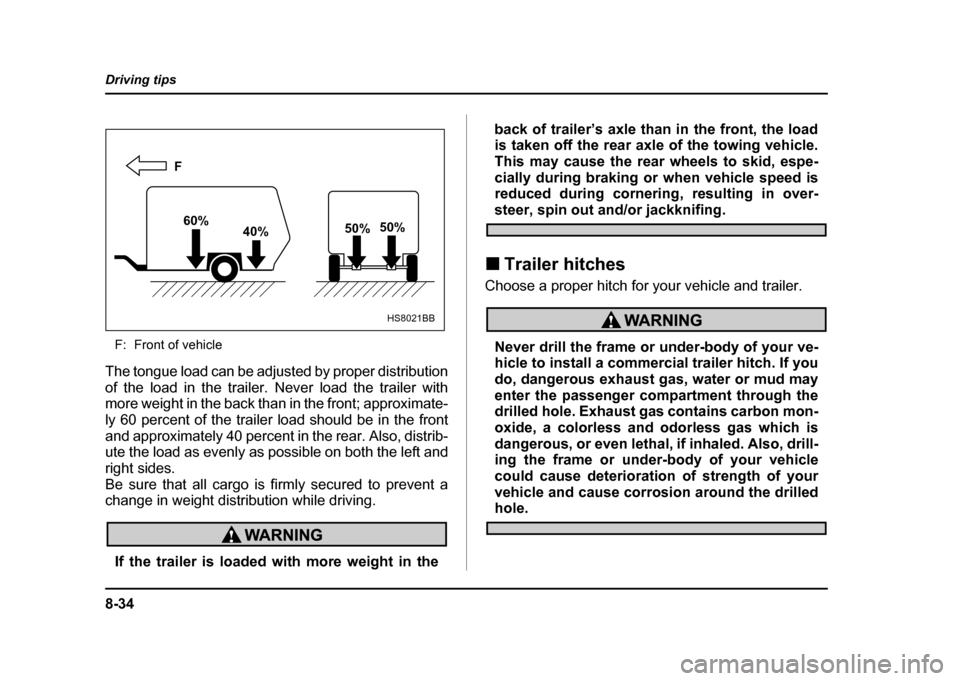
F: Front of vehicle
The tongue load can be adjusted by proper distribution
of the load in the trailer. Never load the trailer with
more weight in the back than in the front; approximate-
ly 60 percent of the trailer load should be in the front
and approximately 40 percent in the rear. Also, distrib-
ute the load as evenly as possible on both the left and
right sides.
Be sure that all cargo is firmly secured to prevent a
change in weight distribution while driving.
If the trailer is loaded with more weight in the back of trailer’s axle than in the front, the load
is taken off the rear axle of the towing vehicle.
This may cause the rear wheels to skid, espe-
cially during braking or when vehicle speed is
reduced during cornering, resulting in over-
steer, spin out and/or jackknifing.
! Trailer hitches
Choose a proper hitch for your vehicle and trailer.
Never drill the frame or under-body of your ve-
hicle to install a commercial trailer hitch. If you
do, dangerous exhaust gas, water or mud may
enter the passenger compartment through the
drilled hole. Exhaust gas contains carbon mon-
oxide, a colorless and odorless gas which is
dangerous, or even lethal, if inhaled. Also, drill-
ing the frame or under-body of your vehicle
could cause deterioration of strength of your
vehicle and cause corrosion around the drilled
hole.
F
60% 40% 50%
50%
HS8021BB
Page 379 of 491
10-2
Appearance care
Appearance careExterior care !
Washing
The best way to preserve your vehicle’s beauty is fre-
quent washing. Wash the vehicle at least once a
month to avoid contamination by road grime.
Wash dirt off with a wet sponge and plenty of luke-
warm or cold water. Do not wash the vehicle with hot
water and in direct sunlight.
Salt, chemicals, insects, tar, soot and bird droppings
should be washed off by using a light detergent, as re-
quired. If you use a light detergent, make certain that
it is a neutral detergent. Do not use strong soap or
chemical detergents. All cleaning agents should be
promptly flushed from the surface and not allowed to
dry there. Rinse the vehicle thoroughly with plenty of
lukewarm water. Wipe the remaining water off with a
chamois or soft cloth.
NOTE
When having your vehicle washed in an automatic
car wash, make sure beforehand that the car wash
is of suitable type. Automatic car wash brushes or
other equipment may damage the rear wiper and
rear/roof spoiler (if equipped).
" When washing the vehicle, the brakes may
get wet. As a result, the brake stopping dis-
tance will be longer. To dry the brakes, drive the
vehicle at a safe speed while lightly pressing
the brake pedal to heat up the brakes. " Do not wash the engine compartment and
area adjacent to it. If water enters the engine air
intake, electrical parts or the power steering flu-
id reservoir, it will cause engine trouble or
faulty power steering respectively.
! Washing the underbody
Chemicals, salts and gravel used for deicing road sur-
faces are extremely corrosive, accelerating the corro-
sion of underbody components, such as the exhaust
system, fuel and brake lines, brake cables, floor pan
and fenders, and suspension.
Thoroughly flush the underbody and inside of the
fenders with lukewarm or cold water at frequent inter-
vals to reduce the harmful effects of such agents.
Mud and sand adhering to the underbody components may accelerate their corrosion.
After driving off-road or on muddy or sandy roads,
wash the mud and sand off the underbody. Carefully
Page 381 of 491

10-4
Appearance care
be difficult to clean off. "
Do not use soap containing grit to clean the wheels.
Be sure to use a neutral cleaning agent, and later rinse
thoroughly with water. Do not clean the wheels with a
stiff brush or expose them to a high-speed washing
device." Clean the vehicle (including the aluminum wheels)
with water as soon as possible when it has been
splashed with sea water, exposed to sea breezes, or
driven on roads treated with salt or other agents.Corrosion protection
Your SUBARU has been designed and built to resist
corrosion. Special materials and protective finishes
have been used on most parts of the vehicle to help
maintain fine appearance, strength, and reliable oper-
ation. ! Most common causes of corrosion
The most common causes of corrosion are:
1. The accumulation of moisture retaining dirt and de-
bris in body panel sections, cavities, and other areas.
2. Damage to paint and other protective coatings
caused by gravel and stone chips or minor accidents.
Corrosion is accelerated on the vehicle when:
1. It is exposed to road salt or dust control chemicals,
or used in coastal areas where there is more salt in the
air, or in areas where there is considerable industrial
pollution.
2. It is driven in areas of high humidity, especially
when temperatures range just above freezing.
3. Dampness in certain parts of the vehicle remains
for a long time, even though other parts of the vehicle
may be dry.
4. High temperatures will cause corrosion to parts of
the vehicle which cannot dry quickly due to lack of
Page 428 of 491
11 -4 3
Maintenance and service
– CONTINUED –
If you continue to drive despite the scraping
noise from the audible brake pad wear indica-
tor, it will result in the need for costly brake ro-
tor repair or replacement.
! Breaking-in of new brake pads and lin- ings
When replacing the brake pad or lining, use only gen-
uine SUBARU parts. After replacement, the new parts
must be broken in as follows: ! Brake pad and lining
While maintaining a speed of 30 to 40 mph (50 to 65
km/h), step on the brake pedal lightly. Repeat this five
or more times. ! Parking brake lining
1. Drive the vehicle at a speed of about 22 mph (35 km/h).
2. With the parking brake release button pushed in,
pull the parking brake lever SLOWLY and GENTLY.
(Pulling with a force of approximately 33 lb [147 N, 15 kg].)
3. Drive the vehicle for about 220 yards (200 meters) in this condition.
4. Wait 5 to 10 minutes for the parking brake to cool
down. Repeat this procedure.
5. Check the parking brake stroke. If the parking
brake stroke is out of the specified range, adjust it by
turning the adjusting nut located on the parking brake
lever.
Parking brake stroke:
7 – 8 notches / 44 lb (196 N, 20 kg)
A safe location and situation should be select-ed for break-in driving.
Pulling the parking brake lever too forcefully
may cause the rear wheels to lock. To avoid
this, be certain to pull the lever up slowly and
gently.
Page 432 of 491
11 -4 7
Maintenance and service
– CONTINUED –
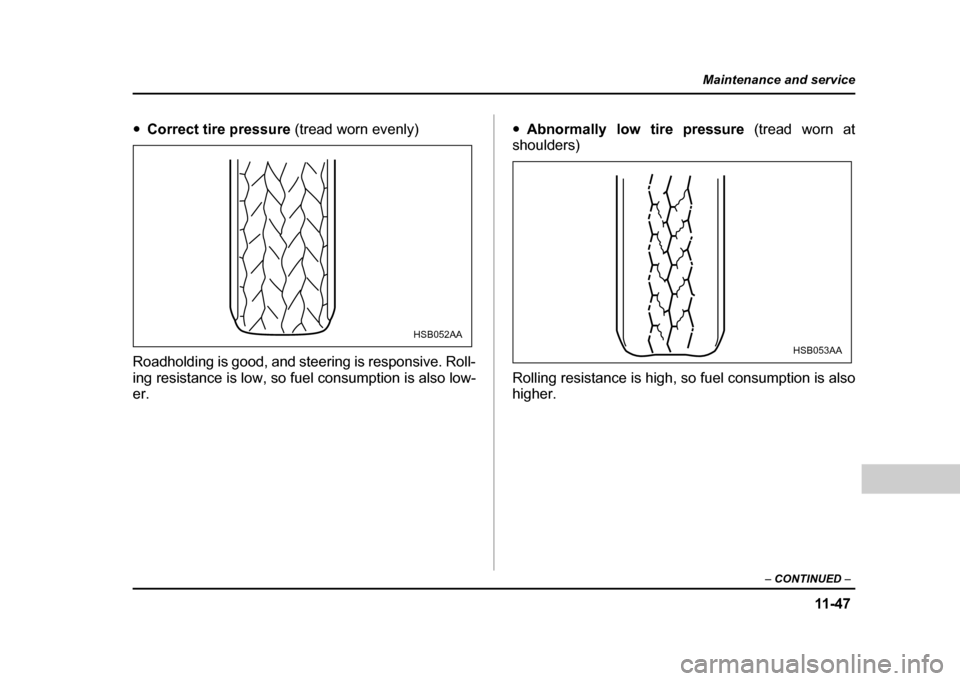
"Correct tire pressure (tread worn evenly)
Roadholding is good, and steering is responsive. Roll-
ing resistance is low, so fuel consumption is also low- er. "
Abnormally low tire pressure (tread worn at
shoulders)
Rolling resistance is high, so fuel consumption is also
higher.
HSB052AA
HSB053AA