tow SUBARU IMPREZA 2004 2.G Owner's Manual
[x] Cancel search | Manufacturer: SUBARU, Model Year: 2004, Model line: IMPREZA, Model: SUBARU IMPREZA 2004 2.GPages: 491, PDF Size: 5.93 MB
Page 265 of 491
6-16
Interior equipment
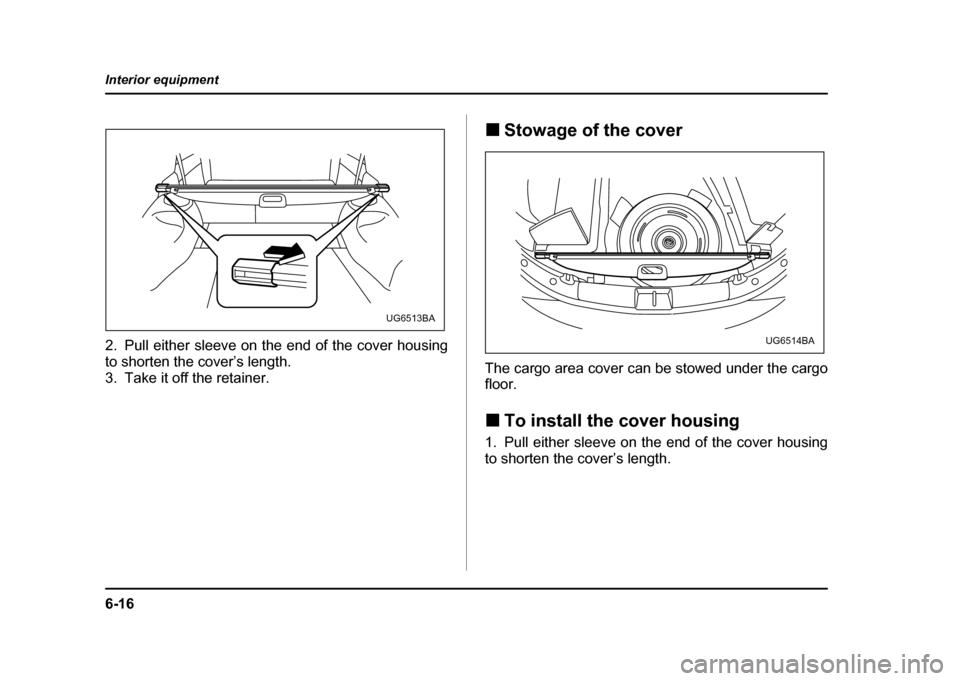
2. Pull either sleeve on the end of the cover housing
to shorten the cover’s length.
3. Take it off the retainer.
!
Stowage of the cover
The cargo area cover can be stowed under the cargo floor. ! To install the cover housing
1. Pull either sleeve on the end of the cover housing
to shorten the cover’s length.
UG6513BA
UG6514BA
Page 289 of 491
7-20
Starting and operating
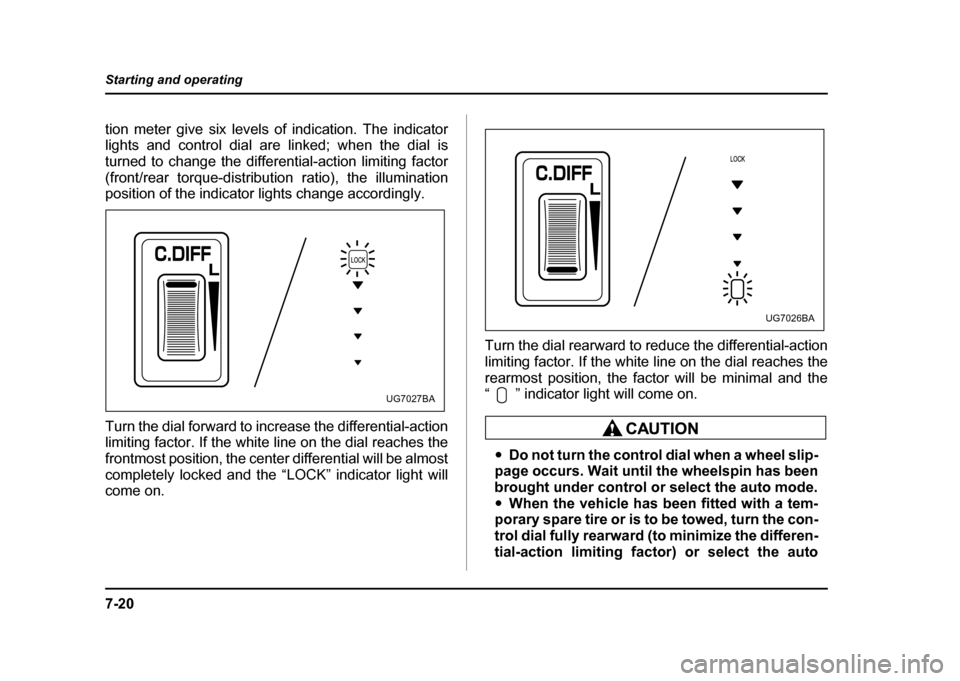
tion meter give six levels of indication. The indicator
lights and control dial are linked; when the dial is
turned to change the differential-action limiting factor
(front/rear torque-distribution ratio), the illumination
position of the indicator lights change accordingly.
Turn the dial forward to increase the differential-action
limiting factor. If the white line on the dial reaches the
frontmost position, the center differential will be almost
completely locked and the “LOCK” indicator light will come on.
Turn the dial rearward to reduce the differential-action
limiting factor. If the white line on the dial reaches the
rearmost position, the factor will be minimal and the
“ ” indicator light will come on.
"
Do not turn the control dial when a wheel slip-
page occurs. Wait until the wheelspin has been
brought under control or select the auto mode." When the vehicle has been fitted with a tem-
porary spare tire or is to be towed, turn the con-
trol dial fully rearward (to minimize the differen-
tial-action limiting factor) or select the auto
UG7027BA
UG7026BA
Page 302 of 491
7-33
Starting and operating
– CONTINUED –
!Steps to take if EBD system fails
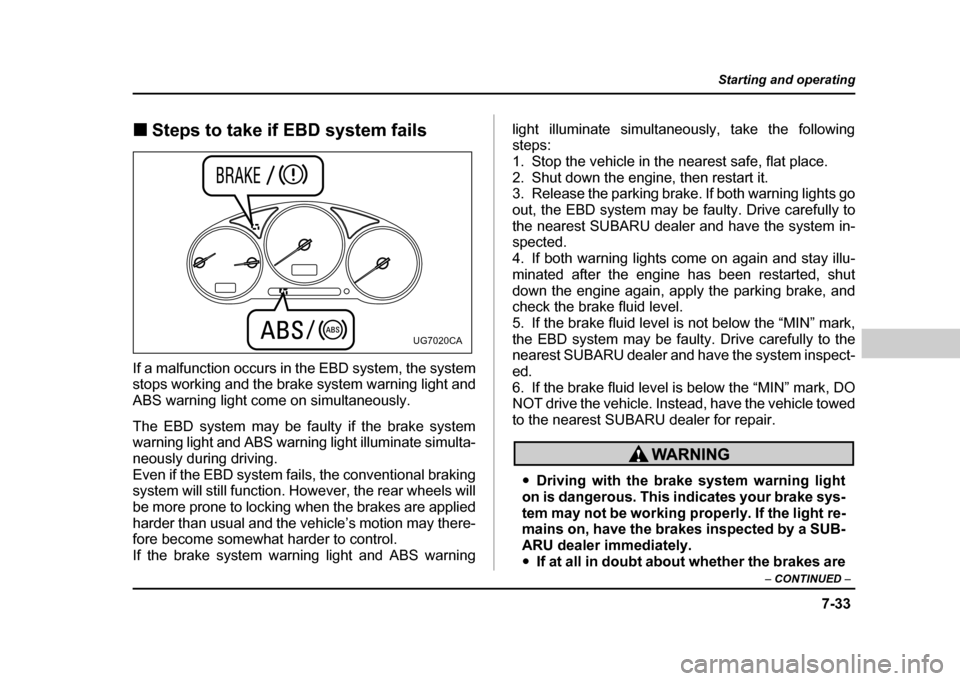
If a malfunction occurs in the EBD system, the system
stops working and the brake system warning light and
ABS warning light come on simultaneously.
The EBD system may be faulty if the brake system
warning light and ABS warning light illuminate simulta-
neously during driving.
Even if the EBD system fails, the conventional braking
system will still function. However, the rear wheels will
be more prone to locking when the brakes are applied
harder than usual and the vehicle’s motion may there-
fore become somewhat harder to control. If the brake system warning light and ABS warning light illuminate simultaneously, take the following steps:
1. Stop the vehicle in the nearest safe, flat place.
2. Shut down the engine, then restart it.
3. Release the parking brake. If both warning lights go
out, the EBD system may be faulty. Drive carefully to
the nearest SUBARU dealer and have the system in- spected.
4. If both warning lights come on again and stay illu-
minated after the engine has been restarted, shut
down the engine again, apply the parking brake, and
check the brake fluid level.
5. If the brake fluid level is not below the “MIN” mark,
the EBD system may be faulty. Drive carefully to the
nearest SUBARU dealer and have the system inspect- ed.
6. If the brake fluid level is below the “MIN” mark, DO
NOT drive the vehicle. Instead, have the vehicle towed
to the nearest SUBARU dealer for repair.
"
Driving with the brake system warning light
on is dangerous. This indicates your brake sys-
tem may not be working properly. If the light re-
mains on, have the brakes inspected by a SUB-
ARU dealer immediately." If at all in doubt about whether the brakes are
UG7020CA
Page 303 of 491
7-34
Starting and operating
operating properly, do not drive the vehicle.
Have your vehicle towed to the nearest SUBA-
RU dealer for repair.
Parking your vehicle !
Parking brake
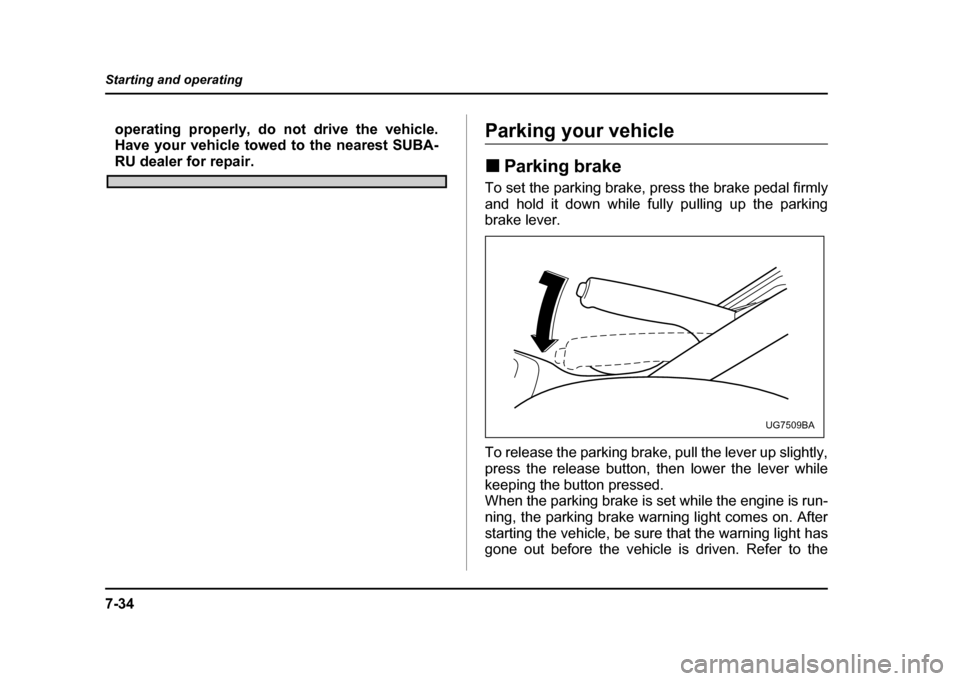
To set the parking brake, press the brake pedal firmly
and hold it down while fully pulling up the parking
brake lever.
To release the parking brake, pull the lever up slightly,
press the release button, then lower the lever while
keeping the button pressed.
When the parking brake is set while the engine is run-
ning, the parking brake warning light comes on. After
starting the vehicle, be sure that the warning light has
gone out before the vehicle is driven. Refer to the
UG7509BA
Page 312 of 491

8-1
8
Driving tips
New vehicle break-in driving – the first 1,000 miles (1,600 km) ................ 8-2
Fuel economy hints ...................................... 8-2
Engine exhaust gas (Carbon monoxide) .... 8-3
Catalytic converter ....................................... 8-4
Periodic inspections .................................... 8-6
Driving in foreign countries ......................... 8-6
Driving tips for AWD vehicles ..................... 8-7
Off road driving ............................................ 8-8 All AWD models except OUTBACK SPORT and vehicles with 17 inch tires ..................... 8-9
OUTBACK SPORT ............................................. 8-9
Winter driving ............................................... 8-11 Operation during cold weather ........................ 8-11
Driving on snowy and icy roads ...................... 8-13
Corrosion protection ........................................ 8-14
Snow tires .......................................................... 8-14
Tire chains ......................................................... 8-16
Rocking the vehicle .......................................... 8-16
Loading your vehicle ................................... 8-17 Vehicle capacity weight .................................... 8-19
GVWR and GAWR (Gross Vehicle Weight Rating and Gross Axle Weight Rating) ........ 8-20
Roof rail and crossbar (if equipped) ............... 8-21
Trailer hitch (if equipped) ............................ 8-25 Connecting a trailer .......................................... 8-25
When you do not tow a trailer .......................... 8-28
Trailer towing ................................................ 8-29 Warranties and maintenance ........................... 8-29 Maximum load limits ........................................ 8-29
Trailer hitches ................................................... 8-34
Connecting a trailer .......................................... 8-35
Trailer towing tips ............................................. 8-37
Page 319 of 491
8-8
Driving tips
latch on the driver’s side. "
Tire chains should always be placed on the front
wheels only. " There are some precautions that you must observe
when towing your vehicle. For detail information, see
the “Towing” section in chapter 9.
" Always maintain a safe driving speed accord-
ing to the road and weather conditions in order
to avoid having an accident on a sharp turn,
during sudden braking or under other similar
conditions. " Always use the utmost care in driving – over-
confidence because you are driving an all
wheel drive vehicle could easily lead to a seri-
ous accident.
Off road driving
" Always maintain a safe driving speed accord-
ing to the road and weather conditions in order
to avoid having an accident on a sharp turn,
during sudden braking or under other similar
conditions. " Always use the utmost care in driving – over-
confidence because you are driving an all
wheel drive vehicle could easily lead to a seri-
ous accident.
Do not drive on rough roads or over curbs in a
vehicle that has 17-inch or other ultra-low-pro-
file tires. The wheels and tires could be dam-
aged by shock forces, leading to abnormal vi-
bration or poor straight-line tracking. Driving
would then be more difficult.
Page 320 of 491

8-9
Driving tips
– CONTINUED –
!All AWD models except OUTBACK
SPORT and vehicles with 17 inch tires
Your AWD vehicle is neither a conventional off-road
vehicle nor an all terrain vehicle. It is a passenger car
designed primarily for on-road use. The AWD feature
gives it some limited off-road capabilities in situations
in which driving surfaces are relatively level, obstruc-
tion-free and otherwise similar to on-road driving con-
ditions. Operating it under other than those conditions
could subject the vehicle to excessive stress which
might result in damage not eligible for repair under
warranty. If you do take your SUBARU off road, you
should review the common sense precautions in the
next section (applicable to the OUTBACK SPORT) for
general guidance. But please keep in mind that your
vehicle’s off-road capabilities are more limited than
those of the OUTBACK SPORT.
Never attempt to drive through pools and puddles, or
roads flooded with water. Water entering the engine
air intake or the exhaust pipe or water splashing onto
electrical parts may damage your vehicle and may
cause it to stall. ! OUTBACK SPORT
Your Subaru can be driven on ordinary roads or off-
road. But please keep in mind that an AWD SUBARU is a passenger car and is neither a conventional off-
road vehicle nor an all-terrain vehicle. If you do take
your Subaru off-road, certain common sense precau-
tions such as the following should be taken: "
Make certain that you and all of your passengers
are wearing seat belts. " Carry some emergency equipment, such as a tow-
ing rope or chain, a shovel, wheel blocks, first aid kit
and portable phone or citizens band radio." Drive carefully. Do not take unnecessary risks by
driving in dangerous areas or over rough terrain. " Slow down and employ extra caution at all times.
When driving off-road, you will not have the benefit of
marked traffic lanes, banked curves, traffic signs and
the like. " Do not drive across steep slopes. Instead, drive ei-
ther straight up or straight down the slopes. A vehicle
can much more easily tip over sideways than it can
end over end. Avoid driving straight up or down slopes
that are too steep. " Avoid sharp turning maneuvers, especially at higher
speeds. " Do not grip the inside or spokes of the steering
wheel. A bad bump could jerk the wheel and injure
your hands. Instead drive with your fingers and
thumbs on the outside of the rim. " If driving through water, such as when crossing
Page 330 of 491
8-19
Driving tips
– CONTINUED –
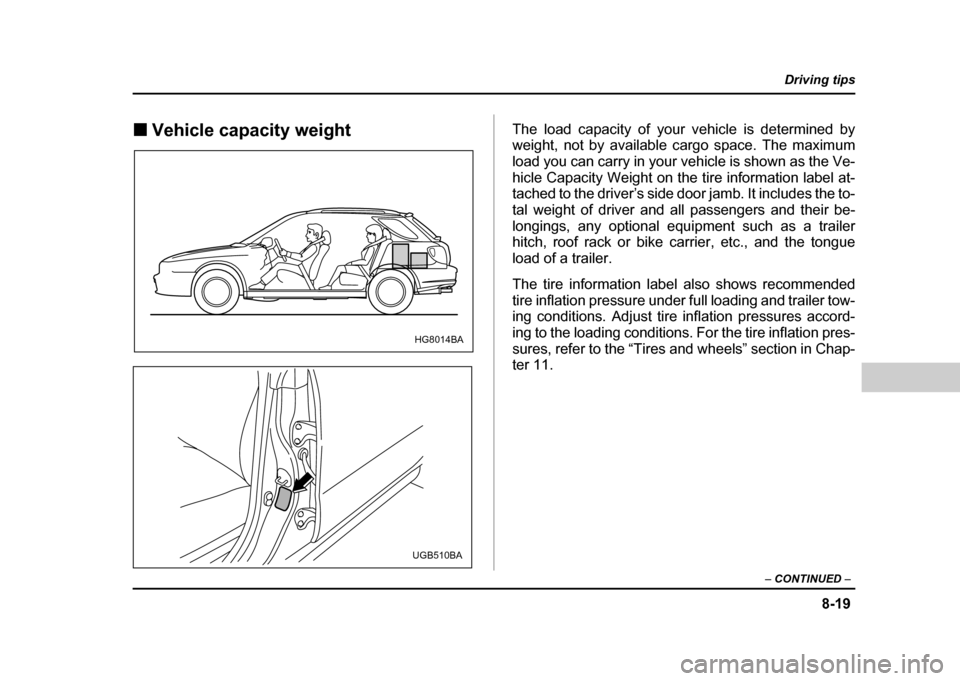
!Vehicle capacity weight The load capacity of your vehicle is determined by
weight, not by available cargo space. The maximum
load you can carry in your vehicle is shown as the Ve-
hicle Capacity Weight on the tire information label at-
tached to the driver’s side door jamb. It includes the to-
tal weight of driver and all passengers and their be-
longings, any optional equipment such as a trailer
hitch, roof rack or bike carrier, etc., and the tongue
load of a trailer.
The tire information label also shows recommended
tire inflation pressure under full loading and trailer tow-
ing conditions. Adjust tire inflation pressures accord-
ing to the loading conditions. For the tire inflation pres-
sures, refer to the “Tires and wheels” section in Chap-
ter 11.
HG8014BA
UGB510BA
Page 334 of 491

8-23
Driving tips
– CONTINUED –
F: Front of vehicle
1) T30 torx® head screw
2) Front arrow label
3) Front crossbar
4) 100LBS load label
5) Lower clamp
6) Roof rail end support
7) Joint line
8) Front arrow label
a: 3 inches (76 mm)
1. Before placing the crossbar on the roof rails, make
sure that the T-30 torx® head screw is removed from
the top of each crossbar end support.
2. Rotate the lower clamp on the bottom of each end
support downward approximately 90 °.
3. With the front direction arrow label on the top right
side of the crossbar pointing toward the front of the ve-
hicle, carefully place the crossbar across the top of the
vehicle so that the crossbar end supports rest on the
top of the roof rails approximately 3 inches (76 mm)
rearward from the seam (joint) between the front roof
rail support and the roof rail.
4. Rotate (raise) the lower clamp up to the bottom of
the roof rail and loosely tighten the T-30 torx® head
screw with the torx® wrench provided, through the top
of the end support and into the threaded insert in the
lower clamp on each end of the crossbar.NOTE
It may be necessary to squeeze the lower clamp
and the end support together to compress the
pads and gain a better alignment of the pieces
while trying to start the screw. Use care not to
crossthread the screw in the insert.
5. Adjust the alignment of the crossbar on the roof
rails, and if available, use a T-30 torx® bit and torque
wrench and tighten the T-30 torx® head screws to 30
to 35 inch lbs. (3.4 to 4.0 N-m, 0.35 to 0.41 kg-m) of
torque (or tighten securely with the torx® wrench pro-
vided).
Page 336 of 491
8-25
Driving tips
– CONTINUED –
Trailer hitch (if equipped)
The trailer hitch is designed to tow a Class 1 rated
load. A maximum of 2,000 lbs. (906 kg) gross trailer
weight and a maximum of 200 lbs. (90 kg) gross
tongue weight are permissible for the trailer hitch.
When you tow a trailer, follow the instructions in the
section “Trailer towing” in this chapter.
" Never exceed the maximum weight specified
for the trailer hitch. Exceeding the maximum
weight could cause an accident resulting in se-
rious personal injuries. Permissible trailer
weight changes depending on the situation. Re-
fer to the section “Trailer towing” in this chap-
ter for possible recommendations and limita- tions. " Trailer brakes are required when the towing
load exceeds 1,000 lbs. (453 kg). Be sure your
trailer has safety chains and that each chain
will hold the trailer’s maximum gross weight.
Towing trailers without safety chains could cre-
ate a traffic safety hazard if the trailer separates
from the hitch due to coupling damage or hitch
ball damage. "
Be sure to check the hitch pin and safety pin
for positive locking placement before towing a
trailer. If the ball mount comes off the hitch re-
ceiver, the trailer could get loose and create a
traffic safety hazard. " Use only the ball mount supplied with this
hitch. Use the hitch only as a weight carrying
hitch. Do not use with any type of weight dis-
tributing hitch.
! Connecting a trailer
1. Remove the receiver cover from the hitch receiver
tube. Then insert the ball mount into the hitch receiver
tube.