wheel SUBARU IMPREZA 2004 2.G Manual PDF
[x] Cancel search | Manufacturer: SUBARU, Model Year: 2004, Model line: IMPREZA, Model: SUBARU IMPREZA 2004 2.GPages: 491, PDF Size: 5.93 MB
Page 430 of 491

11 -4 5
Maintenance and service
– CONTINUED –
When installing winter tires, be sure to replace all four
tires. !Winter (snow) tires
Winter tires are best suited for driving on snow-cov-
ered and icy roads. However winter tires do not per-
form as well as summer tires and all season tires on
roads other than snow-covered and icy roads. ! Tire inspection
Check on a daily basis that the tires are free from se-
rious damage, nails, and stones. At the same time,
check the tires for abnormal wear.
Contact your SUBARU dealer immediately if you find
any problem.
NOTE " When the wheels and tires strike curbs or are
subjected to harsh treatment as when the vehicle
is driven on a rough surface, they can suffer dam-
age that cannot be seen with the naked eye. This
type of damage does not become evident until
time has passed. Try not to drive over curbs, pot-
holes or on other rough surfaces. If doing so is un-
avoidable, keep the vehicle’s speed down to a
walking pace or less, and approach the curbs as
squarely as possible. Also, make sure the tires are not pressed against the curb when you park the vehicle. "
If you feel unusual vibration while driving or find
it difficult to steer the vehicle in a straight line, one
of the tires and/or wheels may be damaged. Drive
slowly to the nearest authorized SUBARU dealer
and have the vehicle inspected. ! Tire pressures and wear
Maintaining the correct tire pressures helps to maxi-
mize the tires’ service lives and is essential for good
running performance. Check and, if necessary, adjust
the pressure of each tire (including the spare) at least
once a month (for example, during a fuel stop) and be-
fore any long journey.
Page 433 of 491
11 - 4 8
Maintenance and service
"
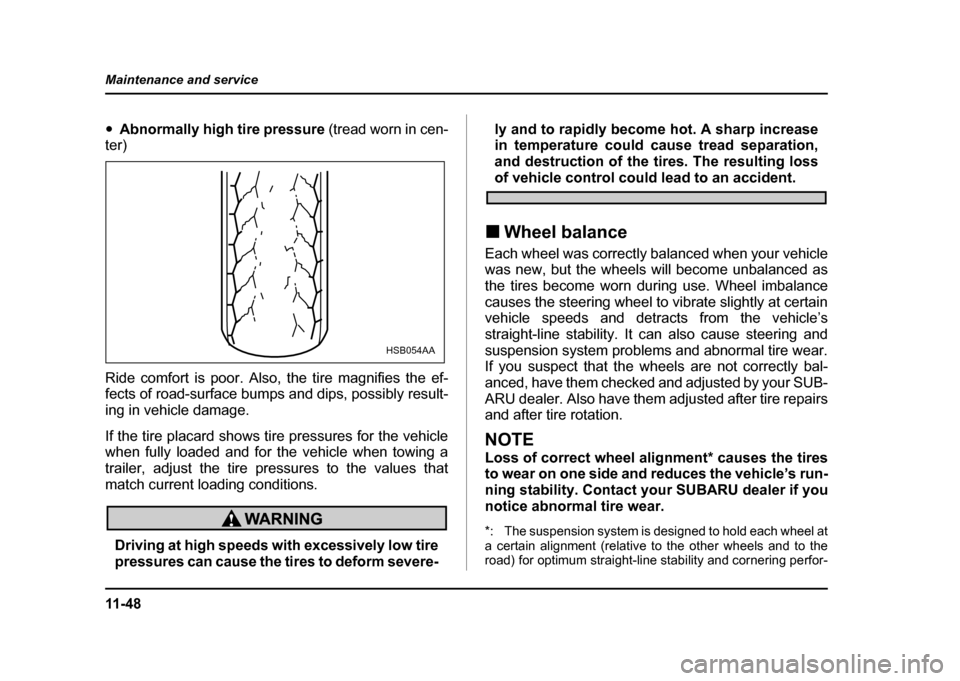
Abnormally high tire pressure (tread worn in cen-
ter)
Ride comfort is poor. Also, the tire magnifies the ef-
fects of road-surface bumps and dips, possibly result-
ing in vehicle damage.
If the tire placard shows tire pressures for the vehicle
when fully loaded and for the vehicle when towing a
trailer, adjust the tire pressures to the values that
match current loading conditions.
Driving at high speeds with excessively low tire
pressures can cause the tires to deform severe- ly and to rapidly become hot. A sharp increase
in temperature could cause tread separation,
and destruction of the tires. The resulting loss
of vehicle control could lead to an accident.
! Wheel balance
Each wheel was correctly balanced when your vehicle
was new, but the wheels will become unbalanced as
the tires become worn during use. Wheel imbalance
causes the steering wheel to vibrate slightly at certain
vehicle speeds and detracts from the vehicle’s
straight-line stability. It can also cause steering and
suspension system problems and abnormal tire wear.
If you suspect that the wheels are not correctly bal-
anced, have them checked and adjusted by your SUB-
ARU dealer. Also have them adjusted after tire repairs
and after tire rotation.
NOTE
Loss of correct wheel alignment* causes the tires
to wear on one side and reduces the vehicle’s run-
ning stability. Contact your SUBARU dealer if you
notice abnormal tire wear.
*: The suspension system is designed to hold each wheel at
a certain alignment (relative to the other wheels and to the
road) for optimum straight-line stability and cornering perfor-
HSB054AA
Page 435 of 491
11 - 5 0
Maintenance and service
!
Tire rotation
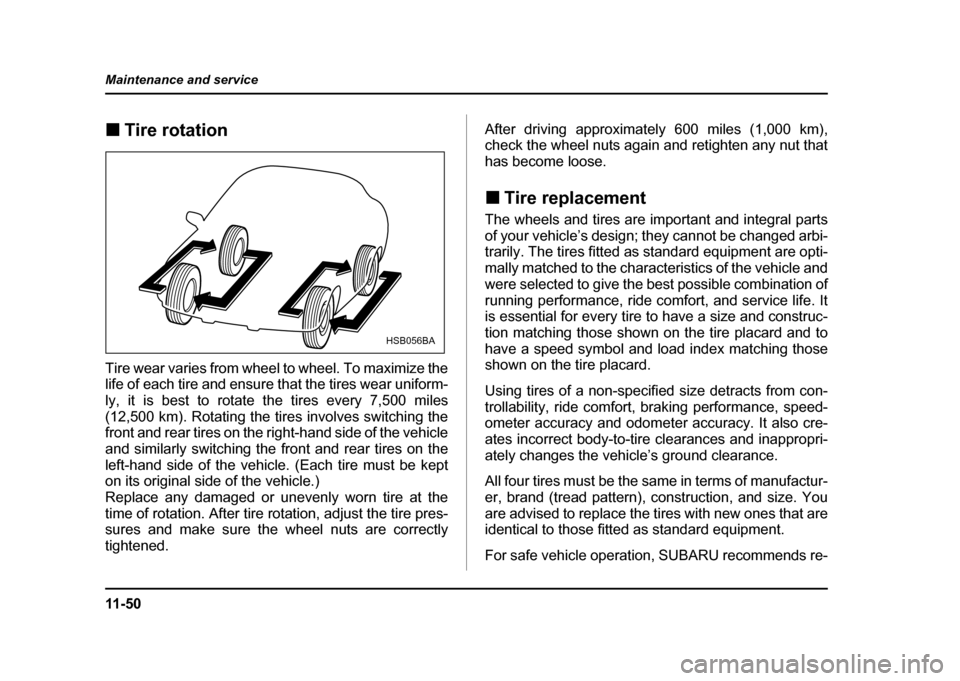
Tire wear varies from wheel to wheel. To maximize the
life of each tire and ensure that the tires wear uniform-
ly, it is best to rotate the tires every 7,500 miles
(12,500 km). Rotating the tires involves switching the
front and rear tires on the right-hand side of the vehicle
and similarly switching the front and rear tires on the
left-hand side of the vehicle. (Each tire must be kept
on its original side of the vehicle.)
Replace any damaged or unevenly worn tire at the
time of rotation. After tire rotation, adjust the tire pres-
sures and make sure the wheel nuts are correctly
tightened. After driving approximately 600 miles (1,000 km),
check the wheel nuts again and retighten any nut that
has become loose. !
Tire replacement
The wheels and tires are important and integral parts
of your vehicle’s design; they cannot be changed arbi-
trarily. The tires fitted as standard equipment are opti-
mally matched to the characteristics of the vehicle and
were selected to give the best possible combination of
running performance, ride comfort, and service life. It
is essential for every tire to have a size and construc-
tion matching those shown on the tire placard and to
have a speed symbol and load index matching those
shown on the tire placard.
Using tires of a non-specified size detracts from con-
trollability, ride comfort, braking performance, speed-
ometer accuracy and odometer accuracy. It also cre-
ates incorrect body-to-tire clearances and inappropri-
ately changes the vehicle’s ground clearance.
All four tires must be the same in terms of manufactur-
er, brand (tread pattern), construction, and size. You
are advised to replace the tires with new ones that are
identical to those fitted as standard equipment.
For safe vehicle operation, SUBARU recommends re-
HSB056BA
Page 436 of 491
11 -5 1
Maintenance and service
– CONTINUED –
placing all four tires at the same time.
NOTE
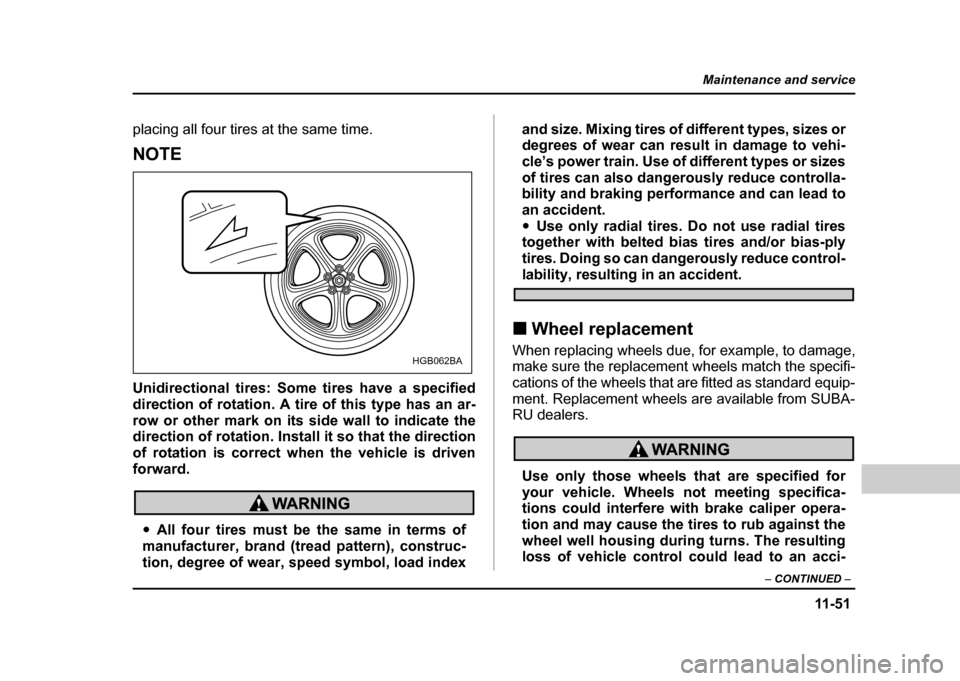
Unidirectional tires: Some tires have a specified
direction of rotation. A tire of this type has an ar-
row or other mark on its side wall to indicate the
direction of rotation. Install it so that the direction
of rotation is correct when the vehicle is drivenforward.
"All four tires must be the same in terms of
manufacturer, brand (tread pattern), construc-
tion, degree of wear, speed symbol, load index and size. Mixing tires of different types, sizes or
degrees of wear can result in damage to vehi-
cle’s power train. Use of different types or sizes
of tires can also dangerously reduce controlla-
bility and braking performance and can lead to
an accident."
Use only radial tires. Do not use radial tires
together with belted bias tires and/or bias-ply
tires. Doing so can dangerously reduce control-
lability, resulting in an accident.
! Wheel replacement
When replacing wheels due, for example, to damage,
make sure the replacement wheels match the specifi-
cations of the wheels that are fitted as standard equip-
ment. Replacement wheels are available from SUBA-
RU dealers.
Use only those wheels that are specified for
your vehicle. Wheels not meeting specifica-
tions could interfere with brake caliper opera-
tion and may cause the tires to rub against the
wheel well housing during turns. The resulting
loss of vehicle control could lead to an acci-
HGB062BA
Page 437 of 491
11 - 5 2
Maintenance and service
dent.
! Wheel covers
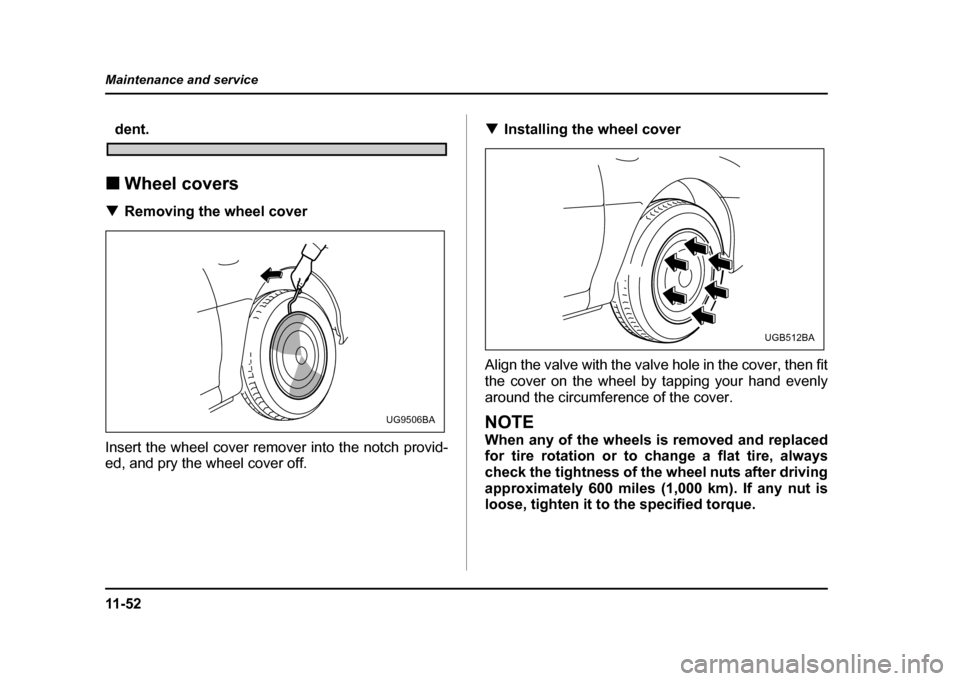
! Removing the wheel cover
Insert the wheel cover remover into the notch provid-
ed, and pry the wheel cover off. !
Installing the wheel cover
Align the valve with the valve hole in the cover, then fit
the cover on the wheel by tapping your hand evenly
around the circumference of the cover.
NOTE
When any of the wheels is removed and replaced
for tire rotation or to change a flat tire, always
check the tightness of the wheel nuts after driving
approximately 600 miles (1,000 km). If any nut is
loose, tighten it to the specified torque.UG9506BA
UGB512BA
Page 438 of 491
11 -5 3
Maintenance and service
– CONTINUED –
Aluminum wheels (If equipped)
Aluminum wheels can be scratched and damaged
easily. Handle them carefully to maintain their appear-
ance, performance, and safety. "When any of the wheels is removed and replaced
for tire rotation or to change a flat, always check the
tightness of the wheel nuts after driving approximately
600 miles (1,000 km). If any nut is loose, tighten it to
the specified torque. " Never apply oil to the threaded parts, wheel nuts, or
tapered surface of the wheel. " Never let the wheel rub against sharp protrusions or
curbs." Be sure to fit tire chains on uniformly and completely
around the tire, otherwise the chains may scratch the
wheel. " When wheel nuts, balance weights, or the center
cap is replaced, be sure to replace them with genuine
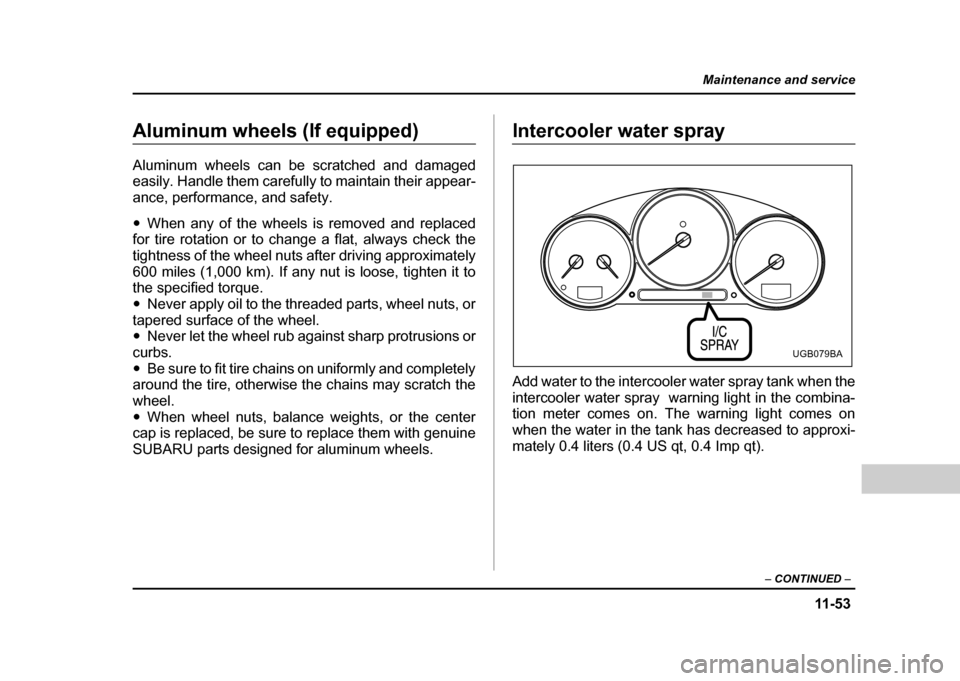
SUBARU parts designed for aluminum wheels.Intercooler water spray
Add water to the intercooler water spray tank when the
intercooler water spray warning light in the combina-
tion meter comes on. The warning light comes on
when the water in the tank has decreased to approxi-
mately 0.4 liters (0.4 US qt, 0.4 Imp qt).
UGB079BA
Page 466 of 491

12-1
12
Specifications
Specifications ................................................ 12-2 Dimensions ....................................................... 12-2
Engine ................................................................ 12-3
Electrical system .............................................. 12-3
Capacities .......................................................... 12-4
Tires ................................................................... 12-5
Wheel alignment ............................................... 12-5
Fuses and circuits ........................................ 12-6 Fuse panel located behind the coin tray ....... 12-6
Fuse panel located in the engine compartment 12-8
Bulb chart ...................................................... 12-9
Vehicle identification .................................... 12-10
Page 467 of 491
12-2
Specifications
SpecificationsSpecifications
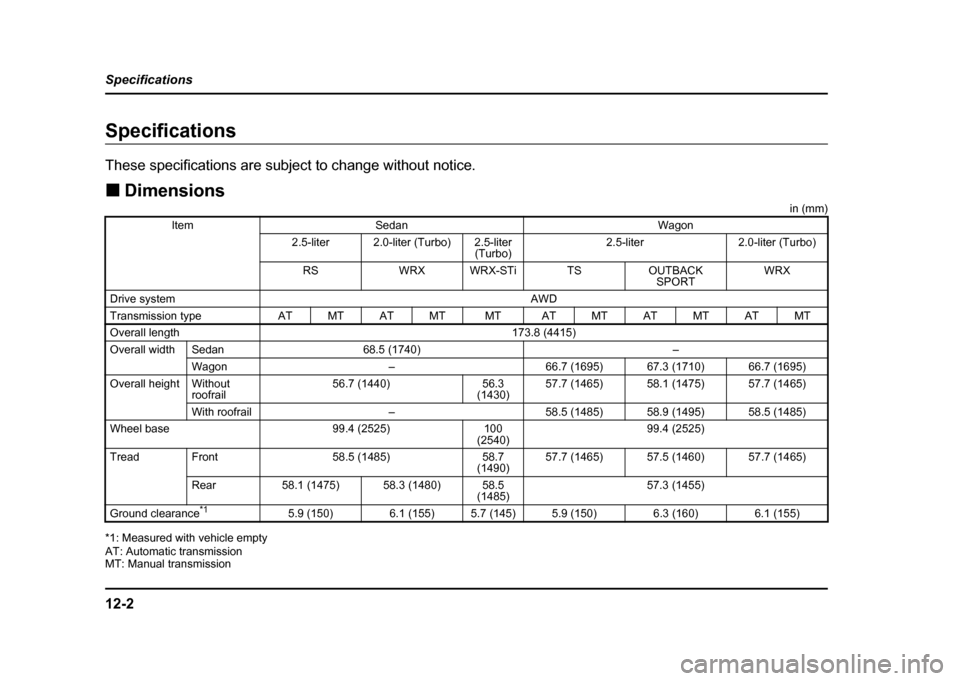
These specifications are subject to change without notice. !
Dimensions
in (mm)
*1: Measured with vehicle empty
AT: Automatic transmission
MT: Manual transmission
ItemSedanWagon
2.5-liter2.0-liter (Turbo)2.5-liter (Turbo)2.5-liter2.0-liter (Turbo)
RSWRXWRX-STiTSOUTBACK SPORTWRX
Drive systemAWD
Transmission typeATMTATMTMTATMTATMTATMT
Overall length173.8 (4415)
Overall widthSedan68.5 (1740)–
Wagon–66.7 (1695)67.3 (1710)66.7 (1695)
Overall heightWithout
roofrail56.7 (1440)56.3
(1430)57.7 (1465)58.1 (1475)57.7 (1465)
With roofrail–58.5 (1485)58.9 (1495)58.5 (1485)
Wheel base99.4 (2525)100
(2540)99.4 (2525)
TreadFront58.5 (1485)58.7
(1490)57.7 (1465)57.5 (1460)57.7 (1465)
Rear58.1 (1475)58.3 (1480)58.5
(1485)57.3 (1455)
Ground clearance *15.9 (150)6.1 (155)5.7 (145)5.9 (150)6.3 (160)6.1 (155)
Page 470 of 491
12-5
Specifications
– CONTINUED –
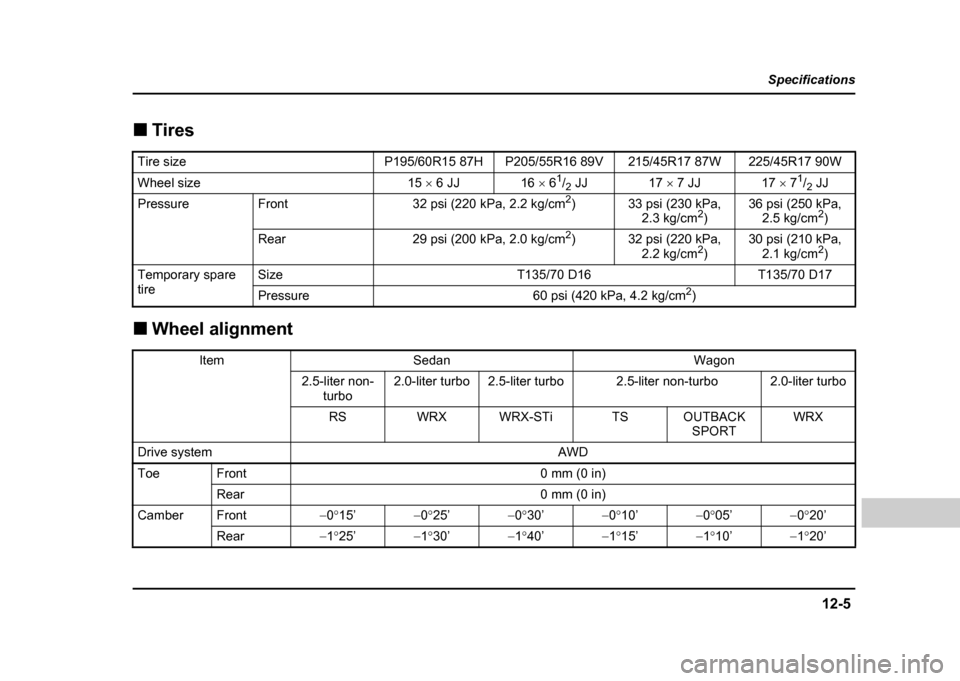
!Tires
! Wheel alignment
Tire sizeP195/60R15 87HP205/55R16 89V215/45R17 87W225/45R17 90W
Wheel size15 × 6 JJ16 × 6 1
/2 JJ17
× 7 JJ17 × 7 1
/2 JJ
PressureFront32 psi (220 kPa, 2.2 kg/cm 2
)33 psi (230 kPa,
2.3 kg/cm 2
)36 psi (250 kPa,
2.5 kg/cm 2
)
Rear29 psi (200 kPa, 2.0 kg/cm 2
)32 psi (220 kPa,
2.2 kg/cm 2
)30 psi (210 kPa,
2.1 kg/cm 2
)
Temporary spare tireSizeT135/70 D16T135/70 D17
Pressure60 psi (420 kPa, 4.2 kg/cm 2
)
ItemSedanWagon
2.5-liter non-
turbo2.0-liter turbo2.5-liter turbo2.5-liter non-turbo2.0-liter turbo
RSWRXWRX-STiTSOUTBACK SPORTWRX
Drive systemAWD
ToeFront0 mm (0 in)
Rear0 mm (0 in)
CamberFront−0 °15’− 0 °25’− 0 °30’− 0 °10’− 0 °05’− 0°20’
Rear− 1 °25’− 1 °30’− 1 °40’− 1 °15’− 1 °10’− 1°20’
Page 478 of 491
13-3
Consumer information and Reporting safety defects
– CONTINUED –
on straight-ahead braking traction tests, and
does not include acceleration, cornering, hy-
droplaning, or peak traction characteristics.
! Temperature A, B, C
The temperature grades are A (the highest), B, and C,
representing the tire’s resistance to the generation of
heat and its ability to dissipate heat when tested under
controlled conditions on a specified indoor laboratory
test wheel. Sustained high temperature can cause the
material of the tire to degenerate and reduce tire life,
and excessive temperature can lead to sudden tire
failure. The grade C corresponds to a level of perfor-
mance which all passenger car tires must meet under
the Federal Motor Vehicle Safety Standards No. 109.
Grades B and A represent higher levels of perfor-
mance on the laboratory test wheel than the minimum
required by law.
The temperature grade for this tire is estab-
lished for a tire that is properly inflated and not
overloaded. Excessive speed, underinflation,
or excessive loading, either separately or in
combination, can cause heat buildup and pos-
sible tire failure.