height SUBARU IMPREZA 2006 2.G User Guide
[x] Cancel search | Manufacturer: SUBARU, Model Year: 2006, Model line: IMPREZA, Model: SUBARU IMPREZA 2006 2.GPages: 365, PDF Size: 7.09 MB
Page 138 of 365
Instruments and controls 3-25
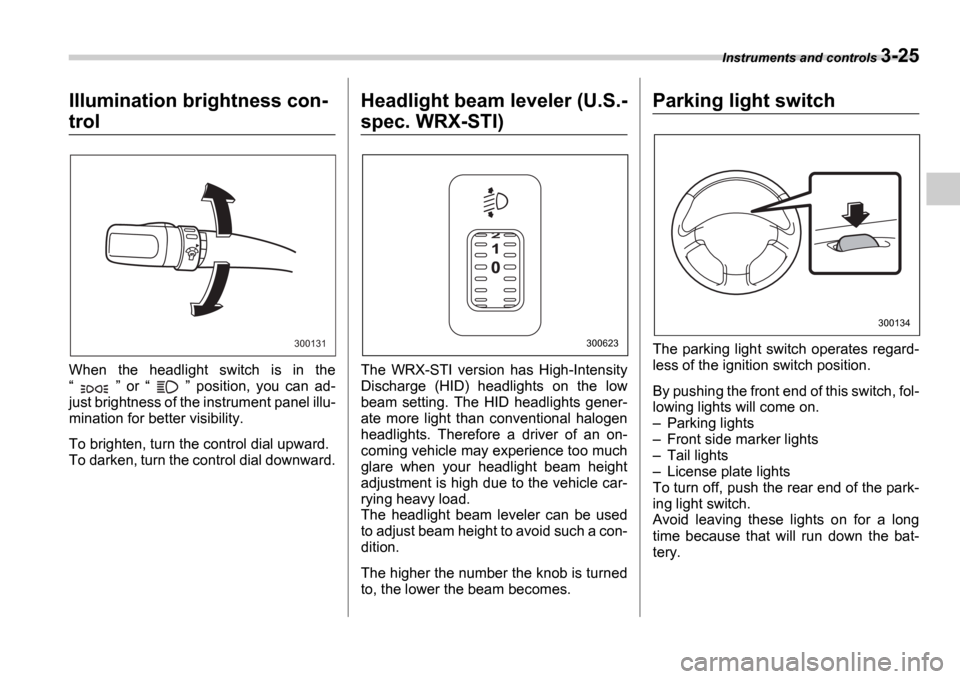
Illumination brightness con-
trol
When the headlight switch is in the
or position, you can ad-
just brightness of the instrument panel illu-
mination for better visibility.
To brighten, turn the control dial upward.
To darken, turn the control dial downward.
Headlight beam leveler (U.S.-
spec. WRX-STI)
The WRX-STI version has High-Intensity
Discharge (HID) headlights on the low
beam setting. The HID headlights gener-
ate more light than conventional halogen
headlights. Therefore a driver of an on-
coming vehicle may experience too much
glare when your headlight beam height
adjustment is high due to the vehicle car-
rying heavy load.
The headlight beam leveler can be used
to adjust beam height to avoid such a con-
dition.
The higher the number the knob is turned
to, the lower the beam becomes.
Parking light switch
The parking light switch operates regard-
less of the ignition switch position.
By pushing the front end of this switch, fol-
lowing lights will come on. Parking lights
Front side marker lights
Tail lights
License plate lights
To turn off, push the rear end of the park-
ing light switch.
Avoid leaving these lights on for a long
time because that will run down the bat-
tery.300131300623
300134
Page 249 of 365
8-22 Driving tips
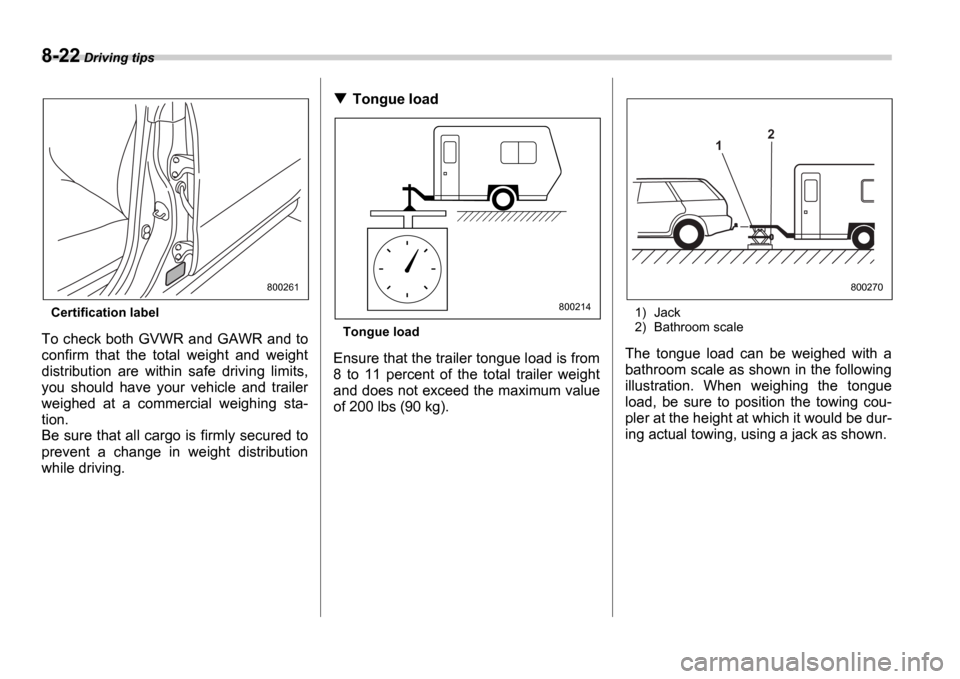
Certification label
To check both GVWR and GAWR and to
confirm that the total weight and weight
distribution are within safe driving limits,
you should have your vehicle and trailer
weighed at a commercial weighing sta-
tion.
Be sure that all cargo is firmly secured to
prevent a change in weight distribution
while driving.
Tongue load
Tongue load
Ensure that the trailer tongue load is from
8 to 11 percent of the total trailer weight
and does not exceed the maximum value
of 200 lbs (90 kg).
1) Jack
2) Bathroom scale
The tongue load can be weighed with a
bathroom scale as shown in the following
illustration. When weighing the tongue
load, be sure to position the towing cou-
pler at the height at which it would be dur-
ing actual towing, using a jack as shown.
800261
800214
1 2
800270
Page 306 of 365
Maintenance and service 11-27
Brake booster
If the brake booster does not operate as
described in the following, have it checked
by your SUBARU dealer.
1. With the engine off, depress the brake
pedal several times, applying the same
pedal force each time. The distance the
pedal travels should not vary.
2. With the brake pedal depressed, start
the engine. The pedal should move slight-
ly down to the floor.
3. With the brake pedal depressed, stop
the engine and keep the pedal depressed
for 30 seconds. The pedal height should
not change.
4. Start the engine again and run for ap-
proximately one minute then turn it off.
Depress the brake pedal several times to
check the brake booster. The brake boost-
er operates properly if the pedal stroke de-
creases with each depression.
Brake pedal
Check the brake pedal free play and re-
serve distance according to the mainte-
nance schedule in the Warranty and
Maintenance Booklet .
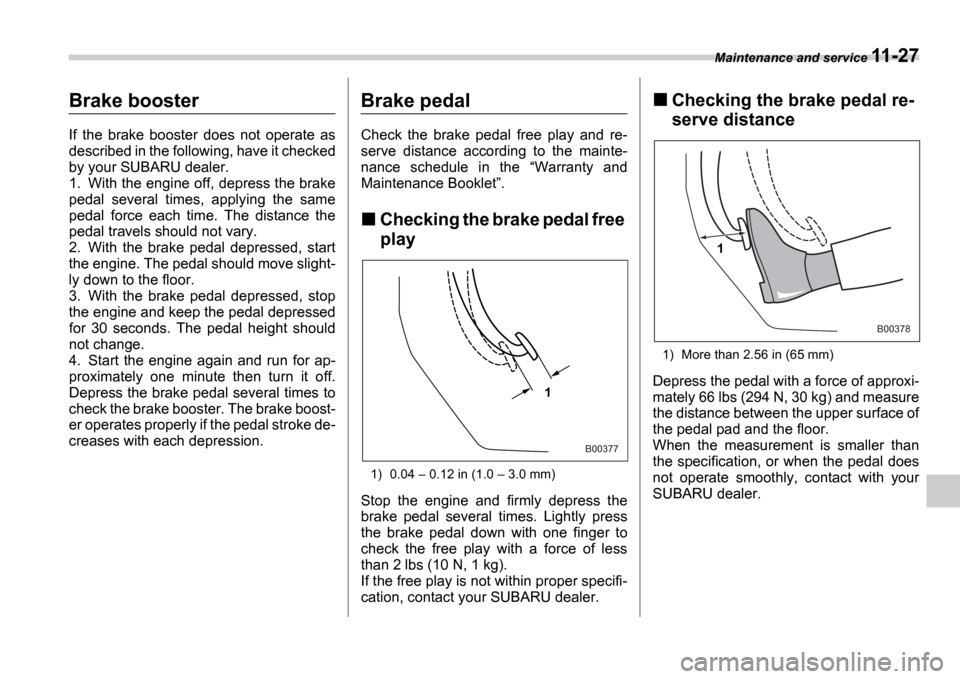
Checking the brake pedal free
play
1) 0.04 0.12 in (1.0 3.0 mm)
Stop the engine and firmly depress the
brake pedal several times. Lightly press
the brake pedal down with one finger to
check the free play with a force of less
than 2 lbs (10 N, 1 kg).
If the free play is not within proper specifi-
cation, contact your SUBARU dealer.
Checking the brake pedal re-
serve distance
1) More than 2.56 in (65 mm)
Depress the pedal with a force of approxi-
mately 66 lbs (294 N, 30 kg) and measure
the distance between the upper surface of
the pedal pad and the floor.
When the measurement is smaller than
the specification, or when the pedal does
not operate smoothly, contact with your
SUBARU dealer.1
B00377
1
B00378
Page 333 of 365
12-2 Specifications
SpecificationsSpecifications
These specifications are subject to change without notice .
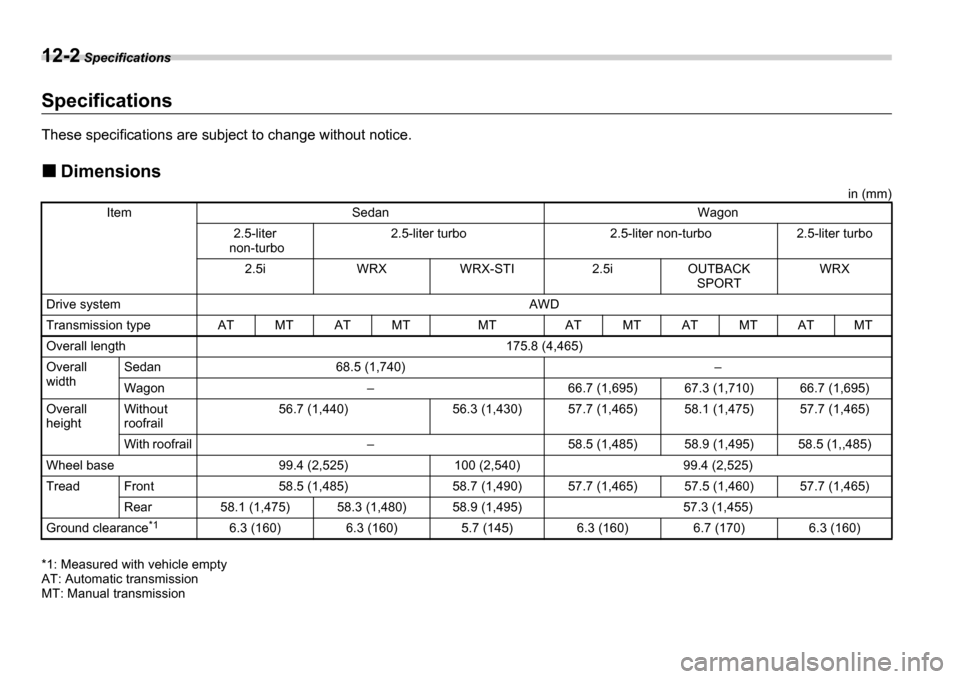
Dimensions
in (mm)
*1: Measured with vehicle empty
AT: Automatic transmission
MT: Manual transmission
ItemSedanWagon
2.5-liter
non-turbo2.5-liter turbo2.5-liter non-turbo2.5-liter turbo
2.5iWRXWRX-STI2.5iOUTBACK SPORTWRX
Drive systemAWD
Transmission typeATMTATMTMTATMTATMTATMT
Overall length175.8 (4,465)
Overall
widthSedan68.5 (1,740)
Wagon66.7 (1,695)67.3 (1,710)66.7 (1,695)
Overall
heightWithout
roofrail56.7 (1,440)56.3 (1,430)57.7 (1,465)58.1 (1,475)57.7 (1,465)
With roofrail58.5 (1,485)58.9 (1,495)58.5 (1,,485)
Wheel base99.4 (2,525)100 (2,540)99.4 (2,525)
TreadFront58.5 (1,485)58.7 (1,490)57.7 (1,465)57.5 (1,460)57.7 (1,465)
Rear58.1 (1,475)58.3 (1,480)58.9 (1,495)57.3 (1,455)
Ground clearance *16.3 (160)6.3 (160)5.7 (145)6.3 (160)6.7 (170)6.3 (160)
Page 343 of 365
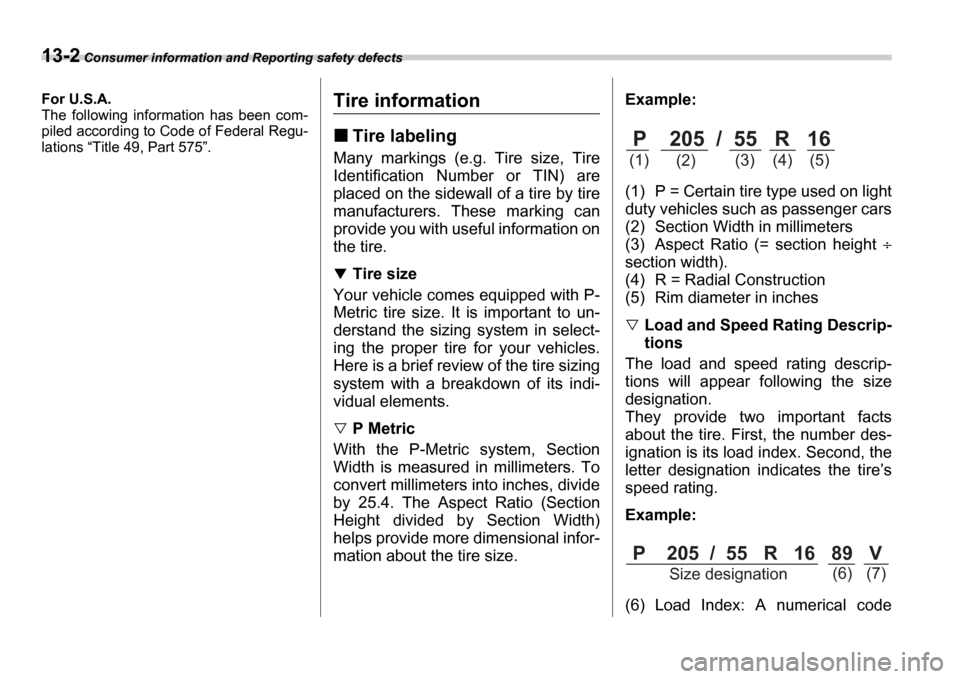
13-2 Consumer information and Reporting safety defects
Consumer information and Reporting safety defectsFor U.S.A.
The following information has been com-
piled according to Code of Federal Regu-
lations Title 49, Part 575 .Tire information
Tire labeling
Many markings (e.g. Tire size, Tire
Identification Number or TIN) are
placed on the sidewall of a tire by tire
manufacturers. These marking can
provide you with useful information on
the tire.
Tire size
Your vehicle comes equipped with P-
Metric tire size. It is important to un-
derstand the sizing system in select-
ing the proper tire for your vehicles.
Here is a brief review of the tire sizing
system with a breakdown of its indi-
vidual elements.
P Metric
With the P-Metric system, Section
Width is measured in millimeters. To
convert millimeters into inches, divide
by 25.4. The Aspect Ratio (Section
Height divided by Section Width)
helps provide more dimensional infor-
mation about the tire size. Example:
(1) P = Certain tire type used on light
duty vehicles such as passenger cars
(2) Section Width in millimeters
(3) Aspect Ratio (= section height
section width).
(4) R = Radial Construction
(5) Rim diameter in inches
Load and Speed Rating Descrip-
tions
The load and speed rating descrip-
tions will appear following the size
designation.
They provide two important facts
about the tire. First, the number des-
ignation is its load index. Second, the
letter designation indicates the tire s
speed rating.
Example:
(6) Load Index: A numerical code
P 205 / 55 R 16
(1) (2) (3) (4) (5)
P 205 / 55 R 16 89 V
Size designation (6) (7)